On the Preservation of Species:
A Logical Argument in Support of a Rational Basis for Community including Necessary and Sufficient Conditions for Sustainable Happiness for All Sentient Beings in a Hypothetical World
The copyright has been removed from this book in recognition of the principles of Open Source and Anarchist philosophy. I expect that decent people will not abuse the content to change the meaning or intent. The reader can determine what I mean by ‘decent’ by reading the book.
Table of Contents
A New Political Philosophy Is Needed
What Freedom Means to Two Very Different Types of People
Chapter 1. Toward a Rational Social Contract
Appendix B. The Definition of The Ruling Class
Chapter 2. Emergy and Economics
Chapter 3. Toward Axiomatic Morality
Appendix: Why Taking Drugs Per Se Imposes on No One
Chapter 4. Philosophical Assumptions or Articles of Faith
Existence in General and the Universe in Particular
Artificial Economic Contingency and Materialism as a Model of Society
Two Lists of Unacceptable Aspects of Materialism Particularly Capitalism
How Money and Trade Are Used As Tools of Depredation
Examples of the General Principle that Tyranny Is a Necessary Adjunct to Business
Appendix. Inequality and Alienation
Relation to Population Size and Growth
Direct Harm to the Environment from Competition for Wealth
The Difficulty of Eliminating Pollution Altogether
Additional Notes on Mass Transit
My Personal Experience as a Chemical Engineer
Recent Items from the Houston Post
Truth Categories of Generalized Statements
Purveyors of Falsehood Classified
The Harm Associated with Various Types of Falsity
Appendix A: Toward Free and Egalitarian Discourse
Appendix B: Excerpts from a Letter to the Texas Populist Alliance
Materialism, M, If and Only If (IFF) Hierarchical Dominance, T*.
Materialism, M, Is Occurrence Equivalent with (IFF) Authoritarian Falsity, F*.
Hierarchical Dominance IFF Authoritarian Falsity.
Occurrence Equivalence of F* with T0, Ť1 = Ğ1, T2 = G2, G0, F0, F1, and F2
Traditional Male Dominance, T3
Chapter 10. Proofs of Theorems
Chapter 11. A Reformed Society with a Natural Economy
Dematerialism as a Political Theory
The Joys of Society without Materialism
Theoretical Aspects of Dematerialism
New Institutions for Old in a Natural Economy
Chapter 12. How Social Change Might Occur
Summary of First Practical Steps Toward a Solution
Appendix I: Fundamentals of Thermodynamics
Overall Availability Analysis of Earth
Summary of Social Problems Discussed in Text
Social Problems Classified Differently
A Rather Long (But Still Incomplete) List of Social Evils
Appendix III. Some Reasonable Objections Considered
Objections Posed by the Average Good Reader and My Responses
References to Research Papers and Books on Intrinsic Motivation
GEORGE: Well, they are people, just like us – from within our own solar system. Except that their society is more highly evolved. I mean, they don’t have no wars, they got no monetary system, they don’t have any leaders, because, I mean, each man is a leader. I mean, each man – because of their technology, they are able to feed, clothe, house and transport themselves equally – and with no effort. – Peter Fonda, Dennis Hopper, Terry Southern, Easy Rider, a film. (George, an open-minded lawyer and an alcoholic, was played by Jack Nicholson.)
The Preservation of Species
During the last fifty years it has become apparent that man is capable of ending all life on Planet Earth. The extinction of the human race is a natural consequence of the exponential growth of Man’s population beyond the Natural Carrying Capacity of Earth. However, no species has had it in its power previously to so despoil its environment as to jeopardize the posterity of every species. The band-aid measures proposed by single-issue environmental activist organizations have no chance to prevent this from happening. The intention of this essay is to present proposals for the consideration of the reader as to what must be done to preserve all species for which it is possible to account including homo sapiens. This will require fundamental political change.
A New Political Philosophy Is Needed
Ironically and tragically, most Americans are embracing obsolete ideas about society, politics, and economics – grasping with hysterical religious fervor ideas that are failing catastrophically. We are approaching rapidly the time when the average wealth available for consumption will be no more than the minimum wealth necessary to live without unbearable misery. Thus, wealth must be shared unless we wish to introduce horrible suffering – more suffering than mankind has even dreamed of. No amount of prayer in school will have the slightest effect upon this problem and the hundreds of difficulties associated with it. It is clear, too, that additional social change must accompany wealth-sharing to prevent repetitions of the past and achieve what was originally sought by the last generation of idealists. It is incredible that almost no one sees that the time has come to dispense with government and leadership as we have always known them.
I believe in the possibility that some of the answers have occurred to me. Yet I am not a charismatic man, not even a particularly good teacher. I wish to influence a few people who are capable of teaching others in ways of which I am incapable. It takes a special sort of person to learn from me. But, such people exist and I have found a few of them. This essay is my way of communicating with those people, who, as they say, are separated from everyone in the world by at most six degrees. The difficulties I expect to encounter and my best expectations are presented below. Please give me the benefit of the doubt until you have heard the entire argument in favor of reforms that may seem preposterous in an initial encounter.
Political Theory
To evaluate the desirability of a proposed political action, one must understand the vision of the person or group proposing the action. If the success of the proposed action depends on a large number of people embracing the vision, it is essential that the vision be based on a derivable theory. For example, Marxism is a promising theory, although not a scientific theory. Marxism addresses inequities in wealth, but does not address the accumulation of power, except obliquely. The theory proposed in this essay supplants Marxism; thus Marxism may continue to be an economic-political-social system that has never been tested – regardless of the false reports that it has been adopted by some of the nations that the United States has seen fit to oppress for its own selfish purposes [1].
The vision of the future described here depends on the thesis that continued competition for wealth and power in all of its aspects, including employment, trade, markets, “free” enterprise, acceptance of rewards for what we do or give, hierarchies in business and government, whether appointed from above or elected from below, must inevitably lead to a totalitarian Orwellian nightmare or the complete annihilation of mankind and many other species, whereas voluntary abandonment of competition for wealth and power will lead eventually to the highly desirable future to be described momentarily.
The vision of a desirable future described below is based on three simple moral axioms, namely, respect for the freedom of oneself and others, respect for the environment, including plants and animals, and respect for truth. [Perhaps, the word “freedom” should be replaced by the word “autonomy”. Nowadays, the word “freedom” is routinely abused whenever the speaker or writer wishes to represent repression, tyranny, slavery, or worse as something desirable that only we (Americans) possess. – Chomsky] These moral axioms are based, in turn, on our innate judgments of aesthetics and reasonableness and our experiential judgment of utility. One may suspect the author’s aesthetic judgment and reasonableness, but he shall deduce scientifically the consequences of avoiding the recommended reforms. The theory can be sustained on utility alone. In this way it becomes a scientific theory subject to falsifiability. These ideas will be seen as utopian by those who are the true utopianists, like the man who won’t quit smoking because by the time he gets cancer a cure will have been found.
It can be shown that competition for wealth and power (or, what amounts to the same thing, inequality in wealth and power) leads to tyranny, the destruction of the environment, and all types of falsity, including repression of dissent and Orwellian doublethink; whereas equality of wealth and power is beautiful, it is reasonable (every other arrangement can be shown to be unreasonable), and it is practical (inequality causes poverty, crime, war, and other modes of human misery). Without equality freedom is impossible and without freedom sustainable happiness is impossible. In Chapter 1, happiness is given a technical definition, following the behavioral psychologists Deci and Ryan [2]. This technical definition is in reasonable accord with ordinary experience.
We should not expect to get out of the mess we are in now without replacing the traditional institutions of money (paper wealth) and trade (particularly trading the time of one's life for money), the idea of “working oneself up”, leadership, law, government, and even the sovereign state itself. What social activists ordinarily call change is no change at all. I am talking about real change.
A Vision of the Future
I now wish to describe a state of human society that might be approached after a long series of small changes. These changes are necessary and sufficient conditions for the sustainable happiness of all of humanity. First and foremost, the population density should be steady near its optimum. Since we Americans must reduce our use of energy by 84% or more, people should be living in small decentralized communities with everything within walking distance except for a few light links to nearby communities to effect economies of scale. Mankind should live in harmony with nature with the compositions of the atmosphere, the oceans, and the soil varying only slightly about desirable steady states. We must hope that renewable energy technology will supply the equivalent of one kilowatt per capita of high-grade energy, otherwise the future of most of mankind will be grim. The extinction of the entire human race is a distinct possibility.
Economic enterprises, including the collectives of applied mathematicians who plan the economies, should be owned in equal shares by their participants who are all of one class. Communicators within the enterprises should be chosen randomly; decisions should be made democratically or by professionals who enjoy no special power or privilege. These isocratic enterprises will follow the economic plans of their choice. We should create institutions to encourage enterprise without economic risk. (Why should we encourage gambling in industry when we deplore it elsewhere?)
Our vast systems of law are ridiculous. Laws should be replaced by a few simple moral axioms from which right action can be derived easily. We should embrace rational morals that anyone can follow as opposed to religious superstitions and sexual and pharmacological prudery that no person of spirit can live by. Dissent should be tolerated and even those who do not accept our rational morality should be accorded the dignity of sovereign heads of state. Government should be nearly nonexistent except for a few randomly selected spokespersons. In a planned economy it is crucial to prevent “natural” leaders from arising. To break the endless cycles of leaders coming to power, becoming corrupt, and being replaced by new leaders after war or revolution, we should abandon the institution of leadership. Isn't that obvious by now?
People should enjoy contrasts between positives rather than paying for a few days of leisure with weeks of drudgery. (Presumably, Einstein enjoyed playing the violin without drudging at physics.) People should not be concerned with what's in it for them, but, rather, with what is interesting to do (to be effective and, therefore happy). This will liberate for useful endeavor the huge class of working people (perhaps as many as 90% of the working class if we neglect health professionals) who currently are concerned exclusively with how the pie is sliced up – salesmen, marketers, dealmakers, corporate executives, etc. – and those who serve them. We would have a smaller but better tasting pie. Generosity, equality, freedom, and intrinsic motivation would replace greed, hierarchy, tyranny, and fear.
Instead of trying to accumulate the most costly economic goods, rational people would be trying to consume as little as possible. Thus, the need to ration scarce and desirable items with a finite money supply would disappear and with it the need for money. Money would be obsolete. Can you imagine how much more leisure you would have if you did useful work but did not have to be concerned with money (and an accounting problem that never ends associated with every aspect of life)! No checkout lines, no tax forms, no insurance, no checkbooks to balance, no comparison shopping, no commercials on TV!
No one should have to work at something he hates to “earn a living”; that is, one’s livelihood should be non-contingent. No one should hate his job. Under these conditions of autonomy (necessary for happiness), we can expect tremendous variety in opportunities for involvement to accommodate everyone's need to be effective. The arts and science ought to flourish. Unpleasant jobs ought to be made into interesting activities or be eliminated, perhaps by robotics. We should treat everyone the same with no celebrities, except, possibly, posthumously, and no awards or phony distinctions. We can respect excellence without idolizing those who manifest it.
What Freedom Means to Two Very Different Types of People
Most people think of themselves as great lovers of freedom, with the usual proviso that my freedom ends at your nose. However, among these champions of freedom we shall distinguish two distinct and antagonistic types: Type Z seems to be in the majority nowadays. He believes in freedom, in particular his freedom to accumulate power and wealth – normally by placing a number of his fellows in a position of accountability to himself according to the most binding species of what we call employment he can get away with. He provides what we call a job with material remuneration to people whom he expects to do his bidding and to place his interests ahead of their own for a significant portion of the weeks, months, or years that constitute their period of employment from his view and the very time of their lives from theirs.
He defends his “right” to do this, which does indeed impose upon the freedom of those who have sold their inalienable right to liberty, and which most certainly extends his freedom to make his own decisions well beyond the tips of the noses of those so bound, because the wage slave has entered into slavery – the antithesis of freedom – voluntarily. But, as we all know, the wage slave really has no choice. The miracle is that wage slaves continue to believe they are free – unless they see the world as it actually is. Therefore, most wage slaves are themselves Type Z. This is really quite strange as they spend most of their waking hours under the command of a boss. Why should such a person imagine that he is free! Yet he is as enthusiastic about freedom, in the abstract, as a Type S person. He imagines that he would die before he would surrender it, yet he gives it up without a thought every weekday morning. Man is an amazing beast.
One would not expect employment to engender much in the way of loyalty; and, with few exceptions, it does not. Normally, the wage slaver shares one peculiar characteristic with the chattel slaver: He expects the slave to live, more or less, according to the moral code of the class of people who are sufficiently powerful to exploit their fellow man. Normally, he supports laws that prohibit taking interesting drugs and engaging in interesting sexual practices. Whether he, the employer, does or does not respect such taboos, he expects his employees to live by them - willy nilly. Type Z has everything precisely backwards, which would be funny except for the catastrophic circumstances attendant upon it. Would that I could make Type Z appear ridiculous – especially to himself.
In stark contrast to the Type Z person, the Type S person recognizes that the freedom to employ others and to engage in the competition for wealth and power is tyranny thinly disguised and is in violation of every principle of freedom. Moreover, he understands that a person who cannot follow his personal moral code and is ruled by taboo morality, which quite generally prohibits whatever is interesting or fun, is essentially a serf.
Revised July 5, 2004
The Plan of the Book
In the first chapter, we discuss the building of a philosophy to provide a basis for a rational social contract upon which nearly everyone can agree. Eventually, nearly everyone will recognize the folly of our present course; however, Mother Nature may have to intervene forcefully to ensure that society does indeed recognize its folly. She will force social changes upon mankind some of which might be decidedly unpleasant for most of the survivors. Chapters 2 - 5 are all that are required to elucidate this “new” philosophy. In Chapters 6 - 8, we shall interpret the fundamental evils that torment almost all of humanity according to the principles espoused in this essay. In Chapter 9, we shall prove that if one of these evils is present all of them will be present (perhaps after a short time lag); if one of them is missing – for a time sufficiently long that we may safely assume it is not on the way, none of them will occur. This means that we must change one thing only – not a host of little things. In Chapter 10, we shall be able to prove a number of interesting and sobering results at least as well as social theorems are ever proved. In Chapter 11, we discuss a hypothetical reformed society and we indulge in some harmless speculation concerning what its institutions might be like. (Personally, I would have liked to employ more graphics to illustrate my futuristic daydreams. Perhaps, someone would like to produce a movie on this imaginary stage.) Finally, in Chapter 12, social change, and how it might be achieved, is discussed.
Appendices I, II, and III are the last three items in the book. Please do not confuse these with appendices to chapters, which are “lettered” in chapters with more than one appendix, e.g., Appendix A, Appendix B, etc., but which are not lettered in chapters with only one appendix. Appendix I is a mini-course in thermodynamics. This, along with the material in Chapter 2, is useful to understand the Environmental Axiom elucidated in Chapter 3. Appendix II, which began as an attempt to catalog all the world’s evils, is really little more than a list of social evils sufficiently complete to convince one that society has real problems worth addressing. In Appendix III, some serious objections are answered, hopefully in a manner that many readers will find adequate. I hope that some readers will look at the appendices. The third appendix probably will attract many skeptics – and I hope we are all skeptics. The second appendix requires only a glance, but the first appendix employs some mathematics.
Note on equations. I wish to pass on some remarkable advice that I received (by way of the written word) from Roger Penrose, I believe. (If, due to a lapse in memory, it turns out to have been written by someone else, I wish to express my apologies to Dr. Penrose and to that “someone else”. What I remember with a fair degree of certainty is that the purveyor of this advice was a person of no mean mathematical attainments, which is what struck me as very remarkable indeed and accounts for the impression it made on me.) The advice is this: “Whenever, while reading, I encounter an equation I do not understand, I simply skip it and continue reading the text. Sometimes, after reading the text, I begin to understand the equation without additional effort. On the other hand, whenever it seems appropriate to do so, I return to the equations later and see if they don’t make better sense to me at that time.” Now I have quoted so loosely that the words are virtually mine; but, I assure the reader, I got the advice from someone else and I merely retail it. Naturally, I endorse it. In this book, especially in Appendix I, many equations are encountered. I wish to take a moment to assure the reader that they are not formidable; but, for the first reading anyway, just take the advice I have attributed to Prof. Penrose. If it’s good enough for him, it’s sure as hell good enough for you and me. In any case, you won’t miss much if you actually skip the equations because the text explains everything I want you to know.
I hope you will assess the validity of my ideas without prejudice. Also, by now, you may be deciding for yourself whether or not our progeny will have a chance to enjoy a future without unbearable misery. Be critical and think for yourself. Don’t take my word for anything. I am fallible. As far as the future is concerned, all I can do is make guesses based on my education, my experience, and, of course, my dreams. No one can predict the future.
Additional Remarks
On Method
In a book like this, filled with controversial claims, normally one would expect to find reams of statistics. That will not be the case for three reasons: First, I do not trust statistics. “Figures don’t lie, but liars figure.” In this essay, as far as I am able, I shall rely upon macrofacts only (very generally believed and easily verified facts). The second reason that you will not see tables of statistics is that I believe that I can arrange my arguments so that the exact or approximate number of cases in point is not important. The third reason for avoiding statistics is that I am unwilling to do the work to collect them. If I cannot make my point with logic, common sense, and very general facts with which most readers would agree readily, I will have done the best I can under the circumstances.
In Chapter 2, “Emergy and Economics”, I have employed more statistics than elsewhere. Emergy, with an m, is an energy-based measure of value that is adjusted to account for cost and/or usefulness, measured in emergy costs of production or, in case of fuels, for example, in the amount of reversible work that can be extracted from them. For example, if 1 kWhr of 110 volt 60 Hz AC electrical energy were taken to be 1 emergy unit (MU), 1 kWhr of fossil fuel would be worth only one-third of an MU because it requires three units of fossil-fuel energy to produce one kWhr of electrical energy; but, one kWhr of work would be equal to exactly one MU. If a manufactured object can be produced by an efficient process with an expenditure of X units of emergy, we say that the object itself is worth X emergy units. Actually, to account for usefulness, we employ a thermodynamic quantity called availability that accounts for energy and entropy simultaneously. These concepts will be discussed in Chapter 2 and Appendix I.
The arguments in this essay advocate the abandonment of social institutions, such as elected officials, laws, and money, and their replacement by other institutions, such as randomly selected messengers, internalized morals, and intrinsic motivation. Each argument has two main parts: First, I must show that the existing institution is immoral and/or does not satisfy the criteria of aesthetics, reasonableness, and utility. Second, and usually most difficult, I must show that we can do without the institution and/or that the institution I wish to replace it with is practical and, perhaps, ideal. Clearly, to a moral and reasonable human being, the first part is enough; i.e., if I prove that the laws against drugs are immoral, they must be repealed; but, for the pragmatist, I must show, in addition, that repealing the laws is feasible, practical, and desirable. I would like to perform experiments (or allow others to perform them) to show that the replacement institution will work; but, like the great American experiment in democracy, it may be impossible to perform the experiment without instituting the proposed reform. In the case of the experiment in democracy, after much debate, it was decided to perform the experiment on part of society – excluding women, most non-Whites (I believe), and, also, non-property-owners (again if I am not mistaken). Clearly, the experiment has failed after two-hundred years of increasing success, but enough of the nation has survived that another great experiment could be performed, this time with a great deal more compelling evidence, if not absolute necessity, in its favor.
Difficulties
Beyond the Comfort Zone
I am struggling with a number of difficulties as I attempt to write this book. First of all, there is a huge gap between what needs to be done and what most people consider “reasonable”. Liberals typically propose social changes that do not exceed the public’s “comfort zone”. For example, liberals are against foreign wars, but being against war is, as Kurt Vonnegut said, like being against glaciers. One needs to be against competition for wealth and power, but that takes one’s arguments beyond the public’s comfort zone and one risks being labeled a nut. I don’t think we have any real choice, though, between (A) advocating changes that are considered “reasonable” by the public (even if they do not favor them – most Republicans think Socialists are evil but not crazy) if those changes are guaranteed to have no effect or even the opposite effect intended and (B) advocating the changes that we really need even though even Socialists might consider us crazy. We must simply tell the truth (defined carefully in the chapter on axiomatic morality) as we see it and expect to encounter serious difficulty in gaining acceptance even if our arguments be irrefutable. (I am holding myself to higher standards of proof than are generally encountered in public discourse. Of course, I cannot attain mathematical certainty, but I have stated my assumptions, defined my terms, and derived my conclusions as rigorously as possible.)
Saying Everything First
The second difficulty, related to the first, is that books are linear media; the ideas have to be presented in a sequence. I must choose the order of this sequence carefully. It may be unwise to begin with bold promises. If I promise the reader that I shall invalidate every American social institution (from the Academy Awards to the Bronx Zoo) within these pages and propose replacements that are guaranteed to remove every social problem in a manner that is within the power of ordinary human beings to implement, even though that is what I personally believe, the reader may stop reading. (One ought to be suspicious of anyone who promises a panacea for all of our social problems, although no one has ever proved that a simple solution to our difficulties cannot be found.) In Appendix II, I shall provide a list of defects of the American system and, in a very few cases, indicate why I think that particular feature is a problem. Sometimes, usually in the more obscure cases, I shall indicate why I believe the reforms suggested by me will solve the problem without introducing unacceptable consequences. At one time I had great plans for Appendix II, but the best I have been able to provide under the exigencies of the real world is not much more than a list.
Anger
The third difficulty is my own state of mind. I am constantly at war with my own frustration and anger. This is bound to come through on the printed page, but it will not facilitate reasoned discussion. It is unlikely that I will be able to disguise my rage, so I frankly admit it. Presumably, I am influenced in part by the disappointments of my own life.
Changing My Mind
The fourth difficulty is that this essay is being written over a long period of time and, during that time, the author’s viewpoint is changing. This could result in inconsistencies, which may annoy or disappoint the reader, but I hope that none of them proves fatal to the author’s main thesis. A final version will be sprinkled liberally with notes in proof correcting and amending older ideas.
Disparities of Scale
The fifth difficulty is that, if I invalidate a social institution such as money itself by a short and incisive argument, the disparity in the scale of the argument and the scale of the social changes implied by it will offend the reader’s sense of proportion. I would like to appeal to the reader’s good sense and open-mindedness; but, if I rely too much on “common sense”, my argument will lack rigor. I would like to supply as much logical rigor as one ever sees in discussions involving humanity. I hope that common sense will overcome the strangeness of arguments that fly in the face of conventional wisdom; I hope that rigorous logic will convince the careful reader that the defects in the conventional wisdom are real; and I hope that common sense will help the reader accept counter-intuitive conclusions despite the disparities in scale. Logic is a lever with which the world can be moved if one can find a place to stand, which brings me to my sixth difficulty.
Not Being Famous Enough To Be Heard or Read
My sixth difficulty is in getting a hearing for these ideas. Part of this is due to the disappearance of free and democratic discourse in the United States and, perhaps, in the rest of the world. While people of ordinary ability with no special qualifications interpret the events of the day on television, it becomes increasingly difficult to be heard if one is not famous. A movie star can get a large cash advance for a book on cosmology; but an unknown scholar, regardless of the effort he (or she) puts into his work, will have difficulty getting a reading and a fair criticism, let alone widespread publication. This is the source of a great deal of frustration. As I write these words, I honestly do not know the extent of my hopes for this work.
I have made no effort to publish this book, which is still under revision; nevertheless, for the convenience of interested parties, I have decided reluctantly to post parts of it at least on the Web. (Although the cost of downloading from the Internet, both in money and time, can be significant, the book will be free.)
I have had remarkably little success in convincing my friends and colleagues to pursue my theoretical ideas in detail. Even though I have made claims for my theory that ought to get the attention of any serious person, no one has read all of my essays. What is going wrong? I believe the answer lies in myself. I am a Very Unimportant Person and I do not possess charisma, therefore everyone assumes that what I have to say is not worth hearing. (Also, I am under five foot seven inches in height, which places me in one of the most persecuted classes of people in America, namely, short men – Ross Perot and Milton Freidman not withstanding.) Also, I think people have a predisposition to avoid the solutions to their problems. This “death wish”, if I may borrow Freud’s worst-case term, manifests itself in a number of ways. I remember a cartoon of William Steig, the famous New Yorker cartoonist. It depicted what appeared to be a carnival with performers standing on platforms distributed throughout a large crowd. These performers were juggling, swallowing swords, etc. and each had a large crowd surrounding his platform. One platform, however, had no crowd surrounding it. The words of the man on that platform, which formed the caption, were “But I can cure you.”
Since I was born before the ideas presented here were accepted by my parents, teachers, and others who influenced my development, I suffer from an irrational desire to have my, presumably, superior ideas recognized by the general public. However, I am not so egotistical as to have lost every semblance of rationality. If I am able to bring my writing to the attention of intellectuals, I might have the opportunity to witness the triumph of reason within a narrow circle. That would please me exceedingly, but I shall never be satisfied until the entire world attains equality, freedom, happiness, and reasonable expectations of permanence. Of course, I don’t expect relief from injustice during my lifetime. Even if my hopes and dreams were completely unworthy or hopelessly impractical, I would continue to write. I would write for the sake of writing.
Probably, most of us have experienced the unpleasantness of writing something and several years later finding it embarrassing. A former colleague visited me a year or so ago. He asked me if I had a collection of his papers. Well, of course I did; I had asked him to send me everything he wrote, some of which I had reviewed even. I pulled out a huge stack of reprints from scientific journals. He said, “Wow, I had no idea I had written so many papers. Now, if I could just write one that won't embarrass me two years later when I reread it.” Well, that used to happen to me when I was his age, but I didn't publish anything I wrote then. Now, when I read something I wrote five years ago, I say, “Wow, did I write that? That's good!” The bottom line is that, whatever anyone else thinks of it, I enjoyed reading an old essay of mine yesterday. Not publishing until after you're fifty won't make you a famous intellectual, but it has a great deal to recommend it. I began reading Charles Sanders Peirce (pronounced like “purse”) recently [4]. Almost no one had heard of Peirce during his lifetime. (He died in 1914.) You may not know who he was yet; but, William James, John Dewey, and Bertrand Russell knew who he was; and they took advantage of it, which, significantly, did not bring his work to the attention of the general public.
Bias against Visionaries
The following observation is troubling me in my dawning comprehension: I am reading many authors including highly respected philosophers from the last generation: Russell, Popper, and other writers (who are not philosophers by trade) including Günter Grass. These people are extremely leery of the man with the “Big Vision”. They refer to him as a utopianist, which, apparently, is a bad sort of person, although they don't say why; and I get the feeling that they expect him to turn automatically into Hitler or Stalin on cue or disappear into nothingness as most of us, vision or not, seem to do. I believe that the people who raise such objections consider themselves well-off and are afraid of what will happen if we are to see an improvement in the miserable lot of “the wretched of the earth”, although they are certain to deny such a serious accusation. They wish to avoid doing anything to solve the problems of humanity. (The problem is inequality; therefore, the solution is equality. But, these famous writers do not wish to set things equal, which, in my opinion, is not only absurd, it is wicked and cruel.)
I refute Popper in Chapter 1, but dozens of writers incorporate similar viewpoints into their works. Obviously, I can’t discuss every error that finds its way into print. But, I think I have identified a new feature of our old nemesis, “the conventional wisdom” – or mass hysteria even, since we were so badly burned by Hitler and Stalin. Clearly, the activities of Hitler and Stalin prove nothing about “Big Visions”. Perhaps, what we already believe about the acquisition of raw power has been corroborated once again. My “Big Vision” rejects the accumulation of power just as passionately as it rejects accumulation of wealth – even fame. I will not become famous; I must avoid fame. That's one of the reasons why I submit so little of my work for publication. (Maybe another reason is the fear of rejection from which I may not suffer even. I may only suspect myself of indulging in a childish fear of failure simply because I know that it is a common failing of better men than I.)
Let me hazard a guess. These great men reject “Big Thinkers” because they suspect that big thinking (by someone else) might create an intellectual or political climate in which they must join the battle to end the misery and evil in the world or admit their own hypocrisy and cowardice. Neither alternative fits in with their plans to live a comfortable self-satisfied life. They are doing well because of their privileged positions in the intellectual elite and they don’t want to take any risks or be placed in a position where they will lose their self-respect if they don’t take risks. Actually, when the students began to protest America’s criminal invasion of Viet Nam, every intellectual immediately became an active anti-war protester or a pro-establishment creep. When a famous Courant Institute professor lied to the students shortly after Cambodia was bombed, a student knocked him flat. This is not an outcome he anticipated when he elected to cooperate with the war criminals to protect his job. Richard Courant, although he was an enemy of tyranny, refused to help the students during the student strike of 1970 because he was “too old”. Perhaps he was. Also, dealing with the Nazis must have taken a lot out of him. A well-known professor emeritus with whom I have corresponded confessed, “I get a nice pension from ‘X’ University and I intend to keep it.” [quoted loosely]
Let me ask you this. You probably agree that the major problem in the world (population aside) is the great disparities in property and income. Now tell me how you can eliminate inequality without establishing equality. This is tautological! Why won't Noam Chomsky say it? Why won't Ralph Nader say it? Why won't Kurt Vonnegut say it? Why won't anyone who can get the ear of the public say it? We expect commonplace, “party-line” objections: “We have just seen the proof that communism doesn't work.” Remarks like these can be refuted easily: “Proof? What proof?” I shall continue to insist that equality of material wealth is essential to the continuation of the human race – in this book and wherever I am allowed to present my views.
[Note in proof (9-22-98). Suppose the population of the earth consists of eight billion souls each of which, to make the exercise simple, requires precisely one potato per day to stay alive and nothing more. If he does not get a potato on a given day, he dies. Suppose further that the earth for thermodynamic reasons is capable of producing precisely eight billion potatoes per day. No more and no less. If a man contrives to consume ten potatoes today, he has virtually murdered nine people. As we shall demonstrate in Chapter 2, this is essentially the situation on earth except the potato is a certain amount of emergy. All true wealth is emergy. A person who consumes 30 kW of emergy, for example, is a murderer. Clearly the excess consumption in the United States causes starvation and other horrors in the Third World and elsewhere – even in the U.S.]
My Expectations
It is customary to ridicule the dreams of the idealist. No doubt the ideas in this essay will receive their share of ridicule – if they receive any attention at all. It is certainly true that the schemes of idealists have not fared well in a nonideal world. When idealists band together to separate themselves from the nonideal world to actualize their vision, they soon discover that among themselves are found the very defects from which they have attempted to separate themselves. Being an idealist doesn’t make one ideal! So, how can the vision put forth in this essay be useful?
In the first place, the usefulness of the ideas presented in this essay had no bearing on the writing or not writing of the essay. The essay was written because I felt the need to write it. Creating the manuscript of the essay will please me. Even the publication of the essay is secondary. Thus, in this respect at least, I am practicing what I preach. My motivation for producing this work has been for the most part – intrinsic. Nevertheless, I think it might be useful to others.
In this essay I have pointed out certain intolerable aspects of modern society that, if unchanged, will lead to the destruction of the planet or the reduction of life for most people to a level not worth living. Thus, anyone who thinks we can muddle along as we have been doing for centuries is the one who is indulging in idle dreams. I remain – a skeptic.
Later, I shall discuss a generic world-bettering plan the first step of which is the general agreement of society upon an ideal world worth pursuing. It may be true that society will never agree upon an ideal world. I will discuss designing a path of constant improvement from our world to this ideal world in a later chapter. I won’t discuss how to convince the entire world that my theory is correct because I don’t know how to reach the entire world. For now, I would be satisfied to convince one other person to pursue the line of thought I have introduced, to make me explain the proof that the abandonment of competition for wealth and power is a necessary and sufficient condition for sustainable happiness, or to prove that my thesis is incorrect. Obviously, it is insufficient to ignore this thesis merely because it does not correspond to one’s preconceived notions. Often a correspondent answers these ideas with “Oh yes, I would like to live in a world like that, but no one else would. I don’t believe it is possible.” Does anyone else see the irony in this? Sometimes I think that if that particular person believed it was possible, it would be. When someone says, “Yes, of course society would be better off without competition for wealth, power, and fame, but it will never happen,” my answer is, “I am only asking you to agree that society would be better off without competition for wealth, power, and fame.”
I began by referring to any system based on competition for wealth, power, and fame as materialism. I, then, wrote for awhile calling it competitionism; and, in addition, coined the term artificial economic contingency to make the idea clearer. I now feel that materialism is the best term to use and corresponds most closely with ordinary parlance. We say that acquisitive people are materialistic. (Also, I have retained the useful expression artificial economic contingency. All three terms are synonymous in this essay.)
Of course, we intend to treat material things with even more respect than ever now that we finally grasp the concept that the earth is truly finite. Moreover, in my short essay “On Space Travel and Research”, I go a long way toward proving that exploitation of other heavenly bodies is the worst conceivable response to that finiteness. Perhaps you can do nothing to eliminate materialism from society, but I believe that you are responsible to understand why it should be abandoned. Understanding the solution to social problems is important. I have never heard or read the solution offered in this essay except in Jack Nicholson’s character’s off-hand remark in Easy Rider (quoted in the epigraph). Correspondents in debate on social issues behave as though they do not understand the solution. Whenever I hear people talk about the need for more jobs, I know they don’t understand! On the other hand, sometimes I think that many people believe these ideas are correct, but they are so afraid of the ruling class that they won’t get involved.
It may be true that, even if a large number of people were convinced of the validity of my thesis, powerful forces would prevent us from embarking upon a path toward that goal. But, activists and humanists will continue to attempt to improve the intolerable conditions in society and alleviate the suffering they see all around them. If they do this, they ought to have a vision of the future they are trying to attain. If they do not have a vision of a reasonably ideal world, it is possible, even probable, that they will make conditions worse in the long run. Many activist organizations replicate the evil in the world within their own organization on a smaller scale by competing among themselves for what they value, namely, status. These organizations are likely to do more harm than good. This is the typical indictment of “do-gooders”. It is conceivable that, if I were in danger of living forever, I might live to regret writing this book. In all probability, if Jesus were alive now, he would regret abandoning carpentry.
The possibility exists that progress directly toward an ideal world could take the world into an improved situation from which an ideal could never be attained. This might be the view of Marxist socialists who expect to see social conditions become so intolerable that the average working man is willing to take up arms and rebel. Thus, it is conceivable that things can only get better by getting worse. This view is rejected in this essay on the basis of faith in an inherent harmony in nature including man. I don’t believe that it will ever be possible to establish scientifically which is actually the case.
In order to reject completely the possibility that mankind can become sufficiently well-educated that nearly everyone can agree upon a rational society, one would have to prove the impossibility of that occurring. It is insufficient to deem the idea absurd and move on. May I suggest that the ideas in this essay, or better ideas, could be propagated from person to person and from people to their children and students in one-to-one conversations and in small study groups such as the one I have put together in Houston. We are not trying to change the thinking of the entire world suddenly, but rather change the minds of a few people close to us one at a time. Moreover, we do not agree among ourselves. People who wish to see the human race survive and attain general happiness ought to debate these issues in a concerted way and, in addition, search for new ideas.
To summarize: first, I have written this essay to satisfy myself. Perhaps I am a utopianist, but I claim that the people who reject these ideas are the real utopianists since the world is bound to become a very unpleasant place if these ideas, or better ideas, are not adopted. I remain, rather, a skeptic, who predicts failure for competing ideas that enjoy currency today. Next, the ideas expressed herein may serve as a guide to activists to help them reject tactics that lead to conditions no better than those they wish to replace; or, better yet, these ideas may help them aim higher. Finally, it is not at all clear that an improved vision of the world cannot be propagated through society one person at a time until nearly all of society is ready to reject the old institutions intellectually and embark upon a path toward replacing them with rational institutions.
As we have seen in the Former Soviet Union, when no one believes in the existing social structure, change can occur amazingly fast. Thus, we may hope that broad change might occur once more but this time in the right direction. Thus, it would be useful if a plan for change were already in place by that time – a plan that could be rejected, accepted, or superseded by all of us without giving political power to the planners. Finally, if these ideas won’t work, we better find some that will – soon.
Acknowledgments
I wish to express my heartfelt thanks to my wife, Ellen Lee, without whose patience, fortitude, encouragement, and hours of assistance at boring and unrewarding tasks this book could not have been written. Also, the importance of the role played by my de facto editor and critic, Prof. Marian Hillar, a man of incredible depth and scope, cannot be underestimated. He read every word of two or three versions of each and every chapter and suggested numerous changes most of which have been incorporated into the final version of the book. I must emphasize the undeniable fact that many sections of the book appear despite his strenuous objections, therefore the final responsibility for errors of fact, logic, and judgment lies with me alone. Thank you, Marian. You have no idea how much your friendship, your articulate reasoning, your encouragement, and your downright hard work have meant to me.
I struggled for many months with the availability (high-grade energy) balance over the earth and her atmosphere without success until Professor Dan Wilkins suggested that I join an Internet list server dedicated to physics. By way of the list server I obtained the assistance of Prof. Dave Bowman who was able to teach me enough irreversible thermophysics of radiation to understand his solution of the problem that had frustrated all my efforts for so many months – despite stacks of textbooks that I found difficult to understand without anyone to tell me which should be read first even.
The methods used to compute the vast rate at which availability passes under the influence of the earth were devised by Dave. I checked every formula and repeated all of the arithmetical computations as an educational activity and to prevent mistakes as far as has been possible. I wish to thank Dan Wilkins and Dave Bowman, who is the de facto co-author of Appendix I, as well as the many physicists who managed to teach me more than I expected to learn so quickly at my advanced age. I think this may have been the most accelerated learning experience of my life. It is fitting, then, to acknowledge the valuable lessons learned from Dave Bowman, Leigh Palmer, John Mallinckrodt, Brian Whatcott, Jim Green, and others who were generous with their time, effort, and knowledge.
Also, I owe a tremendous debt of gratitude to Professor Edward Deci of the University of Rochester who has made available to me at his own expense preprints and reprints of numerous peer-reviewed research papers written by himself and others on the subject of human motivation. This has saved me much time and effort and is greatly appreciated. Also, it is with great sadness that I acknowledge the assistance and advice of John Condry who has recently passed on. Professor Condry introduced me to Ed Deci and, indeed, to the whole idea of intrinsic motivation, which, as the reader will see, plays a crucial role in my philosophy. The literature on intrinsic motivation deserves and receives its own bibliography at the end of Appendix III.
Houston, Texas
October 12, 1990
Revised June 28, 1991
Revised August 1, 1992
Revised May 27, 1993
Revised July 30, 1993
Revised September 30, 1994.
Revised August 6, 1995
Revised May 21, 1996
Revised January 18, 1997
Revised July 2, 1997
Revised September 5, 1997
Revised September 22, 1998
Revised July 5, 2004
Revised January 22, 2005
References
1. Chomsky, Noam, World Orders Old and New, Columbia University Press, New York (1995).
2. Deci, Edward L. and Richard M. Ryan, Intrinsic Motivation and Self-Determination in Human Behavior, Plenum Press, New York (1985)
3. The Chicago Manual of Style, The University of Chicago Press, Thirteenth Edition, Revised and Expanded, Chicago (1982).
4. Peirce, Charles Sanders, Philosophical Writings of Peirce, Ed. Justus Buchler, Dover, New York (1955).
Chapter
1. Toward a Rational Social Contract
But the social order is a sacred right which serves as a basis for all other rights. And as it is not a natural right, it must be one founded on covenants. – Rousseau, The Social Contract
Governments cannot really divest themselves of religion, or even of dogma. ... Governments must proceed on dogmatic assumptions, whether they call them dogmas or not; and they must clearly be assumptions common enough to stamp those who reject them as eccentrics and lunatics. And the greater and more heterogeneous the population the commoner the assumptions must be. ... I repeat, government is impossible without a religion: that is, without a body of common assumptions. – G. B. Shaw, “Preface to Androcles and the Lion”
On Government
The Social Contract
Introduction
Definition (Social Contract). A social contract is a covenant between (1) governments and the governed, (2) between institutions and individuals, (3) between institutions, and (4) between individuals. It amounts to an agreement with general applicability commonly understood to regulate the behavior of every member of society just as a legal contract regulates the behavior of the parties who have entered into it with respect to the specific applicability of the contract – except that a social contract has much wider applicability than a legal contract.
As discussed above, we wish to abandon the institution of government, which no one likes anyway. This cannot be done without a period of delegislation during which laws must be replaced by rational morals gradually. The system of morals that we choose will determine the social contract we end up with. We expect that people who enter voluntarily into a social contract with their neighbors will behave at least as well as people who are constrained by laws normally not of their own choosing. They could hardly behave worse.
In the absence of government, Item 1 in the definition of a social contract will be discarded. This is the portion of a social contract that is supposed to be taken care of by a constitution – even though numerous exceptions are found in every case. Certain portions of the agreement between the rulers and the ruled fall under the purview of tradition, brute force, etc. The people make do as well as they can from their position of relative weakness. They hope that the tyranny under which they live will not be inordinately cruel and that constitutional provisions will not be violated excessively. To eliminate tyranny altogether it seems that government must be eliminated, in which case no constitution is needed.
Regardless of whether or not the contract that governs the behavior of institutions and individuals be written down or not, its provisions must be crystal clear and well-understood and accepted by everyone – or nearly everyone. In a well-ordered society with no government, the social contract must be the basis of the behavior of all those who accept it. They must internalize the morals embedded in the social contract in such a way that their behavior is, for all practical purposes, voluntary. The members of the community are free people who do what they do because they want to. In this chapter, I shall discuss the social contract I would like to have after I explain why I wish to reject the social contract that we actually do have.
Our Current Social Contract
Our current social contract, while centered upon the Constitution, is composed of many disjoint elements some of which are not recognized generally nor are they rational or just. The result is social strife and alienation bordering on outright rebellion especially among youths. The elements of what passes for a social contract nowadays require some discussion:
The Constitution Itself
The Constitution Is Unacceptable Because of Our Desperate Need for Autonomy (Freedom)
The Constitution creates numerous institutions, namely, the presidency, Congress, a judiciary, etc., whose function is to exercise power over individuals. But, individual autonomy is a prerequisite for happiness in the sense of Deci and Ryan [1]. Thus, despite the so-called checks and balances and a sort of fictional responsibility of these institutions to serve the people, we have become victims of the most insidious tyranny imaginable, a tyranny of which many people are unaware. Why should people rebel against tyranny if they have been convinced that they are free? We wish to make clear in this essay the importance of rejecting presidents, members of legislatures, and judges. If we wish to enjoy autonomy, necessary for happiness, we must establish a social contract that prevents the existence of all such leaders. This entails sweeping reform.
The problem of determining how social reform on an extremely broad scale shall be effected is exacerbated by the necessity to achieve widespread social reform essentially without so-called leadership! Normally, what is euphemistically called “leadership” is an impostor term, in the sense of Bentham [2], and should be called tyranny. Tyranny will not resolve mankind’s most serious problem, its greatest challenge, and, perforce, its most dramatic opportunity for universal ennoblement, namely, the elimination of enormous differences in economic well-being and the creation of communities of people who share real wealth virtually equally with essentially no government or “leadership” whatever! Each (undiminished) person must be his or her own leader. This will be discussed in greater detail in later chapters especially Chapter 6. [Having said this, no one should be surprised when I refuse to join with any people for any purpose – even people who agree with me who have organized to implement my ideas. Following William Morris, I reject all political parties, activist organizations however well intentioned, all and any organizations of every stamp. Don’t you see that these are ideal breeding grounds for “natural leaders”. If the government is to be overthrown, it must be overthrown by individuals working alone and anonymously.]
Our Constitution Is Unacceptable Because of Its Inconsistencies Due to Fundamental Religious Content
Religion and Philosophy
Definition (Religion) [from Random House Dictionary [3] (RHD)]. 1. a set of beliefs concerning the cause, nature, and purpose of the universe, esp. when considered as the creation of a superhuman agency or agencies, usually involving devotional and ritual observances and often having a moral code for the conduct of human affairs. [italics mine], 2. a specific and institutionalized set of beliefs and practices generally agreed upon by a number of persons or sects: the Christian religion; the Buddhist religion. 3., 4., etc., not relevant. Clearly, the “beliefs and practices” referred to in Definition 2 might have moral implications.
Definition (Philosophy) [from RHD [3]]. 1. the rational investigation of the truths of being, knowledge, or conduct. 2. a system of philosophical doctrine: the philosophy of Spinoza. 3. the critical study of the basic principles and concepts of a particular branch of knowledge: the philosophy of science. 4. a system of principles for guidance in practical affairs: a philosophy of life.
According to the RHD, then, philosophy and religion have much in common as well as a number of differences depending, of course, on which sense of either word is intended. We may regulate our affairs, then, according to philosophical principles if we accept Definition 4 of philosophy and reject the Moral Code Clause in Definition 1 of religion. Unfortunately, we cannot prevent people from recognizing that the italicized portion of Definition 1 of religion and Definition 4 of philosophy are nearly equivalent. We have fallen into a trap by trying to invoke a principle that can be construed to be religious in nature by anyone who wishes to so regard it. Indeed, in our zeal to avoid the establishment of religion, we have committed the very sin we deplore.
Now, as far as I can tell, religionists – even the most unreasonable right-wing Christian fundamentalists – are not trying to incorporate their cosmological and hermeneutical beliefs or their rituals (other than prayer) into the law of the land. Invariably what they are after is to have their moral code for the conduct of human affairs enacted into law. Therefore, the moral aspect of religion is what should interest us. While it is true that many people believe, with good enough justification, that a moral code alone does not make a religion, one cannot a priori rule out the possibility that many people, including, perhaps, judges and juries in courts of law, do aver that all moral judgments are religious in nature, therefore we must make allowances in advance for such a ruling. Also, consider the point of view of G. B. Shaw quoted in the epigraph.
Improper and Proper Religions
My first inclination is to dismiss all religions as improper; but that will not do. In the first place the theory of morals that I propound in this essay is, in a certain sense, a religion. I claim it is a proper religion, that is, it is not an improper religion. Improper religions are easy to identify. I shall list a few of their characteristics, which should suffice to disqualify all of the religions that threaten the world currently. A religion shall be said to be an improper religion if it has one or more of the following characteristics or if it is inconsistent:
1. It claims to be absolutely true – for all time – never in need of revision. Although most improper religions have undergone considerable revision, they are always in a state of reaction to enlightenment. They lose one position after another to science, but they adjust and continue to assert absolute validity. [Bertrand Russell]
2. It claims to be the sole correct religion and nonbelievers are placed in an inferior position to believers. If the claim is that nonbelievers are in some sense doomed, this constitutes fraud as well as child abuse. [Note in proof (5-30-98). It is generally agreed that free speech does not extend to yelling “Fire” in a crowded theatre. Then, a fortiori, yelling “Eternal damnation” should not be protected either.]
3. It relies on circular reasoning, e.g., such and such doctrine (A) is written in the Holy Bible from which one may deduce that (B) the Holy Bible is the inerrant word of God, therefore the doctrine (A) is true. That is, if A, which was assumed, then B and if B then A, which was to be shown. Regrettably, to prove A, A was assumed to be true at the outset. (I do not know where in the Bible we are told that the Bible is the inerrant word of God. Nor, can I show an example of circular reasoning in connection with the Bible. I do not need a case of circular reasoning to show that Christianity, as it is actually practiced, is improper!) The point, though, is that any religion that is based in whole or in part upon reasoning of the type: if A then B, if B then C, ..., if Y then Z, and if Z then A, i.e., circular reasoning, is an improper religion.
4. It comes with an excessive amount of intellectual baggage that must be taken on faith. It makes claims that cannot be substantiated by observation or experiment, which it justifies by unfalsifiable statements. It claims to know what no one can know – in particular the nature of God. Often it incorporates some sort of belief in magic.
5. It attempts to increase the number of adherents by unethical means such as childbirth or outright lies – frequently preying on human weakness.
6. It has a priesthood that claims to be invested with special knowledge sometimes received directly from God and, therefore, not open to debate.
7. Normally, it incorporates some form of irrational taboo morality.
8. Typically, it will shun all debate with nonbelievers even though it will claim not to.
9. Frequently, money is involved in one way or another.
10. Usually, its code of ethics will accommodate evildoers if they subscribe to its church.
Proper religions have none of these characteristics. I believe a simple heuristic may be employed fairly safely; namely, if it has a church, it’s most likely improper. Please remember that, if a religion be inconsistent or have even one of the above characteristics, it is improper by definition. Certainly, I do not imagine that I have some distinctive right to disqualify improper religions from consideration in a social contract without a general consensus of my neighbors, by which I might have to consider everyone in the world in some cases.
Separation of Church and State
Presumably, the Founding Fathers of the fledgling independent nation known as the United States of America envisioned a State in which every man is free to worship whatever hypothetical deity he wishes in the manner he wishes provided the mode of worship or the rites of his religion do not jeopardize the compelling interests of the State. Probably, though, (it must be admitted) they did not intend to protect people who wished to reject all of religion including every Christian sect.
In May, 1989, in my essay “The Separation of the State from the Christian Church” [4] (renamed “The Separation of the State from the Christian Church and the Case Against Christianity” [5]), I tried to make a case for the Establishment Clause of the First Amendment to the U.S. Constitution. I hoped to show that religionists may not incorporate their arbitrary moral judgments into the law of the land. [In this essay, quotes from my earlier papers will be distinguished by wide margins.] In 1989, I wrote as follows:
The First Amendment of the Constitution guarantees, among other things, that “Congress shall make no law respecting [regarding, concerning, with respect to] an establishment of religion ...” This, together with the expressed belief of the founding fathers, has provided the foundation of what has come to be known as The Doctrine of Separation of Church and State. This doctrine has been interpreted to mean that the public affairs of the people of the United States shall not be imposed upon by the particular beliefs of any religion no matter how widespread its acceptance. Even if the Doctrine were not supported by the Constitution, we would have to respect it because without separation of church and state there would be no possibility of peaceful coexistence of separate religions, cultures, or lifestyles within the United States. The Doctrine means much more than toleration of various religions; it means that individuals must be spared any impingement on their lives by any religious beliefs whatsoever, if that is what they desire. Adherence to religious belief has been shown to be entirely superfluous to the socialization (rendering fit for human companionship) of humanity, so there is no reason why people should be subjected to it against their will.
The point is that the position (stated above) that I took in my 1989 essay could be defeated by a clever debater who would argue that our laws already contain numerous moral judgments, which are never construed to be laws respecting an establishment of religion, therefore the Establishment Clause is either null and void or must be construed in a manner unfavorable to my 1989 argument. And, finally, laws prohibiting abortion and mandating prayer in school are not, after all, unconstitutional, since we have a law, for example, against murder, which is obviously a moral decision, perhaps derived directly from the Sixth Commandment.
Separation of Church and State Fails
Regrettably, the principle of separation of church and state cannot be justified completely on the basis of the First Amendment. This prevents the Constitution – in particular the Establishment Clause of the First Amendment – from protecting us from right-wing fundamentalists who wish to enslave us by solidifying the totalitarian theocratic nature of the State and by introducing into the law of the land the irrational restrictions placed upon our freedom by their improper religions. The arguments that undermine the Constitution are three in number. Generally, these arguments are not considered by champions of so-called separation of church and state, particularly Atheists and Secular Humanists.
Argument 1. The Rule of Precedence
Suppose a religionist school board decided to teach celibacy in the public schools. The religionist would argue that we already teach that killing other people is wrong, which is a moral judgment taken directly from the Bible; therefore, since celibacy is mandated by the Bible as well, it is valid to teach it in the public schools, according to the “rule of precedence”. Teaching celibacy in the public schools is wrong because celibacy is a personal or taboo moral and we have argued that no consensus can be reached regarding personal morals, but the First Amendment is no help because of the precedent provided by “Thou shalt not kill”. We need a new way to defend ourselves from the imposition of irrational or arbitrary morals upon us or upon our children by religious bigots. Sexual inhibition is extremely harmful according to many thinkers, including Wilhelm Reich [6], Bertrand Russell [7], and myself [8]. Thus, we must continue to look for a social contract we can live with.
Argument 2. The Religious Nature of the Bill of Rights
In addition to these inconsistencies, the Bill of Rights, itself, is inconsistent. Although not precisely “made” by Congress in the same sense that Congress makes ordinary laws, the Bill of Rights was originated by Congress and the spirit of the Establishment Clause was broken simultaneously with its creation because of the numerous moral judgments in the Bill of Rights, e.g., no cruel or unusual punishment, etc. If the Founding Fathers intended to disparage making laws respecting an establishment of religion, they should have recognized the inconsistency of a constitutional amendment respecting an establishment of religion. This argument was suggested by the poet Emily Nghiem.
While those who claim that the founding of the United States was based on Christian values are not entirely wrong, it is not clear that the common set of Judeo-Christian values upon which our country was based is useful or desirable now. What is clear is that the society based upon these values is coming apart at the seams and is on the brink of collapse.
What is worse, the Constitution fails to preclude the passing of laws based upon irrational morals; it leaves nearly every moral imperative untreated; and it is woefully vague with respect to the morals it does not neglect altogether. The result is that, in the United States, at the present time, we have widespread disagreement concerning the question of which morals are valid and which are not. It is fair to say that we are on the brink of another civil war. The worst possible catastrophe on the horizon is not the possibility of civil war, but the possibility that the wrong side might win.
Nevertheless, although the Founding Fathers probably did not have freedom from religion in mind when the First Amendment was enacted, the wording is sufficiently clear that religionists who claim that it does not imply separation of church and state and that they may lobby to have anti-abortion legislation enacted are not entirely honest. I continue to be appalled at the unfair use of media by televangelists to promulgate a religion that, if it were at all valid or beneficent, could be encouraged by honest means.
Recognizing the religious character of the Constitution, and perforce its inconsistency, has an interesting side effect; namely, it removes a certain weakness in the liberal position generally opposed to right-wing fundamentalists with which I have not been entirely comfortable. I have noticed, in particular, that conservatives who espouse obsolete and pernicious doctrines frequently are able to score points at the expense of the more nearly correct liberals because liberals are not willing to take a position radical enough to make sense. (Radical means “getting to the root of”.) They are well-intentioned, but they still spout nonsense, which makes them easy targets for right-wing critics. For example, laws prohibiting abortion might be attacked by citing the Establishment Clause of the First Amendment; however, the sovereignty of women over their own bodies is also a religious position; and, particularly, if it is accompanied by advocacy of drug prohibition, it is completely irrational. Also, liberals tend to accept the work ethic, which has religious origins (in Genesis); but jobs are out of the question for a large segment of the population, which is entirely justified in its reliance on crime – given the circumstances under which work is available if, indeed, such circumstances even exist.
Argument 3. Our Need To Espouse Religious Values
I consider a moral code sufficient but not necessary for a religion. Thus, I can’t disparage religion or isolate religion from public policy since almost all public policy (except for minor procedural matters, e.g., dates of public assembly) has moral implications. At least, I challenge the reader to suggest a public policy to which I am unable to assign moral implications. Perhaps not all moral rules for human conduct should be considered religious in nature, but I consider them religious in nature, which I may do if I wish.
The solution to the problem of facing the tragedy that religion, at least the all-important moral aspect of religion, may not be separated from public policy is presented in this chapter. Clearly, it is the rule-giving aspect of religion that gives rise to divisiveness nowadays. Thus, we are forced to consider any moral system whatever – a religion. Probably, a common core set of religious values is necessary to bind a group of people into a community. In the absence of a constitution, I must show how to arrive at a new social contract upon which nearly everyone can agree and which can supplant the State, government as we have grown to know it and hate it, and, indeed, leadership as it normally manifests itself. To achieve consensus through a common religious morality, I must find a way to exclude the dogma associated with the Judeo-Christian tradition and other religious traditions. Upon such dogma we can never agree.
The probability of achieving a general consensus on irrational morals is practically nil inasmuch as one set of irrational morals is no more attractive than another; therefore, the probability that people of diverse cultural, racial, and religious backgrounds should choose the same set is close to zero. A route to consensus is, indeed, what we seek; and it stands to reason that the fewer items that we require general – practically universal – agreement upon, the greater the chance of reaching consensus.
Other Reasons Why the Current Social Contract Is Irrational and Perforce Invalid
Every human being finds himself (or herself) at the beginning of his life in a strange world, presumably without having requested to be sent there. It can be argued that each person has a right to find the world in perfect shape with an ideal social system in place, not having had the opportunity to select the world he would like or the system he would choose and not having been here to arrange matters for himself. From the viewpoint of the previous generations, it doesn’t make sense to deny that the world owes the newcomer a living. The world (society) owes the newcomer much more, in particular profuse apologies for the state of the world that the newcomer finds and nontrivial reparations for not fixing it before the newcomer’s arrival. It is the business of this essay to prove that society is irrational, to describe what a rational society would be like, and to prove that such a society is feasible. If that be true, every normal (undiminished) adult is to blame that society is still not rational.
Clearly, each newcomer will not have signed the Constitution, ratified the laws of the land, or agreed upon the established institutions, but he has a right (or it can be deduced that he has a right) to find them at least reasonable, which they are not. This is what needs to be remedied. Until it is remedied, dissidents may not be treated as criminals. According to the logic just presented, all of the inmates of our jails are political prisoners. No one knows what their lives might have been like in a reasonable world.
Indoctrination in the Schools
Our early and sometimes later schooling consisted of indoctrination that amounted virtually to promises that can never be kept. This was done according to someone’s intentions. We were taught conventional falsehood, which many of us still understand as sacred truth, e.g., the greatness of our nation, the guarantees associated with hard work and conformity, etc. The way we were introduced to particular key words by our parents during the dark ages of our minds (before the age of reason) has clouded our subsequent thinking. It can safely be said that practically no one sees the world as it actually is.
Government Propaganda and Gratuitous Private Propaganda
As O’Flaherty says, “If there was twenty ways of telling the truth and only one way of telling a lie, the Government would find it out. It’s in the nature of governments to tell lies.” [George Bernard Shaw, O’Flaherty, V. C.] The government must tell lies because tyranny cannot be maintained without the consent of the victims, who will not give their consent unless they can be convinced that they are better off than they really are. The corporate media know that they must corroborate the party line to satisfy their sponsors, some of whom own the country and the government as well – for all practical purposes. The large corporations, which either own the country or are owned and/or controlled by those who do, know what to say. This is adequately documented in this essay and more thoroughly in the book by Herman and Chomsky [9]. This party line perforce becomes part and parcel of the social contract as the parties to the contract have accepted it and have been promised that it is true, in return for which they sacrifice their lives or the time of their lives. All of the conditions of a contract are met.
Tradition
The glorification of wealth and excessive consumption has been inculcated by Hollywood, television, etc. The goodness of the upper classes and their express right to their privileges has been promoted as well. I do not claim that the opposite has not been presented for the consideration of the public, but the damage has been done. This is easy to document and may be taken up as an exercise by the reader. Hint: Consider the movie Sabrina, recently remade, to examine both sides of the coin.
A De Facto Caste System
If we are truly equal and live in an equal opportunity egalitarian society, why do we make a distinction between exempt workers and non-exempt workers? See Chapter 6 for additional discussion of the caste system in America, an aspect of our culture that is rarely mentioned in the President’s State of the Union address.
Brute Force
The element of brute force in our de facto social contract is exercised through cops and courts and brought home otherwise by the necessity to be employed or to desire to be employed.
Our National Religion
Our national religion is the Judeo-Christian tradition of teaching blind obedience to the false gods of money, power, and fame. Clearly, this is an element in our social contract.
Superstition and Old Wives Tales
As an exercise, the reader may list a few examples of superstitions and old wives tales that qualify as elements of our social contract.
Community and a New Type of Social Contract Based on Rational Morals
Community Replaces the State
The exhaustion of our readily available supplies of high-grade energy will make large sovereign entities impossible to govern within the foreseeable future. The conclusions of Chapter 2 should convince us that large sovereign states like the U.S. are doomed. We need small lightly linked communities such that everything we need is within walking distance. The exigencies of economics will require that these communities be nearly self-sufficient. Again, see Chapter 2.
The members of these communities will be sufficiently few in number that an agreement upon a new social contract based on very few rational moral axioms and a small number of additional (rational) assumptions is not absolutely out of the question. We must find something of this sort that we can agree upon. We must have consensus to dispense with government and the concomitant strife arising from conflict between the rulers and the ruled. We cannot have a constitutional democracy, but we can exclude irrational religious principles and base our community upon a religion, a minimal proper religion, that makes sense and is easy to follow. We can get rid of tyranny if we replace laws by rational morals. This new type of social contract, based on a minimal number of conditions accepted by nearly everyone, is the binding force within the community and the only hope for sustainable happiness.
Definition (Minimal Proper Religion (MPR)). A minimal proper religion (MPR) is a proper religion that incorporates the minimal number of behavioral requirements necessary to ensure “sustainable happiness” for all of humanity. An MPR places constraints upon those who agree to follow it, but only those constraints upon behavior and public policy that cannot be relaxed without creating unbearable misery for a significant portion of humanity.
On Morals
Most of the material presented below in wide-margin format has been taken from an earlier essay on drug policy [10]. A few passages differ from the original rendering.
Rational v. Taboo Morality
I choose to distinguish two categories of morals: The first category consists of personal or arbitrary morals, the violation of which does not interfere with the freedom or well-being of any other person except, perhaps, in an irrational way. Thus, we could call these morals irrational morals without stretching a point. For example, the homosexual activities of a young man may distress his mother but only because of her irrational bias. Her freedom may be limited because she is afraid to face her friends; but, again, this is due to her misunderstanding of the situation. What I mean by [i] arbitrary morals [or [ii] irrational morals] is roughly congruent with what Bertrand Russell [7] calls [iii] taboo morality. [Let us take these three terms [i, ii, and, iii] to be synonymous for our purposes.] For the most part, arbitrary morals consist of proscriptions of certain activities that are disallowed by primitive cultures for non-rational reasons or to advance the unspoken agendas of the ruling or priestly classes, which might correspond with the best interests of the people from time to time but in an unsystematic way. Examples from this category are the requirement to do no work on the Sabbath, the proscription of eating meat on Friday (no longer in fashion), the prohibition of certain sexual acts, and the use of or abstinence from the interesting drugs.
For example, doing no work one day of the week may be a good idea to permit individuals to [refocus] themselves spiritually and to reconsider what they are doing on the other six days. Also, it might make the tribe more cohesive and facilitate social activities to make Sunday the day off for everyone, but we no longer live in sufficiently small tribes that the regimentation of requiring the day of rest to be the same for everyone can be justified. Even the seven-day cycle is unsuitable for many people whose inclinations and needs differ from the norm. [Soon, we may be living in eco-communities that will resemble tribes more than they resemble nations, but I hope we shall be able to tolerate great diversity within these “tribes”.]
[Note in proof (7-10-04). Perhaps our mean solar days (or sidereal days), lunar months, and sidereal years should be put on the decimal system. Days (either mean-solar or sidereal, whichever is best) could be divided into decidays (144 minutes), centidays (14.4 minutes), millidays (1.44 minutes), and microdays (0.0864 seconds corresponding to greater precision in the measurement of time). (My watch shows hundredths of seconds!) The mismatches between days, months, and years could be dealt with in a number of ways. I believe the day is most important and we should count up to a thousand days before beginning over. We might then write the day of the thousand-day cycle, followed by the month number until 33863 months or one million days have expired, after which we might re-initialize the month number. The number of sidereal years that will have passed is about 2,738, after which time someone else can figure out what to do. Dates might look like this 512,846:21,319:1408, the 846th day of the 512th thousand-day cycle, the 21,319th month, and the 1408th year of our era, the First Era. Dates before the initiation of this system could be written 7-10-2004, for example. This idea just occurred to me and I have given it about ten minute’s thought only. I don’t think I am quite the right person to work out the details. But, notice that, by including three decimal places, I can identify to the nearest minute Moonrise on the night of the Full Moon of the Autumnal Equinox. For example, 512,846.743:21,319.500:1408.750 would represent Moonrise of the Harvest Moon if 0.743 were the time of Moonrise and the 512,846 were the number of the day and 21, 319 were the number of the month of the Autumnal Equinox in the 1408th year.
The second category consists of higher morals the violation of which does interfere with the freedom and well-being of others, which might include plants and animals, although harming plants and animals always impacts on the human race as well. Examples from this category are “Thou shalt not kill”, “Thou shalt not bear false witness against thy neighbor”, thou shalt not incinerate trash, especially in the middle of an urban neighborhood, thou shalt not impose thy religious beliefs on others, thou shalt not start forest fires wantonly. These higher morals correspond to what Bertrand Russell calls rational morals, although they might be based on aesthetics as well as reason and utility. We shall reject lower morals as a criterion for law.
Shockingly, since the social contract – upon which we wish to achieve nearly universal consensus – can be construed to be a religion according to the RHD, I shall be advocating a community religion. But, most religions are harmful, as shown abundantly in my essays on religion. My solution to this problem employs the concept of a minimal proper religion, which, in turn, depends upon our ability to distinguish between proper and improper religions as defined previously.
Taboo Morality Is Coincident with Hypocrisy
Now, an important point made by Russell in his essay “On Chinese Morals” [7] is that, in many cases, taboo morals, particularly sexual morals, are morals that “we preach but seldom practice”. We set up requirements that no man of spirit can live by. We are not supposed to lust after a beautiful, sexual, and otherwise attractive woman; and, as soon as we do, which we cannot seem to help, we are wracked by feelings of guilt. Moreover, we hold our elected officials to higher sexual standards than we ourselves (I am speaking of men in particular now) could ever uphold were we faced with temptations that a young, handsome millionaire who reeks of power is subjected to nearly daily. This leads to gross hypocrisy of the most egregious type, as it discourages talented people from becoming candidates for positions that will be exposed to moral scrutiny. (I find it difficult to imagine that anyone could hold such a position for an appreciable length of time without suffering moral decay – as Lord Acton’s proverb would have it.)
Rational Morals Are Easy To Satisfy
Russell points out that the Chinese don’t bother with morals that no one can live by. On the other hand, everyone is expected not to violate the morals they have adopted. The Chinese take their morals very seriously! Of course, Judeo-Christian morality is full of ridiculous morals and neglects some very important ones. Since Judeo-Christian morality does not satisfy reasonableness, aesthetics, or utility, it should be rejected. To put it bluntly, it’s wrong! Instead, why not select rational morals that we can actually live by, thus avoiding all the hypocrisy, guilt, and stupidity – the stories of which fill our junk periodicals and even first-class newspapers! Regrettably, many of our laws are based on the Jewish and Christian religions concerning which we shall elaborate in a moment. That’s part of the problem. Let people have sex with whomever and under whatever circumstances they wish and, for God’s sake, get high whenever they wish and, in particular, whenever it’s the appropriate thing to do. Every drug in its time and a time for every drug. We are human. Let us act like human beings – and enjoy our natural atavistic animal natures too. It is easy to be virtuous. Unfortunately, we Westerners haven’t the foggiest idea of what virtue is. Russell has had the plain common sense to transcend this difficulty; and, by standing on Russell’s shoulders, I have illuminated the subject further.
Morals Are Preferable to Laws
The sense in which I use the word culture here is distinct from fine art but rather refers to the everyday life in a community, race, nation, or similarly identifiable group of people. One could make a pretty good case that this is the only morality that matters, since practically no one adheres to secular or ecclesiastical law if he finds it inconvenient. I will argue that The Law is practically innocuous and that the reason people take only one newspaper from the box into which one drops a quarter or more to open the hatch is that not taking more than one paper is part of their culture. Cultural values discourage suicide by driving one’s car at full speed into the left-hand lane of a two-lane country road. It simply is not done! I find it amusing, and slightly disturbing, that nearly everyone ignores the Big Time morals like “Thou shalt not steal”. Nevertheless, if a particular mode of theft, e.g., newspaper theft, is not condoned by our culture, it is avoided nearly universally. Could it be that we are not particularly imaginative or creative? Clearly, laws are absolutely the last resort. They are the worst possible solution to the problem of human behavior.
The vast litany of law ensures that ignorance of the law is part of the mind set of every single individual – even Supreme Court justices. Does anyone else find it strange that the country is 200 years old and we don’t even know what the laws should be? When they raised the drinking age in New York State to twenty-one, I commented by way of commiseration with my students, “Can you beat that? Two-hundred years and we still haven’t figured out what the drinking age should be”. I’m not going to look this up, but didn’t Moses write the laws of the Hebrews in a remarkably short time and were they ever changed? For the last ten years, I have been thinking about a tiny system of moral axioms from which all correct behavior can be derived, in which case we can dispense with legislators – perhaps even with lawyers. In this essay, a process called delegislation is proposed to replace thousands of laws by one or two simple rules until the glorious time comes when the replacement of all laws by rational morals has been achieved.
Absolute Morals Approachable But Unattainable
We would like to have a system of absolute morals, morals that are independent of culture or point of view. Of course, some religious people believe that we already have a system of absolute morals given, for example, by the Bible, but most of these people are not aware of the epistemological difficulties that would have to be overcome to establish such a system. Actually, it is easy to show that the Bible is entirely inadequate as a handbook of morals. It is inconsistent and is filled with moral advice that does not satisfy aesthetics, reasonableness, or utility.
Note. I have shown this in some detail in the essay “Separation of the State from the Christian Church and the Case Against Christianity” [5], which can be found in Vol. II of my collected essays [8], which I have called Ancillary Essays on my home page. I return to the quoted passage.
The Basis for Moral Axioms and Philosophical Assumptions
To avoid infinite recursion we need a priori principles according to which we can evaluate the basis of our system of morals. Suppose, following William James [11], we choose reasonableness, aesthetics, and utility. [Note. Reasonableness and aesthetics might be the “left brained” and “right brained” aspects of the same thing. This is to be taken metaphorically until it is shown that reasonableness and aesthetics actually reside in the left and right sides of the brain, respectively. For now, we shall write “left-brained” and “right-brained” in quotation marks.] Then we are confronted with showing that reasonableness, aesthetics, and utility are suitable metaphysical values. Somewhere we must terminate the process and agree that something must be taken on faith. Thus, in all things, even in science, faith plays a pivotal role.
Our system of morals should be derived from a complete, self-consistent, mutually independent set of first principles that can be explained to a six-year-old and upon which most educated people can agree. It is unlikely, though, that mutual independence is possible or necessary. At this writing I do not know if it is possible to derive all morality from a single principle like the Freedom Axiom proposed in this essay. (We will show that the Environmental Axiom (A2) can be derived from the Freedom Axiom (A1), but the Truth Axiom seems to be logically independent of A1 and A2.)
If, in addition, we can prove that the principles upon which our system of morals is based are optimal in the sense that they maximize personal liberty, prosperity consistent with permanence, happiness, and spiritual growth, prevent inequality and injustice, and can never lead to undesirable consequences; and, if we can find a way to win over dissent by examples and counterexamples, i.e., by inductive reasoning (not coercion), we shall have done very well indeed. A system of morals may fall short of optimality and still be good enough to gain universal acceptance within a nation whose members are finite in number. The probability of our system achieving global acceptance might depend on its success wherever it is first applied.
We Are Not Yet in a Position To Live without Laws
It will be some time before the people of the United States reach a consensus on a new social contract. In the meantime, I don’t see how we can dispense with laws immediately as much as I would like to do so. We shall have to limp along with our botched Constitution. Perhaps the most antagonistic members of society, namely, the absolutist religionists, can possess themselves with patience to a somewhat more creditable degree while we undergo what is bound to be a profound spiritual transformation. Perhaps, then, they may begin to understand what their religions are all about.
Laws and Morals Should Be but Are Not Consistent
To continue the above quote from my own essay [10]:
Whether a self-consistent and complete system of morals can be constructed or not, a subset of a system of morals or a superstructure built upon it has been chosen to be the law of the land, or at least that part of the law that deals with human and institutional behavior, as opposed to political formalities, e.g., when Congress shall meet. I submit that the law should be congruent with our system of morals and easily derivable from it. We are far from that advanced state of affairs where legislators would be unnecessary inasmuch as any normal person could determine quickly whether a given proposition was a “law” (or not) by deriving it (or its contradiction) from fundamental axioms or first principles.
In the United States, laws are not congruent with community moral standards. This amounts to a contradiction to the detriment of Law. Rather than having been derived from first principles, laws have been enacted willy-nilly to consolidate the power of the ruling class and to appease the superstitions of the people. (The ruling class is defined in the appendix of this chapter.) The American legal system is in such shambles that we can hardly be considered a society governed by laws at all. However, everyone knows that Law has very little effect on the actual behavior of people. Law is more or less the last resort. People are inclined to obey the laws they wish to obey and to disregard the rest. Presumably, however, we shall have to put up with the institution of Law for a little while longer, and the best we can do is to bring it into line with rational morals insofar as it lies within our power to do so. Moreover, we must do our best to make community moral standards more rational.
Until delegislation is complete such laws as we require should be derived from and be congruent with a system of morals upon which we can all agree. Probably the Freedom Axiom of this essay was the prehistoric basis for all laws, i.e., the necessity to give each person his share or his space. In any case, there is no possibility of a nation living in America in peace unless we can agree to embrace higher morals and to recognize that some morals are a matter of personal preference. (Even if they were the personal preference of every person in the United States, they would still be personal morals.) [I believe that the reason we have so many gray areas in our public discussions of morals is that we are talking about the wrong morals. With the system described in Chapter 3 most (better yet, all) of the gray areas should disappear.] [This ends the quoted passages from Reference 10.]
It is easy to show that morals and laws (other than procedural laws, e.g., on what day a public servant retires to private life) should be congruent.
Lemma: In any rational social contract, laws (other than procedural laws) must be identical with morals.
Proof: Suppose not. Either The Law is evil (something illegal but not immoral) or incomplete (something immoral but not illegal) or both. To elaborate:
Suppose we had a law prohibiting an act that harms no one and is not offensive to the good taste or finely honed reasonableness of a rational person, e.g., the law against adding butter in which marijuana has been sautéed to coffee. Paraphrasing Bertrand Russell: To appeal to The Law to invalidate an act that otherwise would be good is to impute evil to The Law. Conversely, if The Law did not prohibit telemarketers from calling us on our own phones (for which we pay the basic bill including line charges) whenever they chose (which it does not), The Law is incomplete. If The Law of the Land achieves anything at all worth achieving, it certainly does not achieve all that its champions would like to claim for it, namely, protecting citizens from evil.
Rational Morals Provide the Nucleus of a Set of Common Assumptions in a Rational Society
Due to the technological changes in communication and for other reasons, cultural changes occur amazingly fast these days and no one can predict what might happen if a different set of core religious values were presented to society. I intend to present an alternative core set of religious values based not on myths and superstition but rather on firm philosophical principles that satisfy our three criteria, namely, reasonableness, aesthetics, and utility. These criteria are innate, experiential, subjective, or intuitive.
Hopefully, we can agree upon the theoretical aspects of this single most difficult task ever attempted by the human race, namely, the adoption of a new social contract for a large number of loosely linked small communities that will replace the Former United States (FUS). The North American experiment in which a large number of (large) sovereign states were united under a constitution is over. The United States is dead. (We should write FUS instead of U.S.) I set myself the task of forging a new basis for community!
Improper religions will struggle to provide the social contract, but the social contract must come from proper religion only – not just proper religion but a minimal proper religion, so as to reduce the number of points of contention to a level for which an acceptable probability of consensus can be expected. A minimal proper religion is our best hope for a rational social contract that will be safe from the imposition of irrational religious morals.
My agenda, then, for the first five chapters of this book is to establish a philosophical basis for a social contract that, after a suitably long period of adjustment, can be adopted by the vast majority of the members of a community, which might be very tiny, or might encompass the entire human race. This social contract, then, will replace the Constitution locally and provide a guide for human behavior adequate to ensure peace, harmony, and a prolonged period of human happiness. (Procedural matters, such as the time of community meetings, might be decided by consensus on an ad hoc basis.)
Many ecological systems are very large, e.g., the Mississippi Basin; therefore, many communities will need to cooperate to manage such a system successfully. This can hardly be considered “local”. Nevertheless, the MPRs of the several communities must be sufficiently consistent to foster ecological cooperation even though they may differ in ways that do not affect the other communities in the ecological region. The members of each community who interact to ensure that cooperative ecological management proceeds smoothly, without misunderstandings, are the type of public servants who should be selected randomly and retired by secret ballot – if necessary.
Summary
We have solved the problem of the failure of the doctrine of separation of church and state by distinguishing two types of religions – proper and improper. Improper religions disqualify themselves from any rational social contract by their own irrationality. We have solved the problem of achieving wide acceptance for a rational community religion by postulating a certain type of rational religion, a minimal proper religion (MPR), that protects a community of autonomous people from any restrictions upon their (personal and individual) autonomy. (We intend that the members of the community be autonomous and self-governing at the individual level, not merely at the community level.) Let us now consider the construction of a philosophy that will provide a suitable basis for an MPR whether it’s considered religious or secular philosophy. (Recall the similarities in the definitions of religion and philosophy.)
On Philosophy
No man who shuts his eyes and opens his mouth when religion and morality are concerned can share the same Parnassian bench with those who make an original contribution to religion and morality, were it only a criticism. – George Bernard Shaw, The Irrational Knot
Abstract
I am not a professional philosopher, nor am I particularly learned in the history of philosophical thought; therefore, whatever I do in this essay must be especially simple if I am to have a decent chance of getting it right. I am not inclined to read the philosophers of “antiquity”, which shall be taken to include Hegel and all those who precede him. Without going into specific examples – to save space, I believe they accept too many premises, such as the validity of rulers and slaves, that are not acceptable in the present era. Also, their methods of obtaining proofs seem to be inferior to the methods of the best mathematicians, such as Poincaré, Hilbert, and Lax, who is still alive. Regrettably, when I attend lectures on philosophy, I am disappointed that the speaker is interested in the philosophy of someone else, such as Leibnitz, Bentham, or Aristotle, rather than his or her own philosophy. If a professor of philosophy discusses a new point, it is usually a point that is so narrow that the outcome of the discussion is irrelevant. Presumably, professors of philosophy know what they are doing and why, but the point of their efforts eludes me – for which I make no apology. I am aware of my debt to philosophers, though, and I shall begin by borrowing from William James.
[Note in proof 9-23-95. Many months after this section was written I read Bertrand Russell’s wonderful book A History of Western Philosophy [12]. It convinced me that I haven’t missed much in neglecting the philosophers who preceded me other than John Dewey. Also, I heard about Charles Sanders Peirce [13] at a meeting of The Society for the Advancement of American Philosophy. And, of course, we have Russell himself.]
On Existence
The discussion in this section touches on existence itself. We would like to define existence in terms of primitive concepts. However, it is difficult to find a concept more primitive than existence. Obviously the word “thing” follows from existence rather than precedes it. Nevertheless, we shall use the word “thing” in deciding what exists. Following the old semantic trick, we say that everything exists provided it is not said to be something that it is not. By thing we do not limit ourselves to corporeal things.
Definition (Existence). 1. Existence is a name for all that exists. 2. Existence is a property of things that exist and everything exists unless it is said to be something that it is not.
[Note in proof (12-4-04). Consider the statement, “Some things don’t exist.” Is this a paradox that requires a sharpening of our definition of existence? The statement seems to say, “Some things exist that don’t exist” or “There exists a non-empty class of objects that both do exist and do not exist,” which is paradoxical. Thus, the thing is said to be something that it is not, therefore it does not exist. But, it was said that it does not exist, therefore it is not said to be something it is not. So, it exists. This is amusing and, perhaps, a waste of time, but, otherwise, unimportant. The correct sentence is, “Some things do not belong to the Universe or even the Ideals; they belong to our imaginations, our mythology, and/or our fiction.” This sentence is easy to parse, whereas the sentence “Some things don’t exist” is bad syntax, but otherwise innocuous.]
Our conception of existence is illustrated by Fig. 1-1. The thick rectangle is supposed to be the boundary of all that exists. (Never mind the finiteness, boundedness, and two-dimensionality.) We divide existence into five parts as follows:
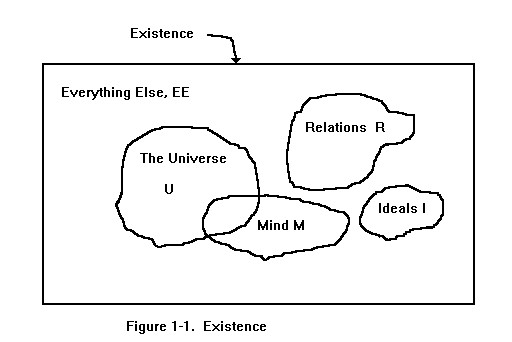
1. The Universe, U, in space and time (with a few extra compact dimensions thrown in to account for the fundamental forces according to Grand Unified Theories). I do not know if this can be said to include all of time or not. (Sometimes only the part of U of which we are aware is referred to as the real world. On other occasions the term real world is taken to be synonymous with U. Differences should be clear from context. In my philosophy, The World, W, refers to all that exists, i.e., Fig. 1-1. Thus W = U U M U I U R U E . For the benefit of the uninitiated, I should say that the symbol in the equation that looks a little like a sans-serif U is the symbol for union; i.e., the objects represented by the letters U, M, I, R, and E are joined together and taken all together to be The World.) The symbol W, then, refers to The World in the large sense as it actually is.
[Note in proof 4-13-96. I believe I can describe a universe that includes all of time and is all of a piece. Every future event in that universe is predetermined, however no part of that universe can be said to be conscious mind. Therefore, events in mind are not predetermined. They enjoy a separate existence, which cannot alter the future of the universe in any way. Nevertheless, from the point of view of mind, the way in which it makes its decisions, i.e., its free will, makes all the difference in the world. What we think determines who we are and our relation to the universe even though it has no effect on the universe as it really is. This is good enough. I am not claiming that what I have just written is the actual case. It is only a renegade thought.]
2. Mind, M, i.e., the sum total of all mental activity and mental latency of all creatures. Mind might be a subset of the universe. I don’t know. Probably, it cannot be known. I do not require a one-to-one relationship between mind and events in the universe such as the flow of electronic currents or the migration of ions in brains even though such a relationship might exist. Mind may be a large connected set or a large number of disjoint sets. The topology of mind is not understood.
3. The realm of Ideals, I, which includes, among many other things, every geometry that could ever exist complete with every lemma, theorem, and corollary – including the correct geometry of the universe, the Grand Unified Theories, if they exist, in all their glory and for every possible world, relations in their universal sense, i.e., greater than, North of, and many other things – things that Russell calls universals. The Ideals are eternal and immutable.
4. The correct relations among things in U and M belong to the realm of the Relations, R, e.g., the distance from the tip of my nose to every other macroscopic, identifiable object in the Universe as I go on my nightly walk is a collection of relations. Of course, incorrect relations exist only in Mind or on the printed page where they are mere artifacts of the Universe. In fact, if one says that the distance from the tip of my nose to the edge of the Grand Canyon – now – is six feet, one speaks of something that does not exist – not the distance of the tip of my nose from the Grand Canyon – then – but the six-foot relation as an object in R. That relation is said to be something that it is not, so it cannot be in R, which consists of correct relations only. Notice that the correct relations are hardly ever known to Mind, first, because their infinitude dwarfs what can be known and, second, because we do not apprehend sense data with infinite precision. The relations available to our minds are only approximations to the correct relations in R, which, nevertheless, exist – unless quantum mechanics somehow makes them impossible, in which case we would replace them with quantum surrogates. This is much more than we need to know; so, necessarily, I have said more than I needed to say. Please disregard anything that seems vague or otherwise incomprehensible.
5. Everything Else, E, i.e., that in which U, M, I, and R are embedded, if it exists, whether it has dimensionality or not – something completely beyond our comprehension or imagination.
Note. The Relations (not the universal relations, which abide in I, such as to the right of, greater than, etc.) evolve in time, but whether or not all Relations for all time exist depends upon whether the Universe, for example, in all of its proper dimensions including time-like dimensions exists; i.e., not only the present exists, but the past and the future exist on an equal footing with the so-called present. This is an interesting question, which opens up inquiry into Everything Else (E), in particular, the possibility of something in which U, M, I, and R are embedded. If that “space” has a time-like dimension, U et al. would appear from the viewpoint of an intelligence living in E, which, if you remember, we know nothing about, as a complete and finished object.
Clearly, this division of existence is valid logically. It is – quite simply – a linguistic convenience, but it achieves a great deal philosophically in that it solves “the problem of God”, for example. It provides a place for God to exist without resorting to a statement such as “God is all in all”, which would be an abuse of language. It comes perilously close to being the “merest truism”; nevertheless, I believe we shall find it useful. For example, we have solved the problem of metaphysical truth, which shall arise in Chapter 3, by reducing it to semantics.
At the same time we have proved half of a conjecture I would like to present for the reader’s consideration, namely, that it is impossible to prove either the existence or non-existence of God – under any reasonable definition of God. Clearly, this proves that a non-existence proof is impossible. But, how can we prove the impossibility of an existence proof? Such a proof would be extremely useful. In particular, it would permit us to follow Walt Whitman’s alleged advice, “Don’t argue about God.”
The category of the Relations was defined to deal with the slight (or profound?) difficulty in identifying the Ideals. When first defined, these were of two types – regrettably. Type I: the eternal and timeless Ideals such as the Idea of the color blue. Type II: the constantly enlarging set of relations among things in U and M, e.g., as I go for my evening walk, the relativistic distances (intervals) between a point on my right thumb and the other objects in the Universe, the relation of every thought of one man to every thought of another. One would like to have the eternal things in a different set from the relations in the evolving Universe; however, we are getting used to regarding time as not very different from the other dimensions regardless of its “arrow”. Who knows but that some of the (compact) dimensions required to unify the forces may have arrows as well. After much deliberation, I have called the Type II Ideals the Relations. However, one wonders if all of Euclidean Geometry – complete and perfect – is a collection of relations and nothing more, in which case the categories are badly named. Let the reader decide.
Avoiding Infinite Regression
At a well-known West Coast university, a series of weekly lectures in science was open to the general public. A lecturer had just finished describing the manner in which the earth revolves about the sun. “Nice theory,” quoth an elderly woman, “but the earth rests on the backs of four elephants who stand on the back of a giant turtle.” With an appreciative grin the lecturer countered with the usual Socratic question as to what supported the turtle. “Oh, I know all about that old argument, but it’s turtles all the way down.” [Note in proof (7-20-2004). This is not a true story, probably.]
William James [11] based his evaluations of religious sentiments on his personal judgments and experience of philosophical reasonableness and moral helpfulness. Following James, I have avoided infinite regression, e.g., “turtles all the way down”, by basing my three moral axioms and my philosophical assumptions (or articles of faith if you prefer) upon my innate judgments of reasonableness and aesthetics and my acquired conception of utility, which might have originated, at least in part, from my experience of pleasure and pain. The foundation of my philosophy differs somewhat from the criteria of James, but what I owe to James is the principle that one not only can but must rely on oneself to provide a foundation for a philosophical edifice.
[Note in proof (1-1-97). When I say “rely on oneself” I refer to certain primitive judgments that are fundamentally subjective – although we may hope for a large class of human beings, perhaps all human beings, experiencing such things in a manner sufficiently similar to the manner in which we ourselves experience them. Perhaps these subjective judgments are universal in nature and we and other people will agree on important matters of aesthetics, reasonableness, and utility.]
My three moral axioms are, roughly speaking, (i) respect for the freedom of oneself and others, (ii) respect for the environment, including animals and plants, and (iii) respect for truth. From these axioms and the basic assumptions, I derive additional morals and what are commonly known as rights, i.e., certain liberties permitted by the axioms and certain entitlements similarly derived. I next define justice and finally arrive at a rational, beautiful, and practical social contract upon which we can gather a very general consensus that permits a community to function in peace and harmony essentially without government! This social contract is what I have termed a minimal proper religion.
Presumably, we are born with a sense of what is reasonable. If not, we acquire it at such an early age that it is not necessary, for this discussion, to determine how it arises. Aesthetics, too, is assumed to be given a priori, but I shall not rely on that assumption here. Then, (1) our experiences of the world, i.e., the universe, which we acquire through our physical senses, extended, perhaps, by instruments, and (2) the events that take place in our own minds, can be used to develop the ability to reason (without assuming that the real world exists; that is, we may be reasoning about things that have no independent existence). But, once we have developed the ability to reason, perhaps by studying logic, sentential calculus, set theory, Boolean algebra, or the works of the masters, we may use it to interpret our experiences as evidence of an objective world; that is, we may deduce the existence of a real world using our developed reason.
[Note in proof (3-28-95). I do not wish to argue the reality of the complementary measurement in quantum mechanics, e.g., the Einstein-Podolsky-Rosen (EPR) thought experiment [14]. Personally, I believe the indeterminate observable is just as real as the measured one; but, obviously, something is real – either the horizontal spin or the vertical spin.]
[Note in proof (9-24-96). Underlying the phenomena we observe lies something that has an existence independent of ourselves as evidenced by the undeniable fact that the Aspect experiments (well-known to physicists [14]) will yield the same results no matter who performs them.]
Once we have established the independent existence of the world, we may rely upon the evidence of our senses and our consciousness to develop a sense of utility enhanced by our comprehension of pleasure and pain. Our comprehension of pleasure and pain is based, in part, on our sense of aesthetics, which we assumed was given a priori, but which may be enhanced by experience and other factors. We are now in possession of the three tools, namely, reasonableness, aesthetics, and utility, with which we will evaluate philosophical assumptions and moral axioms. I hope that I am not an anomalous specimen of humanity, but that my primitive notions will be experienced by most, if not all, of humanity.
Once the moral axioms have been stated with a sufficient degree of rigor, a system of morals can be derived from them that can serve, in turn, as a basis for human rights and for the rights of other creatures. Justice is based on morals and rights. Thus, morals are based on aesthetics, reasonableness, and utility; rights and justice are based on morals; and our knowledge of the world, including our knowledge of the usefulness of things, is supposed to come from experience and reason. What we choose to experience or apply our powers of reasoning to, and how we decide to take the next step in our reasoning may be dictated by our imaginations or other faculties, which might include intuition, a faculty that is presumed to come primarily from experience. It is not necessary to suppose that the origins of intuition are well understood. We do not necessarily deny the existence of divine inspiration. If the conclusions based on the moral system derived from the fundamental assumptions and the moral axioms lead back to reasonableness, aesthetics, and utility, we will have developed a consistent philosophy. I do not see how we can hope to do better. If some future generation accepts it as a minimal proper religion suitable for a social contract upon which a cooperative society such as the one described in this essay can be based, the most improbable dream of a dreamer of impossible dreams will have come true.
I shall give a list of philosophical assumptions, which might as well be called articles of faith. I hope that I do not assume too much. This essay is supposed to be an example of the axiomatic methods of science applied to human society. Normally, if an axiom is required to prove what we already believe is true, we simply go ahead and assume it. For example, most of modern mathematics rests on the Axiom of Choice, which makes claims about what would happen in a process that takes place an infinite number of times, namely, the selection of one member from each of an uncountable number of nonempty sets [15]. Naturally, the axiom cannot be verified experimentally; moreover, it might be possible to derive an entirely different mathematics by assuming that the Axiom of Choice is false. I cannot imagine what would be gained by devoting volumes to determining which is the case even if it is possible to do so. [I believe that it is not.]
I hope that this development is adequate, but, if it turns out to be deficient, I will add whatever else I need to construct this system, which appears to me to be nearly complete according to my intellect and my intuition. These ideas came to me in chronological order, i.e., in the only way in which anything comes to anyone, rather than in logical order, so I must search constantly for errors that may have arisen in the reordering process that occurs when one thinks and writes. This is an important point, which, it seems to me, is frequently overlooked, namely, that we do not present arguments in the order in which they occur to us. One of the ramifications of this may account for our unwillingness to abandon our most cherished notions.
Reasonableness and Aesthetics
Reasonableness is very much related to our sense of aesthetics. Musicians say that a beautiful passage “makes sense” and mathematicians say a reasonable argument is “beautiful”. Perhaps the part of our being that receives pleasure from things aesthetic is identical with or similar to the part of our being that finds satisfaction in things that make sense. It is possible that, if they are not identical but rather two parts of ourselves, they are mirror images of one another, one on the right side of the brain, the other on the left. (Since the right-brain / left-brain theory is unproved, hereafter I shall enclose the terms in quotes to indicate the provisional and figurative nature of the terminology. I do not need to inquire into their mechanisms to identify them categorically or definitionally, but I would like to inquire, briefly, into the origins of our sense of beauty and our sense of reasonableness so that I can depend upon them as a guide for philosophical judgments.)
Are we born with a sense of aesthetics, which, for me, is the same as the sense of beauty? If so, are we born with a sense of what is reasonable? If we are not born with them, do we acquire them early in our lives in an infallible way upon which we can depend with as much certainty as if we were born with them? In the introduction to The Critique of Pure Reason [16], Immanuel Kant claims the existence of a priori synthetic judgments, however the examples he gives do not seem to be valid – in my opinion. The first example is mathematics, which as I have noted below, is essentially definitional and, therefore, analytic, as opposed to synthetic. [Note in proof. The definitions from which mathematics is derived by analysis are synthesized, therefore I am not sure to which category mathematics ought to belong.] The second example is the judgment that every effect has a cause, which might be discredited by the quantum theory. Thus, Kant ends up by trying to determine the properties of a class of objects which may not have any members.
But, if any form of knowledge could be both a priori and synthetic, it seems that it must be our sense of beauty. As far as we know, the beauty of an object cannot be deduced from it by analysis (although probably some scientist or artist is trying to discover how to do it); moreover, it seems that it is not given by experience either. Thus, if I do not misapprehend Kant’s intention, our sense of beauty must be an a priori synthetic judgment. It remains only to determine that our sense of beauty, for example, is what Kant meant by a judgment or a faculty of judgment and I must assume that it is. On the other hand, if Kant would exclude the sense of beauty and the sense of reasonableness from his category of a priori synthetic judgments, his category might be empty, which, of course, is of absolutely no importance.
In this essay, I do not appeal to the idea of a conscience. If the conscience is, in whole or in part, the residuum of notions picked up in our earliest years, before we were able to apply our judgment, then, conceivably, a portion of it could be confused with aesthetics. We might judge that something, e.g., sex, is not beautiful because we have retained an irrational notion that it is not beautiful from notions picked up early on that are in conflict with what we would decide had we been left alone. We would like to distinguish conscience as a negative attribute in contradistinction to aesthetics and reasonableness, which we hold to be natural and desirable. This is a mere semantic quibble and should not cause any difficulties.
Similar reasoning can be applied to our sense of reasonableness. I am not referring to the science of logic or to the theory of sets. In order to acquire these systems of thought one must already be in possession of a sense of reasonableness or one would not be able to turn the first page without throwing up one’s hands in disgust or despair. We understand the fundamental premises of these systems of thought because we are given a sense of what is reasonable a priori. Moreover, the reasonableness of something cannot be deduced from its other qualities without having in place the mechanisms of thought upon which analysis is based and these mechanisms must follow from our sense of what is reasonable. Piaget [17] has given evidence of developed reasoning ability in very young children, who, presumably, are not in possession of a calculus of reasoning such as set theory. I do not know the position of modern child psychology on when the rudiments of reason can first be observed in infants.
We begin to experience the real world (the objective universe or, at least, the part of it of which we are aware) through our senses before we are able to deduce its existence. Also, we are aware of events occurring in our own minds whether we consider them a part of the real world or not. We take advantage of these experiences, which might include our educations, to develop our innate reasonableness into an ability to reason. We are able, then, to deduce the existence of an objective universe from the evidence of our senses. Since I will not give the steps in this deductive process, I will assume the existence of the real world as an article of faith.
Note: Despite the results of the Alain Aspect experiments to test Bell’s Inequality [14], I still insist that something objective and real lies underneath all of these phenomena because the experiments come out the same no matter who performs them. This underlying reality may be much weirder than we have been able to imagine, however.
Utility
Our experience consists of our perceptions of events in the world through our physical senses and the events that occur in our own minds, which we interpret as joy, sadness, pain, love, anger, hate, compassion, nostalgia, etc. We are endowed, too, with memory. The faculties with which we are endowed permit us to develop our primitive sense of reasonableness into an ability to reason, which, in turn, permits us to deduce the reality of some sort of objective universe – regardless of our position in the Einstein-Bohr debate, if we, indeed, have such a position. Our initial experiences and impressions of existence come far in advance of that deduction and, without reasoning, cannot be presumed not to be delusions. Given an objective reality, which includes our own existence and the events that occur in our minds, we are in a position to judge the usefulness of objects and institutions that spawn events of a predictable nature. Since we believe in objective reality as a collection of events and we believe in ourselves, we are not in doubt as to the meaning of experience. Utility, then, is judged in terms of experience and how we perceive pleasure and pain, that is, in terms of our sensibilities. We may exercise our sense of aesthetics, too, in evaluating usefulness. I do not wish to explore the role played by experience in the development of our sense of aesthetics. It may be similar to the role played by experience in the development of reason, but, since I do not claim that our sense of aesthetics has developed into anything new (such as artistic infallibility), I do not need to explore that subject further.
We now have a complete basis for judging values, philosophical assumptions, and moral systems, namely, (i) aesthetics, which is presumed to have been given a priori, (ii) reason, an outgrowth of our primitive sense of reasonableness, and (iii) utility, which is based on experience of the real world. We can construct a basis, then, for deciding what else can be known and for evaluating new knowledge, but we should be aware that the basis rests on assumptions that may not be correct.
Occurrence Implication and Occurrence Equivalence
In mathematical logic, letters stand for simple statements. For example, the letter A might stand for “It is snowing” or “All governments are bad” or “Smarty Jones is a dog with two heads” or “All horses have five legs”. In the statement “It is snowing”, one wonders what or who “It” is. The sentence could have been replaced by “We have snow” or “There is snow” or, simply, “Snowing”. The symbols A → B are read normally as “A implies B”; however, all of the following are equivalent: (i) A implies B, (ii) B if A, (iii) A only if B, (iv) not-B implies not-A, (v) B is a necessary condition for A, (vi) A is a sufficient condition for B, (vii) if A then B. By the symbols A ↔ B we mean: (i) A implies B and B implies A, (ii) if A then B and if B then A, (iii) A if and only if B, (iv) A is a necessary and sufficient condition for B, all of which express the fact that (v) A and B are logically equivalent.
By analogy with the preceding, we may use symbols to stand for circumstances that obtain in society such as ‘Materialism’, ‘Tyranny’, ‘Environmental Destruction’, or ‘Dishonesty’. As in the case of ‘Snowing’, ‘Materialism’ means ‘There is materialism’ or ‘We have materialism’, ‘Materialism is occurring’, etc. Let us replace the questionable notion of cause and effect, as in A causes B, with the useful concept of occurrence implication by analogy with A implies B. In my book On the Preservation of Species <http://web.wt.net/~twayburn/POS.html>, I represent occurrence implication with the symbols A → B which mean that B occurs whenever A occurs. If we have A, B is present too, or, at least, it soon will be. We cannot have A without B, which is the same as not-(A & not-B). We neglect time lags separating the occurrence of A from the occurrence of B as these, typically, are short in comparison with the time frames with which we shall be concerned. Finally, in analogy with logical equivalence, we have occurrence equivalence, written A ↔ B, whenever A → B and B→ A. Occurrence equivalence is an equivalence relation in the mathematical sense.
Occurrence Equivalence as Evidence of Divinity
Of any personal experience that would suggest to me the existence of a Divine Intelligence, I find the following the most compelling: It seems to me that everything that is reasonable is beautiful and practical; everything that is beautiful is reasonable and practical; and everything that is practical is reasonable and beautiful. This strikes me as truly wonderful. I interpret it to mean that, despite the enormous amount of evil in the world, a just and perfect world is within the reach of mankind and our fellow species. I am aware that we may have evolved in such a way that this occurrence equivalence works for us and that the amazing coincidence in which I rejoice is merely a natural result of the way in which we evolved with no need for divine intervention whatever. Nevertheless, I like to think that we would judge reasonableness, aesthetics, and utility the same no matter how we evolved and no matter what we evolved into. Contact with extraterrestrials might settle the question, but I can’t imagine what else would. Do you ever get the feeling that you are out of your depth?
A Minimal Proper Religion as a Social Contract
Minimal Proper Religions
For the convenience of the reader, the definition of an MPR is repeated:
Definition (Minimal Proper Religion). A minimal proper religion (MPR) is a proper religion that incorporates the minimal number of behavioral requirements necessary to ensure “sustainable happiness” for all of humanity. An MPR places constraints upon those who agree to follow it, but only those constraints upon behavior and public policy that cannot be relaxed without creating unbearable misery for a significant portion of humanity.
The MPR proposed by me makes no statements about the nature of any god or gods. It has no unnecessary intellectual baggage; and, although it is designed to gain nearly universal consensus, it prohibits unlimited procreation and any form of trade or commerce (in keeping with the freedom axiom). Obviously, it will not be accepted by everyone immediately. Nevertheless, it has a set of conditions none of which can be removed without destroying the possibility of sustainable human happiness; so, it is minimal. Admittedly, this is counter-intuitive (not what most people would expect).
A minimal proper religion, either mine or someone else’s, has the potential to be the basis for a social contract among the people of a community, which might be as large as the United States, although it would be better if communities were smaller, more decentralized, and, indeed, quite local. It is recognized, though, that some sort of contract among essentially all the people of the world is necessary eventually, in particular so that resources can be shared without introducing contingency. Again I point out that I could avoid the term minimal proper religion and go directly to social contract, but I like to anticipate my critics. It is important to prevent improper religions from trying to pass themselves off as legitimate candidates for social contracts because we shall be indoctrinating very young children with our social contract so that we won’t need a government. Perhaps, no one has tried to indoctrinate children with rational philosophical tenets. Naturally previous attempts to indoctrinate children with unreasonable philosophical or religious tenets have failed and we still have governments – all bad.
The important thing is to achieve a nearly universal consensus about how people living in a community will behave; and, for that difficult goal, one needs the fewest conditions possible. The social contract must deal in a humane and enlightened manner with a few people who do not accept the social contract (based on a minimal proper religion) no matter how reasonable, beautiful, and practical it may be. It will be assumed that something close to a universal consensus can be achieved. This is like Einstein’s Special Theory of Relativity. You don’t have to sell it. People accept it when they understand it. Eventually almost no one thinks it’s wrong whether they understand it or not. Of course, it will have to be modified eventually because, although it’s the best thing we’ve got, IT IS WRONG. (Not because it is disallowed by some reactionary principle but because it is not sufficiently radical.)
Building Upon a Minimal Proper Religion
We might think of the following as interior decoration for the soul. [Sometimes I think of the soul as the history and future, i.e., the trajectory (if you like that word), of the mind. We can count people by counting souls. Please do not argue with me about the soul.] In addition to the conditions in the social contract, people may place themselves under any number of behavioral requirements or conditions (as long as the conditions are consistent with the social contract) and may believe in a God, or a Life Force, or Élan Vital, or whatever they wish to call it. In my linguistic categorization of the world-in-the-large-sense (all that exists), I solved the problem of God by recognizing that the Universe, the Ideals, the Relations, and Mind might be embedded in something, therefore I have provided a category called Everything Else.
I find, upon close introspection, that, whether I wish to or not, I do believe in a personal god, but that belief is not part of my MPR because it is not needed to achieve sustainable happiness for all, nor can it be accounted for by any rational process. It is the philosophical system described in this essay, not the religion of my heart, that provides a basis for an MPR. While an irrational belief in God may be a part of my heart’s own religion, it doesn’t belong in my philosophical system. It is, in fact, a superstition! The position of my MPR is that I don’t know, you don’t know, no one knows, and it can’t be known, whether or not there is a god and, if there is, what it’s like. I call this position hard agnosticism. I, like everyone else, can and will believe whatever I please – or everything, or nothing, or what is reasonably likely to be true. An MPR says nothing about belief and very little about public policy – only the absolute minimum that must be said to protect the rights of others.
A Rational Philosophical Basis for a Minimal Proper Religion
Many able thinkers have attempted to give the Judeo-Christian tradition a philosophical basis, but this was done many years after the tradition was firmly established. Predictably all such attempts have failed. The Jewish and Christian religions arose more or less independently of rational or critical thought and it is extremely unlikely that they could be given a rational basis a posteriori. And yet the aforementioned thinkers recognized the desirability of a rational philosophical basis in view of the ascendancy of science almost concurrently with the Christian era.
I agree that such a rational philosophical basis for religion is desirable. Consider for a moment all of the people who place their faith in science every day with the sole exception of the Sabbath, upon which day they suspend disbelief in the irrational and superstitious aspects of their particular religion, attend church, and do violence to the consistency of their mental attitudes. This is undesirable as it makes the mind much more susceptible to the holding of contradictory beliefs, which is a form of mental derangement and can have dire effects on the behavior of its victims.
The Subject of The Varieties of Religious Experience Compared to a Proper Religion
In the course of lectures upon which he based his famous book, The Varieties of Religious Experience [11], William James deliberately chose to concentrate upon a particular aspect of religious experience, namely, the personal aspect. I am curious to determine if his avoidance of the ecclesiastical and formal aspects of religion, e.g., the commonplace ritual of going to church on Sunday, can be construed as a much earlier rejection of improper religions. Thus, I am largely motivated by natural curiosity and self-interest to determine if William James anticipated some of my “original” ideas. This has been an afterthought. My system was developed completely before it occurred to me that James and I might share similar views. While it should be a matter of complete indifference to the reader, I find that I cannot resist this brief digression. It might even be a source of gratification to discover that not every thought that entered my head found its first earthly home there!
James defends his choice of personal over ecclesiastical (or formal) religion by noting that all formal religions began with someone’s personal religious experience. He argues that personal religious experiences are more profound than the alternatives. “Lutherans wouldn’t attend the church of their choice had not Luther experienced religion in a way that quite probably is to be denied his latter-day followers.” I concur. My personal religious interests are congruent with the pedagogical choices of James, which is not something I normally report, except that, in this case, I wonder to what extent his notion of personal religion corresponds with my notion of proper religion, even though I do not consider James’s opinion more important than yours or mine or in any way essential to my thesis. The reader, therefore, may skip this section as it is strictly tangential.
I would like to dismiss improper religions completely. Improper religions are not religions. In his famous book, James makes no such claims and freely admits that institutions that satisfy other definitions of religion or, actually, aspects of religion, which might include “improper religions”, may properly be called religion. Thus, according to James, improper religions might be proper. (Of course James hadn’t seen television evangelists.) As he says, “[I]t would indeed be foolish to set up an absolute definition of religion’s essence and then proceed to defend that definition against all comers, yet this need not prevent me from taking my own narrow view of what religion shall consist in for the purpose of these lectures, or, out of the many meanings of the word, from choosing the one meaning in which I wish to interest you particularly, and proclaiming arbitrarily that when I say ‘religion’ I mean that.”
And, further, “Worship and sacrifice, procedures for working on the disposition of the deity, theology and ceremony and ecclesiastical organization, are the essentials of religion and the institutional branch. Were we to limit our view to it, we should have to define religion as an external art, the art of winning the favor of the gods. In the more personal branch of religion it is on the contrary the inner dispositions of man himself which form the center of interest, his conscience, his deserts, his helplessness, his incompleteness. And, although the favor of the God, as forfeited or gained, is still an essential feature of the story, and theology plays a vital part therein, yet the acts to which this sort of religion prompts are personal not ritual acts, the individual transacts the business alone, and the ecclesiastical organization, with its priests and sacraments and other go-betweens, sinks to an altogether secondary place. The relation goes direct from heart to heart, from soul to soul, between man and his maker.”
I think it is fair to say that James has expressed a preference in this passage that night be congruent with my view. I have not proposed an exact definition of the essence of religion. Working backwards I gave a preliminary list of what proper religions are not! I didn’t say that my list was exhaustive. James may not wish to offend the purveyors of improper religions, as I term them; but, probably, his sympathies lie with me.
However, the minimal proper religion would not be received enthusiastically by James – the religionist. He would find it too dispassionate and, frankly, too lukewarm, for a religious concept. The sort of religion James had in mind would be considered madness by many people: “There can be no doubt that as a matter of fact a religious life, exclusively pursued, does tend to make the person exceptional and eccentric. I speak not of your ordinary religious believer, who follows the conventional observances of his country. These experiences we can only find in individuals for whom religion exists not as a dull habit, but as an acute fever rather. But such individuals are ‘geniuses’ in the religious line, and like many other geniuses who have brought forth fruits effective enough for commemoration in the pages of biography, such religious geniuses have often shown symptoms of nervous instability.”
As the reader may have noticed, such “nervous instability” is no longer tolerated in the United States, if it ever was. One might just as well be a drug addict. I must not conclude these remarks without discussing my personal religious feelings, including a sense of awe and wonder and a feeling that my every thought and deed is informed by something divine that completely fills my being in the unlikely event that I am fortunate enough to take the right drugs under the right circumstances. This is a feeling that renders death itself a matter of no importance. I wonder if anyone in America has what can reasonably be called a religious experience without drugs. I tend to doubt it because our “advanced” capitalist industrial and technological society floods our minds to their utmost capacity with the thousands of mundane and materialistic considerations that fill our day. Although, in a certain sense God is everywhere (or nowhere), one is not likely to experience the divine spark of the Holy Ghost in one’s bank, brokerage, or business. The sacred drugs permit one to discard all of this obsession with “coping” with “life” for an interlude protracted to as much of the rest of our lives as possible, depending on our capacities. During that blessèd interval, we can be what we were intended to be. The reader had better think twice before he persecutes the next druggie he meets. The druggie may be one of God’s own people – if I may indulge in a literary figure.
September 8, 1996
How a Social Contract Based on Consensus Might Work
Becoming a Party to a Valid Social Contract
When we discussed proper religions and minimal proper religion, we noted that a minimal proper religion could be the basis for a social contract. When a child reaches the age of reason, he may elect to accept the social contract enjoying currency. An alternative is to surrender his personal sovereignty to one or more of his guardians until some later time when he feels he is better prepared to take that step.
Rejecting a Social Contract
Also, he has the option to reject the social contract and retain his personal sovereignty just as a head of a foreign state living in our community might do. Personal sovereignty is the sovereignty that remains when all other sovereignty is found to be invalid. He would enjoy diplomatic immunity and other similar considerations until such time as he wishes to join the community into which he has been born. He must not be treated as a criminal under any circumstances because he has not agreed upon the moral code by which the majority live. If his behavior creates a very great nuisance, he may be treated as a prisoner of war with all of the privileges pertaining thereto. Personal sovereignty persists under all conditions. All contracts are voluntary. That is guaranteed by the Freedom Axiom.
Definitions of Terms Employed in Fundamental Theorem
Sustainable Happiness for All of Humanity
Definition of Happiness
By happiness we do not mean a continuous state of bliss. We agree that happiness requires a reasonable satisfaction of the usual tissue deficits. One can be happy while one is a little hungry, but one cannot be expected to be happy in the technical sense while starving to death, or, as we shall make clear in a moment, while one’s child is starving to death.
Following Deci and Ryan [1], we say that happiness is a state of mind that often occurs when the following necessary conditions are met: (a) autonomy, (b) effectiveness, and (c) relatedness. (We prefer this phenomenological definition because we cannot measure the state of a person’s mind.)
Autonomy means that the requirements of the Freedom Axiom, discussed in detail in Chapter 3, are satisfied. We are free. [See also the note following the definition of happiness on p. 79 in Chapter 3.]
Effectiveness refers to the accomplishment of something satisfying and possibly useful. The usefulness may come from our interest in the task and may have nothing to do with scarcity economics. Time passes so quickly that we are amazed when we realize how long we have been completely engaged and totally absorbed in our task. We say we are “in the flow” or “in a zone”. Our thirst for effectiveness ensures that mankind will not perish in a world where no one is required to do anything to live. Everyone must do something to be happy!
Relatedness refers to our interactions with and feelings toward other sentient beings, in particular, human society. The need for relatedness makes cooperation worthwhile and accounts for the unhappiness of a woman whose child is starving although she may not be.
Finally, happiness in this technical sense requires that the conditions discussed above exist in perpetuity. Happiness requires safety. We must be free of worry that the other requirements for happiness can be taken away (by the rise of a despotic “natural leader”, for example). “Acts of God”, on the other hand, such as astronomical catastrophes, we accept with equanimity, free of negative emotion, and we die the good death of a person who has lived a happy life – without regrets or bitterness of any kind. Actually, most of us don’t devote much of our concern to worries that the sun will burn out or that earth will be struck by a huge comet. And, we should not be influenced by desperate scientists, about to lose lucrative defense contracts, to invest in a gigantic big-science, Star-Wars-type Asteroid Defense Project. Nor, should we be tempted to avert the end of the human race by escape to outer space, as explained in my essay “On Space Travel and Research” [8]. The point is that wisdom, concomitant with happiness, transcends fear of calamity.
To summarize, the conditions for happiness are:
1. Reasonable satisfaction of tissue deficits.
2a. Autonomy or freedom from tyranny.
2b. Effectiveness, the ability to interact with one’s environment in a satisfying and positive manner.
2c. Relatedness, good relations with fellow human beings and, perhaps, animals.
3. Safety, assurance that the above four preconditions cannot be taken away, except, perhaps, by Mother Nature, e.g., astronomical events.
Hypothetical World W′
1. Intrinsic Motivation
Intrinsic motivation is assumed to be the preferred form of human motivation. This is the basis for the scientific theory under development by a number of scientists, notably Deci and Ryan [1]. [Note in proof (11-27-96). I can now provide a long list of peer-reviewed scientific research papers that support the theory of intrinsic motivation. This research makes intrinsic motivation much more than a philosophical assumption. A dedicated bibliography of just the papers read by this author is given at the end of Appendix III.]
[Note in proof (7-20-2004) on Intrinsic Motivation. For most of my life, I have been driven by extrinsic motivation, that is, by parents, teachers, and bosses. Since 1989, I have had no such motivation. I can testify that, without extrinsic motivation, I had a hard time moving. This corroborates Deci and Ryans’ finding that extrinsic motivation poisons intrinsic motivation. Nevertheless, I did get moving, at last, and I have completed a considerable volume of work, some of which can be found on this website. Lately, I have been “working” sixteen hours a day, with the hours melting away like minutes, and the work itself is the sole motivation – as far as I can tell. I believe I am “in a zone”.]
2. Happiness in the Colloquial Sense
People who enjoy the preconditions for happiness, which in this theory were, for technical reasons, identified with happiness itself, will by-and-large allow that they are happy in the colloquial sense. Thus, we retain a phenomenological view.
Essentially, in W′, the theory of Deci and Ryan is correct. Happiness means what it should mean.
Hypothetical World W"
The world W″ is a hypothetical world that has all of the attributes of W′, except that in W″ three additional conditions are met:
1. A Stable (Human) Population
The population will be stable at about ten billion human beings or, preferably, closer to the optimal population size, i.e., a sufficient number of people that succor from one’s fellows is available when needed, not so many people that the quality of individual lives is appreciably reduced, the opportunity for as many people as possible, consistent with the previous two conditions, to be able to enjoy the blessings of having been alive. Probably, the optimum population size will be smaller than ten billion people.
2. Adequate High-Grade Renewable (Sustainable) Energy
In W″, renewable energy technology adequate to provide the energy per capita equivalent to one kilowatt-hour per hour of 110-volt, 60-Hz AC will be available. This is the standard for emergy calculations, therefore we have one emergy unit per hour per capita. (Since this is based on power plant electricity, it represents more energy than 1 kWhr/hr. For example, if half were coal and the rest electricity, the rate of energy consumption per capita would be 2 kW.) Also in W″, the matching problem, providing lower grade energy to those uses for which it is adequate so as not to lose availability converting lower-grade energy to higher-grade energy that is not needed, has been solved. This is discussed in slightly more detail in Chapter 2.
3. Sufficiency of One Kilowatt Per Capita Renewable Emergy
We assume that every human being can live on 1 kWhr/hr – or simply an average rate of consumption of emergy units equivalent to 1 kW of 60-Hz, 110-volt AC electric power. In addition, we must assume that a one kilowatt per capita emergy budget is sufficiently abundant to provide happiness as we have defined it. Perhaps, no American can be happy on only one kilowatt emergy consumption, but we know of primitive peoples who consume much less and they are happy. In any case, this per capita rate of emergy consumption is assumed adequate for a satisfactory life wherein happiness for everyone is possible if not guaranteed.
Sustainable Happiness
Definition (Sustainable happiness). We say happiness is sustainable when it cannot end because of human social factors but only because of astronomical events.
Universal Sustainable Happiness
Definition (Universal sustainable happiness). Universal sustainable happiness is sustainable happiness enjoyed by all of humanity and as many other species of plants and animals as possible. It is a goal of this philosophy that can be approached only asymptotically.
Power
Wealth will be discussed in the next chapter. We now wish to discuss power. The word power has a definite meaning in physics. That sort of power is really material wealth whenever it is exercised. In this essay, we are referring to power such as the power that a rich and influential person holds over a poor and “unimportant” person or the United States holds over Haiti. We ought to choose a new word, but we shall use the same term that is used in physics in keeping with other authors who discuss political power. One can say without fear of contradiction (by reasonable people) that the pursuit of wealth and power is the most highly regarded activity of Western man. It amounts to his religion for all practical purposes, regardless of what he claims his religion is.
Influence in the sense that the United States influences the affairs of Panama is a form of power. Influence in this sense is undesirable. Joseph Stalin and Ronald Reagan wielded tremendous influence in the form of power as leadership; moreover, they did not lead primarily by examples that were imitated voluntarily. The leadership of Joseph Stalin or Ronald Reagan was genuine power over other people and, therefore, undesirable, as no person should have power over another. Unless I specify otherwise, leadership will be referred to in its undesirable sense in this essay. I find it amusing to use a eulogistic term in a dyslogistic sense, i.e., attach a negative connotation to a word that is usually associated with something that most people imagine is desirable even though it may not be – ever. The way the word leadership is used in ordinary discourse makes it an impostor term in the sense of Bentham [4]. I will devote an entire chapter to disposing of leadership, which I portray as the cause of the apparently unending cycles of the rise of leaders, their corruption, and their eventual displacement by reformers, who then become corrupt leaders. “Power corrupts; absolute power corrupts absolutely.”
Rather than the petty tyrant who rules our fireside, we should be concerned with the very rich people (and some who are not so rich) who rule our nation and the even-more-powerful multi-national corporations and who essentially hold power of life and death over us. The definition of the ruling class is given in the appendix of this chapter. (We have agreed to define terms as soon after they are used as is practicable.) These are the leaders with whom we must contend to become free men and women. When the ruling class is deposed, never to be replaced, we can deal with our mothers-in-law, shrewish wives, and incorrigible children appropriately.
Negotiable and Non-Negotiable Fame and Influence
Most of us have noticed that one can exchange wealth for power – perhaps by buying political influence through campaign contributions, perhaps by starting a company and hiring people who must then do one’s bidding. Negotiable fame is in the same class with wealth and power. It is a dangerous thing. It can be exchanged for wealth and power including negotiable influence.
One can easily exchange wealth or power for fame – perhaps by appearing in one’s own ads on TV, as the owner of a well-known hamburger chain has done. Also, most types of power can be exchanged for wealth, for example by selling influence, as former high-ranking elected and appointed officials do when they become lobbyists. Most powerful elected officials leave office nowadays in a better position financially than before holding public office. (I have heard that Nixon, at one time, did not want to reveal his net worth (as required by election rules) not because it was excessive but, on the contrary, because, in fact, it was next to nothing. Apparently, he improved his fortunes considerably by virtue of having been president, even though he left office in disgrace.)
However, power sometimes consists only in influence over other people. This influence may or may not be convertible to wealth. If it cannot be converted to wealth, we shall denote it non-negotiable influence. If it can be converted to wealth, it shall be referred to as negotiable influence. Obviously, negotiable influence is a form of power that can be converted to wealth and, for that matter, fame. Similarly, we have non-negotiable fame and negotiable fame. Negotiable fame can be converted into wealth and power, including negotiable influence. It remains only to give examples of negotiable fame, non-negotiable fame, negotiable influence, and non-negotiable influence. Now, Michael Jordan possesses negotiable fame and Richard Nixon possesses negotiable influence. The other two are harder to find.
Obviously, I hope to influence the reader of this essay, and, conceivably, my influence could be the predominant external influence in some reader’s life, but I shall not exert power over anyone nor shall I accept a position of personal predominance in public affairs voluntarily. My influence must be in and by my words, as opposed to my personality or my authority; i.e., it must be non-negotiable influence.
How can one be sure it is genuinely non-negotiable? That is a difficult question and the best answer I can come up with right now is “Because I say so”. I promise not to negotiate that influence. It may be a bit harder to come up with an example of influence wielded by a living person that, obviously and because of its very nature, cannot be converted into anything else, except, possibly, non-negotiable fame. Except for the very minor and, for our purposes, insignificant power Albert Einstein had over his graduate and post-doctoral students, I would argue that his influence and fame were non-negotiable.
Occurrence Equivalence of Wealth, Power Including Negotiable Influence, and Negotiable Fame As S*
Thus we can form a commutative triangle among (i) negotiable fame, (ii) negotiable influence together with other types of power, and (iii) wealth. That is, negotiable fame can be converted into wealth and power, including negotiable influence; negotiable influence and other types of power can be converted into negotiable fame and wealth,; and wealth can be converted into negotiable fame and power including negotiable influence. The situation is as shown in Fig. 1-2.
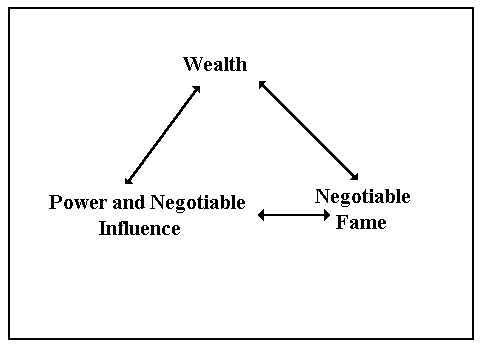
Figure 1-2. Negotiating Wealth, Power, and Fame
To maintain philosophical rigor we must acknowledge that some forms of fame and influence might be non-negotiable. Then, excluding these (which might not exist), we can make our generalization about the equivalence of wealth, power, and fame in the sense discussed above; that is, they form a commutative triangle. I need refer only to material wealth when I mean material wealth and anything that can be converted into material wealth. Because of the above commutation equivalence, we might consider lumping all of these things together and giving them a name. The name I have chosen in the past is importance; but, since I meant worldly importance as distinguished from true importance, it might be better to choose a different term. Perhaps status is the best choice I can make. Other choices include: rank, enviability, distinction, consequence, eminence, worldly success, materialistic success, standing, etc. [Note in proof (1-28-06). To avoid confusion with other concepts, I have elected to use the symbol S* to stand for the equivalent concepts of wealth and power. Probably, to encourage excellence and to accommodate our natural propensities to seek reproductive advantage, we must allow competition for fame, which becomes non-negotiable.]
Note in proof (1-4-06). We shall need a term for the esteem in which we hold people for whom we name our children. Indeed, these people may very likely be the recipients of Tokens that cannot be used by their holders to have children of their own in accordance with the Token Principle of Chapter 3. I have not used the term ‘prestige’ to mean anything else; however, we must be certain that we are talking about something that will not be exchanged for greater wealth or political power. We agree that it can result in greater reproductive advantages – not only for the usual reasons but because of the Token Principle. It may be fame; but, if it is, it must be non-negotiable fame.
We should note at once that if one of the three aspects of S* never occurs, then none of them can occur; whereas, if any of them is permitted to exist in a hypothetical society, then all of them will be present eventually. We refer to this kind of relationship as occurrence equivalence; i.e., wealth, power (including negotiable influence), and negotiable fame are occurrence equivalent. We shall find this concept useful in the sequel.
Ambition
The noble Brutus
Hath told you Cæsar was ambitious
If it were so, it was a grievous fault,
and grievously hath Cæsar answered it.
Definition (Ambition) RHD [3]. 1. an earnest desire for some type of achievement or distinction, as power, fame, wealth, [italics mine] etc. 2. and 3. irrelevant.
I, for one, find it interesting that the Random House Dictionary (the very best English language dictionary that I, personally, can lift without the use of a forklift truck) chose precisely the elements of what we have agreed to call S* to illustrate what I may now adopt as a dyslogistic term, namely, ambition.
Throughout my life, even as a young boy, whenever I have heard ambition praised or the lack of it denounced, I have experienced disgust. Certainly I have no objection to a desire to achieve something worthwhile and I am only a little uncomfortable with distinction. But, I find it amusing that this lifelong antipathy toward ambition has turned out to play a role in my philosophy (and religion).
Ambition, then, restricted to an earnest desire for S*, can be taken to be a major component of what we shall call materialism, competitionism, or, in phenomenological lingo, artificial economic contingency.
Materialism
Definition (Materialism). Materialism is defined to be any system having the following characteristics or the belief in, promotion of, or dedication to such a system:
1. Competition for wealth, power and negotiable influence, or negotiable fame, i.e., S*, in any form.
2. The use of S* as a reward for achievement or good behavior or as a measure of success.
3. Any institutions that permit people to influence the amount of S* they themselves or anyone else (especially their own children) may accumulate, consume, or possess because of who they are or what they do or because of any aspect of their beings whatsoever.
4. Differences in the amount or rate of accumulation of S* whether derived from competition directly or not, e.g., inheritance of wealth. Small differences in the values of homes or their furnishings are not included in the definition. (Normally, homes of similar value are not strictly comparable; i.e., it is impossible to say which possesses the greater real worth. Techniques employed by real estate appraisers might be useful to determine whether or not the differences in value are sufficiently small to be exempted from this definition.)
5. The existence of institutions by means of which wealth can be hoarded in the form of paper money, financial instruments, or ledger entries – usually in a computer.
6. The acceptance of S* as a reward for anything one does, gives, or says.
7. Contingency upon something extrinsic and artificial (as opposed to the amount of rainfall) affecting one’s ability to live abundantly.
We find the following definitions in The Random House Dictionary [4]:
Definition (Contingence). n. contact or tangency
Definition (Contingency). n. 1. dependence on chance or on the fulfillment of a condition. 2. an uncertain event; chance possibility. 3. something incidental.
Definition (Contingent). adj. 1. dependent for existence, occurrence, character, etc., on something not yet certain; conditional ( often followed by on or upon). 2. happening by chance or without known cause, fortuitous, accidental. 3. Logic. (of a proposition) neither logically necessary nor logically impossible.
Definition (Artificial Economic Contingency (AEC)). Artificial economic contingency is the same as materialism. (The term artificial economic contingency will help some people get the idea faster. It is simply amazing how many people do not grasp this concept quickly.)
Perhaps competition for wealth and money is the cause of competition for power; perhaps competition for power (“the will to power”) is the cause of competition for wealth; perhaps both are caused by a strange perverted desire to be loved. In any case, it will be more difficult for people to seek power if they do not enjoy excess wealth and, presumably, the damage done by those who somehow do rise to greater influence will be less severe if they cannot convert that advantage to excess wealth. Whatever the case, the phenomena do coincide.
Originally I employed the term materialism (M) but, as someone pointed out, we really need to respect material more – not less – and we ought to accept and exercise our responsibilities as custodians of the earth’s material wealth. For a while I used the term competitionism (C) instead, and you may see that word occasionally in my writing. Competitionism means the same as materialism, which is the word I prefer – mainly because materialism is the word that most people use to express something very close to this concept, namely, economic acquisitiveness and an obsession with worldly success. The reader should be aware that this definition of materialism (or competitionism or artificial economic contingency (AEC)) applies to this essay only and other essays written by the author. These terms may be used by others in the sense employed by the author, but he is not responsible for their use in other contexts.
The Fundamental Theorems and Premise
Theorem (Fundamental Theorem). The abandonment of materialism is a necessary condition for universal sustainable happiness in W′ and a sufficient condition for universal sustainable happiness in W″.
Fundamental Premise. It is unreasonable to be happy when one is aware of people living now who are experiencing unbearable misery no matter how far away in space they may be. It is unreasonable to be happy when one is aware of circumstances that will lead inevitably to unbearable misery for people who will live at some future time however remote.
Discussion of the Premise. Notice that we said unreasonable rather than impossible. Clearly, a human being would have to be diminished considerably to be happy in the presence of an extremely miserable person. I do not refer to comic or false misery. I refer to starvation, extreme pain, the horror of impending painful death, extreme mental anguish. We can’t ignore the suffering of our fellow human beings including posterity. Surely, we are affected by the unhappiness of those close to us first; but, since we are intelligent reasoning creatures, we cannot be happy while others are miserable even though they are far away in space or future time.
Moral distance in space is the physical distance beyond which a person aware of misery no longer feels the responsibility of a brother for a brother, a sentient being for his fellow sentient being. The question is: How far away does the misery have to be for a reasonable person to be happy? Down the street? Across town? In the next county? In a far-flung principality? I claim that for reasonable people there is no moral distance sufficiently great. If reasonable people are aware of suffering in India, they are unhappy. Their awareness does not attenuate with physical distance like a radio signal. (I shall be delighted, however, if the concern of most people for others should extend to the entire earth – merely, with no concern whatever for hypothetical beings on far-flung galaxies when we happen to witness an astronomical catastrophe that occurred millions or billions of years ago. Also, I would appreciate the reciprocal tolerance of a few of the “unconcerned” if I should moderate my grief over the demise of a single-celled human zygote whose misfortune it was to run afoul of an unlooked for intrauterine device.) By analogy with the relativistic interval, moral interval is moral distance in space and time.
Presumably, we should be distressed by the foreseeable misery of people who will live at some future time – long after we have passed. Although I have written this book to please myself, the principal beneficiaries might be people I shall never know or see. I am concerned about the people who will starve to death when the petroleum is gone. Nevertheless, I, for one, am able to remain aloof from the suffering of past generations. What’s done is done and can’t be undone.
I believe the way in which we respond to the Fundamental Premise divides us into distinct classes. If I indulged in human taxonomy, these classes would be given the highest priority. At this time, however, I see nothing to be gained by giving names to the different classes of persons created by these distinctions. Nevertheless, I am willing to predict that moral distance in space and time (moral interval) will be (or has been) discovered to be an important indicator of “relatedness” in the theory of Deci and Ryan and, perforce, will take its place in W′, which we agreed was identical to the real world, W.
According to the Truth Axiom, described in Chapter 3, all moral persons satisfy their love and respect for truth, in part, by setting their fundamental philosophical goal as follows: To see the world as it actually is. Thus, we may not ignore the misery of unknown people even for the sake of our own happiness. We know that people are starving to death right now and we know that we know it.
Clearly, the Fundamental Premise precludes happiness in the technical sense for this generation of moral persons. Although we cannot be happy in the technical sense, we can enjoy temporary moments of great joy or any of the other sublime emotions while still being dissatisfied with the state of the world and all of the misery in it. We might experience moments of artistic pleasure and intense gratification when we have been effective in completing a difficult project. In particular, we might experience great joy and temporary satisfaction when we are able to alleviate the misery of others or when we achieve a political victory that will permanently reduce the misery in the world. But, this cannot compare to the satisfaction and joy we would experience if we achieved a permanent victory over all man-made human misery.
If we add one more assumption to The Fundamental Theorem, namely, The Fundamental Premise, which deserves some discussion, particularly with respect to moral interval, we can deduce the following result:
Theorem (Strong Version of Fundamental Theorem). Assuming the Fundamental Premise is true, the abandonment of materialism is a necessary condition for a reasonable person to be happy in W' and a sufficient condition for a reasonable person to be happy in W".
In Chapter 10 of this book these results will be proved as well as I can prove them.
Utopianism and Ideals
According to the Random House Dictionary of the English Language [3], the adjective utopian refers to something “founded upon or involving imaginary political or social perfection”. Webster’s New Collegiate Dictionary [18] employs the phrase “impractically ideal social and political schemes”. In Webster, a utopian believes in the perfectibility of human nature or advocates utopian schemes. According to Bentham [2], utopianism is a system of beliefs that attempts to construct an ideal political or social system based upon a program of social changes that is guaranteed to have the opposite effect of what is desired. Thus, utopianism is a fallacy!
Utopian socialism, according to the Random House Dictionary of the English Dictionary [3], is “an economic system based on the premise that, if capital voluntarily surrendered its ownership of the means of production to the state or the workers, unemployment and poverty would be abolished”. Is utopian socialism a fallacy? I believe that it is fallacy the way it is stated here and elsewhere, but that it can be restated so that it is not a fallacy. For example, if one rejects ownership of the means of production by the state and defines employment in a generalized sense, rather than as the condition of having a paying job, one can take the utopianism, in the sense of Bentham, out of socialism; but, then, I suppose, it would not be the socialism we have come to know. It would have to satisfy a different premise, as we have seen.
[Note in proof (5-12-97). Lately, I have heard the term socialism applied to a scheme sufficiently close to the measures advocated in this essay. In this chaotic linguistic climate, I should avoid the word or, at least, not go out of my way to employ it.]
We have discussed the Realm of Ideals above. Now we wish to use the word ideal in another sense. [Note in proof (5-31-96): To avoid any possible confusion, we could have adopted Russell’s term universals for the Realm of Ideals.] The relevant meanings of the noun ideal in The Random House Dictionary are: (2) a standard of perfection or excellence, (4) an ultimate object or aim of endeavor, especially one of high or noble character, and (5) something that exists only in the imagination. The relevant meanings of the adjective ideal are (6) conceived as constituting a standard of perfection or excellence from (2) above, (7) regarded as perfect of its kind, (8) existing only in the imagination, not real or practical; visionary, and (9) advantageous; excellent; best, and (10) based upon an ideal or ideals.
When I use this word, some readers might suppose that I am always referring to something existing only in the imagination as an archetype, something that is absolute and immutable. When I am referring to a Platonic Ideal, it will be clear from context. In many cases, I use the word ideal both as an adjective and as a noun to refer to something advantageous that can serve as a model until something better is discovered. It is not my intention to distinguish among things that are attainable and things that exist only as a vision. I use the word to describe both types of objects. Perhaps the word model would have been a better choice, except that “model” does not always connote excellence.
For example, in this work I refer to an ideal political-economic-social system, by which I mean a basis upon which mankind can build. Nothing could be more fundamental. The discussion of ideals should be the point of departure for all discussion of social change. I need to say what I am trying to accomplish, after which my readers can decide (i) whether or not they accept my vision of the future, (ii) whether or not they believe that my recommendations will accomplish the goals I seek (if not, my plan is merely utopian), and (iii) whether or not my other values are consistent with my ideal. Thus, even futuristic ideals are not only useful, they are indispensable.
When I refer to an ideal society, I am not referring to something absolute and immutable. Ideals are subject to updates and should always take into account the latest information. The ideal society discussed in this work is, indeed, the standard to which I compare all other societies and visions of societies; it is the society I would like to see mankind attain even if it requires a long struggle; and it is closest to perfection of any society that I can imagine; but, it is also the furthest from perfection of any society that I could accept on a permanent basis; i.e., it is the best possible and the least acceptable, not just the least acceptable, but the worst society that is likely to prevent the human race from becoming extinct. It is a necessary and sufficient society. This is a hypothetical judgment, of course, as it is unlikely that I will have to endure any society whatever on a permanent basis, at least as far as this earthly life is concerned, and that is the one upon which I am trying to have an effect. A utopian society, then, is a fallacy, but an ideal society is a useful concept that can serve as a guide for social change and even for discussion of social change. It is a vision of a hypothetical future.
Popper’s Objections Answered
Utopian Religions
Popper’s definition of Utopianism in “Utopia and Violence” [19] is admittedly very much like my explanation of a political ideal. Thus, we shall not quibble with his notion of Utopian religion because it is not so different from my minimal proper religion (MPR), which, if you remember, solved the problem of the religious nature of our Constitution. Now, there is widespread agreement upon our Constitution or, at least, there once was. Today the Constitution is in crisis, cf., abortion, capital punishment, drug prohibition, drug and weapons searches, gun laws, airport security devices showing up everywhere, roadblocks to intercept drunk drivers, etc. If, at the founding of our nation, we had hit upon the concept of the MPR, we might not be able to avoid intolerance between various Utopian religions, but those who reject the social contract established by consensus would not be able to call upon logic in their defense. My claim, then, is that the MPR is at least as good as the Constitution and I don’t hear Popper denouncing the Constitution.
Now, suppose the MPR is a Utopian religion. Let’s catalogue its evils according to Popper and see how many of these my MPR is prone to.
1. [T]here can be no tolerance between these different Utopian religions.
2. [T]he Utopianist must win over, or else crush, his Utopian competitors.
3. He has to be very thorough in eliminating and stamping out all heretical competing views.
4. Again, the only way to avoid ••• changes of our aims [resulting from new conditions arising due to the passage of time] seems to be to use violence, which includes propaganda, the suppression of criticism, and the annihilation of all opposition.
5. The Utopian engineers must become omniscient as well as omnipotent.
6. [I]t does not bring happiness, but only the familiar misery of being condemned to live under a tyrannical government.
Now, anyone who knows my philosophy, knows that none of these things can happen when it has been adopted (in the form of a social contract) by a large consensus – even if there be many reservations and a relatively large body of dissent. So, one of two things is the case: (i) my philosophy is not Utopian or (ii) it will never be implemented, in which case further discussion is of academic interest only and it might as well be incorporated in a work of fiction written for the entertainment of its readers.
Clearly, Popper is aiming at one and only one Utopian religion, namely, Marxism, as evidenced by his reference to “the point of view of an alleged aim of the development of history”. His remarks are not valid in all generality.
Abstract Happiness vs. the Elimination of Misery
Now, Popper says, “Do not aim at establishing happiness by political means. Rather aim at the elimination of concrete miseries”. Let us first list the preconditions for happiness as defined phenomenologically following, in part, Deci and Ryan; then list the various miseries Popper wishes to correct. Popper doesn’t bother to define happiness; so, probably, we aren’t talking about the same thing, which could cause confusion – but it wouldn’t be my fault.
Preconditions for Happiness as Defined by Me, Not Popper, Who Doesn’t Bother To Define
1. Reasonable satisfaction of tissue deficits.
2a. Autonomy or freedom from tyranny.
2b. Effectiveness, the ability to interact with one’s environment in a satisfying and positive manner.
2c. Relatedness, good relations with fellow human beings and, perhaps, animals.
3. Safety, assurance that the above four preconditions cannot be taken away, except, perhaps, by Mother Nature, e.g., astronomical events.
Miseries that Popper Believes Should Be Addressed
2. Tyranny.
4. International crime, i.e., national aggression and the ill-treatment of minorities or perhaps majorities.
5. Poverty. He wants a minimum income.
6. Epidemics and disease. He wants universal health care.
8. Unemployment.
He could think of more if he wanted to. But, notice that happiness is no more demanding than the elimination of his concrete miseries. He is simply more disorganized. There is nothing to distinguish the two programs in scope, steps necessary for implementation, and major necessary social changes. Thus, the difference between abstract happiness and the elimination of concrete misery is an illusion. In the case of unemployment his task is impossible, which is worse than Utopian. He is way behind the curve. It is easy to deduce that the changes recommended by me or changes just as radical as mine would have to be implemented to eliminate the miseries he is against. He is more radical than I, but in the wrong way. How in the world is he going to end poverty without some kind of communism! I may be the Idealist, but he is the Utopian. Popper gives no clue as to how his goals are to be accomplished. Is he day dreaming?
Is There a Utopian Capitalist Religion?
Popper does not give a converse to his theorem, but one wonders whether, if all of the above difficulties ascribed to Utopian religions are present, is a Utopian religion present as well. In America, for instance, all of the symptoms, including a tyrannical government, are clearly present as I have amply demonstrated elsewhere. Why do we not suspect, then, a cabal of interested capitalists who wish to control the entire world under their perverse and evil Utopian (for them) religion, which, in my view, will result in nine-tenths or more of the human race dying off!
Final Remarks
I agree with some of “Utopia and Violence”, but it is not clear that the results of certain points of view must follow inevitably. This is just as absurd as the historicity he denounces. I disagree that “much has been accomplished in the last hundred years” from the point of view of social betterment. I think it’s easy to prove that society is much worse off than it was in 1847. Popper is unaware of the environmental and population problems it seems. And, so was I in 1947. I, too, reject the idea that the happiness of the current generation can be traded off for some future abstract happiness, however attractive. Finally, he speaks of his belief in man as he is. This belief is the basis for my philosophy. “Man is good but corruptible.” – Wayburn
[Note in proof (5-31-96). I have disposed of these accusations of utopianism in a different way in the latest version of the preface. Regrettably, I cannot help suspecting that Popper was a toady of the rich and powerful, despite his remarkable achievements, none of which placed him in danger of incurring the wrath of the power elite, which he served faithfully.]
June 22, 1995
Revised July 2, 1997
References
1. Deci, Edward L. and Richard M. Ryan, Intrinsic Motivation and Self-Determination in Human Behavior, Plenum Press, New York (1985).
2. Bentham, Jeremy, Bentham’s Handbook of Political Fallacies, Ed. Harold A. Larrabee, Johns Hopkins Press, Baltimore (1952).
3. The Random House Dictionary of the English Language, Lawrence Urdang, Editor in Chief, Random House, New York (1968).
4. Wayburn, Thomas L., “On the Separation of the State from the Christian Church”, Truth Seeker Supplement, 117, Nos. 2,4,6 (1990) Nos. 2,4,6 (1991).
5. Wayburn, Thomas L., “The Separation of the State from the Christian Church and the Case Against Christianity,” in Humanists of Houston 1995 Yearbook, Marian Hillar and Frank Prahl, Eds., Humanists of Houston Chapter of the American Humanist Association, Houston (1995).
6. Reich, Wilhelm, The Function of the Orgasm, Pocket Books, New York (1978).
7. Russell, Bertrand, On Ethics, Sex, and Marriage, Ed. Al Seckel, Prometheus Books, Buffalo, New York (1987).
8. Wayburn, Thomas L., The Collected Papers of Thomas Wayburn, Vol. II, American Policy Inst., Houston (Work in progress 1997).
9. Herman, Edward S. and Noam Chomsky, Manufacturing Consent, Pantheon, New York (1988).
10. Wayburn, Thomas L., “No One Has a Right To Impose an Arbitrary System of Morals on Others,” in Drug Policy 1889-1990, A Reformer's Catalogue, Arnold S. Trebach and Kevin B. Zeese, Eds., The Drug Policy Foundation, Washington, D.C. (1989).
11. James, William, The Varieties of Religious Experience, The Modern Library, New York (1936).
12. Russell, Bertrand, A History of Western Philosophy, Simon and Schuster, New York (1972).
13. Peirce, Charles Sanders, Philosophical Writings of Peirce, Ed. Justus Buchler, Dover, New York (1955).
14. Baggott, Jim, The Meaning of Quantum Theory, Oxford Science, New York (1992).
15. Hungerford, Thomas W., Algebra, Springer-Verlag, New York (1974).
16. Kant, Immanuel, Critique of Pure Reason, Norman Kemp Smith, Translator, St Martin’s Press, New York (1965).
17. Piaget, Jean, The Origins of Intelligence in Children, Int'l. Universities Press, New York (1952).
18. Webster’s New Collegiate Dictionary, Henry Bosley Woolf, Editor in Chief, G. & C. Merriam Co., Springfield , Massachusetts (1977).
19. Popper, Karl R., “Utopia and Violence”, in Conjectures and Refutations, Basic Books, New York (1965).
Appendix A. The Case for Rational Anarchism (Libertarianism) or Why We Hate Government and Wish to Rule Ourselves
The following, which needs to be revised, expanded, and, possibly, rendered in a separate essay, is an abstract of what needs to be said:
1. Consideration of the rise of the ruling class from fierce war-like nomadic quasi-savages who initially raided and looted agricultural communities but eventually elected to move in on the husbandry by way of stealing the entire community as described in H. G. Wells’ Outline of History leads us to reject the ruling class as an inferior breed that degenerated in time due to soft living so that even prowess at arms eluded them. Eventually people realized that they didn’t have to put up with this so-called nobility. This scenario of submission followed by rebellion was the prototype of the endless cycles described next.
2. Leadership (hierarchy) condemns us to endless cycles of corruption followed by revolution or reform. The revolution or reformation always becomes corrupt if a “natural leader” [G. B. Shaw] is involved.
3. Leaders invariably force religious beliefs (taboos) upon us as do our neighbors who have no concept of tolerance, which Anarchy will introduce.
4. Deci and Ryan (intrinsic motivation scholars) show that autonomy is necessary for happiness, which forces Anarchy upon those who wish to be happy.
5. People who make their own decisions are more highly evolved (truly noble, if you wish) than the governed.
6. Communism is impossible without anarchy and we are just about at the point where if anyone consumes more than necessary someone will die. (We must try to consume the least we can - avoiding cars, planes, spacecraft, etc.)
7. Starting with “Who owns the skies?” we show that we are already communists.
8. Under the present system, the government is ineffective in many respects, therefore we muddle along under a poorly understood irrational anarchy anyway.
Appendix B. The Definition of the Ruling Class
Never in a million years did I expect to find myself giving a definition of the ruling class. After all, a student at Brown University who could not understand the cause in which Amy Carter and Abbie Hoffman had become involved declared in a television soundbite that his raison d'être for attending Brown was to get into the ruling class and no one asked him what he meant. But, Peter Denning, a columnist for the Scientific American, demanded proof that such a thing exists during the course of a straightforward debate on an entirely different matter. I was shocked; but, if one person needed an explanation of what I meant by the ruling class, it makes sense to include it in the book since one never knows the extent of the naiveté of one’s readers. After a moment’s reflection, I came up with the following:
Definition 1 (Class). A class is a number of persons (or things) regarded as belonging together by reason of common attributes, characteristics, qualities, or traits; e.g., the class of front-wheel-drive automobiles with at least one broken headlight.
Note. I could define the ruling class by virtue of its attributes, but that wouldn’t prove the class isn’t empty. It’s better to enumerate the members by subclass, then the question as to whether or not the ruling class has any members has been answered. Of course, one might still doubt whether the attributes of the subclasses give the ruling class the power to rule. While it is true that no one has absolute power, it is necessary only that people exist who have a disproportionate share of (political) power in order for democracy to be subverted. (Consider your share in the decision as to whose names will appear on the ballot.)
Definition 2 (Ruling Class). The ruling class consists of:
1. Everyone who can afford to give $50,000/year or more to political campaigns, PACs, or lobbies. I chose the number 50,000 for definiteness.
2. The officers of companies who are authorized to make such expenditures on behalf of their companies.
3. Holders of high office, including judges, provided they have not traded away all of their autonomy for campaign contributions, gifts, or favors.
4. Those who have great influence over (i) the holders of high office, (ii) lobbyists, and (iii) members of the other categories because they have acquired great intellectual prestige, e.g., Henry Kissinger, or because they belong to old, prestigious families that traditionally have wielded such influence, whether they have the financial means to assist campaigns or not (old wealth and feudal aristocracy). Other wielders of influence include important members of the media and high priests in the cult of fame, e.g., Frank Sinatra, who, simply because they are famous, exert influence in matters concerning which they have no expertise.
5. The leading lawyers and doctors, for reasons similar to those given under Subclass 4 and, in addition, because they are often in positions of power over other members of the ruling class.
6. The highest officers in corporations, which sometimes wield greater power than sovereign states. Our jobs influence our lives even more than the government does, hence those who rule the workplace have more power over us than does the government, at least until we go to war.
7. The leaders of the military, the presidents of the “great” universities, church leaders, leaders of enterprises, other than government, that have a great influence on society, such as the American Medical Association (AMA), even the NAACP (maybe), perhaps even Sigma Xi, organized crime bosses, leaders of secret societies, such as the Masons or the Knights of Columbus, who might be able to dictate the policies of elected officials, members of conspiracies, such as the Trilateral Commission, if they exist. G. B. Shaw discussed the problem of “natural leaders” in the preface to The Millionairess.
8. Top-ranked bureaucrats.
9. The most important lobbyists, e.g., Michael Deaver before he got busted.
These categories are not mutually exclusive and they probably are not exhaustive. This may seem like a lot of people, but it probably doesn’t amount to more than 1% of the population. Remember, too, that America is ruled by some people who are not even Americans. The attribute that is shared by all of these people is a disproportionate share of political power and influence. For all practical purposes, the U.S. is a plutocracy rather than a democracy. We don’t need to quibble about a few four-star generals, admirals, or university superstars who aren’t rich (yet), do we?
Houston, Texas
February 12, 1990
Revised March 1, 1998
Revised July 5, 2004
Chapter 2. Emergy and Economics
Real wealth is food, fuel, water, wood for houses, fiber for clothes, raw minerals, electricity, information.
A country is wealthy that has more of this real stuff used per person.
Money is only paid to people and is not proportional to real wealth.
Prices and costs are inverse to real wealth.
When resources are abundant, standard of living is high, but prices are low.
When resources are scarce, prices are high, more money goes to bring resources, a few people get rich, but the net contribution to prosperity is small.
Real wealth is mostly the work of nature and has to be evaluated with a scientific measure, EMERGY.
– Howard T. Odum
Abstract
Appendix on Thermodynamics
In Appendix I, I have tried to provide a brief review of – or introduction to – thermodynamics. Readers will determine the usefulness of my efforts. Many readers will wish to skip this appendix; and, if they are familiar with thermodynamics, they might not miss it. I recommend that everyone read it first however. Alternatively, one might read the words and skip the equations – employing the procedure suggested in the preface. Even the expert might gain an insight or two (or find an error). (However, no one should blame himself if he cannot profit from this attempt to explain thermodynamics in about thirty pages. Undoubtedly, the fault lies with me. In any case, one can render Appendix I completely harmless by simply ignoring it.)
My introduction to Appendix I discusses some suggestions by leading theoreticians concerning the appropriate names we should give to the various divisions of the subject. This brief review doesn’t get beyond the basics of the simplest types of problems. The next main section defines some important concepts, namely, the control volume, what is meant by the properties of a substance and the state of a system. Processes, including cyclic processes, and what is meant by a pure substance and a simple compressible substance are discussed. Next, a generic balance equation is presented, e.g., the increase in the population of the United States is the births minus the deaths plus the immigrants minus the emigrants (during the period of interest). To define work in a slightly novel way, I have defined entropy using a definition of entropy developed by Prof. David Bowman, after which I present the energy balance that represents the First Law of Thermodynamics for the easier cases. (Entropy is defined before energy!) The Second Law is presented as an entropy balance, with the entropy created represented by a thermodynamic-lost-work term, the meaning of which is illustrated by an illuminating example.
The appendix ends by combining the First and Second Laws of Thermodynamics to get definitions of the Gibbs availability function and the Helmholtz availabilty function. These terms are not even in common use, which shows the low esteem in which the concepts are held – even by scientists who ought to know better. I have removed the section in which availability analysis is used to compute the maximum quantity of reversible work that can be performed sustainably within the Earth’s control volume; but, I do present a simple availability analysis to determine the break-even efficiency for burning fossil fuels without emitting CO2. I will present the availability analysis of the entire Earth in a separate paper later.
Main Text
I begin this brief introduction with my chronic complaint that practically every author is calling his propaganda educational whilst I am actually presenting material of an educational nature that is nearly guaranteed to be mistaken for propaganda. (Of course some of it is propaganda, but not all of it is propaganda.) With that off my chest, I begin establishing the need for emergy analysis. Next, I present Odum’s theory of emergy and transformity. When I discuss emergy analysis, I shall employ the rough definition of availability given above. That definition will satisfy some lay people. (Many readers will be satisfied with a qualitative definition and leave the thermodynamics, presented in Appendix I, to experts. One might consult a friend who knows thermodynamics to determine how many mistakes I have made – if any – and whether the mistakes are fatal to my thesis or not.)
Using a departure from Odum’s computation of emergy, I outline my methodology for determining the feasibility of sustainable energy technologies in terms of a modified emergy efficiency that I find satisfactory except that the transformity doesn’t have always a unique value in this new setting. In ecology, nature decides what shall be transformed into what and the pattern is basically immutable. For industrial purposes, the matching problem, i.e., what primary energy resource shall be used for what purpose, is considerably complicated by scarcity and abundance and is by no means God given. This explains why Odum finds transformity so useful in ecology whereas I find it troublesome (to keep track of) in determining the feasibility of sustainable primary energy technologies. I indicate how one might go about determining the primary energy costs, including the indirect costs that are normally overlooked, that go into primary energy production facilities (when the transformities are unknown) using nuclear fission as an example.
In the next section, I use a system diagram approach to model the U.S. or world economy and to speculate on an improved humanistic economy. We then look at energy flows on the earth to estimate how much sustainable energy (availability) we can hope for in the best possible case (short of cold fusion). I speculate that renewable energy from biomass is likely to be the major provider of energy toward the end of the next century. [The reader understands by now that, whenever I use the word energy loosely, I am nearly always referring to high-grade energy, availability, or emergy.]
We, then, look at how energy is likely to be distributed in a one-kilowatt-per-capita, neo-tribal, decentralized society that employs advanced technology in an appropriately humanized manner of which, perhaps, even the Unabomber might approve. The Unabomber confessed that he had been unable to distinguish “good” technology from “bad” technology; therefore, he recommended eliminating all technology – and, just imagine, burning all of the technical literature. I believe I have solved the problem of determining which technologies might be safely retained; and, needless to say, if my system were employed, we could dispense with book burning!
Probably, we can retain (i) technologies that consume only moderate quantities of high-grade energy; (ii) that do not dehumanize anyone; (iii) that can be produced locally in plants small enough to fit in two-car garages, which, clearly, will not be needed for cars; and (iv) that can be understood by the average undiminished user, provided he expend a modicum of effort to understand the world he lives in – quite unlike you and me, who are content to utilize dozens of devices we couldn’t repair if our lives depended on it. Shame on us. With a little more time and effort I might be able to sharpen my characterization of sensible technology – guided by the Schumacherian dictum [2] to behave “as though people mattered”.
Next, we revisit the matching problem for a society in which we have a large menu of sustainable energy technologies to choose from. Finally, we consider under what conditions sustainable energy is likely to be sufficient to permit sustainable happiness – at least absence of unbearable misery – for ten billion people. I draw some conclusions of my own and, then, present a series of extremely important questions that I submit for the reader’s consideration and for further research.
Introduction
Propaganda Is Not Educational
Definition (Education) [from Random House Dictionary (RHD) [3]]. 1. the act or process of imparting or acquiring general knowledge and of developing the powers of reasoning and judgment. 2 - 5. (Irrelevant in the sense of which we are speaking).
Definition (Educational) [from RHD [3]]. 1. pertaining to education. 2. tending or intended to educate, instruct, or inform: an educational TV show.
My claim is that the greater part of this chapter (together with Appendix I, which, in an earlier draft, was part of this chapter) qualifies as educational under any reasonable (dictionary) definition of the word because, first, what I tell you is factual (unless I make an error, which, of course, is always possible despite my best intentions) and is not propaganda or indoctrination; and, second, systems diagrams, emergy analysis, and balance equations, especially availability balances that account for lost work – but really all balance equations – are powerful tools for reasoning and making judgments. (In this draft, balance equations are banished to Appendix I.) All of the material given here and in Appendix I is easily checked, therefore the dangers of unintentional errors are minimized.
This is in contradistinction to many other discussions of the environment (whether pro or con), which are referred to as “educating the public” but amount to nothing better than propaganda. Why must scholars, even successful scholars, abuse the word education so shamelessly?
The lack of understanding exhibited by politicians is appalling; but, it is simply incredible how poorly the subject of this chapter is understood by the “experts” who teach college students, write books, head institutes that collect public funds, express their views on TV, and speak in scientific symposia. As of this writing, I have neither heard nor seen the situation stated at all correctly – present company excepted. I’ve heard and read a lot of nonsense – mostly from people who are “soft” on markets, commerce, and capitalism. I am prepared to refute the conventional wisdom in debate – anytime, any place, and against any odds despite a painful awareness of my own limitations. The reader understands that I have no illusions about the extent of my own mastery of the subject, which I recognize as inadequate. Perhaps, though, I can convince someone that I have made a modest start in the right direction. This is a subject about which practically nothing useful has been said. One should not expect my remarks to be the last word.
Quite distinct from the educational material presented in this chapter is my preference for the soft-energy position in the soft-energy / hard-energy debate, which may be viewed as a matter of personal taste. The consequences of a hard-energy scenario, however, can be derived scientifically; and, I do not see how anyone acquainted with these results could prefer the hard-energy position, which, by the way, is part and parcel of the American Dream.
Why We Need this Chapter
We need this chapter to understand the Environmental Axiom, which is presented in the next chapter. That’s why this is Chapter 2, but excellent reasons can be given for presenting this material even if it were not used elsewhere in the book:
Industrial civilization has been based on fossil fuels. Currently, society is challenged by two opposing trends: (1) fossil fuel is running out and (2) developing nations (and poor people in rich nations) want to live the “American Dream”. Americans have been bingeing on fossil fuel for 150 years – particularly on oil since World War II. We have behaved like the heir who squanders in a day a large fortune built up over dozens of generations. Even conservative analysts such as Wolf Häfele [4] predict severe oil shortages beginning around 2030. The most “optimistic” estimates of total reserves – both discovered and undiscovered – would have us running out in about 400 years at the present rate of consumption assuming (1) no population growth and (2) continued disproportionately low use of oil in the third world. This scenario is in severe conflict with the aspirations of many people. Americans use 25% of the world’s energy budget while comprising only 5% of the world’s population.
Moreover, the American Dream is an environmental nightmare. (This claim is justified somewhat near the end of this chapter when I discuss the unlikely plentiful energy scenario. I should say more about the evils of a highly commercial, consumerist society supported by heavy industry, which, in the usual case, is hard on the environment and, in any case, requires costly measures to prevent serious environmental damage. For now, I shall have to let the Unabomber speak for me despite certain discrepancies in our views. Do not make the mistake of depriving yourself of reading his brilliant Manifesto [5] simply because you don’t approve of his marketing methods. This is one of the best analyses of the harmfulness of heavy industrial technology I have seen. Not reading the Unabomber Manifesto because the author had to kill people to get it published is like not reading Mein Kampf because you don’t approve of the Beer Hall Putsch. Even if it’s wrong, you could save yourself a lot of grief by knowing what it says. (Hitler outlined his plans fairly straightforwardly in Mein Kampf. Why, then, were intellectuals surprised when he began killing Jews? Answer: They didn’t read Mein Kampf!)
Some people (usually not technologists) believe that shortages of fossil fuels will be relieved by technological breakthroughs. It has been noted that these people are like smokers who won’t quit because by the time they get cancer a cure will be found! It has taken nature millions of years to evolve the tree. The likelihood of man developing technology superior to a tree is only slightly greater than the likelihood of developing an artificial human being. Actually, the horrifying plentiful energy scenario (described below) with its excessive motion, alienation, and stress, if not pollution and the wiping out of nearly every species of plant and animal, is unlikely. Nevertheless, reasonable quantities of renewable energy will be needed to support human life. At the present time, as far as I know, despite my involvement with the mainstream scientific and technological sustainable energy communities, I have not heard of anyone who knows, or is trying to find out – even, if any renewable energy technology is feasible.
Normally, when technologists discuss the viability of alternative energy sources, they give us energy costs in cents per kilowatt-hour, for example. But, money is an inappropriate measure to determine which sustainable energy technologies will be feasible. As far as primary energy is concerned, we need the cost in kilowatt-hours per kilowatt-hour produced. Prices are distorted by fossil-fuel subsidies. According to Odum and Odum [6], we purchase the 1700 kilowatt-hours (kWhrs) in a barrel of oil with the money obtained by expending only one-sixth of 1700 kWhrs. Money does not account for the work done by nature; moreover, it does not satisfy useful conservation laws. We need an energy-based measure of value such as emergy – with an m. The Odums claim that nuclear fission and, for that matter, photovoltaic cells are net consumers of energy; i.e., if nuclear fission were the only primary energy source and all of the energy costs of producing it – the direct costs and the indirect costs – had to come from nuclear fission and nowhere else (not fossil fuels), eventually the nuclear plant would grind to a halt because it had not produced enough energy to keep itself going.
We need a methodology that is independent of money for evaluating alternative sustainable energy technologies. Money won’t work (i) because of the distortions in the prices of fossil fuels, (ii) because it can be created too easily by governments, for example, and (iii) because money-based economic theories do not account for the work done by nature. In this essay, we use emergy analysis (1) to assign an immutable measure of value to manufactured articles, capital goods, and energy sources; (2) to understand the economic “facts of life” that reveal why almost all public policy is irrational; and (3) to determine good policy and provide arguments toward widespread acceptance of reasonable social goals. The Odums and other practitioners of emergy analysis use emergy theory for many other useful applications, especially in the field of ecology [7,8,9,10]. I have applied (and modified) Odum’s methods in a different setting, which is not to say that the Odums have not anticipated my efforts in these areas as well. They are true visionaries.
This, then, is an attempt to establish methodologies to put public policy on a firm scientific basis. Unfortunately, this chapter, with or without Appendix I at the end of the book, is likely to be more demanding of the reader than other chapters in the book. If you find the writing inaccessible, please refer the material to a scientifically inclined friend and try to get a judgment of its validity, after which – hopefully – you can accept (or reject) its conclusions. Do not be too hasty to dismiss my remarks, though, if your scientific friend has a vested interest in the status quo, e.g., is an employee of a U.S. or multi-national corporation. Be especially skeptical if your “friend” dismisses these concerns with a cursory glance at the material and what sounds like a Rush Limbaugh quote.
What We Hope To Accomplish in this Chapter
I hope to show that we consistently underestimate the social changes required to achieve sustainable happiness for all of humanity. We shall consider three cases: (i) the case where our supply of high-grade energy keeps pace (approximately) with population, (ii) the case of scarcity, and (iii) the case of abundance. I hope to use the results of this analysis to convince the reader that the Fundamental Theorem is probably true.
Fundamental Theorem. The complete abandonment of competition for wealth, power (and negotiable influence), and negotiable fame is a necessary and sufficient condition for sustainable happiness for all of humanity – under certain conditions that will be stated later. (Hopefully, these conditions can be satisfied, in which case the theorem can be stated without the proviso.)
I hope to prove this as well as social questions are ever proved, but we shall need the entire book to do so. In this chapter, we shall see one reason for the necessity to abandon materialism and, hopefully, we will get some idea of the sufficiency – although much research needs to be done to determine if we can produce enough sustainable energy to support ten billion people in comfort. (“One can never prove a theorem too many ways – especially when no one believes it.”) The terms sustainable and happiness have definite technical meanings that are close to ordinary usage. When the reader has heard the argument given here he or she might accept the idea that, in all probability, economic growth is inconsistent with sustainability. We need economic shrinkage (probably). Also, the reader should be convinced that using money as the basic unit of economic analysis leads to confusion and poor political decisions. Using emergy leads to clarity and understanding.
An interesting new development has begun in the environmental debate. Some overtly anti-environmental activists have entered the fray despite the unpopularity of overtly anti-environmental statements. What does it mean? (Normally, everyone pays lip service to the environment regardless of his true intentions.) In my opinion, it means that some conservatives are beginning to understand the true picture; namely, if we really want to protect the environment, we will have to abandon the American economic system. These anti-environmental zealots are willing to sacrifice nature, which is real, to an economic system, which is a failed abstraction! These people are talking such madness that they may convince some people who have been neutral to join the environmental movement and to adopt the radical and scientifically sound position advocated in this essay – but at least they are not kidding themselves. They understand that environmentalism means the end of the American way of life.
In the old days, conservatives used to say that, if wealth were divided equally, the average wealth would decline and all of us would be poor – at least by the standards of middle-class Americans. The conservatives are correct. What they do not take into account is that, if we do not divide the wealth equally, those who receive less than the average will live lives of misery or simply perish. The point of this chapter is that, according to our best scientific guess, there is not enough to go around unless the big consumers reduce their consumption drastically. The criterion of successful living is to consume as little as possible! We must construct institutions, indeed a new form of community, that will make this possible.
Hopefully, when you have finished this chapter, you will have a strong grasp of the following notions, i.e., sufficiently strong that the first clever conservative you meet cannot talk you out of what you know:
1. The so-called energy crisis is much worse than our leaders say.
2. The end of the petroleum era is the most awesome deadline facing humanity.
3. When petroleum is scarce, our diesel farm machinery will stop, which could mean starvation for billions – not millions. Conceivably, nine billion people could die of starvation before the year 2100.
4. When the average emergy per capita is no greater than the emergy consumption just sufficient to live without undue misery, sharing wealth equally becomes a moral imperative. Every individual who consumes a modicum of emergy in excess of his fair share will be directly responsible for the deaths of the people who sink below minimum subsistence. The number of people who die depends upon how the deficit incurred by that one person is apportioned among few or many.
Odum’s Theory
Wealth
Material Wealth
Money is not equivalent to material wealth. I can say this 2000 times and every time I say it it will be true. Material wealth consists of the things we need to live, including art to enhance our spiritual lives, and a few luxuries to take the drudgery out of life. It can be measured in units of emergy – with an m. Examples of material wealth are (i) food, (ii) clothing, (iii) housing and other infrastructure, (iv) tools and other capital goods (things used to make other things), (v) medicine and drugs, (vii) stockpiles of high-grade energy, (viii) works of art, (ix) books, (x) computer programs, (xi) correct, useful, and non-trivial information, etc.
Spiritual Wealth
Naturally, the wealth of the intellect in its vast accumulations of knowledge and mental powers, the wealth of the psyche in its deep understanding and love, and other forms of spiritual wealth are not what we are referring to in our discussion of the evils of inequality of wealth. Indeed, by eliminating differences in material wealth, we hope to make greater spiritual wealth, consistent with one’s capacity, available to everyone. This is why it is so difficult to distinguish one’s final goals. Every goal can be a means to something more and every intermediary stage is someone’s personal goal. These intermediary stages can be taken to be the means to an end by someone else. Thus, Popper’s thesis in “Utopia and Violence” [11] is untenable. He imagines that one can distinguish means from ends, which is impossible. (“Utopia and Violence” was discussed at the end of Chapter 1.)
Money and Other Forms of Surrogate or Paper Wealth
When I speak of surrogate or paper wealth nowadays, I may be talking about entries in computer files. Sometimes there is no paper involved, but the dynamics are the same whether it be paper money, stock and bond certificates and other fiduciary instruments, or simply entries in a computer, e.g., John Doe owns 100 shares of General Motors. Paper wealth is not considered wealth in this theory, despite the terminology. However, as long as people have faith in it, it is a surrogate for real wealth, which means it can be converted into real wealth.
Paper wealth, which is normally negotiable, has brought down empires. It can be accumulated without owning a treasure chest – let alone a storehouse for wheat, cotton, lumber, and drugs. Large differences in paper wealth between citizens who own comparably sized homes can occur. Paper wealth can create massive poverty and it can mask serious underlying difficulties in an economy that is not producing food, clothing, and shelter in adequate amounts. The exact way in which catastrophes occur because of such vast accumulations might be extremely complex. On the other hand, it may be no more difficult to comprehend than our own recent savings and loan debacle. Permit me to describe an imaginary simplified scenario that indicates the type of thing that can happen.
The Fall of the Paper Empire
The claim is that an empire or nation can fall because of large accumulations of paper wealth in the hands of a few individuals – less than 1% of the population, say. The best I can come up with is a thought experiment where this happens. I leave it to the reader to decide whether or not the following scenario is plausible. This point is not crucial to my thesis and I do not absolutely insist upon it.
Ground rules
This is supposed to be a hypothetical society the needs of which are few. The people eat food produced domestically by about 1% of their population, but they do not require dwelling places or health care. The fuel for their cars, trucks, trains, boats, and planes is processed practically automatically from imported crude oil. Their communication is done using amazingly high-tech imported gadgets that practically run themselves. Indeed, everything they need except food is produced abroad and they consume all of the food produced by the tiny minority engaged in that once-noble pursuit, who now eke out a bare existence on practically the lowest level of the social ladder. After all, every adult who does not produce food is a college graduate, normally with a masters degree in something – usually some highly specialized aspect of commerce – The Art of the Deal or something even deeper!?
The accumulation of paper wealth (freely convertible to old man’s toys until the pyramid crashes) comes from business done in connection with foreign trade and the sale and distribution of foreign goods, including primary energy, e.g., petroleum, to domestic customers most of whom are employed in (i) negotiating deals, (ii) selling the goods at the wholesale, retail, and street level (mostly to each other), (iii) marketing, (iv) the government, (v) personal-salvationism; i.e., they are spiritual counselors, lawyers, consultants, presenters of seminars on (a) how to manage people, (b) how to comply with the new government regulations, (c) how to succeed in business without really trying, and (d) how to lose weight while eating as much as you want and never exercising, (vi) managing any of the above. These are a sorry crew. They produce not one single thing that anyone needs to live. They call their society THE INFORMATION SOCIETY, but they might just as well call it the paper money society. [To call what they know information is to call excrement food.]
To show you how simple (and therefore amenable to analysis) this hypothetical society is, I shall divide it into four sectors and four classes. The sectors are (i) business, government, and academia, (ii) service, and (iii) agriculture. Please forgive me for lumping business, government, and academia together; but, really, they are barely distinguishable from one another. It’s easy to distinguish them from service, though, because the service sector pays minimum wage. Agriculture depends on the market, however, so prices are high whenever crops fail, i.e., when there is nothing to sell. If it weren’t for government subsidies, the members of the agriculture sector would make less than minimum wage!
I have saved the fourth sector for last. It is, of course, the military. It is difficult to live off the efforts of the citizens of other nations and their natural resources without a military sector. They enforce business contracts negotiated by men and women who couldn’t pass basic training if their lives depended on it. In other words, the army, navy, air force, and marines “persuade” the trading partners to accept paper currency in exchange for real wealth. This is what petty hustlers and crooks call “a real sweet deal”.
The four classes, then, are (i) white collar criminals and tyrants, (ii) their lackeys, (iii) military personnel, who, with the exception of a handful of lunatics, would not work without pay (but will do anything for a price) and have no interest whatever in the agendas of those who pay them, and (iv) dropouts (usually heavy drug users, artists, and philosophers), the homeless, the hopelessly handicapped and deficient, the elderly, the terminally ill, and people who are kept around, mostly in jails, in case someone of consequence needs a spare part, etc.
What Goes Wrong
1. The agriculture sector must suffer economically so that the rest can eat. Moreover, they tend to be social pariahs and, by induction, so do their children. They resent this and their children refuse to enter the field; moreover, they begin to sell their farms to housing and business developers. Pretty soon some of the food has to be imported.
2. Business and government begin to eliminate middle management and appropriate more and more unto fewer and fewer.
3. The military can barely be paid (the interest on the national debt is staggering) and soon the nation is scarcely able to defend its “vital interests”. Soldiers grumble and desertions start. Also, contrastingly, people who are less willing and less able to fight want to become a part of the military because things are worse elsewhere.
4. In emulation of business, many of the lower paid workers, usually in the service sector, and many of the disenfranchised resort to crime and violence where a few opportunities to become wealthy through drug sales, say, still exist. Soon, enough of these disillusioned people become politicized and organized terrorism begins. The military and police are practically powerless. (The police are outgunned!)
5. The small professional class (not mentioned separately above) is infiltrated by foreigners who nucleate, e.g., hire only people of the same nationality as themselves, and soon control entire areas of expertise. These foreigners have been brought in by predatory businessmen to keep the wages of their lackeys low. Eventually, the lackeys of the tyrants and businessmen are reduced to wage slavery. Natives are no longer attracted to the professions and attempt to become businessmen themselves rather than lackeys. This is a big drain on professional talent. Some of the most gifted people begin to plan a revolution.
6. The rest of the world is loath to accept devalued paper money and the supply of oil and manufactured goods begins to slow down.
7. Agriculture no longer can feed everyone because it is entirely dependent on foreign oil and machinery.
8. Rebellion begins in the military and spreads rapidly. Some military remain loyal to business and the most powerful elected officials and bureaucrats, so civil war spreads throughout the land – mostly in the cities.
9. Resentment of foreigners escalates essentially to pogroms. The foreigners fight back, quickly organizing into “benevolent societies” and “tongs”.
10. Alienation, anomie, and dissolution of all social order is complete.
11. The Four Horsemen saddle up and ride.
Emergy (with an M)
Definitions
Definition (Availability). Availability (or available energy) is energy [enthalpy, H, or internal energy, U] corrected for entropy, S. Rigorous definitions of the Gibbs availability function [H – ToS], the Helmholtz availability function [U - ToS], and entropy are given in Appendix I, Fundamentals of Thermodynamics, where the symbols and technical terms employed in this paragraph are explained. [To is the temperature of the environment, usually taken to be the temperature of the coldest body of water or the atmosphere into which the waste heat of a heat engine can be discharged. For Earth, 300 K will do. The effect of entropy on the availability function of sunlight is to reduce it by the ratio of the temperature of Earth to the temperature of the Sun – a factor of about 19/20. Since the enthalpy of a proton is 4/3 times the energy, the Gibbs availability of sunlight is about 76/60 times the energy.] The reader understands that by the word “energy”, as it is used in ordinary parlance, we mean availability.
Definition (Exergy) [1]. In an environment whose ambient temperature and pressure are known, such as the atmosphere or a large body of water, exergy, with an x, is an exact measure of the maximum reversible work that can be obtained from a fixed quantity of material, such as a fuel, the sole use of which is to supply available energy to a process under investigation. We define the exergy per fixed quantity of material to be the difference between the Gibbs availability of the material and the Gibbs availabilty of the same quantity of the same material reduced to ambient temperature and pressure (generally lower) and, especially in the case of fuels, brought into chemical equilibrium with the surroundings by reacting chemically to obtain products from which no additional work can be extracted. In this treatment, I shall neglect any additional work that might be extracted by allowing combustion products, for example, to diffuse from their high concentration in the combustion chamber to the concentration at which they are found in the atmosphere far from the site of the combustion.
Thus, the exergy of one kilogram-mole of octane at 500°C and 10 atmospheres is the difference between the Gibbs availability of 114 kilograms (one kilogram-mole) of octane (the fuel) at 500°C and 10 atmospheres minus the sum of the Gibbs availability of 352 kilograms of carbon dioxide and the Gibbs availability of 162 kilograms of water (the products of combustion) all at 300 K and one atmosphere. This is the most degenerate state that this collection of atoms can attain in a world where temperatures lower than 300 K and pressures lower than one atmosphere cannot be found except by actually doing work, which would defeat our purpose, namely, to discover the maximum amount of reversible work that we can extract from the 114 kilograms of octane at elevated temperature and pressure. We are assuming here that 400 kilograms of oxygen is obtained from the ambient air and that it does not contribute additional availability; i.e., its exergy is zero – just as its Gibbs availability, which is equal to the Gibbs free energy at atmospheric conditions, is zero. As stated above, we are neglecting any possible work that might be extracted from the high concentration of carbon dioxide and water vapor just after combustion by allowing it to diffuse (through some sort of machine) to the average (low) concentration of carbon dioxide and water vapor normally found in the atmosphere. (Presumably, we could invent some sort of device that would harness the differences in partial pressures using a semi-permeable membrane, say.)
Odum’s original definition of emergy. Odum defined emergy, measured in emjoules, to be the Gibbs availability of the sunlight, measured in joules, required to produce, by an optimal process, (1) fuels; (2) other energy sources such as wind or fresh water in mountain lakes; (3) natural resources such as grass and trees, (4) manufactured objects, (5) human resources; (6) information; and (7) any other objects of economic interest that can be associated with an identifiable quantity of sunlight. This is a sunlight-based emergy. It leads to large numbers for the emergies of primary fuels that are known only approximately; therefore, we shall modify the definition slightly to give common industrial energy products emergies that are known precisely and that are close to 1.0 in magnitude.
|
Table 2-1. Solar Transformities (solar emjoules per joule) [7] |
|
|
Item |
sej/J |
|
Sunlight |
1 |
|
Wind kinetic energy |
623 |
|
Unconsolidated organic matter |
4,420 |
|
Geopotential energy in dispersed rain |
8,888 |
|
Chemical energy in dispersed rain |
15,423 |
|
Geopotential energy in rivers |
23,564 |
|
Chemical energy in rivers |
41,000 |
|
Mechanical energy in waves and tides |
17,000-29,000 |
|
Consolidated fuels |
18,000-40,000 |
|
Food, greens, grains, staples |
24,000-200,000 |
|
Protein foods |
1,000,000-4,000,000 |
|
Human services |
80,000-5,000,000,000 |
|
Information |
10,000-10,000,000,000,000+ |
The transformity of sunlight is, of course, unity. The entry for wind kinetic energy says that 623 joules of sunlight are required to generate 1 joule of kinetic energy in wind. (Wind has about 40 joules of thermal energy, which is not available to us, per joule of kinetic energy.) Each joule of geopotential energy in dispersed rain requires 8,888 joules of sunlight according to Odum. Presumably, some portion of this falls into mountain lakes, etc., which, in turn, feed mountain streams and rivers and may be used to produce hydroelectric power. The entry for geopotential energy in rivers is 23,564. (How it can be known to five significant figures I cannot say.) The emergies of food, greens, grains, and staples must account for the rain they require, the sunlight they absorb in photosynthesis, any fossil fuel that is used in their cultivation and transportation, etc. Each joule (of availability) such foods contain requires from 24,000 to 200,000 joules of sunlight – depending, I suppose, on whether they grow wild in the consumers backyard or are farmed by a giant agri-business and shipped half way around the world. The reader realizes that a meal of greens from the green grocer, which might contain 21 million joules of Gibbs availability, has an emergy that might be as high as 4.2 trillion solar emjoules. The case of human labor is interesting too. I consume energy at the rate of about 0.1 kilowatts when I work. That’s 100 joules per second. If I work one hour using all of the knowledge I have acquired through some very expensive (no doubt overpriced) schooling, the emergy cost of that hour could be as high as 5 E9 solar emjoules per joule times 3600 seconds per hour times 100 joules per second times 1 hour = 1.8 E15 solar emjoules. (That’s 1.8 million billion emjoules.) So, these are some pretty expensive words you are reading!
Sunlight-based emergies have the disadvantage that they are large and known only very roughly. Moreover, gross estimates are used to evaluate the fuels we use most frequently. We don’t know how many joules of sunlight must be expended by the most efficient process to produce one joule of alcohol from biomass. Undoubtedly, the optimal process has yet to be discovered. These are deficiencies in emergy analysis. They can be remedied somewhat as will be shown. Howard Odum recognized that the value of manufactured goods can be quantified in terms of the energy consumed to produce them. What we owe to the genius of Howard Odum is beyond our powers to compute (even in units of emjoules) – it is truly priceless. That said, I must warn the reader that the use to which I put his gift is my responsibility alone. If my implementation of his ideas, which, for the most part, corresponds to my personal taste and inclinations, turns out to be defective, the blame lies solely with myself and does not reflect upon the merit of his original conception and the great body of his vast and rapidly growing scientific legacy.
If we wish to do economics based upon emergy, we need to assign emergies to capital goods and other manufactured objects. Let us see how to do this in a thought experiment involving an imaginary ideal process. In this process, the only input is energy (availability); no raw materials are used or, put another way, the raw materials are not considered to have any value – maybe negative value – like toxic waste or raw sewage, but we won’t take credit for it. The process produces one product. We wish to compute the emergy of that product produced by an optimal process.
|
|
|
|
|
Figure 2-1a. Energy balance for ideal process |
Figure 2-1b. Availability balance for ideal process |
Figure 2-1c. Emergy balance for ideal process |
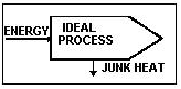
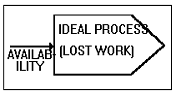
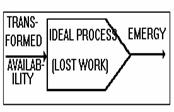
In Fig. 2-1a, we depict the energy balance for our process. We don’t show the product coming out, which is assumed to carry negligible energy. All of the energy entering is reduced to junk heat. In Fig. 2‑1b, availability enters and nothing comes out, since junk heat has no availability (in this analysis) and neither does the product, which can’t even be burned. The lost work term provides closure for the availability balance. Finally, in Fig. 2-1c, the emergy balance is shown with the transformed availability entering, measured as emergy, and the product carrying an equal amount of emergy along with it into the economy – even though all of the availability was consumed as junk heat.
In the case of a similar process that produces the same unit product but is less than optimal, more emergy is required at the input, and the difference between the input and the output is lost. Thus, as in the Combined First and Second Law (Appendix I, Eq. I-6), emergy can be destroyed.
In their earlier work [6], Howard and Elizabeth Odum measured emergy in fossil-fuel equivalents. Emergies used to evaluate industrial economies might be computed more easily by taking the transformity of crude oil or even methane as unity. If we are moving toward an electrical basis for energy analysis, it might be better to take one joule of single-phase, 60 cycle (Hz), 110-volt alternating current (AC) as the unit of emergy – or, perhaps even better, 3,600,000 joules ( = 1 kWhr).
Definition (Standard Electricity). In this paper, single-phase, 60 Hz, 110-volt alternating current is taken to be standard electricity.
Definition (Emergy Unit). My arbitrary – but well-defined – choice for one unit of emergy (1 MU) is 1.0 kilowatt-hours of standard electricity. Although electrical current carries a small amount of entropy manifest in difference currents, for all practical purposes, that is, for engineering purposes, electricity is pure work. The availability of electricity is equal to its energy; and, with this choice of emergy unit, the emergy of electrical current is numerically equal to its energy in kilowatt-hours. The transformity of sunlight, wind, biomass, and other energy products will be less than – but close to – 1.0.
Definition (Transformity). The transformity of a primary fuel is the number of kilowatt-hours of standard electricity one can obtain from 1 kWhr of the primary fuel by an efficient process, the tradition of reporting the availability of fuels in BTUs per pound or kilocalories per gram mole notwithstanding. Any unit of energy can be converted to kilowatt-hours. This is an electricity-based transformity, the units of which are emergy units per kilowatt-hour.
Definition (Emergy). The embodied energy or emergy of a primary fuel is the Gibbs availability of the fuel in kilowatt-hours multiplied by the electricity-based transformity. The emergy of anything else is the sum of all the emergy that went into producing it by an efficient process minus the emergies of any by-products formed. The emergy of an activity is the average rate of expenditure of emergy times the time. These definitions are easily extended to include the dependence of emergy on location and time. The concept of nemergy or negative emergy can be introduced to aid in the discussion of environmental damage.
Definition (Emergy efficiency). Emergy efficiency is emergy out divided by emergy in. This efficiency is 1.0 for an optimal process because the emergy of the output is defined to be the emergy of the inputs. For a less than optimal process, the emergy efficiency is the emergy of the inputs to an optimal process over the emergy of the inputs to the process under investigation. Emergy efficiency lies between zero and one.
The transformity of any fuel can be determined by using it to generate standard electricity by an efficient process. The most efficient process might be a fuel cell. Therefore, the emergy of any fuel is the Gibbs availability of the fuel multiplied by the electricity-based transformity.
Balance Equations. Sholto Maud suggested working out energy, availability, and emergy balance equations for simple extraction and conversion processes. Writing balance equations for extraction and Type 1 conversion helped me to understand what must be included in the definition of emergy and what may not be included without encountering inconsistencies. Many other people can improve their understandings by studying the balance equations discussed at http://www.dematerialism.net/Mark-II-Balance.html.
Extraction. An example of extraction is the production of petroleum from the well to the refinery. Extraction is discussed in http://www.dematerialism.net/Mark-II-EROI.html.
Type 1 Conversion. The first type of conversion is the production of primary energy from energy supplied by Nature for which we do not compensate Nature. This is a sustainable process provided the energy from Nature (natural energy) comes from a source that is continuously renewed by the Moon or by the Sun shining on the Earth. The input to such a process includes other types of energy, material goods, transportation, labor, taxes, etc. The output includes the principal product, by-products, waste heat, and pollution. Normally, pollution is not considered; however, the concept of nemergy (negative emergy) should be employed to account for pollution of every type even, for example, the extent to which animals are deprived of habitat by the mere existence of the energy production facility. Examples of Type 1 conversion are the production of electricity by windpower and solar power. The emergy balance equation for a Type 1 process is illustrated in Figure 2-1d:
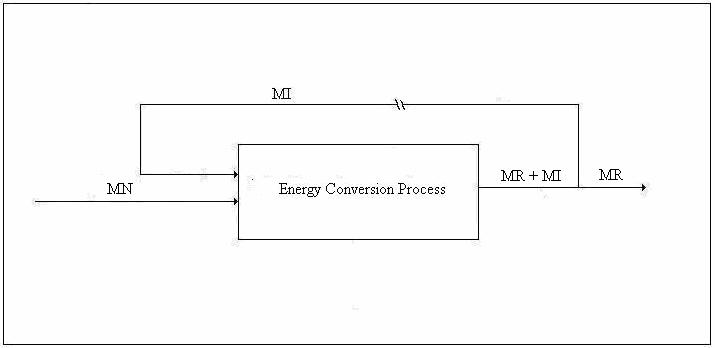
Figure 2-1d. Emergy Balance for Type 1 Conversion
Let us define some symbols to be used in connection with Figure 2-2:
|
Table 2-2. Symbols used in this discussion |
|
|
ER |
Gibbs availability of fuel produced by process |
|
λR |
electricity-based transformity of fuel produced |
|
MR |
emergy of fuel produced by process = λR · ER |
|
MI |
the algebraic sum of all of the emergy inputs (except for MN) minus the by-products |
|
EI |
Gibbs availability of stream MI |
|
μ |
ratio of EN per unit mass to ER per unit mass |
|
EN |
Gibbs availability of energy from Nature = μ · (ER + EI) |
|
λN |
the electricity-based transformity of the energy supplied by Nature |
|
MN |
emergy of energy from Nature = λN · EN |
|
β |
Energy returned over energy invested (EROI) = ER/EI = MR/MI |
|
EP |
the Gibbs availability of primary energy in Type 2 conversions |
|
λP |
the transformity of the primary energy source in Type 2 conversions |
|
MP |
the emergy of the primary energy supply in Type 2 conversions |
Each of the input emergies, except the emergy supplied by Nature, is to be transformed into a product-equivalent emergy. Then, the emergy invested, MI, is imagined to have been produced by the same process that produced the fuel. In this way, it will be apparent immediately if the process consumes more emergy than it produces. All indirect energy expenses should be included in the MI term, in which case EROI is a good measure of the effectiveness of the process. (See http://www.dematerialism.net/Mark-II-EROI.html.) [An example of an indirect cost is the pro-rata share of the commuting costs of the tax consultant (A) that should be charged to the worker (B) who maintains a windpower installation because the man (C) who serves B lunch had his taxes done by A.]
Then, since

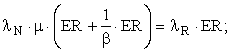
and,

In the first approach, the transformity of the product is determined by the generation of standard electricity with a well-known, efficient process and the transformity of the energy from Nature, whether it be from the tides, from biomass, from wind, from sunlight itself, or from some other natural source, is determined from the emergy balance. Normally, this transformity is well established. Therefore, two separate cases obtain:
Case 1. If λN, the value we compute, is greater than λN*, the accepted value of the transformity of the natural energy, then we should report that our process is part of a more efficient route to standard electricity, and λN should be considered for a new value of the transformity of the energy supplied by Nature.
Case 2. If λN is less than λN*, then our process is less efficient than the process that established the larger value and we must report an emergy efficiency, η, for our process because we could have generated more emergy with the same quantity of natural energy if we had used the standard process. The reader should remember that the energy from Nature is “free”, but the area of the solar collector or the size of the windmill is not.

In the second approach, the well-established value of the transformity of the energy supplied by Nature is accepted and the transformity of the product is computed from it. Call it λR'. If λR' is less than λR, the true value, we should revert to Case 1 and recalculate the transformity of the natural energy. If λR' is greater than λR, then the efficiency is λR over λR'. This is in agreement with Equation 2 above.
Let us imagine the process in the configuration illustrated by Figure 2-1e.
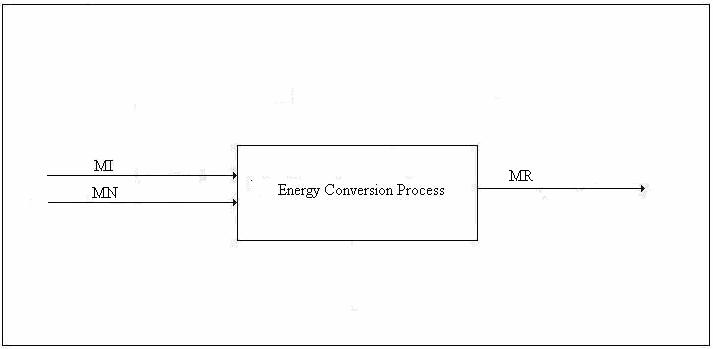
Figure 2-1e. Alternative Diagram for Type 1 Conversion
If the algebraic sum of the emergy inputs to a process minus the emergy supplied by Nature exceeds the emergy of the product, that is, if MI > MR, then the process is wasting energy resources. This is the case for some alternative energy projects that seek venture capital, government subsidies, donations, or unwary buyers. If they were not subsidized by fossil fuel, they would not work.
Type 2 Conversion. The second type of conversion is the production of secondary energy from primary energy. The production of hydrogen from methane or from electrolysis of water is an example of Type 2 conversion. Figure 2-1f is the same as Figure 2-1d except that MP, the primary energy, is substituted for MN:
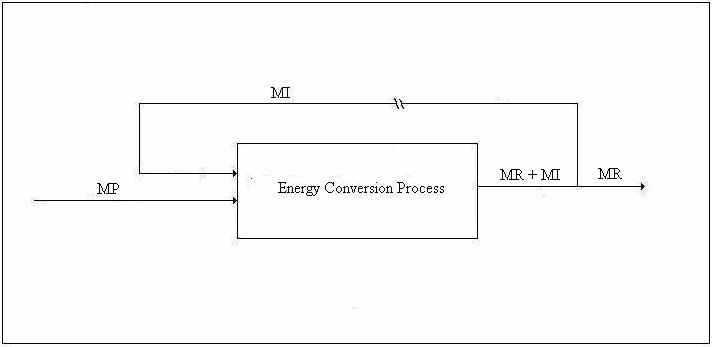
Figure 2-1f. Emergy Balance for Type 2 Conversion
In the first approach, the transformity of the product is determined by the generation of standard electricity by a well-known, efficient process and the transformity of the primary energy is computed from the emergy balance equation just as we did in the case of a Type 1 conversion, mutatis mutandis:
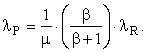
Case 1. If λP, the value we compute, is greater than λP*, the accepted value of the transformity of the primary energy, then we should report that our process is part of a more efficient route to standard electricity, and λP should be considered for a new value of the transformity of the primary energy.
Case 2. If λP is less than λP*, then our process is less efficient than the process that established the larger value and we must report an emergy efficiency, η, for our process because we could have generated more emergy with the same quantity of primary energy if we had used the standard process.

In the second approach, the well-established value of the transformity of the primary energy is accepted and the transformity of the product is computed from it. Call it λR'. If λR' is less than λR, the true value, we should revert to Case 1 and recalculate the transformity of the natural energy. If λR' is greater than λR, then the emergy efficiency is λR over λR'. This is in agreement with Equation 3 above. These results are worth deriving in a different way:
If a fuel the emergy of which is known is produced by the process under investigation and the sum of all of the emergy costs – both direct and indirect – that go into the process (computed with the true transformity λP*) minus the emergies of any useful by-products is greater than the algebraic sum of the emergy inputs for the process that determined the known emergy of the energy product, the process under investigation is sub-optimal and the emergy efficiency, η, is
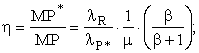
and, the transformity of the product we would compute from
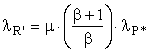
is higher than the true value λR. The only justification for the process is that we cannot do without the product and there is no other way to get it, which is not the case when electricity is used to produce hot water (discussed below) since hot water can be produced with less emergy by burning fuel under normal circumstances. Nevertheless, the process may be needed in extraordinary circumstances where the burning of fuel is prohibited, e. g., on a space satellite.
If the algebraic sum of the emergy inputs for the process under investigation is less than that of the older process, the transformity of the primary energy should be recalculated. It may not be expedient to discontinue production by the older process immediately because of compelling reasons not to shut down the older facilities – not the least of which is the time delay before new facilities can be built. The emergy efficiency of the older process is now less than 1.0.
Type 3 Conversion. The third type of conversion is the manufacture of non-energy goods. The manufacturing process has inputs of energy, material goods, transportation, labor, taxes, etc., and outputs that include a principal product, by-products, and waste heat. This is best illustrated with a diagram such as Figure 2-1g.
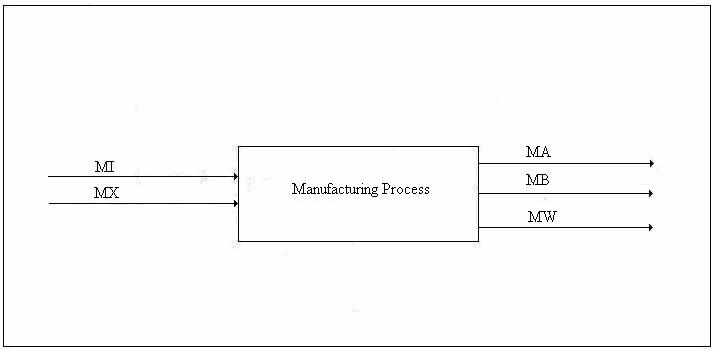
Figure 2-1g. Emergy Balance for Manufacturing Process
|
Table 2-3. Symbols for Figure 4 |
|
|
MI |
emergy of direct energy supplies |
|
MX |
emergy of inputs of material, transportation, labor, taxes, etc. |
|
MA |
emergy of principal product |
|
MB |
emergy of by-product |
|
MW |
emergy of waste heat stream |
The emergy, MW, of the waste heat stream is its availability times the number of kilowatts of standard electricity that can be generated efficiently by one kilowatt-hour of waste heat. The emergy of the sum total of all direct energy inputs to the process is determined in the usual way. The emergy of the sum total of all non-energy inputs must be available from past studies or must be determined during the analysis. It may include contributions from pollution etc. in which case negative emergy in the output is added to the input. Unlike the case of energy production, the transformities of the inputs cannot be influenced by the process. The emergy of the principal product and the by-product must equal the emergy of the inputs minus the emergy of the waste heat. In the case of a principal product as the sole output, the determination is trivial. However, when one or more by-products are present, the emergies of the by-products and the principal project must be apportioned in a canonical manner that should be determined by the analyst on a case-by-case basis.
If the emergy of a by-product is known in some other way, it may be appropriate to use the known value. In a case where the emergies must be distributed equitably, the relation between market price, either instantaneous or averaged over time, and energy or emergy may be useful. See “The Relation of Energy to Money”. Thus, the emergy is apportioned according to market value. This is a singular intrusion of money into the physical realm of emergy analysis and may not be advisable. In a non-market economy, some combination of energy, labor, capital expenditures, product mass or heat of fusion (even) might be of use. In any case, the sum of the emergies of the products must close the emergy balance. The consumer may find it expedient to compare the emergy of any given product with the emergy of a comparable product to minimize his impact upon the environment.
Note. The EROI defined in this essay is sometimes denoted EROI-1 because it is one less than the usual EROI which equals (MR + MI)/MI. The reader should realize that the terms Type 1, Type 2, and Type 3 Conversion have no currency outside of this essay.
Matching Problems
At this late date, we still have no idea if even one sustainable primary energy technology exists other than firewood itself. (We would prefer not to burn firewood directly, because of the smoke, even if it turns out that global warming (from carbon dioxide) is not a problem.) In any case, when we analyze our first sustainable energy process, we have no right to imagine that a less expensive sustainable energy source exists that can be “matched” to that process. We cannot make use of predictions concerning the distribution and usefulness of our form of primary energy (call it Eo) or any other. In other words, we must do our determination of feasibility with only occasional reference to the matching problem that will be solved subsequently.
Thus, it is, in fact, Eo, itself, that must carry the burden of the direct and indirect costs with few exceptions. If we have sustainable electricity, probably we would use electric cars, which are much more efficient consumers than gasoline or diesel cars, regardless of the emergy costs associated with building the cars and providing the electricity. Workers commuting back and forth to work will consume about one-third the energy budget of a gasoline-powered car. We do not use electric cars currently because, with 1997 technology, we would consume more fossil fuel making electricity for electric cars than gasoline cars consume on the road. [A good case can be made that the reason we do not use electric cars in 1997 is that oil companies have conspired to prevent us from doing so, but it is not necessary to make so reckless an accusation to advance the thesis of this essay. This book is about radical social change. It is singularly lacking in sensational conspiracies.] It takes about three kilowatt-hours of fossil fuel to produce one kilowatt-hour of electricity in a modern power plant even with cogeneration. Thus, one-third (of the energy consumption of a comparable gasoline-powered car) is the break-even point for cars powered by electricity from power plants – not that we wish to use fossil fuel even when we can use less of it than the comparable budget for sustainable forms of energy. [Probably, in an economy whose only primary energy is electricity, hydrogen from electrolysis of water would be the fuel of choice (or the precursor of the fuel of choice) for applications that cannot use electricity.]
Examples
Consider Process A, which produces a continuous stream of hot water at 500 K. The inputs to Process A are cold water, whose Gibbs availability may be taken to be zero, and 1 kilowatt of 110-volt, 60-Hz AC. Since electricity can be converted to work with an efficiency close to 1.0, we set the power term in the rate form of the energy balance equation to precisely 1 kilowatt. It may be used to lift a weight or it may be converted to heat completely. Let us divide Process A into two control volumes to facilitate analysis. The first control volume, A1, consists of an ideal electric heater. The energy balance equation, presented in Appendix I, is

It is easy to see from Eq. I-1 that, for A1, which is a steady-state system, Qout = Win, or, in terms of rates,

Next, consider a control volume, A2, consisting of the space within Process A through which the water flows. The inputs to Process A2 are cold water with zero availability and the heat from the electric heater, which for the water should be written Qin. The output is hot water at 500 K. To see that the availability of the hot water is the output of a Carnot engine the high temperature reservoir of which is the hot water and the low temperature reservoir of which is cold water at 300 K, we write the Availability Balance (Combined First and Second Laws) for Process A2. The Availability Balance Equation is

or in rate form

where, for a steady-state process, the term to the left of the equal sign is zero; and, for a reversible process, the rate of lost work term is zero. Moreover, the availability of the water entering is zero, the heat out is zero, and both work terms vanish to give

This shows that the Gibbs availability of the hot water is equal to the exergy. (To find the exergy for fuels one must subtract the Gibbs availability of the combustion products from the Gibbs availability of the fuel.) If, instead, we had transformed the availability of the hot water to standard electricity, we would not have been able to do it with anything like the efficiency of a Carnot engine. Perhaps we would have been able to obtain 0.2 kilowatts, i.e., one half of the Carnot efficiency, which is rather optimistic.
Suppose we wish to produce standard electricity (call it Eo) by means of photovoltaic cells. One emergy unit then is one kilowatt-hour of Eo. An emergy flow diagram for this thought experiment appears in Figure 2-2 below. Since, ultimately, we must determine if this technology is feasible or not, we will assume that Eo is the only form of primary energy available. Therefore, we will employ this form of energy for most of our production needs. Moreover, we must assume that the suppliers of goods and services will employ our product as well. Also, most suppliers have some known emergy costs associated with manufactured items – from paper clips to electron scanning microscopes. Since the emergies are known, either because Eo has been used always or because it is easy to convert the emergies to what they would be if Eo were used, no further emergy analysis is required. Let us denote these emergies Cn, where it is understood that Cn will take different values depending on where the symbol appears. Some of the emergy inputs are not even labeled; i.e., they may include indirect costs that are rarely considered in the peer-reviewed literature. For example, it is assumed that the pro-rata emergy expenses of all people involved in the project in any way whatever are included among these inputs including their living expenses. For a detailed discussion of this point see “Energy in a Mark II Economy”.
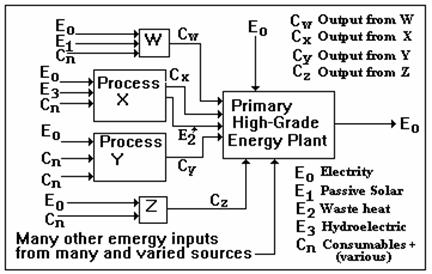
Figure 2-2. Illustration of complex primary energy process to demonstrate EROI calculation
Suppose, though, that, in some process that supplies one of our inputs, passive solar energy can be employed to provide hot water, E1. The manufacturing facilities that produce the passive solar energy apparatus must be assumed to employ standard electricity; nevertheless, under this assumption, we might be able to produce hot water (E1) the availability of which is 1 kWhr by employing only 0.1 MU, say, of Eo . Since the transformity of hot water is 0.2 MU/kWhr, we have obtained two emergy units for the price of one. Suppose, further, that 0.1 kWhrs of E1 is required for each MU of Eo produced. The emergy cost of this input is only

All such emergy inputs will be summed. If they exceed one, the process under investigation is infeasible (under present circumstances).
Determination of Feasibility of Nuclear Fission
To compute the total emergy input of nuclear fission, we must consider all phases of the operation from discovery of uranium to the disposal of the decommissioned plant and the storage of radioactive materials for thousands of years. If the sums of the emergies of the inputs, calculated according to the author’s modifications, exceed the a priori assignment of one MU per kWhr of primary energy (electricity), the process is infeasible. (On December 27, 2005, we still don’t know if it’s feasible, since no nation has used nuclear energy without a generous infusion of fossil fuel.) Even in the case of feasibility, if the emergy costs overwhelm the emergy costs of sustainable routes to electricity, nuclear fission should be rejected, unless our energy consumption has exceeded Maximum Renewables.
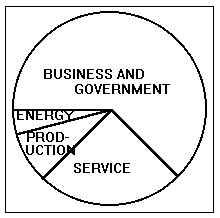
Figure 2-3. Rough proportional partition of economy into sectors
For the sake of simplicity, we divide the economy into four sectors, namely, energy, production (including agriculture), service, and business as shown in Fig. 2-3 and Fig. 2-4. (Government is considered part of business; but, probably, we should separate transportation from other service categories because of the dramatically greater energy use in that sector. The purpose of these pages is merely to suggest a methodology.) In Fig. 2-3 we divide the sectors roughly proportionally to the share of the economy they represent, but in Fig. 2-4, to make further division of the sectors easier to see and draw, we divide the sectors into equal quarters. To the ith sector one assigns an emergy relation for each hour worked: ei = ew,i + aieP,i , where e is the average total emergy expended per person-hour, ew is the emergy expended at the job, and a is the fraction of the personal emergy budget, ep , that must be charged to the job. (In the case of some participants, a might be 1.0.) This methodology is promising because employment figures are readily available and the average emergy expenditure per employee can be estimated closely enough. One can dispense with the individual ew terms in favor of the total emergy budgets or the appropriate pro rata shares, of the participating enterprises. (It is the sum of the aieP,i portions that is conspicuously absent from the standard Energy Returned over Energy Invested analysis in 2005. Please see my study of a theoretical simplified economy in “Energy Flow in a Mark II Economy”.)
We then count the person-hours expended within the energy sector, Eo, both nuclear and non-nuclear that should be charged to nuclear. For example, the work done to discover uranium, mine it, refine it, comply with regulations including getting the plant permitted are part of Eo . (This is not the Eo of the Example (above).) Also, the employees at a nuclear power plant drive back and forth to work and part of their personal emergy budgets, coming mostly from fossil fuels, would not have to be expended if they did not work on nuclear emergy. But, the nuclear sector is serviced by equipment manufacturing and plant construction, which we place in the production sector. Therefore we must count the hours expended in the production sector, P1, that must be charged to the energy sector. The transportation of uranium ore, fuel rods, and production equipment belongs to the service sector, but the people who feed energy and production workers their lunches away from home, do their income taxes, etc. – all of those people spend emergy that must be charged to nuclear fission. Thus, we must count hours in the service sector, S1, that must be charged to the energy sector and the production sector. This service may include scientific research and engineering as well as window washing. Finally, nothing gets done (in this crazy economy) without a huge amount of sales, bargaining, deal making, accounting, shuffling paper, counting beans, hiring and firing, scheming, forecasting, and telling other people what to do. All of which costs emergy, especially the fossil-fuel emergy required to carry these people around in cars, trains, and planes. So, we count the hours in the business sector, B1, that must be charged to the energy, production, and service sectors.
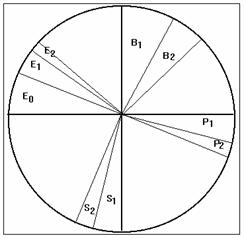
Figure 2-4. Accounting for emergy costs of nuclear fission
But, P1, S1, and B1 must be serviced by additional person-hours, E2, from the energy sector, which hours, in turn, must be serviced by the production sector, P2. For example, accountants need computers and copying machines, paper and ink and many other manufactured items. Economists add this to the Gross Domestic Product, but it is really overhead and should be counted as a debit – not economic growth. This second level of hours spent in the energy and production sectors entails additional work, S2, in the service sector and all three require additional hours, B2, spent in the business sector. Secondary person-hours are followed by tertiary hours until no new hours can be identified. (One must count the gasoline expended by the person who cleans the floors where the paper is printed to do the income tax of the person who delivers the sandwiches to the cafeteria where the man eats who services the copying machine of the person who does the taxes for the truck driver who carries the fuel to the garage where the truck is fueled that carries the steel to the construction site where the equipment is built to maintain the nuclear power plant. The reader gets the idea.)
[Note in proof (2-5-97). In accounting for emergy inputs to transportation, for example, we may take credit for the increased efficiency of electric vehicles over internal combustion vehicles, since we may assume that the emergy from the nuclear power plant is the only primary energy available. Alternatively, we may use that emergy to produce hydrogen for fuel cells if that process reduces the proportion of emergy production that must be charged to overhead.]
This iterative accounting procedure must converge eventually because the total person-hours in the economy is finite over a finite length of time, which may not exceed the period of decay of the radioactive materials. This difficult calculation can be carried out in principle; but, undoubtedly, excessive emergy costs will be encountered in many cases early in the process.
I cannot emphasize enough that this calculation should actually be done – at least roughly – for nuclear energy, photovoltaic energy, energy from biomass from both biological and other processes, such as pyrolysis of biomass. The first two technologies produce electricity, my favorite choice for an absolute emergy standard; i.e., one kilowatt-hour of 110 volt, 60 Hz AC is one emergy unit (MU) even though electricity is not primary energy. Only the assumed emergy of one MU per kWhr of pyrolysis products (or pyrolysis products that have been reacted with hydrogen to produce diesel fuel) is inconsistent with the practice of choosing electricity to be the universal standard to which all emergies should be referred. Inevitably, some electricity must be employed in any biomass process; therefore, we must assign an emergy of 3 MU to one kilowatt-hour of availability from electricity, since we shall require (approximately) 3 kilowatt-hours of pyrolysis product to produce one kilowatt-hour of electricity, as estimated previously. We have reverted to Odum’s original definition; and we have established a transformity of 3 for electricity. We may not employ this emergy or transformity for electricity outside of this calculation without endangering our hope for a universal (electrical) standard for emergy. Alternatively, we could begin this calculation by assigning an emergy of one-third MU for pyrolysis products.
If electricity were abundant, but the scarcity of diesel fuel (needed to run essential farm machinery that we could not afford to replace) had become a life-and-death crisis, we might be pressed into converting electricity into diesel fuel at a loss. Suppose diesel fuel were produced by reacting pyrolysis products of biomass with hydrogen. What is the transformity of diesel fuel in that case? The analyst will want to consider carefully the assignment of emergies, exergies, and transformities in every application.
Improving Efficiency
Suppose nuclear emergy proves infeasible under the circumstances described above. Nothing stops us from recomputing the emergy input costs in a society that has already abandoned materialism. Suddenly, the huge overhead of business and government is gone, e.g., licensing, regulation, inspection, (graft?), exorbitant executive salaries for people who contribute about as much as Dilbert’s manager (the pointy haired guy). (“Dilbert” is a comic strip, written by Scott Adams, that ridicules non-technical managers who “manage” technical workers generally without a clue as to what they (the “techies”) are doing. The reason this is funny is that it is true.)
If decentralization has occurred, the costs of workers commuting will have been eliminated. If money has been eliminated, the costs of accounting, collecting taxes, paying wages, collecting bills – even grocery bills – will have been eliminated. If delegislation has occurred, all legal costs will have disappeared. Ninety percent of the population will have been freed from drudgery and, since economic contingency would have vanished, they could afford to do as they pleased, which might include building a primary energy provider.
Indeed, eliminating materialism can make the infeasible feasible. And, if the infeasible is essential to our survival, I don’t see what there is to decide (politically).
Scarcity
The results of the calculations are not critical for my case unless a per capita energy supply of 1 kW, on an electricity basis (110 AC, 60 Hz), cannot be supplied. High-energy scenarios are rejected for reasons other than their expected impossibility. The very low energy prognosis must be countered with much more stringent birth-control policies – one child per couple, say. Again, one can only hope that this could be achieved voluntarily if it were necessary. People have got to be made aware of the urgency of the situation. They must be convinced that they are personally responsible for the outcome – and might be held accountable for their behavior. Dissenters should be encouraged to speak openly and should be defeated soundly in public debate wherever it occurs. Pointing out the fallacies of policies that promote population growth is one way, perhaps the best way, to teach the lesson. Please do not let anyone make a casual remark, even, that the earth is not really over-populated without making a strenuous objection, even if you are classified thereafter as a crashing bore.
Emergy Analysis of Economies
The Emergy Cycle
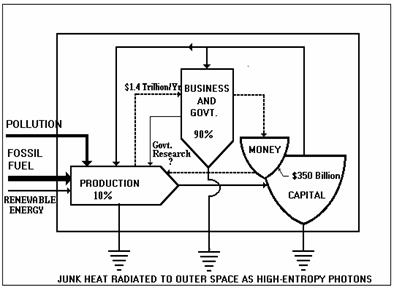
Figure 2-5. Odum’s emergy diagram for economy
Regardless of the basis chosen and in spite of the difficulties, we can use emergy to analyze the U.S. or, indeed, the world economy. This is represented in Fig. 2-5 as a system diagram. In Fig. 2-5, the emergy from fossil fuel is represented by a thick arrow entering production from the left-hand border. The emergy of manufactured objects is stored in a capital pool and, in part, is recycled to production. If the portion recycled is sufficiently great that the means of production can be enlarged so that more emergy can be drawn from the environment and more products produced, we say that we are capitalizing; i.e., we have capitalism in the strict sense. Capitalization can occur globally when the supply of emergy from the environment is essentially infinite, but what we are experiencing now is a gradual shrinkage in the net amount of emergy available from the environment; i.e., we must go out to sea to find oil or transport oil over long distances. Also, we must pay more emergy to restore the environment in case we spill oil or strip mine coal, for example. Pollution is represented by an arrow on the left-hand side of the drawing entering the system. If we wished to represent pollution by an arrow leaving the diagram, we might coin the term nemergy, which would be defined to be negative emergy. In addition, we have a very expensive government (lumped together with business in the center of the diagram) that consumes emergy that might have gone toward improving production. The arrows going to junk heat represent depreciation, consumption, and excess emergy used by less-than-optimal processes. In an emergy limited world (this world), capitalism cannot exist! [Note in proof (10-22-06). It has been proved in my short essay “On Capitalism” that capitalism requires an expanding economy. Conservation measures may counteract the increase in energy budget one would expect in an expanding economy to some extent; however, the extent of conservation is bounded below and economic expansion is unbounded.]
The Money Cycle
Business and Government
Nevertheless, business people (the money people) do their best to keep the money cycle (shown in Fig. 2-5) turning counter to the emergy cycle as fast as possible. The faster the money cycle turns the more money they acquire even though they produce less than no emergy. Since the emergy cycle cannot be accelerated, we have what is known as inflation, i.e., less emergy per dollar. Odum’s diagram is the first explanation of inflation that ever made sense to me.
In this type of economy, the people are regarded as belonging to production, business, government, etc. by virtue of their jobs. The proportions are represented by the percentages on the drawing. Clearly, an inordinate effort is consumed by business and government. (What is the fraction of the population that belongs to the health-care sector? Is health-care overhead? Is it wealth?) Eventually, people begin to lose jobs; the infrastructure begins to decay; and society reverts to barbarism. This is a dog-eat-dog economy.
Let us agree that businesspeople and government employees, with the exception of astrophysicists, particle physicists, space researchers, etc. do not spend as much energy per hour on the job as do people in the production sector; i.e., ew,B in the formula ei = ew,i + aiep,i , where i replaced by B in the case of business (and government), is smaller than ew,P. Normally, they operate low wattage computers and even the cost of air-conditioning and lighting their offices is insufficient to overwhelm the cost of forging steel, for example. However, the part of their personal energy budgets that must be charged to the job might be greater as they often wear suits that must be dry cleaned and, if they receive high salaries, undoubtedly they consume too much high-grade energy in consumer goods and in the operation of their homes. I know a businessman in Houston whose monthly electric bill is approximately $500. The excess over 1 kW per person is enough to sustain two third-world people for each of the four members of his household, some of whom must starve to death no matter what else is done if he should maintain this expenditure. In fact, we might make the case that, if he reduce his consumption to his fair share, more than twenty-four people in Bangladesh who consume 0.1 kW less than subsistence could be spared a horrible death (starvation) each month. In a very real sense, he is responsible for their deaths, which might rise to a staggering debt of 8640 before he dies or is killed. (I don’t suppose it is legal to kill him now to save so many people and to spare him a harsh judgment if God is watching and is at all vindictive, which I very much doubt.)
Now many readers believe that the man (with the $500 electric bill) paid for the use of the electricity and is, therefore, entitled to use it. Nothing could be further from the case. To quote Tom Pinch in Dickens’ Martin Chuzzlewit, the “money is the least important part of the transaction”. All Americans are responsible for the deaths that are caused by America’s imperialistic policies because all of us – even the poorest of our poor – benefit from them. A moment’s reflection, or, in my case, comparison of my expenses when I am unemployed with my expenses when I have a job, should convince us that ep,i is much smaller for unemployed people than it is for job holders. E.g., I don’t need a car when I am unemployed. Do you?
Perhaps I have mentioned already that this general culpability (“for all have sinned”) exonerates terrorists from the oft-made charge that they have injured innocent people. No one is innocent – which indictment quite naturally includes the terrorist himself (lest anyone suppose that I approve of him. I don’t judge him either – no more do I judge the “money creeps”. “Judge not lest ye be judged” Don’t worry; you will be judged whatever you do or don’t do. People are really into judging one another, don’t you think? “What do you care what other people think?” Even if there were no God, we would have to imagine one who knows everything we think and do! We had better please God – imaginary or not!
To continue the indictment of business, a large proportion of the population is employed by business or government, including those who serve business and government indirectly – perhaps as high as 90% or higher. How many people do you know personally who produce something with their own hands that is needed to sustain life? Don’t count the products consumed by business and government. The paper consumed by government is an overhead on our standard of living. My philosophy claims that this expenditure is more than what the human race can afford. (This book is overhead; but, in my view, an essential overhead.) The resources of the earth and the sun have been bequeathed to the human race in common. They must be expended for the common good. No one is entitled to a greater share than another. Nearly everyone agrees that the government spends too much. What I am claiming is that business spends too much and produces practically nothing of value. This is a new idea for most readers. I claim we must find a way to replace business and government. They are cruel, ugly, base (as opposed to noble), immoral, which won’t impress many Americans; but, when the majority of “nobodies” like me realize that we flat-out cannot afford them, they, the majority, may begin to pay attention.
Many people depend on the jobs supplied by business and government. The jobs and wages aspect of current economic practice virtually guarantees that these people will suffer from the increase in efficiency resulting from the elimination of wasteful business and government activities. Why should these people not receive their fair share of the benefits to the economy achieved by eliminating wasteful business and government activities? For example, when an army base closes, the victims might receive a fair share of the money saved – even under our ridiculous capitalist economy. Why should the budget be balanced at the expense of a few and not all?
It is easy to see that the concept of a job is absurd and should be replaced. Whenever I hear a politician call for more jobs, I know that he or she hasn’t got a clue as to how the economy works. One day (DV), I will list the contradictions derived from the notion that people must have jobs to live. For now, consider the conflict between cutting government spending and providing jobs for everyone. Now, imagine what the idea of “free-trade” does for that situation. The notion that we must have a global economy is used to get people (you?) to accept lower wages and be glad that they are employed at all. Why should everyone be employed if a small percentage of us can produce locally everything we need – not what we are led to think we need but what we actually need!
Does the Government Do Anything Useful?
I have drawn a thin line with a question mark in Fig. 2-5 to indicate that, through the sponsorship of scientific research (not all scientific research is as mindless and wasteful as space research) the government could provide something useful to the economy. It does not have to supply much useful information to have a large impact because the transformity of information can be very high. If the government were to supply an equation of state that would govern the two liquid phases found in mixtures of oil and water, we should be very grateful. Unfortunately, that has not been done. If the government would compute the emergy input (using the author’s methodology) required to produce 1 kWhr of nuclear electricity, I would be delighted. Apparently, this is not even thought of. On the other hand, one can dial (as of June 18, 1993) a phone number (1-303-497-3235) in Colorado and obtain a very good approximation to the value of the solar flux for that day. One also obtains a report and prediction of solar activity and the magnetic field for yesterday and today. [Note (7-21-2004). That phone number still answers today, however the information imparted is different. I did not hear the value of the solar constant stated explicitly.] This must be enormously useful to someone, but I can’t imagine to whom. I have discussed the National Science Foundation in my essay “On Honor in Science”. My comments have not been favorable.
Can the Government Solve Social Problems?
The “liberal” approach to ameliorating the terrible misery inherent in the American system is to institute government programs to correct the worst defects of materialism. (Admittedly the government is not monolithic, but it is centralized sufficiently that no one should expect it do anything truly helpful for the poor of our country after seeing it bomb the poor people of other countries, cf., Iraq, to protect the business interests of the wealthiest Americans. The purpose of government is to serve business; but, when its own interests conflict with those of business, it takes care of itself first.) Regrettably, I find that I must agree with conservatives in the observation that these programs almost never have the effect that is intended. A variation of Odum’s diagram with some hypothetical figures as in Fig. 2-6 might help us understand why this might be the case.
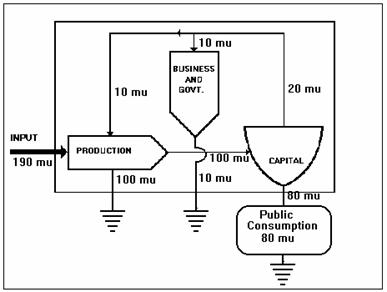
Figure 2-6. Emergy flows in a thought experiment
One imagines that the economy produces 100 emergy units (MU), whatever an emergy unit turns out to be (obviously 1% of the emergy produced). Also, we suppose that the economy is being maintained by only 10% of its production rate, i.e., 10 MU, and that it operates with the amazing emergy efficiency of 50%, i.e., it is half as efficient as the optimal production system, which, of course, has not been invented yet. In this model, we imagine the consumers drawing their livings directly from the pool of capital rather than from the enterprises to which they are attached by virtue of their jobs. We further suppose that only 20% of production has to be recycled to maintain business, government, and production. Let us suppose that this is a conservative number. The 80 MUs corresponds to the fraction of each person’s emergy budget that cannot be charged to his work, namely, (1 - ai ) ep,i .
Suppose, now, that, according to a proposal to eliminate poverty, government decides to collect an additional 6 MUs in taxes to pay for programs for the poor, which might even include job training, as in Fig. 2-7. I believe that an overhead of only 1 MU for this program is a very conservative estimate and accounts for the fact that the total emergy available for distribution to the consumers is reduced by only 1 MU. The careful reader will notice that I have not increased productivity to account for more educated workers. This makes perfect sense as the worker will be converted from a fruit picker to a paper shuffler – in all likelihood.
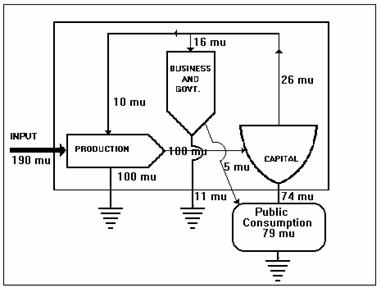
Figure 2-7. Emergy flows in a thought experiment
In Fig. 2-7, government absorbs an additional 6 MUs from the economy in order to pass 5 MUs of its increased input to needy people. Therefore, since the total emergy input to the economy doesn’t change (perhaps because it is already at its upper limit) and production can’t increase its efficiency, 74 MUs, rather than 80 MUs, reaches the consumer in the normal manner, namely, as wages after taxes. The government supplies another 5 MUs, but the net result in this conservative scenario is only a 1.25% drop in the average standard of living of the citizens. Since the rich take theirs out first, the brunt of this minor hardship would fall on the poor who were supposed to benefit. Even if the 5 MUs were aimed directly at the poor, the rich would get at the money by starting drug rehabilitation centers, correspondence schools, etc. Of course, private “charities” would not do better. Non-profit private charity has become profit oriented. Witness the exorbitant salaries paid to United Way executives.
I cannot resist injecting a little first-hand anecdotal evidence. An acquaintance of mine was fired (unfairly, according to him) from a major charity. He fought fiercely to regain his position, going to court, etc. I was puzzled and asked him why he should care about being employed in such a place. Surely, with his Ivy League education and background (and prodigious intelligence), he could do much better. He answered, “Are you kidding? This job is extremely lucrative!”
A Humanistic Economy
In the humanistic economy diagrammed in Fig. 2-8, competition for wealth and power has been abandoned. People receive their fair (equal) share of the national (or world) dividend regardless of the activities they pursue, therefore they are no longer regarded as belonging to their jobs and the overhead of business and government is saved. The only wealth is true wealth (emergy), which cannot be hoarded. The economy is intentionally permitted to reach steady state; production serves people who belong to themselves; and the only motivation is intrinsic motivation – as opposed to greed and fear. Involvement replaces employment.
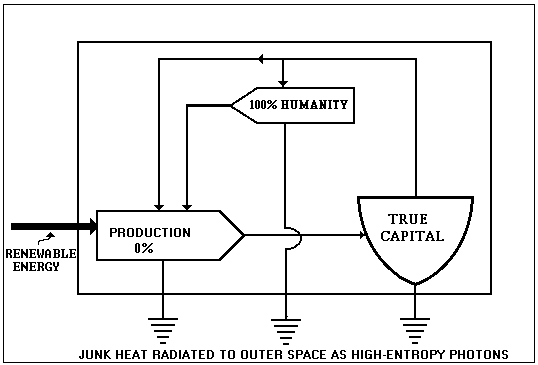
Figure 2-8. Diagram for a humanistic economy
The Availability Supply
Energy Flow Diagram for Earth
Let us now turn our attention to the flow of energy within the earth’s system. The energy flow diagram in Fig. 2-9 is a modified version of Fig. 6-1 in the International Institute of Applied Systems Analysis (IIASA) 1981 study [4], therefore some of the numbers may not be the latest available, but that should not invalidate our rough calculations. Some of the numbers on the drawing are given with greater precision than would be warranted by the accuracy of the energy balance; nevertheless, the arithmetic does not quite work out. (Old joke: “The melody is terrible, but the words aren’t good.”) But that is of no importance to us. We need just a rough idea of where the energy is going. We know that these numbers do not represent availability because, if they did, the number representing radiation from the earth would be more or less, but not equal, to the figure given. The only concession to availability analysis is the designation of some of the flows, e.g., agriculture, as high quality. We would like to have an availability analysis, but we shall have to forego that luxury for now.
The solar constant is about 1353 W/m2. That means that where the straight line joining the center of the sun to the center of the earth crosses the outermost layer of the earth’s atmosphere, 100 miles above sea level, say (since we wish to calculate an upper bound on the rate of energy transfer), the mean energy flux due to sunlight is about 1353 Joules per second per square meter. The solar constant isn’t quite constant, but we shall use it for very rough calculations; so, we may safely ignore the variations. The atmosphere is a very thin shell surrounding the earth and whatever we take to be the outermost layer has a radius less than 100 miles or 160,934 meters greater than the radius of the earth, which we shall take to be 6,378,000 meters. Further, we shall assume that the sunlight strikes the earth in a plane wave. Actually, the sun is more like a point source in the sky subtending just over a half of a degree, but the calculation of the total energy entering the earth’s system is simpler if we assume all of the photons are traveling in paths parallel to the aforementioned line connecting the centers of the two bodies, which gives a value for the total power from the sun entering the earth’s system that is slightly high. (The earth’s system is all of the mass contained within a large (concentric) sphere just beyond the furthest reaches of the earth’s atmosphere and outside the smaller (concentric) sphere representing the depth beneath the earth’s surface that is, for all practical purposes, unreachable.) The projected area of earth, then, is:

Therefore, the total energy striking earth is less than 1353 W/m2 · 134.3 E12 m2 = 181,710 TW, in excellent agreement with the 178,000 TW that Häfele [4] obtains. We could have done a fancy calculation using integral calculus to account for the actual spherical nature of the wave fronts of the sun’s radiation, but it wouldn’t have affected our answer by more than a few percent; so, we would have felt foolish for wasting our time like that. (Actually, I did do the fancy calculation and I did feel foolish; however, this was a counter-example to the well-known “principle” that no person whose age exceeds 40 can evaluate the integrals of integral calculus.)
Notice that the reflected sunlight is about 30% of the incident radiation. Continued population increase and economic “development” could drive that figure higher. Highways and rooftops reflect sunlight “better” than forests do. Another 46.2% of the incident radiation maintains the temperature of the air and water. The mechanical energy of the wind and waves amounts to about 370 TW. This is a high-quality flow; but, for each joule of mechanical energy extracted from the ocean currents, the flow of about 10,000 joules of thermal energy is interrupted. This would have an unpredictable effect upon the weather. The ratio of thermal to mechanical energy is only about 30 or 40 in the case of wind and we should harvest some of that. The 5 TW of run-off is where we get our hydroelectric power, but it’s not worth killing off all the salmon for a fraction of a terawatt additional power. The ecological effects of damming rivers must be taken more seriously. The giant Ashwan Dam project in Egypt was catastrophic, which could have been predicted in advance by the engineers and constructors who used it to line their pockets.
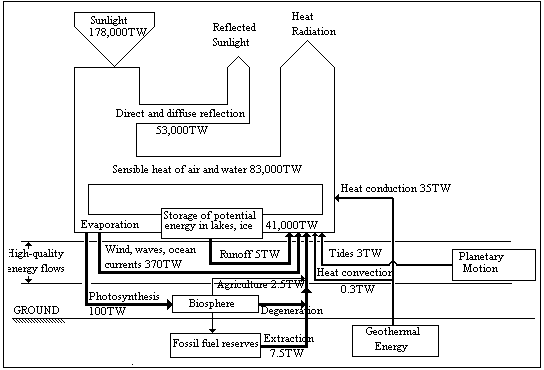
Figure 2-9. Energy flows in the environment
Planetary and lunar motion and geothermal energy can play a small role under very restricted circumstances, but the big renewable contributor is photosynthesis and that amounts to only 100 TW. The rate of energy capture by photosynthesis could grow if we let it; but, again, population growth and economic development will have the opposite effect as we cut down forests for housing and urban sprawl. Thus, in Fig. 2-9 the only “high-quality” flows, other than the extraction of fossil fuels, are from wind, run-off (hydroelectric), heat convection (geothermal), and agriculture (biomass, including silviculture). Is it realistic to expect to harvest even 10% of the energy captured by photosynthesis without extinguishing animal life?! Please remember that the human race has been sustained by photosynthesis throughout its existence. This is the fundamental way in which the sun’s ability to reduce the entropy of the earth sustains life. A change from this fundamental fact of life is very unlikely on the face of it. I have not proved that a fundamental change in the way in which life is supported is impossible. After all, this essay assumes fundamental spiritual change is possible.
Sustainable Energy: How Much Can We Expect?
We would now like to use the concept of emergy to estimate the standard of living in an economy driven by sustainable energy – a world where fossil fuel has been exhausted or may not be used because of global environmental effects or where prudence and common decency dictate that fossil fuel be preserved for future generations and better uses. The best estimates (hard technological limits) for sustainable energy were evaluated in a massive effort by the International Institute of Applied Systems Analysis [4]. A few crucial results appear in Table 2-2.
By 2030, the population of the world is expected to exceed ten billion souls [13]. We have approximately 10 billion kilowatts, which must be distributed equally among 10 billion people to avoid widespread famine and misery, i.e., 1 kilowatt/capita. Besides the obvious immorality of policies that tolerate widespread misery, Machiavellian pragmatism dictates that large numbers of miserable people will be a continuous danger to people who are well off – unless genocide is employed. Moreover, we have assumed that reasonable people (homo sapiens) cannot be happy while others are miserable.
Unless we take economic development to mean economic shrinkage to manageable and humanistic pre-industrial levels, but with a post-industrial soft technological basis, the idea of sustainable economic development is absolutely idiotic. Anyone who uses the term without qualifying it to refer to a level of interaction with nature that is no more violent than the economy of the North American Indians before the advent of Europeans is a fool or a liar. I am afraid that takes in a large class of people, especially people in high places, in particular, every head of state of every nation whose policy is known to me. Who am I too denigrate the high and mighty? Who are they to wield power with so little knowledge and understanding? I am willing to debate anyone anywhere on these issues. The debate must be sufficiently protracted that I can make all my points and refute a torrent of rhetoric backed by tons of irrelevant statistics. (In science, the idea is to extract the sharpest conclusions from the least data. If the scientist can reach a conclusion by pure logic, so much the better.)
Fossil Fuels
The fossil fuel extraction shown on this 1975 chart (Fig. 2-9) is 7.5 TW. Cambridge Energy Research Associates (CERA), directed by Daniel Yergin, author of The Prize [14], predicts 4.8 TW oil production during 1994 [15]. Presumably, natural gas and coal use could bring the fossil fuel extraction up to a level comparable with 1975. I don’t know if we are using more or less fossil fuel today compared to 1975. We are probably extracting less per capita. Also, we probably expend more energy per kWhr recovered since we have to go out to sea to drill for oil, or transport it from far away places, e.g., Alaska, or dig deeper mines, or satisfy more stringent environmental constraints imposed by people who won’t allow strip mines to be abandoned without repairing the surface of the earth. If these things be true, and we certainly need more research to determine if they are true, then we have already begun the long “recession” that will take us back down to a level of energy consumption that can be sustained by nature.
Most experts believe we shall run out of petroleum by 2030, 2050, or 2093, i.e., soon. Taking 10,000 billion barrels of oil as a generous upper bound on the total reserves both discovered and undiscovered (more than twice the highest estimate I have seen in the literature) and using the CERA estimate of 68.3 million barrels per day or 24.93 billion barrels per year, we would run out in approximately 400 years. This assumes no American-style economic development anywhere in the world, no population growth, and no additional expenditures to reduce pollution. Neither does it take into account conservation measures that might counterbalance some of the other effects. We shall consider these effects below. In any case, the petroleum will be gone in a remarkably short time when compared with all of human history.
We have large reserves of coal, but the coal that is easy to get is nearly gone. People will no longer submit to having their neighborhoods strip-mined and deep-shaft mining might consume more energy than it produces – if it be done safely. Besides all that, the enormous difficulties of converting coal into clean energy must be overcome. Perhaps these difficulties are not entirely separate from the difficulties of consuming renewable biomass, but coal is not renewable. Also, the emergy cost to deliver coal to the consumer on an appropriate scale may be greater than the emergy cost to deliver forest and farm waste, municipal solid waste, and other forms of renewable biomass. Research must be done to see how competing technologies stack up on an emergy basis rather than on a dollar basis. I hope the reader understands by now that energy costs in dollars per kWhr are meaningless.
Of course, we are going to burn non-renewable natural gas. It is clean but does not avoid the greenhouse effect – if it exists. Perhaps we must use it or lose it; I’m not sure. But the important thing about natural gas is how small the reserves are. The known reserves amount to our energy budget for only a very few years. Even the most improbable upper bound on total available natural gas both discovered and undiscovered amounts to a very short period assuming today’s usage pattern. Please do not let anyone convince you that natural gas is the answer. Proponents of natural gas are either pitifully naive or else have a sinister hidden agenda. Remember that the natural gas is the common heritage of the entire human race – including posterity.
We have additional sources of fossil fuel such as shale oil, but the difficulties of recovering them may prove insurmountable and, in any case, they are not renewable – regardless of the size of the reserves. Let us now turn to alternatives to fossil fuels.
Large-Scale Alternatives
These remarks are going to be uncharacteristically brief. I do not view any of these options favorably, but I have insufficient data to prove that one or the other is infeasible. I must emphasize at least one more time the need for more research to determine how much emergy is required per unit of emergy produced by each technology. I suggest that we choose 1 kWhr of 60 cycle 110 volt AC as the unit of emergy (MU). This is easy to convert to fossil-fuel equivalents (FFE); namely, 3 FFE = 1 MU – approximately.
The most efficient manufacturing technology will produce 1 MU per MU input. We have discussed why this will not be the case in the modification of Odum’s methods that seems to be necessary to determine the feasibility of sustainable primary energy production technologies. If the emergy consumed over and above the emergy (1 MU = 1 kWhr) provided by the primary emergy source, i.e., if the emergy consumed by overhead exceed the (hypothetical) emergy produced by the most efficient primary energy technology we can find, the most efficient process would not be good enough and sustainable primary energy would be impossible!
A simple way to express whether or not an energy technology meets the criterion of the methodology for determining efficiency described above is as follows: If this technology were the sole energy source, could society sustain itself or would it wind down to the complete absence of all economic activity? Is the technology a net producer of energy of its own kind or a net consumer? We know that firewood, coal, and petroleum have produced sustainable economies in the short run. Around 1850, population growth and urbanization led to the first firewood crises. Coal and the railways saved the day for urbanization and industrial civilization, i.e., civilization itself (in the sense of urbanization). We are now in the age of petroleum, but that must end soon unless we permit the enormous disparities in wealth to persist with their concomitant control of population growth by famine, epidemic disease, and war. In point of fact, we do not know if any other energy technology can sustain a large population. I have not done nor has anyone else done the research to determine if a sustainable primary energy technology is possible. Therefore, the rest of this chapter amounts to no more than my best scientific guesses based on the limited information I can afford to gather.
Although no technology could be found to sustain a large population, we know that firewood can sustain a smaller population – perhaps as large as two billion souls. Even the pollution caused by burning wood might be tolerable, especially if we used the wisest and most considerate combustion technologies in a moral world informed by a humanistic minimal proper religion.
In this worst-case scenario, where we go back to a primitive sustainable technology such as firewood with the concomitant shrinkage in population to firewood-society limits, how this shrinkage in population would occur is unclear. Several possibilities suggest themselves:
1. Systematic birth control is the most humane route back to a sustainable population size, but it would be nearly as difficult to implement as anything suggested in this essay.
2. Survival of the fittest in a fair competitionistic society.
3. Make no changes in our behavior, which would probably lead to one of the following:
4. Brutal wars of extermination.
5. Intervention by nature, i.e., famine, epidemic disease, etc.
But, the survival of the most brutal seems most likely. Undoubtedly, in that case, the extinction of the human race would be preferable as some things are worse than death. This extinction might be facilitated by knowledgeable people (micro-biologists, perhaps) holding themselves to the highest moral standards.
Non-Renewable But Very Extensive
Nuclear Fission
We have discussed nuclear fission by way of explaining the methodology to be applied to each technology to determine feasibility. Moreover, it is insufficient to store nuclear waste unmonitored. The storage of nuclear waste should be an active process with on-going energy costs for thousands of years. Also, it is unclear that people motivated by profit are morally capable of running a nuclear plant safely. This will be documented in a special chapter listing the documented sins of business, government, and industry – all taken from the establishment (corporate) press, which is not likely to exaggerate the sins of its advertisers or their clients.
Fusion
As far as hot fusion goes, we are waiting. It will have to be justified according to the same methodology applied to other technologies. It has one serious drawback to begin with; namely, no working fluid can be found for the power cycle that is not considerably colder than the plasma. That means that heat must be transferred through a large finite temperature difference, which, according to thermodynamics (and discussed in Appendix I), results in a large lost-work term. The term lost work is nearly self-explanatory.
Geothermal
Geothermal is not really renewable energy. When the temperature of the core of the earth reaches the temperature of the surface, it will be gone. And, for that matter, so might we, since the cycles of volcanism and continental shift are necessary to sustain life on earth [6]. Moreover, we do not know what the effect might be of tapping large reserves of geothermal energy near the surface of the earth as in Yellowstone Park. The IIASA (International Institute of Applied System Analysis) estimates that we can capture at most 1 TWyr/yr from geothermal. I suppose we should use geothermal lightly on a personal or local (non-commercial) basis in the few places where it can be done, but it certainly does not represent a solution to our problem.
Renewable
Wind
One of the benefits of having a large pro-industrial / anti-environmental class in our country is that they save us the trouble of debunking the less workable sustainable energy schemes. Dixie Lee Ray, the former governor of Washington, is a good example. She wrote an anti-environmental book that is used in environmental classes at the University of Houston [17]. (I guess that makes the University of Houston officially anti-environmental, although it is innocent until proven guilty.) In her book, she shows that wind power is not the answer and I believe she is right. Most of the wind energy is above 200 meters. Can you imagine the capital (emergy) costs that go into building a 200-meter-tall wind machine, which may be toppled in the next good windstorm! That’s a real problem. One wants the wind to blow hard but not too hard. The wind may not be willing to cooperate. Moreover, only a few places in the world are suitable places for large-scale capture of mechanical energy from wind. However, windpower can be used locally on an individual (non-commercial) basis to do something – at least pump water or grind grain (that’s why we call them windmills) as in olden times. IIASA allows 3 TWyr/yr for wind. I think that’s wishful thinking. Again, we need a complete economic analysis on the basis of emergy.
Tidal and Waves
We have already discussed the large thermal to mechanical energy ratio in waves. Not many locations in the world are amenable to harnessing the tides. IIASA allows only 0.045 TWyr/yr, which we may safely ignore in our long range planning.
Hydroelectric
Hydroelectric turns out to have more adverse ecological effects than we previously imagined. Besides, the magnitude of the run-off is very small – only 5 TWyr/yr. The IIASA allows 3 TWyr/yr from this technology. They imagine that we can convert 60% of the run-off to electricity. I can’t imagine how that can be true. Nevertheless, where large hydroelectric plants are in place it might do even more harm ecologically to remove them. The power station at Niagara Falls is likely to be running into the foreseeable future – barring the complete collapse of our economic system as in numerous apocalyptic novels and movies, e.g., Road Warriors starring Mel Gibson.
Ocean Thermal Electric Conversion
It is a well-known undergraduate thermodynamics problem to determine the Carnot efficiency of a heat engine operating between the (relatively) warm surface waters of the ocean and the (relatively) cold depths. The efficiency is pitifully small. Now as I understand it someone intends to place multi-million dollar floating power plants in the ocean subject to the corrosive effects of seawater and the destructive effects of the ocean itself to operate at this pitifully small Carnot efficiency, which, if you remember, can be approached but never attained. I wonder what Lloyds of London thinks about this. I do not, in general, admire scoffers, so I shall say no more about this idea, except that it must be subject to the same analysis as every other technology.
Lunar Power Station
Criswell and Waldron [18] suggest placing solar collectors on the moon and beaming energy to the earth as microwaves. Only two transmitters are required and a lunar satellite or two to account for the short period of time when neither of the moon’s antipodes is in line of sight with the earth. Hundreds of decentralized collectors are required and I like that idea very much, but I am terrified of whoever will control the transmitters.
Criswell claimed privately that he did an energy efficiency analysis, but none appears in his papers. I am afraid this imaginative scheme would not stand up to the scrutiny required by the methodology recommended above. People working in space will need frequent rest and rehabilitation. (Space sickness is real.) Imagine the cost of shuttling hundreds of workers back and forth from the moon to the earth – even with a permanent space station (which I believe is beyond our means as well). But, I now wish to give one of my heretical arguments for rejecting this technology.
Space is the common property of all of humanity or of a population larger than humanity or of no one. To invade space, especially with commerce (viewed metaphorically as a disease like cancer in this essay), would be improper even if every single human being signed off on it. But that is quite impossible as I shall not sign off on it and when I am gone someone will take my place. In effect I am saying that I share the custodianship of space and you may not invade a domain of which I am the steward. Just stay out of my space; I don’t permit it. What’s that you say? The common will must prevail. Only if it can be defended according to the principles of aesthetics, reasonableness, and utility, and the intrusion of commerce into space is guaranteed to be defeated on all three counts. Someone said that the exploration was a joint international effort, therefore it was sanctioned by all of humanity. My reply is that the leadership of the sovereign states of the world and of the United Nations does not represent all of humanity. On the contrary, it is opposed to it. Leadership represents essentially – itself.
The bottom line, though, is that we can’t afford the emergy to go into space. A scientist who represents NASA at scientific meetings (twice while I was in attendance) was unable to tell me how many kWhrs are consumed on a typical space-shuttle mission. That’s something he should know. That’s the first thing I want to know. You can bet the number of people who have to starve to death to pay for a shuttle mission is shocking and, as previously shown, it is proper to view it from that perspective. (There may be a thousand problems that would have to be removed before one could say that space research was the cause of their deprivation; but, when all those problems were removed, space research would stand between themselves and life itself.)
Permit me to make one more observation with respect to who has the authority to permit the exploration of space. Let us begin by asking who has the authority to permit the exploration of earth? We all know the famous explorers, e.g., Columbus, were not truly explorers but rather invaders. America had already been “discovered” by the people who lived there. When I bought my five acres in Upstate New York, I did not buy the mineral rights. Who retained the mineral rights and why? But, what about the deed to the property that I did obtain? A title search was made (at my expense) and the history of the transfer of ownership was traced back through several “owners”, but not very far back. What would have been discovered if the title were searched back to Columbus? On the wall of the local barbershop hung a map with huge areas of the county ceded to John Doe, say, by King George III. Where did King George get the authority to cede parts of Upstate New York to anyone? By the sword, that is, illegally and immorally by every rational law of God and man. Now, if the title to every piece of land in the United States is in doubt, how can authority to explore outer space be valid? Outer space is unoccupied, so you say. I’m sorry, but that won’t wash. Who has the authority to give one person the right to occupy it rather than another? The answer is no one. I have provided a short essay in Vol. II [12] of my collected essays elaborating my position on space research.
Photovoltaic
Odum and Odum [5] claim that photovoltaic solar energy is a dead loser. I believe them, but I would like to see the data. I think the methodology suggested here should be employed. A cursory calculation seems to indicate that it might be feasible – at least locally on a non-commercial basis. In any case, I think it is a viable means for transporting energy from biomass-rich regions to biomass-poor but sunny regions, such as deserts. Even if more energy goes into the cell than comes out, this unusual mode of transferring resources may be superior to other methods of pipelining energy.
Solar Chemical Reactor
The work of Jim Richardson of the Department of Chemical Engineering of the University of Houston and co-workers [19] will be discussed here. In solar chemical reactors sunlight converts reactants with lower Gibbs free energy (CO2 and CH4) to products with higher Gibbs free energy (2CO and 2H2). These products are pumped to a chemical reactor where the reaction is reversed to release the energy to the consumer. The original reactants are returned to the solar reactor to repeat the process. Even if this technology cannot produce net energy taking into account the pumping costs and the construction and maintenance of the equipment, it certainly can be used to transport energy and, in some cases, it might be the best choice.
|
Table 2-4. Sustainable Energy |
|
|
Source |
TWs |
|
Geothermal (not renewable) |
1.0TW |
|
small |
|
|
Solar (photovoltaic) |
negative |
|
Wind (very questionable) |
3.0TW |
|
Hydroelectric (ecological. danger) |
3.0TW |
|
Tidal and Waves |
small |
|
Ocean Thermal Electric Conversion. |
negative |
|
Biomass (pyrolysis and fermentation) |
6.0TW |
|
Improbable Total |
>13TW |
|
Conservative Total |
<10TW |
Passive Solar
Passive solar for pre-heating bath water in tanks on the roofs of our homes, for example, definitely should be used. It is not clear that the effect is large enough to include in Table 2-4.
Biomass: Fermentation and Pyrolysis
These are the technologies that seems to have the most promise – in my opinion, however they must be subjected to the same rigorous analysis as the others. The reason I favor biomass technology is that the producers of biomass are alive, therefore they reproduce and maintain themselves “automatically”. It must be admitted that the percent of incident radiation that is absorbed by living plants is very small; but, since plants take care of themselves and would essentially cover the earth if we let them, who cares? (This business of planting trees as an environmental act is almost silly. If we leave trees alone, they can plant themselves at a rate that puts to shame anything we can do.)
The area of the United States is about 9,363,397 sq km. According to L.W. Atkins, a political conservative, the area of the forests amounts to 2,954,310 sq km, which gives 31.6% of the U.S. covered with forests. That is a respectable figure and, perhaps, a source of hope. I don’t know if the rest of the world is doing better or worse. We have all heard about de-forestation in the Amazon Basin, which is considered catastrophic by most environmentalists. Whenever we find a conflict between the economic benefits of cutting forests and environmental concerns, we shall have found a contradiction in our conventional economic theories. I shall use these contradictions to discard the institution of The Job and other old-fashioned and obsolete economic notions. After careful analysis the IIASA has come up with a figure of 6 TWyr/yr (maximum) from all forms of biomass. This is insufficient to support a population of ten billion people. We shall need to supplement this with other forms of renewable energy and, perhaps, improve upon that figure – somehow, perhaps, as I have suggested, by turning the earth into a garden. (Place me squarely in the soft-energy camp.)
I do not favor large-scale energy farms of a single biomass crop because nature loves diversity and dislikes monocultures. A single disease or parasite could wipe us out completely if we build commercial monoculture energy plantations. I picture this technology used on a decentralized non-commercial basis where human labor does not enter the economic equation because the people who do the labor will consume the energy. (I do not charge my usual hourly rate when I chop wood gathered from forest debris on my own lot.) The sun supplies about 100 TW according to the IIASA chart – perhaps more (certainly more if we turn the earth into a garden and abandon industrial civilization as in my fondest dreams).
Two promising approaches to energy from biomass are (1) alcohol from biomass [19-22], and (2) pyrolysis of biomass [23-27], but no emergy analysis has been done as far as I know. An advantage of alcohol from biomass by fermentation is that the reactors are living creatures that reproduce and maintain themselves. This is the same advantage enjoyed by biomass as a whole. The advantage of pyrolysis is that the reaction times are very short, perhaps a tenth of a second; therefore, the equipment should be smaller and cheaper. I am hoping that either technology can be constructed in a small shed a safe distance from the consumer’s home and barn but definitely within walking distance of the biomass source and the end use. The conversion of pyrolysis to diesel fuel [28] could save the world from mass (perhaps total) starvation because when the petroleum runs out we will be stuck with tons of agricultural machinery that runs on diesel fuel.
Much of municipal solid waste is amenable to pyrolysis and the interesting thing is this: The compositions of the pyrolysis products are almost completely independent of what is pyrolized – whether it be agricultural wastes, whole trees, or garbage! The fundamental design parameters are simply reaction time and temperature. It should be mentioned, though, that some of the energy input to the pyrolysis process is consumed by the process. Of course the fermentation bugs need energy to live and increase their population, but I don’t know how the efficiencies stack up.
The pyrolysis or fermentation of agricultural products and waste is another possibility. About 100 TWyr/yr of solar energy is absorbed by photosynthesis, but only 2.5 TWyr/yr is harvested as agricultural and sylvicultural products and much of that is not available for energy. Odum and Odum [5] claim that Florida agriculture is fossil-fuel subsidized by a factor of 3.5. (I’ve heard of factors as high as 7.0.). Clearly, this availability-intensive agriculture cannot persist. Extracting energy from agricultural waste might reduce this ratio of kilocalories in the fossil fuels expended to kilocalories in the food we eat; but, clearly, new agricultural methods are needed. (The calories we count when we diet are kilocalories, i.e., the energy required to raise one kilogram of water one degree Celsius.)
I have not mentioned biogas. A burnable gas, absolutely suitable for cooking without fear of bacterial contamination, can be recovered from human and animal excrement. Part of the food that we eat still contains useful energy when our bodies are through with it. Biogas is used in India and it should be used everywhere. It is easy to implement in rural areas and, with any luck, the deurbanization of America will be complete in a few decades, even though we might need much of our remaining petroleum to achieve it.
When deurbanization is complete, almost all of the world will again be – rural. If we wish to play with words, we can refer to this as the end of civilization – since civitas is the Latin word for urban society. And, if you ask me, good riddance. I lived in New York City for twenty-five years; and, at one time, I would not have considered living elsewhere, mainly because of the art and music, especially, for me, jazz. But, after living four years in the country (upstate New York, 100 miles from an interstate), it was much harder to move to Houston than it had been to move to the country. In the society of the future, as I envision it, we will have as good art and music (and better) in the country than we ever had in the city (and I am not referring to what folks call country music, most of which is just commercial trash and bears no resemblance to any kind of music.). That’s one of the reasons I am hoping we can afford the recent advances in communications technology and even more exciting advances over the horizon as discussed below. From an emergy viewpoint, communication is cheap; transportation is dear.
Demand
Table 2-5 shows a conjectured expenditure of a 1-kilowatt (kW) energy budget without any attempt to solve the emergy matching problem, which, of course, will vary from region to region. (We would not want to use biogas to generate electricity for electric stoves, since nearly everyone prefers to cook with gas.) For the sake of argument, let us suppose that the matching problem, which will require a little thought and the continuous application of good judgment, is solved. If we need 0.05kW for cooking, we will have 0.05kW of biogas; if we need 0.15kW for bathing and comfort heating, we will have 0.15kW geothermal or passive solar. We actually eat slightly more than 0.1kW biomass, although some energy remains after we have eaten it; but, for this analysis, it is assumed that somehow we can restrict our use of liquid fuels and other energy costs for agriculture to another 0.1kW. (Currently, we consume between 0.25kW and 0.6kW overhead on food. Ten gallons of gasoline per week amounts to 2.0kW of availability, which neglects the emergy costs of producing gasoline. This is high-emergy consumption.)
|
Table 2-5. Per Capita Energy Budget 2030 |
|
|
Energy Use |
Budget
|
|
Food |
0.200kW
|
|
Cooking |
free
|
|
Refrigeration |
0.025kW
|
|
Hot water |
0.075kW
|
|
Comfort heating |
0.100kW
|
|
Comfort cooling |
0.100kW
|
|
Lighting |
0.100kW
|
|
Health care |
0.150kW
|
|
Housing |
0.050kW
|
|
Communications, etc. |
0.100kW
|
|
Manufactured objects |
0.100kW
|
|
0.000kW
|
|
|
Space travel/research |
0.000kW
|
|
TOTAL |
1.000kW
|
Our Energy Budget
Agriculture
Modern agriculture consumes an excessive amount of energy according to our latest data, but we might recover some of that by pyrolizing or fermenting agricultural waste. In addition, we must decentralize and deurbanize. Probably, every family should have a garden. The giant agri-businesses should disappear. From an emergy viewpoint, they are extremely inefficient. The most absurd practice of which I am aware is the trucking of honeybees from location to location, using precious fossil fuel, to pollinate fruit trees. Pardon me, but what’s wrong with local bees? In Table 2-3, I am assuming no more than 0.2 kW to supply the average consumer with 0.1 edible kilowatts, i.e., 2072.5 kilocalories per day.
Comfort Heating and Cooling
I think we should try to afford comfort heating and cooling. That seems to be a real advance provided by industrial civilization that we would be loath to give up in post-industrial society. The Houston area would be virtually uninhabitable, at least for the elderly, in the summer months without air conditioning, although, if you ask me, they overdo it. (During the summer of 1988, I ran an electric heater in my office in July. Talk about thermodynamically inefficient!) We can improve the efficiency of comfort heating considerably by the use of heat pipes and heat pumps to transfer heat back and forth to the moderately deep earth, which maintains a constant temperature during the entire year. But, above all, we can build houses that are designed to last longer than thirty years and, in addition, have walls that do not transfer heat readily, in particular, because they are four feet thick. Most of that bulk can be simply earth, which, presumably, is cheaply available. The Mexican adobe houses come to mind. My wife and I stayed in a house in El Chimayo, New Mexico, that was about 400 years old and had thick adobe walls that beat modern construction hands down in nearly every category, except, perhaps, profit to the builder. Once again, let me emphasize that the cost of labor is not a big issue when the laborer and the consumer are one and the same person. This is a big advantage of the decentralized post-industrial (nonmaterialistic) economy.
Communications
As stated above, I hope we can retain the best of our communications technology including computing. [Note in proof (4-12-97). My reservations about the usefulness of computers are beginning to occupy more and more of my lucubrations. Also, see “Some Unintended Effects of Computers” [12], which contains a good reference to Clifford Truesdell’s argument that computers are ruining mathematics and science!] I believe in a worldwide communications highway and the amazing technology we have come to expect centered around it. I have a number of provisos though. (1) It must not be used for commerce. (2) It must not be used to keep tabs on people – even so-called undesirable people. (Everyone is undesirable to someone.) (3) It must stay within a reasonable emergy budget. (4) It must be distributed equally to everyone, in which case it can be a force for democracy and virtually eliminate the need for the corporate media. News stories could come from eyewitnesses in far-flung lands who have absolutely nothing to gain by spreading lies. One just turns on one’s computer and begins telling the story to one’s favorite bulletin board, say. (5) Increased communication does not lead to increased transportation even though we would like to meet face-to-face with the person on the other end of the line. (I am concerned about interlocutors falling in love. Perhaps, we could cut down on that by avoiding video telephony. In the worst case, one may walk halfway across the world. Personally, I would be willing to provide a sailboat for the short distances that cannot be walked for anyone who was willing to walk nearly all the way.)
Imagine a television that is truly interactive. Anyone can begin broadcasting on one of millions of channels. But, and this is a blessing, he shouldn’t expect his name to become a household word like Peter Jennings, say, because thousands of others – perhaps millions – are broadcasting at the same time. One could watch a kids’ baseball game (not one of the disgusting Little League games with their excessive adult involvement) or a game played by experts whose names you don’t know because they are playing in one game out of millions of games; but they might be as good as the major-league players of today. And why should they not be good; they are not concerned with the rat race; they have time to do the things that allow them to excel in transcendental disciplines such as art, music, sports, mathematics, and so on! Can you imagine watching a world-class mathematician (one of millions, so you can’t remember her name) doing math at a computer blackboard (or a real old-fashioned blackboard) right in your own home? She doesn’t care if you look over her shoulder and watch her make a mistake because you might enjoy watching her find her mistake and correct it or you might enjoy pointing out her mistake if her incoming port is open and she is willing to be interrupted. Moreover, if she makes a mess, it doesn’t matter because there is simply no such thing as a reputation in the “modern” sense. Use your imagination. There’s no limit. But, we must be able to afford it for everyone without any deprivation anywhere.
Waste Treatment
Nowadays, human waste is one of our most serious problems. It is one of the chief symptoms of overpopulation, which, itself, is a symptom of materialism, (because, without materialism, no one would have anything to gain by indoctrinating as many of his own children as possible in his own particular religion, no one would need a large pool of unemployed workers to take up the slack in boom times and keep wages down, no one would need large numbers of children to support him in his old age (or imagine he did), etc.). Nonetheless, for the present, disposing of human waste is a serious problem. We recommend recycling everything that can be recycled without draining the energy supply and we recommend increasing the energy supply with as much of the residue as is possible. Currently, economic feasibility is done in terms of money, which, as we have shown, is incorrect. When the efficiency of energy from waste is analyzed from the emergy viewpoint we hope the results are favorable. I am accustomed to saying that, in my (former?) profession (chemical engineering), we should consider garbage and sewage as our primary feedstocks and forsake petroleum – unless, of course, petroleum must be used to save even more petroleum in the future. We should use garbage, sewage, and agricultural and silvicultural waste for primary feedstocks for energy and manufactured chemicals including pharmaceuticals. I see no reason why this should not be completely feasible, but research and analysis is needed.
On the other hand, research in superconductivity strikes me as, at best, amusing and, at worst, frivolous. Lost work at low temperatures (and the “high” temperatures in high-temperature superconductivity are still cryogenic, i.e., very low) is excessive. Perfect heat insulators don’t exist, although, to be fair, maybe one will be found. Anyway, I’m willing to bet a quarter that superconductivity will never benefit anyone other than the scientists who do the research and their associates. (I think this is the case with most science and constitutes part of the argument I have given for distributing research resources equally to all scientists, provided their work be not wrong, not a repetition (except to verify), nor trivial.) I hate to stand in opposition to an entire field of scientific research and I do so with great reluctance; however, I shall make exceptions in this case, in the case of all space research (except for space research on paper), and the superconducting super-collider (SSC), and ... oh, never mind.
[Note in proof (9-26-96). A back-of-the-envelope calculation shows that the heat transfer loss to liquid nitrogen might be very much less than the i2R losses that would be saved by even moderately high-temperature superconductivity; therefore, I am no longer willing to write that area of research off quite so hastily. In fact, I may have to eat my words.]
Transportation
I do not believe we can afford mechanized transportation except to a very limited extent to effect economies of scale over moderate distances. (I am not sure that every county should have a plant that produces fourteen-inch deep I-beams.) For this application, I choose single-track railroads (or barges hauled by professional athletes). (Since I am a rail buff, my friends will not be surprised that I choose rail, but they may be shocked to discover that I favor eliminating all but a tiny percentage of existing rail.) As far as agricultural machinery is concerned (and the tractors that haul dead and blown down trees out of the forest) I think they should be designed so that the operator walks along next to them so that they will not be abused. How about transportation for war? I have an idea. Let’s adopt dematerialism and eliminate all the causes of war – including improper religions (the ones that make claims of absoluteness and which are, by definition, intolerant of others).
Please do not imagine that I do not like cars. I love cars: the old Auburn, the Duesenberg (It’s a Doozy!); the great Cadillacs, Jaguars, Ferraris, Bugattis. The only Bugatti I have ever seen was where all the cars belong, namely, in a museum (The Museum of Modern Art in New York), except I would allow anyone, in turn, to take the car of his or her choice for a short spin over a short scenic track to experience the thrill as an aesthetic pleasure – not as a means of transportation. Ditto planes. The flying of planes must be restricted to small areas away from housing – so they don’t interrupt Mozart, for example, and they must land where they took off.
The use of helicopters, especially over cities, is ridiculous. What if everyone did it? That’s a moral criterion if there ever was one and I shall expand on it by deriving it formally from the three moral axioms. (I confessed to my thesis adviser, Prof. Bob Seader, that I often worked on research at seminars. Without so much as drawing a breath he remarked, “What if everyone did that?” He made his point.)
What about travel and wanderlust? Are you aware that with the exception of a couple of short boat trips over the Bering Straits, between Scotland and the Shetland Islands, etc. one can walk around the world. At about twenty miles a day (very do-able for ordinary people) it would take about four years and you might actually see something. Look at your globe. There are very few places you can’t get to by wind or muscle power or both. Perhaps no place.
But, people would have to live within walking distance of where their lives are conducted – for the most part. What are the advantages of this? They are considerable.
1. No one really wants to move over the whole world disrupting family ties and other friendships usually creating conflicts between the needs and desires of people who are bonded in pairs (married, say). One can maintain the same friendships one’s entire life. I am reminded of the local fellows who congregated in the barbershop in Potsdam, New York. They were hanging out with friends they had known their whole lives. It might improve our behavior, too, if we knew we could not escape from people we had treated badly or made fools of ourselves in front of. These folks sure as hell never forgot the guy who shot the sleeping bear at point blank range and then claimed it as a trophy despite the powder burns on the fur. He will never live that down, although the local society accommodates him and knows that we all do things we are ashamed of later. (He’ll never do that again, as Johnny Carson said after he was arrested for drunk driving.) Near the opposite extreme, I have kept track of perhaps one person from grade school, five from high school, and twenty-five from college. I have known most of my immediate associates less than six years.
2. Transportation consumes inordinate amounts of emergy.
3. All of life’s little chores are simplified by proximity. Commuting to work takes an average of 400 hours a year for Americans. That’s like ten extra weeks of vacation! Don’t tell me sitting in traffic on Loop 610 gives you more freedom.
4. Truly democratic societies can be established in eco-communities or sub-communities that are no wider than a day’s walk. The enormous creates insurmountable obstacles to democracy and freedom. I find myself in agreement with Aristotle in this rare instance. He wrote that, if a village couldn’t be seen in its entirety from the top of a low hill, it was too big.
Wasted Energy
We defined emergy in terms of an optimal process. Regrettably, an optimal process cannot be a reversible process, as reversible processes require infinitely large heat exchangers, for example, and must, therefore, consume an infinite amount of energy at some stage in their construction. (See Appendix I or any good thermodynamics book for an explanation of the important thermodynamic concept of reversibility.) Thus, the importance of looking at every phase of the manufacture of everything is emphasized. Since our optimal process is not reversible, it must have some lost work associated with it. This is not what we mean by “wasted energy”. Perhaps this section should have been called availability conservation. The closer to optimal each process becomes, the more availability we save. Some conservationists hope to solve our environmental crisis and maintain “sustainable economic development” by conserving availability, i.e., building more efficient processes including automobiles that get better gas mileage. I am not advocating that these things not be done as a temporary measure; but, by now, I hope, it is abundantly clear that the type of availability conservation normally considered by industrialists is absurdly inadequate.
Cogeneration, waste management, and other laudable efforts by industrialists can save at most 50% of our availability budget – and I am being generous to a fault in allowing such an exaggerated figure. Fifteen percent is more like it. This will not solve the problems of depletion of high-grade energy supplies, worldwide deprivation and famine, and horrifying global conflicts (wars). Nevertheless, we must strive to make such processes as we deem worth having as close to optimal as possible. Wasted availability is an evil to be rooted out with all of our skill and perseverance. We have discussed which processes are “worth having”; we shall discuss it further; and we shall expect long and acrimonious debate as people struggle to avoid giving up their favorite frivolities and their insane and destructive ways of life.
Drawbacks and Advantages of a Large Energy Budget
It is not necessary to prove that every technology capable of supplying plentiful high-grade energy must fail. It is clear that plentiful energy would not be a blessing in a materialistic world. When I was first told of cold fusion, I hoped it would turn out to be a failure. The first thing that popped into my head was traffic on the interstates multiplied a hundred-fold all over the globe. Do we really want to turn the world into Loop 610?
On the other hand, in a cooperative world, (I have claimed) energy would be used wisely as there would be no incentive to use it selfishly and stupidly. (You see; I, too, make use of incentive arguments that presume some knowledge of human nature. I claim that the knowledge I profess has a better basis in fact than theories that deny intrinsic motivation. After all, I am claiming only what everyone believes. We have never given intrinsic motivation a chance, but we can see for ourselves – even feel for ourselves – the power of intrinsic motivation when it is allowed to function.)
For a change, I shall present only an outline of the drawbacks and advantages of a plentiful (high-grade) energy budget – even though I believe that, unless the population be reduced considerably, energy shall continue to be scarce. Thus, I haven’t much hope for a large population; however, a small population might encounter serious obstacles too. Perhaps a small population would have difficulty harvesting even a large supply of biomass and scarcity would persist. As far as those large readily available fossil-fuel reserves are concerned, soon they shall be gone forever.
Outline of Likely Effects of a Plentiful Energy Budget under Contrasting Social Conditions
I. Wrongful Use ( competition for wealth and power)
A. Health risk and discomfort
1. chemical and radiative pollution
2. space pollution (junk in outer space)
3. noise
4. light pollution (we can’t see the stars, which is all we wanted of them)
5. information pollution (lies, propaganda, drivel)
6. excessive motion leading to stress
7. crowding
8. disappearance of wilderness
9. extinctions of species
10. population growth
11. ugliness
12. urbanization
a. garbage
b. sewage
13. crime
14. insanity
15. etc.
B. Useless consumer products and deceptive marketing
C. More junkpiles and less space
D. Wasted effort
E. Unpleasant jobs
F. CONCENTRATION OF WEALTH AND POWER
G. TOTALITARIANISM
H. WAR
II. Proper Uses (cooperation)
A. Population control
B. Pollution control
1. Purification of all waste streams
2. Separation and recycle of all junk
C. Decentralization (deurbanization)
D. Mass communication
E. Equality of wealth, power, and fame
F. Abundant living without excessive work, perhaps none for people who hate work. Of course, many people will work on personal projects interesting to themselves only, one of which might save the world in some easily imagined scenario.
G. Etc.
[Note in proof (1-26-97). Even supposing that we have abandoned materialism, an excessively lavish emergy supply will only make it harder to abide by the spirit and the letter of the social contract derived from our minimal proper religion. Overconsumption and population growth might be hard to resist. Nevertheless, in keeping with the view of humanity that, in Chapter 4 of this essay, is assumed to be a good enough approximation to the correct view, I shall continue to trust humanity to do the right thing. Undoubtedly, this point is moot as emergy will always be scarce. In case it turns out that I am wrong, I hope future generations forgive my lack of prescience, as I forgive past and present generations who can’t read the future or who can’t see the world as it actually is. Remember, many of you have acted (or continue to act) unwisely; however, I will have acted prudently. It is better to have planned for a calamity that doesn’t occur than not to have prepared for one that does!]
A Little Arithmetic
It is easy to see that fewer than 10% of the projected population of the earth in 2030 can spend high-grade energy at the current American rate, under the condition that the remaining 90+% subsist on 0.3kW. Moreover, for each person within the subsistence class who exceeds his allowance someone must die! If the current populations of the U.S., Europe and Japan survive and all else perish, the surviving population must still spend less than 90% of the current American energy budget.
Suppose the existing oil reserves extend to the generous upper bound of 10,000 billion barrels. (The highest estimate I could find was 5,600 billion on Page 53 of Häfele’s book [4].) Suppose, further, that the population of the earth stabilizes at ten billion people for the next one hundred billion years – until the sun burns out. [Some experts suggest a shorter period. Pick your own number.] Given a long life span of 100 years, 100 million people are born in each of 100 billion years giving a grand total of 10 × 1018 people who are entitled by every natural and moral law to share the 10 × 1012 barrels of oil. That gives one millionth of a barrel per person, i.e., essentially none. (In this calculation we neglect new petroleum created constantly, but slowly, by nature.)
Suppose everyone alive in 2030 spent energy at the present American rate, assuming that only half of our energy comes from oil. (This corresponds to the estimate given by Cambridge Energy Research Associates, as discussed above.) This would require an increase of five times (to account for the “improvement” in the lives of non-Americans) and an increase of double (to account for the increase in the population) giving a factor of 10 without counting increased energy use to prevent air and water pollution. Even with the generous estimate of 10,000 billion barrels of oil left, we would run out in fewer than 40 years, i.e., before 2070. Of course, the environment would be destroyed before then – unless perhaps half of the energy were devoted to reducing pollution, in which case we would run out in twenty years, i.e., about 2050.
Conclusions
Fossil fuels should be used to eliminate the need for fossil fuels.
1. Barring a highly improbable “technical” solution, energy budgets in the future will be much lower than they have been during the industrial era. Probably, industrial civilization is ending. Nevertheless, I believe that we shall be able to afford low-impact (on the environment), humanized, but extremely sophisticated, technology.
2. Due to moral, aesthetic, and pragmatic considerations, wealth (measured in emergy) will be distributed equally among all people in the world. A weak world federalism may be needed to redistribute natural resources appropriately.
3. Political changes have to occur to prevent the rise of tyrants and totalitarian systems of government.
4. To achieve these political changes, to minimize transportation costs, and to manage ecologies effectively, people will live in decentralized eco-communities. The new societies might be referred to as low-impact, neo-tribal, firewood societies – not because firewood will be burned (although it might be) but because renewable biomass is likely to be the energy basis of human activity, just as it was before this bizarre, alienating, dehumanizing, but blessedly short, period in human history known as the industrial revolution. (This is the soft-energy viewpoint. Other viewpoints exist.)
5. Because of likely barriers to deurbanization and other steps necessary to reduce our dependence on non-renewable energy sources, we should maintain a very large reserve supply of fossil fuel, especially petroleum in the ground. We should not rely on more expensive fossil-fuel alternatives such as shale oil as they might be, in fact, inaccessible.
Important Questions
Clearly we need to answer many questions if we are to carry out the methods for determining the efficiency of various technologies to provide primary high-grade energy. We need to answer additional questions to determine how much human labor might be needed and how much might be available in a cooperative world. After all, we do not wish to embark upon a social experiment, however noble, whose result is the end of the human race – although our animal friends might be grateful if we did.
1. What proportion of human effort is engaged in energy, production, business, and service? What proportion of each sector serves each of the other sectors? We might ask these questions for a finer division of society into more sectors. For example, we have already suggested that we need to discover precisely who is in the health-care sector both directly and indirectly – counting fractions of a person wherever appropriate.
2. What are the factors in the equation ei = ew,i + aiep,i , used to determine the efficiency of energy technologies? (These were defined earlier in the chapter.) Suppose that, in a plant that manufactures solar panels, the liquid fuels bill is L MU/hour, the gaseous fuels bill is G MU/hour, and the electric bill is E MU/hour, where the units are emergy units per hour. (We don’t look at dollars and cents anymore, remember?) Suppose, in addition, that workers from four economic sectors are employed in this enterprise; i.e., i = 1,2,3,4 . Thus,
 .
.
Similarly for gas and electricity. Also, the ith sector employs Ni workers per shift. Thus,
1. How much effort (person hours) is required in the economic sectors required by a cooperative society?
2. How much effort could be freed up by eliminating business? Government? transportation? professional sports!?
3. How much is consumed by people who contribute useful things to our economy, i.e., food, clothing, shelter, health care, and the few simple luxuries that take the drudgery and misery out of life?
4. How much is consumed by everyone else (the vast majority)?
5. How much space can be allotted for dwelling, gardening, energy cultivation, etc. to each individual or family (or extended family) in an egalitarian, isoplutic (having equal wealth and income), cooperative society?
6. How much emergy can we afford to build a dwelling that would last a thousand years? forever?
7. How will living space be apportioned? Should all waterfront property be public?
8. How much emergy can we afford for health care? How much emergy should be budgeted for the last year of a person’s life or, shall we say, a dying person? Currently, we spend something like 27% or 28% of our Medicaid budget for the last year of each beneficiary’s life. Is that too much? about right? too little?
9. How will health care be rationed?
10. These questions can be the basis of future work by this author and others. Everyone is welcome to participate. I have no special territorial prerogatives connected with my past work. Communication, discussion, and cooperation are encouraged.
November 23, 1996
Revised February 26, 1997
Revised July 2, 1997
Revised December 25, 2005
Revised September 14, 2006
Revised October 28, 2006
References
1. Szargut, Jan, David R. Morris, Frank R. Steward, Exergy Analysis of Thermal, Chemical, and Metallurgical Processes, Hemisphere, New York (1988).
2. Schumacher, E. F., Small Is Beautiful, Economics as if People Mattered, Perennial Library, Harper and Row, New York (1973).
3. The Random House Dictionary of the English Language, Lawrence Urdang, Editor in Chief, Random House, New York (1968).
4. Häfele, Wolf, Editor, Energy in a Finite World, Ballinger, Cambridge, MA (1981).
5. Anonymous, The Unabomber Manifesto, The Washington Post, September 19, 1995.
6. Odum, Howard T, and Elizabeth C. Odum, Energy Basis for Man and Nature, McGraw-Hill, New York (1976).
7. Odum, Howard T. and Jan E. Arding, Emergy Analysis of Shrimp Mariculture in Ecuador, Center for Wetlands, University of Florida, Gainesville, FL 32611, 1991.
8. Odum, Howard T., Elizabeth C. Odum, and Robert King, Ecology and Economy: “Emergy” Analysis and Public Policy in Texas, Lyndon B. Johnson School of Public Affairs, Policy Research Report No. 78, Office of Natural Resources and Texas Department of Agriculture, Austin (1987).
9. Odum, H. T., E. C. Odum, M. T. Brown, G. B. Scott, D. LaHart, C. Bersok, and J. Sendimir, Florida Systems and Environment, Center for Wetlands, University of Florida, Gainesville (1986).
10. Odum, Howard T. and Elizabeth C. Odum, “Energy Systems in Ecology” in Systems and Control Encyclopedia: Theory, Technology, Applications, Ed. M. G. Singh, Permagon Press, Oxford, London (1988).
11. Popper, Karl R., “Utopia and Violence” in Conjectures and Refutations, Harper, New York (1965).
12. Wayburn, Thomas L., The Collected Papers of Thomas Wayburn, Vol. II, American Policy Inst., Houston (Work in progress 1997).
13. Population Studies No. 106, World Population Prospects 1988, United Nations, Dept. of Intl. Economic and Social Affairs, New York, 1989.
14. Yergin, Daniel, The Prize, Simon and Schuster, New York (1991).
15. Stanislaw, Joseph, “OPEC’s Psychological Game”, World Oil Watch, Spring, 1993.
16. Pons, Stanley and Martin Fleischmann, “Calorimetric Measurements of the Palladium/Deuterium System: Fact and Fiction”, Fusion Technology, 17, No. 4, (1990).
17. Ray, Dixy Lee and Lou Guzzo, Trashing the Planet, Harper, NewYork (1990).
18. Criswell, David R. and Robert D. Waldron, “Lunar System to Supply Solar Electric Power to Earth”, Proc. of the 25th Intersociety Energy Conversion Conference, Vol. 1, pp. 61-70, Reno, NV (1990).
19. Diver, R. B., J. D. Fish, R. Levitan, M. Levy, E. Mirovitch, H. Rosin, S. A. Paritatyadar, and J. T. Richardson, “Solar Tests of an Integrated Sodium Reflux Heat Pipe Receiver-Reactor for Thermochemical Energy Transport”, Solar Energy, 48, p. 21 (1992).
20. Jiminez, L., J. L. Bonilla, and J. L. Ferrer, “Exploitation of Agricultural Residues as a Possible Fuel Source”, Fuel, 70, No. 2 (1991).
21. Shirasaka, Yoshihisa, Hiroki Ishibashi, Hozumi Etoh, Hideyuki Michiki, Hisashi Miyakawa, and Shigeru Moriyami, “Intergrated Ethanol Process Based on Advanced Enzyme, Fermentation, and Ethanol Recovery Technologies”, New Orleans Symposium Papers: Energy from Biomass and Wastes, Publ. by Inst. of Gas Technology, IIT Center, Chicago (1990).
22. Wright, John D., “Ethanol from Biomass from Enzymatic Hydrolysis”, Chemical Engg. Progress, 84, No. 8 (1988).
23. Nellaiah, H., “Ethanol Fermentation of Cassava Starch by Zymomonas Mobilis”, Biomass, 15, No. 3 (1988).
24. Kuester, James L., “Conversion of Guayole Risidues into Fuel Energy Products”, Bioresource Technology, 35, pp. 217-222 (1991).
25. Diebold, James, “Development of Pyrolysis Reactor Conceptsin the USA”, in Biomass Pyrolysis Liquids Upgrading and Utilisation, Eds. A. V. Bridgwater and G. Grassi, Elsevier Applied Science, London and New York (1991).
26. Wang, Y and C. M. Kinoshita, “Experimental Analysis of Biomass Gasification with Steam and Oxygen”, Solar Energy, 49, No. 3 (1992).
27. Antal, Michael Jerry, “Mathematical Modelling of Biomass Pyrolysis Phenomena”, Fuel, 64, November, 1985.
28. Soltes, E. J. and S.-C. K. Lin, “Hydroprocessing of Biomass Tars for Liquid Engine Fuels”, in Progress in Biomass Conversion, Vol. V, Eds. D. A. Tillman and E. C. John, Academic Press, New York (1984).
Chapter 3. Toward Axiomatic Morality
Our system of morals should be derived from a complete, self-consistent, mutually independent set of first principles that can be explained to a six-year-old and upon which most educated people can agree. If, in addition, those who dissent – even after we have employed our most compelling logical testimony – can be accommodated without coercion and without inconvenience to themselves or us, we shall have done very well indeed. – Chapter 1, above
Introduction
Disclaimer
In Chapter 1, I noted that we are far from that advanced state of affairs where legislators would be unnecessary inasmuch as anyone with an inference engine (computer and appropriate computer program) could test automatically whether a given proposition was a “law” (or not) by deriving it (or its contradiction) from fundamental axioms or first principles. Presumably, we could dispense with the inference engine if we could agree upon a basis. I hope to convince the reader that reasonable morals and ethics are simple. At least the simple morals proposed here are reasonable! Perhaps simple morals are more likely to be rendered reasonably. As complexity increases, so does the opportunity for mistakes in logic. The American legal system is complex to the point of madness.
Nevertheless, it is unlikely that I shall be able to derive rigorously, in the space of a few pages or even in a thousand pages, a complete, self-consistent system of morals based on three axioms that can be stated without ambiguity; so, this chapter must be taken to be a very rough sketch indicating only the direction such a derivation might take. Hopefully, though, an open-minded reader might accept the plausibility of such a project and our mutual understandings of the intuitive meanings of some of the basic terms employed here might allow this discussion to serve as a common basis for developing an acceptable political, economic, and social philosophy based upon morals.
As discussed in Chapter 1, I call this philosophy a minimal proper religion (MPR). (I have employed the word religion to accommodate people who insist that all moral judgments are religious in nature. Whether my moral philosophy is a religion or not is unclear.) It is supposed to be the basis of a rational social contract that has a decent chance to be embraced by an entire community (except for a few dissidents), in which case the members of the community are governed by moral consensus rather than by laws. They can live in peace and harmony essentially without government.
[Note in proof (6-26-97). I mean government in the conventional sense. Of course, the entire community may meet from time to time on an ad hoc basis to decide by mutual consent matters that affect everyone, which might involve flipping a coin to resolve disputes and, occasionally, selecting by some random process an ordinary, undistinguished member of the community in whom special responsibilities are to be entrusted temporarily. Under these circumstances, a common body of assumptions is even more essential than it would be in a modern coercive government. Since, quite generally, the governed may not exercise freedom that is in conflict with governmental policies, all modern governments are totalitarian. Perhaps readers who do not agree with this “extreme” view will wish to reconsider later – after further discussion (and, hopefully, a little personal reflection).]
The philosophy described in this chapter and the next should be recognized as something that has a much stronger claim upon the term social contract than anything that has been palmed off on the people previously under that banner. In the United States, what influential people call “our social contract” is certainly not deserving of the name.
Also, although this document attempts to follow the procedures of pure mathematics, it is impossible to prove propositions completely rigorously as one would do in abstract algebra, for example. The most we can hope to do is prove our claims as rigorously as social propositions are ever proved.
Of course, my moral sense did not arise from a set of axioms. I know a priori what the morals to be derived should be. The axioms stated below were abstracted from concrete examples (actually from my personal moral biases, discussed below) using what I have come to know as the inverse method. (These biases are revealed in the next subsection, at least in part for the benefit of both my friends and my critics to make it easier to refute my thesis.)
Note. Religious people might agree that Axiom 1, below, is a practical way of ensuring that people will behave as though they accepted the commandment “Love thy neighbor as thyself,” while Axioms 2 and 3 might be interpreted to exhort, “Love God with all thy heart and soul.” In this context “God” is supposed to encompass Nature and Truth.
Although I have rejected the Christian Science definition of Truth as God, I do regard Truth as something we might worship – where “worship” is taken to be a high degree of respect congruent with appropriate behavior in one’s everyday life. Suppose we behaved as though Truth were watching us and listening to our minds constantly and knew every deed, every pre-verbal thought or inclination whether voluntary or not, everything (as discussed in Chapter 1) in the universe (U), the ideals (I), the relations (R), and mind (M) pertaining to ourselves however remotely connected. Suppose nothing mattered to us except how Truth might judge us now and until the end of time. How would that affect our frivolous and wrong-headed inclinations each of which goes into the record of Truth along with everything else never to be forgotten or erased? Hopefully we would know better than to beg favors from Truth, but we do not beg favors from God either, do we!
Toward the Elimination of Gray Areas from Morals and Ethics
Nowadays, we have a large contingent of scholars, intellectuals, academics, and quacks who are representing themselves as ethicists. Ethics is portrayed as an unending series of deep and complex issues – each one requiring delicate weighing of facts and circumstances with the wisdom of Solomon. The “experts” continually refer to so-called gray areas that no tried-and-true set of precepts can subsume. To unravel these enigmas we require the expertise of specialists with years of experience at medical ethics, environmental ethics, business ethics, and so on. How convenient for educated people with no talent or interests! The “professional” ethicist is trying to build a castle of sand on a thoroughly eroded shoreline of cultural tradition that has been under water for at least ten thousand years and counting.
One cannot base a valid ethical system on tyranny, falsehood, and a complete misunderstanding of man and nature. Religion, as we know it, i.e., improper religion, is the primary culprit. When Moses, for example, went to the children of Israel and announced that he had spoken with God, Himself, and that he was prepared to pass God’s commandments from God to man, he was lying through his teeth; but, as is generally the case among Westerners (at least), he imagined that the end justified the means. He thought that a just cause justified any means whatever.
I believe that it is possible to think deeply about ethical situations and see the bare bones of situations without the complexity. I believe it is possible to assess every ethical situation in terms of three or fewer moral axioms without any gray areas arising.
Imagine what that could do for humanity. It renders laws, legislators, judges, and police obsolete. It makes rational anarchy possible. My PhD thesis advisor, Prof. J. D. Seader informs me that many years ago a man claimed that, if we learned the right morals, we could dispense with government. That man was none other than Joseph Smith. Nor do I imagine that Smith was the first to recognize this simple fact of life, which renders government, which most of us don’t like anyway, unnecessary. Of course, we shouldn’t expect to be satisfied with Joseph Smith’s system of morals.
The task I set before the reader, then, is to assess my ethical system and determine if it is consistent and exhaustive. (I drop the goal of mutual exclusivity (independence) as not worth the trouble to strive for. One can make an extremely compelling case without such niceties.) I would appreciate feedback on this, because no one knows better than I that I could have made a mistake of commission or omission. The challenge is to construct a thought experiment in which a situation arises that is not covered by the moral axioms proposed in this chapter or where so-called gray areas arise. I am waiting.
The Author’s Personal Biases
Why should the readers of this essay care about how my ideas got started? To be honest, I don’t think they should; they should judge my arguments according to the merit of the arguments without regard to who is making them or why. But, some readers might wonder what in the world would make a person think like I do. They might wish to dismiss my arguments as the ravings of the product of a disturbed childhood, thereby employing the well-known ad hominem fallacy. I will not give them my life’s story (just yet); but, to aid my critics, I will reveal my earliest impressions concerning the issues under consideration. These are prejudices and biases I picked up without the benefit of rational thought – really just feelings. This essay is supposed to justify those feelings, but the reader might find it useful to be told how my ideas got started. Many writers do not acknowledge that they are writing to promote beliefs that they had acquired without the bother of rigorous thought. The thinking was done much later if it was done at all. This is normal; nevertheless, I believe I give the reader who wishes to refute my conclusions an advantage if I reveal what my beliefs were before I began to think about them. I wish to be refuted if I am wrong, which leads to my first bias.
The Importance of Being Right
Some people think it’s unimportant whether they are right or wrong in their personal beliefs if those beliefs don’t affect directly their ability to satisfy tissue deficits or ensure the safety of themselves and those they care about, which may be very few. To me, being right is not just important, it’s the most important thing in life. Hence this book. (I’m tempted to say being right is the meaning of life; but that would be inconsistent with hard agnosticism; so, I won’t be falling into that trap.)
Nevertheless, writing this book has enabled me to clarify what I believe and has resulted in dozens of changes in my philosophy. Whereas some people think that “whoever has the most toys at the end wins”, I think that whoever has the best philosophy “wins” – if, indeed, life is a sport – as an ubiquitous television commercial in May (the month of the National Basketball Association playoffs) of 1995 would have it. (Television commercials have been telling lies about their products for years; now they have the temerity to spout bad philosophy. How about this one: “You don’t have a right to be thirsty because you have a right not to be thirsty.” [quoted loosely from Gatorade commercial] Wow!)
This need to be right might be irrational. It probably doesn’t matter to anyone but me whether I am right or wrong; and, on my deathbed, it might not even matter to me! My critics will say that I’m merely a conceited, self-important individual full of foolish pride.
Inequality of Wealth
I have never understood why people persist in wanting to enjoy greater wealth than others. Even as a small child I was often ashamed of having more than some of my classmates. I can understand how, in a moment of weakness, we can feel unjustifiably proud of having more wealth than others or even of having parents that do. It’s happened to me. But I still feel that it requires a defective mind to be able to sustain that attitude.
We do not approve of race, color, or gender, which are accidents of birth, as a basis for greater wealth. Why should we approve of intelligence, talent, will power, tenacity, ability to withstand tedium, industriousness, or even “superior” character, which are also accidents of birth, as justification for greater wealth? (We suppose character depends upon heredity and environment. The environment into which one is born surely is the same accident as the accident that selected one’s parents – for all we know.)
Why should an intelligent person who is highly gifted insist on receiving even more gifts as a reward for having received the priceless gift of intelligence? That’s just the way I feel. But, when, in addition to the ugliness of vast differences of wealth, I perceive highly undesirable social consequences, I am inclined to believe that differences in wealth must be immoral.
Bosses
I have never liked the idea of having a boss. I can safely say that I have never had a boss whose authority seemed valid to me. (I’m sorry, Henry, Howard, Alan, and Charlie. I love you all, but that’s how I feel.) I don’t know whether anyone deserves to be my boss or not, but I can’t believe that anyone else knows. If a worker needs advice or direction, he should select an advisor. It shouldn’t be necessary to beg for the type of assistance that good bosses sometimes give; I believe the old adage “beggars can’t be choosers” does not apply. Presumably, people other than the worker have an interest to see the work carried out. We ought to be accustomed to giving a little time to helping colleagues. Our peers will tell us when we are screwing up.
All through school, we are judged (basically) on how we perform on canonical tests. (It is true that what our teachers think of us influences our success slightly; but, in the face of written test scores, it is hard for teachers to discriminate blatantly.) When we leave school, however, our success depends on what someone else thinks of us. I can’t accept that. When I was an assistant professor, I announced that I would not submit to peer review for tenure. Isn’t it bad enough that someone can decide whether or not our papers are published and whether or not our proposals are funded!
I don’t like the institution of boss, manager, or leader – whatever it’s called. It irritates me that George Bush has more political power than I do.
Influence
Lately, I have attended a number of meetings – political, technical, philosophical – at which I have not been invited to speak. That bothers me. Why should someone else be asked to speak and not me? Are not my ideas as good as theirs? Who would know? Who reads the essays of an unknown? One has to “work oneself up” to a position of influence. That can’t be right. In many cases, by the time the thinker has worked himself up to a position of influence, he has succumbed to the routine of his life and his ideas have become pedestrian and anemic. Sometimes, the ideas of a person of influence have survived his ride up the prestige ladder; but, he has too much to lose to insist upon them in public discourse. For example, in the case of Noam Chomsky, he has brilliant ideas; but, because he has a highly valued position to lose (full professor at MIT), he must confine his remarks to criticism of the status quo, and may not tell his audiences what he would choose as an alternative economic system – except I believe I heard him mention in passing (only) anarcho-syndicalism, which I take to be a reference to his own political position. I have not read his books, which I recommend to the reader to corroborate my own ideas (but which I imagine I don’t need to read myself, as I am already a believer); so, I may be doing Professor Chomsky a disservice. If so, I apologize. [Note in proof (9-27-96). Lately, I have read three books by Herman and Chomsky [1] and Chomsky [2,3].] My point is that ideas should be judged on their own merits – not according to who holds them. Thus, the system of discourse is badly flawed. I resent that and intend to do whatever I can to fix it. If I should ever become a person of influence, I hope I remember what I am saying now. Unfortunately, I would most probably become like everyone else of influence, namely, a complete idiot. I’m sorry, but that’s my prejudiced point of view.
Business and Jobs
I have never liked business and commerce. My father was a businessman. His work seemed boring and inconsequential. I resent the business parasites who drive around in German cars with telephones. (I don’t need the driver next to me getting a margin call in rush-hour traffic.) Businesspeople make life difficult for me because they cause money to have more importance than it deserves.
Don’t tell me business creates jobs. Let us consider the principal factors in a person’s engagement in an economic enterprise: (i) the impact upon the environment, which might be quantified in terms of emergy consumed; (ii) the usefulness (to living creatures) of the items produced; (iii) the effort put forth and the time expended by the participant; and (iv) the reward received by the participant. The first two items represent precisely what is crucial in sound economic thinking; the last two items have virtually zero impact upon the preservation of species, whereas they are the first things that people consider when they think of economic enterprises as jobs! This illustrates the essential impracticality of the institution of employment as we know it.
Business doesn’t create anything; it only consumes. Therefore, the concept of job must be flawed. Imagine. Selling the time of one’s life! Where is the merit in creating jobs – an activity about which exploiters of the labor of others like to boast! The most prominent effects of jobs on society are undesirable. A job prevents someone from contributing to the common good without being exploited. Jobs poison intrinsic motivation. They destroy opportunity rather than create it. Personally, I hate jobs!
The Freedom Axiom
Personal Sovereignty
Definition (Rights). Rights are (i) freedoms that don’t violate accepted morals and (ii) entitlements that are guaranteed by accepted morals.
The personal sovereignty of adults is assumed and is not in question. In the absence of better information, we must assume that every new arrival to this universe is the lord and sovereign of his or her own being, and our earliest memories seem to indicate that the new arrival shares that view. One’s sovereignty over one’s own being is a right. Determining who enjoys personal sovereignty is an important part of the Freedom Axiom. We mention personal sovereignty here to motivate the next section, The Purpose of a Human Life, which could have been derived rather than assumed; but the derivation would have rested directly upon the Freedom Axiom, which itself is assumed but is shown to pass the tests of aesthetics, reasonableness, and utility.
[Note (12-9-04). With respect to the debate over abortion, which has subsumed genuine political issues in electoral politics, the moral issue is not the beginning of human life but rather the beginning of human rights. Clearly, human rights begin with the severing of the biological connection to the mother and not before.]
One wonders whether personal sovereignty extends to animals and even, perhaps, to plants. I refuse to discuss the sovereignty of plants here, mainly because I do not wish to appear crazier than I am, except to say that the idea is not absolutely out of the question. The question of the sovereignty of animals remains open. Personally, I regard animals as belonging to themselves, but I recognize that this would be a difficult point to sell to a cattle rancher. I rarely ask the permission of pet owners to address their pets, as I regard dogs, cats, and horses as people. Perhaps this is going too far. I do not insist upon it. After all, it is very difficult to protect rights that cannot be exercised.
Newborn babies, though, are entirely helpless and dependent on other people for survival and, therefore, are unable to protect their sovereignty. Does that mean that their sovereignty is invalid? If that were so, one could infer that the sovereignty of the weak is always at the mercy of the strong, but that would violate our derived sense of morals, as we shall make more definite in the sequel. In the system of morals described here, we protect animals (other than human beings) under an environmental axiom without insisting upon their personal sovereignty, but we establish the personal sovereignty of human beings under the Freedom Axiom. In particular, we insist upon the personal sovereignty of children and adults in order to determine how they are to be treated when they are in conflict with the rest of society and all other moral options have been exhausted. (This is not quite the case for very young infants incapable of reason. Their personal sovereignty is held in custody by their parent(s) or guardian(s) and they are protected from their parents and guardians by the moral axiom that prohibits cruelty to animals. This makes more sense when the details are discussed below.)
The Declaration of Independence states that the right to liberty, which is intimately connected to personal sovereignty, is unalienable. (The modern spelling in inalienable.) This legal term means the right cannot be transferred to another person nor can it be repudiated. The Ninth Amendment indirectly incorporates this right into the Constitution; so, under the Constitution, we are free whether we want to be or not! However, I do not believe this inalienability extends to small children and I don’t believe that the Founding Fathers intended it to. I assume that newborn children temporarily transfer their personal sovereignty to their parents or guardians automatically and, presumably, voluntarily with the first whimper for succor. Older children may transfer personal sovereignty deliberately. The asymmetry between adults and children typically creates moral complexities. I believe we have unraveled these complexities in this chapter and the next two chapters.
Although the Founding Fathers are stuck with what they wrote, the Supreme Court notwithstanding, I am not. Even though I do not accept the Constitution in any permanent sense, I am entitled to use it to point out the inconsistencies of people who do believe in the Constitution but violate it routinely. Perhaps, the political philosophy expounded here requires a new constitution – without elected officials, for example. On the other hand, perhaps no document whatever would serve us best.
Definition (Personal sovereignty). Personal sovereignty is complete control over one’s own mind and one’s own body and its interior, defined so as to include the digestive tract, the interior of the head, etc., in analogy with the supreme and absolute power of a king or queen over his or her domain. Personal sovereignty permits the individual who possesses it to enter into treaties and contracts with individuals, with society, and with social institutions or to refuse to do so and to continue to be treated with respect.
The Purpose of a Human Life
It is assumed in this essay that a human being is the sovereign of his (or her) own being, not a beast of burden the purpose of which is to serve another, presumably superior, human. Whereas a human being may wish to serve others as a manifestation of his (or her) nobility or “to serve God” or some higher purpose in order to transcend himself – from the viewpoint of worldly affairs, he is basically his own person, an end in himself, not a means to an end. Man has been searching for the meaning of life for a long time and many people believe they have found it, but no one can present incontrovertible evidence that would be acceptable within the philosophy discussed here to permit these findings to be applied to public affairs. Perhaps man does serve some higher purpose, and I believe that he does, even if that higher purpose be no more than his own personal conception of the transcendent; nevertheless, no one may assume that a higher purpose exists and, more important, no one may attempt to impose his conception of the function of man upon other people or upon society. The purpose of man and the meaning of life are private matters.
[Note. I had something very definite in mind when I wrote “personal conception of the transcendent”. Clearly, the sum total of a person’s thoughts, words, and deeds exists as a spiritual entity since it can be conceived of, stated in words, and communicated to another person – in principle. This is something that exists. If we could step outside of space-time into whatever space-time is embedded in, if such a thing exists, this entity might be observed as an object, a string of events. This object whether spiritual or material can have meaning. The meaning is transcendent and might be taken by a human being to be the purpose of his life. Clearly, we are free to assign meaning to life in any way we choose or not at all.]
But, people who wish to give a person a purpose other than himself are typically interested in his function as a part of an economy, or as the defender of a nation, or in some other capacity that is not in his best interests. It is this function that is rejected here. This is a humanistic philosophy. We hope to put an end to the exploitation of people as a means to an end. Further, we hope to show that this exploitation is not only immoral but a recipe for doom in keeping with our other demonstrations that from evil comes nothing but more evil – certainly nothing sufficiently good to overbalance the evil. (I am assuming that the “litmus test” of Matthew 7:17,18 can be applied to any institution – not just prophecy. “[B]y their fruits ye shall know them.”)
The Statement of the Freedom Axiom
Definition (Freedom). Freedom is the exemption from external control, interference, regulation, etc. It is the power of determining one’s own actions or making one’s own decisions. These are dictionary definitions; but, for political purposes, there must be a temporal component to the definition. The exemption from external control, for instance, must be in perpetuity. Political freedom must include freedom from fear that the freedom can ever be abridged.
[Note in proof (1-12-98). Perhaps the word autonomy would have been a better choice for this essay. Clearly autonomy is a necessary condition for freedom. The dictionary assigns many more meanings to the word freedom than it does to the word autonomy even though the two words are synonymous! I feel the word freedom is somewhat more compelling, though; and I am willing to take the trouble to disqualify freedoms that impose upon the freedom or autonomy of others. The definition of happiness adopted from Deci and Ryan [5] employs the term autonomy (as a condition for happiness).]
Note. As discussed by Deci and Ryan [5], freedom involves internal conditions as well as external conditions. Normally, people who are involved in the competition for wealth and power are acting under psychological conditions that preclude freedom. In the language of Deci and Ryan they are extrinsically motivated. We are sorry that rich and powerful people are not truly free, despite the relative freedom that comes from their large compass of movement, but we are sorrier still that they prevent us from being as free as we should be, regardless of our internal psychological state. The truth may make us free to some extent, but it cannot grant us access to the beach at Malibu except by an unacceptably circuitous route. We may not be held by fetters of our own making, but we cannot view the most beautiful portion of Paradise River unless we are members of the Plutocrat Hills Golf Club.
Definition (Adult human being). An adult human being is a mentally self-sufficient (human, not animal) person. (At this point I don’t want to cut it any closer than that.)
Definition (Child). A child is the offspring of a human being still dependent on and, normally, living in the abode of natural or surrogate parents.
Note. We have omitted the case of (human) people who are neither children nor adults.
Definition (Human social link). A human social link is an adult human being and any dependent children.
Axiom 1 (The Freedom Axiom). The adult members of human social links are free to do anything they please provided they do not impose (in the present or in the future) upon the freedom of other human social links. (Nearly everyone agrees that his (or her) freedom ends at my “nose”, however many people disagree as to what “impose” means.) Further, the adult members of human social links possess personal sovereignty, which is nontransferable (inalienable), except when they permit their personal sovereignty to be placed in the custodianship of others under the exceptional circumstance that they have violated morals or rights to which they subscribe. Adult members of human social links are the custodians (or co-custodians) of the personal sovereignty of children in their social links until the children reach the age of reason. They may transfer the custodianship of that personal sovereignty to other adults from time to time provided the rights of the child be not abused. After children reach the age of reason, they may elect to leave one or more of their human social links and reclaim their personal sovereignty or to remain in one or more of their human social links and to transfer voluntarily their personal sovereignty to the relevant adult(s) who continue(s) to hold it in custodianship or stewardship. Up until the time the child reaches the age of reason it belongs to the same moral category as animals and is protected by Axiom 2, below.
Definition (imposing upon the freedom of another human social link). If an action interferes with the freedom of another social link but it would not if the members of that link adjusted their mental outlooks appropriately without any other adjustment being made, no violation of Axiom 1 has occurred; i.e., this does not count as imposing upon the freedom of another human social link. If their mental outlook is irrelevant, it counts as imposing upon the freedom of another social link. The point is that we wish to disallow imaginary offenses. For instance, if I can’t go to the Plutocrat Hills Country Club, I can adjust my mental outlook to disparage such a trip, but the fact remains that I must adjust my travel plans as well as my mental outlook. On the other hand, a man’s homosexuality may distress his own mother, but that is because of her attitude toward homosexuality. It does not impose upon her freedom.
Comment. The previous definition explains why this code of morals forbids trade and unlimited reproductive rights, but does not forbid taking drugs and having whatever forms of sex one pleases (so long as an axiom be not violated). An extremely compelling reason for accepting my interpretation of the Freedom Axiom as opposed to the interpretation of the Libertarian Party, say, is that my interpretation eliminates all, or, at worst, nearly all, of the problems that plague society, whereas the interpretation that tolerates commerce, for example, exacerbates social problems. It is no use saying that, if we cannot engage in business, we are not free, because, if anyone engages in business, no one is free. This will be proved by explicit examples in the sequel, even though the a priori reasoning given below is conclusive. (“It is impossible to provide an excessive number of proofs of a proposition that no one believes.”) Clearly, this is a crucial point in my thesis. I must convince the reader that doing business imposes upon the freedom of those who cannot or will not do business – particularly those who do not wish to do business. I will go further and show that it diminishes the freedom of the businessman himself. In Appendix III at the end of the book, I will discuss further why business is immoral but taking drugs is not. I shall attempt to overcome all reasonable objections to my viewpoint.
Rather than provide a philosophical basis for the Freedom Axiom, in the following section I shall defend the notion of equality of personal material wealth, power (including negotiable influence), and negotiable fame. This will turn out to be equivalent to such aspects of the Freedom Axiom as are not readily accepted by nearly everyone, namely, the prohibition of impositions upon ourselves by others and upon others by ourselves, concerning which the conventional wisdom, indeed our entire culture, is curiously silent.
The Beauty, Reasonableness, and Practicality of the Freedom Axiom
Aesthetics
In Chapter 1 we agreed that morals should be based upon aesthetics, reasonableness, and utility. Let us indicate in part how these values can be used to justify Axiom 1. (It is important to attempt to justify the moral axioms by the most convincing arguments we can construct since the fate of the political system proposed in this essay might depend on the acceptance or rejection of the moral axioms.) Clearly, we shall have established the Freedom Axiom if we can make a good case for equality; all the rest is obvious.
Many thinkers and writers, particularly American thinkers and writers, have espoused the equality of all “men”, and yet many of our institutions ensure that such “equality” as we do enjoy shall be meaningless. Presumably equality appeals to us on aesthetic grounds, but we do not construct our institutions always with aesthetics in mind. Axiom 1 espouses ultimate symmetry between adult men and women, while, unfortunately, retaining some unavoidable asymmetry between children and adults. Our love of symmetry is an essential component of our sense of beauty. Even when we avoid it, as when an object in a photograph is placed off-center, the variation calls attention to the underlying symmetry that is intentionally avoided! We build cars with bilateral symmetry just as we ourselves are built, although the symmetry is never exact. In mathematics, symmetry is the underlying concept at the heart of abstract group theory which is at the heart of abstract mathematics. Mathematicians love symmetry for its beauty.
Reasonableness
But, equality among human beings appeals to our sense of what is reasonable. No matter how talented, intelligent, or gifted a person may be, he (or she) ought to recognize that he is no better than other people. Normally our instinct warns us that people who think they are better or more deserving than others lack genuine respect for themselves, which might be evidence of something often referred to as the “inferiority complex”, whether such a thing exists or not. Indeed, equality is more appealing to us than is disparity on the grounds of both aesthetics and reasonableness. Furthermore, those of us who understand the fundamentals of mathematics know that the relations “less than” and “greater than” cannot be applied to a class of objects unless they possess certain properties that humans do not possess. (The problem with applying the relations “greater than” or “less than” to human beings is not that they possess too few attributes but rather too many.) Thus, we cannot establish a reasonable basis according to which one person deserves more freedom, wealth, power, or, really, anything else of value than another. In absence of any such basis, the only relation that makes sense is equality. As Shaw points out, no one person can point to the share of the national dividend that was produced by himself. Moreover, no one can assess the potential contribution of a person who is given his fair share of the national dividend until that person’s life is over – and perhaps not even then.
Utility
But, Axiom 1 can be justified based on its utility and the impracticality of any other moral judgment. The proof of this is the thrust of much of this book. We wish to show that inequality among people is the cause of crime, war, and most other forms of social disorder. Most of us recognize that this is so, but we cannot see our way clear to embracing the idea wholeheartedly. This is mainly because we do not believe in the essential goodness of mankind or even the essential goodness of the universe in which we live. This is shocking and certainly worth serious consideration. Since I shall be devoting many pages to reasons why it is impractical to permit disparities in freedom, power, wealth, and even fame between individuals, I will not attempt to present much of an argument here except to note the following: The time is rapidly approaching when one dissatisfied person who feels he or she has been treated unjustly by society can wreak havoc upon society, perhaps even discharge a nuclear device. The rise in terrorism is a certain sign of this. Soon, people who impose upon the freedom of other people by virtue of greater wealth and power will no longer be safe in their own beds. Inequality will become very impractical indeed.
The Corollaries of the Freedom Axiom
Corollary 1 Establishes Freedom To Dissent
Corollary 1. No one shall force or attempt to force another person to embrace or to be bound by any morals whatever including these morals. Nor shall there be a penalty – direct or indirect, harsh or subtle – attached to the rejection of any moral system. Clearly, I do not share Mr. Shaw’s readiness to label people “eccentric” even, let alone “lunatic”.
Proof. Corollary 1 follows immediately from Axiom 1.
Definition of Justice
Definition (Justice). Justice is the state of human society wherein one of two conditions prevails: (i) all relevant moral requirements have been met or (ii) in case there has been a breach of morals the following events have occurred: (a) the damage due to the breach of morals has been repaired and restitution has been made to the victim(s) and (b) the violator has been dealt with in an appropriate manner, which might not involve punishment or revenge.
Humane Treatment of Violators of Rational Morals that Tolerates Dissidents
Compensation of the victims of injustice is insufficient and, in some cases, impossible. We shall be concerned here with the treatment of violators of valid morals and we must decide what is appropriate treatment for violators. The cases of adults and children must be handled separately. We will discuss the case of children who violate laws based on morals after the axioms and their corollaries have been stated. Further, two subcases must be considered under each main case: (1) the case when the violator accepts the code of morals and (2) the case when the violator does not. Let us consider the normal case first, where the violator is an adult who accepts the code of morals and, in fact, expects to be protected by it.
For those who accept the prevailing morality, but are given to
transgressions of it, a humane form of rehabilitation can be found that does
not compound the felony with cruelty or any further suffering by anyone.
I hope the reader understands that I am uncomfortable
with a discussion that raises the specter of punishment. Presumably, the
culprit’s acceptance of the social contract permits us to dispense with
punishment and to give the remorseful transgressor a chance to suggest the
steps that will help him fulfill his sincere desire not to repeat his
mistake. Clearly, I am reluctant to punish those who act out of fear of
greater poverty than anyone can reasonably be expected to bear. This circumstance
would not arise in hypothetical world
 ,
discussed in Chapter 1.
,
discussed in Chapter 1.
On the other hand, I have suggested (in an earlier essay) that so-called white-collar criminals be reduced to the lowest economic stratum in society, i.e., minimum wage, which has the interesting property that the punishment becomes (nearly) meaningless at the same time as the crime becomes (nearly) pointless, namely, when material wealth is divided equally, that is, when the minimum wage is the maximum wage – or, better yet, the concept of wages has been abandoned. The reader should understand that I am not recommending jail for such criminals. (Ivan Boesky is in jail at this writing, but he is still a very wealthy man. This is stupid and unfair.) I tend to be much less tolerant of crimes that appear to be motivated by greed, but I suspect lately that these earlier sentiments reveal petty vindictiveness on my part of which I ought to be ashamed. Still, it’s not a bad suggestion.
Some crimes, such as murder, will probably require isolation of the criminal from the rest of society. But, can capital punishment be justified even in cases of murder? Apparently, capital punishment is inconsistent with the definition of justice and the suggestion that murderers be isolated from the rest of society. If society revenges murder with murder, the possibility arises that a mistake be made in which an innocent person is executed for a crime he or she did not commit. This would be a violation of morals for which no reparations could be made and it would require the violator to be isolated from society. But, when capital punishment is employed unjustly, all of society is the violator. Since society cannot be isolated from itself, we have run into a contradiction that could have come only from the assumption that capital punishment is valid. (Obviously, all of society cannot be executed!)
This is the type of argument, referred to in the preface, that is conclusive but unsatisfying because of the disparity in scale between the reasoning and the conclusions. Other reasons for objecting to capital punishment are given in the essay “On Crime and Punishment” in Vol. II of my collected papers [6].
[Note in proof (5-17-97). The Houston Chronicle of May 14, 1997, reported the first instance in Harris County of the acquittal of a person accused of a capital offense. Probability dictates that many innocent people have been put to death. What are the odds that only the guilty are accused? Is it reasonable to suppose that the police will have carried out an investigation sufficiently thorough to satisfy every conscientious juryman? Is it not possible that our self-righteous, Bible-thumping, free-wheeling, gun-toting wild men of Texas prefer an execution to an acquittal?]
It might be objected that no reparations can be made to the victim of a capital crime. Regrettably, this is true; but, the killer was not in the business of dispensing justice, a role the State has reserved for itself along with the associated responsibility, which it does not seem to take seriously, at least not here in Harris County in the State of Texas. (I hope the reader does not disqualify me from this discussion because of the guilt I bear as a citizen of this unhappy place.)
While it is claimed that most individuals who accept the moral basis of society presented in this work can teach themselves to live within its bounds, a society of individuals all of whom belong to the same economic class would be able to afford to put up with a residue of totally worthless incorrigibles. A society from which institutionalized evil has been eliminated would not be plagued by continuous class warfare and a class of individuals who will do anything to acquire greater material wealth. Very few people would want to violate a just system of law. Most of the crime we see in 1990 derives from inequalities of wealth and the unacceptable circumstance of having two sets of laws, one for the poor and one for the rich. Why should anyone submit to this type of institutionalized injustice! Criminals and active dissenters are the only people with integrity under these conditions.
But, as I said elsewhere, intolerable breaches of morals must be treated as acts of war rather than crimes unless the perpetrator embraces the morals in question voluntarily. If a transgressor does not accept the moral basis of our social institutions, he or she must be treated as a prisoner of war rather than as a criminal, and as such is entitled to all of the rights and privileges of a prisoner of war, basically in accordance with the way officers would be treated under a liberalized Geneva Conference, i.e., they may not be forced to work, etc. To make certain that the rights of dissidents are respected no matter how bizarre their deviation from the norm, people who do not accept the prevailing morality must be permitted to live as well as, or better than, anyone. Extreme cases, in which isolation from normal society is essential, present special difficulties.
Islands in the oceans might provide suitable isolation from societies that are unacceptable to heteroclite individuals, provided their chances of survival without the aid and comfort of their fellow man, or all but those who share similar views, are as good there as anywhere else. To protect our own innocence and to avoid errors of the opposite type, we should provide such criminals with palatial residences, abnormally abundant material wealth, and, perhaps for our own selfish reasons, plenty of servants.
These “servants”, or, really, guards, have accepted the community social contract and are expected to behave accordingly. We can rely on them to keep us absolutely safe from extreme deviants, while, at the same time, absolutely prevent such people from suffering merely because they are different from us. Apparently, every society has expected “them” to suffer for not being “us”. This is an exceptionally cruel and unreasonable, but morally cheap, purchase of (worthless) self-righteousness for the majority culture. No one ever achieved virtue, let alone nobility, by punishing others. And doing it in the name of God won’t help. Man needs to emerge from the dark ages. It’s time to reject our atavistic natures – to be, at least, human, if not divine.
Thus, society must treat dissident criminals better than anyone else. In particular, we must provide them with their legitimate needs – really, whatever they wish. What was said above about captive heads of state goes. The person with his own moral code is the moral equivalent of a Napoleon. This is required by the necessity to respect the personal sovereignty of the individual according to the Freedom Axiom. In a natural economy this will not amount to a serious drain on our scarce resources because dissident criminals will be extremely rare – if any exist.
Corollary 2 Prevents Inequality of Status
Corollary 2. It is violation of the Freedom Axiom and therefore immoral for a person to attempt to gain ascendancy or to accept a position of ascendancy over another person other than his or her own child or the children of others who voluntarily transfer ascendancy over their children, thus political power must be shared equally by all adults.
Definition of Status and Its Implications
Discussion: Let us interpret power (we should say “metapower”) as the ascendancy of one person over another. Now, we have discussed how power can be converted to fame or money; fame can be converted to money or power; and money can be converted into power or fame. The reader can verify this for himself by choosing examples from among the powerful, rich, and famous. Wealth, power (including negotiable influence), and negotiable fame are occurrence equivalent. By means of this equivalence, we have shown that whatever is true of power is also true of money and fame (within the social context under consideration).
Excess power abridges the freedom of someone, although perhaps not everyone, who does not enjoy that margin of power, otherwise it would not be power. Therefore, since excess power is prohibited by the Freedom Axiom, so are excess money and excess fame. One may object that this argument depends on the exact equivalence of fame, money, and power; therefore, we should consider the use of direct arguments for eschewing power, money, and fame, although it is fame, probably, that will be the last to disappear from our culture. The harmful effects of our preferred treatment of those who enjoy fame, our so-called celebrities, are easy to discern. Fame, money, and power in any combination contribute to what we call status, rank, or, foolishly, “success”. There is no point in talking about self-esteem for the masses while some people are very much more important than others. Normally, we are not dealing with people of extraordinary spiritual depth who are virtually immune to the influence of social ambiance – what happens on TV, for example. The average American knows he is a person of no importance, essentially a “nobody”; and, if he forgets it, society is certain to remind him in a thousand ways.
Proof of Corollary 2
Proof of Corollary 2. To be in a position of ascendancy over a person constitutes an abridgment of that person’s freedom inasmuch as social transactions cannot be negotiated without coercion or, what amounts to the same thing, the possibility of coercion. This is a generalization of the free-market rule, which requires that all participants in free markets have equal power. (My use of the free-market rule in this context is not inconsistent with my rejection of free-market economies. The free-market rule is the justification for free markets. Paradoxically, it never holds true in actual market systems. This observation shows that there is an inherent inconsistency in the reasoning of free-market proponents.) Clearly, a person with greater political power than another could use that excess power to abridge the freedom of the other in many ways, or it might be feared that he could do so, which amounts to the same thing.
Management and Leadership
The institutions of leadership and management are the tools by means of which the domination of some people by others is legitimized in Western society. If we could not invalidate these institutions, we would be forced to abandon our thesis. We can distinguish at least four functions of leadership or management: (i) the planning of enterprises, (ii) communication between members of the same enterprise and between different enterprises, (iii) the determination of what will be done by each of the participants, and (iv) the creation of distinctions among individuals (as in a caste system). These four functions can be separated. The first function poses no threat of domination of one person by another. The selection of communicators could be accomplished by consensus or by some random or quasi-random process, but the removal of communicators could be accomplished by popular vote. Communicators could serve for fixed terms of from one to eight years, say, after which they could return to their careers. But no leader or manager may exercise power over another adult human being. The function of gifted individuals is to advise not control. The power over enterprises of production could be shared by the producers within that enterprise. Any educated person might be eligible to be chosen by a random process for temporary roles as communicators and almost everyone would be educated. The few exceptions might be termed formally uneducable. The fourth function is an outrage against humanity and any rational hypothetical deity one can name.
Formally Uneducable
Definition (Formally uneducable). By formally uneducable is meant the mentally handicapped, the incorrigible, and others the education of whom must be attended by unreasonable hardship, all of whom are to be distinguished scientifically. (This is a very dangerous point and great care must be taken to avoid abuses.) Of course, mentally incapacitated people are not mentally self-sufficient, so they are not properly classified as adults according to our definition.
Corollary 3 Establishes the Moral Necessity To Share Material Wealth
Corollary 3. It is immoral not to share wealth (both property and income measured in emergy units) approximately equally among adult human beings. Small differences in the wealth that surrounds us in our homes to account for special needs are not important. I don’t care if you have a microscope and I don’t. The vast accumulations of paper wealth and the correlative control of capital is the evil we wish to prevent. Of course, vast inequities in personal consumption are to be discouraged too.
Drawbacks of Inequality of Material Wealth
If one person controls greater wealth than another person, he (or she) perforce enjoys greater political power since he is in a position to trade some of his excess wealth for favors or someone might presume that he is able to so do. Thus, the freedom of the poorer man to choose his own political destiny is abridged without any other event taking place. Wealth is power and power can be transformed into freedom; thus, freedom is relative and the man with relatively greater freedom enjoys this margin of freedom at the expense of the freedom of the man with less freedom. Conceivably, this relative freedom is illusory and both the rich man and the poor man lose freedom.
Excess wealth might be a trap that restricts the movements of those who have it. It might be responsible for obligatory social rituals that the rich man must act out faithfully whether he wishes to or not. Also, whereas a rich man may know that he has accumulated X million dollars, he is well aware that X million is next to nothing in comparison to all that he might acquire. Thus, he may be seriously committed to a game that he can never win, since no one can tell him how much he might acquire with greater dedication and perseverance and, thereby, determine what exactly constitutes “winning”. Indeed, he knows that his pitiful fortune is despised by others more ruthless and persistent than himself. This could lead to suicide, even, if the frustration of playing an essentially futile game dominates his other thoughts. In any case, it is clear that the freedom of the poor man is abridged, therefore such differences in wealth are immoral.
It is not clear that a newborn baby should control the same wealth as a fifty-year-old. This might encourage childbirth, which might exacerbate overpopulation. The methods of sharing wealth suggested in this essay, both in the near term and far term, avoid this difficulty.
According to its definition, freedom requires absence of threats to itself. People with more wealth constitute a threat to the freedom of people with less wealth. Society supplies numerous examples that show that relatively greater wealth can be used by one person to abridge the freedom of another; for example, people with excess wealth might be able to purchase large portions of the earth’s surface and unfairly deny others access to it. This is a violation of Axiom 1. The mere existence of money forces people to perform tedious and dreary tasks, cf., filling out income tax forms, in which most people have no interest. This is tyranny. The above discussion provides reasoned arguments for Corollary 3, but we would like to have a brief and conclusive proof.
Definition of Proper and Improper Games
Definition (proper game). A proper game is a fair competition that satisfies generalized game rules: (i) the score is tied when the game begins, (ii) the rules are stated in advance and are known to all contestants, (iii) usually the teams have the same number of players participating at the same time – barring singular circumstances, e.g., penalties in ice hockey, (iv) all contestants begin at the same time or the order of play is determined by lot, (v) the winner is determined in an unambiguous fashion, usually by accumulating the most points, whatever points are called, or by crossing the finish line first, etc., not by the subjective opinions of judges who raise cards upon which is written the number of points scored, usually from one to ten, often from nine to ten, the score depending upon the subjective opinion of that judge – an opinion vulnerable to national chauvinism, point inflation, and stupidity, cf., some of the Olympic Games, the ones that, in my opinion, do not belong in the Olympics, e.g., synchronized swimming and gymnastics even, which is way out of hand, (vi) normally, the rules do not change during the playing of the game; but, if they do, the change or changes occur in a canonical manner that affects all players in the same way, (vii) the winner is not predetermined. This list of game rules may not be complete, but it is sufficient to distinguish between a proper game like gin rummy and an improper game like the stock market – or life! Life is not a sport!
[Note in proof (6-29-97). For years advertising companies have been telling terrible lies about their products. Now, Gatoradeä, the drink, does essentially what it is advertised to do. It tastes bad, but it replenishes important minerals lost during athletic activities. Nevertheless, as far as anyone can tell, the advertising company does not feel that it has done its job until it has concocted a big lie about something. Since lying about the product is inconvenient, Gatorade’s ad agency lies about life. That’s right. They spout very bad philosophy. It’s as though they cannot rest until they have done something wicked. So, they explain (painstakingly) that “Life is a sport.” This is much worse verbal garbage than the lies motor oil manufacturers tell about their motor oils.]
Definition (improper game). An improper game is a competition that is not a proper game.
Note. Some games are not competitive, despite the bad attitudes of some participants, e.g., music, mathematics, but these are not thought of as games by most players despite their insistence upon being called players.
Evils of Improper Games
If someone is forced to play an improper game, we have tyranny, a violation of the Freedom Axiom (Axiom 1), which is why I have introduced the concept of an improper game here. If one of the stakeholders does not know the game is improper, we have falsity, a violation of the Truth Axiom (Axiom 3). If all stakeholders agree, no violation occurs.
Proof of Corollary 3
Proof of Corollary 3. For a moment let us suppose that the competition for wealth and power, i.e., the Money Game were a proper game. If unequal distribution of wealth were permitted, people would compete for wealth and, if competition for wealth were congruent with their desires, they would be exercising freedom. [Note in Proof (11-3-96). Actually, the apparent advantage, relatively greater freedom, enjoyed by lovers of the Money Game may be illusory, as the Money Game creates certain constraints of its own. Notice the misery, sometimes leading to suicide, among inveterate pursuers of wealth.] Excess wealth could be used to acquire excess political power (or excess freedom!) as discussed above. Therefore, a person whose natural talents and inclinations do not result in the acquisition of wealth under the terms of the competition would have the choice of either giving up political power, which would lead to an abridgment of his freedom later on, or entering the competition for wealth on the best terms he could get, which would result in giving up freedom immediately. In either case, we have a contradiction of Axiom 1, which must have come from permitting unequal distribution of wealth. This could be remedied by equal remuneration for all activity including mental activity, but no one’s mind can be shown to be inactive so long as life persists, so we are back to equal distribution of wealth.
The Money Game as an Improper Game
It is easy to see that the Money Game is not a proper game. It is an improper game, since the rules are written down nowhere, not everyone begins with the same capital, conspiracies exist such that it is not at all clear with whom one is competing (friends become enemies, etc.), the rules are changing continuously and in a way unknown to most players, some players are willing to commit heinous crimes to gain a business advantage, nearly everyone cheats (and the term “nearly” is merely for effect), and so on.
Now, no one should be tempted to play an improper game, which would be a violation of the Truth Axiom and, normally, other moral axioms, let alone forced to play an improper game! Further, part of our early indoctrination led us to expect that we would not have to play improper games. But, consider the millions of people who devote their entire lives to an improper game. What do we think of them? Thus, the Money Game is disallowed by every reasonable moral standard. So long as it continues to be the national religion (the world religion), mankind will be mired in a moral cesspool of his own making with no chance of ennoblement. Is this to be its destiny? Someone said, “Capitalism is the worst economic system, except for all the others.” This is not funny. It’s stupid. (I shall now exercise my ingrained snobbery.) Anyone who puts up with this state of affairs, anyone who is soft, even, on capitalism, is not a lady or gentleman! (Apparently, the author is a Victorian conservative.)
Clearly, equality of wealth modulo the small differences alluded to can be achieved most readily and most efficiently by abandoning money and educating away greed. Dematerialism aspires toward a world without money or other fiduciary instruments, such as stocks, bonds, etc. Clearly, the wealth represented by the private property in a normal person’s home, even if it includes expensive computers or power tools, is not the sort of wealth whose excess constitutes the greatest danger to others. It is paper wealth represented by money (numbers in ledgers), stocks, bonds, titles, deeds, mineral rights, etc. that permits the domination of some by others.
If the love of money causes evil, money itself must be closer to the root than the love of money since it logically precedes it. Money is practically obsolete now. (While we are accounting for purchases with our credit cards, we might just as well account for individual items separately instead of in terms of money, since money is not an invariant measure of value anyway, cf., inflation.) But dematerialism is committed to gradual change; therefore, at our present level of inflation, for example, it might make sense to set everyone’s yearly income at his age in years times $1000. Thus, a parent would receive an additional yearly stipend of $2000 for a two-year-old child. A seventeen-year-old high-school student would receive $17,000 during that year. An old man of 80, who, presumably, has a greater need for money, would receive $80,000 for his 80th year.
We don’t need a first step that’s this radical. We need only begin by taking steps to prevent the accumulation of large fortunes. This might be done by enforcing existing laws. But, the important changes are the ones that take place in our minds. It’s entirely possible that the next generation of children of the rich may reject wealth utterly, going further than previous generations of rich kids who have rejected wealth theoretically only. Another possible intermediate step might be to make food, shelter, and health care free, but retain a price on clothing, household appliances and furnishings, etc. I very much like the idea of making tools free to those who actually use them, but how this is to be determined without a lot of rigmarole or the invasion of personal privacy is unclear. Perhaps, “lending libraries for tools” makes sense.
Hoarding should be discouraged by education. In fact, isn’t it clear that this should be one of the fundamental ethical goals of education? When housing is distributed fairly and money and fiduciary instruments no longer exist as repositories of hoarded wealth, the size of one’s home will provide a natural limit on the accumulation of wealth. One can fill one’s home with power tools if one wishes, but that might severely limit sleeping space. Fine jewelry, great works of art, and precious metals are another matter and might have to be handled separately; but, if no market in these objects exists, they might cease to represent wealth – except to the insane. The place for fine jewelry and great works of art is museums. The discussion of a gradual path to isopluty (equal wealth) is deferred until Chapter 12.
Corollary 4: What If Everyone Did It?
Corollary 4. If a violation of one of the other morals would result from a significant number of people performing an act that a significant number of people would be inclined to perform, then that act is immoral.
Example. It is immoral to fly a helicopter over a city for purposes of transportation. If everyone did it, although traffic would be lighter, the noise would be intolerable. (The noise is intolerable when one or two do it. This may not be the case when quiet helicopters are built, but other environmental drawbacks should be expected.)
Corollary 5 Specifically Permits Abortions and Drug Use
Corollary 5. It is immoral to interfere with an adult who wants to have an abortion or an adult who wishes to take drugs.
Comment on Corollary 5. Although Corollary 5 is self-evident to reasonable people, American society, currently, suffers from an “epidemic” of mass hysteria concerning drug use. Therefore, I shall provide an appendix to this chapter that is taken from essays that appear also in Vol. I of my collected essays [7]. Currently, most of the essays on drugs from that volume can be found at http://www.druglibrary.org/schaffer/debate/opinion.htm on the Internet. If the above web address is passé, try a search on “Thomas L.Wayburn”.
The reader understands that I have chosen abortion and drugs because they are each at the center of controversy so inflamed that partisans vote for policies that are not in their own interests to be on the “politically-correct” side of the debate (as they understand it), normally for reasons that have nothing to do with anything that concerns themselves personally. Thus, these issues violate Adam Smith’s principal conjecture concerning human self-interest, although Smith himself was well aware of exceptions such as these. One can imagine a rather long list of similar topics concerning which this philosophy would come to similar conclusions, and some of us will see relatively insignificant differences in perspective blossom into themes for mass hysteria [e.g., same-sex marriage (added 7-31-2004)].
Theorem 1 Establishes the Immorality of Material Compensation for Economic Deeds
Theorem 1. It is immoral to accept material reward in return for what one does, gives, or says.
Proof.
I. Violation of the freedom of others
Accepting material rewards creates materialism, which violates the Freedom Axiom, since, if one person accepts material rewards, others must do so as well to avoid having their freedom abridged by someone who accumulates excess material wealth. This might be avoided by keeping the material rewards the same for all gifts or deeds, but some people give or do nothing for which anyone wishes to compensate them, which leads to a contradiction. (Such a person might be an artist such as Van Gogh who received virtually no compensation during his life but whose paintings now sell for millions – a little late from Van Gogh’s viewpoint.)
II. Interference with one’s own freedom, which, if you remember, is inalienable
A. Compensation for extrinsically motivated activity tends to create a bias toward that activity, which diminishes freedom, in particular the opportunity to become intrinsically motivated.
B. Compensation for intrinsically motivated activity tends to undermine intrinsic motivation according to the theory of Deci and Ryan [5].
Theorem 1 Disqualifies Employment as an Institution
It is easy to see that Theorem 1 shows that employment, which, in most cases, is merely a form of prostitution or slavery, is immoral. Actually, the Ninth Amendment makes employment unconstitutional, as the right to liberty is “unalienable”; i.e., it may not be transferred. But, employment constitutes just such a transfer of liberty. Clearly, the Founding Fathers could not have forgotten the Declaration of Independence when they wrote the Ninth Amendment: The enumeration in the Constitution of certain rights shall not be construed to deny or disparage others retained by the people. This surprising result makes more sense when one puts it in historical perspective. Probably, when they referred to “the people”, the Founding Fathers had in mind small land holders and self-employed craftsmen.
The Rights of Children
The Rights of Members of Social Links
As defined above, rights are (i) freedoms that don’t violate accepted morals and (ii) entitlements that are guaranteed by accepted morals. Axiom 1 (The Freedom Axiom) protects the freedom of adults from incursions, but does not protect the freedom of children completely. If we had stated the first part of Axiom 1 in terms of individual human beings, we would have given children too many rights. Parents must be able to control their children. Indeed, by stating Axiom 1 in terms of the adult members of human social links, we established the responsibility of the adult for the behavior of the child. On the other hand, the child normally belongs to two social links, the social link of the mother and the social link of the father. These are not the same. Axiom 1 prevents one of these social links from abusing the other, but it does not prevent the child from being abused if both parents consent to the abuse. Thus, child abuse by the father would be immoral according to the Freedom Axiom because it interferes with the mother’s social link, which contains the same child – normally. Likewise, child abuse by the mother would be immoral. The mother and the father serve as a system of checks and balances. The unlikely event in which both the mother and the father conspire to abuse the child is not covered by Axiom 1. We must address this difficulty.
The Rights of Children as Individuals
Children do not enjoy the same rights as adults. Despite our philosophical love of symmetry, we must recognize at the outset that the relationship between adults and their children is not symmetric. The child may view the adult as a foreign sovereignty and the adult may view the child as a sovereign animal who has the potential to become an adult human being. The rights of children are based on morals that have been established by the antecedents of the children. The morals do not necessarily apply to the child, but they regulate the behavior of the adults who are responsible for the child’s welfare, namely, the parent(s) or guardian(s).
The responsibility of parents for children can be derived from Axiom 2 and Axiom 1. Axiom 2 requires the parents to treat the children with “every possible kindness” because as human beings children qualify as animals. On the other hand, according to Axiom 1, one is responsible for how one’s own children affect other human social links. This, in turn, will be affected profoundly by how children are treated. In addition, Axiom 1 provides guarantees for future human social links to which one’s children will eventually belong, provided only that they survive and make normal progress toward independence. Finally, Axiom 1 establishes the child’s personal sovereignty, which permits us to determine how children will be treated when they do refuse to surrender their sovereignty and are in conflict with their parents or guardians. Thus, the treatment of children falls into the category of derived morals.
Rights of Future Social Links
Children are protected under Axiom 1 from any activities that would interfere now or in the future with the freedom of the human social link whose adult member the child will become. This is the principle that permits us to derive an environmental theorem from The Freedom Axiom, if we choose not to make respect for the environment part of the second axiom (to preserve independence of the axioms). It rules out many harmful acts. It rules out interfering with the child’s education, which might affect the relative freedom of the future human social link. It rules out environmental pollution, and it rules out the incurring of other social deficits, including financial responsibilities that will fall upon posterity. Thus, modern society is very much in default with respect to these prohibitions. According to Axiom 1, children have a right to find the world in decent shape with rational institutions in place. The advanced state of decay of the world and the corruption in the institutions of human society represent a betrayal and a breach of faith with posterity. The world (society) owes young people profuse apologies and nontrivial reparations. I find it exceptionally irritating when I hear adults say to young people, “Remember, the world doesn’t owe you a living.” I beg to differ.
The Rights of Children as Animals
The future of children is protected by Axiom 1, but not everyone will agree as to what best ensures the future relative freedom of growing children. Axiom 2 (The Environmental Axiom) protects children from cruelty because Axiom 2 requires animals to be treated with “every possible kindness” and human beings are animals. (Even people who do not believe human beings are animals are probably not willing to see children treated worse than animals.) Clearly the possibilities for treating one’s own children with kindness exceed the possibilities for treating grizzly bears living in wildernesses with kindness (although we must treat the grizzly bear much better than we have treated him in the past). The possibilities for kindness to children exceed even the kindness that we lavish on pets. The morals that govern the treatment of animals, then, would apply a fortiori to the treatment of children and would immediately rule out cruelty, which is, after all, our first concern but would allow the adult to assume control over the child, which, hopefully, is in the child’s best interest. The identification of children with animals is in no wise demeaning, especially as the recognition of the nobility of the animals is becoming more widespread, and, I imagine, not many parents would dispute the claim that the identification is realistic. After all, ontogeny recapitulates phylogeny, does it not? Since Axiom 2 is used, the children’s theorem, Theorem 2 below, is a derived theorem rather than a corollary of Axiom 1. Logically it should follow the statement of all of the axioms, but this is of no importance.
The Rights of Children as Sovereigns
We have already assigned sovereignty to the child. But, animals, too, are sovereign over their own beings, which certainly ought to play a role in how we treat them. Personal sovereignty sounds like it might be a very high degree of attainment, but it is no higher than the status accorded to animals; and, in particular, it is insufficiently high to protect the freedom of individuals, in the here and now, from incursions under Axiom 1. Thus, although it doesn’t sound like much, an adult social link has a status higher, according to its entitlements, than that of a sovereign lord. Even before a child is aware of his (or her) sovereignty, though, that sovereignty must be protected by adults, including adults in the same social link. I do not know from personal experience, but I dare say that many parents have felt as though they were raising a little king or queen based on the demands placed upon them.
The personal sovereignty of children determines how they may be treated by adults from their own social links when they are in conflict with them. This conflict resembles war in many respects, and, if parents are at all in possession of their faculties, wars with children should be brief and normally should end with the adult(s) victorious. The child may be treated no worse than one would treat a captured monarch after his defeat. (It is an interesting feature of dematerialism that wars between children and their parents or guardians constitute the only category of wars the probability for which is not reduced essentially to zero.)
Child Development
The development of a child’s moral status can be divided into three stages, depending on the child: (i) the stage before the child is aware of his (or her) own sovereignty, (ii) the stage after awareness of sovereignty but before the age of reason, after which the child is able to make a judgment about the morals generally accepted in the society in which he finds himself, and (iii) the stage after the age of reason but before the achievement of independence from parent(s) when the child becomes or starts his own human social link. The second and third stages can be divided into a number of morally significant periods depending on how the child exercises certain moral options. During the second stage there may be some periods when the child is willing to surrender his (or her) sovereignty to one or both parents or guardians (if there are two) and other periods during which the child is unwilling to be ruled by a parent or guardian or, for that matter, any adult. During the third stage the child may or may not accept the prevailing code of morals. We assume that the child becomes aware of his own sovereignty before the age of reason. In the unlikely event that this is not the case, it is easy to make the appropriate changes in this discussion.
The First Stage
It must be admitted that the newborn child is more like an animal than a human being. The child is not aware of his (or her) sovereignty – only his desires. I see no reason why the child’s every whim should not be gratified, in keeping with the dictum to treat animals with every possible kindness. This ought not to “spoil” the child and is certainly in keeping with sovereignty. Let the child rule then. I think that this is essentially what all good parents do. It is conceivable that any other type of treatment constitutes child abuse. Certainly it places an obligation on prospective parents to be in a position to meet the child’s every desire. In a nonmaterialistic world, this would not be a difficulty unless the parent feels that something else he is doing is more important that attending to the child’s needs, which, of course, would be immoral.
The Second Stage
But, a time comes when the child becomes aware of his (or her) sovereignty. At that time the child has an option. He may elect of his own free will to accept the sovereignty of his guardian and surrender his own. Certainly, this may be done under reasonable circumstances; but, just as certainly, it may be retracted under others, when the child becomes an adult, for example, or if and when the rule of the adult becomes intolerable. Certainly, no one may be forced to submit to an irrational or tyrannous sovereignty, therefore we must place moral conditions on those who have power over children. They must exercise that power in a rational and moral fashion. If they do not, the rebellion of the child is justified and we should expect even more pressing moral dilemmas resulting from having to raise a very difficult child.
Suppose, then, that a child, aware of his (or her) personal sovereignty, refuses to surrender it to his parents or guardians and creates irreconcilable conflicts within the family. It seems to me that, under these conditions, we have a state of war. Presumably, the adult will prevail, but he (or she) is morally bound, according to Axiom 2, to refrain from cruelty (in fact, to continue to exercise every possible kindness) and to treat his “prisoner” according to the usual convention for treating captured sovereign heads of state. The conditions of the imprisonment are unconditional obedience to the parent or guardian, deviation from which is subject to reasonable punishments, which, of course, may not border on cruelty. In particular, assuming no unredressable war crimes, the prisoner must be released when the war is over.
But, suppose the guardian is not victorious. This, in my opinion, immediately classifies the parent as incompetent and becomes sufficient cause for a new guardian or guardians to be selected. This should happen practically never and a class of professional child raisers is unlikely to arise – I fervently hope. But, if this misfortune should befall us, one can only hope against all previous experience that they would not be quacks. In a non-materialistic society no one would stand to gain much by quackery. Financial advantages are out and the only possible reward for quackery must be eventual disgrace.
The Third Stage
Eventually, the child reaches what I have called the age of reason, at which time the child is able to make a judgment concerning the moral and philosophical basis of society. The child may enter into a contract with society as represented by its own parents or guardians simply by freely accepting the morals that govern society with a reasonably complete understanding of their philosophical basis. But, the morals and their philosophical basis must make sense. No one can be expected to enter into a ruinous contract. And yet, children are very nearly forced to accept the world as they find it, not having had the opportunity to select the world they would like or the system they would choose and not having been here to arrange matters for themselves.
As stated previously, each newcomer will not have signed the Constitution, ratified the laws of the land, or agreed to the established institutions, but he (or she) has a right (or it can be deduced that he has a right based on Axiom 1) to find them at least reasonable, which they are not. Under these circumstances, we should expect children to be rebellious. Moreover, the more intelligent the child and the deeper his (or her) moral sense, the fiercer the rebellion. But under no circumstances may children be treated as delinquents, nor may dissidents be treated as criminals. If children are capable of becoming independent or they can induce other adults to take responsibility for them, I see no reason why children should not be allowed to divorce their parents, particularly when the parents’ moral philosophy is unacceptable to the child. (From time to time, I suppose, children will want to be taken back and parents will accept them back.) They are merely people who have refused, on reasonable grounds, to enter into a contract with society. According to the logic just presented, all of the inmates of our jails are political prisoners. No one knows what their lives might have been like in a reasonable world.
Unfortunately, it is impossible to derive a system of morals that will be deemed reasonable by everyone, particularly children. In fact, we ought to encourage children to question the moral and philosophical basis of society. It is unreasonable to expect that a system derived in the twentieth century or any century will be the last word. Therefore, the prohibitions against cruelty and the personal sovereignty of individuals continue to be operative even in the cases of the most rebellious children and adults. We must protect dissent, even if we find it dreadfully inconvenient to do so. Clearly, though, we should expect much less dissent from a system that, at least, is not insane.
The Theorem Concerning the Treatment of Children
The foregoing discussion can be summed up by and provides a plausibility argument for the following theorem:
Theorem 2 (The Treatment of Children). The personal sovereignty of newborn children is held in custodianship or stewardship by their parents or guardians. When they are old enough to be aware of their personal sovereignty and to articulate that awareness, they may surrender it on a voluntary and temporary basis to one or more parents or guardians provided they can be made to understand what the ramifications of that surrender will be. Children must be treated with every possible kindness. In particular, they are protected from cruelty. When they are old enough to understand the moral basis of society, they may accept the moral basis or reject it. They may not be held accountable to it unless they accept it. Whenever a conflict, which might arise because of differences in philosophy, between a child and his (or her) parent(s) or guardian(s) is resolved by forcing the child to do the adult’s will, he must be treated with the respect due to a sovereign unless he has surrendered his sovereignty and not retracted it.
Note in proof (8-3-2004). At this writing I have experienced the pleasures and annoyances of raising an adopted daughter from the age of two and a half to her present age of eight and a half. I found everything I wrote above without the benefit of experience to be true in this particular case – insofar as it can be verified.
Environmental Axiom
Summary of Chapter 2
In Chapter 2 we showed why money is an unsatisfactory measure of value and proposed instead Howard Odum’s concept of emergy. Emergy is a measure of energy that is adjusted to account for temperature and entropy as well as ability to do useful work. Also, emergy must be normalized by setting one emergy unit equal to a unit of energy (or availability) from the primary energy source best suited to the purposes of the analyst.
The transformity of a primary fuel is the number of kilowatt-hours of standard electricity one can obtain from 1 kWhr of the primary fuel by an efficient process, the tradition of reporting the availability of fuels in BTUs per pound or kilocalories per gram mole notwithstanding. Any unit of energy can be converted to kilowatt-hours. This is an electricity-based transformity, the units of which are emergy units per kilowatt-hour. The embodied energy or emergy of a primary fuel is the Gibbs availability of the fuel in kilowatt-hours multiplied by the electricity-based transformity. The emergy of anything else is the sum of all the emergy that went into producing it by an efficient process minus the emergies of any by-products formed. The emergy of an activity is the average rate of expenditure of emergy times the time. These definitions are easily extended to include the dependence of emergy on location and time. The concept of nemergy or negative emergy can be introduced to aid in the discussion of environmental damage. [5-23-07]
Professor Odum, the father of emergy analysis, does outstanding work in ecology, where sunlight plays the primary role; therefore, he employs sunlight-based emergy in which one emjoule is equivalent to one joule of energy (or availability) from sunlight. It takes about 40,000 joules of sunlight to produce one joule of petroleum. Thus, a joule of petroleum is worth 40,000 emjoules. If the sum of the direct and indirect emergy inputs required to produce a widget – by an efficient process – is 10,000,000 emjoules, the widget is thought of as carrying ten million emjoules of value with it as it proceeds through the economy. Thus, emergy, as opposed to money, is the basic economic entity. This is an incredibly powerful tool for economists.
I find electricity-based emergy convenient for industrial applications, therefore I take one kilowatt-hour of 110 volt, 60 Hz, A.C. electricity as one emergy unit (MU). One kWhr of electricity represents much more emergy (measured in MUs) than one kWhr of warm water, which is not very useful as an energy source.
Emergy could, in fact, be scaled in such a way that a barrel of crude oil (rather than a joule of sunlight or a kWhr of electricity) equaled one emergy unit (the choice of scaling is really up to us). This would serve to remind us of the most compelling item in any reasonable projection of world history into the future, namely, that we live in an oil-based economy that is running out of oil, particularly if the aspirations of the developing nations are not to be completely frustrated, which might have dire political consequences of its own. Technologists have no idea if alternative fossil fuel energy strategies or sustainable energy strategies will have positive energy efficiencies – even if we take sunshine to be free. (We pointed out that it is the sun’s ability to reduce the entropy on the earth that makes life possible.)
Now, even in the unlikely instance of plentiful energy, the results of continued high consumption are likely to be catastrophic due to the mind set of Western man, which is spreading throughout the globe and which thinks of man as the triumphant conqueror of Nature rather than Her partner. We should expect even more industrial pollution, stress (some due to excessive noise and motion), and alienation. More important, we should expect thousands of species of plants and animals to become extinct with the concomitant horror of greatly reduced bio-diversity. Population will continue to grow and concentration of wealth and power, totalitarianism, and war is likely to be the normal state of affairs.
Also, we used system diagrams to understand the emergy cycle and the countercurrent money cycle in a materialistic economy and an improved emergy cycle in an economy without business, government, and money. This last we termed a humanistic economy. We could have employed the term natural economy once again. Also, in the midst of this discussion, we did a thought experiment wherein the government tried to help the poor but ended up making things worse. We are not fond of government.
A glance at Fig. 2-8 shows why we are not too optimistic about a large sustainable energy budget for ten billion people. After all, throughout history our energy has come primarily from photosynthesis and in Fig. 2-8, we see that the International Institute for Applied Systems Analysis [8] is counting on only 100 terawatts from photosynthesis. Is it at all likely that we could harvest 10% of that net, i.e., after the cost of harvesting? For this reason and others, we suggested that solid waste and sewage should be primary feedstocks for energy and other chemical processes.
At the end of Chapter 2, we drew a number of conclusions, which, taken cumulatively, show that we must make enormous changes in our lifestyle. This is the point of view adopted by the author. When anything less than the average emergy per capita will not support a lifestyle free of unbearable misery, we have no moral choice but to divide the emergy equally. This is a simple practical and moral argument for sharing wealth. I do not see how it can be refuted. Proceeding from the conclusions of Chapter 2, we now construct a moral Environmental Axiom.
A Quasi-Steady-State Environment
Definition (Strong quasi-steady-state environment). A strong quasi-steady-state environment (SQSS) is one whose storehouses of material and energy and whose flows of material and energy, at least those that influence the important periodic processes that support life on this planet and are of chief concern to ecologists, are constant in magnitude or undergoing only minor perturbations about an acceptable average value, accounting properly for their natural periods.
Definition (Weak quasi-steady-state environment). A weak quasi-steady-state environment (WQSS) is a SQSS except for a slight diminution in the storehouses of readily available high-grade energy. For as long as it takes to wean ourselves from fossil fuels, especially petroleum, we shall have to avail ourselves of at least some of the earth’s reservoirs of this precious inheritance. Oil should be used to restructure society so that it no longer needs oil. Small self-sufficient communities will have to be constructed and people will have to travel to places where they can stay put – except for walking. This will require spending some fossil fuels – perhaps the rest of the world’s supply of petroleum, even.
The Environmental Axiom
Definition (Life Replacement Token). Every person is born with one hypothetical (abstract) token that represents his or her own life and the possible replacement of his or her own life with the life of one unborn child.
Axiom 2 (The Environmental Axiom). Each adult’s share of the population is s = t / P, where t is himself (or herself) and any dependent children that resulted from the expenditure of his token and any tokens that were given to him and P is the number of individuals in the population.
Over a suitable averaging period (one year, say), the share of the population corresponding to each adult shall not have consumed more emergy than s times the net recoverable emergy the sun has provided. [During the WQSS period (which must be replaced by a SQSS before 2035, say) the emergy to be shared may include fossil fuel that is used to decentralize appropriately to eliminate the use of fossil fuel in the future.]
No one may impede the natural cycles of the earth without remedy within a lunar month, say. The emergy required to superpose the new trajectory in phase space over a likely candidate for a proper (undisturbed) cycle is charged to his share. (If you don’t know what phase space is, ask a scientist.)
Every kindness must be extended to plants, animals, pre-reason children, and diminished adults. Only in case of pressing need may the happiness of an animal be disturbed and then multifold pre-compensation must be awarded beforehand and the moment of the sacrifice delayed as long as possible. Pressing need is a technical term.
Definition (Pressing need). A circumstance shall be deemed a pressing need if human life is immediately threatened and every effort has been made in the past to prevent this circumstance from arising.
Note. This probably needs sharpening. It could be subject to abuse. Clearly, nothing prevents humanity from applying the remedy as soon as the crisis ends, provided that society discontinues the practice of contriving to create a continuous string of crises.
Example. If an animal absolutely must be sacrificed for a meal or a medical experiment, that animal must be given an extraordinarily pleasant life up to the moment of the sacrifice, which shall be delayed as long as possible and carried out as humanely as possible. Clearly, this interpretation is too loose from the point of view of many animal lovers. Someday it might become obsolete as we learn to live in perfect harmony with animals.
The Basis for the Environmental Axiom in the Three Criteria
We can prove the validity of the aesthetic basis for Axiom 2 by simply noting the ugliness of its violation. We live in a beautiful world populated by beautiful animals and plants. Every species is beautiful in its way, cf., the graceful movements of the octopus, the winged flight of the most pestilential insect. Nature is beautiful. Our sense of aesthetics dictates that it be preserved. We could appreciate the beauty of the common Norwegian house rat even, if we could induce him to select his environment more felicitously – from our viewpoint. This could be done and we could end an ugly and cowardly war waged by an entire species (man) upon another entire species (the rat).
Practically nothing could be less reasonable than the destruction of our own environment or the elimination of even the least significant species. The extinction of a species is irreversible. It is unreasonable to commit acts that result in damage that cannot be undone, particularly, from the viewpoint of utility, if the results turned out to be unexpectedly harmful even to man. I think it would have been appropriately characteristic of the idiocy of mankind if we had wiped out the entire population of mosquitoes with DDT only to discover that mosquitoes performed a vital ecological function without which we could not survive. We might wipe out a plant whose sap contains the sole cure for cancer. We had better not burn our ecological bridges behind us until we understand the environment completely; but, as we all know, that day will never come.
The utility of preserving the environment is easy to prove. Unless we follow Axiom 2, or some moral construct very much like it, we ourselves are doomed as a species. What could be more utilitarian than survival itself!
The Necessity To Control Population Growth
Currently each person’s share of the surface of the earth is about 42 acres. That includes each person’s share of the oceans, rivers, lakes, polar regions, deserts, agricultural land, living space, industrial land, parks, land for public buildings, railroads, roads, canals, land for telephone and power lines, sewerage, trash dumps, junk yards, wilderness, rain forests, and the tops of mountains. Only approximately 12.3 acres is land and some people feel that at least half of that should be reserved for wildlife.
It seems to me that in 1949 the human population of the earth was about 2 billion. Thus, very roughly, the population has increased by 50% in 40 years. (This is a conservative estimate. I have heard that the population doubled between 1950 and 1987.) A 50% increase in 40 years amounts to an increase each year by a factor of 1.0101882. If the population should continue to increase at this rate, let us determine how long it would take before each person’s share of the entire surface of the earth were reduced to 0.01 acres. An area of 0.01 acres is equivalent to a square plot 20.871 feet on a side. Two-thirds would be ocean and, at most, one tenth of the rest would be suitable for land-based agriculture, i.e., a square plot less than 4 feet on a side.
The population would have to increase by a factor of 4201.8, i.e., to approximately 12.6 trillion people. At a rate of increase of 1.01882% per year, as previously computed, this would take only 823.1 years, a length of time 100 years shorter than the time from the Norman Conquest to the present (1989). Of course, “natural” events, namely, famine, war, and epidemic disease, would intervene long before such growth could take place. Which do we prefer, to limit the population “naturally”, i.e., through human misery and suffering to be accompanied, no doubt, by even greater damage to the animal population, or artificially by birth control and family planning? If we have pledged ourselves to achieve a society where hunger and war are unknown and disease is under control, we must limit the population by birth control and family planning. It remains only to decide how childbirth is to be apportioned among the people alive now.
Probably there is an optimum human population density, which might vary from time to time because of the availability of energy, the state of technology, and other circumstances. We would like to have the greatest number of people enjoy life subject to preventing the diminution in the quality of life due to crowding. Clearly there is a lower bound to optimum population density corresponding to a scarcity of humans such that mutual aid and comfort is hampered, but undoubtedly the population density is too high at the present level. We are running out of air and water and many species of animals are becoming extinct.
It could be argued that a large population is necessary to allow man to develop a technology with sufficient power to permit space colonization, which would then permit a greater number of humans without increasing the density, perhaps lowering it. If suspended animation were perfected there would be no difficulty in very long trips other than the reliability of the equipment over long periods of time. After all, who cares, when he goes to sleep, whether he sleeps eight hours or 2000 years provided the sleep is untroubled. But the satisfaction of man’s natural appetite for conquest is insufficient justification for the colonization of space. Man as he is now would be like an epidemic disease infecting the galaxies. He needs to improve his behavior a great deal before he can justify exporting himself beyond spaceship earth. In my essay “On Space Travel and Research” in Vol. II of my collected works [6], I outline a reasonable case against space travel, the high point of which is C. S. Lewis’s impassioned denunciation of space travel, which I used as an epigraph.
Theorem 3 (The Token Theorem). Each person is born with one (abstract) token, which may be spent to replicate her- or himself or may be transferred voluntarily to another person to so do. This state of affairs shall persist until such time as the human population of the earth shall be less than optimal, at which time the number of tokens shall be increased in a just, possibly random, manner. Unused tokens, from childless people, are distributed fairly – possibly given to whomever the donor wishes, although some sort of lottery seems more fair. This would not obtain until the population was at or below its optimum – although it’s a little difficult to tell how we would know when this was the case. Clearly, we should consider the benefit of affording the gift of life for as many people as possible provided overpopulation does not create undue misery or depopulate the plant and animal kingdoms – or drive species to extinction before Nature does so in Her natural way. [Note. This is a derived law rather than a theorem. It is easy to reformulate it as a theorem.]
Proof. That the population must remain constant (or shrink) follows from the Environmental Axiom. It remains only to show that the proportions of posterity must be shared equally by the progeny or the surrogate progeny of each individual. Since our fundamental unit of human population is the human social link, the usurpation of more than one’s fair (equal) share of posterity should be interpreted as a violation of the Freedom Axiom.
Example. A woman can have one child without the permission of anyone; but, to have a second child, she must arrange for someone else to spend his or her token.
Note: I have omitted discussion of the numerous complications that arise because of asymmetry between children (born and unborn) and adults, but last February 5th at the Ramada Inn I said something wrong. The corrected statement is that the mother may, indeed, make unilateral decisions about a fetus if it was conceived as a result of the expenditure of her token.
Second proof. The Token Principle is an example of a concept for which I can construct a more compelling proof if I derive the Environmental Axiom from the Freedom Axiom. (You may do this as an easy exercise.) We have shown that population growth has an undesirable impact on the environment. Undoubtedly, this has been going on for many generations since we have long since passed the optimal population size. Let F be the Freedom Axiom; let E be the Environmental Axiom; let T be the Token Principle: and let P be population growth. Logically, F → E implies not E → not F. Now, not T → P → not E → not F, therefore a violation of the Token Principle is a violation of the Freedom Axiom.
The Environmental Axiom as a Corollary of the Freedom Axiom
The Environmental Axiom is not independent of the Freedom Axiom but rather a corollary derived from Axiom 1 as follows: Deterioration of the environment by one human social link abridges the freedom of other social links to enjoy the earth and all of its glory and abundance. In particular, it abridges the freedom of the human social links formed by dependent children and their (future) dependent children, i.e., posterity. Suppose, for example that someone uses 20 gallons of gasoline per week in a large, powerful, expensive car. Suppose, further, that our petroleum reserves are diminished by one barrel of crude oil as a result of this. One hundred years from now, for example, a great-great-grandchild of the reader might very likely face hardships because of the lack of that barrel of oil. Thus, the social link composed of the reader’s great-grandchild and great-great-grandchild has been imposed upon (impacted negatively and unfairly). But, this means that the social link composed of the readers grandchild and great-grandchild has been imposed upon, thus the social link composed of the reader’s child and grandchild has been imposed upon, and the social link composed of the reader and his/her child has been imposed upon, which, of course, imposes upon the reader himself. Similar arguments can be fashioned respecting every form of environmental damage including simple cruelty to animals, which might redound to a species endowed with even greater asperity toward mankind and, in turn, greater difficulty for your remote descendant to enjoy the great pleasure of cohabitation and friendship with members of other species than is enjoyed at present. This is a violation of Axiom 1. The independence of the three axioms is a question of mathematical and logical elegance only and cannot be achieved without excessive logical baggage probably. An environmental axiom as a fundamental principle upon which all of society is to be based is more compelling to self-interested people than is an axiom requiring kindness to animals and plants only.
Truth Axiom
Tell the truth to those who have a right to know it. – Ernest Hemingway
On Truth
Introduction
In this essay we must define truth in order to present the moral system upon which our political theory depends. Unfortunately, the discussion in this section tends to get a little technical at times. The reader, then, has the choice either to suffer through the minor inconveniences that reading such material normally entails or to accept his or her intuitive notion of what truth is in the sense of (i) congruence of statements with events and (ii) fidelity to a standard. [Note in proof 9-20-95: The latter sense of the word has been subsumed by the former by interpreting behavior as a series of statements and thoughts as events.] This section is self-contained and, provided one is satisfied that we can differentiate between truth and falsehood, it can be skipped without undue damage to the rest of the thesis. Although it may be difficult to say what we mean by a true statement, it is easy to recognize falsehood in practice. “When we have cleared away all of the falsehood, what is left is true”. We wish to include among falsehoods incomplete truths if the missing parts are crucial to the impression formed in the mind of the reader, listener, watcher, etc. On the other hand, incomplete or approximate scientific theories should not be considered falsehood, provided they are not applied inappropriately or taken to be precisely correct in an absolute or final sense. (Newton’s laws are not applied to photons and Darwinian evolution is not passed off as the last word.)
Disclaimer
To define truth is a formidable task. We shall not be able to supply a simple, unambiguous, coherent statement in this work, but we ought to be able to accomplish something that will point the way for further efforts toward establishing an unambiguous, coherent statement that will be satisfactory for social, political, and economic purposes regardless of the complications. We might reasonably begin by looking in the dictionary to identify what we are interested in describing and ruling out what is irrelevant for our purposes. To be useful to the reader, this section must be about what the author means by truth.
The Dictionary
Webster’s New Collegiate Dictionary [9] defines truth as follows: 1a: archaic: fidelity, constancy, 1b: sincerity in action, character, and utterance, 2a (i): the state of being the case, (ii): the body of real things, events, facts, (iii) often capitalized: a transcendent fundamental or spiritual reality, 2b: a judgment, proposition, or idea that is true or accepted as true, 2c: the body of true statements and propositions, 3a: the property (as of a statement) of being in accord with fact or reality, 3b: fidelity to an original or to a standard, 4: capitalized, Christian Science: God.
Definitions 1a (archaic: fidelity, constancy) and 1b (sincerity in action, character, and utterance) are not useful and, in fact, are rarely used in serious discussion. Definition 2a (i) (the state of being the case) is closer to what we are looking for but is a little circular. If we knew what the case was, we would be done. We shall need to discuss Tarski’s [10] elaboration of this difficulty a little later. Definition 2a, part ii, (the body of real things, events, facts) is the universe (or U, I, R, and M) if I am not mistaken. When we wish to refer to the universe, we will call it the universe. Part iii of 2a (a transcendent fundamental or spiritual reality) is referred to dishonestly by religionists, again, as something that can be known, in fact, as something known to them and only to them. Again, it’s not useful because it is unknowable. We might think of it as an abstract ideal that may or may not exist. Definition 2b (a judgment, proposition, or idea that is true or accepted as true) won’t serve our purposes; (i) it is circular, (ii) it is not independent of what people believe. Definition 2c (the body of true statements and propositions) encompasses too much. We cannot know nor will we ever need to know so much. It is not clear even that such a thing exists. If it did, consider what might be the cardinality of the set so defined.
At last, in definition 3a (the property (as of a statement) of being in accord with fact or reality), we find what we are looking for. This is close to the definition I have proposed previously: Exterior or factual truth is the congruence of statements with events. Of course, I shall have a bit of work to make precise what I mean by “statements”, “congruence”, and “events”. Definition 3b (fidelity to an original or to a standard) is useful to carpenters. We say that a perfect right angle is “true”. We could make use of this definition of truth, namely, fidelity to a standard, in our definition of inner or personal truth. Instead let us strive for unity at a slight cost in simplicity. Inner or personal truth is the congruence of a person’s behavior with his or her moral standards. We shall interpret our behavior as a sequence of statements about our own standards, which are events in our own minds.
Perhaps we ought to reject Mary Baker Eddy’s definition 4 (God) out of hand because it is arbitrary and troublesome. (If God is Truth and God is Love, is Truth Love? Throughout this essay I have pointed out that enormous social difficulties surround the use of the word “God”, principally because no one knows what anyone else means by it. For example, the Christians claim that Jesus is God, yet, for all practical purposes, what they worship is money!) I am aware, though, that I have suggested we might worship truth and that I have capitalized truth in my comparison of these moral axioms with the teachings of well-known religious teachers. I believe, this is reasonable if one can show that the great religious teachers used the word in accordance with definition 3a (the property (as of a statement) of being in accord with fact or reality) and that its use in accordance with definition 4 (Christian Science) resulted from the confusion of the followers of religious teachers. For example, Jesus, no doubt, used the definition that we are trying to construct here, although he was not familiar with modern philosophy or mathematics. Mary Baker Eddy seized upon his emphasis upon truth and elevated it to godhead. It is fair to assume that we may attribute some aspect of the word truth as we use it here to any hypothetical deity worth discussing, but it is not clear that we ought to identify truth with an absolutely truthful being or a being who possesses all truth. I fail to see what is gained by doing that. One succeeds only to confuse metaphysics with morality. Perhaps my own use of the word with a capital T should be taken with a grain of salt. I am not certain that I wish to endorse the great religionists of antiquity.
The Random House Dictionary of the English Language [11] supplies essentially the same definitions as those discussed above with a few differences. The Christian Science definition is omitted. The reference to transcendence is tempered so that it might correspond to scientific reality rather than religious reality, that is, “ideal or fundamental reality apart from and transcending perceived experience” is something that certainly exists, but normally we do not need to refer to it except to say that it is something we will never know.
Also, the Random House Dictionary mentions truisms (under truth, Def. 9) as obvious accepted facts or platitudes. The definition of truism is a self-evident obvious truth; but, in the Webster’s Deluxe Unabridged Dictionary [12] (which is large but probably not worth its weight) we read: (truism), n, a statement the truth of which is obvious and well-known,; a platitude; a commonplace. It is, of course, the merest truism to say that a party is of use only so far as it serves the nation. – Theodore Roosevelt. This is an unfortunate example as it is not even true. Barker [13] gives as an example of a logical truth something like “Jim isn’t married because he is a bachelor.” This is what I would have called a truism, but it does not differ logically from the statement “Jim doesn’t believe in God because he is an atheist.” I don’t think we need to bother about truisms as a category of true statements. For our purposes no truth can be sufficiently obvious. How shall we classify statements such as (i) “A rose is a rose” and (ii) “It’s not over until it’s over”? Interpreted correctly, i.e., as intended, these are logically true.
Categories of Truth
I. Exterior or factual truth
A. Truisms
B. Fictional truth
C. Mathematical and logical truth
D. Empirical truth: verifiability and induction
1. Under our noses
2. Scientific and historical truth
a. Probability, macrofacts, and microfacts
b. Must be said with a British accent.
c. Occam’s Razor
3. Truth about events in our own minds
4. Truth about events in other people’s minds
E. Metaphysics
II. Inner or personal truth
Exterior or Factual Truth
We wish to expand upon the definition of exterior or factual truth as the property (as of a statement) of being in accord with events, facts, or reality. Events, facts, and reality belong to the Universe, Mind, the Ideals, the Relations, and whatever else exists, E, as shown in Fig. 1-1 and discussed above. Statements are special types of events or things, therefore they belong to U, M, I, R, and, for all we know, E.
External truth is a quality of language, which might include sign language, body language, mathematics, the language of sound symbols, which includes, but is not limited to, ordinary spoken language and music, the language of visual symbols both (relatively) stationary and moving, combinations of the above and other forms of language that might support statements that have truth values, perhaps pre-verbal statements that occur in our minds before they are translated into words or while they are being translated into words. The words true and false apply only to statements, but not to all statements. The statements must have the property of being either true or false, as one learns in a course in logic or Boolean algebra. Further truth and falsehood applies to compound statements such as Newtonian mechanics, which is composed of many simple statements. In Chapter 8, “Falsity”, I have classified statements in a number of useful ways.
Truisms
Truisms are discussed above. Following Barker [13] we have agreed to classify what most people call truisms as logically necessary statements. We shall say why we feel our philosophical assumptions are self-evident. Otherwise, we shall do our best to provide some evidence for them – even if we agree that they remain unproved.
Exclusion of Unfalsifiable Statements
We would like to demand that every true statement be verifiable. In many important cases, this is impossible. Instead we put things the other way around. We demand that every empirical statement taken as true be falsifiable. It must be possible to distinguish the state of affairs described by the statement from the state of affairs described by the negation of the statement. In particular, scientific theories must be falsifiable in the sense of Popper [14]. Statements that proceed logically from a set of given propositions (that establish the game rules for the mathematics under discussion) do not have to be falsifiable even though they can be tested as is often done in mathematics to check mathematical proofs and look for exceptions as displayed brilliantly in the book Proofs and Refutations by Lakatos [15]. Thus, a certain falsifiability is still operative. If, on the other hand, following Einstein [16], the conclusions of a mathematical deduction are supposed to apply literally to the universe, U, then the premises must be falsifiable.
As an example of a falsifiable empirical statement, one can say that Mary is wearing a red hat and it is easy to distinguish the case where Mary is wearing a green hat and the statement is false. A perfect example of an unfalsifiable statement was given by the comedian Steve Wright. He states, for our amusement, that someone broke into his apartment and replaced everything by an identical replica. This is funny because it is obvious to the intelligent listener that there is no way he could know this. The statement is unfalsifiable.
Another candidate for an unfalsifiable statement is the statement that the reason every electron has the same mass and charge is that there is only one electron traveling back and forth in time. Perhaps a physicist can devise a test to distinguish this case from the accepted many-electron hypothesis.
Finally, the Axiom of Choice [17]; namely, that there exists a function that selects exactly one member from each set in every collection of non-empty sets, regardless of the cardinality, is formally unfalsifiable, and, therefore, has no formal truth value. Consistency proofs do not alter this situation. Unfalsifiability is closely related to undecidability, a well-known concept belonging to modern symbolic logic. (In this case, unfalsifiability turns out to be an advantage because mathematics is essentially about statements that have no meaning and whose truth is of a logical nature. I do not wish to pursue this line of thought further in this essay since I would like to finish the essay sometime during the twentieth century.)
Fictional Truth
Fictional truth is the prerogative of the omniscient author of a work of fiction; i.e., if Dickens tells us that Pip was sorry to see his benefactor die, we are obliged to believe him. In its own way, fictional truth, oddly enough, is the type of truth upon which we may place our greatest confidence. I think this may be a nontrivial observation.
Mathematical and Logical Truth
Despite some genuine difficulties with, for example, the Axiom of Choice, mathematical theorems, lemmas, etc. can be regarded as essentially true statements since everything contained in them follows from the definitions of the objects under consideration, e.g., the real numbers. When philosophers are looking for examples of objects in the realm of Ideals, they frequently refer to mathematics, particularly geometry (although I know of no essential reason why geometry should be preferred to algebra, as they are two sides of the same coin). Mathematics consists principally in investigating objects in the realm of Ideals. Even when mathematics is applied to the real universe, it is done so in terms of assumptions about the real world that map the real world into the domain of Ideals. The mathematical theory of hydrodynamics does not apply to water itself but, rather, to water as an Ideal. The remarkable correspondence to the real universe is virtually miraculous.
Barker [13] makes a distinction between logical truths and empirical truths. As noted above in the discussion of the dictionary, his example of a statement that is true logically is: “Jim isn’t married because he is a bachelor.” Clearly, the logic is that a bachelor is defined to be a person (man?) who isn’t married; therefore, depending on one’s viewpoint, the set of bachelors is a subset or the entire set of people who are not married. I believe I can make the distinction between logical truths and empirical truths more useful. Suppose I have proved “if A then B”, where A and B are certain statements. Suppose, too, that repeated experiments have shown B to be the case. Then, the statement “B” is an example of a statement that is true empirically with a certain probability, but the statement “if A then B” is true logically with probability one, since it has been proved. It is a much weaker statement, of course, because I have not proved that A is the case.
Empirical Truth: Verification and Induction
We wish to distinguish between derived truths and observed truths and, under observed truths, whether the observation be part of an experiment or not. In his essay “Truth and Falsehood” [18] Russell writes, “The whole process (of verifying a hypothesis) may be illustrated by looking up a familiar quotation, finding it in the expected words, and in the expected part of the book. In this case, we can strengthen the verification by writing down beforehand the words which we expect to find. I think all verification is ultimately of the above sort.” In the case of the verification of historical truths, we rely to a great extent on induction. If our expectations about what our research concerning this event should reveal are satisfied repeatedly, we come to have a greater expectation that they shall always be satisfied. We are most likely to experience this type of satisfaction if we do not inquire too deeply into an event. Scientific truth, too, depends on induction.
Many scientific truths, B, depend on long chains of reasoning and, if they are stated with all of their experimental evidence and underlying assumptions subsumed in a statement A and are couched in the form “if A then ...”, then they are true logically, provided, of course, that the logic is correct. Nevertheless, the scientific theory is not useful (to make predictions) except in the form “B”. (We are not satisfied with a mechanic who says, “If my theory is correct, your car will not explode (spontaneously).”) The statement B, then, by itself (“Your car will not explode.”) is an empirical truth – not a logical truth – and must be verified. Repeated experiments or observations (not necessarily on or of the same car, but on or of many similar cars) constitute “proof” by induction. This procedure has made science possible and, it must be admitted, fairly successful, but it does not guarantee infallibility. Consequently, scientific theories are overthrown regularly, although they often remain useful long after they are known to be not absolutely true, cf., Newtonian mechanics. One supposes that no scientific theory will persist forever. Perhaps, even science itself will pass.
Under Our Noses
Some statements, however, are easy to verify either because they are about events directly under our noses such as “the bowl is on the table”, “it is raining”, etc. or because they are reported in all of their essential aspects in a large number of places. Examples of the latter would be the existence of a country named Iraq as discussed in the section on macrofacts. Even in the case of mathematical truth, we like the proof to be, so to speak, under our noses. For example, the Four-Color Theorem has been proved, but the proof involves looking at many cases. We would welcome a short concise proof on a single sheet of paper that we could peruse in a short time with little chance of error. For similar reasons, we believe that we can count three birds, but we are extremely skeptical about the ability of anyone to count a thousand birds accurately – or even a hundred birds in flight.
Scientific and Historical Truth
Exterior truths need to be further divided according to whether (i) the essential aspects of the event in question can be repeated in another event, as in the case of a scientific experiment that can be reproduced, or (ii) the essential aspects of the event can never be repeated, in which case they belong properly to what we call history. Scientific and historical truths consist of the undiscovered or unknown as well as the known. (Complete historical truth and complete scientific truth or, indeed, complete mathematical truth belong to the realm of the Ideals or the Relations.) In “Truth and Falsehood” [18], Russell makes a good case that the verification of historical truths does not differ as much as one might imagine from the verification of scientific truths. Both are very much like looking up a quotation in a book.
Probability, Macrofacts, and Microfacts
I’ve said it before and I’ll say it again. “We think we know everything. What we actually know is almost nothing and most of that is false.” What we know is an infinitesimal fraction of what can be known and most things cannot be known. I would like to offer a conjecture for the consideration of the reader: The cardinality of all that can be known is a lesser order of infinity than the cardinality of what cannot be known.
The only absolute truth (other than fictional truth) is mathematical or logical truth and that is so because mathematics is essentially self-definitional. Most statements having truth value, i.e., being either true or false, are in the nature of conjectures. Nevertheless, we may attach to them a probability of being true – at least roughly. Some people believe that every statement should come with a tag that gives the probability of the statement being true according to the best lights of the statement’s author or communicator. We do this very roughly when we precede our statements with words like presumably, plausibly, perhaps, certainly, undoubtedly, indisputably, etc.
Iraq is a country in the Middle East. The ruler is a man called Saddam Hussein. If I wish, I can find out if he is left-handed or right-handed. These I term macrofacts. They can be discovered by anyone and they may be believed without reservation. If I am told what was said to Saddam by our ambassador, how Saddam came to power, what his intentions have been toward Saudi Arabia, I am inclined to discount what is said one-hundred percent. These are microfacts. They involve details that are difficult if not impossible to verify.
If you tell me that President Kennedy was killed by gunfire in 1963 while riding through the streets of Dallas in an open car and that a conspiracy is not out of the question, I believe you. If you tell me that Lee Harvey Oswald met with Jack Ruby on such and such a date and such and such was discussed, I am very skeptical. The first statement consists of macrofacts; the second statement consists of microfacts.
Must Be Said with a British Accent
On January 6, 1990, an all-day symposium on (or, more properly, a sales talk for) the Superconducting Super-Collider was given at Rice University. An astrophysicist named Edward “Rocky” Kolb was discussing degrees of certainty starting with mathematical certainty and going down through well-established theory and working hypotheses down to “must be said with a British accent”. I thought this was extremely funny because, in fact, the talking heads we hear on TV are believed more readily by the American public if they do have British accents. Perhaps this is an example of American self-doubt if not self-loathing, but I use the term to represent the least credible statements with nonzero probability of being true. (In a movie I saw lately on TV an Englishman attributed his success in business in Japan to his British accent. He said that, provided one spoke with a sufficiently highbrow British accent, one was presumed to come from a “good family”. Actually, he said, he came from an abysmal family.) I tried without success to reach Professor Kolb to get his complete list, which was very cleverly constructed, but the point is well taken that there are some things that should not be believed at all.
Occam’s Razor
[L]et us never accept as a cause for what we do not comprehend, something else we comprehend even less. – Marquis De Sade, Juliette
In this world, we live our lives, make decisions, and form judgments in the face of uncertainty. Outside of mathematics, we rarely know the truth with certainty. Above we said that (perhaps) we ought to attach a probability to every statement we propound as truth. Frequently, we are faced with the problem of the necessity to make decisions according to which of two contradictory statements is true and which is false. If a statement and its opposite, each having a truth value, can be deduced from a set of unverifiable premises and we are faced with the necessity to make a choice between one statement and the other (a choice we would prefer to avoid), then the statement that can be deduced from the simplest set of premises is taken to be true. This rule is known as Occam’s Razor. Let us say that the statement based on the simplest assumptions is provisionally true.
I would like to have used the example of the statement that the earth turns on its axis and revolves around the sun as opposed to the statement that the heavens revolve around the earth, but both of these statements are equally true (unfalsifiable?). If the heavens revolve around the earth, the planets must take epicycloidal trajectories and the motions of the so-called fixed stars become more complicated still. Actually, if our methods for determining astronomical distances are correct, the stars must travel in excess of the speed of light, which, according to the theory of relativity, is impossible; however, in that theory, that (impossibility) is a premise and is not proved. Thus, the Copernican statement is more convenient as a model. I intend to use Occam’s Razor to favor scientific explanations over ecclesiastical explanations in the development of my philosophy. This doesn’t mean that we have to believe either statement.
Let us employ Occam’s Razor to choose between the truth and falsehood of the fundamental Christian doctrines. If Christianity be true, we must assume a virgin birth of a man who is both God and the son of God (as well as the son of Joseph, a descendent of kings), i.e., his own father. This man rose from the dead and was correct when he said he would return to earth walking on the clouds after the stars had fallen from the sky during the lifetimes of people within sound of his voice despite the nearly indisputable fact that no one who was within the sound of his voice is now alive and these events have not occurred. Moreover, we must assume that virgin births, avatars, resurrections, and miracles are true in the Christian context while they have been false when believed by the adherents of hundreds of other superstitious, barbaric, tribal religions, cf., The Golden Bough [19].
On the other hand, to conclude that Christianity is false, we need assume only that an itinerant preacher with moderately advanced ideas, when he began to be deified by his overzealous followers, lost his head, like so many others before and after him, and began to make extravagant claims for himself (and, by the way, began to treat ordinary people with less than common courtesy). Occam’s Razor disposes of Christianity rather brutally. (My position on Christianity is in print [20,21,6] and I am reluctant to discuss it further.)
Truth about Events in Our Own Minds
As opposed to exterior truths in the sense of events outside ourselves, capable of independent verification by more than one person, we wish to distinguish truths about events in our own minds, which depend upon introspection, i.e., the correct observation of events that occur within our own minds. These are exterior truths in the sense that our minds are not all of a piece and may observe themselves. Unfortunately, we may not be able to convince others that we observed what we say we observed. In fact, sometimes we lie to ourselves, but it is up to ourselves to recognize when this has been the case. (We should not let others, particularly professional “psychologists”, decide about this for us based on some putative theory.) To facilitate convincing myself at a later date, occasionally I insist that I say out loud what I think – perhaps even write it down and date it as I am doing here. So, when you hear someone talking to himself, be not so quick to diagnose insanity (or what I prefer to call craziness to protest the medicalization of inappropriate behavior, i.e., the classification of “conflicts in living” as medical conditions requiring “treatment”). [Attribution: Thomas Szasz]
Deductions may be verified independently by anyone, therefore we shall be interested in empirical truth as it applies to the observation of events that occur in our own minds. These events may occur as a result of an experiment, such as taking a drug, but normally science does not rely upon introspection to establish its results. That’s too bad because millions of dollars are expended on psychological experiments to determine the truth of matters concerning which no reflective person requires evidence. (Science is not the only road to knowledge. Occasionally, it is invoked when other methods, e.g., introspection, would be preferable.) Nevertheless, some events that occur in our minds can be verified independently under some circumstances. But, even if they cannot be verified independently (by testing our behavior for accuracy and appropriateness, e.g., in an experiment), we ourselves know that they have occurred and to deny that they have occurred or to report them inaccurately is an exception to truth. In many cases, we have formed statements, usually in the language that we speak, silently inside our heads and we know exactly what those statements have been. They must satisfy all of the properties listed below, except verification by several independent observers, to qualify as truth.
Truth about Events in Other People’s Minds
Events in the minds of others are a subcategory of external truth. By analogy with ourselves we may assume that statements are made in the minds of others. Other people are true or false to their ideals as well. We may be able to infer truth or falsehood by observing behavior. According to Bertrand Russell [18], an event in the mind of another person may be inferred from behavior depending on the accuracy and appropriateness of the response to a given stimulus. For example, if a tiger escapes from the zoo, the subject may flee in a direction opposite to the direction from which the tiger is coming. One might infer that the subject sees the tiger and recognizes the danger. Some of my readers may know the story of the hoax of the counting horse. In a sense, the horse could observe statements in the minds of humans. Occasionally, we feel safe in accepting another person’s account of statements that have occurred within himself. We recognize that our position with respect to him is the mirror image of his position with respect to us and we may make some judgments by reflection. The definition of inner truth is the same for him (or her) as it is for us. It is difficult, however, for us to sit in judgment on the truth or falsehood of statements in other people’s minds. We don’t even know if any particular statement exists.
The truth or falsehood of statements about what another person is thinking is one thing; whether another person’s behavior is congruent with his thoughts is another. We would like to know whether Christian evangelists are evil or only stupid, but the question is very difficult to decide except in exceptional circumstances where, for example, we have their phones tapped or we have infiltrated their inner circles. For all practical purposes, the difference is irrelevant, so we are content to leave the matter unknowable – even though we may entertain an opinion. [Lately, I have agreed to take the philosophical position that these two cases shall not be distinguished.]
Metaphysical Truth
We solved the problem of metaphysical truth in Chapter 1 by reducing it to semantics. The reader needn’t believe in the separate existence of Everything Else, but he will know what I mean when I use the term. In particular, he will understand my particular combination of belief in God and hard agnosticism when I say that, if God exists outside the mind of man, He lives in the unknowable land of Everything Else – speaking metaphorically.
Discussion of External Truth
Let us attempt to provide a list of the attributes of both observed and derived external truths and then see to what extent these attributes apply to inner truth. I no longer entertain much hope that these attributes will be complete, independent, and, consequently, minimal. This is a subject that needs more thought. For now, I can only venture a few steps in what I hope is the right direction.
Definition (External truth). External truth shall be defined according to its properties. Undoubtedly, the following list is incomplete.
Property 1. External truth applies only to statements, including generalized statements in music, body language, mathematics, pictures (both moving and still), etc.; thus, it is a subcategory of language, which is assumed to be understood by induction (experience) and deduction. All statements either have a truth value or they do not. Truth applies only to statements that have a truth value, i.e., statements that are either true or false. [Clearly, a large billboard with a picture of a camel smoking a cigaret makes a statement with a truth value.]
Property 2. Scientific, empirical, factual true statements must have been verifiable independently by experiments or by the observations of several disinterested people. A statement that is corroborated independently a large number of times without a contradiction arising, even though none of the corroborations by itself may be regarded as conclusive, may be accepted as true with a high probability according to the principle of induction. A similar criterion may be applied to historical truth except that verifications are of a slightly different nature – although not as different as often supposed.
We use the predicate “must have been verifiable” in Property 2 to indicate that the circumstances under which events take place do not always admit of the desired number of independent observers. We distinguish events that can be repeated, in all of their salient aspects, under controlled conditions, from events that have already occurred, which may not be repeated and in which we believe or do not believe. Statements about an event witnessed by a sole observer resemble statements about events that occur within the mind of an individual even though the events are external and the statement satisfies all of the properties. We do not rely on the truth of statements about events that have been witnessed by a single individual unless circumstances require such reliance.
Property 3. An empirical statement must be falsifiable before a ruling can be made on its truth or falsehood; i.e., it must be possible, at least in principle, to devise an experiment that will fail if the empirical statement be false. If the conclusion of logical deduction is claimed to apply to the universe, U, the premises must be falsifiable. Property 4 applies to logical statements.
Property 4. A statement is true if it can be deduced from one or more true statements employing the Rules of Inference of sentential calculus [22]. (If a false statement can be deduced from a test statement, then the test statement is false.) If a false statement can be deduced from the negation of the test statement, then the test statement may be regarded as true. (reductio ad absurdum) Etc. In mathematics, it is permissible to assume the truth of the premises to construct a theory for which the premises provide the setting, but have no concrete meaning outside the theory, e.g., a point or a line in geometry needn’t be an object that we know from experience.
(Property 5). We would like to ask that the statement under consideration be written in a special restricted lower-order technical language such that the language in which we shall make our judgment of truth or falsehood is a higher-order metalanguage in the sense of Tarski [10]. Tarski [10] claims that he is unable to construct a method for identifying a true statement in ordinary colloquial language. I don’t believe Tarski has proved that no such method can be constructed – ever (except for formalized languages of infinite order), but that none of the known techniques is adequate. On the other hand, Tarski found an adequate method for statements written in a lower-order technical language like the specialized notation of Principia Mathematica [25], provided that a metalanguage be constructed for the definition, which can always be done; therefore, the usefulness of adding Property 5 is apparent.
In the interests of mathematical rigor, we would like to have our statement in a specialized technical language; but, that requirement is prohibitively restrictive for ordinary political statements, for example. Where are we going to find a politician who understands Tarski [10]? Or Whitehead and Russell [25]? If the subject be sufficiently important, we should employ the technical notation of mathematical logic within a group of specialists, which may be growing; but, regrettably, we may not insist upon Property 5 in normal public discourse. Nevertheless, let us strive to master the relevant techniques, teach them, and encourage others to learn them and teach them. Just once, in the Supreme Court, I would like to see the proper language of formal mathematical logic applied to the discussion of the constitutionality of drug prohibition! Can you imagine? I would enjoy that even if it occurred in a work of fiction.
(Property 6). We would like to exclude Occam’s Razor from our definition of truth, or refrain from employing it insofar as we are able; but, when all is said and done, we have diminished only slightly the basis for what we accept and do not accept by attaching Occam’s Razor. What we object to is someone who spouts “truths” that have none of the above properties. The relation of Occam’s Razor to the other properties of external truth is similar to the relation of Euclid’s axiom about parallel lines to Euclid’s other axioms.
Other Properties. Perhaps, with a little effort, the reader can add to this list. I haven’t tried for completeness. In Tarski [10], Chapter VIII, Section 2, Pages 173-185, five axioms and twenty-one definitions are presented, many of which should enjoy our consideration in meeting the challenge of defining true statements. (The indispensable general logical axioms may be found in Whitehead and Russell [25].) Also, in [10], many mathematical statements distinguished by a name such as Convention T or a title such as theorem, definition, lemma, etc. appear in Chapter VIII, Section 3, Pages 186-209. In fact, all of Chapter VIII is outstanding. Only one task remains as of this writing, namely, to determine if it has been surpassed.
Inner Truth
This above all: to thine own self be true,
And it must follow, as the night the day,
Thou canst not then be false to any man.
– William Shakespeare
In George Orwell’s famous novel, 1984, he introduced the term doublethink, by which he meant the ability of people to entertain simultaneously two (or more) mutually inconsistent beliefs, ideas, thoughts – all of which can be taken to be internal statements that we make to ourselves. Whether or not this strange propensity comes from the bicameral nature of the brain is unimportant. If a statement be recognized as a special sort of event, this is a violation of the congruence of statements with event, that is, a violation of truth. In Chapter 8, on falsity, doublethink will be identified as one of the most pernicious types of falsity. Indeed, materialism may be the wellspring of all social evils, but every evil act begins with the perpetrator lying to himself – probably. Thus, Inner Truth is behind every other virtue, while everyone, it seems, lies to himself from time to time and falls short of complete inner honesty – or, as it is sometimes known, integrity. (Perhaps, for this reason, the ideals espoused in this essay are approachable asymptotically only.) The section on Inner Truth could end here except that I am concerned also with artistic integrity about which I would now like to include a few words written earlier.
May 15, 2005
We have all heard the line “Truth is beauty and beauty is truth”. I believe that it has a useful meaning. Later in this chapter, we establish the sense of aesthetics as an a priori judgment in the sense of Kant. All we really mean is that we are born with an aesthetic sense or we acquire it so early in life that we might as well be born with it. We do not deny that it can be cultivated (or decultivated) however. Actually, this statement is much more than we need for this system of thought. We need only believe that each person has a sense of aesthetics, more or less developed, and is aware of it. When one’s behavior is congruent with one’s aesthetic sense insofar as it is consistent with the Freedom Axiom, this person is expressing a truth in the sense of “fidelity to a standard”. However, for the sake of unity, we have agreed to consider the aesthetic sense as a series of events (perhaps a single event) occurring in a person’s mind and the corresponding behavior as a series of statements (or a single statement). Thus, we may retain the original sense of truth as the congruence of statements with events.
The reference to the Freedom Axiom is to prevent the reader from falling into the error of supposing that we intend to denigrate people, animals, or plants not possessed of great personal beauty. Probably, most components of such personal physical beauty are illusions resulting from extensive negative acculturation. We are so indoctrinated by the media that we hardly know what we are looking at when we contemplate the beauty of other human beings. Frequently we confuse glamour with beauty.
In an amusing experiment [attribution forgotten], a larger and larger number of pictures of women’s faces were “averaged” by a computer to produce composite photos. These composite photos were then rated as to beauty by a group of subjects (men). Amazingly, the greater the number of individual photographs that were averaged, in a definite way, to obtain the composite photo, the more beautiful was judged the composite. The inescapable conclusion is that what men frequently mistake for beauty in women is averageness! Unfortunately, I have lost the documentation for this experiment; but, like other scientific truths, it can be verified by another experiment. [Note in proof 9-21-95: Recently I heard that this theory had been falsified and therefore must be rejected. Of course the falsifier might be wrong.] In any case, we must be very careful of the effect of our assessment of the beauty of animals, plants and, especially, humans; however, in this development, we are concerned primarily with the beauty of other things.
The media concept of personal beauty has been carried to the extreme of great personal inconvenience to myself. Whenever I view a movie or television drama, which, if it were produced later than about 1970, when money established itself as the official god of America or, perhaps, the entire world (nearly), I must rely on the superior visual perception of my wife to identify the characters. “Is this the wife or the sister?”, I might ask. Does anyone else have this problem?
Now, in architecture we recognize beautiful buildings and ugly buildings, but not every beautiful building looks like the Empire State Building or the Taj Mahal. I think this is a good analogy. When negative acculturation by the media to sell beer, say, disappears – because we have abandoned the profit motive, the class of beautiful men and women will include all sizes, shapes, and other characteristics. Probably, inner beauty will shine through, which, to continue the architectural analogy, represents the conception of the creative artist responsible – even if it be “merely” a principle.
Clearly, I should extend the definition of inner truth to include all sorts of personal standards and thoughts, particularly those of a philosophical or religious nature.
Definition (Inner Truth). Inner truth shall be taken to be not only the congruence of one’s inner statements with each other but fidelity of one’s behavior, as described and delimited above, to one’s aesthetic standards and to one’s personal moral standards and to other philosophical, political, and artistic commitments. If our personal aesthetic, moral, and other standards, in fact everything we think, are taken to be events and our behavior is taken to be a statement or a collection of statements, we can recover the original definition that truth is the congruence of statements with events.
Comment (on precedence). Fidelity to one’s aesthetic standards is not a moral – in this system – until it becomes truth as defined here. Once truth is defined and the moral axiom concerning respect for truth is enunciated, then inner truth can be asked to bear the additional burden of fidelity to one’s moral standards. This minor technical issue of precedence is of no importance and could be gotten around by adding more technical jargon, but it isn’t worth the trouble.
Additional Discussion for the Mathematically Inclined
Most readers may skip this section without undue cost. They might just as well assume that they have a pretty good intuitive idea about what a true statement is and they can recognize a false statement in most cases, especially if it is pointed out to them. The funny thing about truth is that we all do in fact have a pretty decent intuitive notion of what it is. We all know what is meant by “It is raining” and can look out the window and see for ourselves if that is the case. But, to define a true statement to the satisfaction of a twentieth century logician is likely to be an unrewarding task. Consider the following:
Tarski’s Conjecture [1]: The definition of a true statement cannot be constructed in the (formalized) language in which the sentence occurs. In particular, it will never be possible to define a true sentence in ordinary colloquial language.
Proof: None.
Plausibility argument: All known methods for defining a true statement in the (formalized) language in which the sentence occurs have failed. (Defining a true statement is logically equivalent to identifying a true statement.)
[Note. It has been proved that it is impossible to construct a definition of a true statement in a formalized language of infinite order.]
Existence
Previously, we asserted that we consider Existence (the World, W, in the large sense) to be divided into (1) the Universe, U, with three space-like dimensions and one time-like dimension (and, perhaps, a few extra (compact) dimensions to account for the fundamental forces), (2) Mind, M, which may or may not intersect the universe to an undetermined extent, (3) the Ideals, I, which contains among other (incorporeal) things the complete and perfect Euclidean geometry replete with all of its theorems and proofs and with nothing missing or corrupted, (4) the Relations, R, (the relations among all things everywhere and, perhaps, for all time) and (5) Everything Else, EE, about which I have nothing to say except that it could be anything or nothing. Also, I have no idea whether all of the past and future of the Universe exists or not. This was illustrated in Fig. 1-1 and discussed briefly in Chapter 1.
Events
Let us explore further the components of the statement, “Truth is the congruence of statements with events.” What is an event? In the universe of space and time, an event is a point set. For example, a baseball is thrown from the pitcher’s mound to home plate at the Astrodome. We are free to take the event to be the space and time occupied by the ball from the time the pitcher “comes set” until the catcher feels the ball strike his mitt. We can take ancillary activities to be part of the event if we wish. We can define the event to be all of the space within the convex hull of the Astrodome over the corresponding period of time. This is a larger point set in four-dimensional Minkowski space.
Clearly, such an event generates an infinite number of relations that exist in R, our symbol for the Relations, a subset of Existence. The Relations, unlike the Ideals, continue to be created in time. The current distance from the end of my nose to the source of the Nile is a relation. So are the similarities and differences between my philosophy of ethics and that of the Stoics.
[Note in proof (7-9-97). Regarding “the congruence of statements with events”, events are composed of phenomena, which are presented to our senses as surrogates for the noumena or “things in themselves” of which we have no knowledge. In the following discussion, we accept the phenomena as actual events. Truth, then, applies to phenomena.]
We would like to define events outside the Universe or in the intersection or union of the Universe with Mind, the Ideals, the Relations, and Everything Else. Therefore, we allow that events in the mind occupy space, although perhaps not measurable space, and they certainly occupy time. (It will be unnecessary to justify, in this exposition, the notion that thoughts, for example, occupy some type of space in the mind.)
Events in the realm of the Ideals are incorporeal objects with an existence completely invariant with respect to time. Thus, we use ‘event’ in a generalized sense in this space. But, the difference between a point set in some sort of generalized (topological?) space and the Cartesian product of such a space with the time line is of little concern to the logician. Therefore, Euclidean geometry can be taken to be an event just as the number one can be taken to be an event or the perfect curve ball to a left-handed batter can be taken to be an event even though it is only an Ideal. (Please note that the ideal curve ball (a pitch in the game of baseball) does not occupy time even though its “real” counterparts do. As stated above, its actual counterparts generate an infinite number of relations in R.) We can discuss it, say true and false things about it, and, in fact, make discoveries about it. We may refer to events outside the part of Existence known to ourselves, but we cannot say much about them. Probably, though, they are not described in a book such as the Bible or in the cosmology of any religion. These descriptions are myths and, in some cases, are beautiful myths that do no harm unless they are taken to be true!
Statements
What a Statement Is from the Existential Viewpoint
Statements, including generalized statements, e.g., Beethoven’s Fifth Symphony, and compound-complex statements, e.g., Newtonian mechanics, map mental images of events, i.e., point sets in space-time, as in special relativity, into minds capable of imagining similar events in the reader’s own conception of the proper setting for the events, normally the Universe, in any case, the World or some part of it, e.g., a subset of the Ideals, wherein lies (miraculously) all of differential geometry, or (merely) a particular incompressible viscous fluid. (Although no such real fluid exists (in U), this particular fluid is an idealization (in I) that approximates the behavior of many real fluids well enough for most practical purposes. Without such idealizations science would be severely handicapped.)
For the sake of simplicity, we are considering only written statements that will be read by someone other than the author at a later time. (Other types of statements can be handled similarly with little difficulty.) We need to look at such statements from three distinct viewpoints. We may call the first viewpoint the existential viewpoint. At the outset, we must agree that the typographical marks “In the beginning God created the heaven and the earth” on p. 7 of my copy of the King James Bible do not by themselves constitute the statement in quotes. The statement is at least the equivalence class of all such typographical marks whether they be Times Roman or Helvetica, whether they be 8-point or 10-point, whether they be in one copy of the Bible or another. These equivalence classes are the statements from the existential viewpoint.
What a Statement Is from the Functional Viewpoint
But, further, the truth of the statement may depend on whether or not the statement be lifted from this equivalence class of typographical marks to the point in time and space when and where the first member of the class was placed on the printed page for the first time by its author. This process of lifting is a very important part of what I mean by a statement. I wish to give a trivial example. Suppose an author writes, “It is March 23, 1934. I am in Detroit, a city in Michigan, and it is snowing.” This statement most assuredly does not mean that today is March 23rd, 1934, and that the author is in Detroit and that it is snowing. The statement is taken to be true or false at the time and place when and where it was written and that is the time and place when and where we take it to have meaning. If the statement be true, independently of time and place, the lifting process will do no harm. It would simply remind the reader when and where the statement was written if it were carried out even unnecessarily.
Sometimes a lifted statement must be re-embedded in time and space to have its proper meaning. An example is the case of the sign that says, “You are here.” What happens to the truth value of that statement when I walk away from the spot where I read it? If I re-embed the statement, nothing. If not, it becomes nonsense. In this case, the statement is lifted from the equivalence class of all such typographical marks and re-embedded in the time and place when and where it is being read.
Thus, a statement must be looked at from the functional viewpoint, in which case it carries along with it its writer, its reader, and the event toward which the statement points. The truth or falsehood of the statement may depend upon the positions in time and space of the statement (from the existential viewpoint), of the writer, of the reader, and of the event. To generalize (from the written statement) slightly, a clock in a photograph of a clock is interpreted to tell the truth only at the time the photograph was ‘taken’ (neglecting time of exposure). How many times have we seen a sign in the window of a closed restaurant that says “OPEN”!
The Purpose of a Statement
The purpose of a statement is to transfer a mapping of an event from one mind to another. Clearly, if I wish to describe an event to you, I cannot produce a motion picture of the event that will play inside your head. Even if I could, you would have witnessed only a facsimile of the event – not the event itself. Even the witnessing of an event constitutes a mapping of one view of the event into one’s mind. Normally, statements do much less. They transfer a corrupted and incomplete facsimile of a viewpoint of the event from one mind into another mind or into the same mind at a later time. We shall refer to this as a mapping of the event. The truth or falsehood of the statement depends on how closely the event in the reader’s mind, say, projected into the reader’s perception of reality, which we agree is the same reality of which the writer has a conception, corresponds to the actual event in reality. What is close enough under some circumstances is not close enough under others, therefore truth and falsehood depend on context. We shall make this abundantly clear by examples – hopefully, in such a way that objections amount to mere quibbles. Let us employ the diagram shown in Fig. 3-2 on the next page.
Analysis of Statements Using a Model Inspired by Mathematical Categories and Functors
Figure 3.2 is supposed to be taken as a mathematical representation of what occurs when a true statement is understood and interpreted properly by a reader. All of the processes represented by arrows labeled by numbers in circles are assumed to have taken place correctly. Arrow 1 represents the intake of sensual data in which an image of part of reality is transferred to the mind of the writer, X. The process begins with light striking the retina of the writer. Eventually, an image is stored in X’s brain. This data is processed in the mind of the perceiver, X. For example, a part of his mind operates on the incoming signal and determines what part of it to process further. Anyone who has taken peyote or one of a number of similar drugs knows to what extent Mr. Huxley was correct in naming his book The Doors of Perception [23]. What we choose to see and how we see it is determined to an amazing degree by ourselves. Most of us could not tolerate unfiltered perception for long.
Every element in the image in the perceiver’s mind corresponds to an element of reality, but not every element of reality ends up mapped into the perceiver’s mind. Hence we represent perception as a surjection f(ex(E)), a morphism whose domain is part of the writer’s perception of reality and whose range is all of the perception of the phenomenon in the writer’s mind. The mathematical object ex(E) is the image in the brain of the writer, X, of the event, E, from X’s viewpoint. The surjection f(ex(E)) maps an image in the brain onto mx(eX(E)), which is X’s mental image, mx, of the event, E, from his viewpoint. This all occurs in the Category P, of minds, brains, and events. Thus, mx(ex(E)) = f(ex(E)).
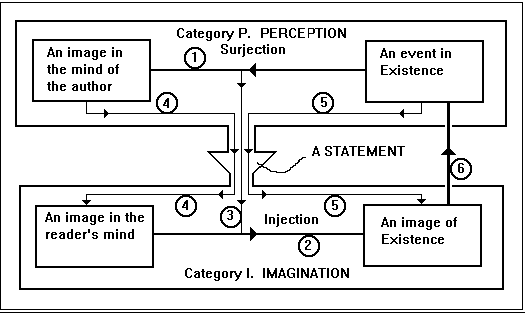
Figure 3-2. Definition of a true statement from a pseudo-functorial viewpoint
[Note. Since we have mentioned peyote, the skeptical reader may argue that the perceiver might be hallucinating and Arrow 1 is not a true surjection. Let us exclude that possibility in our discussion and finesse the question of whether or not hallucinations are “real”. I have a genuine bias when it comes to the notion that psychiatrists have anything to treat. I question the notion of mental illness and I abhor the medicalization of every deviation from “normal behavior”.]
Arrow 2 represents the imagination of the reader, Y. He reads a statement, for example, and he projects the image that appears in his mind into (hence injection) Existence as he perceives it. This all happens in the Category I, principally of imagination. We conceive of imagination, then, as a mapping of an image in the mind into reality. Although the reality where the mapping ends up is the reader’s conception of reality, it is a conception of the same reality perceived by the writer. The injective morphism is g(cy(E)), where cx(E) is Y’s conception of the event, E, obtained by reading the statement. It maps this conception of E into iy(E), the way in which Y, the reader, imagines the content of the statement about E in its appropriate setting, e.g., the Universe or the Ideals, for example. If we may generalize our usage slightly, the statement is a functor, F, mapping perception into imagination. Thus, g(cy(E)) = iy(E).
Since every element mapped by the reader into his conception of reality originates from a unique element in the reader’s mental image of the content of the statement, the (left) inverse map of Arrow 2, gL-1 is well-defined on the relevant part of the reader’s conception of reality. The statement (essentially, but not precisely) maps the author’s perception into the (left) inverse of the reader’s imagination (Arrow 3). (See equation below.) It maps (Arrow 4) the image in the mind of the writer (a point set in his mental space) into a point set in the mental space of the reader, one dimension of which is time. Also, the statement maps the event in reality perceived by the writer into the event in reality imagined by the reader (Arrow 5). Arrows 3, 4, and 5 comprise the statement from the pseudo-functorial view. Arrow 3: F(f(ex(E)) = gL-1(iy(E)). Arrow 4: F(mx(ex(E))) = cy(E). Arrow 5: F(ex(E)) = iy(E). We may represent the pseudo-functor F as a function of three variables:

The success of this process is determined by Arrow 6, P(iy(E)) → ex(E), which is not part of the functor. If the mapping P, for pointer, points toward reality in the sense of Russell [18]; and, the correspondence, element-by-element, is close enough (which almost always depends on context and circumstances, especially usefulness to the reader), we say that the statement is true. If Arrow 6 points away from reality and the reader is not at fault, we say the statement is false. If the reader reads badly, the arrow may point away from reality even though the statement would have been true otherwise. The problem, then, is to determine whose fault it has been when Arrow 6 points in the wrong direction. That is why Arrow 6 cannot be said to be a proper part of the statement. In many cases, particularly in modern advertising, the writer has deliberately set a trap for the reader to ensure that the arrow will point in the wrong direction. Of course, the writer has had to make a judgment about how well the reader will read. He aims his statement at the bad reader with the intention to deceive him. This is falsity and the statement might just as well have been an outright lie from the functorial point of view.
Unfortunately, the notion of intent enters the disquisition. We have already stated that the circumstances under which we can be certain of intent are rarely encountered. The notions of accuracy and appropriateness of the response of a large number of subjects might aid in an inductive proof of malicious intent; however, it is safer philosophically to reject distinctions between wickedness and incompetence (stupidity), which, to the phenomenologist, are indistinguishable anyway. (Phenomenologists consider information that does not come from the direct experience of phenomena less useful than experiential knowledge. Scientists are phenomenologists.) Obviously, we cannot experience the mental state of another person. But, when we are experiencing intense pain or grief the unknown cause of which is the wickedness or stupidity of someone, the possibility that the agent of our misery is an idiot offers little consolation or none. If we are given to blame, we are just as happy to blame the moron as the villain.
Drawbacks of this Approach
Regrettably, a little cloud casts its shadow over our mathematical landscape. The expert at category theory will note immediately that our categories and our functor do not satisfy the conditions of that theory exactly. See Hungerford [17]. The surjections and injections do not satisfy the associative condition because the events are distinct from the other objects in the pseudo-categories. Our use of the term functor should be taken to be an approximate analogy borrowed for our purposes for lack of a better term. Nevertheless, there must be dozens of decent formulations of models of communication among intelligent beings that employ functors and category theory more or less properly. I shall present my latest efforts, for whatever they’re worth, in the next section. [Tarski [10] uses the term functor, too, but in a manner quite distinct from its use in classical category theory – as far as I can tell.]
Second Approach
Let us consider an extremely simple scheme for determining in an impossible thought experiment when a statement is true. This scheme will be diagrammed in Fig. 3-3, however the arrows will not be explained. The objects in Category E are writers and readers who have witnessed (or not) a particular external event E. Let the writer be X and the reader Y. Let us assume that the writer, X, has witnessed the event and, to gratify ourselves, will write a statement about what he saw to be read subsequently by the reader, Y. Now, here’s the thing: In Category E, the morphisms, fi , i = 1,2,3,…, are the transformation of one person into another bijectively. That is, anyone can become anyone else, by executing fk, say, as in the commonplace saying, “If I were you, ...”; and, whenever he wishes, he can transform back into himself by executing fk-1. Naturally, while Y is X, he can see whatever X would have seen had not Y been mapped into him.
The functor P will map within individual minds visual images, say, of a particular external event E into conceptions of E. The functor P is essentially what we mean by perception. Let g[Cx(E)] be the simple associative surjective morphism that amounts to no more than X, the writer, providing Y, the reader, with a written account of the event E.
Then, the functor P maps, in addition, the extremely awkward morphism f-1(X) into the extremely convenient morphism g(Cx(E)). The written statement g maps the percept Cx(E) = P(Vx(E)), which is the writer’s perception of his own visual image of the event E, into Cy(E) = g[P(Vx(E))], the reader’s conception of the statement g.
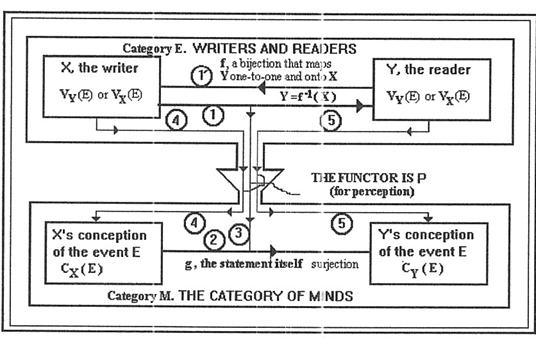
Figure 3-3. Second approach to the definition of a true statement
To determine the success of the communication (or if the statement be at all true), we consider a surrogate for Cy(E), namely,

This is the conception Y would have had of the event E if he had been X when X acquired his visual image of E, which was then perceived by Y. If Cy*(E) is very close to Cy(E), it is difficult to see how a statement could do better. Obviously, writing is easier and a lot more fun than having oneself changed into someone else – even if we were permitted to disregard the impossibility of doing so. Then, if X’s perception be correct and X’s statement to Y be true, the condition of Y’s mind is close enough to what it would have been if Y had become X. What we mean by “close enough” was discussed in connection with Arrow 6, above. Between the virtually absolute truth, when Cy* = Cy(E), and absolute falsehood, diametrically opposed to the event E witnessed by X, we can expect every gradation of verity and falsity. What is true enough for one person is a dirty lie for another – depending upon context, circumstances, and personal need. Only in mathematics, logic, fiction (and occasionally elsewhere) do we have a clear choice between true and false.
The inverse of the functor P is the process of imagination that the reader Y employs to visualize the image the writer X is trying to convey. In this model of written communication, the imagination of the reader is not part of the written statement, which seems fair enough, as it is not the writer’s fault if the communication fails due to the reader’s lack of imagination.
Third Approach
This approach involves four categories each of which is simpler than those previously presented. The first Category W consists of various phenomena q, r, s, ... spawned by a distinguished event, E, say. The surjective morphism f maps deeper (further removed from human perception) phenomena into more readily observable phenomena, which some people take to be the objects that are explained by the deeper (and less apparent) phenomena, for example, q could be the events associated with the collision of two neutrons under extremely high-impact energy, and r could be a photograph of a vapor trail in a cloud chamber that recorded a small portion of what occurred. The surjection f is a partial explanation of q.
The functor P maps Category W into Category M, the objects of which are various mental states of the mind of the writer, X, an eye-witness (or very nearly) of the phenomena. The functor P maps q onto P(q), X’s perception of the phenomenon q from his viewpoint. Likewise, for r. Finally, since g is an injection of P(r) into P(q), it is like an explanation of r in the manner according to which we usually explain the more perceivable events with “myths” about the underlying barely knowable phenomena P(f(q)) = gL-1(P(q)). This is more like a description of how q occurred. Since g is an injection, it is (left) invertible on its range.
The objects in Category R are conceptions of the meaning of the statement S in the mind of the reader, Y, or, at least, conceptions that arose because of reading the statement, if we wish to leave ‘meaning’ out of it. The surjection h maps Cy(P(q)) onto Cy(P(r)), i.e., h(Cy(P(q))) = Cy(P(r)). The functor S maps P(q) onto Cy(P(q)). Also, S(P(r)) = Cy(P(r)). Finally, S(gL-1(P(q))) = h(Cy(P(q))). The functor S is the statement. Whether or not it be true and understood depends upon the resemblance of q*, f*, and r*, described below, to q, f, and r, which can vary from (nearly) the identity to (nearly) the opposite, i.e., a perfect misrepresentation.
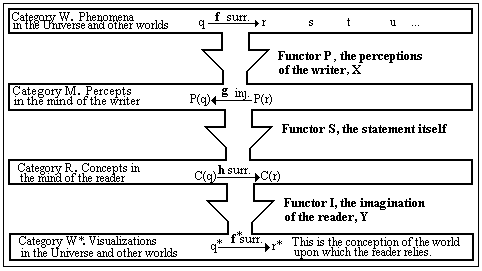
Figure 3-4. Third approach to the definition of a true statement
The objects of the fourth category, Category W*, are the phenomena perceived by X projected by Y’s imagination into his (Y’s) conception of the world, W*. These are Iy(Cy(P(q))), etc., which have been simplified already. Let us simplify further and call them simply q*, r*, etc. The imagined projection of the morphism f will be called f*. It maps q* onto r*. The functor I, between R and W*, maps Cy(P(q)) onto q*; Cy(P(r)) onto r*, and h(Cy(P(q))) onto f*(q*).
Fourth Approach
Finally, we can simplify the third approach by simplifying the categories to categories each containing one object (only), such that the sole morphism is the identity. Let Category W have one phenomenon, call it q. Category M has only X’s perception P(q). Category R has Y’s conception of what the statement S means, namely, Cy(P(q)). The functors P , S (the statement), and I map q to P(q) to Cy(P(q)) to q*. The statement S is successful if q* resembles q.
Examples of Failed Communications, Usually Purposely Deceptive
Herman Melville in his famous masterpiece The Confidence Man produces hundreds of statements that are intentionally designed so that Arrow 6 will point the wrong way. The reader soon discovers that he himself, rather than a character in the book, is the “mark”. (A mark is the victim of a confidence man’s schemes, i.e., the person swindled.)
In the unfortunate case where one watches TV (perhaps because he is an incurable baseball fan), it is advisable to take notes while watching and keep track of all of the falsity one encounters. The other day I saw an ad in which the viewer is told (by implication) that he (or she) ought to patronize an auto parts company because it doesn’t put on sales and, after all, auto parts companies that do have sales probably won’t have the part you want on sale anyway. This points away from the fact that the prices at the store being advertised are not lower than prices elsewhere.
You receive a postcard that says you have already won one of five prizes. The image of the least valuable prize that pops into your head is worth many times the prize the swindler intends to “give” after you have paid shipping and handling, say, that costs far more than what the “prize” is worth. The correspondence in its essential elements is not close enough to consider the swindler’s statement true – although a machine that can parse English sentences might deem the statement congruent with an accurate statement of the actual case. That is, the swindler might escape jail because, in a dictionary sense, what he says is strictly true, but he has conspired to make Arrow 6 point in the wrong direction, namely, at something quite different from what the mark imagined. In my essay on television in Vol. III of my collected essays [18a], I shall give a large number of examples of this form of falsity, including statements made by some of the most highly respected organizations in the world, i.e., respected by some.
In a lighter vein, the King in “The Lion and the Unicorn” in Through the Looking Glass [24] abuses truth in a humorous way. He exclaims, “There’s nothing like eating hay when you’re faint.” When Alice suggests that throwing water over oneself or taking (sniffing) sal volatile (smelling salts) would be better, he insists that he didn’t say there was nothing better than eating hay, only that there was nothing like eating hay. The King, of course, is being silly; but, if he were serious, we should accuse him of intentionally deceiving us because, in colloquial speech, when we say “nothing like” we mean “nothing better”. He knows this as well as we do and ought to understand that we will take “nothing like” to mean “nothing better”.
Here’s a trick that illustrates how we may confuse our listener. (I stray from our specialization to the printed word.) Sitting in the cafeteria of a famous university with a famous philosopher, looking across the East River, I ask, “Which of those three smokestacks are farthest apart? Without hesitation, he answers, “The two on the left.” (He may have said “right”, but that’s irrelevant.) “What about the two on the ends?”, say I. He has been had. Naturally, he supposed I have asked him to make a judgment and, since the three smokestacks do not appear to be evenly spaced, he assumed I was asking him to make a judgment about their spacing. That’s a fair assumption. What is fair to assume does not correspond to the accurate parsing of the sentence. As a joke this is fine. It would be immoral to place a money bet on his answer – according to my moral system, which I claim is complete and the best one can do. I await the reader’s criticism.
I can’t resist giving you one more example: I shall tell two stories – one true, the other false. Remember, these are normally given orally, so don’t “study” the versions. Just read quickly out loud and make your choice. Please decide which is which without looking at the text after the first reading and before I reveal the answer in the last paragraph of the main part of this chapter (not the appendix). Here goes:
1. There’s a little town in Iowa. The main street is a continuation of the state highway. At one end of the main street there’s a fire station. Across the street from the fire station there’s a general store. In front of the general store there’s a big wooden block. On top of the big wooden block there’s a big wooden Indian. Whenever the firebell rings the big wooden Indian jumps down off the big wooden block and chases the fire engine.
2. There’s a little town in Iowa. The main street is a continuation of the state highway. At one end of the main street there’s a fire station. Across the street from the fire station there’s a general store. In front of the general store there’s a big wooden block. On top of the big wooden block there’s a big wooden Indian. Whenever the big wooden Indian hears the firebell he jumps down off the big wooden block and chases the fire engine. Remember, don’t look at either version again until you decide. I’m afraid it’s too easy.
Tarski’s Theory of True Statements
The White Knight’s story in Through the Looking Glass [24] may be useful to understand Tarski’s arguments. (It helped me understand computers!)
“··· The name of the song is called ‘Haddock’s Eyes.’ ”
“Oh, that’s the name of the song is it?” Alice said, trying to feel interested.
“No, you don’t understand,” the Knight said, looking a little vexed. “That’s what the name is called. The name really is ‘The Aged Aged Man.’ ”
“Then I ought to have said, ‘That’s what the song is called’?” Alice corrected herself.
“No, you oughtn’t: that’s another thing. The song is called ‘Ways and Means’: but that’s only what it’s called, you know!”
“Well, what is the song, then?” said Alice, who was by this time completely bewildered.
“I was coming to that,” the Knight said. “The song really is ‘A-sitting on a Gate’: and the tune’s my own invention.”
In computer programming one must distinguish carefully among the following objects: (i) a datum (a number, say), (ii) the address of the datum, (iii) the name of the datum, and (iv) the address of the name. For example, X = 255; 255 is stored in location 1025 in RAM; 255 is called X, in our case because that is its name (no subtle knightly distinctions between names and what things are called for us); the name X is stored in its own location in RAM with its own address – 2049, say. The name of the datum may appear in a number of places. For that matter, so may the datum. So, it’s no good saying that it is a truism that every object can be in only one place at a time. (OK, you wish to quibble? The symbols “2”, “5”, and “5” are only the components of my name for the representation of the datum. This representation is the binary number 11111111, but the actual representation is a sequence of charged electronic devices, each capable of designating one bit. The datum itself is an abstraction. It is an equivalence class dwelling in the Realm of Ideals. One can really appreciate the difficulty Tarski is concerned with in defining a true statement in colloquial language. Look at the difficulty I’m having here. It’s conceivable that we could make things worse by trying to be too accurate. There is something to be said for leaving a statement alone when the reader gets the point.) The point is that things have to be kept separate from their names.
In symbolic logic, statements are given names. In every case, they can be given names that are the statements themselves in quotation marks; i.e., the name of the sentence It is snowing is “It is snowing”. These are called quotation-mark names! In the example below the same sentence is given three names: (i) c, (ii) “c is not a true sentence”, and (iii) the sentence set off by asterisks. Obviously, it is important to distinguish a statement from a name of a statement. In the case of (ii) above, the name of the sentence contains another name of the sentence. Also, the name contains the sentence itself.
Tarski [10] has explored thoroughly the possibility of defining rigorously the concept of a true statement. Tarski has successfully defined a true statement within the narrow bounds of a specialized logical language – such as the language of Russell and Whitehead [25]. On the other hand, he has more or less proved that a true statement cannot be defined within the context of ordinary colloquial language. (What he actually showed was that all of the techniques that have been employed so far to define a true statement in ordinary colloquial language have been unsuccessful. He didn’t show that no technique can ever be found.) The machinery required to give the proof is beyond the scope of this discussion – and we really don’t need it. Most of the counterexamples he chooses are quite pathological and of no genuine practical interest. For example, suppose we name the sentence set off by triple asterisks just below as the sentence c, i.e., c is the name of the sentence set off by asterisks.
*** c is not a true sentence ***
We notice two facts: (1) “c is not a true sentence” is identical with c, i.e., “c is not a true sentence” = c = the sentence set off by asterisks, and (2) “c is not a true sentence” is a true sentence if and only if c is not a true sentence. (1) and (2) taken together give the contradiction that c is a true sentence if and only if c is not a true sentence.
According to Tarski, the difficulty arises because the sentence c contains the words “true sentence”. (In my naiveté, I would guess that the paradox occurs because the sentence refers to itself by name.) Perhaps this is analogous to Russell’s famous paradox [26] concerning the set of all ordinary sets. Russell’s paradox can be avoided by defining classes first then defining sets in terms of classes – but more restrictively. This has been done at the beginning of the book on algebra by Hungerford [17]. I do not believe it will present a serious difficulty for my theory. I am encouraged in this belief by two observations:
1. Basically, everyone knows intuitively what a true statement is. I realize this is a dangerous assumption.
2. But, in this essay, we shall rely mainly on macrofacts, which are easily verified, as opposed to microfacts – as discussed previously.
In point of fact, we are most often concerned with statements that are false. Obviously, whatever technical difficulties lie in assigning truth to statements having truth value are shared by the problem of falsehood. But, in the normal case, the difficulties do not arise. Although it may be difficult to define rigorously a true statement, no such difficulties exist in the case of falsehood – at least in the case of the falsehoods in which we shall be interested. “Falsehood is so unexacting, [it] needs so little help to make itself manifest!” [Proust] This shall be expanded upon, mostly by example, in the chapter on falsity. I realize that I may be skating on thin ice here. With about two more years of study either (i) I would feel more confident thinking about mathematical logic or (ii) I would avoid it like the plague. Many a vessel more seaworthy than mine has come to grief on the rocky shores of mathematical logic.
The Statement of the Truth Axiom
Axiom 3 (The Truth Axiom). Every person shall promote the truth, the whole truth, and (in the class of statements that possess truth value) nothing but the truth. Truth shall be exalted to the greatest extent possible – to such a great extent, in fact, that it must be withheld from those in authority, who are unworthy of it. (We don’t expect a member of the French underground to tell the truth to the Gestapo!)
Justifying the Truth Axiom According to the Three Criteria
Aesthetics
“Truth is beauty and beauty truth.” We all love the truth because of its beauty. This is what drives (or used to drive) scientists, probably more than curiosity. In fact, it is probably safe to say that the aesthetic pleasure derived from watching the truth, new truth, unfold gradually is an important component of what we call scientific curiosity, which I have tried to make clear in my essay “On Honor in Science” in Vol. II of my collected papers [6].
Reasonableness
Truth is at the heart of reasonableness. Reasonableness is our first criterion for assessing truth. If a statement fails the test of reasonableness, we will require some powerful logic to overwhelm our objections, and yet, for many readers, many of the ideas presented in this essay will strain the sense of what is reasonable. I maintain that such readers aren’t looking at things the right way and, as soon as they shake off old untrue prejudices, they will see that these ideas are entirely reasonable.
Utility
Finally, truth meets the test of utility. Imagine a world where no one could depend on the truth of any statement. That should not be difficult to do. We have very nearly achieved it. When my doctor tells me I have such and such wrong with me and I require such and such treatment, I must believe that what he tells me is true or seek a second opinion. The mere suggestion that I cannot believe my doctor or my dentist is horrifying. I would like to believe my auto mechanic too, and, in fact, I do, but mainly because I know him and I know my car. Truth is useful and falsehood is damned inconvenient, to say the least.
[Note in Proof (7-28-96). When I wrote the earlier drafts of this chapter it did not occur to me that truth needed an elaborate defense. I imagined that nearly all reasonable people saw that, at least among friends and colleagues (but not between ourselves and our enemies), truth needed no defense. I knew that business, especially the sales and marketing aspect of business, embraced falsity, but I supposed that even they knew that what they were doing was immoral and harmful. Lately, I have observed a disturbing trend and, perhaps, I am the last to notice it. Social activists and other so-called world betterers are beginning to adopt the techniques of business, government, and politics to achieve what they still believe are desirable ends; i.e., they are employing deception, half-truths, hidden agendas, equivocation, double meanings, and specious reasoning to influence people whom they would someday like to consider friends and allies. (It would be a different story if they were hoodwinking their sworn enemies, the enemies of society – hopefully.) I believe this is wrong and harmful. Clearly, it is a violation of the Truth Axiom and, therefore, a violation of the morals proposed by me.
Remember that we said that relatedness was a requirement for happiness. Clearly, it is important to have a good relationship with people you wish to include in your expanded family of man – your friends and allies and those who will become your friends and allies if you can convince them that you are part of the solution to their problems or the problems of others that they wish to correct, e.g., starvation in the Third World. How can you have a good relationship with people you lie to or upon whom you practice falsity to gain their confidence? What will they take you for? What should they take you for? Just another phony who wishes to exploit them for his own personal gain. Can you blame them? Is it not essential to establish a relationship of complete trust with all such people and how can that be accomplished except through uncompromised truthfulness! Please keep this in mind when I discuss the harm done by falsity in Chapter 8 and social change in Chapter 12. Unexpectedly, this has turned out to be a pivotal point in advancing this theory. Lately, I have been vilified for speaking the truth (within the drug policy community). Moreover, my detractors are terrified that I will speak the truth in public. They have said as much using precisely those terms!]
Immediate Corollaries of the Truth Axiom
I am tempted to take another crack at absolutist religionists here, who purvey a brand of nonsense that they try to pass off as truth whether it contains an element of truth or not, but I have devoted an entire essay to them in my collected papers [6], which was published also by some friends [21]. This essay, “On the Separation of the State from the Christian Church and the Case Against Christianity”, concentrates on the only religion I know well as I am a former believer. Actually, my philosophy is derived from Christianity. Naturally, I consider my philosophy a vast improvement (but not the last word).
Note. We need to say a word about nosiness and the invasion of privacy, which should not be encouraged by virtue of their compatibility with the Truth Axiom. A judgment about the importance of a piece of information or the suitability of its transfer has a truth value too.
Corollary 6. To represent something as something that it is not is immoral except in the context of a proper game or in one’s dealings with authority. (I do not mean to disparage the play-action pass, a deceptive maneuver that belongs to the popular American game football.)
Corollary 7. One’s behavior must be congruent with one’s moral, political, religious, philosophical, and artistic values, in short, everything one thinks.
Example. When a musician, for example, performs a given piece of music, in addition to the statements in the language of music that are rendered thereby, the musician is making a statement about his aesthetic judgment, presumably that he approves of this piece of music. Now the musician knows whether he (or she) approves of this piece of music or not, but we don’t. We interpret the playing of a piece of music of which the musician approves as truth and the playing of a piece of music of which the musician does not approve as falsehood, which can be remedied only partially by a plain announcement of disapproval both before and after the rendition. This renders a lie true only in a limited sense. Can you imagine Lawrence Welk’s entire band standing up before the first piece is played to announce that they don’t approve of the style in which they are about to play; but, if that’s what the audience wants, well, they’ve got to eat! Actually, L.W.’s band was interviewed by one of the popular music magazines years ago and, according to the interview, they didn’t approve of Welk’s music. (Shakespeare announced pointedly that he did not approve of what he was writing in the title to As You Like It.)
Example. While there is no accounting for taste, it would be a violation of Corollary 7 deliberately to promulgate ugliness for some ulterior motive such as to gain the sympathy of persons whose taste is less developed than one’s own, as one might do to sell a product, particularly if that product were a work of “art” or a form of entertainment. Also, in the selection of alternatives in the exposition of science, mathematics, and logic, this corollary should be observed.
Concrete Example. The promotion of inferior popular music, music that the promoter or artist finds repulsive, is immoral.
Corollary 8. Each person shall follow his or her innermost feelings and the dictates of his or her own heart.
Corollary 9 (The Fundamental Premise). It is unreasonable to be happy when others are miserable or when the misery of posterity is inevitable.
Proof. It is assumed that no reasonable person can be happy while in the presence of misery. Happiness is meant in the technical sense, which implies satisfaction. Even the momentary happiness that comes from seeing an improvement in the condition of the miserable person will not satisfy the technical definition of happiness given in Chapter 1. If a reasonable person were satisfied with the state of affairs even though he knew (with certainty) that people were enduring misery at a far-distant place or were certain to endure misery in the future, he would be denying the truth of what he knew about the present or future condition of those people, which he could not do if they were in his presence. This is at variance with complete respect for truth as required by Axiom 3 because it implies that events far away in space or (future) time do not occur.
Note. It is not clear how knowledge of misery in the distant past would impact upon the happiness of every reasonable person. At least, I have nothing to say on the subject.
Comment. A reasonable person may temporarily disregard a fact of which he is aware if he is not constantly reminded of it; but, eventually, that small nagging inner voice will remind him of the unpleasant situation he has temporarily forgotten. Temporary forgetfulness of misery is not happiness.
The Truth Axiom in Education
The relevant definition of education given in the Random House Dictionary [11] is as follows: Education: 1. The act or process of imparting or acquiring general knowledge and of developing the powers of reasoning and judgment. 2. - 5. (irrelevant – for our purposes). Let us agree that special interest groups are not interested in developing our powers of reasoning and judgment; therefore, if they are educating the public, they must be imparting information. Clearly falsehood ought not to be classified as information under this definition, moreover half-truths might just as well be false. Also, a statement that has an unknown truth value might be uttered as though it were true. This, too, is a form of falsehood. Information that qualifies as educational, then, consists of true statements.
But even if we speak only the truth our statements may not qualify as educational. It is possible to speak the truth but not the whole truth and thereby deceive our listener. Deception should not qualify as informational. Let us agree to consider partial truth and falsehood as non-educational. I think it will assist the reader if I give some examples of educational statements and non-educational statements. All sorts of statements qualify as non-educational, however the non-educational statements in which we are interested constitute propaganda, indoctrination, and brainwashing (used in its ironic sense).
Marijuana is a harmful drug is a non-educational statement. The educational statement is “Some people believe marijuana is harmful; others do not.” Another non-educational statement is “Atheists are trying to drive God out of the public schools.” This is silly because atheists don’t believe in God and theists don’t believe God can be driven here and there. The educational statement is “Atheists are trying to prevent the word God being used in the public schools without qualification.” “Global warming is occurring” is a non-educational statement. An educational statement would be “Computer simulations show that, if the concentration of carbon dioxide in the atmosphere were increasing, the average global temperature would increase – other things being equal.”
To reiterate the beginning of the introduction to Chapter 2, I claim that most of the contents of Chapter 2 qualify as educational under both aspects of Definition 1 because: (1) what I tell you is factual (unless I make an error, which, of course, is always possible despite my best intentions) and is not propaganda or indoctrination and (2) availability, emergy analysis, balance equations in general, and systems diagrams are powerful tools for reasoning and making judgments. (The material given there is easily checked, therefore the danger of unintentional errors is minimized.) This is in contradistinction to many other discussions of the environment (whether pro or con). Actually, most of what most special interest groups are calling education is merely propaganda. Even my attempt to sway the reader away from the hard energy philosophy toward the soft energy view should be considered propaganda rather than education.
Answer to the Puzzle about the “Little Town in Iowa”
Since the wooden Indian does not move until he hears the firebell and wooden Indians can’t hear and never do hear, the second story is true. (The first story would have the wooden Indian moving “whenever the firebell rings”, which is impossible.)
References
1. Herman, Edward S. and Noam Chomsky, Manufacturing Consent, Pantheon, New York (1988).
2. Chomsky, Noam, What Uncle Sam Really Wants, Odonian Press, Berkeley, CA (1992).
3. Chomsky, Noam, World Orders Old and New, Columbia University Press, New York (1995).
4. Bentham, Jeremy, Bentham’s Handbook of Political Fallacies, Ed., Harold A. Larrabee, Johns Hopkins Press, Baltimore (1952).
5. Deci, Edward L. and Richard M. Ryan, Intrinsic Motivation and Self-Determination in Human Behavior, Plenum Press, New York (1985).
6. Wayburn, Thomas L., The Collected Papers of Thomas Wayburn, Vol. II, American Policy Inst., Houston (Work in progress 1997).
7. Wayburn, Thomas L., The Collected Papers of Thomas Wayburn, Vol. I: Drug Policy 1986-1996, American Policy Inst., Houston (1996).
8. Häfele, Wolf, Editor, Energy in a Finite World, Ballinger, Cambridge, MA (1981).
9. Webster’s New Collegiate Dictionary, Henry Bosley Woolf, Editor in Chief, G. & C. Merriam Co., Springfield , Massachusetts (1977).
10. Tarski, Alfred, “The Concept of Truth in Formalized Languages”, in Logic, Semantics, Metamathematics, 2nd Ed., Ed., John Corcoran, Trans. J. H. Woodger, Hackett, Indianapolis (1983).
11. The Random House Dictionary of the English Language, Lawrence Urdang, Editor in Chief, Random House, New York (1968).
12. Webster’s Deluxe Unabridged Dictionary, 2nd Ed., Simon and Schuster, New York (1983).
13. Barker, Stephen Francis, Elements of Logic, McGraw-Hill, New York (1974).
14. Popper, Karl R., Conjectures and Refutations, Harper, New York (1965).
15. Lakatos, Imre, Proofs and Refutations, Cambridge University, New York (111976).
16. Einstein, Albert, Sidelights on Relativity, Dover, New York (1983).
17. Hungerford, Thomas W., Algebra, Springer-Verlag, New York (1974).
18. Russell, Bertrand, “Truth and Falsehood” in The Basic Writings of Bertrand Russell, Eds. Robert E. Egner and Lester E. Denonn, Simon and Schuster, New York (1961).
19. Wayburn, Thomas L., The Collected Papers of Thomas Wayburn, Vol. III, American Policy Inst., Houston (Work in progress 1997).
20. Fraser, James George, The Golden Bough: A Study in Magic and Religion, 3rd Ed., St. Martin’s Press, New York (1963).
21. Wayburn, Thomas L., “The Separation of the State from the Christian Church: Parts 1, 2, and 3”, The Truth Seeker, 117, Nos. 2, 4, 6 (1990).
22. Wayburn, Thomas L., “The Separation of the State from the Christian Church and the Case Against Christianity”, The Philosophy of Humanism and the Current Issues, Marian Hillar and Frank Prahl, Eds., Humanists of Houston, Houston (1995).
23. Tarski, Alfred, Introduction to Logic and the Methodology of the Deductive Sciences, Oxford University Press, New York (1994).
24. Huxley, Aldous, The Doors of Perception, Harper, New York (1954).
25. Carroll, Lewis, “Through the Looking Glass” in The Lewis Carroll Book, Ed. Richard Herrick, Tudor, New York (1931).
26. Whitehead, Alfred North and Bertrand Russell, Principia Mathematica, Cambridge University Press (1912).
27. Penrose, Roger, The Emperor’s New Mind, Oxford University Press, New York (1989).
Appendix: Why Taking Drugs Per Se Imposes on No One
Pleasure, after all, is a safer guide than either right or duty. For hard as it is to know what gives us pleasure, right and duty are often still harder to distinguish and, if we go wrong with them, will lead us into just as sorry a plight as a mistaken opinion concerning pleasure. When men burn their fingers through following pleasure they find out their mistake and get to see where they have gone wrong more easily than when they have burnt them through following after a fancied duty, or a fancied idea concerning right virtue. The devil, in fact, when he dresses himself in angel’s clothes, can only be detected by experts of exceptional skill, and as often does he adopt this disguise that it is hardly safe to be seen talking to an angel at all, and prudent people will follow after pleasure as a more homely but more respectable and on the whole more trustworthy guide. – Samuel Butler, The Way of All Flesh
Pryer (a de jure clergyman and a de facto stock swindler): ... [N]o practice is entirely vicious which has not been extinguished among the comeliest, most vigorous, and most cultivated races of mankind in spite of centuries of endeavor to extirpate it. If a vice in spite of such efforts can still hold its own among the most polished nations, it must be founded on some immutable truth or fact in human nature, and must have some compensatory advantage which we cannot afford altogether to dispense with. – Samuel Butler, The Way of All Flesh
Comment. In the “Preface to The Millionairess”, G. B. Shaw claimed Butler was the greatest of the nineteenth century novelists. Notice what a skillful architect of language he was – despite the occasional less-than-optimal choice of word, owing, no doubt, to hurried composition. Indeed, Butler did not survive to see his masterpiece, The Way of All Flesh, in print. The second quote, placed in the mouth of the scoundrel Pryer, may be supposed to be facetious; however, as Shakespeare gives that old rat Polonius “To thine own self be true, etc.”, why should not Butler place his own radical opinion in the mouth of whomever is speaking when the inspiration came? I like this thought independently of its source.
Please see “The Case for Drug Legalization and Decontrol in the United States” at http://www.druglibrary.org/schaffer/DEBATE/dpf89.htm and “We Must Prove Drugs Are Good and Laws Are Bad” at http://www.dematerialism.net/crucial.htm.
Chapter 4. Philosophical Assumptions or Articles of Faith
Introduction
The arguments presented in this book are based on fundamental assumptions and facts. In this chapter, I will attempt to state as many of the assumptions as I can think of; but, it is in the nature of the human condition that we are unaware of many things that we believe in implicitly. It behooves us to search constantly for these “hidden” assumptions and examine them critically. This collection of essays itself is an attack on unexamined assumptions. It is entirely possible that, upon close reading of my own manuscripts, I might discover additional assumptions that should have been listed. Over the last several years, since I wrote the initial draft of this chapter, I have added several assumptions that had been overlooked initially.
As stated previously, I shall try to rely only on facts agreed upon by nearly everyone and concerning which there can be little doubt. We agreed to call these macrofacts. In addition, we make use of a small amount of statistical data, such as U.S. high-grade energy consumption, which are known only approximately. We will attempt to use generous upper and lower bounds in our calculations so that, even if the data are off considerably, the conclusions will be acceptable.
Ideally, I would like to produce a work that stands or falls on the truth or falsehood, consistency or inconsistency, completeness or incompleteness of the basic assumptions. If I make a mistake in reasoning or rely upon an erroneous fact, that will not be the case. But, in the ideal case where I use only macrofacts, if no flaw in the reasoning can be found, the skeptic will be left with only the fundamental assumptions to criticize. It will not be possible to accept the fundamental assumptions, the data, and the reasoning and reject the conclusions without violating the general principles of logic, which are assumed to be correct. One, then, could evaluate the fundamental assumptions on the basis of reasonableness, aesthetics, and utility and decide upon the validity of the case presented.
Unfortunately, not all of the assumptions upon which this case rests will be listed. Many of them are hidden deep inside the author’s psyche. At least he is not aware of them. The reader is responsible to watch closely for hidden assumptions that may or may not destroy the validity of some or all of the arguments. Also, in issues involving human beings, it is impossible to achieve the logical rigor that one can achieve, for example, in the theory of finite groups, a branch of abstract mathematics. Not only are we not able to state with definiteness what we are talking about because we, as human beings, are not completely defined philosophically, but we are in the difficult position of being a part of the subject under observation. Clearly, the very act of observing ourselves changes what it is that we are observing. Nevertheless, these difficulties should not discourage us from applying rigorous logic to the subject at hand as far as we are able.
One often appeals to the intuition to guide the intellect. This is proper and from time to time saves us from making serious mistakes due to erroneous reasoning. Suppose, for example, that we wish to compute the speed of sound in helium. Due to an error in the conversion of units, say, we compute a velocity in excess of the speed of light. Intuitively, and from general principles, if we are acquainted with them, we know that something is wrong and we begin to look for our mistake. We have done what we ought to do. If, on the other hand, at the beginning of the twentieth century, we were looking for an explanation of the Michelson-Morley experiment and we determined that we could account for the observations only by rejecting the absolute nature of time, we would have been making a big mistake if we rejected our reasoning because it was in conflict with our intuition, which, before Einstein and Poincaré, told us that time is the same for everyone, everywhere, regardless of one’s motion.
The development of mathematics and science in the nineteenth and twentieth century has led to a large number of counter-intuitive results. If people had been unwilling to adjust their intuitions to fit the discovered facts and were unwilling to travel down the trails blazed by unfettered reason, we would have remained in ignorance and error in a number of categories.
A similar drama is waiting to unfold in our views of mankind and society. We must scrutinize society with as few preconceived notions as possible and we must be aware constantly of the assumptions we have retained and look for hidden ones. Finally, we must follow wherever our reasoning leads us no matter how disappointed we might be to discover that everything we once held sacred is wrong.
Above all we must not be bound by the sacred and cherished beliefs of other people, particularly the belief that human nature is well-understood – independently of set and setting, i.e., the mental state of the subject (set) and the social circumstances that surround him (setting). It simply will not do to discover a new “theory of relativity” and then reject it simply because we don’t think anyone else will accept it. Instead, let us worry about what we ourselves can derive and understand beginning with a firm foundation. With understanding comes the courage to communicate what we have learned to our children, our friends, anyone who will listen and, finally, the world. We may imagine that the world will never change, that society will never reject its dearly held beliefs, but we must not ourselves persist in error when our hearts and minds have uncovered it. Here is the list of philosophical assumptions or articles of faith:
Existence in General and the Universe in Particular
1. We assume the existence of the real world.
The World (all that exists) was described in Chapter 1. The Ideals, Relations, Mind, Everything Else, and even the Universe might be described differently by different members of a community all of whom accept a social contract based upon these assumptions. The object known as the Universe must exist at least in the present, which depends upon the relative motion of the observer. One usually associates knowledge with science and faith with religion. Probably, though, science has less claim to knowledge than we suspect. The eventual fall of one scientific theory after another is a fact of life. Only in mathematics can we say that essentially everything we believe is true. That is because we always begin by stating what it is that we are talking about. In a very real sense, we have created the subject matter (except for the counting numbers – and maybe a few other mathematical objects). In the physical sciences we are not at liberty to say, i.e., choose the properties of, what it is that we are talking about because we are talking about physical reality, which is a given. If in science we can do without absolute knowledge, we cannot do without faith. One does not embark upon a career in science without faith in an objective Universe.
Note. I wish to distinguish three levels of objectivism. Absolute objectivism would hold, contrary to the Copenhagen interpretation of quantum mechanics, that the spin of two electrons (whose combined spin is zero, as in the Einstein-Podolsky-Rosen experiment [1]) is an objective fact of the universe in every orientation of the experimental spatial coordinates with respect to the laboratory coordinates regardless of which spin, if any, is measured. Hard objectivism would hold that only the spin that is measured has objective reality, but it is the same for every observer. Soft objectivism would relax our grip on reality further and admit, strangely, that the result of the measurement depends on who makes it. Soft objectivism will accommodate Schrödinger’s cat “collapsing the wave function” from his point of view, particularly if he is alive, and the cat remaining in a combination state of both dead and alive from the viewpoint of the human experimenter since the cat’s observation might not count as far as the human is concerned. I think the cat’s consciousness collapses the wave function to any extent it does indeed collapse and no nonsense of a cat that is both dead and alive is necessary. I would like to suggest a variation of the Aspect experiment, but I fear this is not the place to do it. Anyone who is not familiar with this fascinating and confusing philosophy of science issue can simply put this paragraph out of mind, since, in this essay, we deal with macroscopic reality and the fine points of quantum theory are not really relevant.
To continue, scientists traditionally believe that the laws of nature are invariant in space and time. We do not expect to find a region at the far reaches of the universe where the Second Law of Thermodynamics is reversed, although that is not absolutely out of the question. Even stronger is our faith that the laws of physics do not vary between London and Paris. Also, scientists take it as an article of faith that the laws of physics do not vary from year to year. One would not undertake to unravel an obscure principle if, before one had published one’s results, the principle were likely to change. However, there is no reason why the laws of physics might not have been different before the big bang if it turns out that, indeed, the big bang was not the absolute beginning of time.
Scientists are aware that their measurements alter the thing being measured. This is the substance of the famed Heisenberg Uncertainty Principle, which asserts that one may not know both the position and the momentum of a particle. However, I have not heard it suggested that scientists, particularly particle physicists, are actually changing the nature of matter by their investigations of particles. I do not mean that they are changing the nature of matter in the trivial sense in that they are creating new particles from old, but that they may be changing the very laws that govern matter. Perhaps, the fundamental laws of physics themselves are being deformed by the pressure of the physicist’s inquiry. As far as I know, physicists conduct their affairs with complete and unquestioning faith, faith worthy of the most fanatical religious zealot, that this, the alteration of the fundamental laws of physics under the pressure of inquiry, is not occurring.
But, the faith in reality that is required to study the subject of this essay is not very demanding. We need only have faith that a macroscopic, physical, objective universe exists independently of what people believe or hope for. We are not concerned with the laws that govern affairs far from our Mother Earth, nor are we concerned with what happens at high energies and other extreme conditions. We are concerned with the ordinary affairs of man. We know that we cannot rely on an account of an event on the other side of the world observed by a person who has a personal agenda unknown to ourselves, but we can be reasonably assured that the nation where the event occurred actually exists and the head of state of that country is who everyone says he (or she) is. We don’t know how that far-distant ruler thinks or very much at all about him, but we know his name, although we cannot pronounce it properly, we know when he took office with acceptable accuracy, and we can know the color of his eyes if we want to know.
I would like to make clear what we mean by saying that the universe exists and that we can know reasonably well certain things about what happens on this earth and that we can be confident that we are not being deceived so long as we don’t try to know too much. I refer to this type of knowledge as broad macroscopic knowledge (macrofacts), but it isn’t worthwhile to try to give a philosophically rigorous definition of it. (Macrofacts were defined loosely in Chapter 3 in the section on truth.) We shall try to limit our assumptions about what goes on in the world to as few as possible and restrict ourselves to “facts” about which people are in very general agreement. Therefore, we shall shun the results of statistical surveys as much as possible, because we do not trust them and because it is our policy to assume as little as possible. But, we must assume the existence of an objective reality and the existence of objects and events, an existence that can be verified independently by as many observers as wish to verify it. Since we have established a reasonably sound basis for the definition of external empirical truth, we will be able to withstand the criticisms of those skeptics who do not think we can define an objective truth because we will have defined it in terms of principles that no one on this planet can afford to live without. This should silence the skeptics.
Of course, the knowledge to which we refer is knowledge of phenomena. Phenomena are our impressions of objects whose intrinsic nature is hidden from us. The genuine reality underlying phenomena was referred to as noumena by Immanuel Kant. [Note in proof (7-2-97). Kant may not have meant what I mean by noumena. I mean Definitions 1 and 2 in the Random House Dictionary [2].] Since we believe that phenomena are the manifestations of noumena that make an impression upon our senses aided, perhaps, by the most sensitive instruments with which we investigate the phenomena underlying the phenomena that constitute our everyday experiences. We pour a glass of water, which seems like a continuous fluid. If we look more closely, we perceive the atomic nature of water under which an even finer structure consisting of fundamental particles exists. This is not water as it really is however. Underneath the quarks, etc., is something stranger still and, eventually, unknowable.
[Note in proof (7-9-97). If Mind – all of Mind – were a subset of the Universe, then, perhaps, we could attain knowledge of the noumena associated with our own consciousnesses merely by deep introspection! This is just an idle thought.]
Nevertheless, we attempt to penetrate deeper and deeper into this apparent world of perceived phenomena, even though we are unlikely to discover the essential reality underlying water, namely, the noumena themselves. We believe that the noumena exist because, under the same circumstances, water inevitably engenders the same phenomena in the experience of every observer. Rarely, do we consider this viewpoint when we experience thirst. If the thirst be sufficiently great, our thirst for philosophical understanding is all but slaked. In any case, there is some kind of objective universe out there underneath all the phenomena because the Aspect experiment itself always comes out the same no matter who performs it – provided they perform it correctly.
2. As a compromise, we agree not to decide upon the existence of events that cannot be replicated under any circumstances whatever by impartial observers. People might believe that these events occurred and they might be referred to as supernatural. It is not necessary to argue about that. Instead, we will disallow the introduction of such events as evidence for or against social policies.
It seems to me that the conventional division of all phenomena into natural and supernatural is pointless. What does it mean? Does it mean that some events occur and some do not? Recall that most imagined instances of the supernatural are related to poltergeists, ghosts, and goblins – purely fictitious creatures. If that’s what we mean by t·h·e s·u·p·e·r·n·a·t·u·r·a·l, we may dispose of the category immediately because it is empty. Does it mean that some events obey discernible, discoverable laws and others don’t? If that’s what it means, how do we draw the line between discoverable and nondiscoverable? Most laws that govern natural phenomena are undiscovered, nor do we know that they can ever be discovered. (In some cases, we know that they cannot be.) Does that make these events supernatural? On the other hand, we might discover laws that govern telekinesis, mental telepathy, communication with the dead, or spontaneous material manifestations, if such events actually occur, in which case they would have to be classified as natural. So, in this case too, we see that the division between natural and supernatural is artificial.
We speak of all that exists in terms of five distinct, but not necessarily disjoint, “worlds”, namely, the Universe, U, Mind, M, the Ideals, I, the Relation, R, and Everything Else, E. We didn’t claim to know anything about Everything Else. On the contrary, we claimed that nothing can be known, except, perhaps, in a negative sense. Let us suppose that the universe in space and time, whether finite or not, bounded or not, is embedded in a larger space of unknown dimensionality or beyond dimensionality. Then, so-called supernatural events could be interpreted as the projection of extra-universal phenomena, the laws governing which may not be discoverable, upon our universe, just as the footsteps of a giant human may be interpreted by an ant as evidence of the existence of a larger world that he cannot see, provided only that he has the wit to so interpret. Just because we could not explore the space in which the universe would be embedded would not justify considering it supernatural – or unnatural, which amounts to the same thing. The designation supernatural tends to place the part of existence that we cannot explore in an inferior position with respect to the rest of existence, but this is open to debate and I do not insist upon it. All of existence might be considered Nature. In any case, the use of the term “supernatural” seems to increase confusion rather than dispel it. As elucidated further below, some events originating in the part of existence distinct from the Universe, the Ideals, the Relations, and Mind may be called supernatural by some people if they wish, but we shall not permit those putative events to be introduced into discourse on public policy – unless, of course, some means can be found to subject them to ordinary scientific scrutiny.
Natural events occurring in the Universe are divided readily into those that can be reproduced over and over again, such as the dropping of a weight from the Leaning Tower of Pisa (which may not have been the experiment performed by Galileo), and events which occur only once, such as George Washington crossing the Delaware. Whereas reasonable procedures exist by means of which we can ascertain with a high probability that George Washington did indeed cross the Delaware under the circumstances related in history books, no scientific proof can be put forth. One can distinguish, too, between events that occurred only once but that can be replicated readily in their essential details under different circumstances, such as Washington tossing a coin across the Potomac, and events that cannot be replicated by anyone in any of their essential details under any circumstances, such as Jesus ascending into heaven. To bolster our faith in the famous legend let a few men of approximately George Washington’s size and build toss a coin across the Potomac.
Suppose, as a compromise, we agree not to decide upon the existence of events that cannot be replicated under any circumstances by impartial observers. People might believe that these events occurred and they might be referred to as supernatural. It is not necessary to argue about that. Instead, we will disallow the introduction of such events as evidence for or against social policies. This, then, is an assumption upon which this work is based: Any knowledge based on events that cannot be replicated or observed by impartial observers are to be excluded from discussion of public policy. Now, if we have excluded natural events from debate on public policy when they cannot be replicated in any of their pertinent aspects and they cannot be verified otherwise, our inclination to consider events that are supposed to be supernatural vanishes.
As far as events are concerned that occur in the part of existence, E, outside of the universe, U, mind, M, the realm of Ideals, I, and the relations, R, we believe that nothing can be known about them unless they interact with U, M, I, or R. Such interactions are considered natural if they can be investigated by scientific methods or introspection. We agree that some people may believe in occurrences resulting from interactions of E with I, R, M, and U that can be perceived only by select minds, e.g., “the elect of God”, or may not be investigated by the methods of science for some other reason, and these people may call these occurrences supernatural if they wish, but we shall not allow them to be introduced as evidence in the determination of public policy.
This prohibits the introduction into public policy of the miracles ascribed to certain religious figures and the religions or religious beliefs based upon them. This is the compromise that I once believed was guaranteed by the Establishment Clause of the First Amendment of the Constitution of the United States. Although we now understand the difficulties inherent in the Bill of Rights, we recognize that people who wish to introduce irrational and personal religious agendas into public policy, even by legal means, are enemies of freedom and enemies of the human race. [Note in proof (9-28-96): We might continue to insist upon separation of Church and State despite our reservations about the Constitution.]
The Human Condition
3. We assume that we ourselves exist as do the events in our own minds.
I have nothing to say to justify my assumption that I, or any of us, exist. If we don’t, then my thesis is merely academic – whatever that would mean. I do not like Descartes’ reasoning. I am at least as unsure about whether I think as I am about whether I exist. Nevertheless, I have something to say about what we, all of us, think.
The rejection of the supernatural does not mean that we reject the spiritual nature of man. The events that occur in the mind of man can be verified by introspection and, insofar as a significant number of people attest to their occurrence within themselves, we do not deny their existence. They are best interpreted spiritually because, although each of us is certain of the occurrence of thoughts, feelings, ideas, perceptions, and insights, we do not know how to draw a one-to-one correspondence between psychical events and the physical events that occur in the brain, such as the flow of electrical currents and the migration of ions, nor do we know that we will ever be able to do so. Nevertheless, we ourselves are witnesses to psychic events in our own minds even though we cannot prove their existence to anyone else. One may be reasonably certain, though, that, when someone is speaking, processes are at work in that person’s mind with which we are familiar because of our own experience with speaking. We may assume that people do not differ so markedly as to invalidate that presupposition.
The assumption needed for this work is that each person is capable of observing psychical events that occur in his own mind and these events have an objective reality despite the impossibility of independent verification. They may not, however, be introduced into public policy except insofar as they are capable of being actualized. Thus, one may say to himself with certainty, “I did not know the gun was loaded,” but this knowledge may not be introduced into the testimony at a public hearing. On the other hand, if a reliable witness heard the subject say, “This gun isn’t loaded” before the hypothesis was tested and his assertion had the ring of sincerity to it, we might be more disposed to believe that the state of the subject’s mind was as reported. Personally, though, if I want to be certain that I thought a particular thought, I say it out loud. Is this a superstition? (See the discussion of inner truth in Chapter 3.)
4. We suppose that events occur in other people’s minds just as they do in our own minds.
Each person is capable of observing the events in his or her own mind; however, normally, they may not be introduced as evidence in debate on public policy. This was discussed above.
5. We assume that the ability to reason can be developed in the normal undiminished human being.
The Child’s Age of Reason
The ancient Greeks, if I am not mistaken, took the age of reason to be seven-years-old. Most modern human beings can reason well enough when it comes to determining what is wrong with their automobiles. (I hope I don’t give them too much credit.) But, something has gone awry in their ability to reason about political, philosophical, religious, and moral questions. I believe this can be traced to Madison Avenue, television, the schools, the churches (including televangelists), and advanced principles of modern psychology, which have been applied for commercial profit and learned well by political power brokers. Recall the amazing success of the Republican presidential campaign with the extremely brief Willy Horton ad used against Dukakis in 1988. It pushed the so-called “hot buttons” in many peoples minds. This is something that politicians didn’t know how to do in 1888. But, what we want to know now is how human beings become so diminished.
On Education
My Personal Viewpoint
Fortunately, my higher education was in engineering and mathematics where the only matter of opinion is whether the subject is worth learning. When we study the design of an ethylene oxide plant, we ought to discuss whether or not it is wise to build such a plant. Of course, most professors do not raise such questions. Normally, the professor leaves the student with the impression that it is OK to build such a monstrosity; and my experience with practicing chemical engineers is that almost all of them are unwilling to consider the opposing earth-as-a-garden viewpoint. This leads them into some interesting conflicting logic, which they tolerate quite well with their well-developed ability to doublethink. I could tell some stories here, but let me say only that when I suggested that we ought to phase out big industry in a talk at the Houston Chapter of the American Institute of Chemical Engineers, most of the audience went ballistic – although without loss of decorum. Surprisingly, a nontrivial number expressed agreement and even the president of the Chapter, a vice-president of a major industrial and chemical construction company, defended me; but, then again, he and I are friends.
Before college and in the divisions of universities that shouldn’t exist, e.g., business and marketing (since they teach lies and how to lie), I perceive two major difficulties in the curriculum: (1) students are taught horrendous lies, e.g., America is the greatest nation on earth with the ideal political and economic system, and (2) students are inculcated with the delusion that the sole purpose of an education is to get good grades so they can make more money, which sounds like something written on the back of a book of matches. This latter promulgates the notion that it is the student’s duty to prepare himself to be a cog in the giant industrial-business-governmental machine.
In addition, the schools are troubled by an extremely inefficient top-down hierarchical administration that provides endless impediments to the sincere teacher. As for the universities, they seem to be run for the benefit of a handful of top dogs who benefit the most from the university’s existence. The increases in tuition outstrip inflation every year. Where does the money go?
I have much more to say about education, including my prescription for a good education, in various essays in Vol. II and Vol. III of my collected papers [3]. What really burns me though is the shoddy education I received in music, my first true love (my love of chemistry was a childish infatuation with explosions). Every grade school graduate should be able to recognize intervals, chords, and scales, and be able to sight sing reasonably difficult compositions. Perhaps, then, we wouldn’t have to put up with the horrendous unmusical popular pabulum that permeates our airwaves and, outrage of outrages, our telephones when we are put on hold, which happens nearly every time we call business or government.
Character Education, Anti-Drug Propaganda, and Religion
Character Education
The Houston Independent School District (HISD) is considering putting into place a professionally designed Character Education Program. Look at some of the things they will teach and decide for yourself if this enhances the student’s ability to reason. Before you can teach character, you really have to know what it is, and I don’t know anyone at HISD who does know anything about good character – almost certainly not anyone who would be teaching it. Certainly, not anyone who works for a public or private school or university. Most “successful” teachers are good politicians, which might not be compatible with a good grasp of ethics and the attributes of good character. What follows is a discussion of some of the major topics covered in a course in “character education” that the HISD is considering for adoption (if they haven’t already adopted it):
Loyalty
“Write the pledge [of allegiance] on a chart and verify that the students understand the meaning of all the words in the pledge.” How about the word indivisible and the word God? Does anyone know the meaning of the word God? Does this mean that people with good character are anti-secessionist? Further they ask the students to discuss loyalty pledges. Shades of McCarthyism.
Justice
“Have the students brainstorm all the phrases they have heard that contain the word ‘justice’. You can help them by providing some examples such as ‘justice of the peace’, ‘Supreme Court Justice’, ‘...with liberty and justice for all’, etc. The students can infer the definition of justice from these phrases.” I very much doubt.
Justice in the real world is discussed. What can they possibly say? “...but we will focus our attention on solving injustice in a positive manner.” Undoubtedly, this means within the establishment. Fat chance.
Teacher (from character-education manual): Everyone has a right to seek justice in the courts.
Teacher (from manual): Observe the city government in action.
Wise-ass student: Do they mean in public or in the smoke-filled rooms?
Teacher (from manual): Invite a judge or an attorney to visit the classroom and discuss the justice system.
[The scene changes]
Attorney: Well, kids, there’s this favor bank. Joe does something for me and I get his client off light.
Judge: We get a little on the side in bribes. For example, I’m owned by the Gambini family. They don’t get no rumble from me. Like the man said, “Be fair, but, if you can’t be fair, be arbitrary.”
Teacher (from manual): Invite a police officer to come and speak to the students on this subject.
Cop: Well, kids, I’m only the bag man, so I can’t speak with authority.
Commitment
“You can use this opportunity to discuss commitments that politicians make to their constituents and why and how the politicians are held accountable to these commitments. You can invite a politician to speak to the class or collect newspaper articles illustrating how politicians are meeting specific commitments.” Yep, nothin’ beats a politician for good character, I don’t think. I think I read somewhere in my copy of the character-education manual that both (notice, not all) political parties want what’s best for the American people; they just have different ideas about how to achieve it.
Self-Discipline
This is mostly an attack on drugs and I discuss that below and in Vol. I of my collected papers [3]. But, at least this gives the students a chance to notice that the teachers are liars themselves; so, naturally they are quite competent to inculcate good character. Ha. Another bad habit, though, that is disparaged is staying up late at night, regardless of the well-known fact that nearly all good intellectual work gets done in the middle of the night. They preach day-people chauvinism and bigotry against night people.
The Scapegoating of Drugs and Mass Hysteria
As if the lies concerning ethics, private enterprise, and government, including its history, weren’t bad enough, the children have their minds made up for them concerning the desirability or undesirability of taking drugs. As in every other case, there is a time and place for drugs and “Just say no” encourages decisions without contemplation and reinforces stupidity. The efficacy of drugs is an open question and educators may not determine which side of an open question is correct.
Religion
Finally, we have the intrusion of religion, especially prayer, into the schools. This encourages unreasonableness to a marked degree whatever positive effects can be achieved by the childish imagination and the self-hypnotic effects of prayer. It is unconstitutional and it is immoral. Moreover, it is blasphemy! The people who encourage this idiocy are irreligious themselves regardless of how they spend their Sundays. If they actually believed in a god who watched their every deed, they could not behave as they do; therefore, I must conclude that they are atheists whatever they call themselves. Again, the rest of this is covered in my essays on religion in my collected papers [3].
John Gatto’s Seven-Lesson School Teacher
I wish to list the seven lessons in Gatto’s excellent paper [4]. It is worth taking the trouble to look up this reference. Now, Gatto’s case is certainly not one of sour grapes because he won the award for the outstanding school teacher in New York State, regardless of the meaninglessness of the award. I, for one, never noticed his seven points while I was in school; so, I was a victim, which accounts for some of the brainwashing performed upon myself, which, by the way, has taken decades to overcome, if, indeed, I have overcome it yet.
Lesson 1 (Confusion). Everything is taught out of context – disconnected facts rather than meaning.
Lesson 2 (Class position). Students are numbered in more ways than ever before.
Lesson 3 (Indifference). When the bell rings, we drop whatever it is we were learning as if it had no more importance than a discussion on the “Larry King Show” when a commercial break is due.
Lesson 4 (Emotional dependency). “By stars and red checks, smiles and frowns, honors and disgraces, I teach you to surrender your will to the chain of command.” Students are hostages to good behavior.
Lesson 5 (Intellectual dependency). “Successful children do the thinking I appoint them with a minimum of resistance and a decent show of enthusiasm. ... Curiosity has no important place in my work, only conformity. ... Good people wait for an expert to tell them what to do. ... [O]ur entire economy depends on this lesson being learned.”
Lesson 6 (Provisional self-esteem). “I teach that your self-respect should depend upon expert opinion. ... People must be told what they are worth.”
Lesson 7 (You can’t hide). There is no private time. Schedules are designed to prevent fraternization. Homework extends constant surveillance into the home even. “The meaning of constant surveillance and denial of privacy is that no one can be trusted, that privacy is not legitimate.”
Television
Television is poison. (That’s a metaphor.) Every detail of every mainstream program is designed to paralyze our natural reasonableness – especially the news. The casual characterization of our guys as the good guys and as heroes and our opponents as the bad guys and thugs is only one example of many. The clothes worn by and the cars driven by the characters in television shows are blatant consumerism. In a very real sense, nearly everything on television, including public television, is advertising and propaganda. No one has to tell TV executives what to do; they understand what they have to do whether they approve of it or not. I will write an essay on television for Vol. III of my collected papers [3].
6. Man is naturally capable of independent thought and action, unless something has been done to him, some sort of conditioning that weakens his (or her) natural self-confidence.
Independent Thought
Piaget [5] has shown evidence of reasoning ability in very young children. Most of the other points to support this position, which, if you remember is an assumption and need not be proved, were made in the previous section. Of course, I hope that my explanation for my faith in the assumption will influence the reader’s viewpoint even in the case where he formerly believed otherwise.
Independent Action
Although we are interested in independent action, it is necessary to say a word about the antithesis of independent action, namely, extrinsic motivation. The motivation to write this book, learn to play the drums, and build my model railroad has been intrinsic. But, all these things are being accomplished in spite of the enormous difficulty I experience to this day doing something that no one requires me to do.
In school and at work, I have done whatever I did do to please a teacher or a boss. Yes, I wished to please. Now, that I am “free”, no one is telling me to do these things, and, for that matter, no one gives a damn if I do them or not, unless they wish I would not do them. Once I get started on one of these tasks inertia takes over, but I have gone for weeks without being able to lift a hand. This makes me mad, because I know I wasn’t like this as a small child. My experiences in school and at work have damaged my natural intrinsic motivational nature strictly in accordance with the theories of Deci and Ryan [6,7] and Condry [8].
One should not suppose that I have only limited evidence for the assumptions associated with the hypothetical world W´, described in Premise 9, below, wherein the theories of Deci and Ryan are correct – or, rather, good enough for our purposes. At the end of Appendix III, where I make my final case for the principal scientific hypotheses adopted by the intrinsic motivational school of behavioral psychology, I provide a non-exhaustive bibliography dedicated to the rather extensive (peer-reviewed) scientific literature that supports these hypotheses. Until then, I shall cite only the papers [6,7,8] referenced above. These are the papers I had read when I began this essay.
7. The doctrine of Original Sin is assumed to be a hoax.
The doctrine of Original Sin, which is based on the book of Genesis in the Bible, presupposes a perfect man who, through some sort of happenstance or other (the Bible is very specific about just what this was, but we needn’t assume so much), has committed a first sinful or foolish act, which afterward was passed on to his progeny (presumably) genetically. This is asking quite a bit of genetics for we all know that losing one leg before one has children does not result in one-legged offspring. Holders of this doctrine believe that man would retain residual evil impulses even in an environment free of corrupting influences. This reminds us of the theories that postulate some mechanism whereby heredity triumphs over environment, although these theories do not necessarily rule out environmental influence absolutely.
It cannot be denied that parents can transmit their sins to children through their influence and proximity without the agency of heredity, but the effect is likely to die out after three of four generations (as the Old Testament scholars may have believed). In any case, sin could not be transmitted in this manner to children who were isolated from society, including their parents, or, rather, the corrupting influences of society. Admittedly, this manner of preventing the transmission of sin would be difficult to implement. That is why I suggest transforming all of society gradually, but simultaneously instead. This can be accomplished by altering our institutions.
The biblical basis of original sin is discussed in my essay “On the Work Ethic” in Vol. II of my collected papers [3]. The question of whether Original Sin exists or not boils down to whether man is born evil or whether man becomes evil due to the society in which he finds himself, of which religion itself is a component. The concept of Original Sin supposes that people are born in sin, whereas sin, which, after all, is nothing but foolishness, probably arises because of the social system into which people are born. The social system might have arisen accidentally. When the first cave man considered taking more than his fair share or trying to dominate his tribe, he might have decided that it wouldn’t be a good idea, since an even stronger man was bound to come along later whose victim he would become. On the other hand, maybe the lust for wealth and the will to power come directly from our animal nature, although not every animal species exhibits greed and pecking orders. Perhaps, sin originated from man’s first demand for compensation for a good deed; i.e., sin originated in what is commonly called Trade rather than from man’s first attempt to distinguish good from evil. [According to this hypothesis, sin originated precisely from materialism in the technical sense of the term employed in this essay as our model of society. One could not expect more from a model. It explains every social evil beginning with the original social evil. This is more than we have a right to hope for.]
Certainly man is corruptible and we should remove the corrupting influences from society, one of which might be the work ethic itself. I believe that man, like the animals, is born innocent, but perhaps with an atavistic animal nature. (Ontogeny recapitulates phylogeny.) Hopefully, a child born into a decent environment will become self-socialized (fit for the companionship of other human beings without special training or coercion) when he reaches the age of reason (develops the ability to reason, about seven years of age or earlier). I can’t prove this. It would be difficult to do experiments to verify or falsify this conjecture because human beings may not be treated like lab animals (even lab animals should not be treated like lab animals), but the large number of wonderful children who appear to be without sin seems to indicate that the environment, and not original sin, is what shapes our characters.
Despite the difficulties, I have not completely abandoned the possibility of furnishing scientific proof for this thesis, which is at the core of my entire philosophy and, currently, must be taken on faith, just as the doctrine of original sin is taken on faith. (I never said that I would eliminate faith.) In any case, it is not at all clear that it is possible for the origin of sin, whatever it might have been, to be transmitted genetically. Rather than the doubtful hypothesis of Original Sin, this theory depends upon the elementary premise that human beings are good but corruptible.
Note in proof (1-1-06). Many contemporary readers who have been under the influence of Richard Dawkins (The Selfish Gene) and Steven Pinker (The Blank Slate) will recognize, in this section and the next two, the influence of the ‘liberal’ idea that, when a child is born, his mind is a blank slate. This is a valid criticism. However, in searching the peer-reviewed literature in evolutionary biology and evolutionary psychology, I have been unable to find evidence of an adaptation (an innate mechanism) that prevents normal undiminished people from living a satisfactory life in accordance with the three moral axioms discussed in Chapter 3. There is nothing inherent in their natures that would prevent them from being happy and free under such conditions – more happy and more free than they would have been in a materialistic society. Certainly, human beings, especially males, are born with an innate propensity to dominate other people to enhance their reproductive advantages; however, they are not born with a necessity to manifest that propensity in any of the ways prohibited by the three axiomatic moral principles. Nothing in the Social Contract suggested by Dematerialism prevents the realization of every reproductive advantage inherent in manifest excellence, including the acquisition of Tokens donated by persons unwilling or unable to spend their Tokens by reproducing themselves according to the Token Principle of Chapter 3.
8. Human beings are good but corruptible.
Note in proof (1-2-06). Apparently, it is necessary to say what I mean by the word ‘good’. In a general way, of course, I mean ‘that with which I approve’. In the context of this essay, I mean ‘that which satisfies the criteria of reasonableness, utility, and beauty’. We do not claim that a lion is bad because he exhibits dominance traits. We expect wild animals to behave like wild animals. A young puppy is not bad if he growls at a boy. Dogs will be dogs and boys will be boys. However, we do consider it a bad thing if, after a normal course of dog training, a dog still growls at all boys. Even the dog knows what we mean by “Bad dog”. If we approve of the dog’s behavior, we say “Good dog”. I didn’t expect to have to justify the terms ‘good’ and ‘even’; but, I do not intend to leave the use of these useful words to hypocrites any more than I intend to leave the terms ‘morals’ and ‘ethics’ to prudes and liars.
9. People are assumed to be good enough to satisfy the conditions of this theory without further evolution.
How Good Are We?
Selfishness
Adam Smith, in Wealth of Nations [9], said, “It is not from the benevolence of the butcher, the brewer, or the baker, that we expect our dinner, but from their regard to their own interest.” Whether or not Original Sin exists or not, many people, practically whole nations in fact, believe that man is driven primarily by self-interest. If this be true, then man will have to change or suffer the consequences of this intolerable defect, i.e., extinction (or, possibly, life as a slave to a totalitarian state, as discussed in a later chapter). I do not believe that it is true, however. It seems much more likely that selfishness comes from fear and fear comes from ignorance.
Although I do not believe that we are motivated primarily by self-interest, nothing in this theory asks or expects man to behave contrary to his best interests, which are assumed to include living in a beautiful community as well as living in a beautiful house. It’s a question of mental orientation, isn’t it, whether one dwells upon the self or upon external and more interesting things, which generally leads to a much more satisfactory life. Truly, virtue, in its true sense, as espoused in this essay, is its own reward. Why, for example, would anyone want to live among neighbors who, if they thought about him at all, ought to despise him and for whom his particular death would be a blessing! Why would anyone want to live in a nation despised by most of the rest of the world such that airplane flights require extensive precautions and the threat of terrorism grows daily?
Desire for Approval
As pointed out by Jon Wisman [10], Adam Smith wrote another book that is not so well-known as Wealth of Nations, namely, The Theory of Moral Sentiments [11], in which he argues that, “Nature, when she formed man for society, endowed him with an original desire to please, and an original aversion to offend his brethren.” Smith says, “Humanity does not desire to be great, but to be beloved,” and “¼it is chiefly from (the) regard to the sentiments of mankind that we pursue riches and avoid poverty.” What’s the point of becoming a multi-billionaire if there’s no one to admire you for it? What man really wants is approval according to this theory. I believe this is true; but, again, I believe it arises from a negative emotion, namely, insecurity or fear. Everyone knows how much more potent a person becomes when he or she doesn’t give a damn what anybody thinks. Thus, we must look further to discover a valid reason for doing what we do.
The World W′ According to Deci and Ryan
We will need to prove that our world, W, is actually W′, the world in which the theory of Deci and Ryan [6] is correct (or sufficiently correct for our purposes). This will be needed later when we prove our Fundamental Theorem, but it constitutes one of our philosophical assumptions, so it belongs here. The assumption about intrinsic motivation can be developed into a genuine scientific theory, but we allow (for now) that it is simply an article of faith – faith in the goodness of man that, presumably, we share with many intelligent people – despite the cynics, whose intelligence we respect and who are not necessarily under suspicion of ill will. The following are conditions that obtain in W′:
0. Many Unstated Assumptions. Undoubtedly, we have omitted to write down many of our deep-seated unstated assumptions, therefore the reader should be on his guard for such addition logical requirements. We said that we were fallible. Of course, many unstated assumptions are entirely self-evident and “go without saying”.
1. Intrinsic Motivation. The thrust of the Deci and Ryan theory is the choice of intrinsic motivation as the most satisfactory mechanism to keep us ticking, as discussed above. It is recognized, though, that many of us have been raised under such severe forms of extrinsic motivation (“Daddy won’t love you if you don’t get good grades”) that we have difficulty doing anything that we are not forced to do by our atavistic, but irrational, fears. They are irrational because they no longer apply or, rather, they need not apply to us – except that we live in an irrational society and in a wicked world. We live in the Dark Ages if we are not still cave men.
2. Preconditions for Happiness. People who enjoy the preconditions for happiness, stated in Chapter 1, which in this theory were for technical reasons identified with happiness itself, will allow by and large that they are happy in the colloquial sense. Thus, we retain a phenomenological view.
I have always taken it as an article of faith, amply borne out by observation, that what man really wants is satisfaction, which he obtains from doing things for the sake of the things themselves. Everyone has experienced at least once the magical quality of time passing when one is truly engrossed in one’s task. Researchers in behavioral and human psychology call this intrinsic motivation; i.e., the task is performed in the absence of any outside influence that the experimenter can detect. In recent experiments performed by [the late] John Condry [8], Deci and Ryan [6,7], and others, significant improvements in performance coupled with more creativity and a greater desire to return to the task on a subsequent occasion have been observed in children and adults in the absence of extrinsic motivation in the form of money and other rewards. Moreover, given a choice as to whether to perform certain tasks with or without a reward, subjects preferred to work without a reward, presumably to avoid competition. These results and the results of future experiments may allow me to remove this assumption from my list of articles of faith because it will have been proved scientifically at least as well as such things are ever proved.
The implications are indeed profound. Reactionaries will no longer be able to point to self-interest as the “most efficient” way to motivate society economically, and the rest of this theory should find ready acceptance among reasonable people. The work of Deci and Ryan [6] essentially proves W = W'. We will return to this proposition in Chapter 10. Also, in Appendix III, at the end of the book, where likely objections are attacked in a concentrated way in keeping with their worthiness of consideration, immediately following the general references I have dedicated a special reference section exclusively to the literature of the intrinsic motivation school of motivational psychology.
It is probably worth noting that I haven’t said anything about altruism. I have not said that people must act counter to self-interest. It is just that earlier psychologists and economists have not understood just what is in the best interests of by far the majority of people. Obviously, if becoming rich does not lead to satisfaction and fulfillment, it is not in anyone’s self-interest to become rich. Nearly everyone has experienced some materialistic desire accompanied by the firm belief that, “if I could only have a boat, say, of such and such description, then I would be happy,” only to grow accustomed soon to having the longed for object and not being happy. That sort of thing is a fact of life known to most of us. Getting a PhD, making Full Professor, getting that hard-won promotion, etc. all turn out to be empty, don’t they? This author believes that Deci and Ryan, for example, are getting very close – close enough – to the main idea about happiness.
Independence
The opposite of intrinsic motivation is extrinsic motivation, with which we are all painfully familiar. “Daddy won’t love you if you don’t get good grades.” “If you’re late one more time, you’re through.” “If you don’t learn this, you’ll be killed, soldier.” Or whatever it was in your family or place of work. Another form of extrinsic motivation studied in the research described above is control or the appearance of control. If the results of this research are correct, we should expect that the presence of management or even leadership is deleterious. In this work it is assumed that, although man enjoys the companionship of his fellow creatures, he is naturally capable of independent thought and action, unless something has been done to him, some sort of conditioning, that weakens his (or her) natural self-confidence. While it is true that many people are looking for something or someone they can depend on or look up to, generally this can be traced to a negative emotion resulting from an undesirable environmental circumstance. I have often wondered why criminals are afforded such an honored place in the folk literature of humanity. I believe it is because they are the only truly independent people in a society where nearly everyone is under the control of someone else. Even the absolute monarch is a slave to his cabinet ministers, if not to his wife or his valet.
As William Morris said, “No one is good enough to be someone else’s master.” The notion of the professional manager is probably a myth. When we visit our doctor, we are the client, and we expect the doctor’s interests to coincide with our own, or at least we used to until physicians began to succumb to the lure of untold riches. Presumably, the worker should be the client of the manager. But, the manager reports to another manager higher than himself whose interests may not coincide with those of the worker. The function of the manager, then, may be to get more work out of the worker, regardless of the effect on his happiness or health. Either the manager does profess a system of thought that enables him (or her) to manipulate the worker in the interest of himself or other managers or the discipline of management is empty and exists only as a symbol of membership in an elite class. In any case, the primary talent required of a manager, or of any leader for that matter, is the ability to become a manager, that is, to climb the ladder. The primary preoccupation of managers and leaders is to retain their privileged positions or to climb even higher, none of which is in the interests of the worker or of society in general. It makes sense, then, for workers to replace managers by representatives of themselves, whenever such a representative is useful. What is the meaning of a democracy in which 90%, say, of all of our meaningful activities are subject to authority over which we have no influence!
Innocence and Corruptibility
In contradistinction to Original Sin is another premise upon which this essay is based, namely, that man is essentially good – but corruptible. Rather than wealth and power, what people really want is satisfaction, which comes only from spiritual growth and creative endeavor. Human nature is inherently good and generous. The evil deeds done by humans come from the defects in society. Natural people have no desire to be exalted, because of accidents of birth for example. When people are educated properly they will become socialized naturally. Even if man be not perfectible, he can contrive to establish institutions that prevent corruption and abolish institutions that promote it. He has the power to construct a society that takes advantage of his goodness, but is proof against whatever undesirable traits he may retain. We shall discuss some possibilities for desirable alternative institutions in subsequent chapters, especially in Chapter 11.
Evidence of Man’s Goodness
The most interesting evidence that I can provide for man’s (and woman’s) natural goodness is his (and her) badness – strangely enough. It is an observable fact of life that, almost without exception (and the exceptions may be only failures to observe well enough), the worse a human being is treated – the more savage the environment from which he comes – the worse is his behavior. The application of this idea to child abuse is familiar to all of us. The first question we ask when we hear about child abuse is: Was the abuser abused? Indeed, evil begets evil, a principle that will be taken as an article of faith below.
Now, if it were possible to quantify man’s goodness or badness, and, if we could place a numerical value on his environment as well, we could make a plot of behavior as a function of environment. Certainly, we shall have no observations near the origin of coordinates, which, in our impossible thought experiment, is presumed to represent perfect behavior in an ideal environment. But, if a smooth curve could be drawn through the observations we have made and that curve passed through the origin of coordinates, we would have shown that, in an ideal environment, man’s behavior is acceptable, i.e., perfect. Unfortunately, we cannot carry out this task for every reason, however, we may imagine that, if it were carried out, in some suitable metric space, the results would be as I have described them. Perhaps there would be strange and inexplicable instances of conduct; but, I take it as an article of faith that human conduct would be at least sufficiently good that all of the problems of society known to most of us, discussed in the essay “Social Problems and Solutions” in Vol. II of my collected papers [3], and catalogued in Appendix II, would virtually disappear, i.e., they would no longer be global social problems that need concern all of society. A few residual problems that might exist in a cooperative society will be discussed at the end of Chapter 9, “The Occurrence Equivalence of the Violations of the Moral Axioms with Materialism and with Each Other”.
A second reason why I believe in the principle of man’s intrinsic goodness is that I can describe in detail the mechanism by which undesirable behavior arises as a result of the social condition I wish to remove. This is an important consideration and it is sufficient to raise my article of faith to the stature of scientific hypothesis. Unfortunately, from one view, but most fortunately from another, human beings may not be treated like lab animals (even lab animals should not be treated like lab animals), thus it is difficult to perform experiments upon human beings that withstand scientific scrutiny. I do not believe that it should be necessary to do such experiments to justify changing society to correspond to the ideas presented in this essay inasmuch as the aesthetic and theoretical desirability of these ideas is so compelling that any reasonable person should want to carry out these changes with or without rigorous scientific proof that the results will be as intended. Nevertheless, we expect to present many reasons why we need to make these changes and why the effects will be felicitous. Skeptics will present myriad reasons for not making changes, but most of these will be the standard fallacies that normally are presented under these circumstances, as discussed in detail by Bentham [12], who made a useful study of the excuses politicians make when they wish to avoid implementing a needed reform.
Human Perfectibility and Creative Evolution
Suppose that we have agreed to make changes in society that depend, for their success, upon a certain amount of goodness in man, which we shall make explicit in the next few assumptions, and upon removing temptations from man by carefully designing the social institutions we shall retain and abandoning the rest – gradually, as I hope I have made abundantly clear. We might wonder if it is possible for man to evolve into something even better than he is now and whether man, himself, might influence that evolution to hasten it, for example. This is an important question, but I shall not address it here because I believe that man can improve his circumstances a great deal, even guarantee himself a sort of permanence, depending only upon astronomical events rather than upon his own affairs, without becoming any better than he already is. However, it seems reasonable to suppose that the possibility of evolving into something more than human is greatly improved by the survival of humanity for a very long time, to say the very least, and by optimizing the circumstances under which it survives, to say a great deal more.
Needs and Desires
Happiness was defined in Chapter 1. We recall that happiness requires (1) reasonable satisfaction of tissue deficits, (2a) autonomy, (2b) effectiveness, (2c) relatedness (which, hopefully but tenuously, underlies the Fundamental Premise that it is unreasonable to be happy while others are miserable or inevitably will be miserable), and (3) safety, i.e., the assurance that (1) and (2) will continue in perpetuity. We might as well state that mankind wants to be happy, needs to be happy, and has a right to be happy in this technical sense. As we said before, man may enjoy the sublime emotions, such as joyfulness, nostalgia, etc., without being happy. It may be reasonable to experience joy from time to time even though most of the world is miserable, especially whenever a permanent improvement in the condition of the rest of mankind has been achieved, but that is not the same as the joy and satisfaction we should feel if misery were abolished.
We assume that man should live in a stable society free of war, famine, and epidemic disease. We assume the desirability of happiness, abundant leisure, and prosperity, consistent with a permanent, strong quasi-steady-state world. When we say “permanent”, we neglect possible astronomical catastrophes. We modify “steady-state” by “quasi” to indicate that we are neglecting minor variations in periodic cycles and a few unopposed trends in climate, continental movement, etc. (Hopefully, we will find a way to balance our high-grade available energy budget so that we can have a strong quasi-steady-state world, as defined in Chapter 3.) The principles of freedom, justice, equality, and other human rights follow from the three moral axioms, which are based, in turn, on aesthetics, reasonableness, and utility.
We assume, then, that we have a reasonably accurate notion of the desires and needs of humanity (A). This outlook toward needs and desires was discussed informally in the short essay “What We Want and What We Get” in Vol. II of my collected papers [3]; but, my somewhat heterodox viewpoint toward what many may view, quite legitimately, as important central religious tenets is everywhere apparent in this essay, e.g., my attitude toward sex, must be defended, approved, and adopted (α to ω). In Chapter 11, I shall describe some new institutions that might make an ideal society possible. {Establishing new institutions (Γ) is concrete action.} To achieve all of these needs and desires, we shall require such concrete action to eliminate all of the problems listed in Appendix II (Δ), which follows automatically from (Γ) and which leads automatically to the realization of the needs and desires of humanity recognized in (A). Of course, we need to solve the problem of behaving as well as we need to behave to solve these problems. {That is, we shall need to form a consensus and resolve upon concerted community action (B) that rejects individual ambition, reward, fame, and glory.}
I hope the reader is not getting dizzy from going around in circles. (Why should he? The path A → B → Γ → Δ can be regarded as straight enough in the peculiar geometry of the space in which social change occurs, can it not? However, whatever happens that permits people to experience the spiritual awakening required for α to ω is of very great concern. I understand that I am supposing that people should think as I do rather than the way they have thought in the past, which might seem like the height of arrogance on my part, especially if stated that bluntly; however, underneath that view is a deep humility that the careful reader will not completely disregard.
How Good Do We Need To Be?
Some Fundamental Economic Premises
Let us denote abstractly as Premise A the premise of capitalism and its predecessors that man should compete for material wealth and that material wealth can be used as a reward for achievement, or as a reward for good behavior, or as a way of measuring success in life. Premise A presupposes that man will not do good works without a material incentive. Premise A is a feature of what I have chosen to call materialism, but, to illustrate that we need not prejudice our thinking by employing terms that have common and multiple meanings, let me carry forward the discussion a little further using this abstract terminology even though it may present a slight impediment to our memories. Let us denote as Premise B the premise of Marxism that people will voluntarily produce material wealth for the common good to the best of their abilities, provided only that they are supplied with a sufficient portion from the common pool of wealth to supply their needs and to satisfy their desires. Finally, let us denote as Premise C the premise that man will produce adequate material wealth for himself and others, and that he will behave in a socially acceptable manner that renders him fit for human companionship, without any reward whatever, but, rather, because of his natural love of accomplishment and the satisfaction he derives from the pursuit of worthwhile goals. Let us append to Premise C the Fundamental Premise of Chapter 1. Further, let us assume that every undiminished person, i.e., not feeble-minded, is capable of becoming reasonable. Premise A is in conflict with Premise B and Premise C. Premise C places even more demands upon the goodness of man than does Premise B. In this essay, we shall determine if the conflict between Premise A and Premise C can be resolved by defining a new set of values that transcends our old way of looking at society. The question we want to address here is: How good does man have to be to satisfy Premise C, which is the natural successor to Premise B, the premise of Marx? We shall try to determine that Premise C is “good enough” whereas Premise B is not. [The introduction of these abstract terms might be most useful in scientific surveys of young people (or any group of people) who have picked up from their parents (or from society in general) prejudicial viewpoints toward economic systems with descriptive names.]
The Importance of Goodness
Whether the ultimate destiny of man, here or in a hypothetical hereafter, is influenced by a deity or not, goodness, i.e., good behavior, behavior consistent with the moral system described in Chapter 3, is desirable from the viewpoints of reasonableness, aesthetics, and utility. I have already stated that I believe reasonableness enjoys an intimate relationship with aesthetics, which might even be the ultimate intimacy, namely, being the same thing. But, goodness appeals most directly to aesthetics and utility. We love to contemplate goodness whenever and wherever we perceive it, and we find it useful besides. Evil is ugly and inconvenient. Thus, we don’t need a god in order to want to be good and to want to surround ourselves with other people who want to be good. Our survival as a species depends, not only on our being good, but being much better than we have been in the past. Of course, I am referring to our behavior; I have already said that I don’t think there is anything intrinsically wrong with us. We just seem to have gotten onto the wrong path somewhere.
Satisfying Premise B without Being Good Enough
Premise A is predicated upon self-interest, which is clearly deficient from the point of view of goodness, as all of us know intuitively, whatever we profess. But, Premise B leaves something to be desired too, namely, that we expect to get something back in return for what we do. We expect everyone to pull his (or her) weight to the best of his ability and we are disappointed, to say the least, if they do not. “From each according to his ability; to each according to his need.” However, people are very different one from the other. It is not our business to judge what is correct for our fellow man (although the reader may feel that I am indulging in that business to a marked degree). Some people can contribute; others cannot. Premise B is still deficient from the point of view of goodness. Jesus advised us not to be concerned about what we get. “Your Father in Heaven knows what things ye have need of.” Why is it that people believe in God, but they don’t believe in Goodness? – I keep asking.
What Is and What Is Not Required To Satisfy Premise C?
In one way, Premise C is more demanding. It requires that we give without worrying about whether or not we will receive. On the other hand, it confers more freedom. “From each according to his inclinations; to each according to his need.” But does it require perfection? I think not. Suppose, for a moment, that I am given to rash impulse buying on my credit card. Soon I have developed a bad credit picture. Must I be good enough to curb this destructive appetite by force of will alone? Certainly not. In a moment of lucidity I may destroy the credit card and call the issuer to cancel my account. I have removed the danger by contriving to alter my personal social institutions. (Never mind, for now, that I can’t rent a car. I’ll get around that another way.) This shows that one can do in cold blood what one may not be able to do under the pressure of an emotional situation. (The reason that we are horrified by a “cold-blooded killer” is that we all know that we expect to do the right thing when we are not emotionally exercised.) This is all that is required to alter our institutions to remove corrupting influences from society.
Suppose two companies, by coincidence, are manufacturing physically identical, but chemically different, unmarked bars of soap in an economy that has already recognized that packaging soap contributes unacceptably to the volume of waste. Manufacturer Y, whose bar uses less expensive ingredients, can easily introduce his soap into the consumer pipeline as an impostor for that of manufacturer X. Must he have enough integrity to change the shape of his bars or otherwise mark them to avoid letting Y-soap be sold as X-soap, presumably, at a higher price? Of course not. Under Premise C everything is free, so manufacturer Y has nothing to lose by changing the shape of his bars. It’s the right thing to do and the changes he must make to his manufacturing process are free too. For that matter, he may decide to improve the quality of his soap and the formula used by X is a matter of public record. He may, in fact, decide that he can provide greater variety to the public by making a slightly different product. The necessity to sacrifice an advantage to himself isn’t even in the picture.
Suppose a man’s neighbor’s wife throws herself at him. Must he renounce personal pleasure to avoid causing his neighbor distress in the event that the neighbor should find out what has happened? He does not have to be good enough to renounce pleasure under these circumstances to satisfy Premise C. How then can a society be built on an economic premise that is no better than this? In the first place, the situation is not likely to arise in a society where nothing can be gained by deliberately creating an image of sexual attractiveness in order to sell vanity products. In a society where sexual repression is not part of the moral code, the need for special events to satisfy sexual appetites is less likely to arise. Sexuality is normalized. Sexual taboos exacerbate sexual frustration, which, in turn, leads to undesirable behavior, just as the prohibition of drug taking leads to excesses in the use of drugs. There is less reason why the man should want his neighbor’s wife, nor do the circumstances exist to make the husband of her neighbor more attractive to the woman. Sex is no longer an arena for competition. The economic conditions have been abolished that could lead to marital disorder due to the business activities of any of the principals. And, finally, it is possible that marriage as we know it may no longer be considered rational once the superstitions that are used to reinforce the work ethic have been removed.
A representative of a small community is asked to make arrangements with the operators of a water conservation project that provides water for the community. He is forced to make some concessions that may not be favorable to all of the members of the community. Does he have to be good enough not to disguise the true circumstances under which the concessions were made in order to enhance his likelihood of being re-elected to the post of representative? No, because he will not serve again as representative in any case. The new representative will be chosen randomly. He has only to be honest under circumstances that will have no effect on his well-being, except that he will most certainly gain more respect by being honest than by prevaricating.
It is easy to give examples like these, but to complete the case I would have to provide an exhaustive list. These few examples should illustrate how one might carry this out. The important point is that man does not have to ask God to deliver him from temptation; he can deliver himself from temptation. He is good enough to satisfy the requirements of this system of morals without further evolution.
10. Living in harmony with Nature brings out the best in Human Nature.
This is an aggressive assumption, but it is testable (falsifiable) and, therefore, open to scientific inquiry. Perhaps one of the many scientists who believe that our love of natural beauty has evolved because of the ecological importance of leaving Nature undisturbed will design a suitable experiment.
Note (7-26-07). I believe I am trying to characterize a human animal that might just as easily treat its natural environment with love and respect as carry on a lifestyle that is guaranteed to destroy it. It occurred to me this morning that the great monotheistic religions arose in a part of the world the natural beauty of which might be as hard to appreciate as it is to live in. And, monotheism does not encourage respect for the environment as much as does pantheism. After all, if there is a god living in every stream and every tree, it might be harder to despoil it for one’s own purpose than if there were one abstract god who, regardless of what is taught, is always thought of as being somewhere else. One might conclude, then, that environmental destruction is more an artifact of one’s tribal religion than an innate characteristic of humanity.
11. Everywhere I look the intrinsic harmony of Nature is apparent.
It is apparent that the author believes in the intrinsic harmony of Nature. This appears to be a religious tenet.
12. We assume Socrates, or his modern surrogates, can spread truth from person to person on a one-to-one basis.
Every person in the world is separated from truth by at most “six degrees”. This is the six-degrees-of-separation idea that claims every person in the world is separated from every other person by only five people, numbered two through six, the original subject knows Person 2, who knows Person 3, etc. I can relate myself to the most outlandish people imaginable by fewer degrees than that. Take the bat boy for the Boston Red Socks, a baseball team. I know a girl who dated Ted William, who must have met at least one of the current active Red Socks, who knows the bat boy. I could work the same trick for someone famous – Yasser Arafat, say.
Unfortunately, spreading wisdom like Socrates, walking about engaging in discourse, suffers from the same difficulty as do “pyramid clubs”. Eventually, no new people can be found as we keep running into the same people. Our case has the merit, though, that ideas can spread like wildfire as they do not run into cash-flow problems – as do televangelists and Ponzi schemers. I will have more to say about spreading these ideas in Chapter 12, the last chapter in the book.
On Knowledge
13. The laws of physics are reasonably invariant for all practical purposes.
As discussed above, the fundamental laws of physics are not changing under the pressure of inquiry. Nor, do they vary between Detroit and Cleveland – nor between Christmas and New Years Eve.
14. Faith in reasoning: The fundamental laws of reasoning (logic) as expressed by set theory, sentential calculus, symbolic logic, etc. are reliable.
15. Macrofacts are reliable; microfacts are unreliable.
Iraq is a country in the Middle East. The ruler is a man called Saddam Hussein. If I wish, I can find out if he is left-handed or right-handed. These I term macrofacts. They can be discovered by anyone and they may be believed without reservation. If I am told what was said to Saddam by our ambassador, how Saddam came to power, what his intentions have been toward Saudi Arabia, I am inclined to discount what is said one-hundred percent. These are microfacts. They involve details that are difficult if not impossible to verify.
I am reminded of a rather longish passage in One Hundred Years of Solitude by Gabriel Garcia Márquez:
Tormented by the certainty that he was his wife’s brother, Aureliano ran out of the parish house to search through the moldy and moth-eaten archives for some clue to his parentage. The oldest baptismal certificate that he found was that of Amaranta Buendia, baptized in adolescence by Father Nicanor Reyna during the time he was trying to prove the existence of God by means of tricks with chocolate. He began to have the feeling that he was one of the seventeen Aurelianos, whose birth certificates he tracked down as he went through four volumes, but the baptism dates were too far back for his age. Seeing him lost in the labyrinths of kinship, trembling with uncertainty, the arthritic priest, who was watching him from his hammock, asked him compassionately what his name was.
“Aureliano Buendia,” he said.
“Then don’t wear yourself out searching,” the priest exclaimed with final conviction. “Many years ago there used to be a street with that name and in those days people had the custom of naming their children after streets.”
Aureliano trembled with rage.
“So, he said, “You don’t believe it either.”
“Believe what?”
“That Colonel Aureliano Buendia fought thirty-two civil wars and lost them all,” Aureliano answered. “That the army hemmed in and machine-gunned three thousand workers and that their bodies were carried off to be thrown into the sea on a train with two hundred cars.”
The priest measured him with a pitying look.
“Oh, my son,” he signed. “It’s enough for me to be sure that you and I exist at this moment.”
The priest has no faith whatever in microfacts and in only the most essential macrofacts. He is an agnostic of the strictest sort. He might accept the existence of a country called Iraq but without commitment and only in a case of absolute necessity. He holds himself to higher standards than I – even. I am gullible compared to the priest; nevertheless, my conservatism with respect to our knowledge of the past ought to satisfy the most skeptical among us. I have retained as articles of faith statements about events that are believed by nearly everyone without reservation. Certainly, I am entitled to state as proven a great deal more than I have staked a claim to – in particular, the theories on human motivation are entitled to a more dignified position than I have claimed for them. The world W′ is more than hypothetical.
16. We assume that we may enlarge our knowledge of the world by the evidence of the senses (perhaps enhanced by scientific instruments) and logic.
How We Obtain Knowledge
We have agreed upon the existence of some sort of objective reality. Also, we agree that we ourselves exist, as do the events that take place in our minds. Thus, we may rely upon the experiences we have of the world through the evidence of the senses. Also, we may extend and amplify our senses by employing various scientific instruments. We understand that radio waves received by giant receptors are part of our experience. Most of us learn through reasoning and judgment applied to observations, which should be generalized to include sight, hearing, taste, touch, smell, and cognizance of psychical events in our own minds. From time to time, scientists and others perform what are known as experiments. Experiments involve observations, but they also involve various contrivances that determine what is observed. Some experiments are useful, others are not.
Clearly, faculties other than reason are employed to help us determine what to observe. For that matter, it is not absolutely clear what it is that makes us decide to take the next step in a line of reasoning. Thus, we do not wish to deny the existence of faculties other than our powers of reasoning, our judgment, and our physical senses. (Most scientists employ methodologies that are far from the neat little “scientific methods” taught to school children. Many people would be amazed at how chaotic the process of “doing” science really is.) It is not my intention to discuss the nature of intuition here. Many people believe intuition comes only from experience. The point that I wish to make here is that, in the determination of public policy, only reason and the evidence of the senses may be applied directly even if divine inspiration played a role in constructing the line of reasoning we employ. We may not enter as evidence, in a debate over public policy, divine revelation, conversations with a deity, or any irrational process. These things may or may not exist (irrational processes certainly exist) and may or may not aid observation and reasoning, but they may not replace them.
Nor do we require the introduction of “supernatural” faculties to enhance our ability to make judgments about the nature of the world, modulo uncertainty, or to make decisions as to the conduct of our own lives. Applying only the evidence of our senses and our reasoning, we can defend a comprehension of objective truth that is substantial enough that people can embrace it without fear of diminishing themselves as human beings, that is, without fear of becoming less human. We can reap the benefits of knowledge and understanding and we do not have to believe anything that would trouble a reasonable mind – except for a few points in quantum theory that won’t affect this thesis. I have attempted to define what I mean by external truth in the last chapter.
When I say “modulo uncertainty”, I am saying something that has a definite technical meaning in terms of the thinking of Heisenberg and Gödel. I am recognizing that some things are naturally unknowable. In modulo arithmetic, we neglect certain differences between numbers. We say two equals four modulo two and that eight o’clock is eight o’clock every day whether it be AM or PM when we use an old-fashioned clock that tells time modulo twelve. (If it is 10am and we wish to know what time it will be in six hours, we add 6 to 10 to get 16. Then we neglect multiples of 12, in this case 12 itself, to get 4PM; i.e., 10 + 6 -12 = 4.) What I mean by modulo uncertainty is that two interpretations of an event that differ only with respect to the unknowable or the undecidable are logically equivalent; i.e., we neglect the unknowable or undecidable. We believe, for example, that we cannot ascertain both the position and momentum of an electron nor will it ever be possible to deduce that the laws of arithmetic are consistent; nevertheless, we must assume that the things we need to know for the purposes of this discussion can be known.
This work is based on faith in our ability to understand reality, as well as it can be understood, employing observation, including observation of the events that occur in our own minds, and reasoning alone, without the aid of the supernatural or special mystical revelation, rejecting completely the direct applicability of personal divine revelation to public affairs, whether or not intuition or divine inspiration plays a role in what we choose to observe or how we reason. It should not be construed, however, that the exact procedure according to which reasoning, intuition, experiment, and observation interact during the scientific creative process is well understood. We are reminded by Lakatos [13] and Popper [14] that we learn from our mistakes; we employ the method of proofs and refutations (or – more simply stated – trial and error).
As a corollary of the position that experimentation and observation, i.e., the evidence of the senses, and reason are adequate to understand the facts of reality, we must assume that modern man is in a better position to assess reality than were the ancients. While it is possible, even certain, that facts formally known have been irretrievably lost, we should not make use of unsupported statements and predictions found in books written by authors who belong to the pre-scientific eras. Unless someone can demonstrate the mechanism by which a biblical prophet was able to understand the nature of conflict in the Middle East in 1990, we would be foolish indeed to base our national policy upon it, as some members of the clergy imply we should do. We simply have to assume that we are in a better position now to assess events in the world than was ancient man, claims to divine guidance notwithstanding.
The Role of Knowledge in Education
In education we should be concerned primarily with (i) learning how to think, (ii) the languages, including music and mathematics, and, lastly and least importantly, (iii) some knowledge of true facts – excluding biased propaganda inserted into curricula to ensure a supply of well-behaved, docile workers – true facts such as the location of Singapore, how sulfuric acid is made, the latest theories in physics and their logical predecessors and their history, as well as similar points of interest. All of this must constitute a body of true statements, which were defined in Chapter 3. There is no place for falsity in education. It is one thing to explain all sides of an open question and quite another to present one of them as though it were true. Of course, acquaintance with a reasonable portion of the world’s great works of art and literature might be subsumed under (ii), but this is something that we will arrange to do on our own, seeking the guidance of true artists when we get to know them.
A Minimal Proper Religion
17. To avoid infinite regression, we assume that aesthetics, reasonableness (or reason), and utility are a valid guide for making philosophical judgments. We recognize that judgments that satisfy these tests may not be infallible.
This was established in Chapter 1 in the section “Building a Philosophy and Establishing a Social Contract”.
18. Never to be conceived creatures have no philosophical status or rights. All other creatures are non-comparable.
Let us consider for a moment the philosophical meaning or status of a never to be conceived living creature as opposed to a being yet to be conceived, e.g., posterity. Upon reflection, we agree that, even taking into account the quantum theory, a never to be conceived human being is a meaningless concept in the context of the pro-choice/pro-life debate. He lives in a so-called parallel universe. The understanding of the universe in which we actually live is proving to be an insurmountable task. We have no basis for making the first judgment in a parallel universe as everything there might be different. To say that, “If Einstein’s parents had not met, the theory of relativity would have been discovered by someone else” may have meaning to me; but, “If Einstein’s parents had not met, the universe would have no planetary systems that could support life” is just as meaningful philosophically. The point is: Einstein’s parents did meet. The statement, “If Einstein’s father had conceived a child of Marie Curie, we would have a Grand Unified Field Theory” is meaningless too. The never conceived child of Einstein’s father and Pierre Curie’s wife has no status philosophically.
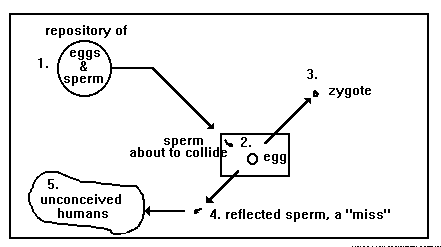
Fig. 4-1. Closeness in potentiality of five identifiable objects.
I would like to show that, if one is concerned about the potentiality of a human zygote, one must be nearly as concerned about the combination event of a sperm about to collide with an egg, shown in the small box in Fig. 4-1. This event may evolve into a zygote or, with a much greater probability, it may evolve into a reflected sperm and an unpenetrated egg (a “miss”), which is philosophically equivalent to a never to be conceived human being. Thus, the formation of a zygote is an event that is close to an imminent collision between a sperm and an egg in space-time, but the two events may not be close in terms of potentiality. Nevertheless, what is taken to be close in terms of potentiality is arbitrary and the two events in question may be close enough in the judgment of a reasonable person that he makes no moral judgment. (As in the well-known joke, the million-dollar prostitute and the five-dollar prostitute differ only in degree not in principle.) Once we have established that the potentiality of an imminent collision is close to the potentiality of a zygote, we may dismiss our concern over the potentiality of the zygote because the potentiality of the imminent collision is even closer to the potentiality of a “miss”, which has no human potential at all. (If A is close to C and B is close to C, then A is close to B. (Careful analysts will notice that this applies only in a realm under consideration where distance is defined, which may not be the case in the realm of human potentiality; therefore, the remark retains metaphorical content only.)) An imminent collision is also close in potentiality to all of the unejaculated sperm and unovulated eggs until the end of time. The situation is represented in Fig. 4-1. It would be madness to be concerned about their potential humanity because the number of potential humans lost would be an astronomical number that would dwarf in magnitude the sum total of all other events in the history of humanity.
Let us estimate the number of lost potential human beings to date. Suppose we assume that half the people who have ever lived are alive now. Further assume, conservatively, that each human has only twenty years of potential procreativity. Finally suppose that each female has 1 egg per month ´ 12 months per year ´ 20 years = 240 eggs and each male is capable of ejaculating 367.5 million sperm, which is about average, five days a week for twenty years, i.e., 5 ´ 52 ´ 20 ´ 3.675E108 = 1.911E1012 sperm. Since every sperm may have combined with any one of the eggs depending upon accidents of birth etc., we have 5.0E109 males ´ 1.911E1012 sperm per male ´ 5E109 females ´ 240 eggs per female = 1.15E1034 potential humans per generation. Suppose my result is too high by a factor of a ten thousand. We must still contemplate ten to the thirtieth power potential humans who could have been born but were not born. That’s a million million million million million. We don’t mean that they all could have been born, but that any one of them could have been born. (We haven’t even taken into account all the possible ways in which the genetic material of the gametes may combine, each combination representing a different potential human being.) The only concern we need to have concerning these potential human beings is that some people may try to arrange for more of them to be born to satisfy the yearnings of childless couples, for love or money; and, of course, to satisfy the insatiable curiosity and greed of biological researchers. The proverb states: “Anything that can be done will be done.” Clearly, the human race can prevent some things from being done in unacceptable ways. Dissatisfied individuals are beginning to flex their muscles. Mock trials, to provide circuses for the people, are not a factor in this equation, which is about little people fighting powerful interests any way they can. I do not threaten; I predict, only, that we shall see much more of this and on a much greater scale.
I regret that I must leave up to human judgment the closeness in potential to becoming a human being of (1) an imminent collision (between a sperm and an egg) and of (2) being a zygote. I suppose that this is at the cutting edge of the debate. Some will say that the potentiality of the zygote is, in fact, certainty, i.e., that a zygote is a human being. I find it far-fetched to imagine that a human being is a one-celled creature or that a one-celled creature is a human being. If we could agree that it is not, it would be easy to argue that an extremely undeveloped fetus is not a human being either. I believe that in order to have a soul one must have memories, hopes, dreams, and reflections; and in order to be considered a human being one must have a soul. Thus, in my philosophy, zygotes and very young fetuses are not human beings even though they are human zygotes and fetuses. (To avoid the difficulty with the word being I could refer to a human person instead, as I recognize animals as people, but, of course, not human – fortunately.)
The religionists, on the other hand, believe that the soul has supernatural origins and can be implanted in the fetus without the fetus having had experiences. But, the imposition of religious beliefs upon the general public is precisely what is prohibited in the first clause of the First Amendment. The second clause protects the free exercise of religion, which guarantees that no one may be required to have an abortion, but it also guarantees us the right to take the drugs of our choice. In my opinion, the reason that the nation is so screwed up is that people making important decisions have not taken enough drugs. Imagine that! (“Turn on; tune in; and drop out!”)
August 13, 1992
19. Newcomers to this world have a right to expect to find a rational society governed by rational morals.
This was stated in Chapter 1 in the section on the social contract.
20. Human beings belong to themselves. No one can assign an extrinsic purpose to another individual.
This was established in Chapter 3.
21. We agree that our laws, if we have any, should be congruent with rational morals. If we do not have laws, our behavior should be governed by rational morals with which we have been indoctrinated as small (pre-reason) children.
This is proved in some of my older essays. Also, it was argued in Chapter 1.
22. We accept the three moral axioms including the definition of “imposing upon the freedom of another human social link”.
The prohibition of business and commerce (and the concomitant introduction of wealth-sharing) is the only aspect of my moral axioms upon which I expect widespread disagreement. Even the reasoning about one child per person (the Token Theorem) will be widely accepted soon enough that the population will stabilize at ten billion by 2050 – I hope.
Definition (“imposing upon the freedom of another human social link”). If an action interferes with the freedom of another social link, but it would not if the members of that link adjusted their mental outlooks appropriately without any other adjustment being made, no violation of Axiom 1 has occurred; i.e., this is not a case of “imposing upon the freedom of another human social link”. Only if the victim’s outlook is irrelevant, is the perpetrator guilty of “imposing upon the freedom of another social link”. The point is that we disallow imaginary offenses.
Comment. The previous definition explains why this code of morals forbids trade and so-called reproductive rights, but does not forbid taking drugs and having whatever forms of sex one pleases (so long as an axiom be not violated). An extremely compelling reason for accepting my interpretation of the Freedom Axiom as opposed to the interpretation of the Libertarian Party, say, is that my interpretation eliminates all, or at worst nearly all, of the problems that plague society, whereas the interpretation that tolerates commerce, for example, exacerbates them. It is no use claiming that the prohibition of business is tyranny, because, if anyone engages in business, no one is free. This will be proved by explicit examples in the sequel, even though the a priori reasoning given in Chapter 3 is conclusive. (“It is impossible to provide an excessive number of proofs of a proposition that no one believes.”)
23. We assume our three moral axioms can be used in a reasonable fashion to define rights and, in turn, justice.
This is obvious and, for that matter, we have done it. It could be dropped as an assumption.
Definition (Rights). Rights are (i) freedoms that don’t violate accepted morals and (ii) entitlements that are guaranteed by accepted morals.
Definition (Justice). Justice is the state of human society wherein one of two conditions prevails: (i) all relevant moral requirements have been met or (ii) in case there has been a breach of morals the following events have occurred: (a) the damage due to the breach of morals has been repaired and restitution has been made to the victim(s) and (b) the violator has been dealt with in an appropriate manner, which might not involve punishment or revenge.
24. We assume that all rational morals can be derived from our three moral axioms without grey areas arising. Such morals will be consistent and withstand the tests of aesthetics, reasonableness, and utility.
In this essay we assume that a rational code of morals can be derived from the three basic moral axioms presented in Chapter 3 and that that code of morals can be the basis of, if not identical with, the laws that govern society, which laws, as discussed above might be derived automatically by an inference engine, perhaps as the need arises, i.e., to determine if a proposed action is legal or not. This would eliminate the need for lawyers, legislators, and, for all practical purposes, judges. (It is difficult to see, though, how we could dispense with individual good judgment any time soon, nor do I see any reason why we should want to. It is more likely that we could dispense with the inference engine. One of the functions of an education is to facilitate the congruence of individual judgments with the dictates of reason.) In a modern world with humanized, low-energy technology, people can make their wishes known on any question of public procedure directly, by means of a computer and a modem (or even a touch-tone phone, which might as well be a computer); they do not need representatives to vote for them. [Lately (1991), Rob Lewis [15] has posed an objection to this idea, but I don’t think his objection would be insurmountable in a cooperative society.]
25. We reject arbitrary, personal, or taboo morality as a basis for public policy.
We have said enough about this already. What is more to the point, many other authors have said even more. Bertrand Russell solved the problem of sexual prudery decades ago. My essays on drugs in Vol. 1 of Ref. 2 and occasional comments on sex should help. At this writing I do not know if there will be an essay on sex in Vol. II or III of my collected papers [3]. Obviously, my moral system does not consider sex immoral unless the Freedom Axiom or the Truth Axiom be violated. I hesitate to give an example of how far I will go in my sexual permissiveness, as I can offend nearly every twentieth-century person with my wildly inventive liberal imagination.
26. Unverified events whether taking place exclusively in the Universe, our Minds, in the realm of the Ideals, or in the Relations or not are excluded from the discussion of public policy – just as they would be discarded as evidence in a legal hearing.
Any knowledge based on events that cannot be replicated or observed by impartial observers under any circumstances whatever are to be excluded from discussion of public policy. This prohibits the introduction into public policy of the miracles ascribed to certain religious figures and the religions or religious beliefs based upon them.
Social Change
27. We shall assume that a social system that retains residual institutionalized injustice is unacceptable as a basis for permanence.
A social system that retains residual institutionalized injustice must be rejected as an ideal. If we can show that injustice, at least institutionalized injustice, can be eliminated, then we must not rest until the goal of eliminating institutionalized injustice is achieved. It is unacceptable to say, “The world is unfair,” as though it always will be. One of the primary goals of mankind should be to ensure justice for everyone, everywhere, including plants and animals, therefore it was necessary to define justice as the state of human society wherein one of two conditions prevails: (1) all relevant moral requirements have been met or (2) in case there has been a breach of morals, the following events have occurred: (a) the damage due to the breach of morals has been repaired and restitution has been made to the victim(s) and (b) the violator has been dealt with suitably. Injustice is deviation from justice.
Condition 2b of the definition of justice raises the question of punishment and revenge. Undoubtedly, revenge is the least attractive feature of the concept of justice. We would prefer not to see the issue arise. Usually, it represents a foolish attempt to make a “right” out of two “wrongs”. In Chapter 3, we discussed at length the meaning of “dealt with suitably” under each of the following circumstances: (i) the transgressor accepts our moral code and (ii) he (or she) does not.
28. I assume that at least one hypothetical feasible path of constant improvement connects this society with a cooperative (ideal) society.
This is an extremely important assumption and I make it in the
first person. Further, I assume that our present world, W, is already the
same as the world 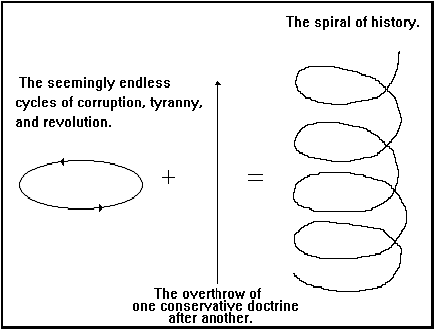 in which the theories of Deci
and Ryan hold or theories close enough for our purposes obtain. Further,
as soon as the overwhelming majority of people accept these assumptions or
equivalent ones, this world will have evolved into W
in which the theories of Deci
and Ryan hold or theories close enough for our purposes obtain. Further,
as soon as the overwhelming majority of people accept these assumptions or
equivalent ones, this world will have evolved into W , which is the name
we give to such a world. Later on we shall attempt to prove that this
world can evolve into W if and only if we abandon
materialism, therefore the reader should scrutinize these assumptions carefully
and, in addition, look for hidden assumptions.
, which is the name
we give to such a world. Later on we shall attempt to prove that this
world can evolve into W if and only if we abandon
materialism, therefore the reader should scrutinize these assumptions carefully
and, in addition, look for hidden assumptions.
Human Society in Historical Times
At this point in the essay I wish to make an important observation, which, if it is in doubt, will have to be considered an assumption. If it is not self-evident, it is a crucial assumption as I shall base about half of my political philosophy upon it. To wit: the history of human society can be characterized by two major tendencies. (The first tendency is the seemingly endless cycles of corruption and revolution, i.e., government becoming sufficiently corrupt that revolution, usually under the guidance and perhaps genius of a charismatic leader, is the only reasonable course. “Every revolution is hopeless until the night before it occurs.” The tyranny, however entrenched, is overthrown and a new and more just regime takes power. Regrettably, power corrupts and yesterday’s charismatic and heroic leader becomes the new tyrant who quite generally needs to be overthrown himself (or occasionally herself) after a not very long period of relative grace. This is an unsatisfactory way of carrying on for all the obvious reasons.
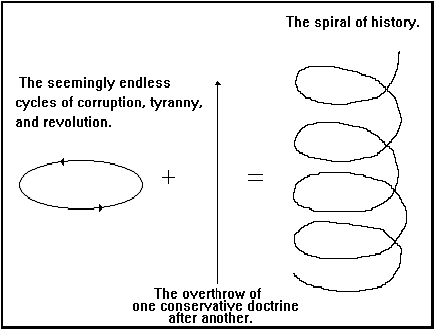
Fig. 4-2. The Spiral of History.
The second major tendency is the overthrow of one conservative doctrine after another. This may, in fact, represent overall long-term improvement or it may not. The overthrow of the conservative doctrine that heavier than air devices will not fly has not been particularly felicitous from my view although I am certain that the majority will disagree with me even after reading Chapter 2.
The combination of these two tendencies ensures that history does not repeat itself as indicated in Figure 4-2.
Problems and Solutions
Every problem that is stated in such a way that it makes sense can be resolved satisfactorily in one of several ways: (i) by proving that no solution exists, (ii) by finding a unique solution, (iii) by showing that multiple solutions exist, determining how many, whether it be a finite or infinite number, and exhibiting some or all of the solutions. A less satisfactory resolution is to show that we will never know whether a solution exists or not. A solution might exist, but the probability of finding it might be zero. All the levels of uncertainty above and beyond that level of uncertainty represent increasingly less desirable resolutions of the problem.
Schumacher [16] engages in a lengthy discussion concerning what he calls convergent and divergent problems. Divergent problems are presumed to have no clear-cut solution; they are in what we call the “grey area”. Divergent problems arise because of trade-offs one is forced to make between irreconcilable opposing principles, such as the principle of law and order and the principle of freedom. I believe in divergent solutions, but I do not believe in divergent problems. I believe these conflicts arise because one is employing the wrong principles or one is employing the right principles but the principles have not been stated sufficiently sharply. I believe that, outside of mathematical constructions, one can always find a higher principle with which one can adjudicate unambiguously between opposing lower principles. Principles conflict because we are not employing the right principles. True divergent problems, in the sense of Schumacher, turn out to arise from trying to do things that should not be done. This requires a tremendous leap of faith, equivalent to belief in God even. No proof of this is forthcoming. The best we can do is give as many examples as possible to show how the principle works in practice. In Chapter 3, I stated that my system of three moral axioms eliminates grey areas. However, the reader is invited to construct a thought experiment (hypothetical circumstance) that is not covered by my moral system. Then, as an exercise, he may show that he is mistaken. Although it is no substitute for a proof, I will send a box of fruit to anyone who can stump me. Remember, I am permitted to reject the circumstance if it could not arise in a society with no artificial economic contingency. I offer a similar challenge with respect to “divergent problems” mutatis mutandis.
We know that one cannot trisect an arbitrary angle, in plane geometry, with the aid of a ruler and compass only. We cannot nor will we ever. Of course, we can trisect a 270° angle, but that is not arbitrary. In one sense, the impossibility derives from the fact that there is no integer that when multiplied by three equals two raised to an integer power; i.e., there is no integer N (....-3,-2,-1,0,1,2,3,....) such that 3N equals two squared, or two cubed, etc. In another sense, the impossibility is of the same nature as the impossibility of being dealt five aces from a standard 52-card deck. We cannot solve nor will we ever be able to solve arbitrary quintic polynomial equations and polynomial equations of higher degree by simple rational processes such as we use to find the roots of quadratic equations, that is, by adding, subtracting, multiplying, dividing, and taking roots. (Of course we can solve x5 - 1 = 0, which is not an arbitrary quintic polynomial.) We have proofs of the two impossibilities mentioned.
However, no proof has ever been supplied for the impossibility of performing a given physical feat, let alone solving a social problem. Even travel faster than the speed of light in a vacuum, which is supposed to be a fundamental constant of the universe, depends on the correctness of this extremely crucial (assumed, not proven) premise of the special theory of relativity. Although the special theory of relativity is almost certain to be overthrown eventually, this particular premise may, in fact, be true in spite of everything. In this work, we have faith that the problems of humanity have solutions, not necessarily unique. If someone believes that no solutions exist, he (or she) should try to supply a proof.
One Step at a Time
I believe that at least one feasible path of constant improvement exists connecting this society with a cooperative society. The nonexistence of that path requires a proof. Such nonexistence proofs are very difficult to find, however. If we construct such a feasible path, even in a valid thought experiment, we will have proved its existence within the space of all possible worlds in space-time.
This path of constant improvement can be traversed by a long series of small steps. The end, normally, does not justify the means, therefore each step should be an improvement. Thus, we should not permit leaders to guide us on this path. Strong leadership would be a step backward and any leader may become dangerously strong if we rely upon him or her. We must rely upon ourselves – sharing responsibility equally and isocratically according to the methods outlined in this thesis. A generic world-bettering plan described in the text is assumed to be possible under this restriction. There are no “divergent” problems (in the sense of Schumacher). (This is a huge assumption and I make it in the first-person singular.) More than any other assumption, this assumption requires a leap of faith – in humanity. Thus, this philosophy, like every humanistic philosophy, is essentially – a religion – a minimal proper religion. We shall require a Grand Social Experiment to see if it might be true; but, if the first such experiment fails, we shall have to try again. Any other course is unacceptable to me and to some of my fellow humanists.
When the End Does Not Justify the Means
[A] corrupt tree bringeth forth evil fruit. – Matthew 7:17
It is an article of faith in this system that the end does not justify the means if the means be evil. Jeremy Bentham [12] takes the idea that the end justifies the means to be a fallacy of confusion that appeals to judgment (ad judicium), i.e., to bad judgment, except under the following conditions, all of which must be satisfied: (i) the end be good, (ii) the means be either purely good, or, if evil, having less evil in them on a balance than there is of real good in the end, and (iii) the means have more of good in them, or less of evil, as the case may be, than any others which might have been used to attain the end – to quote Bentham loosely. I have some difficulty in accepting (ii) and (iii). I do not see how the evil in the means can be compared to the good in the ends nor how the evil in one set of measure can be compared to the evil in another in the general case. The deeds of men are not a partially ordered set in the mathematical sense and, therefore, the relations “less than”, “greater than”, and “equal to” do not make sense when applied to them. Under very special circumstances, for example, when the end is to save the lives of n men and the means is to sacrifice the lives of m men, where m is less than n, the conditions apply for the very reason that they do not apply in the general case, namely, that human beings do not belong to partially ordered sets either, so it is not possible to assert that the lesser number of men can be superior or worth more than the greater number. In the absence of any way to evaluate the worth of the men, one must assume that it is better for fewer to die than for more to die, all other things being equal.
I take it as an article of faith, and, I suppose it must be considered an article of religious faith, that good does not proceed from evil, that the spiritual nature of man is such that the results of evil acts are generally even more evil. I cannot prove this. It is merely an empirical law to which I cannot recall seeing an exception. Let’s look at an example. While it is true that prohibition permitted the ruling class to become more integrated racially, I do not perceive this as a good upon close inspection, as the existence of the ruling class is itself an evil, despite the fact that no race has a better right to belong to it than another. Thus, each apparently worthwhile end that justifies evil means turns out, on close inspection, to be corrupt. That is what I believe.
A Generic Evolutionary World-Bettering Plan
Given that it has been decided that our social-political-economic system is to evolve into a system that will provide a permanent basis upon which we can build, it is necessary only to characterize the nature of our world-bettering plan. The four tasks that must be accomplished to initiate any evolutionary world-bettering plan are: (i) characterizing the tentative “ideal” or target world, which is provisional and subject to updates, (ii) proving by thought experiments, computer simulations, sociological experiments, and by construction that there exists a feasible path of gradual and continuous improvement (actually, upon close inspection, a large number of jumps, most of which would be characterized as quantum leaps in the vernacular) connecting this world with the ideal world, (iii) convincing people that the results of (i) and (ii) are correct, and (iv) embarking upon the path. Without an ideal to which we can refer we would never know what the next social change should be since we would never know if we were getting closer to the ideal or not, the views of Popper refuted in Chapter 1 notwithstanding. I favor social evolution through thousands of small, but significant, changes, of which all are in the right direction. [Actually, some of the changes I recommend, e.g., canceling all foreign debt, would not be characterized as small by most people; but, in terms of the complete history of humanity, they would have to be considered small.] As discussed above, I do not believe that the end justifies the means. Also, the process must be adaptive, i.e., sensitive to new information. The evolution of this badly flawed world into an “ideal” world, then, is the means by which the problems of mankind are to be solved. In this work, it is assumed that this is possible.
The World W*
The (hypothetical) world where all of the preceding assumptions are accepted or believed to be true, whichever is appropriate, by nearly all of the people or, if possible, have been proved to be true is known as W*. In W*, assumptions touching upon the actual state of affairs in the universe have been tested and found to have a high probability of being true. In Chapter 5, we shall attempt to prove that this world W, assumed to be the same as W′, can evolve into W* if and only if we abandon materialism. I hope that the reader of this book will conclude that this statement is true and act accordingly. I hope to change first your minds then your lives. W′ is a world that involves assumptions about human nature, assumptions that are capable of being proved or falsified. W* is a world that depends somewhat upon what is true, but it depends to a much greater extent upon what people believe – about what people believe is permitted as well as what people believe is so, in short, what people are willing to agree upon.
The World W″
The world W″ is a hypothetical world that resembles W′ , except that in W″ three additional conditions are met. We have no idea if these conditions will be satisfied ever, let alone by 2030 or 2050 when we shall desperately need them to be satisfied. Otherwise we are looking at unspeakable misery in the near future. To determine if these conditions can be met and, then, to meet them should be the primary preoccupation of the present generation. The vast differences in the nature of the assumptions or evidence that lead to the worlds W′, W*, and W″ should be obvious to the reader. The characteristics of W″, then, are:
1. The Characteristics of W′
2. A Stable (Human) Population
The population will be stable at about ten billion human beings or, preferably, closer to the optimum population size, i.e., a sufficient number of people that succor from one’s fellows is available when needed, not so many people that the quality of individual lives is appreciably reduced, the opportunity for as many people as possible, consistent with the previous two conditions, to be able to enjoy the blessings of having been alive.
3. Adequate High-Grade Renewable (Sustainable) Energy
In W″, renewable energy technology adequate to provide the energy per capita equivalent to one kilowatt-hour per hour of 110-volt 60 Hz AC will be available. This is the standard for emergy calculations, therefore we have one emergy unit per hour per capita.
4. Sufficiency of One Kilowatt Per Capita Emergy Budget
We assume that every human being can live on 1 kWhr/hr – or simply an average rate of consumption of emergy units equivalent to 1 kW of 110 AC, 60-Hz electricity. (Since this is based on power plant electricity, it represents more energy than 1 kWhr/hr. For example, if half were coal and the rest electricity, the rate of energy consumption would be about 2 kW.) This per capita rate of emergy consumption is assumed to be adequate for a satisfactory life wherein happiness for everyone is possible if not guaranteed. The matching problem, providing lower grade energy to those uses for which it is adequate (optimal) so as not to lose availability converting lower-grade energy to higher-grade energy that is not needed, has been solved. This was discussed in slightly more detail in Chapter 2.
We have no idea if these conditions can be met in time. I must insist that to determine if these conditions can be met should be the highest priority for technological research. Every other topic is of much less importance – unless I am badly mistaken. It is my intention to belabor this point wherever I can and to continue to ask that this research be done even if I have to do it myself for which I would need about ten million dollars – a mere pittance. (I estimate the manpower requirement at about 200 man-years. I believe I could manage 100 undergraduates, graduate students, and post-docs, who must be completely committed and incapable of making the slightest uncorrected error.) The adequacy of one kilowatt per capita of emergy has been assumed. I can’t believe that primitive people are that much more intelligent than are we – such that they can be happy on much less than one kilowatt and we cannot be happy on one kilowatt. I agree that I am leaving our desire to live forever out of the equation!
September 28, 1990
Revised August 13, 1992
Revised July 21, 1993
Revised completely September 24, 1995
Revised completely December 11, 1996
Revised July 3, 1997
References
1. Baggott, Jim, The Meaning of Quantum Theory, Oxford Science Publication, New York (1992).
2. The Random House Dictionary of the English Language, Lawrence Urdang, Editor in Chief, Random House, New York (1968).
3. Wayburn, Thomas L., The Collected Papers of Thomas Wayburn, Vol. I, American Policy Inst., Houston (1996), and The Collected Papers of Thomas Wayburn, Vol. II and III, American Policy Inst., Houston (Work in progress 1997).
4. Gatto, John Taylor, “The 7-Lesson Schoolteacher”, The Truth Seeker, 118, No.4 (1991).
5. Piaget, Jean, The Origins of Intelligence in Children, Int’l. Universities Press, New York (1952).
6. Deci, Edward L. and Richard M. Ryan, Intrinsic Motivation and Self-Determination in Human Behavior, Plenum Press, New York (1985).
7. Deci, Edward L. and Richard M. Ryan, “A Motivational Approach to Self: Integration in Personality,” Nebraska Symposium on Motivation 1990, Dept. of Psychology, University of Rochester (1991).
8. Condry, John, “Enhancing Motivation: A Social Developmental Perspective”, in Advances in Motivation and Achievement, Vol. 5: Enhancing Motivation, Eds. Martin L. Maehr and Douglas A. Kleiber, JAI Press, Greenwich, Connecticut (1987).
9. Smith, Adam, The Wealth of Nations, The Modern Library, New York (1937).
10. Wisman, Jon, “Pour une Economie Appropriee: Une Conception de l’Homme Appropre,” The Human Economy Newsletter, 11, No.1 (1990).
11. Smith, Adam, The Theory of Moral Sentiments, Garland, New York (1971).
12. Bentham, Jeremy, Bentham’s Handbook of Political Fallacies, Ed. Harold A. Larrabee, Johns Hopkins Press, Baltimore (1952).
13. Lakatos, Imre, Proofs and Refutations, Cambridge University Press, New York (1976).
14. Popper, Karl, Conjectures and Refutations, Harper, New York (1965).
15. Lewis, Rob, "Pursuing Democracy", SA: An Opinionated Journal of Opinionated Essays, 1, No.1, (1991).
16. Schumacher, E. F., Small Is Beautiful, Economics as if People Mattered, Perennial Library, Harper and Row, New York (1973).
Chapter 5. Materialism
To walk in money through the night crowd, protected by money, lulled by money, dulled by money, the crowd itself a money, the breath money, no least single object anywhere that is not money, money, money everywhere and still not enough, and then no money, or a little money or less money or more money, but money, always money, and if you have money or you don’t have money it is the money that counts and money makes money, but what makes money make money? – Henry Miller, Tropic of Capricorn
Models of Society
Unified Theories
We would like to understand the behavior of the universe and the behavior of man in terms of unified principles. In physics, the quest for a Grand Unified Theory that explains the fundamental forces in terms of a more or less simple, but unified, underlying geometry is an example of this search for unity. In metaphysics, generations of thinkers have tried to identify a single metaforce that accounts for all of man’s proclivities. (If in physics we refer to forces and powers, which are, after all, technical terms, in metaphysics we should, by analogy, refer to metaforces and metapowers.) In this paper, I would like to construct a model of society that is as unified and as simple as it can be but, in keeping with Einstein’s stricture, not simpler.
Toward a Unified Model of Society
In the previous chapter we postulated that the history of man in society can be constructed by taking the (vector) sum of two prevailing tendencies, namely, (i) the seemingly endless cycles of reform and corruption, associated, in this theory, with man’s insistence upon being led by powerful charismatic heroes as leaders and (ii) the overthrow of one conservative doctrine after another, not always with felicitous outcomes, e.g., the overthrow of the doctrine that earth is the center of the universe is at least partly responsible for the immoral, ill-advised, and patently absurd agenda to send human beings into space and to colonize extraterrestrial territories. This is discussed in an essay “On Space Travel and Research”. As diagrammed in Chapter 4, the (abstract) vector sum of these two tendencies is a spiral – like the spiral in a spiral notebook with time running from the bottom to the top of the spiral notebook parallel to the edge. See Figure 4.2. We now seek a model of society as it is presently constituted.
In keeping with our love of unity, we would like to find a single principle upon which a model of society can be based. It does not seem to make much difference whether that principle be negative or positive. It is often said, on the one hand, that money makes the world go ’round, while, on the other hand, money is the root of all evil. (“They” say “the love of money”, but “they” might just as well say “money itself”.) Thus money is the motivation for both the good and the evil in the world according to this reasoning. If the prime mover be sex, the same observation holds. Sex causes a great deal of mischief, but we would not want to live in a world without it. In the following paragraphs, I shall touch upon a number of theories that are supposed to account for the behavior of humanity, but I shall end up assigning all of the evil to a single source of all human immorality, where immorality is taken to be that which we cannot tolerate aesthetically or pragmatically. I claim that, unless this “cause” of social disorder be removed, society will not achieve the goals advocated by my theory, namely, freedom, equality, justice, happiness, and permanence. (I place the word cause in quotation marks to signify that causality itself is in doubt, but the coincidence of systemic social defects and undesirable social consequences is not.)
Psychoanalytic Models
We might begin by noting that a number of models of society are based on psychoanalytic theories due to, for example, Sigmund Freud, Carl Jung, and Wilhelm Reich. These theories usually suggest that something has happened to us at a very young age that has shaped our lives ever since. Presumably, the catastrophic events occurred before we were able to make reasoned judgments about the information we were absorbing. Many readers are better qualified to comment on these theories than am I, since I have abandoned them years ago after some first-hand experience with the proponents of the more prominent ones. Behind each theory is the idea that, if some inner disturbance within the individual were removed, all conflicts (or most important conflicts) in living would vanish. This may indeed be true if the inner disturbance could be removed simultaneously from every participant in social action. The defect in any theory that concentrates on the improvement of the individual is that the improved individual will be living in an unimproved social system. In effect I shall be asking that at some time in the future essentially every member of society be disabused of certain irrational and untenable notions, but I fail to see why this is a medical problem and, even if it is viewed simply as a psychological problem, how the relief of only those who can afford the treatment will allow everyone to live in a satisfactory world. Nor do I see the practitioners of these methods advocating that those who enjoy power abandon it. On the contrary, most psychiatrists and clinical psychologists are working as hard as they can to become members of the powerful and privileged class.
Mechanistic Models
It might be argued that human beings are essentially machines that are driven by their own DNA to do whatever is necessary to replicate that DNA to the greatest extent possible. Thus the DNA forces us to be competitive and the competition causes all of our difficulties as well as our survival. This is an attractive theory in that it does not invoke magic. However, it neglects completely the spiritual nature of man, which clearly exists, but, in this theory, is supposed to be a simple extension of a mechanism. According to this theory, we would not be able to save the world, because our DNA is incapable of absorbing the necessary conditions for survival. DNA is, after all, only a molecule – not a mind. I think that the “desire” of the DNA to replicate itself can be a useful model to explain some aspects of human behavior; but, since it leaves us without hope, I am forced to abandon the theory before I examine its ramifications in depth. I must suppose that human beings possess minds that are capable of analyzing the tendencies of the DNA and either accepting or rejecting them.
Religious Models
The (improper) religious models of society will be discussed in some detail later on, but they can be rejected here because they do not provide a rational basis for society upon which all rational persons can agree. In fact, the most distinctive characteristic of (improper) religious views in general has been the wide disparity of belief, which, from time to time, results in copious bloodshed and the most disorderly and undesirable human behavior described by historians. If this behavior were necessitated by a divine intelligence, we would be in no better shape than if society were governed by unthinking molecules. [A critic might object that all of the DNA molecules working together engender thought, but that remains to be shown.] Models based on our failure to obey religious taboos must be rejected as irrational, and organized religions rarely preach seriously against the violation of rational morals. This essay, preaches rational morality.
Most particularly, in this essay, we must reject the notion of original sin, which requires man to earn his living “by the sweat of his brow” as a punishment for the misbehavior of some original ancestor whose misdeed has been carried along by our DNA. (The notion that habitual misbehavior is learned by children from their parents should probably be dismissed because no religious prophet of whom we know advocates the separation of children from their parents at birth as an expedient to breaking the chain of our supposed sinful nature. Of course, it must be admitted that, if children were separated from their parents, it is not easy to see how they would learn to speak without associating with some adult or other who, presumably, is not without sin. Nevertheless, I am sure the reader can imagine a number of methods for accomplishing this, perhaps by the use of computers, and, who knows, someday such methods might be tried.) Even if the notion that bad behavior is learned from our parents be allowed, we must reject the work ethic, which is derived from the concept of original sin, because of its many drawbacks (other than having no scientific basis), namely, its responsibility for human suffering and its high impact on our environment. This is discussed in detail in my essay “On the Work Ethic”.
Models Based on Sex
Models of society based on sex fit into the above models, but a paragraph devoted to sex alone is in order. Perhaps man is dominated by the desire to have sex with desirable women. Perhaps he attempts to acquire power (or wealth, power, and fame) for this purpose alone. I believe I have heard of powerful corporate executives excusing marital infidelity on the basis that without it all of the power they have accumulated would have been wasted. After all, even ordinary men can have sex with their wives! On the other hand, people who are deprived of sex often exhibit deplorable behavior. Perhaps the sublimation of sex can result in a great artist or an insane tyrant. The effects seem to be unpredictable. In at least one psychoanalytic theory, cf., Reich, they are almost always bad. Perhaps, the evil in the world can be explained by the obsession of religions with sexual prudery.
Almost no one (in our culture) is capable of observing the sexual restrictions imposed upon him by the religion into which he was born. This can result in terrible guilt and moral confusion. Perhaps, sexual prudery perverts our normal sexual function so that it transforms itself into a horrid “will to power”, like Dr. Jekyll transformed himself into Mr. Hyde, which, in turn, leads to social disorder and human misery. Alternatively, we could take the desire of men to dominate each other as the fundamental flaw, which leads to political and religious systems that repress human sexuality to retain power. In either case, the animal aspect of our nature atavistically overpowers our humanity; but, in the first instance, it harms us because we attempt to repress it; and, in the second, because we do not. In this essay, we assume that we can overcome our so-called will to power.
Models Based on Race
It is possible to analyze society in terms of race. The white race dominates the world. Perhaps not all of humanity is so deeply flawed as is the white race. If only the world were dominated by Africans or Asians, so the theory might go, the world would be well-ordered and society would be harmonious. I am certain, if one looks hard enough, one can find an advocate of the policy of eliminating the white race. My experience of race, though, is to note the similarities under similar circumstances, although I do recognize differences in the races. Indeed, I believe society is too much oriented toward the psyche of the white man and is dominated too much by European culture. Nevertheless, what creates the humor in the movie Putney Swope is the reasonableness of the notion that, if African-Americans were placed in positions of power held by the richest members of the white race, they would behave nearly as badly.
Models Based on Gender
In the above discussion I emphasized man and the white man at that. Many people, who, I suppose, must be classified as feminists, believe that it is the domination of society by the male gender that is the heart of our problem. Men are aggressive, start wars, lust for power, especially power over women (as many women as possible, it could be argued), and, in general, do all the nasty things of which I have been critical. I agree. But, it is not at all clear to me that women are exempt from bad behavior and for the same reasons. Women seem to be all too willing to indulge in the fight for wealth and power, nor is it clear that they do it all for love. It may or may not be possible to reject the desire for love as the fundamental driving force in society simply because women do not do the same things for love as do men.
On the other hand, this difference does tend to give some credibility to feminist theories. In general, I am suspicious, though, of a theory that is based on asymmetry rather than symmetry, but that is by no means sufficient grounds to reject feminist theories. As I understand the situation, feminist theories do not reject the domination of one person by another, only the domination of women by men. Some feminist theories apparently go so far as to advocate the domination of men by women. I find it difficult to believe that the world would be very much improved by reflecting it across the line between genders, but I shall keep an open mind.
Models Based on Sexual Orientation
Clearly, it is possible to develop a theory similar to feminism based on an attack of heterosexuality. The charge that without heterosexuality there can be no posterity would be easily answered by such theorists. I am certain that I would find difficulties with such a theory if I should ever hear one propounded; but, again, I would be forced to keep an open mind.
Other Models
I have heard it explained that, rather than all of Western civilization, it is the drug of choice of Western civilization, namely, alcohol, that is the problem. Perhaps, if we all smoked marijuana or ate hashish, society would be based upon cooperation rather than competition. Theories based on duty, or the neglect of duty, have been propounded too. I hesitate to mention theories based on primitive myths or the positions of heavenly bodies. The theory propounded here does not absolutely exclude all of these other models, but concentrates, instead, on artificial economic contingency, which leads to competition for status, and the moral bankruptcy of the institutions of money and – what is eulogistically termed – leadership. Thus, we should consider economic models of society.
Economic Models
The Adam Smith economic model asserts, essentially, that every member of society is engaged in making economic or market decisions that favor his or her own welfare and that the combined effect of this is to encourage those activities to be carried out that most favor the common good. This theory suffers from two major defects. The first is that it does not assign any value to the work done by nature in providing the economy with natural resources, particularly sources of high-grade energy such as petroleum. The result of this defect is that natural resources including energy reserves are exhausted as quickly as they can be. The second defect is comprehensive, namely, that this theory permits the perpetuation of every evil enumerated in this essay.
Marxist theory [1] recognizes the existence of class warfare and has predicted correctly the mass migration from the countryside to overcrowded cities where armies of employed and unemployed workers accumulate, often under deplorable conditions of poverty. The remedy it proposes suffers from the necessity of the creation of a massive bureaucracy that tends to be self-perpetuating rather than self-abdicating. Also, Marxism requires the ascendancy of the working class to a position of power; but, in reality, only privileged members of the working class may hold power; and, as soon as they do, they no longer belong to the working class. It is not at all clear what is meant by “the dictatorship of the proletariat” or why it should be any more helpful than other modern institutions.
The emergy theory of H. T. Odum [2] was propounded in Chapter 2 “Emergy, and Economics”. Professor Odum has used his theory primarily to study ecological systems and he does not reject the marketplace utterly. I have employed his theory to show that we need an economic system that encourages as little consumption as possible rather than the reverse.
Ignorance and Falsehood
Whatever the cause of our moral retardation, we are unable to overcome it because we are mired in superstition, which prevents us from extricating ourselves from our moral predicament by the force of our minds, i.e., by reasoning. Whether it be a faith in the supernatural, in religion with its taboos on sex, and, by extension, on drugs (because we see drugs as essentially sexual), or a faith in free-enterprise or Marxism or psychology, we somehow find a way to repress our imaginations and prevent ourselves from thinking unfettered thoughts and, perhaps, catching a glimpse of ourselves as we really are. We continue in error because we think that the fundamental philosophical questions have been answered for all time. We cut off our opportunities to save ourselves because we think that we have already been saved, by religion, by science, or by politics.
We imagine that we need only make a slight adjustment in our social systems and everything will be all right. Some think science is the answer; others religion; still other imagine that The State can solve our problems. All of our institutions have come up short, but we would rather wallow in our ignorance than admit that everything we believe about ourselves is wrong. Without giving up what we have learned about nature, we must recognize our self-ignorance and open the door to a new round of inquiry. The door is locked tight with the key guarded jealously by everyone who has the power to do so. If this state of affairs persists, the human race is doomed.
Artificial Economic Contingency and Materialism as a Model of Society
In Chapter 1, materialism (M) was defined to be the belief, or any system based on the belief, that people should compete for material wealth or power or fame and that material wealth or power or fame may be used as a reward for achievement or good behavior or as a measure of success. Any system or belief that permits people to influence the amount of material wealth they themselves may consume or possess privately or power that they may wield because of who they are or what they do or because of any aspect of their beings – any social, political, or other circumstance that can result in a relation between (i) what people think, say, or do; or who they are, or who their parents are and (ii) their wealth or power – is classified as materialism even if competition is not involved.
Ultimately, competition is involved – at least indirectly, because people who are deprived of the necessities of life must compete for them and those who equate wealth with status must compete in the money game. In fact, as long as materialism exists everyone will have to compete in the money game – at least from time to time. If those who inherit wealth wish to keep it, they must contend with the predators who wish to make certain that they don’t. For many years, I used the term competitionism in preference to materialism. Indeed, competition for wealth and power is at the center of materialism.
Fame is a little different. Anyone can become famous by going over Niagara Falls in a barrel, eating all of his children, or discovering a Unified Field Theorem. But, if that fame is converted to wealth or power over others, we have materialism; otherwise not.
The term artificial economic contingency (AEC) is used to express the dependence of people’s economic well-being on factors other than the weather or so-called acts of God. We agreed that, since AEC and M and C are synonymous terms, we may use whichever term we please. Elsewhere, we have used the initial M to stand for all three. (Occasionally, I have used the initial C to stand for competitionism, materialism, or artificial economic contingency.) In this essay, I shall attempt to show that materialism is a necessary and sufficient condition for nearly all of the evils in the world today, certainly the principal evils.
When materialism is absent, wealth is approximately equal except for minor differences that no one cares about and power is precisely equal; viz., everyone has power over himself or herself and his or her dependent children and absolutely no power over anyone else. (Power over dependent children is a special case that was considered in detail in Chapter 3.) People share wealth and power without regard to who creates wealth and no one has anything material to gain or fear from circumstances within or beyond his control. Differences in wealth and power simply are not in the picture and nobody expects otherwise. To put it scientifically, wealth, power, and – perhaps after a long time – fame, taken together as status, are absolutely uncorrelated with human behavior and circumstances. People cooperate, share, and value one another equally. This is an extremely natural state of affairs and it is only an absurd accident that has disturbed it. It is only because of indoctrination and our lack of imagination that we think our material well-being must (or should) be related to our activities. I coined the term artificial economic contingency to emphasize the noble inclination to share wealth that I hoped to find in “Natural Man”.
To attain a permanent, sustainable, essentially steady-state social environment, we must discard the institutions that foster competition for wealth and the use of wealth in the ways mentioned above. (We must discourage ambition in the sense of “earnest desire” for status.) In addition, we must reject the ancillary institutions upon which the failure of society depends. This suggestion may appear shocking, but rigorous logic leads to it ineluctably. If we reject the dictates of reason because they do not appeal to our intuitions, we must suffer the consequences, which might very well include the extinction of the human race.
It appears, then, that, among all human institutions, the institution that has played the single most important role in perpetuating evil is the institution of competition for material wealth, which led to the use of wealth, represented primarily as money, as a reward for good behavior or achievement and, in turn, as a means of keeping score in a game – an improper game, the rules of which are unwritten (and unknown to the majority of contestants), in which the contestants do not enjoy the same opportunities to score points, do not start at the same time, and for which different rules apply to different contestants.
One can assign the blame for society’s ills to sexual repression if one chooses to do so; one can claim that, if the drug of choice in the Western world were marijuana rather than alcohol, Western society would not be so barbaric; but, I hope to show that it is simpler to regard sexual and pharmacological repression as results of competition for wealth and power rather than as causes. One can identify other prime candidates for the most harmful of all the institutions of society, such as absolutist religion, government, rites of passage, irrational sexual customs, the family itself; but, it is easy to derive the major defects in society from competition for wealth. Additional models of society were discussed above.
In the remaining chapters, I shall attempt to link the problems of society to materialism (or artificial economic contingency). I must convince the reader that every (serious) social problem can be assigned to the violation of one or more of the three rational moral axioms stated formally in Chapter 3; moreover, if materialism were abandoned, these moral principles would not be violated except in trivial ways that we may safely ignore. Thus, if materialism were abandoned, our serious social problems would disappear.
Two Lists of Unacceptable Aspects of Materialism Particularly Capitalism
During the latter part of 1987, I began to wonder why so many Americans believed in the ultimate goodness of capitalism despite the many social problems that could be traced to it easily. I composed for my own purposes a list of twenty-nine difficulties with capitalism that seemed to disqualify it for the position of Economic System of Choice. Early in 1989 I purchased a copy of The Communist Manifesto [1] and read it for the first time in many years. I wondered why Marx and Engels had not discussed the difficulties with capitalism that I had noted, and for over a year I entertained the mistaken idea that my list was more complete than theirs. Lately, I re-read Chapter 1 of the Manifesto, but this time I made a list of the defects of capitalism that they had pointed out specifically. To my great amazement, Marx and Engels had discussed forty-one separate defects of capitalism, beginning with the class struggle between the bourgeoisie and the proletariat, which I listed last as the culmination of all of the other defects of capitalism, but Marx and Engels had discussed capitalism in such a unified historical context that the number of defects appears to be much smaller than it actually is. In a sense every defect seems to stem from one single defect, namely, the capitalist mode of appropriating wealth, as discussed by Engels [3].
As of this writing it is fashionable to discredit Marxism because of the economic difficulties of Eastern European Marxist regimes and the profound economic changes going on in Eastern Europe. Certainly the implementation of Marxist ideas has been badly flawed nor is it likely that the pure Marxist philosophy is without difficulties, but none of this invalidates in any way the criticisms of capitalism discussed in Chapter 1 of the Manifesto. Regrettably most of the dissatisfaction with Marxism comes from people who imagine that they will become wealthy under capitalism. Some of them will, but always at the expense of those who don’t. It is not at all clear that “all boats will rise”.
If we disregard what we learned in Chapter 2 and pretend, for a moment, that the consumption of material wealth is desirable and that money is a useful measure of its value, we can do a little thought experiment in which we estimate the material benefits to average people of rejecting experiments in Marxism (whether sincere or not) in favor of American-style market economies. If each Polish citizen, say, could sell the probabilistic expected value of the wealth that he might be able to appropriate due to the labor of others, he would be wise to part with it for about $2000 per year of income over and above the probabilistic expected salary he might obtain as a wage slave, i.e., a normal worker in a normal American-style, profit-seeking company in which he had no stock.
Approximately 50 million people will be competing for the chance to be one of about 100,000 millionaires, people whose lifetime earnings of capital created by others might amount to $30,000,000, say, or $1,000,000 per year. If we wish to convince Eastern Europeans to adopt the economic system with which we wish to replace capitalism, it would be helpful to show that dispensing with the capitalistic mode of appropriation has an expected value of at least $2000 per year per person in addition to all the other benefits that will accrue due to eliminating the defects of capitalism.
We are not trying to increase the material wealth of human beings but rather the quality of their lives, which cannot be measured in monetary terms. Nevertheless, it is likely that alternative systems can do better than capitalism even in terms of material wealth, mainly because of the inefficiencies incurred by business in dividing up the pie, which is, after all, a zero-sum game. (A zero-sum game is a collection of transactions wherein the gain by one participant is exactly offset by the losses of one or more other participants.)
I claim that materialism (M) can be disqualified on the basis of its defects just as Marx and Engels disqualified capitalism. The term materialism subsumes the term capitalism, which is only one of many forms that materialism could take. However, American-style capitalism is the only form of materialism that we know. What is amazing is that capitalism is accepted by anyone, since it has been discredited completely for nearly 150 years! In my opinion, the acceptance of capitalism has been made possible by the abuse of psychology. A rather complete list of typical social problems and their relations to materialism (M) is given in Appendix II.
The following is the list that I compiled toward the end of 1987 with some commentary added in 1990 and more commentary added in 1991. I find it interesting to compare this list with the list compiled from the Communist Manifesto, but the reader may not. Probably, Marx and Engels had not had the importance of environmental conditions thrust upon them as have we. The urgency of reform is greater now than it had been during their time. Let us consider carefully each of Marx and Engels’ observations and look for inconsistencies and other defects.
My List
The original of this list – handwritten quickly on foolscap perhaps in less than fifteen minutes back in 1987 – was the birth of this theory. The list hasn’t changed much over the years. Originally the list was conceived as a list of the drawbacks of capitalism. My contribution has been to recognize that capitalism is merely an example of a more fundamental evil, namely, artificial economic contingency or materialism, depending on how you want to think of it. I have generalized this aspect of the theory of Marx. I believe I have discovered precisely the boundary between a happy society and a miserable society. I have found necessary and sufficient conditions for sustainable happiness – in the technical sense, of course.
1) Materialism (M) causes endless cycles of boom and bust against which no one can make dependable plans. M is the cause of the wasted talent of people who begin studying a discipline when its practitioners are in short supply and who find the market glutted when they graduate. Like Items 20, 21, and 33 in the list from The Communist Manifesto (TCM).
2) People work too hard and neglect family and aspects of life other than their careers. The world has become a work camp. Many forms of work impact on the environment undesirably. Business isn’t even good for businessmen. Witness the incidence of cancer, heart disease, ulcers, and divorce among them.
3) Many people live under unreasonable expectations. Anyone can become rich, but not everyone can become rich.
4) Too much work is wasted dividing up the pie, i.e., trying to get a bigger share for oneself or one’s employer. The work of many other people is wasted as well, namely, the people who carry such people to work, fly them from place to place, build and maintain their communication systems, write their decision-making software, educate them, serve them their lunches, make their hotel beds, etc., etc.
5) The waste of many talented people whose lives are consumed in schemes for avoiding taxes, cutting a slicker deal, getting around the law, etc. is caused by M.
6) Commerce is destroying the best in our culture, for example, through TV, most of which is designed to serve commerce. An essay on how TV is destroying our values and has diminished the ability of children to learn is nearly superfluous.
7) In the rush to accumulate wealth, which our system has changed from a choice to a necessity, people must neglect many important aspects of our culture. Allan Bloom states that no university in America is capable of imparting an acceptable liberal education. In fact, there is no one left to teach it.
8) Materialism influences people’s behavior, what they study, read, what they do for a living, how they treat other people, their choices of spouses, and other things that should be influenced only by the heart and one’s natural inclinations. People try to buy love.
9) Not all forms of endeavor result in the same gain in material wealth. There are dramatic inequities. Investment bankers earn much more than mathematicians, which is ridiculous. This is better than Item 24 of TCM.
10) Materialism causes crime. Middle-class and rich people cannot go into certain parts of the city. Even the downtown business districts are unsafe at night and on weekends. Does that sound like a social system that is working! Religion, as we know it, won’t help.
11) Materialism causes poverty. People are forced to accept charity. Poverty impacts negatively even on the wealthy who must breathe fumes from poorly maintained cars, turn their homes into fortresses, etc. Eventually, if the poor become sufficiently dissatisfied, they may riot, this time destroying the homes and property of the rich, or they may achieve a revolution during which many of the wealthy may be killed and after which some may be brought to trial. This subsumes TCM Item 35.
12) Gradients in wealth subvert democracy as some can buy influence in the legislatures and the courts. It is possible that the president of the U.S. could be influenced by the wealthy. Actually I think it’s much worse than that.
13) People cheat to get ahead. Farmers and processors of food tamper with the food supply and treat animals inhumanely to increase their profits. Industrialists pollute. The corporate ladder is an institution that disgusts nearly everyone who knows anything about it. It is the subject of obscene jokes.
14) Lesser men (and women) gain ascendancy over greater. The unenlightened rule the enlightened. This covers TCM Item 40.
15) Materialism teaches people to follow their base animal instincts. People survive not by intelligence but by low animal cunning.
16) Materialism leads to conflict with other political and economic systems. It must end in war or revolution because it creates natural enemies. This is like TCM Item 41.
17) Nearly everyone worries about money. The majority of marital disputes are about money.
18) People who are rich are accorded status and prestige they do not deserve. They harbor illusions about themselves. M is really as bad for the rich as it is for the poor. The unhappy rich kid is a proverb.
19) It is difficult to relieve incompetent people of responsibility as their families, who may be innocent, will suffer. People are even kicked upstairs.
20) The distribution of wealth is never fair. No reasonable system is in place. It is impossible to devise an absolutely fair system other than equal division with an adjustment for special needs.
21) Ultimately we will have to abandon our quasi-laissez-faire approach to regulating the economy. One of the drawbacks of M is that we will not have acquired any experience in genuine economic planning.
22) People are forced to move about from place to place because of job changes, to get work, because rents are allowed to rise, because neighborhoods are destroyed. Frequent relocations have many undesirable effects.
23) Consumerism flourishes. Because of the need for markets, people are encouraged to purchase useless or marginally useful gismos that complicate their lives; stockpiles of available energy and material are depleted; the junk heap grows.
24) Nations seeking new markets adopt imperialistic foreign policies that lead to terrorism and war. Actually, foreign trade has become war.
25) Capitalism requires economic growth, which impacts undesirably on the environment and the quality of life. This is like the important Item 9 in TCM.
26) Materialism leads to problems with taking care of the elderly and people who cannot cope, problems with the apportionment of costly medical procedures.
[Note in proof (1-2-98). Recently, Prof. Lester Thurow commented that, when it comes to health care, everyone is a communist. No parent wants to hear that his child will receive inferior medical care because he is insufficiently rich.]
27) People inducing other people to make purchases should worry that their subjects cannot afford to pay for the purchases.
28) Entrepreneurs are forced to take serious risks that sometimes imperil their families. Gambling is supposed to be a vice. Why should gambling on business ventures be encouraged or even tolerated?
29) Materialism leads to a complicated system of laws both civil and criminal and endless legislation and litigation. Ignorance of the law is not only an excuse, it is the unavoidable condition of every single person.
30) Materialism compromises the trustworthiness of nuclear power plants, which, when operating normally, produce no pollution, provided we can solve the problem of disposing of nuclear waste. (The problem of nuclear waste does not arise in fusion plants, but not all of the technical problems associated with such plants have been solved.) Unfortunately, even people who support capitalism do not trust the operators of nuclear power plants under the profit motive. Nuclear power will not be safe until the only motivations for producing it, above and beyond public service, are scientific and technological prestige, which, of course, would be severely compromised by accidents. [Note (2-5-92). Nuclear power is probably hopeless anyway.]
31) Materialism leads to socialized industry, which, in turn, leads to managers who are not practitioners. This leads to uninformed decisions and inferior product quality.
32) It is difficult to get rid of useless or harmful jobs because jobs are equivalent to livelihoods. We find it difficult to close an army base that is no longer needed. We would like to provide free medical care for everyone, but that would displace workers in the health-insurance sector. The concept of The Job leads to many absurd contradictions.
33) Artists, scientists, and scholars must have freedom to create. We all suffer when their sponsors exercise control over what they do. Truth suffers. And yet, under any materialistic system, capitalism or socialism (in America we have both), artists, scientists, and scholars must live by handouts from someone. We have no guarantee that that someone will not abuse his influence, in fact, unless we are very naive, we expect him (or her) to abuse that sort of relationship. The current crisis at the National Endowment for the Arts represents precisely the type of tampering that we find unacceptable.
Science is one of the most important activities of man, actually one the most successful as well. It is transcendent in that, like art, the ordinary activities of man are justified by it. We don’t paint pictures so that we can grow corn; we grow corn so that we can paint pictures. The same is true of true science. Thus, any political or social system that is harmful to science (or art) cannot be accepted as a permanent solution to mankind’s needs. Both socialism and capitalism and systems like the American system that are a mixture of both are harmful to science. In fact, any materialistic system whatever is harmful to science. Socialism, because bureaucrats have power over what science is done; capitalism, because the rich and powerful do. No one should have that power save the scientist himself. Thus, M is rejected. [Please don’t claim that we have made remarkable strides in art and science since materialism became the world religion. That is easily refuted.]
34) Materialism makes possible the bidding up of junk to the status of art.
35) We don’t believe that accidents of birth such as race or gender justify greater material wealth. Why should we accept accidents of birth like higher intelligence or even good character as justification for greater material wealth. On the contrary, intelligent people of good character should renounce wealth.
Houston, Texas
January 6, 1990
The List Compiled from Chapter 1 of The Communist Manifesto [1]
“The history of all hitherto existing societies [not including prehistory] is the history of class struggles.” So wrote Marx and Engels [1] in 1848. Human society is a complicated hierarchy of classes and subclasses each one oppressing those beneath it. But, in Marx’s day, class antagonisms were simple enough that Marx could identify a single oppressor class made up of capitalists and their top managers and a single oppressed class made of workers, both employed and unemployed.
Nowadays, class struggle has become more complicated because of the rise of a powerful elite composed of top-level bureaucrats, religious leaders, powerful lobbyists, self-serving academicians, entertainment and media superstars, top sports figures, white-collar criminals (including the bosses of the most powerful drug cartels), and others. But, most of these identify themselves, or can be identified, with what Marx called the bourgeoisie and what I call, in plain English, the money and power seeking class, as discussed in “On a New Theory of Classes”. Also, Marx’s model must be modified to account for new members of the oppressed classes who would be surprised to find themselves considered part of something called “the proletariat”, in particular, reasonably well-educated (yet incredibly naive) engineers, scientists, and other so-called professionals. After college and graduate school, which are part of their oppression, they join Marx’s traditional proletariat, which was valued primarily for its physical strength, which is rarely of much use in this day of powerful machines, and which accounts for the marginalization of “manual” laborers.
Let us list Marx and Engels’ criticisms of capitalism one-by-one and see if we can find any fault with them. It appears that Marx is more concerned about honor and nobility than I am! I seem to be more utilitarian than Marx!
1) Although the workers, including technical workers, produce the wealth, their share of it remains disproportionately low. Moreover, they are under the power of a handful of capitalists and the highest paid managers who produce nothing.
Thus, we begin by observing the incontrovertible fact that the workers produce the real wealth and get poorer and poorer, with occasional reversals in their general decline, whereas the capitalists and their chief henchmen produce nothing but get richer and richer. The world is in danger of falling into the absolute power of a handful of billionaires who head the largest multi-national corporations.
Capitalists and managers work hard normally, but their efforts succeed only to divide up the pie in their own favor or to increase the surplus value of labor if they are successful. They produce no food, clothing, nor shelter. It cannot be argued that they create jobs; it is easy to imagine the production of wealth without jobs, as we normally think of jobs. It is my intention to develop this idea as far as I can.
2) The modern state is but a committee to manage the affairs of all of business.
This is true both in ways of which business approves and in ways of which it does not approve. Businessmen have the wherewithal to make massive contributions to political campaign funds leaving office holders beholden unto them. Also, they pay lobbyists huge sums to look after their interests. On the other side of the coin, businessmen have been discovered to be so corrupt and unethical, disregarding the most obvious requirements of human decency, that the people, including a few rational members of the business community, have found it necessary to impose a gigantic governmental regulatory apparatus upon business to oversee its every move and to control business – sometimes for its own good. This represents an enormous burden to both the taxpayer and business, which of course passes its expenses on to the public. Thus, everyone must pay the overhead for the baby-sitting without which no sane person would leave business unattended in our national home.
3) The only bond between man and man is naked self-interest and cash payment.
Earlier on, people were constrained by principles exogenous to economics, such as religious principles, principles of chivalry, loyalty to kings, etc. Nowadays, the worker is for sale to the highest bidder and as we all know, when it comes to conflicts between profit and other values, business is business. Let’s face it folks: We’re all whores.
4) The only freedom preserved is free trade or, as it is termed when restricted to domestic affairs, free enterprise. As Chomsky [4] points out, the big companies can suspend the laws of the market whenever it favors their interests to do so. [Chomsky observed as well that, in “politically correct” speech, any term that incorporates the modifier free is a eulogistic term for tyranny in one of its manifold forms.]
How many times a day are we told that America is a free country. What does that mean? Does it mean that society is so corrupt that we are free to break the law with impunity? If so, the statement would at least make sense. But, no, we are free in actuality to behave as everyone else behaves. If our neighbor exceeds the speed limit by 10 miles per hour, we may do so too, generally. If we are in a context where snorting cocaine is done generally, we may do so too; but, if the context should change suddenly, due to the appearance of authoritarian police, we might suffer dearly for exercising freedom. What freedom really means to an American, and, for that matter, to a resident of another country who is trying to become an American, is the freedom to go into business and exploit one’s fellow man by living off the surplus value of his labor.
Certainly, anyone can become rich. But, can everyone become rich? Certainly not. It is true, however, that a gifted person, perhaps even a moron, who devotes all of his efforts to making money might very likely succeed eventually to become rich. But, what sort of person would dedicate his life in this manner? Would he be a highly evolved human being possessed of the attributes that most distinguish us from the beasts? Undoubtedly, low animal cunning will stand one in better stead in the pursuit of wealth than will finely honed human sensibilities. Is this the sort of character that society should reward?
5) Instead of exploitation veiled by religious or political illusions, capitalism has substituted naked, shameless, direct, brutal exploitation.
Kings ruled by divine right, which was transferred to the rest of the nobility according to their hereditary rights. The serf’s duty to his feudal lord was based on traditions carefully nurtured by those who had the most to gain from them. One might argue that the great virtue of capitalism was that it stripped away all that nonsense and replaced it with something we can understand. The rich have the money and power and control the goods we need to live. The situation is plain. To eat one has to serve the rich in one way or another.
Certainly, workers may band together to force capitalists to grant certain concessions on pain of lost production and the threat of violence, but management has devoted a lot of creative energy to the process of subverting these tactics. Union busting is as old as unions. Furthermore, unions have not always acted in the best interests of their members. Unions have leaders; leaders have power; power corrupts; and so it goes. But, no one can violate certain minimum standards of human decency that have been established over the centuries, mostly by the efforts of artists, intellectuals, and ordinary heretics, many of whom have been martyred. This complicated and fragile web of acceptable social practice is the only hope for the little person, but powerful forces are doing everything they can to tear it asunder. [In former times, workers did their duty to feudal lords and kings who ruled by divine right. Capitalism has done us the service of dispelling the myth that the common man has a duty to anyone. Nowadays, he understands that the rich man controls the money and the goods one needs to live. If he doesn’t sell the time of his life to the capitalist employer at whatever wages the market allows, normally his life will not be worth living.]
6) Capitalism has dishonored every occupation.
Under capitalism, money is king. Let us consider, first, the professions. Traditionally, professional people have been dedicated to their work, which they do for love and the benefit of society. Nowadays the rise of money as the only thing of value has changed all of that. The professions have dealt with this situation in various ways, and, depending on how successful they have been in dealing with it, they have gravitated toward the money and power seeking class or toward the working class. In a very real sense, the criminals are the only members of the working class who retain any honor.
7) Capitalism has reduced the family to a mere money relation. “As long as you live under my roof at my expense, you will do as I say!” Sound familiar? It is fashionable nowadays to speak of dysfunctional families. According to Bertrand Russell, the family has been dysfunctional since men began to leave the homestead and work elsewhere for wages. How can a social institution that is expected to engender love and trust function on a cash basis!
8) Capitalism requires the constant revolution of the means of production with its attendant personal hardship and social disorder.
9) Capitalism requires constantly expanding markets, therefore it has spread itself like a cancer over the entire globe. This is like my Item 25.
10) It has destroyed the national basis of industry, destroying self-sufficiency and necessitating heavy transport. This is globalization concerning which I have said a great deal.
11) It has created desires and needs where previously none existed. I have denounced marketing and consumerism at length, cf., Item 23.
12) It forces Western civilization and the capitalist mode of production on every nation and society.
13) Capitalism has subjected rural life to rule by the cities. To a great extent rural life has simply disappeared. In fact, it has nearly replaced rural life with urbanization with all of its attendant evils. If you don’t believe in the evils of urbanization, I suggest you read the newspaper or watch television. Even the disorder in small towns is a result of urbanization elsewhere, the institutions of which, such as teen-age gangs are replicated by people in small towns who wish to emulate big cities.
14) It has made the so-called less developed nations dependent upon the more developed, i.e., industrialized or mercantile, nations, which are still imagined to be better off; and, inasmuch as their citizens are not starving because even their poorest citizens benefit somewhat from the predatory trade practices of imperialists, really are better off. My detractors are quick to point out that many more people wish to move from countries that are victimized by imperialism, i.e., neo-colonial nations, to predatory nations such as the United States. Why is this surprising? Does the immigrant who wishes to gather the crumbs from the capitalist table deserve respect or consideration from anyone regardless of the dangers and inconveniences he faced to achieve his selfish ends? In what way does this circumstance speak to the superiority of the imperialist power? Why do we continue our greedy lifestyles in the face of so much suffering for which we are responsible? Most of this expansion of my Item 24 was added by me on January 5, 1998.
15) Capitalism has concentrated wealth into the hands of a few.
16) It necessitates political centralization. (So does socialism apparently.) [Note in proof (12-4-96). Chomsky [4] has disabused me of the notion that socialism had been tried in the Soviet Union. How did I fall for that? The centralization in the Former Soviet Union, then, is an example of this feature of capitalism – state capitalism.]
17) It attempts to subjugate nature to man without regard to the consequences. This is touched upon in my Item 2, but it is covered in depth in at least two chapters.
18) Capitalism has released forces it cannot control.
19) It creates the necessity of revolution. I suggest this as a possibility in Items 11 and 16.
20) It creates commercial crises of increasing severity, e.g., the epidemic of overproduction that leads to depressions. See my Item 1.
21) It deals with economic crises by paving the way for even deeper crises in the future. See my Item 1.
22) It treats human beings like commodities, cf., the labor market, also the phrase – human resources (instead of personnel), analogous to natural resources.
23) Work has lost its individual character and, hence, its charm.
24) The more repulsive the work, the lower the wages. I think I said this better in Item 9.
25) As the use of machinery and division of labor becomes more widespread, the burden of toil increases either by the lengthening of working hours or by the increase in work per unit time due to the increased speed of the machines. Man is enslaved by the machine.
26) Masses of laborers crowded into factories are organized like soldiers, with sergeants, lieutenants, etc.
27) Profit is in conflict with every decent human tendency, in particular the natural priorities of an honest enterprise.
According to my standards, as discussed elsewhere, the priorities of an honest enterprise should be (i) to do no harm, (ii) if the first priority be satisfied, to ensure the happiness and spiritual growth of the stakeholders, (iii) if the first two priorities be satisfied, to produce a quality product (or service). In a materialistic society, if the first three priorities be met, an enterprise might glean a reasonable profit. If, at any point, one of the first three priorities be not met, the enterprise should terminate itself.
28) Differences in age and sex have no longer any distinctive social validity for the working class. All are instruments of labor, more or less expensive to use according to their age and sex.
29) The worker is set upon by other predatory businessmen as soon as he is paid.
30) The lower strata of the middle class are sinking into the working class partly because of inequities of scale.
31) The workers direct their frustrations against the wrong targets, against imported goods or the instruments of production themselves rather than against the capitalists.
I am not convinced that imported goods can be justified under any circumstances, particularly if the energy costs of moving goods are non-negligible, but my chief objection is to distance rather than the crossing of international borders; i.e., I might prefer to import an item from Ontario to Michigan rather than from Texas to Michigan, if the item cannot be produced in the county where it is to be used.
32) The workers fight the enemies of their enemies, in particular, the remnants of the aristocracy, small landlords, and small businessmen. Also, members of the working class fight those who have slightly more than themselves because the rich are isolated and unavailable for battle. The unemployed prey upon the employed.
33) Wages are unstable due to competition among capitalists and economic cycles. See my Item 1.
34) Development of new machinery makes the livelihood of the worker ever more precarious.
35) Instability leads to social disorder including riots, which are not usually aimed at the sources of the trouble. My Item 11 subsumes this.
36) Capitalists from different country fight trade wars and shooting wars. Touched upon in my Item 24.
37) The conditions of life of the disenfranchised class caused by capitalism make it susceptible to bribery by reactionaries.
38) The worker is deprived of every standard of human society, national character, family, culture.
This was true mainly in Europe, Americans having no culture to be deprived of. But, the imposition of popular culture, applied to what used to be called pure and applied art, on the lower classes and, to a certain, extent, on all classes is a prophetic reminder of Marx’s judgment. [This has been more the case in Europe than in America, which had no national culture to speak of until movies and jazz music arrived. But, capitalism has debased culture wherever it has found any by commercializing the arts and corrupting the artists. Popular culture in America, that is, culture for profit, e.g., popular music, has assaulted the sensibilities of the lower classes and, to a great extent, the upper classes too, which shows that the weapons of capitalism are often turned upon itself.]
39) The worker becomes poorer and poorer even faster than the rich become richer, faster even than the growth of population. [With the exception of a few periods during which unions were able to reverse the trend, workers have been unable to hold more of their wages than what is required to keep them alive and to keep their minds off the real reason for their troubles.]
40) Capitalism produces a ruling class that is unfit to rule.
41) Capitalism results in a class struggle that threatens to destroy the world, a struggle more vicious than any conflict the world has ever seen. As someone once said, “You ain’t seen nothin’ yet.”
July 21, 1990
References
1. Marx, Karl, and Frederick Engels, The Communist Manifesto, Washington Square Press, New York (1964).
2. Odum, Howard T., and Elizabeth C. Odum, Energy Basis for Man and Nature, McGraw-Hill, New York (1976).
3. Engels, Frederick, Socialism: Utopian and Scientific, Pathfinder, New York (1989).
4. Chomsky, Noam, World Orders Old and New, Columbia University Press, New York (1995).
Chapter 6. Tyranny
Lord Acton’s dictum that power corrupts gives no idea of the extent to which flattery, deference, power, and apparently unlimited money, can upset and demoralize simpletons who in their proper places are good fellows enough. To them the exercise of authority is not a heavy and responsible job which strains their mental capacity and industry to the utmost, but a delightful sport to be indulged for its own sake, and asserted and reasserted by cruelty and monstrosity. – George Bernard Shaw, Preface to Geneva.
Introduction
This chapter and the next two chapters discuss violations of the three moral axioms stated formally in Chapter 3.
Definition of Tyranny
Violations of the Freedom Axiom are termed simply tyranny, even when the violation amounts to no more than excessive procreation, i.e., more than one child per parent. I take this to be a form of tyranny, but the term is supposed to refer primarily to man’s domination of man. The domination of a person is an imposition upon that person’s freedom – by definition. Thus, the domination of one person by another is a violation of Axiom 1, the Freedom Axiom. We should expect to find enormous harm resulting from this violation and, of course, we do. The killing of thousands of people in wars is the most obvious example but perhaps not the most terrible. The enslavement of nearly all of humanity in corrupt and obsolete economic systems is not exactly irrelevant. (“What is the murder of a man compared to the employment of a man,” quoth MacHeath.)
“The history of all hitherto existing societies [not including prehistory] is the history of class struggles.” So wrote Marx and Engels in 1848. Whatever one thinks of Marx and Engels, this view of history, unfolded in Chapter 1 of The Communist Manifesto [1], would be difficult to refute. I do not believe that anyone can predict the future with anything like precision, but a valid analysis of the past is not beyond the abilities of an average good mind. Marx had a better than average mind and his analysis is accordingly more astute than other analyses. His analysis was so good that it appears to have predicted the future for over one hundred years after it was written, but most of the social institutions that have affected the years since 1848 were operative at the time of his writing.
One can go further and argue that human society has been characterized by struggle between individuals who are subjugated and individuals who dominate – in politics, on the farm, in the workplace, at the beach, and in the home – punctuated by occasional battles between equals that seesaw back and forth with first one then the other combatant in ascendancy. Some struggles end in stalemate or détente. Our daily experience of family life is characterized by the successive dominance of first one family member then another. Rarely is a single dominant person able to retain power throughout an entire day, let alone throughout the duration of a marriage or the childhood of an offspring. From time to time the entire family is dominated by the youngest child. The dominated child who grows up to be the family tyrant is a proverb.
I am now ready to identify the domination of one person or group of people by another person or group of people as one of the three principal evils of society associated with materialism. It is the source of social strife within families and on the playground as well as between nations. It is the major obstacle to peace. Whenever I see one of those bumper stickers that reads “Visualize World Peace”, I visualize the horrible spectacle of an entire world of people entirely and totally subjugated by a handful of ruthless plutocrats, probably the heads of multinational corporations. Hardly a pleasant vision. As long as a single person is dominated by another there is no reason to hope for peace. What is especially relevant in 1990 is that a single abused and subjugated person who is unwilling to tolerate his situation is capable of destroying an entire city if he puts his mind to it. The world can no longer tolerate inequality and injustice. It is not clear that the “will to power” was caused by materialism, but it is certain that materialism is the principal institution that permits one person to dominate another.
Authoritarianism and Totalitarianism
Normally, widespread tyranny that is not absolute is referred to as authoritarianism. When it becomes absolute, we call it totalitarianism. But totalitarianism can arise momentarily and locally in a restricted setting. If I call a television call-in show that accepts phone calls, e.g., “Larry King Live”, the producers of the show have complete control over who may speak and Larry King can cut off a speaker any time he wants to. His control is temporary and applies only to a tiny part of society, but at that time and in that place it is total. That is what I would refer to as local totalitarianism. Now, if we were sitting in Larry King’s living room, we might be able to construct some justification for the type of control he exerts; but, on the public “airwaves”, which, because the number of channels is limited, are a public trust, his control is simply an abuse of power and belongs in the category of events that make up and contribute to a growing, spreading totalitarianism that many powerful people would like to see brought to its logical conclusions.
Industry exercises nearly total control over its own employees and over the segments of society under its influence. I have no more control over the affairs of my next door neighbor, the Panhandle Eastern Company (a gas pipeline operator), than I do over affairs in Ursa Major – nor do their employees nor the rest of the general public. Big corporations may do as they please except when the government regulators exercise their power. But, the Panhandle Eastern Company is free to spend as much money as it wishes influencing the regulators and, indeed, the politicians that appoint and control the regulators, just as the savings and loan industry influenced their regulators by contributing to the campaign funds of corrupt politicians. Moreover, it is practically impossible to get rid of corrupt politicians (and the senators questioning the Keating five must feel at least slightly hypocritical) since the politician who spends the most money is almost guaranteed to win (because of advanced techniques of thought control developed on “Madison Avenue” and in the psychology departments of our major research universities – to their everlasting shame). The incumbents can raise more money because they are in a position to do a favor right now – as opposed to ten weeks from now.
But, some incurable optimist might suggest that, if a group of people, or single person even, to whom, for the sake of argument, we might grant benevolent characteristics, should seize complete control of the entire nation or even the entire world (if it has not already happened – and I believe that it has not), that group of persons, or person, could institute procedures to clear up all forms of environmental destruction as the problems resulting from industrial competition would disappear. (The game would be over and the winners could be announced. Of course, materialism would persist as individuals competed for favor with the winners.) Under these conditions, we might live in a safe and permanent society where all of our needs would be taken care of except for the need to control our own destinies. This is a genuine fear and I believe, for some, it is a genuine hope. Perhaps it accounts for the fact that many members of the ruling class seem to be singularly unconcerned about environmental destruction. They are close to achieving global totalitarianism at which time they will end environmental destruction and reverse the damage done – perhaps by employing the people of the world, who would be their virtual slaves, in a remedial fashion. It is not clear whether these people might live with scarcity or with abundance, nor do I care because life under these circumstances would be intolerable to genuine human beings.
I am always faintly amused or to a large degree sickened when I hear American conservatives championing freedom. Even the old-fashioned phrase “free world” is a nasty joke because every policy of so-called conservatives puts the ruling class in a better position to rule totally. Even the populist Republican or the Libertarian espouses indefensible political positions built on myths.
Materialism as a Violation of Freedom
As I have written elsewhere, “the fundamental principle of morality, which allows one to be free to do anything one pleases so long as the freedom of others is not abridged, is the prehistoric basis for society, giving everyone his or her own share and space. I believe that I can prove that respect for the freedom of others implies equal distribution of material wealth, since excess wealth can be used to abridge the freedom of others, in one case by purchasing excess political power, in another by bidding up the price of land and acquiring unfair exclusive access to part of the earth’s surface, in another by holding a stronger negotiating position in an economic transaction, which might be the employment of one person by another, a practice that is revolting to many thoughtful people.” The remark in the epigraph by George Bernard Shaw points up the fact that the pursuit of wealth by some people necessarily constrains the activities of everyone else – in one way if they try to keep up, in another way if they don’t.
I have indicated why competition for wealth and power (and, for that matter, fame) is a violation of the Freedom Axiom, i.e., that it violates the freedom of others by its mere existence – without any other event having taken place. Competition for wealth and power easily can be shown to be equivalent in terms of incidence to differences in wealth and power; i.e., you can’t have one without the other. Thus, both competition for wealth and power and differences in wealth and power are intrinsically immoral. It is imperative to show that equality of wealth and power is an absolute moral necessity without which sustainable human happiness is impossible. It’s worth a lot of words to prove this because contemporary human society depends on it not being true. Nearly everyone who is likely to read this essay is depending on it not being true and, for many people, admitting it is true will invalidate their entire lives. Can you imagine how hard their capacities for self-delusion and denial will fight to prevent the triumph of reason in this particular case? (The use of the word denial does not constitute approval of the so-called mental health community, which will deny this logic as vigorously as anyone.)
The Tyranny of Money
Ninety-nine percent of all Americans are in the power of the wealthiest one percent of all Americans or their counterparts abroad. That is, whatever freedom the “poorest” ninety-nine percent enjoy can be taken away if ever, or whenever, the wealthiest members of the ruling class wish to take it away by political, legal, economic, or criminal action. Thus, we are victims of tyranny at all times according to the principle that freedom that can be taken away is not freedom. We all know that this is true even though we pretend that it is not. Nevertheless, in this essay I will try to prove that it is true or, at least, give a good plausibility argument for it, although each of us can prove it for himself (or herself) by performing a little thought experiment in which a powerful lobby has a law changed, a powerful litigant takes us to court, or an employer forces us to do his will, fires us, or blackballs us so that we may never work again at our chosen profession. Indeed, the rich can ruin our businesses, take our homes, sue us, have us thrown in jail, or have us beaten senseless or even killed (provided they don’t brag about it on TV or in a junk newspaper), and there’s nothing we can do about it, because the wealthiest people are the law. It could happen to anyone. Yes, even in America. That’s what it means to be in someone’s power and, as is often said, money is power. Meanwhile, the wealthiest Americans and some who are not so wealthy are beginning to barricade themselves in their homes, which they are turning into fortresses, to protect themselves from the poorest among us, who may riot or commit mayhem or worse since they have nothing left to lose.
Because of the importance of money in our culture, practically every aspect of our society that could be arranged to facilitate freedom has been corrupted by coercion. Without coercion many would not work, pay taxes, or fight in a war. People are going crazy at an alarming rate, as witnessed by the street people, random killers, and stressed-out wage earners. Nearly every person (at least every white person) begins life with high expectations, but almost everyone fails, as Kurt Vonnegut pointed out [2]. What is most discouraging is that, in order to be heard (in order to sound the alarm and offer solutions), success and fame are practically indispensable, but the proportion of people who enjoy materialistic success and fame is vanishingly small. (Of course, I am speaking of success in the sense that most people speak of it.)
Money itself (or, if you insist, the system that employs it) is tyrannous. I have no interest in filling out income tax forms, but I am forced to do it. I do not enjoy shopping for the most economical insurance, long-distance telephone service, airline fare, car rental fee, etc.; but, if I don’t engage in these dreary tasks, my family is placed at a disadvantage. In fact, wanton disregard for money could put us in the street. I don’t enjoy checking my phone bill, balancing my checkbook, or billing my client either, but money makes me do it. When I watch my wife clipping coupons or checking a grocery bill, I could weep.
Yesterday, for the N-th time, in a discussion with a rich conservative to whom I had to speak respectfully for a friend’s sake, I was treated to yet another litany of the injustices suffered by the rich, chief among which was the large number of persons who live without working. Of course, all he does is talk; but, undoubtedly, he considers that work – albeit work that he loves and that I would pay my last farthing to avoid. As it happens, I no longer have a paying job. Would he be willing to pay me to write this book; or, for that matter, to play jazz music on my instrument of choice? Why is it that he grows rich doing what he loves to do, but I get nothing for doing what I love to do – even something I don’t positively loathe? What sort of freedom is that? This is a serious difficulty with the institution of employment. Nay. An intolerable difficulty!
Significantly, many of the defects in American society might just as well be invisible to people who are successful in acquiring money. The rich and famous, who don’t ride the bus or subway, don’t understand what’s really going on because they don’t experience it. They may have struggled once, but, for the most part, they have short memories or, perhaps, some things, mercifully, cannot be remembered, e.g., physical pain. Of course, many successful people have not suffered at all, except perhaps on the therapist’s couch, but they can’t make the connection between that suffering and the suffering of the masses. Don’t look for help in that quarter. Activists who patronize the rich usually make things worse.
Leaders as Tyrants
Also, it will be difficult to convince the reader that the term leadership is, for the most part, an impostor term in the sense of Bentham [3], and that we need to abandon the institution of leadership (in the sense of one person enjoying more power than another) because it is intrinsically immoral and because it leads to impractical consequences, not the least of which is war! (Obviously, you are not free if someone else can tell you what to do; or, if to be the one who tells others what to do, you have to do things that lie outside your natural inclinations.) This is a difficult part of the essay because many readers already are – or intend to become – leaders. Also, it is difficult to see how the changes in this essay will be implemented without leadership – and strong leadership at that. But it must be done, because equality of wealth implies a planned economy; and, in a planned economy, it is essential that strong leaders do not arise. Power corrupts. I have devoted some space to discussing how society might change without strong leadership, but I will need to employ a case history or thought experiment to convince the reader that positive social change might occur without a single leader. People will have to learn to be their own leaders. The other way is unacceptable morally. Also, it doesn’t seem to be working out in practice. (We couldn’t find good leaders even if we were willing to accept them.)
Final Introductory Remarks
I have been discussing only the violation of the Freedom Axiom even though it leads to the violations of the other axioms as well. I shall present a long list of social evils in Appendix II. Every social evil listed is connected to a violation of the moral axioms proposed in this essay. In a few odd cases where the connection is not obvious I will prove that such a connection does indeed exist.. This is a very compelling argument as opposed to the arguments of religionists who claim that the evil in the world comes from the violation of their (irrational) taboo morality, usually prohibiting some modes of sex and the best drugs while permitting the hoarding of wealth in obscene quantities, which is frequently excused as the benefit of pleasing some obscure god. While it is clear to me (and others) that religionists have things backwards, I shall have to prove to many readers that social evil is not caused by sex and drugs. On the contrary, sexual and pharmaceutical prohibitions, rather than sex and drugs, are the harmful factors – although they are merely symptoms of the fundamental social evil, namely, the struggle for wealth, power (including negotiable influence), and (negotiable) fame, i.e., status. Indeed, we have identified status as the fountainhead of nearly all human misery – perhaps all human misery.
How Money and Trade Are Used As Tools of Depredation
People who wish to ban guns are about 500 years behind the times. What people should want to ban now is money! In prehistoric times, the strong man with a club could rule the tribe. Later, he needed a horse; so, wealth began to enter the picture as an instrument of depredation. But, the bourgeois revolution gave the power to the rich merchant who required a policeman or a paid soldier or bodyguard to defend him as he personally could not fight his way out of a paper bag. [The modern successful businessman, however, is usually a pretty hard-boiled individual – basically a type of gangster.] Everyone hated the merchant: the nobles, who, presumably, gained ascendancy by force of superior character, courage, or strength; the craftsmen, who produced things with their own hands, but no longer profited from them; the workers, who were reduced to quasi-slavery; the artists and scholars, who were dependent on philistines to support their activities; children, because the activities of the merchant resemble play less than do the activities of any other sector of society. Everyone hated the bourgeoisie then; but, nowadays, we have seen a comicstrip wherein a small boy wears a suit and tie to school and aspires to the behavior of stockbrokers and investment bankers. The bourgeoisie has contrived to glamorize its own image without coercion, as far as we know.
“What is a picklock compared to a bankshare?” spoke MacHeath, if I remember correctly. What indeed? When a bank robber robs a bank, we go to extreme lengths to catch him, even jeopardizing the lives of children by pursuing him in a motor vehicle, although fatalities from this highly dramatized activity have been rare. But, when we catch him, we take back the money! We know who stole the money from the savings and loan companies, but have we recovered the money? Not that I know of. Let me speculate, following a hint from Pete Brewton of the Houston Post, that the reason the government doesn’t try to recover the money is that the members of government have too much of it. The members of the ruling class probably have all of it!
Yes, money can be converted to power and fame, power into fame and money, and (negotiable) fame into money and power. It takes money to make money and money means power and power corrupts. I hope no one reading this book thinks that a rich and powerful person does not impose upon the freedom of an ordinary person. Consider corporate takeovers that have plundered employees’ pension funds after stealing their jobs. Not only do people who make most of the money contribute the least to the economy, it is almost impossible to make more than a subsistence income by producing something of value. More than any other group, the technologists have made decent livings by producing real wealth; but, in so doing, they have dehumanized the lives of the working class to a shocking degree as well as producing intolerable conditions for life on this planet. We shall discuss this in detail in a later chapter.
Leadership
It must be by his death; and for my part,
I know no personal cause to spurn at him,
But for the general. He would be crowned.
How that might change his nature, there’s the question.
It is the bright day that brings forth the adder,
And that craves wary walking. Crown him that,
And then I grant we put a sting in him
That at his will he may do danger with.
The abuse of greatness is when it disjoins
Remorse from power. And to speak truth of Caesar,
I have not known when his affections swayed
More than his reason. But ’tis a common proof
That lowliness is young ambition’s ladder,
Whereto the climber-upward turns his face;
But when he once attains the upmost round,
He then unto the ladder turns his back,
Looks in the clouds, scorning the base degrees
By which he did ascend. So Caesar may.
Then lest he may, prevent. And since the quarrel
Will bear no color for the thing he is,
Fashion it thus: that what he is, augmented,
Would run to these and these extremities;
And therefore think him as a serpent’s egg,
Which, hatched, would as his kind grow mischievous,
And kill him in the shell.
“Since the quarrel will bear no color for the thing he is, fashion it thus” means, according to the editors, “since our case against him will not be supported by his known nature, this is how our case should be made.” In Shakespeare’s play [4], then, Brutus reasoned concerning the advisability of killing Caesar before he became a dangerous tyrant. Are we to view this as self-deception or sophistry? I do not think so although we may disapprove of the violent measures taken. Shakespeare lets Marcus Antonius deliver the verdict concerning Brutus as follows:
This was the noblest Roman of them all.
All the conspirators save only he
Did that they did in envy of great Caesar;
He, only in a general honest thought
And common good to all, made one of them.
Since Marcus Antonius could not know Brutus’s honest thought, we must assume that it was Shakespeare’s verdict that Brutus was sincere in his reasoning concerning the rise of natural leaders. Essentially, then, this is Shakespeare’s view. Also, it is the reasoning adopted in this essay.
Breaking the Cycles
The history of society can be analyzed in terms of cycles of corruption and reform. People become powerful. Power corrupts. Forces for reform gather. The powerful are swept away and replaced by reformers. The reformers grow powerful. Power corrupts. ¼ It seems as though the cycles will never end. Permit me to suggest that the way to break the cycle is to get rid of the leaders. Leaders, after all, are characterized by a talent for becoming leaders and a preoccupation with retaining power. We don’t need anyone to boss us around. According to William Morris, no one is good enough to be someone else’s master.
Suppose, then, that we are able to break the endless cycles of power, corruption, and revolution by dispensing with leadership. Of course, I am referring to the type of leadership that holds power. I hope to make this clear by example below. I suggest that all the roles of leaders other than communication can be otherwise delegated and I suggest that we might be better off if we selected our spokespersons and communicators by some sort of random process for terms of finite length. We have watched the so-called democratic election process abused in various ways in the United States. The marketing of candidates according to the techniques developed by “Madison Avenue” with the help of social scientists has driven the last nail in the coffin of the American electoral process, in which no reasonable person should retain any faith. Elections might be used to remove leaders. Let us study the role of leaders in a little more detail.
[Note. This is the most revolutionary idea in my political philosophy. I don’t know where I got the idea, but it is not new. In the film Easy Rider, Jack Nicholson’s character mentions in passing a hypothetical society with no monetary system and no leaders. That’s it. He mentions it and moves on without one word of discussion, but there it is: precisely what I advocate. Strangely, I read the screen play to this movie ages ago and did not retain a conscious memory of this line. But, I saw it for the first time since that initial reading only the other day. Imagine my surprise. I will tell this story again in Chapter 12. I want the reader to understand that I may not have conceived of the thrust of my thesis quite independently. Anything that I do not attribute to another was originated independently by me, so far as I can remember, regardless of the multitudes who have thought the same thoughts previously – unbeknownst to myself.]
Command
Traditionally, the fundamental role of leaders has been to command. Leadership, to use the eulogistic word for it, has been the centerpiece in man’s domination of man. Clearly, those who command impose upon the freedom of those who are commanded, even in the case when the followers voluntarily discard their inalienable right to liberty. They become co-conspirators in the transfer of something that may not rightfully be transferred. In a situation where material wealth is independent of one’s behavior, in the broadest sense of the word, the role of the commander will disappear and good riddance.
Making Decisions
Leaders traditionally make decisions and their presumably superior ability to do so is what makes men flock to the standard of a Napoleon, say. But, nowadays, decision making has been developed into a science and can be done by a specialist, in many cases with the aid of a computer and mathematical software. The decision maker no longer need wear the admiral’s braid. He or she can be anyone. Still, skeptics claim that no one can replace a Lee Iacocca at the helm of an industrial giant and that’s why he makes millions of dollars per year. I don’t believe that for a minute. What I believe is that a consensus on the assembly line at the Chrysler Corporation could have come up with decisions just as good as and better than those of Mr. Iacocca. What Iacocca did was sell the bail-out plan to the government, for which no one deserves a reward. That should have been a matter of public referendum based on the facts, not a sales job. We need some social scientific research to complete the argument that we do not need leaders to make decisions for us. It is easy to think of appropriate experiments and, perhaps, the reader will pause and try to think of some.
Genius
However, it must be admitted that there is no substitute for genius. I admit the existence of genius, which occurs from time to time in a few people and may reside permanently in fewer still, however it remains to be discussed what role genius plays in leadership. I have said before that, nowadays, what distinguishes leaders is a genius for becoming leaders, if we may call it that. The occurrence of this so-called genius for becoming accepted as a leader coincides almost never with genius for anything worth having genius for. Einstein was a genius, but he did not command, nor did he make decisions except for those who requested his advice voluntarily, as far as I know. Certainly, he was no more autocratic than the average full professor. Genius can express itself perfectly adequately without assuming the mantle of leadership in the sense in which it is under discussion here. Clearly, Einstein was a “leader” in physics and, equally clearly, he had “followers” in physics, but each acted as an individual in so far as he or she was able. I am not rejecting leadership in this sense, as I indicated in the opening paragraph. This is leadership in the nonintrusive sense. I am rejecting the type of leadership that imposes upon the freedom of non-leaders, principally because it is a violation of a fundamental moral principle. But, nowadays, this is almost always the sense in which it is used in political, social, and economic discussions. When we refer to the leaders of our nation, we are not referring to geniuses.
Organization
Leaders, in the sense of those who hold power, are normally responsible for organization, which in America is approximately the same as establishing a hierarchy. Hierarchy, of course, is what I am against. But, even a horizontal division of labor requires organization. Again, organizing, like planning, is a scientific discipline and can be done by someone who retains no power over his fellow human beings. [Note in proof (1-5-98). It is not clear that organizations are at all useful. Lately, and in this book, I have expressed increasing doubt concerning all sorts of organizations. Presumably, though, we shall retain the principle of organization at some level.]
Communication
The distinguished position for which we need special procedures to select people is representative or communicator. If nations and states continue to exist (communities might be preferable), they will require spokespersons to interpret the will of their citizens to the citizens of other communities. This is a highly visible role and we need to be certain that it is not used by natural leaders to assume power. Also, organizations of all types, public and private, need spokespersons to communicate with other organizations and to communicate between their own subdivisions to avoid having everyone talking at once. These people have to be chosen in special ways to avoid the rise of natural leaders. I suggest that their selection be random and for finite terms that are not contiguous with terms in other highly visible roles. In any society and certainly in a highly educated society, nearly anyone is capable of communicating. Ronald Reagan was considered the great communicator, yet he rarely completed a sentence in a fashion that would be acceptable on the printed page. If he could do it, anyone can do it, provided the object be merely to convey the truth. Many of us could use a little more practice though; and, naturally, I would like to see us get it. What we need is to see public servants relegated to the role of messengers, albeit messengers with important messages, but that is no reason to give them power over anyone.
Newtonian and Einsteinian Physics
I would like to draw a parallel between (i) the change from old-style dominating leadership to egalitarian democracy, which, in this paper, I call isocracy, meaning equal distribution of political power, and (ii) the change from Newtonian physics to Einsteinian physics. This parallel was suggested by Bertrand Russell [5]. I hope I do not misrepresent him.
In Newtonian physics one thinks of the sun as the center of the solar system and of the planets as being attracted to the sun by gravitational force. Further, the planets are surrounded by moons that are, in turn, attracted to the planets by gravitational force. Thus, we have a hierarchy of heavenly bodies that very much resembles the hierarchies we set up in society with great leaders at the center and their followers attracted to them by some sort of force acting at a distance. In Einsteinian physics we recognize that the planet is not really aware of the sun shining in the distance. It behaves according to what it experiences in its immediate neighborhood; that is, it moves along a geodesic (shortest path) that is determined by the geometry of space-time in its immediate neighborhood. The force acting upon it at a distance is fictitious.
I do not wish to establish a causal relationship between the move to the more egalitarian Einsteinian physics and the higher expectations of personal liberty expressed in this book, but the analogy is there for anyone who wishes to explore it. In Newtonian physics, everybody experiences time in exactly the same way and even space seems to enjoy an absolute nature that must be surrendered in relativity theory. In the new physics, each body has its own proper time and no body enjoys a distinguished position. Not only would it be impossible to determine that it did, but the statement that it does has no meaning.
The Napoleonic Army
In the Napoleonic army, officers and regular soldiers, or what we call enlisted men, were carefully distinguished. The story goes that Napoleon himself prevented one of his men from shooting an enemy officer because officers were in a protected class. The organization of the Napoleonic army persists to this day and is replicated in civilian life in the dichotomy between managers and workers. May I presume to point out that this is a phony class distinction and has nothing to do with the relative merits of one class with respect to the other. In many companies, the workers are divided into “exempt” workers, who belong to the class of individuals who enjoy the privilege of being candidates for leadership but who may work as long as the employer requires them to work, and a “nonexempt” class, who are compensated for “overtime” but who must endure the humiliation of belonging to an inferior class and who have limited leadership opportunities. Thus, the class distinctions are used to exploit members of both classes. This is an intolerable situation that is the residue of extremely unenlightened thinking. Managers often attain their positions not because of some special qualifications to which they have attained but because they belong to the superior class. Merit has nothing to do with it.
To sweep away this injustice, it should be sufficient to call attention to it. But, the systematic repression of dissent makes this very difficult. The ruling class controls the media. Many people are completely brainwashed. Thus, the domination of some by others makes brainwashing easy to accomplish and brainwashing preserves the dominance of the ruling class. This symmetry shall be elevated to the level of a theorem (practically) in Chapter 9.
Management
As a Discipline
Perhaps, the graduates of universities would reject caste systems in whatever form they occur if the universities would reject caste systems in the conduct of their own affairs and if they would stop teaching doctrines that validate caste systems. On the contrary, we have entire schools of management in our most prestigious universities. Presumably, the students in these schools are learning something and that something qualifies them to manage even if they were not born into the class of individuals to whom leadership is a “birthright”. Perhaps, some of that training will help the graduates make decisions or organize enterprises, and that expertise can be used in an isocracy, but some of the skills learned in management schools have another purpose, namely, to control and manipulate workers.
When a patient goes to a doctor, the patient is the doctor’s client and the doctor is beholden unto him; but, although, in an important sense, the worker is the manager’s client, the manager is not at all responsible to the worker. Instead, the manager reports to another manager higher up on the infamous corporate ladder. Thus, management, if it is not a completely empty discipline whose only purpose is to maintain class distinctions, is a conspiracy against the worker to get him (or her) to do things that are in the best interests of someone other than himself even if, from time to time, those interests coincide with his own. Indeed, in thumbing through a table full of management texts in a large bookstore, I found an example of how workers may be manipulated in every text examined. I recognize that a list of examples would help my case and I shall attempt to supply such a list, if possible, before I deem this essay complete. [Note in proof (9-29-96). This will have to wait for a later edition.]
Motivation
Just what are these tools of the management profession, if, indeed, it is a profession? Nowadays, one hears that the job of management is to motivate workers. The other day I heard two baseball broadcasters debate the relative merits of two (baseball) managers one of whom maintains iron discipline but whose players are a little tight and the other of whom is happy-go-lucky and whose players are loose but play a little sloppily from time to time. They thought that million-dollar salaries should be incentive enough but that managers needed to make more money (in this singular instance they earn less than players) to command more respect. It occurred to me that, if adult athletes cannot maintain enough interest in a game, perhaps a nearly perfect game that is fascinating enough to attract spectators, without externally imposed discipline or, for that matter, financial incentive, they ought to be doing something else that does hold their interest without making them tight. After all, the tightness could not occur unless they were under the influence of some factor external to the game. Thus, the question of motivation can be analyzed in terms of the distinction between intrinsic motivation and extrinsic motivation mentioned earlier. We like to avoid activities that require extrinsic motivation. To achieve this highly evolved state we need to open up an infinitude of new opportunities for people to contribute to society – on their terms, not on ours. This is an important point.
Other Functions of Management
I asked an acquaintance of mine who is a social activist, but has not yet rejected the institution of leadership, what distinguished a good leader. His answer was that a good leader “makes people think it was their idea”. Thus, a good leader leads by deception. Clearly, one of the functions of managers is to dish out praise and censure. May I suggest that it is demeaning to permit ourselves to be manipulated in this way. Moreover, reward and punishment administered by a human agency is never fair. Who, after all, is qualified to judge! We reject people who try to manipulate us outside of our jobs; why should we accept them in a setting where we spend more time than nearly anywhere else!
It is interesting to note at this point in our discussion that for most of our childhoods we were judged primarily on the basis of objective criteria, namely, how we performed on tests. This state of affairs persisted through graduate school, after which we were thrown into a world where the only thing that mattered was what someone else thought of us. Is that fair – to prepare us for life on one basis, then, when it really matters, change the basis? Moreover, we have been taught, if we have been taught any ethics at all, that the last thing we should be concerned with is what other people think of us, although very few of us attain that lofty state of indifference.
Recently it occurred to me that a useful role played by the institution of management is to provide a refuge for people with diminished creativity who might pose as possessors of wisdom. Management might even serve as a repository for persons no longer competent to do useful work. Indeed, I wonder how many CEOs could perform an entry-level job satisfactorily. Perhaps they are fit only to command.
Do We Really Need Leaders?
No doubt thoughtful readers can list a number of additional functions of leaders who wield power over us, whether we surrender that power voluntarily or not, particularly those readers who have leadership aspirations themselves, but I stand ready to refute them because of my faith that aesthetics and utility, as the basis of morals, never lead to conflicting conclusions. I remain confident that, since leadership, in the sense that it implies the domination of one person by another, is so morally repugnant that natural law will not prevent it from being replaced by a more enlightened and useful institution. This, of course, is an article of faith.
Years ago Leonard Bernstein appeared with a symphony orchestra on a television program called “Omnibus” (which might have been the last worthwhile program ever to appear on that medium). Suddenly, in the midst of a performance, he dropped his baton and turned to the audience to say, essentially, “See. They don’t need me to play.” And, indeed, the orchestra carried on without the conductor as though nothing had happened. I am not suggesting that Leonard Bernstein did not contribute to the orchestras he conducted, nor do I imagine that he intended to suggest it; but, the gesture served as an illustration of something that I would like us to keep in mind.
Examples of the General Principle that Tyranny Is a Necessary Adjunct to Business
In Chapter 9, I prove that whenever we have materialism we have tyranny. I rely exclusively on a priori logic; that is, I do not cite actual cases of falsity arising from business or commerce (the struggle to acquire money and power). In this section, I wish to give a few examples of tyranny arising from normal business practices just to convince myself and the reader that what has been proved theoretically is actually represented in the real world. These examples, even if I had a million of them, do not constitute a proof that tyranny will arise in connection with business without exception. The inevitability of tyranny in connection with the profit motive is proved in Chapter 9. The profit motive means materialism and materialism means tyranny.
I intend to do the same thing for falsity (dishonesty) and environmental destruction, i.e., give concrete examples of dishonesty and environmental destruction arising from the ordinary conduct of business. Moreover, in the next two chapters, I will consider cases where business has been indicted, tried, and convicted of some sort of fraud or violation of environmental regulations – as reported in the establishment press. Very few of my readers will doubt that these events actually occurred. Unfortunately, for my present purposes, business is almost never convicted of tyranny, e.g., unfair employment practices. Therefore, I shall beg the reader’s indulgence to the extent that he must infer the existence of tyranny of employers over their employees based on very general statements that we find in the establishment press. Of course, we had no hope of providing a rigorous proof until Chapter 9 anyway. Let us list a few of these journalistic revelations that corroborate what we know is going on, namely, that business is exploiting its employees with greater regularity, complete impunity, and with more insidious methods and catastrophic (for the worker) results than at any time since World War II.
On April 23, 1989, just before the idea of writing a book had occurred to me and a couple of years before I began clipping articles from our daily paper, the Houston Post, on a regular basis with a particular application in mind, I happened to see an editorial by Henry Greenwald in the Houston Chronicle reflecting upon the French Revolution. I disagreed with Greenwald but decided to save his editorial. (Sometimes, I am more interested to give the offending author a piece of my mind than I am to enter the world of public discourse. I told you that I was shy and retiring and hated acrimonious debate, which it is my fate to cause whenever I express my views. Needless to say, I’d rather dismantle my opponents privately than create the spectacle of a public massacre.)
Greenwald writes that “a simple glance at the world, at any day’s headlines, shows tyranny, accompanied by misery and death, on a scale undreamed of in the shadow of the guillotine.” He believes that Equality and Liberty are incompatible because equality can be brought about only by force. Also, he believes that Fraternity is frustrated by our abandonment of religious spirituality. This is not a propitious beginning to my avowed program of giving examples to corroborate my proof that business leads to tyranny. What has gone wrong? Why doesn’t he identify business as the culprit? Principally, he has accepted the Type-Z assumption that one is not free unless he may exploit his fellow man, which he thinks of as a necessary adjunct to success in business. Thus, he cannot reconcile Liberty and Equality. If religious spirituality were a proper guide to a selfless yearning for equality, equality would be achieved without force. But, that is incompatible with an economy based on – business. The Type-S mentality recognizes that inequality and tyranny are occurrence equivalent. (Corollary 2 and 3 show that inequality is a violation of the Freedom Axiom and any violation of the Freedom Axiom is tyranny according to my definition.) Religious spirituality must engender good morals. If adults were taught the moral system espoused in this essay when they were very young children, they would value equality and despise status seeking. True brotherhood (Fraternity) follows naturally.
Comment. We know we shall not read about corporations convicted of tyranny. We must look for the tell-tale signs of tyranny that have been discussed elsewhere, namely, (i) increasing disparity in wealth between the rich and the poor or between management and labor, (ii) unfair employment practices, (iii) a concerted effort by government and business to render ordinary people powerless to make decisions that affect their own lives.
On 4-7-91, Kate Thomas informed us that First City Bancorp of Texas will terminate the group medical insurance of about 400 retired employees with only two-weeks’ notice. Judy Shub pointed out that “these are earned benefits”. Is it obvious that unilateral expropriation of earned benefits without an opportunity to appeal is a form of tyranny?
Also on 4-7-91, Reuter released a piece that described karoshi, the Japanese word for death from overwork. The unknown author quoted a poem, which must have lost a great deal in translation, but the reader will get the point. “Don’t the salaried workers of ‘prosperous Japan’ today actually live more miserably than the slaves of old?” Let me take a crack at that. This is my second poem in thirty years. It ought to be pretty bad.
Karoshi
Oh, salaryman, salaryman, why do you sacrifice your divine flame
To the “prosperous nation” that mocks your misery?
Even the long-dead slaves of times that seemed as bad as they could be
Pity you who suffer torture the bosses are too cowardly to name.
Old Japan loses face and weeps but must live on
While karoshi disembowels the proud warrior, the last of proud Nippon.
Apparently, Japanese business has spawned tyrants who are even more ruthless than their American counterparts, although I shall be able to present some hearsay pointing to a similar worsening of the worker’s plight in the U.S. Of course, this is only anecdotal evidence.
On 9-1-91, a headline reads “New poll shows more of us are working 2cd job”. This cannot be altogether good. Apparently, the power (tyranny) of the employer over the worker has driven the worker to drastic extremes.
On 8-9-92, A. J. Frey, in a letter to the Houston Post complained that, although HEB Pantry Markets were coming to Houston with thousand of jobs, the jobs would be part-time with no benefits and pay only $4.75 per hour – hardly a living wage – although, personally, I don’t know why anyone would want to do the bidding of another for more than 20 hours a week, which ought to be full-time at this late date.
On 8-30-92, Michael Davis reports that the Port of Houston Authority has agreed to lease Omniport to a group that plans to use non-union stevedores. Union busting is an important tool of the modern business tyrant in his continued agenda to render the worker powerless. Thomas Geoghegan, a Chicago labor lawyer said, “We have seen these sorts of situations developing more often in the last few years.”
Headline on 9-4-92: “Poverty hits highest level in decades”. In 1991, there were 35.7 million people living under the poverty line, which, for a single person, was $6,932. When they say poor, they mean really poor! The poverty line for a family of four was $13,359.
However on October 7, 1994, under the headline “Setback in war on poverty” and the sub-headline “Census: More poor in U.S., but rich getting richer”, we read that for 1993 the number that fell under the newly established poverty line was over 39 million. For comparison, the poverty line for a family of four was $14,763, which is an increase of 10.51%. To be fair, this may have outstripped inflation slightly – at least the way the government computes inflation, which may not be fair. (The poor do not buy computers the price of which is falling; but, for escape, they do go to the movies, the price of which is rising faster than inflation if I am not mistaken as I can no longer afford them – or rather I choose not to afford them. I am ignorant of clothing prices too as I don’t buy clothing – except socks and underwear. The expense of dressing up to community standards is painfully borne by the poor who feel hard-pressed to keep up appearances. Also, they tend to be susceptible to fads the result of which is to induce them to discard such clothing as they can afford before it is worn out despite its shoddy manufacture. This, of course, is one only of the myriad ways in which the poor get poorer.) “Income growth seems to be concentrated among better-off Americans”, Daniel H. Weinberg of the Census Bureau said Thursday. “The long-term trend in the U.S. has been toward increasing income inequality”. I apologize for telling you what you already know. Is there anyone, liberal or conservative, who thinks this may not be true? It constitutes a microfact, as discussed in Chapter 4, and it’s not the kind of information I like to make use of, but I am inclined to believe it, aren’t you? Let’s not be careless about what we believe regardless of its usefulness as propaganda favorable to our cause. Let’s not take this as a proven fact just yet. We can make our case without it. By the way, if the poor amounted to 15.1% of the population in 1993, as reported by the Census Bureau, with the poverty line set at $14,763 for a family of four, what would the percentage of poor jump to if a more reasonable value of $40,000, which still precludes owning a summer getaway, were used as the “poverty line”? (Actually, I think you have to be a moron not to be comfortable at $40,000, but you don’t think so – probably. Am I right?)
On 9-7-92, I spotted the headline “Few companies training workers for the front lines, study shows”. The article goes on to say that our educational system is geared toward college-educated white-collar workers, but these are not the bulk of our work force by a long shot. The companies don’t pick up the slack even though well-trained manual laborers are needed if America is to provide any of the manufactured items it uses. The reader knows by now that I believe in decentralized economies such that nearly everything we used would be manufactured locally. (It is recognized that communities might span national borders until such borders are no longer recognized.) Most young people, about 80% of those in high-school, will not go to college. Therefore, their futures are dim either in low paying, insecure service jobs or in fast disappearing manufacturing jobs but not on such a favorable basis as the previous generation enjoyed. Apparently, industry is getting ready to phase out blue-collar workers altogether – if this report is accurate. Remember Player Piano by Kurt Vonnegut.
Here’s a good one: On 10-16-92 “Fatal disease, crime increase as economy sinks, studies say.” Some academicians, albeit sponsored by unions, have gotten around to showing what everyone knows; namely, that when the economy is bad, those who suffer most die from “heart disease, stroke, suicide, and drinking. It [the inability to earn a living] also makes people mean and turns some of them into criminals, a pair of studies says.” Oh, I don’t know about “mean”. If I had starving children, I would do whatever was necessary; but, I probably wouldn’t take it out on myself. It seems as though crime is the rational choice. Warning: Don’t get caught – not that anyone reading this book would be stupid enough to get caught!
On 12-8-92, the headline notes “Little change in raises for ‘93”, which is not surprising. The sub-headline says, “Health-care executives will get biggest increases.” Well, the biggest increases are expected to go to executives of some kind; and, as no one wants to die, the health-care sector always gets theirs. So, we are inclined to believe this little squib. (These observations apply to Houston only.)
On 1-15-93, the headline of an article by Tim Bovee reads “Poor families more likely to split, census suggests”. This is consistent with mainstream sociological thought. I remember hearing that most family quarrels are about money. Oddly, the man will suffer the most in a divorce, according to the old book by Durkheim [6], which may be largely discredited by now. I couldn’t find too much to agree with when I read it in July, 1996.
On 3-18-93, I noticed the headline “Despite jobless rate, overtime at highest level since 1950s”. “At a time nearly 9 million Americans can’t find jobs, others are putting in the most overtime since the government started keeping records in the 1950s.” “..., the Bureau of Labor Statistics says more than a tenth of all work done in U.S. factories is done on overtime.” This is an irrational difference between the “haves” and “have-nots” among the working class. Some are working too hard; other are too poor. Mainly, to avoid health-insurance and training costs, businessmen have made this heartless materialistic economic decision. Both the overworked and the underpaid are victims of the tyranny exercised by business over the working class.
A headline on an article by Daniel Fisher on 3-29-93 reports “Compaq’s Pfeiffer got $5.4 million annual report says”. Pfeiffer, the chief executive of Compaq, is not an American. I hope that makes you mad. Oddly, Pfeiffer achieved the gains he is rewarded for by slashing operating costs. Some may have suffered by these cut-backs, but it looks like they did not suffer in vain: Pfeiffer benefited. It can be argued that consumers benefited as well by lower prices, but the tyranny of business is very much in evidence as a German citizen wields enormous power in a country where he has no business drinking the water even. How many animals were displaced to provide him a suitably large home?
Headline on 9-27-93: “Poll: Americans working longest hours in 20 years”. When I was a child the standard work week was 40 hours. I worked on developing computer software to increase the productivity of chemical process engineers. As stated in my essay “Some Unintended Consequences of Computers” in Vol. II of my collected works [7], I expected this to result in shorter hours and more leisure with the same pay. I still feel cheated and I’m mad as hell. I wrote that software for other chemical engineers not for Steve Bechtel. If I had known what he would do with it, I would have sabotaged him. I could have gotten periodic raises and succeeded quite well – even more so than I did – had I not manifested my genius, which was used to stigmatize me as an oddball and a potentially dangerous person. I could have been another parasitic manager. Well, as it turns out, I am a dangerous person. Management countered the reasonable demands of reasonable chemical engineers for higher wages (proportionally), which they were entitled to because of increased productivity facilitated by themselves. (Managers don’t write time-saving software; managers can’t do anything – except in the odd case of a Howard Garrison, say.) How did they manage this? Easily. They began to import foreign-born engineers who had no recollection of the struggles for a shorter work day, as they had not been here to witness its success. Nor had they contributed to the success of the American union movement of the early part of the twentieth century. Moreover, they were so delighted to be in a country where they could increase their consumption by a factor of thirty (even though it didn’t bring a proportionate increase in the quality of life. On the contrary. As one Russian émigré said as a reservation to his otherwise whole-hearted acceptance of the American system, “You know, Dr. Wayburn (he was courteous), what I can’t understand about America, despite its obvious blessings, is why the people are so unhappy!” Why indeed.)
On 11-25-93, a headline reads, “Sears faces EEOC bias suit”. The article begins with “Chicago-based Sears Roebuck and Co. violated federal age discrimination laws by requiring employees to sign waivers before getting a severance plan, a lawsuit filed at the Equal Employment Opportunity Commission contends.” This is a slightly different twist on corporate tyranny if true. Of course, we would like to know if Sears were convicted, but I don’t have this information. With the huge army of lawyers they can put into the field, if a corporation be convicted of a violation, we are inclined to believe it was actually guilty. Remember, though, that corporations do not act; people act. The tyrants are real people and we would like to know who they are and where they live. I wish the papers would publish their phone numbers as well.
A headline on 1-16-94 reads “Income equality not likely in near future”. University of Michigan professor Sheldon Danziger said, “Poverty today is higher than 1973. The percentage of rich has roughly doubled.” Look out folks; it’s a jungle out there. If you are not rich, you are poor. And, if you are rich, you mustn’t loosen your grip for a minute. Those who are satisfied with what they have will soon enough have nothing at all – except in a few remarkable cases. Normally, the pursuit of wealth is a total and constant struggle without end. It consumes everyone who embarks upon that course. One wonders who suffers more: the status seekers or the disenfranchised poor. Neither enjoys anything approaching meaningful freedom.
Article of 7-15-94: “Many U.S. companies have decided they’d rather pay higher taxes than force their top executives to accept pay packets totaling less than $1 million a year, according to a survey.” Yes, the IRS denied tax deductions for executive pay in excess of one million. You don’t suspect that the top executives had something to say about the decision to skip the tax deduction – to the detriment of their stockholders and others. Thus, the workers get less, but the people for whom the company exists, namely, upper management, get richer and richer.
An article printed more recently (6-22-96) prompted me to suspend my moratorium on clipping to provide a final example of tyranny that must not be forgotten. A man was released from prison after nearly seventeen years after DNA evidence connected another man to the crime. Obviously, this represents a major drawback to the use of punishment as part of our treatment of “perpetrators” in accordance with our definition of justice given in Chapter 3 and elsewhere. What if he had been executed? It would then be impossible for society to compensate this man for his suffering – again as required by the definition of justice. What, you ask, is the State doing to compensate this man for nearly seventeen years in prison? Nothing! This is an intolerable state of affairs and provides an example of tyranny in the name of justice. Anyone who thinks that the imprisonment of innocent people is rare should consider this: The police and prosecuting attorneys have a vested interest in convicting someone of every crime. Do you honestly believe that it is a matter of great concern that the man they convict is the culprit? Conceivably, every single inmate of our barbaric and anachronistic prisons is innocent – at least in the large sense that he was not responsible for whatever occurred – and, with a non-negligible probability, because he had nothing to do with the crime.
June 25, 1991
Revised June 22, 1996
References
1. Marx, Karl, and Frederick Engels, The Communist Manifesto, Washington Square Press, New York (1964).
2. Vonnegut, Kurt, Hocus Pocus, G. P. Putnam’s Sons, New York (1990).
3. Bentham, Jeremy, Bentham’s Handbook of Political Fallacies, Ed. Harold A. Larrabee, Johns Hopkins Press, Baltimore (1952).
4. Shakespeare, William, Julius Caesar, Eds. Louis B. Wright and Virginia A. LaMar, The Folger Library, Washington Square Press, Pocket Books, Simon and Schuster, New York (1959)
5. Russell, Bertrand, The ABCs of Relativity, Signet Science Library Books, New York (1962).
6. Durkheim, Emile, Suicide: A Study in Sociology, The Free Press, New York (1951).
7. Wayburn, Thomas L., The Collected Papers of Thomas Wayburn, Vol. II, The American Policy Inst., Houston (Work in progress 1997).
Appendix. Inequality and Alienation
A Little Reasoning
Many liberals might agree that medical care should be free. But should the health-care givers be paid by the government? In Chapter 2, I showed using energy systems diagrams that government health-care systems are too inefficient; so, for once, I’m in agreement with conservatives. I am in agreement with empirical evidence too; but, unlike the conservatives who base their position on incorrect reasoning, I can prove they are right. I enjoy that. The solution, of course, is that everything else must be free too. But then we must plan the economy as we will no longer have the so-called invisible hand of the market to determine the distribution of goods and services. Of course, we can discover what goods and services are likely to be needed using systems engineering and statistics, but how are we to prevent the rise of autocrats? We must design our institutions so that it is impossible for leaders, managers, bosses, power brokers, etc. to arise. In a materialistic economy with everyone motivated extrinsically that sounds not only impossible but foolish. The reason it sounds that way is everyone is looking at society from the viewpoint of extrinsic motivation, i.e., the wrong way. Looked at properly, it is not only possible, it is essential.
Alienation and the Crisis of Importance
But it is important to give at least one more reason for supporting the equilibrating of status in the United States even before an intrinsically motivated economy is in place. People view status as essential to their existence. People who are not famous or important – who never see themselves on TV or quoted in the newspapers or, for that matter, do not see their viewpoints represented anywhere – are becoming alienated from the rest of society in the existential sense. They are in danger of becoming mentally deranged. It is impossible to imagine how they may behave when they no longer feel as though they exist or, what amounts to the same thing, their existence doesn’t matter. A couple of years ago Jeffrey Dahmer was nobody; now, whatever else he is, his name is a household word. Charles Manson is better known than the inventor of the intermittent windshield wiper and the inventor was on the front page of the Houston Post only a few days ago [June 21, 1992]. Important people better begin to worry about this.
June 25, 1991
Revised June 21, 1992
Chapter 7. Geophagy
DARKNESS
(A poem by George Gordon, Lord Byron)
I had a dream, which was not all a dream.
The bright sun was extinguish'd, and the stars
Did wander darkling in the eternal space,
Rayless, and pathless, and the icy earth
Swung blind and blackened in the moonless air;
Morn came and went – and came, and brought no day,
And men forgot their passions in the dread
Of this desolation; and all hearts
Were chill'd into a selfish prayer for light.
And they did live by watch fires – and the thrones,
The palaces of crownèd kings – the huts,
The habitations of all things which dwell,
Were burnt for beacons; cities were consumed,
And men were gather'd round their blazing homes
To look once more into each other's face.
Happy were those who dwelt within the eye
Of the volcanoes, and their mountain-torch:
A fearful hope was all the world contain'd;
Forests were set on fire – but hour by hour
They fell and faded – and the crackling trunks
Extinguish'd with a crash – and all was black.
The brows of men by the despairing light
Wore an unearthly aspect, as by fits
The flashes fell upon them; some lay down
And hid their eyes and wept; and some did rest
Their chins upon their clenchèd hands, and smiled;
And others hurried to and fro, and fed
Their funeral piles with fuel, and look'd up
With mad disquietude on the dull sky,
The pall of a past world; and then again
With curses cast them down upon the dust,
And gnash'd their teeth and howl'd. The wild birds shriek'd,
and, terrrified, did flutter on the ground,
And flap their useless wings; the wildest brutes
Came tame and tremulous; and vipers crawl'd
And twined themselves among the multitude,
Hissing, but stingless – they were slain for food.
And War, which for a moment was no more,
Did glut himself again; – a meal was bought
With blood, and each sate sullenly apart
Gorging himself in gloom. No love was left;
All earth was but one thought ¾ and that was death,
Immediate and inglorious; and the pang
of famine fed upon all entrails – men
Died, and their bones were tombless as their flesh;
The meagre by the meagre were devour'd,
Even dogs assail'd their masters, all save one,
and he was faithful to a cor[p]se, and kept
The birds and beasts and famish'd men at bay,
Till hunger clung them, or the dropping dead
Lured their lank jaws. Himself sought out no food,
But with a piteous and perpetual moan,
And a quick desolate cry, licking the hand
which answer'd not with a caress – he died.
The crowd was famish'd by degrees; but two
of an enormous city did survive,
And they were enemies. They met beside
The dying embers of an altar-place,
Where had been heap'd a mass of holy things
For an unholy usage; they raked up,
And shivering scraped with their cold skeleton hands
The feeble ashes, and their feeble breath
Blew for a little life, and made a flame
Which was a mockery. Then they lifted up
Their eyes as it grew lighter, and beheld
Each other's aspects – saw, and shriek'd, and died ¾
Even of their mutual hideousness they died,
Unknowing who he was upon whose brow
Famine had written Fiend. The world was void,
The populous and the powerful was a lump,
Seasonless, herbless, treeless, manless, lifeless ¾
A lump of death – a chaos of hard clay.
The rivers, lakes, and ocean all stood still,
And nothing stirr'd within their silent depths;
Ships sailorless lay rotting on the sea,
And their masts fell down piecemeal; as they dropp'd
They slept on the abyss without a surge –
The waves were dead; the tides were in their grave,
The Moon, their mistress, had expired before;
The winds were wither'd in the stagnant air,
And the clouds perish'd; Darkness had no need
Of aid from them – She was the Universe.
–Diodati
July, 1816
This frightening masterpiece describes the end of sunlight. Although it does not correspond to what scientists in 1993 think will happen when the sun burns out, it might describe a situation that man could bring upon himself without astronomical intervention. This essay, however, is not necessarily a prophesy of doom but rather a promise of a bright new future of freedom, justice, and sustainable happiness wherein man treads lightly on the earth, which might become a beautiful garden replete with vast areas of wilderness and untainted oceans. Mankind might live in harmony with nature with abundant leisure and no significant deprivation.
Introduction
I have chosen the term geophagy to represent all types of environmental destruction, including the depletion of our natural resources, especially our reserves of high-grade available energy – or simply availability. Geophagy is a real word that means, literally, earth eating, which is imagined to be a psychiatric disorder unless the earth eater is starving to death and hopes to extract nutrition from chalk or clay, for example. This psychiatric connotation appeals to me, since, if anything be madness, the destruction of our environment is. Geophagy denotes any violation of the Environmental Axiom. (The reader will kindly permit the author to stretch a point slightly in terming cruelty to animals “geophagy”.)
In Chapter 2, we established, modulo reasonable assumptions, that the continued depletion of fossil-fuel reserves and the failure to develop sustainable high-grade energy supplies in comparable quantities is a prescription for doom. We suggested that a reasonable rate of expenditure of high-grade energy per capita might be one kilowatt (or one kilowatt-hour per hour, as energy experts like to report consumption rates). We indicated that approximately 20% of that would account for our food and that, although we hoped to sustain and extend communication, mechanized transportation seemed to be out of the question. Since we must establish a society without mechanized transportation within a few decades to avoid widespread famine, we should begin the transition soon. If it must be soon, why not now? Public policy that continues to bandy about terms like “economic growth” and “more jobs” is folly. We are not quite finished discussing the contradictions inherent in the institution of paid employment or – jobs.
Issues Other Than Population
The Importance
The human race has survived a long time with tyranny and falsehood, and it could probably survive another ten thousand years under the yoke of tyrants and the burden of superstition, but it cannot survive very much longer at all with environmental destruction proceeding at the present rate. Thus, the consideration of environmental destruction imparts an urgency to our discussion that tyranny, brainwashing, and, for that matter, poverty, could not impart. Now, since it turns out that environmental destruction persists because of tyranny and falsehood, we can no longer tolerate any of the social problems concomitant with these evils because they bring along with them the destruction of our planet and the extinction of the human race. Let us, then, continue to investigate how all of this comes about and what we can do about it.
Classification of Harm
We tolerate the pollution of air, water, soil, and our supply of food and medicine by undesirable chemicals and radiation. Large amounts of space, portions of the earth’s surface, are devoted to storing dangerous chemicals. Even if such storage facilities were monitored continuously, i.e., treated like a chemical process (which they are not), they could be regarded as a form of pollution because they make space unavailable for other purposes; but, probably, the term space pollution should be reserved for the junk we are leaving in orbit around the earth, sun, and in more complicated trajectories. Some people believe that ordinary electromagnetic radiation is dangerous, but the jury is out on that. No one, however, disputes the putative fact that beta radiation from radioactive materials is a threat under some circumstances. Actually, if we believe that X-rays, which are a form of electromagnetic radiation, are dangerous, I don’t see why we should not be suspicious of electromagnetic radiation from other parts of the frequency spectrum. People no longer view sunbathing in the same light as previously. (If they are wise, they might view it from the shade.)
Our environment is polluted in other ways that are not usually considered by environmentalists. For example, our cities are polluted by noise, including some noise that masquerades as music, although it is safe to say that any music we do not wish to hear at a particular time is as bad as noise or worse since it carries information. (Popular music, to which we are subjected when we make telephone calls to most institutions, carries information imparted by commerce. I don’t see why we should expect this information to be any more truthful than other information imparted by commerce.)
Most of us have heard about the Second Law of Thermodynamics that assures us that the net effect of most, if not all, of our activities is to reject low-grade energy in the form of heat to our surroundings. Since this heat cannot be used further to perform useful work, we might as well allow that it represents pollution of a sort, and we shall call it thermal pollution. Clearly, if we feel that the heating up of the planet due to greenhouse gases represents a threat, we ought to be concerned about thermal pollution.
Also, we are immersed in an environment of constant movement and busy-ness. When the number of objects in our vicinity traveling at appreciable velocities becomes annoying, we may justifiably say that we are suffering from motion pollution. I feel that this is the case in our cities. I am not sure that I could put up with the residual motion of very many walkers even if the use of automobiles were abandoned. Finally, I do not wish to discuss, except in passing, the pollution of our sources of information with falsehood and triviality. Obviously, the proliferation of harmful or useless information increases other forms of pollution, such as emissions from paper plants, that harm us directly. Also, I would like to mention light pollution, which prevents the observation of the Milky Way from populated areas, by which I mean nearly everywhere in the United States, say, even on an exceptionally clear night. I am not certain what the effect of light pollution is on the human race. I am certain that it has harmed me spiritually; I have to rely on my memory to re-experience the vision of a million billion stars, one of the most spiritually exhilarating experiences I can recall.
Other concomitant and equally serious forms of environmental destruction are the spoliation of the landscape, the squandering of high-grade energy and material reserves, and the killing off of plants and animals that have as much right to the planet as do we. The proliferation of urban sprawl is like a fungus or even a cancer that is spreading across the surface of the earth. The attendant ugliness is another form of pollution, but only those who can tell the difference between beauty and ugliness and continue to create ugliness can be found guilty. There is no accounting for taste. If someone tells me that he finds gravel pits more aesthetic than virgin forests, I have no choice but to believe him. On the other hand, I shall want to keep a close eye on his activities.
Most forms of environmental destruction have been discussed widely [1,2,3]. I have tried to restrict myself to questions that have been ignored or questions upon which opinions differ markedly.
Relation to Population Size and Growth
Acreage per Person
Population growth requires and facilitates economic growth and economic growth leads to population growth. Infinite growth in a finite world is a contradiction in terms conveniently or stupidly overlooked by growth advocates. Economic growth leads to the clearing of land to build factories; population growth leads to the clearing of land to build subdivisions. Sometimes agricultural land is diverted to other uses. If this practice should continue indefinitely, the inevitable result is widespread famine. I have already shown, in the section on the Token Theorem in Chapter 3, that, with only 1% annual growth in population, each person’s portion of the earth’s surface will shrink to less than 0.01 acres in less than 1000 years. Even supposing that housing can be stacked infinitely high, so that the portion allotted to housing can be neglected, we would rapidly approach a state of affairs where going out of doors would have to be rationed if poor people were permitted to go outside at all. But, population growth has already begun to cause some very unpleasant effects.
Undesirable Residential Property
It seems to me that when I was a little boy I did not hear about catastrophic floods very often. As I said before, I am not willing to look up flood statistics and find out if more or fewer people are being affected adversely by floods. But, with all the money that has been spent in the name of flood control, one wonders why floods continue to be a major source of human misery. May I suggest that people are building houses in undesirable places because of crowding in desirable places. Recently I moved from a rural community in upstate New York. Even at a distance of one hundred miles from an interstate (and a look at the map shows that not many habitable places in the U.S. are one hundred miles from an interstate), very few days passed such that I was not within earshot of a chain saw or the beep-beep-beep of earth-moving equipment backing up. Our previous residence was a remote farm chosen specifically for its remoteness. Before the year was up, surveyors were measuring off lots across the street and construction had already begun next door.
Pressure on Animals
The pressure of crowding on people is unfortunate, but people have no one to blame for it but themselves. The crowding of animals would be inexcusable even at levels of crowding to which human beings are subjected, but the crowding of animals is of infinitely greater extent, namely, crowding off the face of the earth. Recently I heard the shocking estimate, hopefully exaggerated, that half of the extant species of animals will be extinct by the year 2000. Someday men will learn to their sorrow to what a great extent their happiness is contingent upon the well-being of the other species with whom they share the earth. Perhaps someday mankind will be able to share the same space with animals; but, if so, it will have to be without the convenience of the motor-powered passenger vehicles that litter our highways with roadkill, each individual animal an unforgivable indictment of mankind. For the time being, the only possibility is to prohibit the intrusion of human beings into large portions of wilderness set aside for animals. Under very special circumstances, zoologists might be permitted to enter; but, frankly, I resent the so-called scientists constantly pestering wildlife with tranquilizer darts, tags, and transmitters. Perhaps they are doing some good, but I wish they would leave the animals alone.
Garbage and Sewage
Undoubtedly crowding is undesirable. Rats have been shown to exhibit bizarre behavior when placed in crowded cages. Perhaps some of our so-called senseless crimes are triggered by crowding. But, crowding results in unavoidable environmental destruction over and above the marginal increase in the rate of consumption of our storehouses of high-grade available energy. We create garbage and sewage even if we are not highly industrialized. We can reduce the amount of garbage significantly by recycling, but we cannot eliminate it, and about the quantity of sewage we can do nothing – except diet. [Note in proof (9-29-96): We should encourage research on technology to recycle the water in sewage and to make use of it in other ways as well.] The rivers are polluted, even the Great Lakes are polluted, and, finally – and unbelievably – the oceans are polluted. Permit me to hazard a guess on why we are seeing whales beaching themselves. They are committing suicide as an alternative to enduring a slow death, as a species, resulting from the gradual destruction of their entire habitat. Farfetched? Perhaps, but I cannot think of an alternative explanation.
Recently, my wife and I dined on whitefish taken that day from Lake Michigan, but we were warned not to repeat the experience more frequently than seven time a year. I find this shocking and, as a person who grew up near Lake Michigan, astounding. In my lifetime filet of sole has gone from one of the cheapest foods, a staple of a young unemployed musician, to one of the most expensive foods one can choose. This is accounted for by the long distances fishing boats must travel from the coast of the United States to avoid pollution due to dumped garbage.
Treatment
Certainly we can develop the technology to treat sewage and garbage and release nothing harmful to the environment. This we must do, but we should be aware of the tremendous energy costs in so doing. Ideally, we might be able to extract energy from garbage and sewage. In fact, someday they might be prime feedstocks for chemical processes. But we shall be attempting to purify very dilute solutions. The thermodynamics of the situation is not in our favor, moreover we must consider the energy costs in building and maintaining the equipment that is to perform this essential task. The energy expended in rendering our sewage and garbage harmless must come from somewhere and, particularly if we agree not to deplete our storehouses of high-grade available energy, which we may not do anyway because of its effect on the atmosphere (maybe), the quantities of energy available for the production of consumer goods will be limited severely. It is not a question of whether or not we intend to live with fewer gadgets and doodads. Rather, it’s a question of which we should eliminate first. My choice is automobiles, but eliminating automobiles tends to dictate the need for permanent employment for anyone who wants it, which, in turn, seems to indicate the necessity for a planned economy because, in the first place, market economies are guaranteed to undergo cycles, as proved by Norbert Weiner in Cybernetics [4]. This thesis will be advanced later on in the chapter in the form of a sort of story written earlier by me but never published.
By nearly eliminating the manufacture of mechanized transportation and its ancillary equipment, we can reduce the production of chemicals dramatically, which, in turn, would reduce pollution. (You will not hear many chemical engineers endorse this policy. Later in this chapter I will explain why chemical processing has associated with it at least a residuum of air and water pollution.) This would be a good start. But, what about the loss of jobs? Since the workers displaced were producing something destructive rather than constructive or useful, it is preferable that they live off the productive members of society until they find something to do that will help society. This can be achieved without loss of self-respect provided we change our attitude toward work, as recommended in this essay.
Energy Recovery
We can get some energy back from sewage and garbage. Thermophilic bacteria, for example, can be used to convert biomass to alcohol, a process that has been the subject of research for at least ten years, but does not go forward well because of the irrational way in which Americans look at their economy. Even so, the energy cost in carrying out the conversion of some part of our garbage and sewage to useful things may not be left out of the equation, and, again, we must not forget that it requires energy to build equipment and equipment requires maintenance, nor does it last forever. After we have done everything that can be done with our sewage and garbage by the most efficient means possible, we are still left with an insurmountable problem unless we find a way to stabilize or reduce our population.
How to Argue with People Who Say We Do Not Have a Population Problem
People who try to tell us that the earth is big enough to accommodate a much larger population probably have their own hidden agendas. For example, they may want to ensure a cheap, readily available labor supply for themselves or for those they serve, or they might hope that many more dissatisfied people will give them political power faster. Thus, they hope to make things better by making things worse. Perhaps one could justify increasing the number of people on the earth to give as many souls as possible the opportunity to experience life regardless of the quality of the life they experience, but that is a theological argument and most critics of population stabilization do not present it. (In the system of philosophy espoused by me, human beings who might have been born but have never been conceived are accorded no meaning.)
One such critic (of population control) is Julian L. Simon [5], whose attack on the arguments for population stabilization is so persistent that it is worth a few lines to discredit him once and for all. We should be suspicious of a scholar who publishes a paper with one serious error in it. A scholar who publishes papers with many errors in them and refuses to acknowledge his errors when they are proved in detail could be a menace to society. I shall not apologize for my membership in Phi Kappa Phi, an elitist honor society. By belonging to Phi Kappa Phi I am able to monitor the harm done by its leaders and, in addition, I become familiar with the many indefensible views of the “well-known” “scholars” who publish in the Phi Kappa Phi National Forum that comes free with membership. Since many members pay the modest dues merely to enhance their resumes, one assumes that most copies of the National Forum go into the wastepaper basket, which increases the pollution of the land but decreases the pollution of our minds. (The outrageous article by William Bennett discussed in “A Litany of American Myths” in Vol. II of my collected papers [6] came from the National Forum. Not every author who publishes in the National Forum is as ridiculous as William Bennett, but most of them express the typical “one-quarter-inch-wide academic view” [attribution forgotten]. Sometimes I think academicians are simply afraid to say anything that might offend their deans, their colleagues, or their funding agencies.) [Note in proof: In 1992, I ceased to pay dues to Phi Kappa Phi, but I have not yet formally resigned – as if anyone cared.]
In a letter, I challenged the following statement in the paper “Population Growth Is Not Bad for Humanity” by Simon: “It is this decrease in the death rate that is the cause of their (sic) being a larger world population nowadays than in former times.” [emphasis mine] Let A be the proposition that the death rate decreased and B be the proposition that the population of the world is larger now than formerly. When one says that A was the cause of B (as opposed to a cause of B), one means that if not A then not B. This is the same as saying that, if the death rate had not decreased, the population would not have grown. All I have to do to disprove this statement is show that the population would have increased even if the death rate had not decreased, i.e., both not A and B. I can show that even if the death rate had not decreased over the last forty years the population would have continued to increase, even though the birth rate decreased too.
Look at the crude birth rates and crude death rates in the table on page 200 of Population Studies No. 106, World Population Prospects 1988, United Nations, Dept. of Intl. Economic and Social Affairs, New York (1989) [7] The pertinent data appears in Table 7-1 on the next page. The birth rates decreased from 0.0374 in the period between 1950 and 1955 to 0.0277 in the period between 1980 and 1985. The death rates decreased from 0.0197 in the period between 1950 and 1955 to 0.0104 in the period between 1980 and 1985. These rates were calculated by dividing the number of births or deaths in the given period by the average of the populations at the two end points. Starting with the population in 1950, we can calculate what the population, pfinal, would have been at the end of each successive period if the birth rate were as shown but the death rate remained at what the death rate had been between 1950 and 1955, i.e., if the death rate did not improve.

where b = crude birth rate and d = crude death rate and

A little algebra shows that
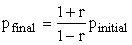
where

Thus, unless the death rate exceed the birth rate, the population will continue to increase, since the fraction (1+r)/(1-r) will be greater than one. Clearly, it is not true that the increase in the population since 1950 has come only from a decrease in the death rate. Even if the death rate had not decreased, the total population would have increased. The increase came from the fact that the birth rate exceeded the death rate. Simon answered my letter with a phone call and attempted to defend the statement by showing that increase in population per capita was due to a decrease in the death rate per capita, but in his paper (and perhaps in one or more of his books) he said that the total population increased solely because of the decrease in the death rate. He used the phrase “a larger population” without any reference to increase per capita. In his defense, I agree that at some time in the past, but not within living memory (perhaps excluding the periods of the world wars), the death rate was so bad that, if we did not improve upon it, the population would be shrinking – at the present birth rates.
His mistake came in dividing the first equation through by pavg and assuming that, since the increase in population per capita, as opposed to population itself, would have decreased had the death rate remained constant, the total population would have decreased. The actual differences b-d over the seven time period studied were 0.0177, 0.0184, 0.0197, 0.0206, 0.0193, 0.0173, 0.0173. So, one sees that the actual difference did not rise monotonically. The differences between bactual and d1950-1955 were 0.0177, 0.0159, 0.0155, 0.0142, 0.0118, 0.0087, 0.0080, which, as we see, did decrease monotonically. This is what Simon was referring to over the phone, but the population continued to rise.
|
Table 7-1. From Table on Page 200, Population Studies No. 106 [7]
|
|||||||
|
Indicator
|
1950-55 |
1955-60 |
1960-65 |
1965-70 |
1970-75 |
1975-80 |
1980-85 |
|
Initial Total Population (thousands)
|
2515312 |
2751558 |
3019376 |
3335927 |
3697918 |
4079753 |
4450210 |
|
Final Total Population (thousands)
|
2751558 |
3019376 |
3335927 |
3697918 |
4079753 |
4450210 |
4853848 |
|
Population
|
47249 |
53564 |
63310 |
72398 |
76367 |
74091 |
80728 |
|
Crude
|
37.4 |
35.6 |
35.2 |
33.9 |
31.5 |
28.4 |
27.7 |
|
Crude |
19.7 |
17.2 |
15.5 |
13.3 |
12.2 |
11.1 |
10.4 |
|
|
17.7 |
18.4 |
19.7 |
20.6 |
19.3 |
17.3 |
17.3 |
|
|
17.7 |
15.9 |
15.5 |
14.2 |
11.8 |
8.7 |
8.0 |


Simon’s paper is now discredited, but it is worthwhile attacking other false and deceptive ideas in the paper to enable the reader to discredit them wherever they arise. Simon states that “the number of children that one wishes to bear and raise” is “one of the most sacred and valued choices a family can make.” Where does the sacred nature of this choice come from? Surely not religion, which may not be introduced into public policy? I have shown the immoral nature of replacing more than oneself and one’s spouse in Chapter 3, but I have not elucidated on the use of procreation to promote one’s religion, political ideology, culture, values, etc. In my opinion, the single most unfair, aggressive, and hostile act, with the exception of war itself, that can be perpetrated by a race, religion, political party, sovereign state, family or other similarly identifiable group is to increase deliberately for an ulterior purpose, e.g., the spread of religious or political doctrine, its proportional representation in the population by increasing or failing to decrease its birth rate.
Simon defends population growth because it encourages rather than impedes economic growth. This is exactly the point. Population growth is both a cause and an effect of economic growth, but economic growth in a finite world is absurd unless economic growth be measured in an absurd way. If, for example, efforts to cut pollution that do not result in the increased production of consumer goods are considered economic growth, we could have concurrent economic growth and the shrinkage of the supply of consumer goods and the shrinkage of the accumulation of capital, too, an obvious absurdity. While it is true that more useful effort may be made in the future to support even a smaller population, it is not necessarily true that the amount of wealth (as opposed to money) created will be greater than currently. As I have stated in this essay and elsewhere, we must be particularly careful not to confuse money and wealth. We can’t eat money.
Simon claims that economic growth and the concomitant decrease in birth rates (not number of births) has been greater in market-directed economies than in centrally planned economies and that this “provides solid evidence that an enterprise system works better than a planned economy”. It is clear that Simon’s other arguments are directed toward his devotion to capitalists and capitalism. But, the phrase “works better” ought to refer to more than economic growth. In fact, the thesis advanced by me is that, if the entire population enjoys sufficiency, economic shrinkage is preferable to economic growth. The failures of centrally planned economies cannot be attributed to planning itself. I have discussed and shall continue to discuss the other variables. I hope that Simon does not imagine that market economies have been proved superior to planned economies. If you planned a trip and the plan didn’t work out, would you neglect to plan the next trip? Wait until the new market economies get a load of capitalism. The carpetbaggers are already over there or on the way. In any case, economic planning need not imply state capitalism, which seems to be what has failed, planning or not (and I don’t think much of the planning that was tried). Even though I insist upon a planned economy, although perhaps not a centrally planned economy, I deplore state capitalism and I have listed its defects elsewhere. (Some projects, e.g., flood control, require central planning and, indeed, are centrally planned in all societies.) [The point I wished to make here is that nothing has been proved by the collapse of the Soviet Union. This point can be made easily in a number of ways.]
Simon claims that the scarcity of natural resources, even of high-grade energy reserves, is not a problem. He shows that the relative costs of natural resources have decreased over the years. Again he is confusing wealth with money. The price of petroleum depends on the cost of getting it out of the ground, which we are able to do with greater efficiency nowadays than formerly, but it does not account for the millions of years of work done by nature. No one argues that we can discover and mine natural resources more efficiently and rapidly than formerly. What Simon neglects is their finiteness. He is depending on the development of technology that does not yet exist, nor do we know that it can ever exist. The trend in science over the last century is to reveal what cannot be done, cf., the Second Law of Thermodynamics, special relativity, the Heisenberg Uncertainty Principle, Gödel’s proof, deterministic chaos. Despite the tremendous strides made in technology, we know better than ever that some limitations will not be overcome. Simon is playing fast and loose with predictions about the future that are likely to have catastrophic effects if we believed in them and acted upon them. Moreover, he neglects the effects of removing natural resources from the ground, which might have catastrophic effects on the earth itself that are just beginning to be studied. Also, he neglects the effects of expending energy, not just greenhouse effects, but thermal and motion pollution. He neglects the alienation from nature that is an unfortunate consequence of widespread industrialization and migration from the countryside to the cities.
Simon imagines that, since natural resources, including agricultural soil (!), represent a smaller percentage of the gross national product than formerly, they are less important or not at all important. (He suggests that if we lost all of our agricultural land, it would effect our economy only slightly!) This fits in with the popular myth that we are becoming an information economy, that we can survive by counting beads, shuffling paper, and selling that which we do not produce, and, indeed, it seems that, during the eighties, the rich got richer by doing just that. What is actually happening is that we are mortgaging our futures and driving the majority of our population toward unbearable poverty. We are turning our nation into a third-world country replete with feudal plutocracy.
Simon offers three graphs to support his claim that water and air are getting cleaner rather than dirtier. He shows that our drinking water is becoming purer over time without mentioning the tremendous amount of high-grade energy that must be expended to clean it or to acquire water from an unpolluted source. The implication is that the purity of the drinking water is a good measure of the purity of all water. He shows that the annual emissions of some toxic or greenhouse gases, particulate matter, and lead is decreasing, but not by much. Granted that political pressure by some people (but not by many professors at business schools) has forced the reduction of some emissions, particularly lead, which is recognized as extremely dangerous and is easy to prevent from getting into the environment as it is a solid at room temperature, is not a component of fossil fuels, and is easy to separate from other chemicals. But, until we know the rate at which the gases are removed from the atmosphere, we do not know if the gases are accumulating in the atmosphere or not. Net accumulations represent a deficit for which we will pay dearly. Again Simon confuses rates with accumulations as he did with population itself.
Finally, Simon advocates a way of life, i.e., a political-social-economic system, that is guaranteed to have effects opposite to what he claims for it. He believes that people should have incentives to work hard and take risks to provide for themselves and their families and that selfishness will have beneficial results. He believes in respect for property. He believes that the rules of the market can be made fair and sensible. He believes in personal liberty that is compatible with economic freedom, which, presumably, refers to the classical “right” to exploit whomever one pleases. He believes people will act “spontaneously” in search of individual welfare, ignoring completely the fact that a large proportion of the people in a capitalist society are bound to be no better than wage slaves and that, under capitalism, if they were not, college professors would have nothing to eat or wear and nowhere to live. The entire thrust of this essay is to show the absurdity of Simon’s claims and to show, in fact, how to do much better – without government intervention and without anyone teaching business.
Industrial Activity
All things being equal, the more people, the more industrial activity. Greater population facilitates industrial activity and, to a certain degree, it makes it more necessary (but not as necessary as we are accustomed to think). Even in a humanistic society, we will require a certain amount of (humanized) industrial activity to optimize our chances for survival under tolerable conditions, although the scale of our industrial activity undoubtedly will be reduced. In any case, even in the best possible world, the extent of our industrial activity will be roughly proportional to the number of people. The most likely deviation from proportionality would be to cause the activity per person to rise to account for the additional measures that must be taken due to crowding, cf., taller buildings cost more per story. But, industrial activity has its inevitable environmental costs, again because of the difficulty of attaining high purity in any purification process. Even in a zero-emissions industrial facility, which, for now, is only the engineer’s far-distant dream, the amount of energy that is consumed both directly, to produce a product, and indirectly, to clean up the mess (which ought to be as small a mess as possible by design), will be the ultimate unavoidable cost of industrial activity. Ultimately, everything boils down to energy. (Of course, I mean high-grade energy, or availability, or, better yet, emergy). Even in the simplest possible human society, the energy cost will rise at least proportionately to the number of people.
[Probably, the zero-emissions facility will produce volumes of activated charcoal in drums containing hazardous substances concerning which nothing more can be done. This reminds us of the atomic waste problem. Bio-remediation offers some hope, though, for a permanent solution to air and water pollution; but, presumably, it will not be free; i.e., it will entail emergy costs.]
Renewable Energy
To what extent can we provide ourselves with renewable energy
sources that do not themselves harm the environment unacceptably when the
energy is acquired or when it is consumed? That’s a big question.
The answer will determine if the world can exist, which is the sufficiency
condition for the Fundamental Theorem. We have tried to answer it in
Chapter 2, but I’m afraid that we asked more questions than we answered.
Clearly, research is needed along the lines suggested in Chapter 2, but I am
not aware of any such research currently being funded. Hopefully, I am
merely uninformed. Unfortunately, the best answers we have heard so far
are disappointing. Solar energy has energy costs of its own associated
with it that make solar collectors less efficient than trees and plants that
could be grown in the same space, according to Odum and Odum [8]. [Unless
they make their raw data and calculations available to me, I shall have to
repeat their work, which, of course, may be wrong.] So far, we have not
developed materials that are adequate for exploiting geothermal energy, nor do
we know what the effect of hastening the cooling of the earth’s interior might
be, although it might be negligible. Similar remarks could be made about
wind power and tidal power. And yet, all of these possibilities must be
investigated thoroughly because the burning of fossil fuels seems to be out of
the question. The Odums claim that nuclear fission is a net loser
of energy. Fusion seems as far away as ever, perhaps infinitely far
away. I, personally, shall continue to be an opponent of nuclear energy
so long as it is produced within a market economy to make money, even though I
recognize many of the advantages of nuclear energy if we are able to care for
(notice, I did not say dispose of) the radioactive waste, which, after all, may
some day turn out to be very useful stuff (certainly it is too special to
discard). My experience (including extensive reading) tells me that a
person trying to accumulate wealth will do anything. (That,
in all of its manifestations, is, to a great degree, what motivates this
essay.)
Immigration
Introduction
As a continuation of the subject of population growth and crowding, it is time to make some remarks that ought to be very unpopular among many people who might otherwise be my allies. First of all, though, I want to make it very clear that I do not favor the mistreatment of immigrants. On the contrary, I wish to prevent them from being exploited. They should be treated as honored guests. But, the time has come to defend my view that immigration should be sharply curtailed if not eliminated.
[Note in proof: In defense of the idea of the melting pot (I myself come from mixed parentage), I must say that the mixing of the races probably has been good genetically, as nature loves diversity. I hope that racial mixing continues and I see no reason why it should not – even if excessive migrancy should be curtailed now. I shall need to say more about this when I discuss institutions of the future, which might include world tours – on foot – with free hospices everywhere.]
Clearly, excessive movement of people on the face of the earth is per se undesirable. It causes excessive expenditure of energy, it creates excess motion pollution, and it tears up the fabric of society. Travel is a broadening and otherwise rewarding experience, but most migration of people has economic ramifications and undesirable effects that overbalance the normal rewards of travel. Normally, it has nothing to do with what Thomas Cook meant by travel, namely, an educational and entertaining experience.
Interchange of people between countries on a temporary basis is desirable for purposes of cross-acculturation and because it makes life more interesting, but migration should not be allowed to increase the population density or to upset economic planning. It might be argued that, while immigration increases the population density somewhere, it decreases the population density somewhere else. This is true except in cases where the immigrant is moving from a nation that has reached a sort of saturation density to a nation that has not. By a saturation density, I mean that the population is in a self-limiting condition due to infant mortality, inability to take care of the elderly, inadequate health care, malnutrition, epidemic disease, or civil war. In the nation with a near-term saturated population density, the individual removed from the population will be replaced, at least statistically, whereas, had he not been removed, the saturated state of the population would not have permitted the population to rise. This is true only statistically; but, the fact is that, when under-saturated nations act as relief valves for saturated nations, the under-saturated nation becomes more nearly saturated, endangering life for all living things there; and, the saturated nation is encouraged not to take steps to remedy its saturated state. Moreover, as pointed out by Ehrlich and Ehrlich [3], a person in the United States does about thirty times as much damage to the planet as does a person in Nepal, say. One of the reasons people want to come to the United States is so that they can participate in this environmental destruction! “I came to America for a better life.” They might as well not kid themselves and simply say: “I came to America to consume more.” More consumption is not the same as a better life! Of course, stupid people think it will be, but they are doomed to live a life of perpetual dissatisfaction, as discussed by Durkheim [9] years ago and verified by anyone who has ever tried to attain happiness by acquisition and consumption if he is at all introspective.
Immigration is a threat to people who do not own their own businesses. I am not impressed when you tell me that immigrants are willing to work harder. Most of us work too hard already and we don’t need competition from someone who is willing to work even harder. Most immigrants are delightful people and don’t realize they are doing anything wrong; but, since they weaken the bargaining position of American workers, they are basically what union people call scabs.
The immigration policy of this country was wrong when we turned the “hungry and tired, yearning to be free” into virtual slaves and it’s still wrong. Basically, it has been a pyramid club: A wave of immigrants comes in and is exploited by people who are established. If they survive, they are allowed to have children who can exploit the next wave of immigrants, and so on. This game can be played out forever provided the country is infinitely large; but, like all pyramid clubs, it must come to an end because of finiteness. I believe we have come to the end. The people are pushing out the wildlife and destroying the environment.
I shall discuss briefly five categories of immigrants here, namely, (i) people who come from countries that have been exploited by U.S. imperialism, (ii) exploitative businessmen or – what amounts to the same thing – crooks, (iii) graduate students and high-tech workers, (iv) political refugees, and (v) other economic refugees, sometimes people who have come from countries that have been exploited by imperial powers other than the United States; however, in any case, people who wish to consume more. It is doubtful that anyone comes to the United States to consume less! Of course, we must react by consuming much less ourselves. Until that has been accomplished, we haven’t much of a case.
Category I. Victims of U.S. Imperialism
As most of us know, American foreign policy in Central and South America, Haiti, the Philippines, and elsewhere has not taken into consideration the well-being of the majority of people there. We have exploited their natural and human resources and even our foreign aid has been a form of depredation. For example, in a recent address (at The Other Economic Summit, Houston, Texas, July 6-8, 1990), Professor Howard T. Odum of the Department of Environmental Engineering Sciences of the University of Florida at Gainesville, pointed out that, when we lend $1,000,000 to a typical Central American country, for example, they receive $1,000,000 in American standard of living. Some of this money goes back into the hands of American construction companies and contractors.
Often the loan does not benefit the people who need help the most. But, what is shocking, according to Professor Odum, is that when the money is paid back, even leaving the interest out of account, the Central American country must pay back four times as much standard of living as $1,000,000 buys in the United States.
This is obviously true, although the factor may be too small or too large. We hear that a peasant in a third world country is living on $600 dollars a year, but he is living; so, we know that $600 must buy a lot more “living” there than it would in New York, say. A person would die in New York if he or she had only $600 to spend in one year. So, it’s clear that the repayment of the loan, much of which was spent on the purchase of U.S. goods and services, entails paying back a lot more “living” than was borrowed, and that doesn’t take into account the interest.
Our debtors to the south have paid back the principal on their loans many times over. Some of them are spending a very high percentage of their GNP on interest payments. Thus the money transferred to the U.S. is a major hemorrhage of the life’s blood of their economies. The upshot of this is that many of their citizens are forced to follow their money from its nation of origin to its destination in the United States to get jobs. Of course, most of them do this in violation of our immigration laws, but not in violation of the fundamental law of nature, the right to survival. But, this does not account for all of the immigration from Central America.
The United States continues to pursue its imperialistic policies in many of these countries under the guise of containing communism or under the guise of a “war on drugs” (as if one could make war on an inanimate object). What the United States really wants, as all but the most naive among us know, is continued access to raw materials (including the nutrients in the soil), cheap labor, and expanded markets. We have always considered our neighbors to the south ours to exploit. The term “banana republic” has meaning to all of us because it bespeaks the truth. If the reader has not already done so, he or she might look at some of the novels and short stories of Gabriel Garcia Marquez, who won the Nobel Prize in literature, particularly the novel entitled One Hundred Years of Solitude, a Bard book published by Avon Books [10]. On or about Page 282 in the fifteenth printing of the paperback edition, the author describes the shooting of 3000 striking workers of the banana company. This is fiction, but sometimes reality is worse – too horrible to put in a novel. Nonfiction works on American imperialism are readily available [11,12]. Presumably, the government tolerates such books because they reach very few people, and it is too much trouble to suppress them. At no cost to themselves, the powers-that-be can claim to observe the Bill of Rights, which they do not do in many important cases discussed elsewhere in this essay and other essays by the author.
Many people in opposition to corrupt regimes in Central America have been forced to flee for their lives because of vicious repression of dissent and violations of human rights that would not exist except for present and past American foreign policy. (Many of these, I am told, are being detained in what amounts to little better than a concentration camp at Port Isabel, Texas.) Thus, immigration of this type would not occur were it not for America’s vicious foreign policy, whose only beneficiaries are those who least deserve to be Americans, namely, parasites and vampires. Clearly, immigration to America in pursuit of one’s money or to flee from state-sponsored terrorism is undesirable on the face of it. It entails leaving one’s home and friends, traveling to a strange land where a different language is spoken by most of the population (still), and starting all over again. The forced migration of people over the face of the globe has its human and its environmental costs.
Rejection of imperialism is part of what many people may feel is an isolationist policy advocated in this essay. If one doesn’t like the policy, one might call it isolationist; but, if one does, one might call it decentralist or anti-imperialist or anti-colonialist or decolonialist. Actually, since I am rejecting trade in every form, I am a fortiori rejecting foreign trade. This is discussed below.
Category II. Invaders
I wish to limit my discussion of the class of immigrants who have moved to the United States to exploit Americans to a brief comment. (I shall resist my inclination to tell the story of the foreign-born cardiologist who presented me recently with an outrageous bill for minimal service and an incorrect diagnosis. Presumably, I would like to ask, there are no sick people in her native land!)
In Hocus Pocus [13] Vonnegut refers to people who move to America because the government here does so little to protect poor people from predators. Of a character named Paul Slazinger, a (fictional) recipient of a MacArthur Foundation grant, Vonnegut writes, “He said that so many people wanted to come here because it was so easy to rob the poor people, who got absolutely no protection from the Government.” Many have come to take advantage of our tolerance of any activity whatever – so long as its purpose is to make money. Also, these parasites know that even if they run afoul of the ruling elite they have little chance of being punished for their crimes because of the chaos and disorder in our legal system. Moreover, if things get hot, they can escape to their native lands.
Many take care of that eventuality in advance by operating their businesses from abroad. These people are like the carpetbaggers who swarmed down upon the crippled and vulnerable states of the Confederacy after their defeat in the Civil War. Similar types will be infesting Eastern Europe soon if they are not already there. Wait ’til the folks there get a taste of what free enterprise really means. Also, and perhaps concomitantly with this phenomena, we have observed a class of immigrants (perhaps very small) who despise Americans and a somewhat larger class who have no intention of integrating into the mainstream of American life as the ancestors of most of us have done. Why in the world should we put up with this! Isn’t the country fragmented enough! (In this essay, we wish to encourage variation in lifestyles, but we depend on a consensus to establish the moral basis for it. We do not need to import variation.)
Category III. Students and High-Tech Workers
I now wish to summarize what my thoughts were more than two years ago on the immigration of graduate students in engineering and science by quoting from two letters, the first to Science (not published) and the second to Time (never sent).
The response of engineering faculty members to the survey reported in Science, April 3, l987, [The Impact of Foreign Graduate Students on Engineering Education in the United States]; viz., approval of foreign graduate students, demonstrates disregard for American engineers and, indeed, the rest of the U.S. economy. Professors require research assistants (slaves?) to satisfy their lust for prestige and money; they are blind to the consequences of their greed.
If foreign-born recipients of American PhD degrees leave our country, they transfer technology to competitor nations. (Some foreign-born PhDs work in America for awhile then leave, thus compounding the rapid technology transfer.) The net result is a lowering of the standard of living of American workers. (It is true that in an ideal democratic, egalitarian world with fair play between nations this lowering would not occur.) If foreign-born PhDs stay in the U.S., they compete with American PhDs and drive down the market value of the degree, which becomes less attractive to talented American students.
It is hypocritical to encourage Americans to do graduate work while admitting foreigners into graduate programs. Also, to accept tuition from a student to launch his or her engineering career and then to undermine that career by glutting the employment market is, at best, a breach of faith. Of course, academic, governmental, and industrial employers of engineers benefit from a large, cheap, readily available supply of engineering talent, but why should the exploitation of engineering be more rewarding than the practice of engineering! It is ironic that an American engineer could lose his or her job to a foreigner whose education he or she has supported through taxes.
Even if we are willing to ignore the best interests of American engineers, we should not accept graduate students from countries with governments or social systems of which we do not approve. If they return to these nations, they reinforce a bad political (or social) system with American expertise. If they do not return because, for example, they do not approve of the political system, they decrease the possibility of reform through dissent. (If they approve of the bad political system, they are not likely to have a positive impact on American society.) On the other hand, if the student comes from a “good” country, we do that deserving nation a disservice by increasing the likelihood that its pool of talent will be depleted.
Potsdam, New York
May 10, 1987
[Note in proof: Of course, nowadays, I don’t believe that any “good” nations exist. Moreover, it’s hard to imagine a country with a more repressive government than ours, however Singapore comes to mind. In any case, to argue that things are good here because they are worse elsewhere is the well-known ad metum fallacy.]
Foreign-born engineering graduate students [Education, Jan. 11] transfer technology instantly to our competition if they return home. If they stay here, they are often exploited, particularly by universities, and they drive down the market value of the PhD degree, which then becomes insufficiently attractive to young Americans. Engineers (including immigrants) should petition congress to curtail sharply the number of student visas issued and to prohibit subsidizing foreign students with public funds. It would be ironic if engineers were displaced by (even newer) immigrants whose educations they have paid for through taxes.
Houston, Texas
January 7, 1988
I feel now essentially as I felt then. I have been replaced successively by two foreign-born engineers, both of whom tolerate circumstances of their employment that should be intolerable to most Americans of my generation with my expectations. It is not that these people dispossessed me. I was leaving those jobs anyway; but, if a large supply of ready and willing workers weren’t standing behind me waiting to take my place, my employers would not have been able to get away with some of the employment policies that made working for them so degrading. Thus, management has been able to reverse the trend of improvement of working conditions that engineers enjoyed for a number of decades. I noted recently that the M. W. Kellogg Company, a formerly U.S.-owned engineering construction company, which in the best of times peddles the warm flesh of its employees to its clients who pay by the engineer-hour, now takes sick leave out of vacation pay, an open invitation to work while one is sick and to infect one’s fellow employees. This could not have been done without the help of the U.S. immigration policy and/or competition for jobs from abroad, although it must be admitted that this company obtains a great deal of work that should be done by the nationals of other countries.
Before I make a few additional observations, let me say that I have nothing but the highest regard for most of the foreign-born engineers and scientists I have met. I really like them and I have enjoyed the opportunity to meet and know people whose backgounds and experiences are different from my own. I am not a bigot. I am not even a xenophobe. [Note in proof: At a recent technology conference I heard an older Indian engineer say to a younger Indian engineer who had been educated in the U.S. and a resident for ten years, “Why should they hire you? They can get someone right off the boat from Bombay much cheaper.”]
Observation 1: In the event that the U.S. finds itself at war, it will find itself hard-pressed to fill scientific jobs that require security clearance. Actually, it is unlikely that our enemies, including Japan, have been so stupid that they have not placed spies in the American scientific and industrial community. [Note (12-3-90). Americans used to be concerned about wars with communists, but the war with Iraq for which the country is preparing at this writing is a war among capitalists. Capitalism spawns economic competition and economic competition spawns wars. Japan has been at war with the United States almost continuously since 1941. Nowadays the war takes the form of economic depredation at which Japan excels.]
Observation 2: The American ruling elite has a long history of exploiting immigrants. Now, immigrants are being exploited at a slightly higher level but, essentially, as scabs.
Observation 3: Many immigrants are coming from nations that do not permit foreigners to work.
Observation 4: All things being equal (and they never are), each new immigrant must be accounted for by an additional person unemployed and an additional person without a home. Much of the burden of immigration is borne by disadvantaged American minorities. When new housing is built, animals are displaced. As Calvin of “Calvin and Hobbes” puts it, “Squirrels can’t afford condominiums.”
Category IV. Political Refugees
The fourth class of immigrants to be considered here is the class of political refugees. We discussed political refugees in the section on U.S. imperialism. We must assume that these people are in genuine danger of being liquidated by the government of the country from which they came. If the political refugee is a victim of a truly repressive regime, we ought to assist the refugee in developing the skills required to reclaim his (or her) country, which means that, so long as the victim is here, he must attend to that business to the exclusion of other business even if his stay is permanent and he has to be supported by donations from freedom-loving Americans. Of course, in the usual case, the United States is an active ally of the repressive regime and is materially aiding the repression of dissent; so, it’s unlikely that we would sponsor a school to train Salvadoran guerrillas to overthrow their government.
Category V. Economic Refugees
If we were to accept economic refugees, we would confine immigration to those who are nearest to starvation, but those are the ones we make the greatest effort to exclude. This last category is not independent as its members are in I or IV – usually. If not, they fit into the even less desirable categories. If a country from which a refugee is fleeing has a more enlightened political system than the American system, e.g., communism, one can imagine that I am not terribly sympathetic with those who wish to escape it. For example, people who wish to escape communist countries because they object to not being allowed to exploit people weaker than themselves and would like to carry out such exploitation under the good old Stars and Stripes are not my favorite people.
If the Immigration and Naturalization Service (INS) lets them in, I must observe that the INS is acting as a semi-permeable political filter, blocking liberal politics from entering and passing conservative politics freely, perhaps even discharging some elements on the left by trumping up charges that result in deportation.
Totalitarian communism is preferable to totalitarian materialism, which is what we have here in the United States. Libertarian communism is to be preferred over both, but the chances of obtaining it are better starting with a planned economy and few super-rich members of the commissar class. I think I should like to include a letter I wrote, from my heart, to a Chinese graduate student who was requesting my technical papers. I do not know if he received this letter or not. I never heard from him again, which should amuse at least some of my detractors; but, it might not be funny. I, too, hope he simply thought I was nuts. Here’s the letter.
I am delighted that someone is still interested in the work I did in the 80s. Currently, I am, to a slight extent, the victim of American repression of dissent, which has cost me, in part, the loss of three jobs, although, of course, I can’t prove this. The methods are quite subtle. Perhaps, even the perpetrators are unaware of it. In America dissent is not exactly punished; dissent is impossible. Nearly, everyone accepts the propaganda of the government and the multi-national corporations, who control most of the world and are intent upon controlling all of it. The propaganda is very subtle. It is embodied in the clothing worn by the children on the “Cosby Show”, a television program. Practically no one is immune. Independent thought is extremely rare. The people believe they are free while, in fact, they are controlled by a vicious plutocracy, which amounts to a totalitarian dictatorship under the President. (The dictator changes from time to time; but, the dictatorship is the plutocracy, which is permanent.) Most Americans think that market systems and capitalism not only work but are ideal, while, in fact, the system is on the verge of collapse – both morally and economically. Don’t for an instant believe the lies of the people who wish to emulate the United States. Most of them wish only to exploit those weaker or less gifted than themselves. Conditions here are horrible. The quality of life of the average engineer is no better than that of an eighteenth century Russian serf. [Note in proof (12-5-96). I can defend this statement.]
While the government in China may not be ideal. The chances are much better in China of developing a libertarian communism of free people working together voluntarily in peace, sustainable happiness, and true equality than they are nearly anywhere else.
I don’t know if my letter will reach you and I don’t know what they will do to me if they intercept it, but I don’t think they can check all of the mail, so I am willing to take a chance on getting the truth out to you. Of course, we are all fallible and I may be wrong, but I don’t think so. I am including my hopes for the future of the world.
Whatever you do, please do not come to the United States! Stay in China. Your country needs you. With luck, we can stay in touch and exchange ideas. Perhaps the mails will continue to get through. If not, perhaps the electronic superhighway (faxes, etc.) will allow world-wide communication.
[Note in proof (5-30-96). When I hear an immigrant explain that he came to the United States for a better life, I am not terribly thrilled. I know that he thinks a better life is lived by consuming more, which is far from the case. Americans already consume many times the world average and some of that, e.g., automobiles, is involuntary. The U.S. is the most over-populated country in the world from the viewpoint of the environment, as an American consumes as much as thirty times the emergy of a person living in a less developed country, e.g., Tibet. Yet, the quality of life here is poor! Also, with each new immigrant the habitat of wildlife shrinks still further and yet another animal (species) faces extinction. Immigration into the United States cannot be justified by the Statue of Liberty.]
[Note in proof (9-29-96): Immigrants escaping unbearable poverty caused by a colonial power other than the United States should consider visiting themselves upon their current or former economic oppressors. Currently, England is paying for some of her former and current sins in just this way. To the poor of India I would say, “Try England if you can’t fix India.”]
A Word on Patriotism
Two distinct viewpoints are in evidence in the foregoing remarks: (i) I would like to improve the political situation in the entire world as rapidly as possible since good is good and evil is evil no matter where in the world they occur and (ii) I seem to have a higher regard for my fellow Americans than I do for other people. Due to the disparity in these viewpoints, I must say a few words about patriotism. From the first point of view patriotism does for nations what egotism does for people and we are bound to despise it. The people who want to pass laws against burning the flag or introduce the Pledge of Allegiance everywhere are the stupid sort of patriots who make us sick. But there is something to be said for caring more for our immediate family than our neighbor’s, caring more for the people in our own community than for the entire state, more for our state than for other states, more for the our nation than for other nations. This can be interpreted as selfishness because the operative quality is proximity or it can be interpreted as a natural affective tendency. It must be admitted that we find evil committed under our own noses more repulsive than evil we read about in the newspapers, although, if we are at all imaginative, we are repelled equally by evil perpetrated far away, even in a different era. (This is the gist of the Fundamental Premise.) Similarly, we are moved more directly and without the aid of our imaginations when we observe goodness with our own eyes. This is to a degree excusable because we do not really understand events far away from us in space and time as well as we understand nearby events. It is possible, even, to mistake good for evil and evil for good if we are sufficiently far removed from the event. Therefore, it is necessary to interpret patriotism from both viewpoints. I don’t have much patience, though, with a person who wants to lynch someone who burns the flag but who himself drives a Toyota.
[Note in proof (1-10-98). Despite my best efforts, it’s really hard to find anything good to say about patriotism. Who am I kidding! I was young and stupid when I wrote those letters in which I expressed concern for the United States. Of course, I’m just as enraged as ever about foreign engineers and scientists taking my jobs and, for all practical purposes, stealing my money. I have to live in this world.]
Direct Harm to the Environment from Competition for Wealth
With International Trade
It is easy to see that the destruction of the environment will never end so long as there is competition for wealth between separate sovereign states. While it is true that international laws could be enacted that would be administered by the United Nations, they could not be enforced without the expenditure of more resources than we possess. International law has never enjoyed the power of national law. If it did, the sovereign states would have been absorbed into one giant nation. Something might be said for such an arrangement in the far-distant future, when the ideas presented in this essay (or better ideas) are accepted by everyone; but, until that is the case, a world state would simply mean world conformity – conformity to the disgusting norms enjoying nearly universal acceptance in this world at its worst moment. Although emigration does not represent much of an option to most and I have already said what I think of immigration, leaving one’s homeland remains the option of last resort, short of revolution, for those who cannot tolerate their governments at all.
Thus, we might hope for – and expect to have – separate sovereign states for some time to come even though our ideal is small or mid-sized communities without borders. When the very existence of an enterprise in one sovereign state is threatened by competition from abroad or even when it can gain an advantage over its competitors, we can expect that it will apply pressure to have its nation’s environmental laws relaxed in its favor and, if that cannot be carried out to a sufficiently great degree, it will violate the laws of its nation. If the owners and top management of the offending firm are located in a country other than the one in which the laws are broken, they will be able to wreak havoc with impunity. That’s why we fear the institution of the multinational company more than nearly any other institution in the world today. We may assume without fear of contradiction that so long as foreign trade and competition for wealth coexist environmental destruction will continue at an unacceptable level.
Certainly, economic transactions must have occurred between nations or nationals of different nations at some time in all of human history that have been beneficial to the human family and to all parties involved. My problem is that I do not know of any and I cannot imagine a scenario, even in a thought experiment, that does not harm one party or the other, usually both, and that does not violate the morals espoused in this essay.
Comparative advantage is no longer a valid reason for foreign trade, as it, for the most part, no longer exists; but, if it did, it would depend on the sequestering of knowledge, which is a violation of Axiom 3, the Truth Axiom. The uneven distribution of natural resources over the Earth’s surface (and under it) has been addressed by suggesting a weak world federalism to redistribute natural resources without reciprocity. For now, let me pose a few questions: Why should natives of Sri Lanka make sweaters for the people of the United States for less money than they would need to buy sweaters? Why should American workers have to compete with foreign workers who are willing to live in thatched huts without running water? Why should Iraq sell its oil to the West when it has no means for earning a livelihood for its people when the oil is gone and when giving up the oil materially reduces the prospects of ever having the means? Why should Iraq be allowed to sell the natural resources bequeathed by the earth to its entire population (including plants and animals) just because of the accident of its nation’s birth having placed it directly over those resources? Why should citizens of the United States be permitted to sell, at a profit, goods produced by the labor of the citizens of other nations? The real fruit of imperialism and colonialism is war and death.
Finally, I would like to dispose of the myth of the global economy and to some extent I have already done so. Nothing stops us from producing everything we consume locally. We do not have to compete with enterprises in foreign countries. Capitalists and their highly paid toadies would like us to think that global competition is unavoidable so that we will work harder, for less money, under poor conditions, for more days with longer shifts per day and fewer benefits. They want us to put up with anything and be glad that we are not unemployed. Moreover, we are supposed to understand that it is not their fault when we eventually lose our jobs and have no incomes. We don’t have to put up with these lies and this type of exploitation. There are more of us than there are of them!
In the old days, foreign trade caused war. Many say that protectionism caused war, but probably we can show that foreign trade is not found without protectionism. In any case, nowadays, protectionism or not, trade is war. As far as the environment is concerned, it cannot afford the emergy to move goods thousands of miles (or even hundreds of miles) before they are consumed.
Competition for Wealth Even without Foreign Trade
But the banning of foreign trade will not put an end to environmental destruction. Question: Why does not Congress legislate an energy policy that would put an end to the transportation of huge quantities of oil in a single vessel over the oceans upon which life on this planet depends? Answer: because the interests that benefit from this insane practice control Congress. We will not be able to end environmental destruction while those who stand to gain from it wield this total power. This will continue so long as the institutions exist that permit one person to gain at the expense of another – in short, so long as people compete for wealth or, for that matter, so long as a single person can influence his (or her) share of material wealth and worldly influence by anything he says or does.
The Difficulty of Eliminating Pollution Altogether
Also, many of the measures that the strictest environmentalists would like to see taken are impossible without ceasing altogether the manufacture of chemicals that all of us have grown accustomed to using. I believe that we must reduce the quantities of chemicals upon which we rely, and phasing out the institution of business is consistent with this, but we will always need to produce some chemicals. Perhaps, chemical engineers should consider garbage, sewage, agricultural waste, and other biomass as the only acceptable candidates for feedstocks.
As an example of unreasonable demands, many environmentalists would like to see process engineers account for all of the materials entering and leaving the process up to microscopic amounts. With today’s computers we can calculate material balances up to 0.1 pound moles per hour of most chemical species, but this leaves amounts of up to several pounds per hour unaccounted for due to round-off error. One can make the plant’s joints and seals as tight as possible; but, with our best technology, gases leak somewhat no matter what is done.
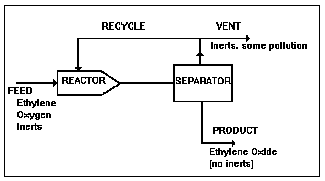
Figure 7-1. Chemical Reactor and Separator with Vent
Also – and regrettably – in nearly every chemical process inert gases are introduced with the starting materials and, at some point in the process, they must be purged. They will be mixed with valuable process chemicals, toxic waste products, greenhouse gases, etc. If the process chemicals are not too valuable, the most economical tactic in many cases, in a market economy, is to purge to the atmosphere. Suppose this may not be done. Then, the purge stream must be processed further and, hopefully, some useful materials will be captured from this secondary process, but the secondary process itself must be purged. We can imagine a tertiary process; but, if the secondary process were uneconomical (according to old-fashioned economics), the tertiary process will be more uneconomical still. We may have a quaternary process and so on; but, eventually, something must be discarded. The situation is illustrated in Fig. 7-1 for the case of an ethylene oxide reactor and separator. The feed contains oxygen and, therefore, some inert gases such as argon, krypton, helium, etc. When these are discharged some of the ethylene must be discharged with them as all of the inerts are extremely volatile and, if the ethylene is to be recycled, some inerts will leave the top of the separator with it. Suppose, as in Fig. 7-2, there is no vent. This is the situation that diehard radical environmental activists would like to force upon industrialists, isn’t it? Inerts are entering in the feed and the only place they could be leaving is in the product stream at the bottom of the separator. But, their volatility is too high to leave there; so, they must not be leaving at all! Thus, inerts must be accumulating in the process and, eventually, the reaction must cease and the plant must stop working, in which case society will have to do without its product.
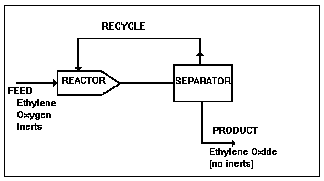
Figure 7-2. Reactor and Separator Without Vent
This is a situation that most environmentalists – or, rather, those who say they are – would find inconvenient, to say the least. They want the products but not the pollution. Unfortunately, if we are to live without air and water pollution, we will have to give up many products that we have grown accustomed to, such as paints, glues, detergents, cosmetics, some pharmaceuticals, not to mention motor fuels, lubricating agents, and, in the case of this plant, anti-freeze. It is simply amazing how many chemicals we have in our dwelling places – let alone the commodity chemicals that are used in the myriad consumer items with which we are surrounded. Agriculture, of course, is chemically intensive; but, if we wish to reduce pollution to acceptable levels, we had better become organic farmers in one way or another. We must return to a simpler lifestyle if we don’t want pollution and, if I am not mistaken, most of us will find that lifestyle harder but sweeter. Yes, harder but much sweeter.
Fortunately, the biosphere can absorb a finite quantity of chemicals that would be dangerous in high concentrations – or if they were allowed to accumulate – and a steady-state biosphere still be maintained. Chemical reactions occur in animals, plants, the oceans, the earth, and the atmosphere that are not dangerous and that help us dispose of some otherwise dangerous chemicals. For example, trees absorb carbon dioxide beneficially. If we go far enough in processing chemical waste streams, all of the chemicals that would be in excess of what the biosphere can absorb and maintain a steady state will be accounted for by our process. Bio-remediation and dynamic storage of drums of contaminated activated charcoal – stored like we should store atomic waste – might end the last vestiges of air and water pollution.
But, in a materialistic setting, a competitor could always give itself an advantage by releasing waste streams with dangerous levels of environmental contaminants. Every experience we have had with the so-called free-enterprise system shows that, when competitors have the opportunity to take advantage, they will take advantage – regardless of the social costs. Capitalists, for example, may try to remedy this situation with one or another new institution, and it must be admitted that they have improved slightly, but only because they have been forced to improve because of socialistic restraints, which they don’t like, which they try to eliminate or avoid, and which are costly to society because of the burden of the concomitant socialistic bureaucracy. If multinational corporations obtain monopolistic control over entire societies, they will do as they please, presumably because the handful of plutocrats that control the multinationals imagine that they can isolate themselves from the damage even if it requires travel to outer space.
The Environment as a Business
We are accustomed to thinking of the environment as the Earth, its atmosphere, its oceans, the biosphere, etc.; but, nowadays, “the environment” is much more. It is a billion dollar business! We have environmental organizations – both for and against, the lobbyists, the spin doctors, the media, legislators, environmental engineers and managers, environmental lawyers and consultants – whether pro-active, compliant, or evasive – manufacturers of pollution-control equipment, and the sellers and promoters of pollution-control equipment and all of the ancillary business associated with such equipment, e.g., the manufacturers of catalysts. We even have the advertising people who portray massive polluters like Dow or DuPont on television as pro-active environmentalists. That’s big business. I’m sure I’ve left out plenty because in America, indeed in the whole world, when there’s money to be made, there’s someone out there to make it, even if it be selling messages from heaven – on easy pay-as-you-go terms.
I have before me a complicated systems diagram. I drew it by hand. Even so, it barely fits on one piece of paper. When I contemplate drawing this with the primitive graphics software I have at my disposal, I shudder. Instead, let me tell you the drawing. That might be easier on both of us. Remember, this is just my conception of how the environmental business works. It might be completely at odds with reality in many cases. Some companies want to do as much as possible to avoid environmental destruction – going way beyond the law – so long as they don’t put themselves out of business. These I term pro-active, but I’m not sure any exist. Many companies – or, rather, many individuals in many companies – would like to comply with the law, provided it be not too strict. These I term compliant. Finally, and I believe this is the largest category, many companies wish to evade the law – to increase profits, obviously. These I term evasive.
The systems diagram begins with the public and ends with the environment. The public gives money and personal support to environmental organizations and participates in the “environmental business” in other ways – perhaps by voting against congresspeople who sponsor tough environmental legislation. The public receives feedback from the environment in terms of a better or worse quality of life. It also receives propaganda from environmental organizations – perhaps through the media – and propaganda from the management of industry – perhaps through multi-million dollar ads on TV. (I won’t trace all the in-between steps, e.g., the ad agency.) Both the environmental organizations and industry put armies of lobbyists into the arena, who try to influence members of Congress, other members of Government, and Government itself. Members of Congress draft laws, which, after a great deal of lobbying, etc., are sent to Congress. Let’s follow the path of a new law sent to Congress. Congress is forced by various factors, including lobbying, to amend the law, which is then passed. The environmental experts in the management of affected industries read the law and, depending upon whether the company be pro-active, compliant, or evasive, they draft a preliminary company policy, which is sent to an environmental lawyer or consultant, who prepares a report to be sent back to the environmental experts within management. This report may show the company how to comply with the law most economically. It might point out loopholes in the law, or it might show the company how best not to get caught. After a few go-arounds, a final policy is drafted, which is sent to production.
Now, production has its own agenda. Production personnel might like to follow the company policy on environment, but they have production quotas and budgetary constraints. At this time, transactions with pollution-control equipment vendors may or may not take place. Actually, it’s much more complicated than that. They might call in their process designers; they might change feedstocks or their primary energy source or a combination of everything. Or – they may do nothing.
Production will pollute. What they report to the environmental consultant or lawyer and what they report to the environmental experts in their own management is up to them. They may say, “You don’t know, and you don’t want to know,” or they may tell flat-out lies, or they may tell the truth and ask for help in concealing or evading the effects of their actions. Or, amazingly, they may do the right thing; but probably not in every instance. I will share my suspicions with the reader toward the end of this chapter by way of accounts taken from the Houston Post, a conservative paper that is certainly not biased against the chemical or petroleum industries.
Now, in our thought experiment, let’s add a new element, namely, the whistle blower. Suppose a brave right-thinking soul decides to blow the whistle on his employer who is committing environmental atrocities with which the whistle blower is familiar. In my systems diagram, I show the pollution as an input to the whistle blower, but I show also tremendous coercion from industry, management, its “experts”, and its lawyers and consultants. He (or she) could even be killed; but, in my system diagram, I show feedback to the public in terms of information, which might go through the media or a film maker, and feedback to the public in terms of less pollution.
This is all imaginary; but, in any case, environmental considerations generate much activity that’s not really about the environment. It’s about the environmental business. Of course, economists will add all this to the Gross Domestic Product and claim it adds to our standard of living, which, depending on circumstances, ranges from debatable to absurd. The following was written a couple of years ago, but I never tried to publish it. (I gave copies to a few friends, though.) At last, I’ve found a use for it, although writing for the sake of writing is fine with me.
Mass Transit
Here in Houston and in other U.S. cities we have a terrible problem with air pollution. The city government has spent millions on studies to determine if a rail rapid-transit system is feasible. Houston is a city with several business districts and far-flung neighborhoods; so, if the rail system is supposed to eliminate cars by bringing people to work, it will have to be too big for the budget of any U.S. city, let alone Houston. If it is desired to connect only the main business districts, including the medical center, which would enhance the prestige of the city, as the mayor hopes, and aid tourists or business travelers, it will not affect air pollution appreciably. It will aid the affluent only and be paid for by everyone. In any case, the rail system is infeasible.
But, suppose for a moment that it were economically feasible. That would present an entirely different set of problems, similar to the problems on the New York City subways. Middle-class people would be safe only at certain hours. Unless strongly repressive, presumably unconstitutional, measures were taken, the rail system would become a haven of last resort for the homeless and a predatory jungle during the nonpeak hours. Of course, we are delighted that the homeless would have a “haven of last resort”, but the use of the rail system as shelter for the homeless would conflict, no doubt, with its use for mass transit. This new set of problems is unavoidable since the free-enterprise system allows for and encourages vast differences in wealth. Free enterprise creates class warfare and, in particular, an underclass with nothing to lose. So, mass transit cannot serve the needs of the entire city at all times and the restrictions placed on its use by the defects in society would be impossible to predict far in advance or even from hour to hour.
February 7, 1990
Revised February 25, 1992
Additional Notes on Mass Transit
This brief dismissal of mass transit as an energy conservation tool seems inadequate according to discussions I have had with proponents of rail plans. In an extremely uncharacteristic gesture (and at the invitation of the guest) I called a radio talk show and could make no headway in explaining these points. The following are some notes I sent to both participants following the show. Pardon the informality. I may never get around to “fleshing them out” or, for that matter, discovering the name of the architect referred to, but the reader probably knows his name anyway.
Joe and Scott, here are some rough notes that I’ll flesh out when I get more time. Basically, they are objections to Joe’s plan, which I take to be the lesser of many evils – perhaps – but still wrong.
1. Power plants pollute and their pollution is concentrated even if they have a tall stack and are kept away from populous areas. Moreover, they produce electricity from fossil fuels at 25% efficiency according to Howard Odum. Let’s suppose we can get the efficiency up to 33% using cogeneration etc. We still haven’t accounted for the fossil fuel used to build them, carry the operators back and forth to work, carry the people who serve the operators lunch back and forth, ¼ You get the idea. In fact, if we count the hidden costs, nuclear plants have a negative efficiency. So, to break even, the mass transit trains have to be three times as efficient as cars – at least. Crude oil can be refined into gasoline with about 97% efficiency.
2. But, the
trains must run nearly empty much of the time or no one will use them.
They must run all night. What if you miss the last train? If they
run all night, you must account for the objection [concerning conflicting uses
discussed in the paragraph at the top of this page]. I admit that I have
not done the complete analysis of the efficiency of trains. We can draw a
bimodal plot of ridership and assume that an empty train uses only one-half the
energy of a full train. It should be easy to get the statistics for
energy per unit mile for a full train with N cars and some assumed
acceleration-constant_velocity-braking profile – assuming dynamic
braking. Joe, you need these figures. And, speaking of electric
power – What if it turns out that the electromagnetic radiation from the power
lines is unacceptable! What about 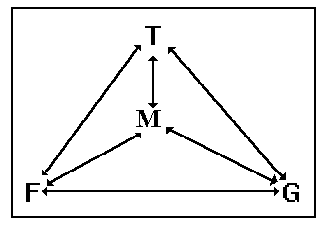 losses? High-temperature
superconductivity is out of the question. That’s utopian! [Note
in proof (9-29-96). Perhaps not. I have done some very rough
heat transfer calculations that indicate refrigeration costs, even for liquid
nitrogen, might be less than i2R losses.]
losses? High-temperature
superconductivity is out of the question. That’s utopian! [Note
in proof (9-29-96). Perhaps not. I have done some very rough
heat transfer calculations that indicate refrigeration costs, even for liquid
nitrogen, might be less than i2R losses.]
3. Joe’s system will create more activity not less and, in fact, if people can get to the airport faster, they will take more plane trips. (I assume that flying is even less efficient than driving. People will take the plane to Austin where previously they would have driven. Let’s check on whether flying is less efficient than driving. Planes create terrible environmental problems, in any case, not the least of which is noise. Also, they dump unburnt fuel into the air over cities from time to time because they don’t like to land with too much in the tanks.) In fact, every means of moving people will tend to become saturated as long as people are “addicted” to movement. (Call that Wayburn’s Law of Transportation. Ha, ha.) Joe is giving people more reasons to move around: trips to Galveston, a fun downtown, etc.
4. The answer to my objection to students living off campus was not well taken. Do we mean to say that people will never change? Change they must. Nature will ensure that.
5. People in Houston will still need a car because in July one cannot walk very far without one’s temperature beginning to rise. Each suburban home generates about 14 car trips a day according to that architect from Florida. (Could his first or last name be Andre?) Mass transit will take care of only two [perhaps four] of those trips at most. (My private opinion is that in 50 years Houston will barely exist – and good riddance. I’m sorry, but that’s how I feel.) People in Houston will use cars in the summer if they have them because walking is intolerable. The transit system will have low ridership all summer unless it delivers everyone right to his or her door.
6. The energy costs of building and maintaining the system and all the hidden energy costs must be charged to the system and they will not be offset by fewer automobiles. Moreover, the lifetime of the system is limited to about 50 years at most. This is debatable.
In fact, everything is debatable. Let’s debate! Joe, if you are unwilling to debate me, how can you expect Bob Lanier [the mayor of Houston] to debate you. I think you should come to the Future Forum [a discussion group discussed in Vol. II of my collected papers] more often. I understand that you’re a man on a mission and it may be impossible to get you to devote your considerable talents to something more worthwhile.
February 25, 1992
A Parable
I choose to demonstrate, by means of a parable, written by me earlier (but never offered for publication), why air pollution alone, as a typical and serious form of environmental destruction, can never be eliminated in a market economy. This parable was preceded by a brief analysis (printed above) of why public transportation cannot supply a solution to air pollution in Houston, Texas, where a highly flawed rail plan is being forced on an unwilling public at this writing.
The Air-Pollution Crisis and Free Enterprise
BUT: A Story of Automobiles, Airplanes, and Business
John Doe worked for seven years for a large oil company on the west side of town. Since he was just out of college and newly married when he got the job at the oil company, he wanted to buy a home close to the office building where the business offices of the oil company were located. He hoped to walk to work, but the oil company had to be in a business neighborhood in order to conduct business with its contractors and customers without inconvenience. Thus, the nearest suitable residence was two miles from John’s place of business. Two miles isn’t too far to bicycle though, and John could have helped cut down air pollution by riding a bike, but all the people who drive cars, either because they live too far to bicycle or because they need an automobile to do their work, make riding a bike too dangerous.
About three years ago, John lost his job with the oil company because of one of those business cycles that are inevitable in the free-enterprise system, but John immediately embarked upon a long and costly job search. He found a job, but not the job he wanted. He considered himself lucky to find a job in a chemical plant; but, unfortunately, it was on the east side of town. He wanted to relocate, but selling and buying a house and moving his small children to a new school was not feasible, so he has to bite the bullet and commute twenty miles twice a day during rush hours. His car continues to emit noxious fumes even when he is stuck in traffic, and he spends a lot of his “leisure” time in his car, but at least he has a radio.
John has to work a lot of overtime now that his company is being pressured by foreign competition. By letting John work overtime, rather than increasing personnel by 50%, the company saves a bundle on benefits; but, unfortunately, John gets sick much more often now and the health insurance carrier is going to raise its rates by 40%. Also, John doesn’t see much of his kids anymore, but he can see them when he’s sick.
John works at an operating plant, but his degree in business doesn’t qualify him to make chemicals. John spends a lot of time on the road, usually in a company car, tooling around Houston drumming up business for the plant, but also on plane trips to American and foreign cities. Those airplanes use a lot of gasoline so John’s old company is doing pretty well now, but the planes pollute the air, even dumping excess fuel into the air over cities from time to time. You see, John is a salesman; but, if he perseveres, in a few years he will get in on the really big deals.
Actually, in high-school, John thought he would like to be a physicist; but, when he entered college, he became convinced he would have a better chance to make a good living if he studied engineering. He had an aptitude for engineering; but, when he saw what those graduating business majors were making right out of college, he decided that engineering was too much of a grind anyway. John’s first love is still science. He can hardly wait for his Scientific American to come in the mail each month, but he rarely has time to look at anything but the ads.
It’s too bad, though, that John didn’t stick with engineering because a lot of other young Americans had the same idea as John and now business majors are a dime a dozen and engineers have to be imported. Of course, importing engineers increases the population, which means more roads and more cars and more pollution. All summer John has needed an extra half-hour to get to and from work because of highway construction. In fact, they tell him he is going to have a feeder road nearly in the backyard of his house soon. He didn’t use his backyard much for recreation anyway, but the kids did. John prefers to enjoy his leisure on hunting trips into nature’s great unspoiled wilderness.
Unfortunately, the forest where John used to go deer hunting has become a subdivision, but it doesn’t matter since John doesn’t have time to go hunting anymore anyway. But, what the hell, soon there won’t be any deer left, not because of hunters, but because free-enterprise capitalism requires an expanding economy and further expansion abroad is limited by severe competition from hard-working Asians and Europeans and by revolutions in our former colonies. We’ll be lucky if, in a few years, we don’t have to substitute for the raw materials we used to get by raping someone else’s wilderness. But, ¼
The Benefits of a Planned Economy
If the U.S. had a planned economy, the oil company would not have had to transact business with anyone, or with only a fixed set of suppliers and receivers, and would have had to transmit only factual information rather than lies, empty promises, recriminations, and quibblings over deals. Thus, the necessity to place its offices in a business district might have vanished, in which case John could have walked or bicycled to work. If everyone did that, air pollution due to automobile emissions would be reduced considerably. However, even in a planned economy, there might be some justification for grouping enterprises together in an enterprise district, which might preclude walking to work.
But, if the U.S. had a planned economy, there would not be the need for an entire building devoted to the oil company’s business. In fact, business as business, dedicated to getting a bigger share of the oil business for John’s company, wouldn’t exist and, probably, John would work in an operating environment. Perhaps John would not be able to live within walking distance of his job because operating companies need to cluster together on waterways and near rail lines. Nor would John want to live near the company’s operation unless the plant had acceptably low emissions. (The plant would be odorless – at least.) Reducing waste is cost effective up to a point; “zero” emissions is another story. One would have to bear the high expense of dealing with extremely dilute mixtures. But, the plant would have at least a chance of having acceptably low emissions because there would no longer be any companies threatening to take away the plant’s share of the market if it didn’t keep its anti-pollution costs down. In any case, there would be housing within bicycling distance of the operating plants because waterways and rail lines extend in only one dimension (as opposed to covering up entire areas) and space that is too far away from the waterway, say, for refineries, but not too far for bicycles, would be available for residences. Also, if the U.S. had a self-contained, planned economy, John wouldn’t have to make all those business trips, increasing the entropy of the universe, wasting the fossil-fuel reserves, and polluting the air; but, then, John would have studied physics or engineering in that case instead of business.
The Moral of the Story
We have seen that the air pollution problem cannot be solved by mass transit. Also, it isn’t possible to retain the free-enterprise system and eliminate the use of automobiles and airplanes. Four things, at least, must be done to eliminate air pollution:
1) We must shrink the economy, reducing industry to what we can accommodate with acceptably low emissions.
2) We must have a stable, self-sufficient, scientifically planned economy in order to prevent forced relocations of our work force and to eliminate the need for business travel.
3) We must make workers full partners in the enterprises in which they participate in order to provide incentives for excellence and to reduce the inclination to change jobs.
4) We must reorganize our cities and suburbs so that (i) workers can walk or bicycle to work and (ii) workers can travel between production or planning facilities under their own power, since motor vehicles will be used for emergencies only.
Some Reasoning
Acceptably low emissions implies lower production per unit input. (Compute, if you will, the reversible work required to reduce 10,000 gallons/day of water containing one part per million benzene to water containing one part per trillion benzene – while recovering 99% pure benzene. [Note in proof (9-29-96). Actually, the reversible work is negligible. The real cost is in the equipment.]) Either fewer goods must be produced, greater input applied, or production efficiency must be increased by advanced technology, which requires increased input of its own. (Probably production efficiency can be increased only slightly after which we will need to reduce output. Pollution can be reduced slightly with some savings in cost, but to bring pollution down to acceptable levels requires solving some very difficult separations problems, which will increase energy consumption markedly.) The input comes either from the environment or from human effort. (Some increased benefits might result from better use of solar energy and wind power, but improvements from these sources are limited, unless, again, the economy shrinks, and, of course, like all technological improvements, they require more human effort.) If increased input comes from the environment, other environmental problems result. If it comes from increased human effort, the human resources must come from increased population, which places the pressure back on the environment, or from the transfer of human resources from somewhere else in the economy into useful activities. Business itself and its army of ancillary institutions [including government] are the only possible places where large amounts of human resources (wasted human effort) can be found, resources that can be transferred to (i) production to operate the pollution control equipment, (ii) engineering to develop the technology, (iii) science to provide the basis for the technology, and (iv) manual labor consistent with a reasonable energy budget. This would require more people working with their hands and more people studying mathematics, science, and technology rather than accounting, law, and business. Perhaps it would be better if we abandoned the enterprises that create harmful emissions and allowed the business class to supply the energy to replace them or the energy we will need to conduct our lives without them rather than sitting at a desk ten hours a day, then going to the gym. It would be helpful if the disenfranchised could be given the opportunity to become involved in their own support, nevertheless we need the roughly 90% of working people who directly or indirectly support business to produce the wealth they actually consume. Hence we are forced to consider a planned economy to reduce the resources allocated to business.
If passenger automobiles are to be eliminated as a means of getting people to work, bicycles (perhaps solar-powered bicycles) or tricycles or quadracycles or walking are the only remaining practical possibilities. (Non-polluting public transportation is infeasible without changes even more sweeping than those recommended above.) This means that all workers must be located near where they work. This means that cycles in the economy must be eliminated and workers must be full partners in their workplaces. If not, either they will be forced to change jobs or they will be inclined to change jobs eventually. This implies a planned economy with workers full partners in the enterprises where they work.
Even with these improvements, some workers will be changing jobs because they want to, for reasons of their own. They will simply have to relocate unless they are lucky enough to be attracted to a new work environment close to the old one or they can arrange to do their work in their homes. Working in the home is something that could be instituted even under free enterprise, except that entrepreneurs are not inclined to trust hired workers to make a full effort unless they are under surveillance. As I have pointed out elsewhere, computers might play a role in facilitating surveillance by Big Brother, but this is undesirable for other reasons. If workers are full partners in the workplace, they will not require surveillance.
If airplanes are to be eliminated, either communications must be vastly improved or business travel eliminated. Even with improved communications, there will be a need for some face-to-face talks because businessmen don’t trust one another unless they are looking directly into each other’s eyes and can read each other’s body language. (Even then, trust is a rare commodity and rightly so.) Also, businessmen will not be able to resist trips across town. (The organization of villages to eliminate trips across town in a planned economy is [discussed in Chapter 11].) The only possibility is to eliminate business. The airplane would still be needed if people relocated to different cities often enough, thus the measures taken to keep people from making frequent job changes must be employed to eliminate the need for airplanes as well as cars.
The elimination of costly devices for transportation constitutes, in itself, a shrinkage of the economy. Automobiles and planes might persist as sporting devices to be operated on fixed courses for pleasure and sport, but they would always return the adventurers to the starting point at the end of the adventure.
February 7, 1990
Revised February 25, 1992
My Personal Experience as a Chemical Engineer
The foregoing essay regards air pollution from a particular viewpoint. The author’s employment as a chemical process design engineer serving the chemical and petroleum industries whenever economic circumstances made such employment relatively necessary gives him special insights into the environmental destruction for which chemical engineers and their employers are responsible. Over the years I’ve seen a lot of abuses, some of which I shall describe. In defense of chemical engineers, though, it must be said that their attitude has improved.
Nevertheless, I have witnessed with my own eyes a number of corporate environmental atrocities and I have heard reliable second-hand reports from colleagues who are just as sickened by the crimes committed against society by our profession as I am. (I have abandoned chemical engineering four times for periods of varying length, mostly because I wanted to do other things, but I have returned three times because I was too hypocritical to pass up the chance to earn money doing that which has paid me best over the years.) For example, it seems that many plants here in Houston operate at night in a highly polluting (but economically efficient) mode because no one can observe what’s coming out of their stacks. They return to safer operation at sunrise when the plume of noxious materials above their plants would be visible.
In 1964 (or thereabouts) I worked on an air-pollution control project for Owens-Corning Fiberglass. (Remember that nowadays almost no one is in control of that company who was in control in 1964, so we cannot blame present management for these events. Perhaps the result I am about to describe was so unfortunate for the company that they elected never to do that again. Who knows?) The company was forced by public opinion to scrub the stack gases coming off their fiberglass line with caustic soda followed by water to absorb most of the contaminants, but they wished to kill two birds with one stone; namely, they hoped to show that large vessels of the type needed for scrubbers could be made of fiberglass. Owens-Corning selected Bechtel, my employer, to be the prime contractor, who, in turn, chose a small fabricating company to design and build the vessels. This company had been doing space (outer space) work and had not built anything larger than a breadbox previously. That company, in turn, purchased fiberglass from Owens-Corning – completing a circle that turned out to be vicious.
The vessels were built and I was selected to work on the start-up team, a thankless job that involved staying up all night and postponing going to the bathroom indefinitely, although all of us relieved ourselves on the roof of the plant. We had a great deal of difficulty getting the setup to work. In particular, whenever the pressure from the blower was increased even by inches of water (one atmosphere or 14.696 pounds per square inch is about 407.2 inches of water at 60 degrees Fahrenheit, so an inch of water is a very small pressure) the tanks bulged like balloons. I can’t imagine how anyone could have induced me to walk from the top of one tank to the top of the other to check something under those circumstances. (The plant personnel objected that I wore tennis shoes, but tennis shoes were safer than safety shoes for that job.) Finally, it was obvious that we would not be able to get the caustic to circulate properly, but I don’t remember why. The representative for Owens-Corning said something like this: “Oh, what the hell, the only thing they can see is the water vapor, so just run it with water and the neighbors will think the problem is fixed.”
I thought that was pretty callous, but I was not politically active enough to be a whistle blower. He told us a lot of other stories too. He bragged about the time they paid all the employees with two-dollar bills in a small town in the Midwest to help the local merchants understand the economic importance of the plant and stop complaining about air pollution.
Finally, the phony air-pollution-control project was handed over to the plant personnel. About two weeks later both tanks collapsed and emptied millions of gallons of water onto the roof of the plant. I’m afraid I would have liked to see that, but from a distance. When I think that those tanks could have collapsed with me on top of one of them ... The subsequent legal actions never materialized. Owens-Corning would have sued Bechtel, who would have sued the small contractor, who would have sued Owens-Corning, who had made unrealistic claims for the physical properties of fiberglass as they had never built anything that big out of it before. Engineers do make mistakes. Think of Bhopal. The catastrophe at Bhopal was an engineering error as well as an operating error because the design engineer chose the worst possible intermediate product to store.
Modern day examples of callous pollution by big chemical and petroleum companies are not hard to find. Conoco just paid off a big claim without admitting guilt, but the evidence against them was fairly dramatic. Then there was Love Canal, and so on, and so on. I hope no one still thinks that competitive businesses will voluntarily clean up their acts, or that they will stop lobbying for looser regulations, or that they will stop violating them no matter how loose they are.
Cooperation, that is, economic planning, rather than competition is necessary to control pollution. An incredible effort will have to be made that will affect every aspect of society – where people live, what goods may be produced safely, how much energy is to be expended, etc. This could be done voluntarily. I think that it should be done voluntarily. For now, we must urge responsible people to do what they can do and continue to point out to anyone who doesn’t realize it that, without economic planning, environmental destruction will never be brought under control. The big question is: How can we plan the economy without coercion? The ideas presented in this essay are supposed to answer that question.
Recent Items from the Houston Post
Most of the horror stories experienced personally by me occurred so long ago that the industry can justifiably claim that things are different now. I believe things are better, but they aren’t good. Not nearly good enough. For the last few months, I have been clipping articles out of the Houston Post. We are not talking about the Socialist Worker here. This is an establishment newspaper most of whose editorial views I oppose whole-heartedly. I hope to add some examples of bias in the news articles in the Houston Post to the chapter on falsity if I have time; but, if anything, this newspaper is biased in favor of the chemical and petroleum companies, which still carry tremendous political and economic clout in the Houston area. Undoubtedly, the Houston Post would prefer to omit bad news in the chemical and refining sector if it weren’t for the fact that such bad news cannot be hidden and, if they suppressed it, they would lose all credibility. The dates at the left margin refer to the day the story appeared.
The purpose of this section is to corroborate my claim that business is essentially evil. I cannot prove this in all generality, but I can deduce the result partly from a priori reasoning and specific instances such as the ones documented below. Television advertising is another area where well-known multi-national companies reveal cynicism and dishonesty to a marked degree. The incidents documented below merely show that some famous corporations are capable of criminal acts. It should not be difficult for reasonable people to see the connection between these isolated incidents and a general tendency to do evil when the profit motive is present.
Accidents
December 27, 1991. OSHA says Union Carbide’s Seadrift plant ignored safety recommendations for 20 years and exposed employees to serious hazards resulting in some deaths.
July 5, 1993. Sumitomo Chemical Co. semi-conductor materials plant explosion kills one and injures three.
January 7, 1993. Exxon Valdez toll may reach further into future than previously estimated.
January 26, 1993. Gas cloud from sulfuric acid from Lubrizol Petroleum Chemicals Co., Houston, released. Neighbors asked to turn off pilot lights etc. (accident)
January 29, 1993. Blast at chemical tank owned by Khempak Industries Inc., Houston, kills one, injures one.
February 1, 1993. University of Michigan researcher contends Bureau of Labor Statistics vastly understates number of workdays lost due to accidents.
January 1, 1994. Nearly 500 packages of pesticides spilled from a French ship into the North Sea. Pesticide sickens 26 working in orchards. Seventeen toll collectors on New Jersey Turnpike were overcome by fumes and hospitalized after toxic leak from refinery.
February 28, 1994. A train carrying chemicals and explosives derailed and exploded in Burlington, North Dakota. More than 1500 people had to be evacuated from their homes.
March 2, 1994. Radioactive water was discovered leaking from pipes at Unit No. 1 of the South Texas Project (nuclear plant).
March 15, 1994. Collision between tanker and freighter in Bosporus causes huge fire with loss of life.
March 31, 1994. Oil tankers collide in Persian Gulf spilling 2 million gallons.
April 21, 1994. A series of explosions at Gulf Coast Fractionators could be heard for miles, but only two injured.
April 22, 1994. Toxic chemical gas leak at Johnson Space Center is under investigation.
May 11, 1994. 1,200 seek treatment for ammonia leak at Sterling Chemical in Texas City. Warning system failed. Scientists at the EPA have found that very low (normal) levels of dioxin can cause serious health problems for developing fetuses and the immune system. Cancer is not the most serious risk. Dioxin is in our food chain.
Pollution
January 23, 1992. Animals, especially eagles, living near Great Lakes still not reproducing normally. Man-made chemicals suspected. Haze due to air pollution in national parks will take a long time to clear according to National Research Council.
January 31, 1993. Lead sinkers used by fishermen may be a threat to wildlife. Batteries in landfills pose threat. Treating roads with salt in Winter causes environmental damage.
November 14, 1993. Canada’s Atmospheric Environmental Service published a report in Science that shows potentially skin-damaging ultraviolet radiation has increased by 35% in Winter since 1989. This is attributed to ozone depletion, some of which may have natural causes, e.g., Mount Pinatubo eruption.
December 5, 1993. Worldwatch Institute claims drastic action is required to save world’s oceans from pollution, overfishing, and degradation of coastal habitats. U. N. Food and Agriculture Organization reports 1,433 of an estimated 4,000 breeds of domestic animals are threatened with extinction.
January 9, 1994. High sea levels are caused by man, study at Ohio State University reveals. Various causes were cited: pumping water from aquifers, deforestation, etc. MAXXAM (the head honcho is the notorious Charles Hurwitz) is destroying redwoods. (Why is this man walking around?)
February 1, 1994. Harris County will sue Pollution Control Management Corp. for pollution at its Channelview plant!
February 22, 1994. World population must be slashed, ecologist David Pimentel of Cornell says.
March 2, 1994. EPA clamping down on 370 facilities, of which 111 are in Texas, that have unacceptably high toxic emissions. The plan targets 510,000 tons of substances like benzene, chloroform, and ethylene glycol. This should have the side benefit of reducing smog by 1 million tons.
April 3, 1994. Acid rain is killing off snails, which, in turn, hurts birds as reported in Nature.
April 17, 1994. DOE cost for containing nuclear waste skyrockets. [This means that efficiencies calculated by friends of nuclear power may be even more distorted (on the high side) than we imagined previously.]
April 20, 1994. A number of Texas congressmen who do not support measures to improve our tap water drink bottled water at their offices according to Sierra Club protest.
April 21, 1994. A federal jury ordered Monsanto to pay $84,000,000 in a lawsuit related to a superfund site.
May 3, 1994. The Clean Water Act and other federal legislation are failing to protect freshwater fish, shellfish, and wildlife in and around America’s lakes and rivers according to an Environmental Defense Fund study. This could have disastrous ecological consequences. The Supreme Court ruled that cities that burn garbage for energy must treat the ash as hazardous waste.
May 10, 1994. U.S. Rep. Jack Fields will ask federal agencies to expedite their inquiry into what is killing record numbers of sea turtles along the Texas coast this Spring.
May 20, 1994. The owner of a cruise ship videotaped dumping waste oil into the ocean pleaded guilty to two felony charges.
Convictions
These reports are most compelling, first, because the Houston Post is not likely to report a conviction of a powerful industrial entity unless it were true, and second, because powerful industrial entities, with their huge teams of expensive lawyers, are not likely to be convicted unless they are guilty. Just imagine the number of industrial crimes that go undetected and of those that are detected how many go unpunished. I believe the way to bet is that this is just the tip of an iceberg – millions of times more destructive than the iceberg that sunk the Titanic.
On 3-25-92, Michael Cinelli writes, “Federal prosecutors have reached a $1 million settlement with a Houston-based chemical storage and transfer company, ending a protracted legal battle from the mid-1980s over violations of U.S. environmental laws.”. Three current or former executives of Baytank Inc., the company involved in the case, also settled with prosecutors on Monday and face fines ranging from $20,000 to $40,000.” ¼ “The jury found the defendants guilty of discharging pollutants into the Bayport Turning Basin in violation of government permits.” ¼ “In Monday’s settlement, Baytank agreed to the $1 million fine for six counts of violating the federal cleanwater act between 1983 and 1986, as well as one count under the federal ‘superfund act’. Two executives, former Baytank executive vice president Havaar Nordberg and operation manager Roy Johnsen pleaded guilty to two violations of the act and were each fined $40,000. A third executive, technical manager Donald Gore, pleaded guilty to one count of the act and [was] fined $20,000.”
On 12-20-92, Frank Bass writes in the Houston Post, as part of a much longer article, “The biggest penalty assessed (through the first three months of 1992) was $15 million against Texas Eastern Transmission Corp. The 1989 decision was based on three violations of laws that regulate the disposal of polychlorinated biphenyls.” This is pretty nasty stuff, but I shall not try to quantify that.
On 6-16-92, David Ellison writes, “Monsanto Co. agreed Monday to a $39 million settlement with over 1,700 people who claimed injuries as a result of living near a toxic waste dump in Southeast Harris County.”
On 8-20-92, we read, “Atochem North America Inc. has paid a $900,000 administrative penalty for pollution violations in its organic chemicals plant ... the Environmental Protection Agency announced Wednesday. The incidents, which occurred between June 1990 and February 1991, included 56 separate violations of the federal hazardous waste law. The penalty was based on 51 violations. ... The Atochem penalty is the second highest in this region for hazardous waste violations according to the EPA. The highest, assessed in February 1991, was a $3,375,000 penalty against Formosa Plastics Inc. in Point Comfort.”
On 11-20-92, Kate Thomas, “Union Carbide has agreed to a $1.5 million penalty and to modify operations at its Seadrift plant to settle allegations the company violated government safety standards. ... In agreeing to the settlement, the Danbury, Conn.-based firm denied it violated any Occupational Safety and Health Administration standards or that signing the agreement constituted an admission of guilt.” Dear reader, do you believe it constituted an admission of guilt? How about an admission of being at fault? Don’t tell me they didn’t do anything wrong. I was once an assistant professor of chemical engineering at Clarkson University, a diploma mill in upstate New York that graduates people who have never solved a process design problem correctly in their lives. Union Carbide was one of the major employers of Clarkson graduates. I was told by a colleague that the engineer who designed the Union Carbide Bhopal plant was a Clarkson graduate. He needn’t have stored such vast amounts of such a dangerous intermediary. It was a very bad design decision that turned into one of the worst catastrophes in industrial history.
On 11-10-92, Teledyne Industries paid a $17.5 million criminal fine Monday for falsifying tests on electronic switches, a fine U.S. Attorney Tyree A. Bowers called the largest ever imposed for defense fraud. Teledyne pleaded guilty to 35 counts of preparing and submitting false statements on tests of relays from its Teledyne Relays Division in Hawthorne, Cal.
On 12-6-92, we read, “The Atlantic Richfield Co. [ARCO] has agreed to pay $500,000 to settle a federal lawsuit accusing the company of exceeding federal limits on lead in gasoline.” ARCO protested innocence in the same style as Union Carbide above. Personally, I would not accept punishment for a crime I didn’t commit without a fight, although I am aware that small-time street people do all the time, especially if they are Black. ARCO could have cleared its name for expenditures not too much in excess of the settlement if they had been innocent. Isn’t a good name worth anything?
On 1-5-93, we read that Rockwell International paid a fine of $18.5 million for wrongdoings at the infamous Rocky Flats weapons plant in Colorado.
On 6-20-93, Mark Smith writes, as part of a long article, “Formosa Plastics’ original Point Comfort plant – built in the 1980s – has been hit with numerous penalties. There was a record $3.37 million hazardous waste fine by the Environmental Protection Agency in February 1991 and a $244,700 fine by the Texas Water Commission in May 1990 for 54 water quality violations from 1986 through 1989.”
On 12-9-93, we read “Two men have been handed prison terms for their roles in the improper dumping of hazardous waste – the first time in Texas history, a prosecutor says, that a defendant has been ordered sent to prison for a state environmental crime.”
“But state District Judge Jim Barr sentenced the president and vice president of Allied Applicators Inc., a painting and refinishing company, to three years in prison and fined them each $5,000. Charles Dean, the company’s president, and his brother, Edgar “Larry” Dean, pleaded no contest in October to multiple violations of the state’s health and safety codes.
“A third man involved in the case, Duane Dees, was sentenced to five year’s probation and fined $5,000. The company itself also was fined $25,000 for the illegal dumping and the county’s attorney’s office has filed suit to shut down the company in the 6000 block of St. Augustine.
“Haseman [the assistant D.A.] said the three men were indicted in January after an off-duty airport police officer, in April 1992, witnessed Dees dumping 13 tons full of waste material on a dead-end street in north Harris County.”
On an unknown day, I learned from the Houston Post that one of the nation’s largest lumber companies, Louisiana-Pacific Corp. was fined $11.1 million on a Monday for violating clean-air laws and was ordered to install $70 million in anti-pollution equipment in 14 facilities ... (I believe one could determine what that date was if necessary.)
On 4-2-94, we read, “United Parcel Service will pay a record $3 million for not fully complying with a 1992 agreement to improve the way its workers handle hazardous materials, the government said Friday.”
On 4-21-94, we read, “A Federal jury in Houston on Wednesday ordered Monsanto Co. to pay $84 million in a lawsuit related to a Superfund site in LaMarque. Monsanto must pay $52.9 million in compensatory damages, $28.55 million in punitive damages, and $2.55 million in fees. A jury found in favor of IT Corp., a subsidiary of International Technology Corp. The lawsuit claimed fraud, negligent misrepresentation, and breach of a contract calling for IT to incinerate contaminated material at the Monsanto site. Monsanto’s reaction: outrage.” My reaction: minimum wage for life for all directors and executives of Monsanto.
On 5-5-94, we read, “Hoechst Celanese Corp. has settled two law suits with more than 800 plaintiffs who accuse the chemical company of contaminating the air and water.”
On 5-20-94, we read, “The owner of a cruise ship videotaped dumping of waste oil into the ocean pleaded guilty Thursday to two felony charges and agreed to pay a $500,000 fine. The dumping caused a 2½-mile-long oil slick less than four miles off Palm Beach, Fla., the U.S. justice department said. No fish kill or environmental damage was reported from the spill.” Do any of my readers believe that last sentence?
On 11-1-94, we read, “Fina Inc. has been ordered by a U.S. District Court judge to pay $400,000 criminal fine for discharging oil into a southeast Texas waterway on two occasions in 1992. In addition to ordering the fines, Judge Richard Schell also placed Fina on three years probation and ordered it to complete a remedial action plan that will include unannounced plant inspections. Fina is the U.S. affiliate of Belgian oil group Petrofina SA. Schell said the spills showed a pattern of negligence and ‘conscious disregard’ by senior plant management. On May 4, Fina pleaded guilty to releasing oil into the Neches River on two separate occasions in June and July 1992.”
Foolish Policies Advocated by Leaders
February 4, 1993. “Greater Houston Partnership advocates economic growth and environmental sensitivity.”
Miscellaneous
January 23, 1992. Poachers killing swans in Greece.
February 7, 1993. Famous East Texas oil field dwindling.
February 25 1993. Recycling not that helpful. (Actually, it permits foolish people to justify excessive consumption – among its other difficulties. No scientific research on its helpfulness or emergy costs has been done.)
February 27, 1992
Last revision June 26, 1996
References
1. Caudill, Harry, My Land Is Dying, E. P. Dutton, New York (1971).
2. Carson, Rachel, Silent Spring, Houghton Mifflin, New York (1962).
3. Ehrlich, Paul and Anne Ehrlich, Earth, Franklin Watts, New York (1987).
4. Weiner, Norbert, Cybernetics, John Wiley, New York (1948).
5. Simon, Julian L., “Population Growth Is Not Bad for Humanity”, National Forum, Phi Kappa Phi, Box 16000, Louisiana State University, Baton Rouge, Winter, 1990.
6. Wayburn, Thomas L., “A Litany of American Myths”, Collected Papers of Thomas Wayburn, Vol. II, American Policy Inst. (Work in progress 1997).
7. Population Studies No. 106, World Population Prospects 1988, United Nations, Dept. of Intl. Economic and Social Affairs, New York, 1989.
8. Odum, Howard T. and Elizabeth C. Odum, Energy Basis for Man and Nature, McGraw-Hill, New York (1976).
9. Durkheim, Emile, Suicide, A Study in Sociology, The Free Press, Glencoe, Illinois (1951).
10. Garcia Marqez, Gabriel, One Hundred Years of Solitude, Avon, New York (1971).
11. Chomsky, Noam, World Orders Old and New, Columbia University Press, New York (1995).
12. Chomsky, Noam, What Uncle Sam Really Wants, Odonian Press, Berkeley, CA (1992).
13. Vonnegut, Kurt, Hocus Pocus, G. P. Putnam’s Sons, New York (1990).
Chapter 8. Falsity
I wish to propose for the reader’s favorable consideration a doctrine which may, I fear, appear wildly paradoxical and subversive. The doctrine in question is this: that it is undesirable to believe a proposition when there is no ground whatever for supposing it true. – Bertrand Russell
O’Flaherty: ¼ [I]f there was twenty ways of telling the truth and only one way of telling a lie, the Government would find it out. It’s in the nature of governments to tell lies. – George Bernard Shaw, O’Flaherty, V. C.
Tell the truth to those who have a right to know it. – Ernest Hemingway
Introduction
Generalized Statements including Compound Statements
It’s a pity that collections of verbal symbols have been given the all-inclusive term language. I refer to music, mathematics, dance, acting, pictures (moving and still), and many other modes (all modes) of communication as languages too. Then I am able to say that I believe in teaching languages, and only languages, in schools perhaps until the end of high-school and perhaps all through college. I wish to generalize the word language to include every form of communication. Some languages might consist of more than one type of communication. Opera, for example, is a language that employs a number of modes of communication.
Normally, the statement, as opposed to the word, is the unit element in language. “Ouch” is a statement first, in fact a sentence, and a word much later. Now, I wish to generalize the word statement to include statements that are larger than sentences – perhaps constructed of a large number of simple statements, e.g., the complete works of Dickens or, better yet, Poincaré, or, as an example of a somewhat smaller, yet still very large compound statement, Newton’s Principia Mathematica. Thus, I wish to generalize statements to include constructs that are composed of statements, perhaps very many statements, whatever the class of language, e.g., all abstract paintings. In the sequel, then, whenever I refer to a statement, I mean a generalized statement (simple and compound statements of any type, including statements whose constituents are of many different types, i.e., complex-compound statements, unless I specifically restrict myself. Remember I shall not repeat the broadening word generalized; but, unless I specify otherwise, I mean generalized statement when I refer to statements. I shall divide up the statements according to their relation to the concepts truth and falsity. Truth was discussed in Chapter 3. Falsity is discussed in this chapter – beginning with the definition.
Definition of Falsity
I have elected to term the violation of the Truth Axiom falsity. The reader recognizes that the term falsity is likely to be confused with all deviations from truth whether the Truth Axiom be violated or not. Therefore, I shall define a collection of useful concepts to distinguish tolerable deviations from truth from the type of falsity that does real harm in society – falsity that we wish to prevent and that we have reason to believe can be cured by eliminating materialism. I believe I have made a creditable case for this in Chapter 9. In any case, the converse, namely, that violations of the Truth Axiom are certain to persist in a materialistic world, is proved conclusively in Chapter 9.
Truth Categories of Generalized Statements
Statements with No Truth Value
Some statements do not have a truth value. (I am assuming that the reader is familiar with the section “On Truth” in Chapter 3.) I would like to give an example of a statement that cannot be construed to have a truth value under any circumstances whatever, but it is not easy to do. Under some circumstances the simple greeting “Hello” is a bald face lie as it implies a friendliness or absence of hostility that does not exist. Therefore, I shall specify the circumstances pertinent to the example I shall give in which case I may choose as an example a statement that, under a straightforward parsing, must certainly have a truth value. I have already decided that my example had better be a question as the indicative mode is hard to unload (relieve of hidden, unintended, and/or extraneous meanings). Suppose I attend a cocktail party and I am introduced to a perfect stranger. If I should inquire “How are you?”, I mean absolutely nothing by it. It is the merest formality and is not to be construed as an indication that I actually care how the person is. I may say, under these restricted and all too common circumstances, that the statement has no truth value.
The imperative mode is even more likely to be a good source of statements with no truth value. I can’t imagine under what circumstances the statement “Stop the car here” could be either true or false. (Perhaps the reader will argue that interrogative and imperative sentences are not genuine statements. Undoubtedly, many experts will claim that x + y = 5 is not a statement either – until conditions on x and y are given.) I don’t know that I shall have any further reason to refer to this category of statements.
[Note in proof (1-16-97): I have assumed that the class of statements that are neither true nor false is not empty. To be honest, I should admit that this may be an open philosophical question. I am under the impression that doubts as to the existence of such statements have persisted from antiquity. I am not qualified to argue this point to a satisfactory conclusion, nevertheless I hope the reader is satisfied that the outcome does not affect the validity of this essay.]
Statements that Are True with a Greater or Lesser Probability
In Chapter 3, I discussed the meaning of the term “true statement” and, despite the logical difficulties, found a large class of statements that can be taken as true with a certain probability depending on the number of corroborating instances that have been found according to the principle of induction. This class is not the primary subject of this chapter, except to exclude it from the class of false statements – unless, of course, the probability of being true is very small and is not stated, even qualitatively, e.g., “Man descended directly from the raccoon.” as opposed to “Despite the very great unlikelihood, man may have descended directly from the raccoon.” Also, in Chapter 3, I discussed statements that are logically true, in which case the probability that they are true is 1.0.
Exempt Statements
Although Newtonian physics is not quite true except under a restricted but very large range of applicability, such scientific theories, which have been overthrown insofar as their complete generality is no longer accepted, are still very useful; and, even if Newtonian physics were not at all useful, we should not accuse Professor Newton of falsehood. Scientific theories put forward in good faith under the normal proviso of fallibility are exempt from the derogation that normally pertains to falsity. We call them, simply, exempt statements.
Most scientific theories turn out to be false. That should not be construed as a reason to abandon the invention of scientific theories even when the inventor – or theoretician – has only the slimmest hope that the theory may bear fruit. Some scientific theories enjoy long-standing credibility and, finally, perhaps after centuries, prove false or at least not true in the way they were believed to be true. These, too, belong to the exempt category.
Presumably, conjectures outside the domain of science, put forward in good faith, with the understanding, circulated wherever the conjecture is heard, that the conjecture is provisional and not only may turn out to be false but should be expected to turn out to be false, deserve the same immunity as exempt scientific statements enjoy. We do not wish to discourage speculation, even wild speculation, in the arts, public policy, sports, and so on.
Petty Falsity
Falsehoods that are not harmful and amount to no worse than an inadvertent lapse of memory are classified as petty falsity, FP, and do not concern us as a social evil. The fact that I may assert that I went to the store yesterday whereas I actually went to the store the day before yesterday is not of any importance normally and we shall not give it any, except to hope that I am not losing any of my marbles, which I am at liberty to doubt. I can’t imagine why petty falsity would be caused by materialism.
Amnesia
In Remembrance of Things Past, the novelist Marcel Proust commented that the normal state of memory is amnesia. Let us see if this is essentially true. Of course you remember your name and what your job is, but how much do you remember of your past life? What were you doing on the morning of May 23rd, 1990. I know that I spent the morning of that day writing these words, but you, dear reader, you remember next to nothing, unless my choice of day has been unfortuitous for my case. Perhaps, after all, you remember that you were fired from your job at 2:45PM on May 23rd, 1990, when you returned from lunch. This reminds you that you mentioned to your wife only that morning how secure your job was and that you had difficulty starting your car because the lights had been turned on during a cloudburst the day before but not turned off when the weather cleared. You might even remember what you ate for lunch because May 23rd was a pivotal day in your life, but do you remember what you had for breakfast? If so, what about the Wednesday a week earlier? Describe your thoughts and actions on that day beginning with your first thought upon awakening. What we remember is like a chain of tiny islands in a vast ocean of what we do not remember.
Ignorance
But, if the normal state of memory is amnesia, the normal state of knowledge is ignorance. If, to assist human comprehension, the space of all knowledge were pictured as a large piece of paper (never mind the finiteness, boundedness, or two-dimensionality), the parts that would be shaded to indicate what is known (to humans) would be invisible to the naked eye and the piece of paper would appear blank. Certainly, this vast space has tiny little islands of knowledge possessed by human minds; but, in comparison with all the knowledge that is possible, represented by the entire space, including all past knowledge that has passed out of living memory, these tiny island are barely noticeable, except, of course, to ourselves, whose minds are absorbed by them. If we could see our ignorance as well as we see our knowledge, we should have quite a shock. Unfortunately, most of what we believe is part of our ignorance. I wonder which is worse: forgetfulness or ignorance. I know that my own worst fault is something I know but I forget.
Justifiable Falsity
Hemingway, in The Green Hills of Africa, asks us to “tell the truth to those who have a right to know it”. Presumably, we are not to tell the truth to people who do not have a right to know it, which, in my philosophy, includes those who pretend to have authority over us. It remains to decide who else does not have a right to know the truth. I refer to this as Hemingway’s Stricture.
We understand that it is justified not to tell the truth to people in authority if it might be harmful to do so. A member of the French underground would not tell the truth to a member of the Gestapo! Justifiable falsity denotes the withholding of truth from authority as required by the Truth Axiom (and Hemingway’s Stricture). The perpetrator must represent false statements as true because of violations of the Freedom Axiom by tyrants representing authority. Justifiable falsity might just as well be included among the exempt statements; however, it is genuinely occurrence equivalent with materialism.
If I lie to authority, although the harm to authority may be grievous, that is just as it must be, and I have violated no moral axiom. When we shall have eliminated the type of tyranny referred to as authority, this distinction will disappear. Thus, in a very real sense, justifiable falsity is not falsity! (We shall employ the symbol FJ to designate justifiable falsity to remind us that, while it is occurrence equivalent with materialism, it is not what we mean by falsity as a violation of the Truth Axiom.)
If materialism is extant, tyranny and the authority of some over others, which perforce imposes upon their freedom, must be present as well. When a representative of authority imposes upon our freedom or the freedom of our allies (presumably lovers of liberty, perhaps even freedom fighters), we are obliged to withhold truth from the oppressor if his knowledge of the true state of affairs is inconsistent with our best effort to regain our freedom. This situation is bound to arise eventually, therefore lying to authority is occurrence equivalent to materialism. Sooner or later every tyrant is someone’s “mark”. (Mark is the confidence man’s term for his victim.)
Thus evil persists, but the evil is the violation of the Freedom Axiom by the tyrant representing authority. The perpetrator of justifiable falsity is forced to separate himself from the tyrant by means of falsehood in the interest of freedom – past, present, or future. Although falsehood is harmful, particularly when it poisons the relationships upon which happiness depends, the evil is not caused, normally, by the (typical) petty tyrant, e.g., a cop, but rather by a system that tolerates materialism.
If we avoided the use of the term falsity altogether in describing this type of falsity, we could have preserved a slightly simpler definition of falsity. Of course, we would still have had to consider separately the exempt cases and cases of petty falsity. The reader is welcome to try to simplify this terminology.
Ordinary Falsity
Definition (Ordinary falsity). Ordinary falsity, F, sometimes referred to as grand falsity, is harmful violation of the Truth Axiom such that the harm done is the responsibility of the violator (of the Truth Axiom) as opposed to the case of justifiable falsity where the harm is done by a violation of the Freedom Axiom (by authoritarians) rather than by a violation of the Truth Axiom by the falsifier.
Ordinary falsity is the type of falsity that I expect to disappear if materialism is abandoned. The term ordinary falsity refers to most types of violation of truth, including incomplete truth (the truth, nothing but the truth, but not the whole truth). It includes falsehood, fallacies in argumentation, dishonesty, thought control, brainwashing – or more properly “brainstuffing” (but we shall retain the term “brainwashing” in its ironic sense), repression of dissent, and even difficult access to the media. Also, ordinary falsity refers to what George Orwell termed doublethink, the holding, by an individual, of two contradictory notions. It seems that doublethink makes all of the other violations of the Truth Axiom possible because people don’t like to admit that they lie to others, believe in lies, or lie to themselves. Naturally, though, I am concerned to a great extent with the difficulty of bringing the ideas expressed in this essay (or better ideas) to the attention of thinking Americans. From my point of view, this difficulty permits falsehood to reign supreme in these Former United States.
Materialistic Falsity and Developmental Falsity
Materialistic falsity (FM) consists of falsity associated with competition (for wealth, power including negotiable influence, and negotiable fame), and falsity associated with “manufacturing consent”, repressing dissent, inculcating materialistic notions in children, systematically miseducating children and adults, and disseminating materialistic propaganda. Developmental falsity (FD) consists of superstition, narcissism, other forms of self-deception, and our tendency to deceive people with whom we have a romantic or erotic relation for reasons not necessarily connected to the best interests of those whom we wish to love. Certainly, FM will disappear when materialism does, whereas it is an open question, which I have answered (for myself) in the affirmative, whether or not FD will disappear when FM does. Ordinary falsity F, then consists of FM and FD.
More on Falsity and the Rest of the Chapter
In my (incomplete) essay “On Television”, which will appear in Vol. II or III of my collected papers [1], I will catalogue a host of lies promulgated by the most respected people and organizations in America in their television advertising. [Note (6.12.2004). Every commercial has one or more (frequently all) of the following features: (i) dishonest and deceptive statements, (ii) abysmal taste, (iii) idiotic philosophy, (iv) unfair use of unannounced and unapproved junk “music”, (v) disproportionately (sometimes painfully) loud audio track.]
Lately, I have been clipping stories from the Houston Post, an ordinary establishment newspaper. These describe a litany of dishonest practices of which our noblest citizens and corporations are guilty and a few choice specimens appear at the end of this chapter. Lies and dishonest political and business dealings are easy to document and no observant American needs to be convinced of their existence; therefore, I shall give precedence to doublethink and widespread incorrect beliefs held by a large majority of Americans who are painfully aware of the more obvious forms of falsity. Many of these are enumerated in my unpublished essay “A Litany of American Myths”, which is ready for Vol. II of my collected papers [1].
Fallacies in the sense of Bentham [2] abound in public discourse. With respect to the fallacies used in the “War on Drugs”, I have taken the trouble to compound a list of my own in “Fallacies and Unstated Assumptions in Prevention and Treatment” [3]. This is one of a rather large number of essays on drug policy that have been gathered together in the first volume of my collected papers [3]. [Note in proof (6-30-96): Today some of my drug essays can be found on the Internet at http://www.druglibray.org/schaffer/DEBATE/opinion.htm.]
Herman and Chomsky [4] have written in detail how the corporate media mold the minds of gullible Americans to suit their own interests. Although I shall provide a small number of examples of bias in the print media, I shall devote more space to the means by which the counterculture, including so-called alternative media, the very people who complain the loudest about corporate and government thought control, exclude new ideas. In fact, as pointed out by Robert Nisbet [5], most social activists are busy establishing pecking orders within their movements. Appendices A and B recount difficulties in presenting new ideas to so-called liberals – even.
By now, with all the difficulties I have had getting these ideas published, shouldn’t I begin to believe that the trouble is with me. I have two reasons for thinking otherwise. (1) My writing can’t be that bad. To prove that my quibble with awards (in general) is not a case of sour grapes, I accepted the Ted Peterson Award for the best paper written by a student in the field of computers and systems technology. That is the last award I shall accept. (2) These ideas are quite original and deserve to be published because of their novelty alone. I do not believe I have read any other author who advocates dispensing with money and other financial instruments and dispensing with leadership as well. I shall be delighted to become acquainted with the work of my predecessors if it exists; so, readers, don’t be shy in educating me. I want to hear from you, be it only a criticism.
[Note in proof (12-6-96). Recently, it has dawned on me that my publication record is pretty good for a writer who almost never sends a piece to a person who can publish it, i.e., a professional editor rather than a personal friend or the person whose incorrect views I have read (or heard) and wish to correct, i.e., the very person who has the least interest to see my views published.]
Although ordinary falsity shares with justifiable falsity the distinction of occurrence equivalence with materialism, it cannot be said that the perpetrator is innocent. He is certainly guilty of aiding and abetting materialism with all of its associated evils. In addition, ordinary falsity has associated with it evils peculiar to itself:
· People who employ falsity to achieve their goals are in danger of believing their own falsehoods. This leads to self-deception, discussed below, which can be the principal operative characteristic of their minds.
· The use of falsehood can be habit forming. Liars may not be able to become honest when they wish to.
· They may lose self-respect as well as the respect of others, which may deprive them of love and friendship.
· Thus, in addition to loss of good personal relationships, necessary for happiness, they may lose, also, the opportunity to be effective, as no one will trust them.
· They may create great inconvenience for themselves and others, perhaps people they love.
· They have opened the door to every imaginable evil.
The harm done by falsity depends upon which of its numerous manifestations is operative. Various categories of harm done by F are discussed below. In Chapter 9, I shall offer a proof that ordinary falsity (F), which includes both materialistic falsity (FM) and developmental falsity (FD), is occurrence equivalent with materialism, in particular, it will disappear if materialism is abandoned in the political sense, that is, not merely by an individual who wishes to improve himself but by essentially everyone in the relevant community, which might turn out to be all of mankind. The proof is quite rigorous in the case of FM, which is by far the more harmful of the two subsets of ordinary falsity; however, one should not expect FD to disappear when materialism does unless one believes that the aberrations associated with FD have been inculcated by improper developmental theories having been applied to children and have been exacerbated by subsequent mis-education and that they can be eliminated with proper child developmental procedures, reasonable indoctrination, and a good non-materialistic education.
Purveyors of Falsehood Classified
Government: To Exercise Tyranny Efficiently and To Retain Power
America, the land of the free and the home of the brave. One nation, indivisible, with liberty and justice for all. The free world. “It’s a free country.” George Orwell would be impressed – to use a Chomskyism. Goebbels would be impressed – to use another. Indeed, it is a marvel of propaganda that close to 300 million people think they live in a free country, whereas they are free to behave like everyone else in any essential aspect of behavior. It’s like Hobson’s Choice. (A renter of horses ran his establishment according to this simple rule: every customer got the horse stabled closest to the door, i.e., the next horse in line. Hence, the expression Hobson’s Choice means no choice at all.) Of course, in the U.S. (or Former United States), the government (and others, as documented below) makes an enormous effort to ensure that its citizens will choose voluntarily according to the wishes of the government, which are the same as the wishes of the owners of the country, i.e., the richest and most powerful.
Consider the Government Press Corp. This collection of worthy journalists must report something to their employers (for the most part the corporate media, which are owned by the owners of the country of course) on a daily basis. They go to the government and the government tells them what to report. What would you have them do? Make a daily investigation into the activities of a gigantic bureaucracy and make reports based upon direct observation? That’s slightly impractical; but, besides that, the government has ways of making it so difficult as to be virtually impossible, Bernstein and Woodward notwithstanding. The government tells the media what they want you and I to believe and truth is the first casualty. Just consider what the government told us during the Viet Nam “conflict” and compare that to what we have learned and come to understand since, although we rarely admit that the U.S. was involved in a mean, vicious, illegal, inhumane, and criminal war of aggression against an innocent people.
Remember O’Flaherty’s advice: [I]f there was twenty ways of telling the truth and only one way of telling a lie, the Government would find it out. It’s in the nature of governments to tell lies.
It is unnecessary to discuss the role of falsehood in electoral politics. Candidates are marketed like beer and cigarets, therefore this topic is subsumed by the next one. It is well understood by nearly everyone. I have nothing original to add.
Commerce: To Succeed in the Money Game
How many ways do I deceive thee? Let me count the ways.
1. Promises that Are Not Intended To Be Kept
To be competitive and to win contracts, businesspeople often make promises they have no intention of keeping – promises that, in fact, they know in advance are impossible to keep. When I was a software engineer, I begged the owner of our company not to promise his client certain software that I was working on until I was actually finished writing it, particularly as I had no idea how long it would take to finish. It is in the nature of writing software that no one can anticipate where difficult time-consuming problems will arise. (Also, sometimes, a task for which weeks have been budgeted is accomplished in five minutes!) Finally, the completion date he promised was a date I knew was well outside the realm of the possible. Again, I complained but to no avail. The promised date came and went. The client was irate; but, as the owner explained, it was too late for him to abandon us and begin all over again with another vendor. Regrettably, I quit the company shortly thereafter and the software was never delivered. The client made an attempt to deal with me independently, which I declined.
2. Lies
Just listen to the ads on television. Or see my essay “On Television” in Vol. II or III of my collected papers [1]. “[The AT&T collect-call service] is always cheaper than 1-800-COLLECT.” That is a flat-out lie. “This battery is guaranteed for the life of your car.” Why is it then that, when the battery fails and the guarantor replaces it, you are presented with a large bill?
Recently, the management of a corporation whose preferred stock I owned asked me to vote to redeem preferred stock for an “equitable” number of common shares based on some averaging method for the value of the common stock coupled with a fail-safe provision to account for catastrophic drops in the price of the common stock over a suitably long period. If you ask me, the scheme was intended to be complicated to prevent shareholders from understanding it, but I don’t insist. The upshot was that I was guaranteed that I would not lose by the transaction. ... I lost.
3. Deception
Sometimes the businessman will make a statement that can be parsed mechanically so as to represent a true statement, but contains within it certain verbal traps that make it all but a certainty that you will end up interpreting the statement to mean what the deceiver wants you to believe, which is not the truth. “This car has the highest resale value in its class.” Notice he has not defined “its class” and he hopes that your ear will gloss over these seemingly unimportant words. Also, he does not state that the resale value is the highest percentage of the purchase price of any car in its class even. He hopes you won’t notice that the resale value is higher, in part, because the purchase price was higher. This is falsity, but it’s not lying.
4. Withholding Relevant Information
Sometimes a businessperson will sell you a horse without telling you it is sick. A store will sell you merchandise that is to be discontinued next week and for which they do not intend to stock consumables or replacement parts.
5. Oversimplification
“Ten cents a minute anytime to any place.” “We have the lowest prices in the business.”
6. False Advertising
Since many of my examples come from false advertising and since almost all (all?) advertising is false, I shall say no more here. My essay “On Television” [1] will be a good source for anyone who doubts. Better yet, if you watch television, take notes documenting the falsity in the ads. Listen, watch, and analyze carefully. Convince yourself.
Religion: To Be Believed and To Acquire Money
My essay “On the Separation of the State from the Christian Church and the Case Against Christianity” in Vol. II of my collected papers [1,6,7] covers this subject for the only religion I know much about.
Pedagogy: To Serve Business, Religion, and Government
Among the three failings of education, two, at least, amount to the propagation of falsehood. Please see my (forthcoming) essay “On Education” in Vol. II or III of my collected papers [1].
1. False Facts
The schools help spread the official party line about America as discussed below. Also, see the remarks, below, concerning John Gatto’s seven-lesson school plan [8].
2. False Purpose
“Stay in school and get good grades so that you can get a good job with high pay.” Wrong!
3. Impositions upon Teachers
Horrible, inefficient, and tyrannous bureaucracies in lower education, and to some degree in higher education are the rule – not the rare exception. In higher education, the institutions are run, for the most part, for the benefit of a handful of privileged elite insiders. The rest be damned. I have spoken elsewhere about the conflicting agenda of students, alumni, trustees, faculty, staff, and administration. Normally, these agendas are secret. The students are supposed to think the school is there to educate students. Ha! Whatever blame can be attached to the teaching profession, it would be hard to convict them of not working hard. The administrations impose practically slave labor conditions upon those who have not imposed such conditions upon themselves – usually because of dreams of glory (in the case of the university research elite).
Single-Issue Activist Organizations (SIAOs): To Attain Status
When I began this chapter literally years ago, I had no idea that serious people could imagine in the wildest stretches of their imaginations that falsity might be a valid means to effect useful social change. Lately, I have been shocked to find many single-issue activists who wish to employ falsity as an important part of their strategies. In many cases, these organizations purport to represent positions that I support; however, I am beginning to believe that many social activists are no better than businesspeople – except that the “profit” they seek is fame, although many people make a living from activism. As business people, they are “no better than they should be”. Amazingly, I have been criticized for warning such people that “a corrupt tree bringeth forth evil fruit” [Matthew 7:17]. (I hope nobody thinks that the biblical Jesus didn’t have a single lucid moment.) In a recent case, I was warned by a friend, the “designated” enforcer of the official group conformity, that I would be asked to resign if I expressed dissent over what are clearly corrupt practices according to the ethics presented in this essay, which are taken to be “my opinions”. (Opinion is the dyslogistic term employed to disparage logical proofs that are not understood, usually because they conflict with preconceived notions or violate the received wisdom or the brainwashing of the “victim”.) In the aforementioned recent (July, 1996) episode, the majority could not or would not present even a clue as to why, let alone a reason why, they wished to defend falsity so vigorously – nay, ruthlessly, as my feelings were not to be considered. Another organization; another hopeless case!
I would like to have a succinct summary of my argument that “honesty is the best policy” in one of my forthcoming essays, but, probably, not this one. Perhaps I shall have written the proposed essay in time for the second or third volume of my collected papers. Concurrently, I am considering the conjecture that SIAOs replicate, within their own organizations, the evil they wish to eliminate or the circumstances that give rise to that evil. I wish to determine whether or not the conjecture is true; and, if it be true, why. (SIAO rhymes with cow by analogy with the Italian word ciao, therefore it is pronounced like sow, our name for an adult female pig.) Appendix A and, especially, Appendix B pertain to many SIAOs.
Nisbet's Conjecture (stated by Nisbet as a theorem [5]): Activists are engaged primarily in pecking-order fights among themselves.
Wayburn's First Conjecture: All SIAOs replicate within themselves the very evils that cause the problems or are identical with the problems they wish to solve.
Wayburn's Second Conjecture: All SIAOs are harmful.
Wayburn's Third Conjecture: All organizations are harmful.
Note: Organizations might properly be termed conspiracies. In which case, Wayburn's Third Conjecture would read “All conspiracies are harmful.” Organizations would then be defined to be conspiracies. One hopes that exceptions to Wayburn’s conjectures exist.
Art and Entertainment: To Achieve Commercial Success
Some artists betray their own artistic values to achieve popularity. This violation of inner truth will not be discussed here. It is touched upon in Chapter 3 and in some of my essays.
The Harm Associated with Various Types of Falsity
Thought Control
Two principal evils in society are widespread belief in falsehood and suppression of dissent. For example, nearly everyone in the United States believes that market economies and free enterprise are superior to planned economies of every sort, even though there is no justification for such a belief. Attempts to universalize belief in God and the belief that the nature of God is known can be interpreted as the supporting structure for this economic and political party line as illustrated in my essays on religion in Vol. II of my collected papers and elsewhere [1]. This would not be so troublesome a circumstance were it not for the difficulty of gaining access to the mass media to refute this notion. In America it is often said that we support freedom of speech and that dissent is not repressed. This is true, but only in an inconsequential way. For example, I have written letters to the editors of newspapers and magazines both big and small and no one has ever printed an argument in favor of a planned economy. I am a member of both Phi Kappa Phi, an interdisciplinary honor society, and Sigma Xi, a scientific research society. Presumably these organizations should print the views of their members. Apparently they do not, if the views do not correspond to the official state religion of the United States, which is essentially the struggle for wealth and power under the great god money. This struggle is sanctioned by the Judeo-Christian religious tradition, which is based on the love of money, cf., Lawrence Durrell’s famous Avignon Quintet [9].
Not only are dissident views not heard in the mass media, but Americans are bombarded daily with propaganda favoring party-line economic policies that are absolutely certain to terminate the existence of the human race on this planet, as we have shown in this essay. Every sitcom (television situation comedy) is a thinly disguised advertisement for the conspicuous consumption of material wealth, primarily in the form of automobiles, clothing, home furnishings, and alcoholic beverages. Not only are the televisions flooded with ads, but the programs themselves are nothing but ads for the party line. This is thought control.
Independent thought is disappearing in the United States. One hears statements on television that presuppose general agreement on what constitutes good music, the meaning of our national flag, which entertainers are universally appreciated (We all love Lucy?), who our greatest heroes have been, and on and on. Of course, dissent is still alive or you would not be reading this book, but the number of independent thinkers has dwindled significantly (approaching extinction?) in just the last twenty years. There is good reason to believe, though, that 1990 is a turning point and a new generation of Americans is coming of age. Hopefully, this generation will react against the excesses of the last ten years; but, more important, they will begin to think for themselves and examine the premises that have been foisted upon them by people consumed by their own self-interest. (Presumably, this hope is excessively optimistic.)
Doublethink
Mankind seems to have a talent and a tendency for holding contradictory viewpoints simultaneously. George Orwell referred to this phenomenon as doublethink. It is not clear if this faculty has been cultivated by tyrants to enslave us or if this faculty has permitted the rise of tyrants (if we don’t approve of them) or leaders (if we do). Clearly doublethink is a characteristic that plays into the hands of those who wish to exploit us either to accumulate wealth or to wield power. The ruling class in the United States, for example, has used this weakness and its power over the mass media to repress dissent or, more properly, to make effective dissent nearly impossible. We are not certain which of our undesirable characteristics – our gullibility (susceptibility to doublethink), our greed, or our “will to power” – is the root of our difficulties, or if our institutions, which arose accidentally, inculcate undesirable characteristics upon us, but we are reasonably certain that, if we can overcome these shortcomings by creating better institutions or undergoing a spiritual revolution, we will have a better chance to survive as a species and to approach a destiny worthy of a transcendental creature who may be the evolved state of ourselves.
It is possible, as suggested by C.W. Dalton [10], that doublethink is made possible by the fact that our brains are divided into two parts, the right brain and the left brain, which are in conflict. Dalton suggests that the rational left brain never will be able to overcome the unreasonableness of the “creative” right brain. (Are the functions of the two parts of the brain supposed to be interchanged in left-handed people?) The bicameral brain theory is consistent with the two aspects of truth discussed in Chapter 3. The part of truth that corresponds to our notion of truth as beauty pertains to the right brain, scientific truth to the left brain. Regardless of the manner in which doublethink arises, it seems clear that respect for truth can eliminate it because the two aspects of truth, as defined in this essay, are never contradictory. This corresponds to our supposition that reasonableness and aesthetics are two sides of the same coin. We claim that the difficulties described here are caused by failure to adhere to the Truth Axiom. Our answer to Dalton is that doublethink seems to be just as harmful to the right brain as to the left brain.
We may reserve judgment on (or even reject) the bicameral theory of the brain and still retain the terms “right brain” and “left brain” as metaphors for the creative and rational parts of ourselves. It doesn’t matter whether these aspects of our minds actually reside in the right brain and the left brain or not. Unless I forget to do it, I shall retain the quotation marks to remind us of that – if I use these terms again.
But, why do we believe the preposterous? Under questioning, most of us will reveal allegiance to conflicting sets of ideas. On the one hand, practically no one believes that the U.S. economy could function without business; so, presumably, business is good. People imagine that capitalism is the optimal economic system. But, many of us, although fewer than previously, despise business and commerce. We ridicule television ads. We are cynical as to the motives of the giant corporations. Practically no one thinks that they will stop polluting the environment without outside coercion if they can improve their profits by polluting. Practically everyone knows someone who has been treated unfairly by big business. Most people have suffered somewhat at the hands of commerce, yet they continue to have faith in the “American way”. They wear tee shirts with the logos of giant corporations on them. They tolerate the intrusion of commerce into their living rooms. How can we believe in an economic system that is despicable? Is this not doublethink?
Perhaps a better example of doublethink can be found among young people for whom the possibility of achieving great wealth is not absolutely ruled out. Many of them will categorically deny that they think they have a good chance to become rich and yet they behave as though it were nearly a certainty. [In a recent poll, 27% of those questioned thought that they personally would become rich! I do not insist on the correctness of this figure.] Nearly any person – talented or not – who devotes himself (or herself) totally to the pursuit of wealth cannot be prevented from acquiring a great deal of it, but most people are unwilling to impoverish their lives to that extent spiritually, or even socially, so their chances are not really very good. After all, they are in competition with fanatics.
When one simultaneously believes two mutually exclusive notions, it is impossible to make a reliable decision in a situation that depends upon which notion is true. Moreover, the victim may be inconsistent in ordinary affairs, which could damage his personal life or his career. He may lose the respect of rational people – although, it should be admitted, hardly any rational people exist; therefore, it is unlikely that his relationship with a rational person will affect his life. Nevertheless, from the viewpoint of a rational person, I can testify that it is next to impossible to establish a satisfying relationship with any resident of the United States without making incredible allowances for the tragic states of their minds. Also, and this is debatable, the author is blamed frequently for the defects of his critics.
Self-Deception
When we deceive ourselves, we are unable to make decisions wisely that depend upon seeing things as they really are. This is related to doublethink, unexamined assumptions, etc.
Unexamined Assumptions
The following is taken from “Fallacies and Unstated Assumptions in Prevention and Treatment” in Vol. I of my collected papers and elsewhere [3].
We think we know almost everything; what we actually know is almost nothing – and most of that is false. The most pernicious type of ignorance is belief in falsehood. We are ignorant, but our minds are filled with something. In the beginning, our minds begin to be filled by words, which represent ideas. Next, our minds begin to be filled with notions, i.e., unexamined assumptions, promulgated or inculcated by parents, teachers, government, business, etc. Some of these notions we hear repeated everyday, but others are buried so deeply that never are we aware of their existence. In either case they are prejudices, by definition, since they have been assimilated without the exercise of judgment or reason, i.e., from Latin: prejudicium – before judgment. Some are true, but most are false. Social institutions are willing to go to great lengths to prevent falsehood from being exposed. Heterodox views are everywhere repressed. The world stands on the brink of the Orwellian abyss.
People who are unwilling to examine their prejudices are said to be closed-minded. The notion that all fundamental philosophical questions have been answered is the ultimate mind closer. The world is filled with closed-minded people and most of them will never be influenced by appeals to reason, but that does not excuse any one of us as individuals from dragging out and examining under the cold light of reason even our most cherished prejudices. The world may not be ready to give up its myths, but there is no law of the universe that says we cannot understand something merely because our ability to make a living depends on our not understanding it. As soon as one of our assumptions is questioned or its opposite averred by even one solitary soul, it becomes incumbent upon us to drop the contested claim as an assumption and provide for it, instead, a proof. If the claim be metaphysical, it must be supported by reasonableness, aesthetics, and utility. That’s what I believe. None of us is completely open-minded. I am curious to know, however, why there is such a great disparity between what one can say to an individual and what one can say to the general public.
To summarize, we accept much falsehood for two important reasons: (1) most of what we believe was learned before we were able to examine its reasonableness critically, and (2) we are bombarded by lies every single day of our lives. As an example of lies we learned when we were young permit me to cite the Pledge of Allegiance to the flag of the United States of America. The words “one nation, indivisible, with liberty and justice for all” leave young children with at least three incorrect notions: (i) the United States really is a single nation rather than a hodgepodge of nations living under two sets of laws, one for the rich and one for the poor, (ii) the idea that we are politically indivisible and that no part of the federal entity will ever separate itself from any other part, and (iii) we actually enjoy liberty and justice, now in the present rather than at some time in the indefinite future. [I ignore, for the present, the words “under God”, whatever God is, because, when I was a child, they were not recited.] As an example of the lies with which we are bombarded every day let me cite the claim by government that the purpose of the armed forces of the United States is to protect us from foreign enemies. Who is going to attack us? Mexico? Canada? Japan is a real enemy. Do the armed forces protect us from Japan? One can construct a long list of lies sponsored by government, business, academia, medicine, and every other established institution simply by turning on one’s television set and listening critically for a few hours – perhaps only a few minutes.
Group Think: Le Bon, Gustave, The Crowd: A Study of the Popular Mind, MacMillan Co., New York (1896).
Today, October 9, 1996, I heard the term group think in a lecture by Lloyd Jeff Dumas. I believe it should be mentioned here. Group think is falsity that arises due to a group of individuals deciding incorrectly what is so when none of the individuals would have come to an erroneous conclusion left to himself. Clearly, this is one of the hazards of organizations. Dr. Dumas gave examples of erroneous conclusions arising from the interaction of otherwise intelligent individuals. His examples were catastrophic engineering design decisions that resulted from the members of the group fearing disapproval and lacking the intellectual courage to present what they imagined was a minority opinion that they expected would not be popular.
Promises that Are Not Intended To Be Kept
People who make “false” promises, usually businessmen and salespersons, are creating a growing class of people who don’t trust them and, eventually, will “cross them off their lists”. In business, this is fatal. But, it can ruin careers in the valid pursuits too, e.g., music, scholarship, science, erotic love if that may be considered a career, etc.
Lies
In the singular case in which the liar needs to communicate something vital to his own interests or even to the interests of others (as not every liar is disinterested in the well-being of his fellow man) he may not be believed, which could be catastrophic – as in “The Boy Who Cried Wolf”.
Deception
Deception, like other forms of Grand Falsity, poisons the mind of the deceiver as he becomes more and more susceptible to that which he avers; i.e., he begins to believe his own lies. From deception follows self-deception, which causes the same sort of harm that is caused by doublethink, which, after all, is a form of self-deception.
Moreover, deception subverts relationships, which, as we have assumed, are necessary for happiness. An entity that uses deception to gain an advantage will eventually find itself trusted by no one, even though its absolute ruin may be postponed for rather a long time. “Evil’s death is sure – but slow.”
Example. Most world-bettering organizations hope to forge positive relationships with those whom they try to influence. How will this relationship be affected by the common knowledge that the organization has used deception to gain influence, in particular, the deception that its goals are circumscribed when, in fact, they are global? An example is drug policy organizations that ask only for an examination of drug policy when their goal is the legalization of all drugs. (My personal approach is to point out that the laws against drugs are immoral and unconstitutional and, therefore, drugs are legal now. My antagonists know where they stand with me.)
Unwarranted Assumptions
Nevertheless, we persist in the fundamental error of believing we are in possession of knowledge that in fact is only conjecture. Over and over again individuals think they have the answers to the fundamental philosophical questions. They believe and act upon the belief that they understand a supreme metapower of the universe and know how the metapower wants man to behave.
Let me disclaim any absolute knowledge of that sort here and now lest anyone imagine that I am claiming anything like it. Whatever I assert without proof must be scrutinized carefully and the best that can be said for it is that it seems reasonable, appeals to our sense of aesthetics or beauty, and appears to be advantageous to the well-being of the human race. These judgments are always subject to revision in the light of new facts and new thinking.
I wish that our religionists would take a similar position. Unfortunately, for the most part, they do not. The dogmatism of religion permeates every aspect of our lives. Politicians espouse, with nothing less than religious fervor, ideologies built upon falsehood and illogic. The truly religious person knows that almost all knowledge, especially religious knowledge, is provisional. Jesus could not have improved upon the thinking of the ancient Jewish prophets had he believed that their philosophy was immutable. Regrettably, he did not seem to recognize the provisional nature of his own enlightenment; at least his chroniclers did not give him credit for recognizing it.
Withholding Relevant Information
When enterprises engage in this type of falsity, everyone suffers. Let us assume that it is generally better to know than not to know. Granted that valid information is useful and has economic worth, the cost of it is driven up whenever it is withheld. This cost must be borne by all of society. Those who like to hoard “trade secrets” may find themselves with an information deficit, eventually, should the practice spread or be directed against themselves. Personally, I prefer to share whatever useful knowledge I possess with anyone who has a use for it regardless of his behavior toward myself or others. This is the spirit of generosity advocated by my philosophy. It happens to coincide with the Jesuist attitude. (I refer to the philosophy of Jesus before Simon Peter crowned him Christ, the Son of the living God [Matthew 16: 16], as Jesuist. I refer to the rest of Christian philosophy as Paulist salvationism, except where later interpreters have been responsible.)
Oversimplification
“The derivative of a real-valued function of one real variable at a point xo is the slope of the tangent to the graph at xo.” This will pass and get the student by in the early stages of a mathematical education, but it makes the derivative seem to be a mere number, which is false. The derivative is a linear transformation of a particular type. The initial statement is oversimplified and is guaranteed to lead to misunderstanding and other difficulties later on. (The reader will kindly excuse an example from mathematics, but oversimplification in pedagogy is rife. Undoubtedly, many children feel that we are insulting their mental capacities.) A simpler example is, “The vowels are A, E, I, O, U, and sometimes Y.” What about the U in “union” and the O in “one”?
False Indoctrination of Children
This is done routinely in the United States and, presumably, elsewhere. For example, children are taught that the United States is the greatest country in the world and that its economic system is not only adequate but essentially perfect.
Also, I think that life as an improper game should be viewed as an example of ordinary falsity – especially since we are indoctrinated as children with the notion that it is not. Further, we are bombarded continuously with the lie that our materialistic success in the world depends upon ourselves alone and that, essentially, anyone can achieve materialistic success. (Even if anyone can achieve success, certainly not everyone can achieve materialistic success.) Presumably, this diminishes the size of the criminal class somewhat, but at the expense of millions of bitter old men.
As children catch on, they begin to despise adults. The result is usually completely different from the intended effect and as undesirable as it possibly can be from the viewpoint of the tyrants who indoctrinate children. Children may join anti-social gangs and make as much trouble as possible for the “system”. I wish only that their rebellion would be focused on the real enemy and be more useful politically. People who don’t figure things out until they are no longer children should not be blamed if they turn to crime.
Repression of Dissent
In a democracy, everyone is entitled to be heard. The criteria for publication are simple: (i) not clearly false, i.e., no existing proof that it is false, (ii) not trivial or irrelevant, and (iii) more or less original – certainly not the subject of undue repetition. Here, in America, where dissent is practically impossible, my remarks have been censored essentially in direct proportion to their originality. Whereas numerous trite and banal observations or deductions that came fresh from my own pen many years ago are routinely retailed as though they were worth repeating by people who have access to my work – invariably without attribution. I am beginning to wonder if an organization dedicated to social reform may not be an impossibility. [Note. Wayburn’s three conjectures touching upon organizations were stated above, however the reader might be interested in the author’s sole attempt to start an egalitarian organization.]
It might be worthwhile to take a moment to describe the circumstances surrounding the writing of “American Myths and Higher Education”, which has been renamed “A Litany of American Myths” [1], because those circumstances provide a specific instance of the difficulty of communicating important ideas to the public or any segment of the public, even if their lives depend on it.
For foolish reasons of my own, I permitted myself to be inducted into the honor society of Phi Kappa Phi. (I no longer pay dues.) An essay called “American Myths and Higher Education”, which has been renamed “A Litany of American Myths” [1], was written to refute an article by William Bennett concerning what should be taught at American universities. Bennett’s article appeared in National Forum, the official publication of Phi Kappa Phi, which is supposed to be an interdisciplinary honor society but rarely publishes the views of working scientists and engineers.
I sent a condensed version of my rebuttal of Bennett’s article to the editor of National Forum, explaining that I had a right to have it published as I was a member of Phi Kappa Phi (I do not know if Bennett is) and my dissenting opinion had to be heard in the spirit of free discourse. Now, I am not going to beg anyone to publish anything I write. This was a demand based on common decency and years of paying dues essentially for nothing – certainly not for the useless articles in National Forum, which were generally wrong, irrelevant, or merely trite.
In a reply that showed that the editor had completely misunderstood the content of both my paper and the cover letter, I was informed that I had no such right and that he would decide what went into the journal. So far, no article of mine that is critical of the American economic system has been published in National Forum; nor have I noticed criticism as direct as mine published in National Forum by anyone. (The articles consist mostly of the standard “quarter-inch-wide” academic drivel written by professors of non-disciplines or outright Fascist propaganda such as Bennett’s.)
I must conclude, after a lengthy correspondence with the editor, the president, and the academic advisor to National Forum, that, despite its avowed goals, Phi Kappa Phi does not permit dissent. It is basically a Fascist organization. (The term Fascist is used in a definite technical sense, namely, in reference to any plan, policy, idea, or system of thought whose purpose is to make capitalism work.) Perhaps someday I will publish some of the correspondence with Phi Kappa Phi. Suffice it to say that it shows to what lengths people will go who wish to suppress the truth – mostly from stupidity rather than malice – I can only hope. It would be funny if it weren’t so tragic. My article was renamed “A Litany of American Myths” as I shall say most of what I have to say about higher education in another essay.
Appendix A features yet another rather prolix passage on the repression of dissent. Since all of that appendix was written on the same day and once stood alone, I shall not combine that passage with this one, which might not have been a bad idea, but this book can stand a little disorganization. It was not written by a machine. Or, worse, someone who learned to write in college; or, in the worst possible case, someone who taught writing in college!
False Advertising
This is discussed above. Probably, though, nearly every reader has thought sufficiently about the TV ads he has seen that he is convinced they are all dishonest in one way or another. I only hope that I am not insulting your intelligence by discussing it at all. Anyone who has the slightest doubt might wish to see my forthcoming essay “On Television” in Vol. II or III of my collected papers [1]. Unfortunately, I made my observations a few years ago and some of the ads I analyzed for the essay may be too old to be remembered vividly by the average reader. Of course, I can repeat the exercise, but watching television even for a week is not something I look forward to.
The direct harm done to the consumer by false advertising is relatively unimportant compared to the harm to children caused by the bad examples set by “respectable” corporations the names of which are household words and which represent America itself to the young and impressionable. “If AT&T cheats, why shouldn’t I?”
Widespread Incorrect Beliefs
In Chapter 4 of this essay, I attempted to state the fundamental assumptions upon which this work is based. Unfortunately, my quest for completeness was doomed from the outset. Even the use of a single word rather than another will reflect an unexamined and unstated assumption of which I might not be aware. I believe that this is true of everyone. The most I can hope for is consistency. Hopefully, the main points in my argument will not suffer from the omission of a handful of assumptions, some of which might even be true. Nevertheless, the reader should be on guard for what is assumed but not stated. He (or she) must then assess the impact of the truth or falsehood of the uncovered premise on the relevant conclusions. I believe that no one should have access to the world of free and democratic discourse without meeting certain obligations to new ideas, but I am not prepared to engage in intellectual terrorism, e.g., interfering with television broadcasts. Respect for truth requires that scholars give the ideas of others a fair trial, which certainly entails the examination of a great deal of falsehood. But falsehood must be proved false.
The Idea that Marxism Has Failed
Lately, profound changes are being felt in Eastern Europe. Economies supposedly based on Marxism are being rejected in favor of market economies. People are saying that communism is dead and the West is crowing about the triumph of capitalism, for which the United States and her chief allies have been struggling since the end of World War II. Marxism is based on the theory that people will voluntarily produce material wealth for the common good to the best of their ability, provided only that they are supplied with a sufficient portion from the common pool of wealth to supply their needs and to satisfy their desires. In practice, Marxist leaders, like leaders of every stripe, do not rely on volition, but resort to coercion just as the feudal capitalists they overthrew had done. No one knows whether the theoretical premise of Marxism is true or false, as it has never been tested. Actually, saying that Marxism, or any aspect of Marxism, e.g., economic planning, has been proved invalid is like saying that failure of cold nuclear fusion proves that all nuclear fusion is impossible, which would mean, of course, that the sun isn’t shining.
The Invisible Hand
The detractors of Marxism claim that “human nature” inherits certain congenital defects that prevent mankind from satisfying the Marxist ideal. They claim that the theoretical requirements of Marxism are in conflict with man’s essential nature. Most of the detractors of Marxism are believers in capitalism and so-called free enterprise whether it is in their best interests to believe in such things or not. Therefore, not only are they satisfied with a system that relies on self-interest to motivate individuals; but, in addition, they claim that such a system can be predicated upon the existence of metaphysical forces upon which we may rely to preserve our species. Thus, the “invisible hand of the marketplace” is supposed to regulate the affairs of man satisfactorily without human intervention. This belief is nothing less than a religious tenet. [Note in proof (1-12-98). The religious aspects of Marxism are noted elsewhere.]
The Idea that Capitalism Has Triumphed
Clearly, despite what many people believe and say, nothing has occurred that rectifies the overwhelming difficulties of capitalism, pointed out by Marx. Why, for example, should a person devoted to diverting wealth and power from the hands of others into his own hands or the hands of his employer, without producing anything of value, be able to acquire so much wealth that he can dictate the policies of the state through officeholders whose campaigns he has financed or through expensive lobbyists, while a person who produces genuine wealth that benefits all of humanity lives so close to the subsistence level that a minor illness can cast him into the streets, robbing him of home and family? How can a system that demands constant economic growth, consuming more and more energy and nonrenewable resources, be compatible with permanence in a finite world? Why should we tolerate the replacement of genius, talent, and diligence by salesmanship and hype in even our youngest enterprises – or, what is even more tragic, the turning of scientific geniuses into businessmen, the reverse of the alchemist’s dream?
It has been argued by political conservatives, notably George Bush, that private charity can somehow ameliorate the inevitable poverty concomitant with capitalism. The hope for this is no longer tenable because charity itself has succumbed to the methods of capitalism; and, when one contributes to an organized charity, one is merely supporting a non-profit institution the leadership of which earns more money in a year than the poorest people earn in a lifetime. Even the private beggar may turn out to be a confidence man whose income far exceeds that of the unwary donor. Thus, charity not only begins but also ends – at home. I am sure all of us can arrange to become acquainted personally with someone whose need is genuine, even if his troubles were caused by himself, but we are best advised to really get to know the person whom we wish to benefit. This getting-to-know is, indeed, part of the charity. Nor, is it advisable to support scientific research through charitable institutions, as I have demonstrated in the essay “On Honor in Science” in Vol. II of my collected papers [1].
Despite the fact that capitalism has been able to seduce millions of people with its promises of material wealth that have only a slight chance (or no chance) of being fulfilled, despite the fact that even those whose expectations are not unreasonable are willing to do anything to achieve the levels of consumerism attained in the capitalist countries, which represent little more than crumbs from the tables of the rich – despite all that, capitalism has not triumphed and remains a badly flawed system with little chance for permanence. Nothing has been done to prevent (i) abject poverty, (ii) catastrophic economic cycles, (iii) long working hours that subvert family life, (iv) crime and class war, (v) autocratic and arbitrary business and government leaders, (vi) a corrupt legal system, (vii) ignorance, (viii) cultural crudity, (ix) illiteracy, (x) intolerance, (xi) bigotry, (xii) immorality, (xiii) the disappearance of independent thought, and (xiv) continued destruction of the environment because of the need for economic growth in the face of competition from abroad, to mention only a few of the worst, seemingly unsolvable, problems of capitalism. What we are concerned with in this essay is the persistence of so many people in an obvious delusion from which we cannot discover a simple way to disabuse them.
The Old Big Lie: The Soviet Union Wishes To Spread Communism throughout the World
The old “big lie” was “the international communist conspiracy” – like a “boogie man” (a myth with racist connotations) waiting in the dark to rob you of your freedom and your sumptuous American lifestyle. We have seen what has become of the international communist conspiracy. In actual fact, no government on earth was interested to establish communism within its borders or anywhere else for that matter, least of all the Soviet Union, which was busy repressing communist and socialist tendencies everywhere within its “sphere of influence”. (This has been all but proved by Chomsky [11].) But, in point of fact, totalitarian American communism wouldn’t have been much different from (totalitarian) American quasi-free-market socialism. In either case, we are not free.
The myth of the international communist conspiracy was used as a scare tactic to keep workers at their jobs, to destroy unions, and to prevent them from achieving the gains working people everywhere should have achieved. It was used to discredit those of us who wished to end racism and get a handle on the military-industrial complex and other manifest social evils. If you were a liberal, you were “soft on communism”, which was defined to be the antonym of democracy. Democracy, meanwhile, was doing no better. Nowadays, I am critical of anyone who is “soft on capitalism”, i.e., opposes it but with insufficient zeal.
The New Big Lie: Global Economic Competition
The international communist conspiracy is gone (never was – except in the wildest dreams of a few schoolboys), but industrialists, bureaucrats, and plutocrats still need a “boogie man” to induce American workers to behave in ways that are not in their own best interests. “We can’t raise your salaries now. We wouldn’t be globally competitive.” “We can’t enact tougher environmental standards without destroying the global competitiveness of our industry.” And so the lies go. Global competition is the new “big lie”. Has it occurred to anyone that we don’t have to compete with the rest of the world? The world is finite and, for all practical purposes, isolated. Somehow we muddle by in an isolated world. What if the world were somewhat smaller – the size of the United States, say. Would we perish? One knows better than that. Robinson Crusoe, whether fact or fiction, could survive on a deserted island in the ocean, as could the most resourceful among us if we put our minds to it. The area of the United States is practically a universe. I shall be prepared to answer in the sequel all objections to this notion that I haven’t answered already.
Trade with Japan? I’m not sure we should trade with Oklahoma. As for the Third World, why should American workers compete with people who live in grass huts. For that matter, why should people who live in grass huts make shirts for Americans! I have said a great deal to denigrate trade and I shall have much more to say. It’s unfair, impractical, ugly, and far too costly – in terms of real wealth (emergy). I believe, however, that a weak world federalism should redistribute some natural resources to make up for the bad luck of ancient peoples who pitched their tents in unfortuitous spots. Redistribution, but redistribution with no strings attached, i.e., with no payments of any kind, is a noble and moral policy. Even Americans might accept charitable donations such as gift packages of plant seeds that could be made to grow in America under special conditions; but, perhaps, indigenous plants are best.
Note (7-26-2004). The newest big lie is The War on Terror, which is impossible. Much more needs to be said and is being said about this.
The Purpose of Our Armed Forces Is To Defend Our Freedom
First of all, we are not free; so, there is nothing to defend. Of course, it could be worse, but it is the expectations of the American people that keep it from getting worse, not the armed forces. Moreover, it is getting worse. The War on Drugs is nothing but an attack on the Bill of Rights. Who are the armed forces defending us from? Canada? Mexico? Cuba? In the movie A Few Good Men, the colonel, played by Jack Nicholson, claimed that American marines are in danger from Cuban attacks. I find that ludicrous. The Cubans must be terrified that we are getting ready for a little more military adventurism of the can’t-lose variety as in Grenada, Panama, and Iraq, except that, this time, it will be Cuba. Why not? Short supply lines. The last of the communist “menace”. A nation too tiny and too weak to put up much of a struggle. And a host of Cuban expatriates ready to go back to exploitation as usual.
We live on an isolated continent. Technology has not advanced to the point where we can be attacked effectively by any nation at any great distance from us. Terrorism and selective assassinations are much more effective anyway, and the armed forces are useless in such cases, unless they arbitrarily punish the innocent for the deeds of the courageous few. This has been one of the most cowardly acts of national policy one can imagine. Rather we might stop doing things that make people want to kill us. I refer to our imperialistic foreign policy and our exploitation of the natural and human resources of weaker nations. That is what the armed forces are in place to protect: not our liberty but just the opposite: our ability to deprive others of their liberty.
But, when all is said and done, the one single most important reason for the existence of our giant military-industrial complex is its own interests – not ours. The military will contrive every imaginable excuse to continue its existence far out of proportion to our real needs, e.g., to protect our borders, which are wide open anyway. As far as the manufacturers of military equipment are concerned, we know all about them and we shall document some of their dishonesty with stories from the establishment press later on in this chapter. It is worth mentioning that modern weapons, paradoxically, kill fewer people per unit cost than did Civil War muskets. While the weapons have increased destructive ability, they can be employed from a guarded position of relative safety; therefore, their operators are less likely to be killed than were the long lines of exposed infantrymen advancing upon battlements in plain view of the defenders. Just compare the casualty lists at Bull Run with a day of battle in Bosnia. Thus, to kill a given number of people, the weapons customer must spend more money (adjusted for inflation) per unit kill. This works to the advantage of the military-industrial complex. Perhaps, it is the result of careful planning. I don’t insist, but who knows?
The Assumption that the Will of God Is Known
Many religionists assume that the will of God is known and is given to man in books such as the Bible. Occasionally they claim to have had the will of God revealed to themselves directly. These people usually wants to regulate every aspect of our lives to conform with what they imagine to be discovered truths. The harm done by religious moralists is legend. Examples abound: the Inquisition, the Massachusetts witch hunts, the “pro-life” movement in the United States [see the relevant essays in Vol. II of my collected papers [1]], the war against drugs [see Vol. I of my collected papers [3]], and so on. Since Christian fundamentalists are in the vanguard of religious totalitarianism, i.e., the attempt to impose personal morals upon all of society, I have taken the trouble to discredit these dangerous people in an essay originally entitled On the Separation of the State from the Christian Church [6,7], a version of which is reprinted in Vol. II of my collected papers [1]. As the reader may have noticed, I am not fond of organized religion or its clergy. Sometime in the future, though, I must write an apologia for religion. In Chapter 1, I distinguished improper religions from proper religions. (Normally, only personal religions are proper.) I know of no organized proper religions. One may declare the system of morals and philosophical assumptions proposed in this essay a proper religion, provided people make it part of their personal religions voluntarily as discussed in Chapter 1, presumably by what psychologists term identification as discussed elsewhere. See “A Litany of American Myths” [1] for more comments on commonly held false beliefs (or beliefs that are avidly promulgated – even if no one actually believes them).
Notes from the Newspaper
In Chapter 9, I prove that whenever we have materialism we have
grand (ordinary) falsity. Also, we have justifiable falsity, the case
where we lie to authority from whom we are obliged to withhold the truth, which
implies tyranny and, in turn, materialism. (Justifiable falsity has been
defined in such a way that it can’t exist unless materialism is present in the
background to provide the justification. Thus, the reverse arrow (FJ M) is proved without effort.)
Since, by definition, whenever we have business, commerce, the profit motive, and all such like barbarisms, we have materialism;
and, whenever we have materialism, we have falsity – certainly we have competitionistic
falsity, a subset of ordinary falsity, which shall be proved as well as such
things are ever proved; however, again, if not, competitionistic falsity
doesn’t exist. No serious person entertains the slightest doubt on that
score. However, many people will argue that falsity is simply part of
“human nature” and, therefore, not important. If it’s inevitable,
then it’s one of those things they have the wisdom to recognize cannot
be changed. (Spare me that “prayer” in which “God” gives us that
“wisdom” ad nauseum.) In my view, this is an intolerable outrage
against decency. Certainly, no person who thinks otherwise can be
considered religious in any reasonable sense of the word.
M) is proved without effort.)
Since, by definition, whenever we have business, commerce, the profit motive, and all such like barbarisms, we have materialism;
and, whenever we have materialism, we have falsity – certainly we have competitionistic
falsity, a subset of ordinary falsity, which shall be proved as well as such
things are ever proved; however, again, if not, competitionistic falsity
doesn’t exist. No serious person entertains the slightest doubt on that
score. However, many people will argue that falsity is simply part of
“human nature” and, therefore, not important. If it’s inevitable,
then it’s one of those things they have the wisdom to recognize cannot
be changed. (Spare me that “prayer” in which “God” gives us that
“wisdom” ad nauseum.) In my view, this is an intolerable outrage
against decency. Certainly, no person who thinks otherwise can be
considered religious in any reasonable sense of the word.
Nevertheless, as in Chapters 6 and 7, I shall list a few concrete instances of the general principle – again taken from the Houston Post, an establishment newspaper that would have no reason to exaggerate. On the contrary, this newspaper has every reason to “play ball” with business, which, after all, provides most of its income through print advertising. Although a general principle cannot be proved by listing individual cases however numerous, it is satisfying to know that such concrete instances of the general principle are actually found in the real world. Bentham [2] teaches us that it is a fallacy to say that something is theoretically the case but is not true in practice. Obviously, if it were not true in practice, the theory would be wrong. Indeed, materialism implies falsity in practice. I shall report convictions only – not indictments.
On 8-13-91, Bill Henzel, Jr., of the Houston Post writes, “A jury has awarded $3.6 million to an 18-year-old Houston youth for the actions of a residential substance abuse clinic ...
“The jury in state District Judge Lamar McCorkle’s court found that Westbranch Residential Treatment Center used deceptive trade practices and breached its contract with ...”
My indictment of the drug treatment business appears in Vol. I of my collected papers [3] (in more than one essay); thus, I am not disappointed to see my a priori suspicions corroborated. After all, these enterprises have an enormous profit incentive to ensure that such problems as arise due to the illegality of drugs are never solved. They are big-time drug profiteers. The child’s parents spent $55,000, according to the Post to treat an imaginary illness, according to my theory.
On 7-23-92, we read, “General Electric Co. pleaded guilty to criminal charges and agreed to pay $69 million in fines Wednesday in a bribery and fraud scandal involving the sale of military jet engines to Israel. Prosecutors said $40 million was diverted in the largest case of fraud ever under a U.S. government program to finance sales of military equipment by American companies to foreign governments.”
On 12-19-92, we read, “National Health Laboratories Inc. of San Diego agreed Friday to pay $111 million to settle charges that it duped doctors into ordering ‘free’ unnecessary blood tests that actually cost taxpayers millions of dollars. The giant medical testing company paid the highest civil settlement of a Medicare fraud case in U.S. history in a fraudulent billing scheme that it said was similar to others used in the industry.” This answers partially a question I have entertained concerning medical testing: Why does medical testing, which is highly automated, cost more now than it did when it had to be done by tedious labor-intensive methods? Automation is supposed to reduce costs.
On 7-29-93, the Houston Post reports that a federal jury convicted a Huntsville couple and Shadylane Farms Inc. in a $26 million bankruptcy and fraud scheme involving several Texas banks. One of those convicted was a real estate developer.
On 8-3-93, in connection with overbilling allegations, “Grumman has already returned $2.3 million”, which one assumes is an admission of guilt. The investigation continues, however.
On 10-15-93, we read that Raytheon Company ... has agreed to pay $3.7 million to settle claims it had overcharged the army for Patriot missile systems used in the Gulf War.
On 11-1-93, we read that Continental Airlines was fined $20,000 for deceptive advertising involving non-existent low fares. The Department of Transportation fined U.S. Air $5,000 earlier.
On 11-23-93, we read, “A jury Monday awarded Rubicon Corp. of Houston, an independent oil company, $417 million in a suit against Amoco Production Co. The jury ... found Amoco had committed fraud and breach of contract ...” Hey, so the big ones do it to the little ones.
On 3-3-94, Pete Wittenberg wrote in the Houston Post, “A partner in a consulting firm headed by former NASA administrator James Beggs pleaded guilty in Houston Wednesday in a sting operation aimed at inside bid information on a Defense Department subcontract.”
James A. Robertson pleaded guilty to one count of wire fraud and admitted that he used interstate telephone facilities to accept the bid information which helped him prepare the proposal submitted to Texas Research Institute of Austin. ... He faces up to five years in prison and $250,000 in fines.
On 3-8-94, Marty Graham reports such conclusive evidence revealed during the trial of Sysco Inc. for bid rigging that I feel justified in breaking my rule about reporting convictions only. White Swan Inc. and Glazier Foods Inc. are also implicated. Sysco and White Swan have been convicted previously in these schemes to bilk public school districts. The conviction on these new charges is reported below.
On 3-15-94, we read, “ Exxon Chemical Co. on Monday paid $3.8 million in fines and reimbursement, as it agreed when it admitted in federal court that its former engine testing lab falsified reports to the U.S. army. ... Workers at the Paratell Laboratory in Linden recorded false temperature readings and fabricated missing data for tests on how different oils protected engines ...” Of course, we know from the conflicting claims in their television ads that not all oil companies are forthright with respect to the performance of their motor oils! The plain fact is that the consumer has no way to evaluate engine oils unless he makes his own carefully controlled scientific tests. I have no idea what Consumer Reports says, and I can’t be certain that it matters.
On 5-3-94, Gardner Selby writes that Allstate Insurance has paid the heaviest state fine ever for discriminating against customers even though they admitted no wrong doing. It is my experience that large companies do not settle unless they know they cannot be found innocent, but let’s leave it at that. Incidentally, the fine was $850,000.
On 5-20-94, we read, “The bidding manager for Glazier Foods Inc. was sentenced to four months in prison Thursday for his role in a bid-rigging scheme involving food suppliers to more than 30 area school districts and hospitals. John E. Johnson was convicted of mail fraud and bid-rigging by a federal jury in March. According to testimony at the trial, Sysco Inc.’s bidding manager directed Johnson and White Swan Inc.’s bidding manager to submit high bids, then divided up the business among the three companies in about $18.7 million worth of contracts with 30 school districts between 1987 and 1990”. It’s a good thing they didn’t steal a loaf of bread or they would have had to serve some real time!
My sole reason for reporting criminality in the business community is to show that real-life examples can be found of the corruption that is a necessary adjunct of materialism. Some readers will want to know that the events predicted by my theory actually occur.
May 23, 1990
Revised June 10, 1996
Revised October 29, 1996
References
1. Wayburn, Thomas L., Collected Papers of Thomas Wayburn, Vol. II and Vol. III, American Policy Inst. (Work in progress 1997).
2. Bentham, Jeremy, Bentham's Handbook of Political Fallacies, Ed. Harold A. Larrabee, Johns Hopkins Press, Baltimore (1952).
3. Wayburn, Thomas L., Collected Papers of Thomas Wayburn, Vol I, American Policy Inst., Houston (1996).
4. Herman, Edward S. and Noam Chomsky, Manufacturing Consent, Pantheon, New York (1988).
5. Nisbet, Robert T., The Present Age, Harper and Row, New York (1988).
6. Wayburn, Thomas L., “The Separation of the State from the Christian Church: Parts 1, 2, and 3”, The Truth Seeker, 117, Nos. 2, 4, 6 (1990).
7. Wayburn, Thomas L., “The Separation of the State from the Christian Church and the Case Against Christianity,” in Humanists of Houston 1995 Yearbook, Marian Hillar and Frank Prahl, Eds., Humanists of Houston Chapter of the American Humanist Association, Houston (1995)
8. Gatto, John Taylor, “The 7-Lesson Schoolteacher”, The Truth Seeker, 118, No.4 (1991).
9. Durrell, Lawrence, The Avignon Quintet, Five novels in five volumes, Penguin, New York (1984 - 1985).
10. Dalton, C.W., The Right Brain and Religion, Big Blue Books, Lakeside, CA (1990).
11. Chomsky, Noam, World Orders: Old and New, Columbia University Press, New York (1995).
Appendix A: Toward Free and Egalitarian Discourse
Merit
Now, I do not accept the philosophical validity of differences in wealth and power and, of course, access to the media or the podium comes under differences in power. But, even if one does reject equality philosophically, he or she is left with merit as the only remaining valid criterion for the choice of one person over another. Therefore, may I suggest that, if we are not to be equal, the criterion for difference must be competition in a proper game; i.e., a fair test. This test must be administered blindly and must be designed so as not to favor any characteristic other than the characteristic for which the candidate is being tested. This means of determining merit must be expanded to include every conceivable post or position – baker, judge, foreign minister, orchestra conductor, shortstop, public speaker. And, of course, even in a society that maintains equality of wealth and power, it should be used to determine who is permitted to perform brain surgery or drive a locomotive. Public speaking, however, must be open to everyone.
School Days
When we were children in school, our success was based mostly on merit. It is true that some teachers had their favorites, but correct answers on exams could prevent even the most biased teacher from discriminating against us unduly. Most teachers call them as they see them. They don’t pay too much attention to the name on the examination paper. As a teacher, it was the last thing I looked at. Basically, good grades on exams will ensure success in school regardless of whether one is black or white, short or tall, male or female, old or young, etc.
Success in America
But, things change drastically once we graduate and enter the “real world”. In the real world, it is always what someone else thinks of us that determines success. I am reminded of William Burroughs’ passage in The Naked Lunch where a judge is imagined to be giving advice to a protégé. “Be fair,” he says, “but, if you can’t be fair, be arbitrary.” Gabriel Garcia Marquez portrays the general in The Autumn of the Patriarch reaching the height of arbitrariness as he chooses officers for his army. (I quote approximately.) “You to colonel, you to captain, you to major, you to sergeant, etc.” That’s how it’s done in American society. If someone likes your “style”, you are promoted, or chosen to speak, or asked to run for public office, or given the contract, or lent the money, or whatever. In particular, in corporate America, promotions come from above.
The Purpose of Politics
The purpose of politics is to achieve happiness and permanence for human society. I do not mean happiness exclusively in the sense of pleasure, but the ordinary day-to-day happiness of a person who enjoys good health and enough material substance to live on and who is isolated from the more gruesome effects of a bad social system – excessive toil or tedium, cruel and inhumane bosses, poverty, loneliness, alienation, armed combat, etc. This is the happiness spoken of by Aristotle and Russell and nearly all of the philosophers in-between. [Note in proof. Deci and Ryans’ [1] definition of happiness was given in Chapters 1 and 3 and elsewhere.] By a “permanent” society I do not mean a society that would not end when the sun burned out, but merely a society that would not end due to its own defects. I hope that human society does terminate properly when the sun burns out and does not survive by having “infected” some other part of the universe. I have expressed strong opinions about this in my (incomplete) essay “On Space Travel and Research” planned for Vol. II or Vol. III of my collected papers [2].
Freedom and Equality
It is easy to show that happiness depends on freedom. By freedom, I do not mean “free enterprise”, i.e., the freedom to exploit one’s neighbor, nor do I mean freedom to have as many children as one desires, which imposes upon one’s neighbor’s children. I mean the freedom to do as one wishes so long as the freedom of one’s neighbor is not imposed upon. (The following note was written here and inserted in Chapter 3, nevertheless it is treated as a repetition here.)
[Note in proof (1-12-98). Perhaps the word autonomy would have been a better choice for this essay. Clearly autonomy is a necessary condition for freedom. The dictionary assigns many more meanings to the word freedom than it does to the word autonomy even though the two words are synonymous! I feel the word freedom is somewhat more compelling, though; and I am willing to take the trouble to disqualify freedoms that impose upon the freedom or autonomy of others.]
I hope no one thinks that a rich and powerful person does not impose upon the freedom of a poor person. Thus, freedom depends on equality, particularly equality of wealth and political power. Even marginally excess wealth or power imposes upon those who do not share it. For example, persons who can afford lawyers may commit torts upon those who cannot. A person who can afford theater tickets displaces at the theater a person only slightly worse off. Those with the tiniest amount of excess political power may make statements to the press that displace comments by others who do not share that power. In addition, of course, tiny amounts of political power often lead to greater amounts of political power and, as nature runs its course, power corrupts. To whom does the phrase “power corrupts” apply? It applies to everyone, but it applies especially to those who think it does not apply to them. The most well-intentioned reformer may become the vicious autocrat who makes us very unhappy indeed. Russell claims that the primary causes of personal unhappiness are egotism, narcissism, and megalomania. It is easy to see how excess wealth and power are both the cause and the result of these defects. However, this is not Russell’s essay.
Nowadays, many oppressed or formerly oppressed people who have typically cried out for equality are asking, instead, for equal rights to oppress others. For example, women who only a few decades ago were banned from the workplace altogether complain that they are not represented in equal proportions among business executives. Arguably, it is the function of business executives to wield power over persons engaged in the enterprise of transferring wealth from the poor to the rich. Thus, these women want an equal right to exploit. Instead of advocating the abandonment of “management” and “business” as institutions, they wish only to be a hammer rather than a nail. A similar statement could be made about poor blacks who wish only to be rich blacks. They fail to recognize that their riches would be just as responsible for the poverty of others as the riches of whites have been responsible for the poverty of themselves. It may be hypocritical for a white man who has benefited from the accumulation of wealth by other white men to deplore the accumulation of wealth by non-whites, just as it may be hypocritical for Americans to deplore the industrialization of India, but we must tell the truth whatever people may choose to think about it. After all, we may plead with others not to make the same mistakes we have made, but we do not compel.
Competition
But, happiness – by way of autonomy – and permanence depend on equality. The alternative to equality (of wealth and power) is competition for wealth and power, which, again, is both the cause and effect of inequality. Competitors for wealth despoil the environment and consume excess quantities of high-grade available energy. (What I really mean is that they increase the entropy of the biosphere faster than we can harvest the reduction in entropy given to us by the sun.) Also, competition for wealth and power leads to war. I have gone to a lot of trouble to explain that, unless human society abandons competition for wealth and power (and fame, too, if it is used to acquire wealth and power), the world is doomed. Of course I am not against competition in a proper game where the rules are stated in advance, known to each participant, and not changed during the course of play, and, further, the score is tied at the beginning of the game, among other generalized rules of fair play, as in baseball or gin rummy. Competition for wealth and power is never a proper game. But, even if it were, it would be unfair to people who wish to play a different game, because scoring in this game provides the necessities of life, which can be obtained in (practically) no other way.
A Little Evil Is a Dangerous Thing
Now most types of inequality are all of a piece. The validation of one form of inequality essentially validates all forms. To be as specific as I can be, the choosing of some people to speak at a forum and the denying of other people equal time (or, for that matter, inviting some speakers and only permitting others) belongs to the same class of activities as spending millions of dollars to keep some people alive while denying any medical treatment whatever to others. The difference is in degree only. Once the principle has been validated in the minor case, it can be extended without philosophical difficulty to every case. It is extremely important to be correct philosophically – or, rather, to approach correctness as closely as possible. The tiny grassroots organization that treats people differently according to their fame (or anything they may have accomplished in the past) may as well have bombed Iraq! The ghastly bombing follows inexorably from the minor inequity. Evil must start somewhere. Either we treat people the same or we don’t. We should not be blind to the consequences of tolerating the philosophy that people can be treated differently. Those consequences can lead so quickly from a little light-weight elitism to death camps for “undesirables” that a nation will not even notice the change in its collective consciousness. This we have seen in, for example, Nazi Germany.
To many readers it may seem unreasonable that a very small deviation from an ideal can have such catastrophic effects. One senses a discrepancy of scale. Perhaps a little unfairness will have only a tiny effect and the “good one does” will overwhelm the tiny bit of harm. I believe that all of the great catastrophes of the human spirit have begun with small deviations from ideals. Deviation from ideals feeds upon itself. It is like a nuclear chain reaction. Each deviation makes additional deviations easier and, perhaps, less noticeable. To deny access to the podium to one speaker may end in a situation where only Big Brother himself (or one of his surrogates) may speak. We are upset that the newspapers and television do not allow us to make our complete case against foreign military adventurism, but we are guilty of the same practices ourselves when we preselect our speakers.
The Repression of Dissent
Choosing Who Will Speak
Philosophical consistency is our friend and falsehood is our enemy. Please let us not get into an argument about the “political correctness” debate or into the details of epistemology. I have discussed these problems elsewhere. It is not difficult to keep one’s head above water and one’s eye on the ball if one is willing to look at things simply and without presupposition. The people stirring up the mud in these debates have agendas of their own that have nothing to do with simple truths that are absolutely apparent to the average six-year-old. Whether philosophical correctness (truth) can be achieved through the medium of free discourse or not, without free discourse falsehood is guaranteed to triumph. That is, even if free discourse is not a sufficient condition for the triumph of truth, it is a necessary condition.
When one is critical of others, e.g., the establishment media, one ought to be above reproach oneself. (I am referring to (absence of) systematic institutional error rather than inadvertent personal error, of course. Otherwise, I would join everyone else who thinks I'm a hypocrite. After all, I intend to criticize nearly everything. (The reader may be amazed to learn that I approve of the distance of ninety feet between the bases in the American pastime.)) But many activist organizations repress free discourse. They are friends of falsehood and enemies of truth. (We recognize that we get closer and closer to the truth but never arrive at the final absolute truth.) Leaders choose who is to speak and who is to be represented. They try to do this in a way that is guaranteed to perpetuate their own viewpoints. Thus, if there is anything wrong with their viewpoints, it is likely to be perpetuated. (Occasionally spontaneous mutations of the standard “party line” do occur. Sometimes the leaders make a mistake about the content of what one of their chosen speakers is going to say. They misjudge their “man”.) Organizations that determine policy from the top down are bastions of falsehood. I cannot think of a single activist organization with which I am acquainted that does not fall into this class. There’s not much difference between Common Cause and General Motors in this respect. As a result, activist organizations rarely, if ever, understand the factors that affect the “cause” with which they are concerned. To fall back on a contemporary cliché, they fail to think from a systems viewpoint, therefore they see their own “cause” in isolation. People against war don’t recognize the relation of war to animal rights or to capital punishment (in this case they may recognize it) or to air pollution or to free and open discourse or to the evils of capitalism, commerce, and trade. Perhaps there is something intrinsically wrong about organizations.
Setting the Agenda
Sometimes an organization will hold a conference in which everyone is invited to speak; however, the agenda is set by the leadership. This is a much more subtle method for repressing dissent. You can speak, but you can’t talk about anything that is relevant as the subjects suitable for discussion have excluded all but what the leadership wishes to emphasize. In particular, whatever might upset the local “establishment’s” apple cart is “off-topic” and, therefore, “out of order”. Yes, minority, alternative, progressive activist organizations have establishments – just like the bigger world whose establishment they detest. Thus, liberals are conservatives who have yet to acquire the power they seek. (Whereas, “conservatives are liberals who haven’t been arrested”.)
Other Motives for Pre-Selecting the Speakers
Some organizations try to choose the most entertaining speakers either because they enjoy being entertained or because they wish to raise money or increase attendance. I do not believe this can be justified under the emergent circumstances in the world today. This is not show business. We have a world at stake. Hopefully it is not true that organizations choose famous speakers because they are worshippers of fame. The cult of fame is one of the most harmful institutions in the world. Just look what it has done to music. I have covered this subject in some detail in “On Awards”, an essay that has been moved from Vol. I [3] to Vol. II [2] of my collected papers. Finally, the organizers who preselect speakers may genuinely believe that they are arranging matters so that the maximum quantity of information will be imparted. I do not believe that this can be justified. What we need today is more reasoning about the information we already have rather than more information – macrofacts, as opposed to microfacts, ought to provide an adequate basis for valid reasoning. Activists may find it satisfying to hear about one more outrage perpetrated by the purveyors of American or British foreign policy, but I can’t imagine that anything really new can be learned in that way. Also, by concentrating on “facts”, one runs the risk of spreading falsehood. It might be more useful to make more deductions from fewer facts. We need to get a better handle on just what it is that we are trying to accomplish so that we do not indulge in useless or harmful activities. The harm done by the well-meaning do-gooder is proverbial.
Some people may not wish to open our forums to everyone because they are afraid that an extremely charismatic sophist will lead us astray. This fear is unfounded. In fact, we should welcome the opportunity to refute the fallacies of sophists in a public forum where they cannot hide behind a “commercial break” or a strict programming schedule. Bad ideas are guaranteed to be embarrassed in an open forum. Lately I have seen two apologists for differences in wealth shot down so badly in public that I began to feel sorry for them personally. We should welcome with open arms holders of ideas of which we do not approve.
In contrast to the author, most speakers at activist/reformist forums and rallies have absolutely nothing new to say. In a scientific forum, they would be open to ridicule for trying to palm off last year’s research as this year’s. Most of what they say isn’t even defensible logically. But I am not the one who is controlling the media and the podiums to prevent them from speaking. Let them be heard, but let me be heard too. Nevertheless, if the podium is not open to everyone or if some speakers are treated preferentially, I shall not appear – despite my desire to further truth and understanding. I do not expect much good to come from evil practices. Of any pervasive institutionalized evil, elitism, the notion that some people are entitled to preferential treatment because they belong to a class of superior persons, is, perhaps, closest to the root of all evil. (My personal choice, however, is money – not the love of money but money itself.)
Most political theorists (or utopianists) imagine themselves at the center of social change. This, of course, is a fallacy. Indeed, my remarks may be construed as egotistical or even megalomaniacal. However, this theory is designed to make it impossible for the theorist to become a leader or to acquire more power than other people. He would refuse it even if it were offered. Of course, nothing can separate him from the intrinsic enjoyment of having been effective, but that is normal and not at all harmful. No one but the writer need be aware of it. Probably, though, death will intervene before he need concern himself with accepting or refusing the rewards of recognition.
A Paradox
It has often been objected that strict egalitarianism will lead to universal mediocrity. Strangely, exactly the opposite seems to be the case. The only excuse for elitism would be to further excellence, but, instead, elitism exalts mediocrity and drives out creativity and genius. Peter Senge [The Fifth Discipline [4]] suggests that a committee composed of people of 130 IQs, say, behaves like an individual with an IQ of about 60. I do not mean to validate the concept of IQ or endorse the ideas of Senge, but merely to point out that the elitist institution embodies mediocrity. “Talent recognizes genius instantly; mediocrity knows nothing higher than itself.”
June 10, 1991
References
1. Deci, Edward L. and Richard M. Ryan, Intrinsic Motivation and Self-Determination in Human Behavior, Plenum Press, New York (1985).
2. Wayburn, Thomas L., Collected Papers of Thomas Wayburn, Vol. II and Vol. III, American Policy Inst., Houston (Work in progress 1998).
3. Wayburn, Thomas L., Collected Papers of Thomas Wayburn, Vol. I, American Policy Inst., Houston (1996).
4. Senge, Peter M., The Fifth Discipline, Doubleday, New York (1990).
Appendix B: Excerpts from a Letter to the Texas Populist Alliance
The announced purpose of the Alliance was to permit people to regain control of government, but the reason that the people do not have control of the government is that government is in the hands of “important” people, whether those people achieved importance by virtue of wealth, power, or fame. But, the procedures employed by the alliance replicate in the small the procedures employed by the establishment to ensure that “important” people retain power. ¼ Important people spoke and important people decided who was going to speak. In this way, my freedom of speech was imposed upon by the exercise of power. That’s exactly the problem we are trying to solve.
What happened at the meeting is that those who are important enhanced their importance. Those who are content to follow basked in the starlight radiating from the “natural leaders”. And anyone who wished to express an opinion distinct from the received wisdom was hooted down. It is completely irrelevant whether they were right or wrong. By repressing dissent, you save yourself from wasting a lot of time listening to crackpots, but you absolutely guarantee that you will not get any closer to the truth than you had been previously. The breakthroughs always come from lone dissenters.
Actually, the received wisdom is what I call conservatism, which, among other things, retains the obsolete notions that (i) a permanent and just society can be achieved within a market economy, (ii) government can solve the problems of the people and is qualified to determine what is good for them and what is bad for them (one person asked that we adopt an anti-drug policy in our mission statement), and (iii) leadership does not impose upon the freedom of non-leaders. The people who are content to be followers will have to arouse themselves and begin to do their own thinking unless they wish to perpetuate the evils we have witnessed. This can happen only after a suitable education is imparted. Thus, we need educators rather than leaders, but the educational institutions, at least in America, have driven educators out of the picture, in higher education by insisting on quantities of funding and publication, in primary and secondary education by suffocating creativity and integrity with oppressive bureaucracies.
Propaganda and the perpetuation of biases are not education. [The remainder of this discussion is omitted as the topic is covered adequately elsewhere.]
People, in their little grassroots organizations based upon incorrect theories or no theories at all, may make a few changes that I am perfectly aware are matters of life and death for the few people whose lives are enhanced or even saved by them, but the world gets worse and worse; and there is absolutely no guarantee that, in the long run, the efforts of these groups will not contribute to making the situation worse.
Do-gooders had damn well understand what they are doing and, again in my opinion, which I didn’t get to express, it is too early in the debate over theory to try to make more than the simplest efforts to feed the hungry and heal the sick. Attempts by the populist movement at passing legislation are not warranted at its present level of understanding.
[Some comments about the leaders of the Texas Populist Alliance have been excised here to protect the innocent or to avoid litigation, whichever is the case.]
Now, you can dismiss all of this as the ravings of a crackpot if you wish; but, you must realize that in so doing you run the risk of persisting in serious error. If no one tells you that you have fallen into error and you do not realize it spontaneously, no one can blame you, since we cannot control what ideas occur to us; but, if someone tells you that you are wrong and explains why, your responsibility rises dramatically.
Houston, Texas
September 11, 1990
Chapter 9. Pandora’s Box (or “The Occurrence Equivalence of the Violations of the Moral Axioms with Materialism and with Each Other”
Introduction
The Purpose of this Chapter
|
Table 9-1. Glossary of Symbols |
|
|
Symbol |
Description |
|
M |
Materialism |
|
T0 |
Schoolyard bullies, children as family despots, etc. |
|
Ť1 = Ğ1 |
Excessive procreation due to narcissism or fear of infant mortality |
|
T1 = G1 |
Excessive procreation for other reasons, which are discussed elsewhere in this chapter |
|
T2 = G2 |
Cruelty to animals and wanton destruction of animals and plants |
|
T3 |
Man’s traditional domination of women |
|
T* |
Man’s domination of man and forms of tyranny other than To, Ť1, T1, T2, and T3 |
|
G0 |
Inadvertent environmental damage including accidental pregnancies |
|
Ğ1 = Ť1 |
Excessive procreation due to narcissism or fear of infant mortality |
|
G1 = T1 |
Excessive procreation for other reasons |
|
G2 = T2 |
Killing animals and plants wantonly |
|
G3 |
Unnecessary industrial pollution |
|
G* |
Excessive consumption and other energetic costs of materialism |
|
F0 |
The falsely stated “I love you”, romantic flattery, etc. |
|
F1 |
Self-deception, double-think, narcissism, etc. |
|
F2 |
Superstition |
|
F3 |
Dishonesty in business |
|
F* |
“Manufacturing Consent”, false indoctrination of children, controlled media, etc. |
In this chapter, I will identify the evidence for the proposition that the violations of the three moral axioms are occurrence equivalent with materialism and with each other. In Appendix II, I have presented a long list of social problems that are occurrence equivalent to materialism and to violations of the three moral axioms. It is difficult to think of a social problem that is not on this list. Thus, nearly all human social problems can be linked to materialism. Materialism is Pandora’s Box. The meaning of this is clear: The preservation of our species and other species endangered by the unreformed behavior of human society as it is presently constituted depends not on many things but on one thing only, namely, an end to materialism.
Previously I have identified these arguments as proofs, with the qualification that the propositions are proved as rigorously as propositions concerning society are ever proved, granting that they are never proved so rigorously as mathematical propositions are proved. Perhaps it would be more honest to say that the arguments put forth are closer to those put forth to win a debate than they are to the arguments put forth in the construction of a mathematical proof; but, in many ways, the arguments used in constructing a mathematical proof are no better than what is necessary to convince a mathematician that the proposition is true. We have heard it said that a good proof is an argument that convinces us that a given proposition is true. That is what I have tried to provide in this chapter.
If, instead of trying to link all of our social problems to materialism, I had attempted to link all of our social problems to American-style capitalism, which, if it is not Capitalism in the pure form, is the manifestation of materialism that is destroying the world and extinguishing species (including ours) currently, my task would have been much easier, and I could have used arguments that have a much more direct and visceral impact when used by others; e.g., Chomsky. Unfortunately, this leaves the door open for yet another reform that doesn’t work or, worse yet, has unpleasant side effects, since there are many social systems that avoid the most spectacular failures of capitalism but that eventually will lead to all, or nearly all, of the same social evils, in particular Communism (even decentralized communism) with a strong leader whom power will corrupt – in short, any sort of communism without a decent admixture of anarchy. To avoid this mistake, I must work harder and my arguments will be less compelling. Finally, the reader must read more carefully to find the inevitable holes in my argument. I am not likely to think of everything. Hopefully, the generous and sincere reader will complete my arguments and determine faithfully whether or not the fundamental conclusions are affected by my mistakes. Not every mistake is fatal.
Occurrence Equivalence and Occurrence Implication
Occurrence equivalence, as expressed by a statement such as A if and only if B (abbreviated A iff B), means that if there is A there is B or there soon will be B after a negligible grace period, and if there is B there is A or there soon will be A after a grace period that is negligibly short from the viewpoint of this theory. If we neglect short time lags, we may say of A and B that either both are present or neither are present. It follows, then, that A implies B means that the occurrence of A is contingent upon the occurrence of B or that there can be no A without B or without B there is no A. It may not be the case that A is the cause of B. Nor is it necessarily true that B is causing A (unless it be the sole cause of A); but, rather, in the absence of B, A will be prevented from occurring. Moreover, unless something is done to prevent it, A, which is undesirable, is likely to occur. Thus, the presence of A is a good sign that B is occurring. (This argument will be applied to F* below.) Also, we shall use the expression A implies B when the occurrence of A leads to the occurrence of B; or, whenever A occurs, eventually we will have B; or (the occurrence of) A implies (the occurrence of) B. Despite the very bad reputation of cause and effect in the wake of Quantum Mechanics, under the circumstances that obtain in the settings considered in this essay, namely W', W", and W*, A may be taken to be the cause of the effect B. Thus, we say A causes B without putting the word cause in quotes, even. Finally, we may make use of any of the well-known surrogates for ‘A implies B’ in logical parlance, namely, ‘if A then B’, ‘A only if B’, ‘A is a sufficient condition for B’, ‘B is a necessary condition for A’, ‘if not-B then not-A’, etc.
The Three Fundamental Problems of Mankind: Tyranny, Geophagy, and Falsity
In this section, for the convenience of the reader, I have copied the definitions of tyranny, geophagy, and (ordinary) falsity from Chapters 6, 7, and 8.
Tyranny
Violations of the Freedom Axiom are termed simply tyranny. Even excessive procreation, i.e., more than one child per person, is taken to be a form of tyranny (T) because in Chapter 3 we proved that usurping an unfair share of the carrying capacity of the earth with one’s own progeny imposes upon the freedom of human social links that do not increase the population unfairly; but the term is supposed to refer primarily to man's domination of man.
Five motives for excessive procreation are (i) narcissism, (ii) fear that not all will live, (iii) cheap labor to promote family wealth, (iv) hope for support in old age, and (v) to spread rapidly a racial plurality, a religion, ideology, culture, or general system of “family values”, often superstitions and myths, to which the violator of the Token Theorem is committed, dedicated, or enthralled – or at least wishes others to be committed, dedicated, or enthralled. Accidental pregnancies will be treated as though they were simply another form of inadvertent environmental destruction. Presumably, inadvertent pregnancies can be eliminated by a combination of education, indoctrination, and science all unfettered by superstition. [Note. When a beloved child dies the parent’s grief is not diminished by the survival of another child, therefore the motive for having more children to ensure against such a tragedy may be assumed to be narcissistic.]
A good case can be made that multiple pregnancies in women can be traced to the traditional domination of women by men that gave rise to the Feminist Movement. This is precisely the sort of domination that would not have arisen in a non-materialistic world, however many people will claim that materialism follows from competition for desirable sex partners rather than the reverse. Even though women very recently began to play more prominent roles in the societies of “developed” countries, this should not be construed as the triumph of Feminism in its earlier manifestations. It is easy to see that the roles played by dominant women nowadays are indicative of exactly the same trends toward materialism that (true) Feminism opposed. Likewise, many of the excess pregnancies, including accidental pregnancies, identified as geophagy and tyranny above may still be laid at the feet of man’s traditional domination of women and, in turn, materialism. Although, in some cases, women themselves may be convinced of the advisability of multiple pregnancies, the incentive to so convince them against their best interests could not exist and be effective outside of a materialistic setting. This can be discussed on a case-by-case basis. The relationships between M, T3, T*, F*, and multiple pregnancies are somewhat complicated.
Geophagy
I have chosen the term geophagy to represent all types of environmental destruction, including the depletion of our natural resources, especially our reserves of high-grade available energy – or simply availability, as defined in Chapter 2 and Appendix I. Geophagy (G) is a real word that means, literally, earth eating, which is imagined to be a psychiatric disorder unless the earth eater is starving to death and hopes to extract nutrition from chalk or clay, for example. This psychiatric connotation appeals to me, since, if anything is madness, the destruction of our environment is. Geophagy denotes any violation of the Environmental Axiom. Clearly, excessive procreation is a form of geophagy as well as a form of tyranny. Also, the reader will kindly permit the author to stretch a point slightly in terming cruelty to animals “geophagy”. Since cruelty to animals imposes upon the freedom of animal lovers to enjoy the privilege of cohabiting the Earth with species other than man whether they be necessary for man’s continued existence on the planet or no, we consider cruelty to animals, and a fortiori the wanton destruction of plants and animals, G2, to be a form of tyranny denoted T2. In fact, every form of geophagy imposes upon someone, therefore geophagy is tyranny. That is why the Environmental Axiom (Axiom 2 of Chapter 3) can be derived from the Freedom Axiom (Axiom 1 of Chapter 3). Nevertheless, we shall continue to treat geophagy and tyranny independently.
Falsity
I have elected to term harmful violations of the Truth Axiom ordinary falsity (F). A rather complete taxonomy of generalized statements is given at the beginning of Chapter 8 including exempt falsity, petty falsity, and justifiable falsity, as distinguished from ordinary falsity, referred to as falsity without a modifier. It is understood, then, that, in the rest of this book, whenever I write falsity (F) without a modifier, I mean ordinary falsity. In Chapter 8, I further divided falsity into (1) materialistic falsity (FM), which was associated with (1a) “manufacturing consent”, (1b) repressing dissent, (1c) inculcating materialistic notions in children, (1d) miseducating children and adults, (1e) disseminating materialistic propaganda, (1f) competing for wealth and other forms of status, and (2) developmental falsity (FD), which includes (2a) superstition, (2b) narcissism and other forms of self-deception, and (2c) the falsely stated “I love you” among other lies of the sexual arena. Certainly, FM will disappear when materialism does, whereas it is an open question, which I have answered (for myself) in the affirmative, whether or not FD will disappear when FM does. Ordinary falsity F, then consists of FM and FD. Finally, let us represent the type of materialistic falsity associated with competing for (i) wealth, (ii) power (and negotiable influence), and (iii) negotiable fame, namely 1f above, by the symbol F3 whilst the other types of materialistic falsity (1a-1e) are denoted F*, which we shall call mass deception or materialistic propaganda. If we wish to retain the word falsity in its name, we will call F* authoritarian falsity. (My critics claim that egalitarians might employ coercive methods to enforce equality. This would be anti-egalitarian as we are fallibilists who recognize that we may be wrong. Therefore we take pains to encourage dissent and protect dissenters, perhaps even sociopaths, from retribution.)
The Commutative Triangles
Hypothesis. The fundamental problems (evils) in human society are tyranny (T), geophagy (G), and falsity (F), respectively, which correspond to violations of the Freedom Axiom, the Environmental Axiom, and the Truth Axiom, respectively. In Appendix II and elsewhere we show that every major problem of the human race can be traced to violations of these moral axioms or to materialism directly.
Theorem 1. Given that the hypothesis is true, tyranny, geophagy, and falsity are occurrence equivalent with materialism; and, with certain possible trivial exceptions, they are occurrence equivalent with each other. Moreover, every major problem of humanity will be solved if materialism is abandoned. By a natural extension this will solve the problem of extinction for most species. [Thus, every important problem of humanity, as enumerated in Appendix II, is occurrence equivalent with materialism. Clearly, this theorem is the central point of this essay. I regret only that it has taken so long to get to it. Critics of dissent push the dissenter to make his point early in the argument, but without lengthy preparation the point is not understood.]
Figure 9-1. Occurrence Equivalence of Social Evils
I hope to establish the occurrence equivalences diagrammed in Figure 9-1, which is composed of commutative triangles (and, for that matter, commutative quadrilaterals in case four conditions are to be linked by relations that go in both directions – hence ‘commutative’). Although materialism is just one thing that is either absent or present, falsity, geophagy, and tyranny have a number of manifestations. We must be careful to choose the cases so as to cover completely each of the three violations of the moral axioms. The subcategories have been listed in the Glossary of Symbols (above). We would like to be able to say that every instance of every social evil is either absent or present if materialism is absent or present. This is true absolutely of the principal social evils, however a few residual instances of minor social evils can occur even in a natural (nonmaterialistic) society due to a few diminished persons, incorrigibles, or unregenerate criminals. My claim continues to be that crime and perversity are the natural consequences of materialism and would not arise without it. In America, capitalism drives people crazy.
Methodology
In this chapter, we begin by proving that T*, G*, and F* are occurrence equivalent to materialism, M. Domination and hierarchy are two terms for the same state of affairs, namely, T*. Also, manufacturing consent, F*, as discussed by Herman and Chomsky [1], is achieved by corrupting society in a variety of ways; however, its relationship to materialism is univalent. G* is a little different; it has a number of aspects that I have elected to relate to materialism separately.
Clearly, if T*, G*, and F* are occurrence equivalent to materialism, they are occurrence equivalent to each other. Nevertheless, it is useful to explore the direct relations between each of these principal evils and the other two. Therefore, we discuss these direct relations next. In the case of the lesser evils, some of which should not be expected to disappear completely even in a non-materialistic society, it will not be necessary or, in some cases, possible to prove direct relations. It is sufficient to prove directly that T0, Ť1 = Ğ1, T2 = G2, G0, F0, F1, and F2 are occurrence equivalent with F*, which is done next.
It is easy to prove directly that G1 ( = T1), G3, and F3 are occurrence equivalent to M. Their relationships to the other social evils are evident. Finally, the slightly complicated relations between traditional male dominance F3, materialism M, authoritarian falsity F*, hierarchical domination T*, and excessive procreation G1 and Ğ1 including accidental pregnancies G0 are discussed. Regardless of any appearances to the contrary, the evils of traditional male dominance, especially general societal attitudes that were engendered by traditional male dominance, are still operative and as destructive as they have ever been – even if a woman is the president of the United States.
Materialism, M, If and Only If (IFF) Hierarchical Dominance, T*.
M Implies T*
Any violation of the Freedom Axiom is termed tyranny. In this chapter, we deal separately with juvenile misbehavior and traditional power struggles within families, traditional male dominance, which subsumes the proverbial battle of the sexes, excessive procreation, and wanton damage to animals and plants. This leaves the principal types of dominance and hierarchy to be discussed. These are lumped together under the symbol T* and denoted hierarchical dominance, which makes their relationship with materialism nearly self-evident. Since I wish to establish the occurrence equivalence of tyranny with materialism, I hope that every violation of the Freedom Axiom of Chapter 3 is included in T0, T1, T2, T3, and T*. In particular, it is assumed that, other than T0, T1, T2, and T3, every form of domination of one person by another is made possible by differences in wealth, power and negotiable influence, and negotiable fame. If not, I hope that whatever I have forgotten does not damage my thesis except perhaps in an unimportant way.
In Chapter 3, we showed that differences in wealth, power, and fame (except non-negotiable fame) are occurrence equivalent and may be subsumed by differences in status. [It seems obvious that unless there be differences in status, the concept status is meaningless. Thus, equality eliminates status. Most of us do not want others to enjoy status even if we desire it for ourselves – or our children, presumably because, no matter how much status a child commands, the parent commands more status as the parent is above the child.] Also, in Chapter 3, we showed that materialism implies the certainty of differences in status, which, in turn, implies that some social link will impose upon another by virtue of such differences eventually; or, what amounts to the same thing, no person can be certain that such an imposition will not occur. Moreover, this sort of imposition cannot occur in a non-materialistic society. Corollary 2, which is discussed and proved in Chapter 3, shows that materialism implies tyranny, namely T*, as tyranny is defined to be violation of the Freedom Axiom.
Corollary 2. It is a violation of the Freedom Axiom and therefore immoral for a person to attempt to gain ascendancy or to accept a position of ascendancy over another person other than his or her own child or the children of others who voluntarily transfer ascendancy over their children, thus political power must be shared equally by all adults.
T* Implies M
It is convenient to separate economic tyranny, political tyranny, and other serious impositions upon our natural freedoms, i.e. T*, from tyranny associated with environmental destruction, including excessive procreation, from the societal effects of traditional male dominance, and from the tyranny exercised by childhood playground bullies and troublesome family members, especially infants demonstrating their atavistic animal natures, which is virtually impossible to extirpate. This last relatively unimportant tyranny, which plays a small role in our deliberations, shall be notated To. We shall discuss the relationship of To only with authoritarian falsity F*, since T0 is not a threat to the preservation of species,. Nevertheless, children should be much more reluctant to misbehave in a society based upon a rational social contract. Social contracts in the past must have given intelligent children grave doubts concerning the sanity of adults. Up to the present time one can detect an undercurrent of conflict between children and adults. During my lifetime, adults and children have been at war, as far as I have been able to understand events. I know I have considered nearly all adults, including my parents, as enemies, except at singularly rare moments of tenderness, e.g., some Christmas mornings.
Since T* implies M is the same as not-M implies not-T*, we may ask if tyranny would disappear if we abandoned competition for status. It is difficult to imagine that no one would violate the freedom of anyone else – ever, but tyranny would not exist as an institution of society. The distinction between employee and employer would disappear and no one could be forced to do anything against his or her will because of economic considerations, since material wealth would be independent of human activity. Political power would disappear as discussed earlier. It is difficult to imagine that bullies could be at all successful in a society that had rejected institutional tyranny and where children were taught that domination of one person by another is immoral. Natural bosses might arise in families, but less frequently, and they would be easier to discourage. Probably the last form of tyranny to disappear would be the tyranny exercised by very young children over their parents.
Materialism, M, Is a Necessary and Sufficient Condition for (IFF) the Worst Forms of Environmental Destruction, G*.
Note. Both M implies G* and G* implies M are proved simultaneously since materialism is the sole cause of the violations of The Environmental Axiom listed and described briefly in this section.
All Human Activity
All human activity degrades the environment, if for no other reason, because we must degrade food energy into high-entropy junk heat. Clearly, then, excessive procreation, almost all of which can be linked to materialism, is a form of environmental destruction since every single human being destroys the environment more or less simply by being alive. The reader has gone to the trouble of reading Chapter 2 to understand this if it is not obvious from previous experience or study. The concept of emergy, as a universal measure of value, is useful to explain excessive consumption of emergy and environmental pollution. Environmental pollution can be thought of as the production of negative emergy (nemergy). All geophagy is the deficit spending of emergy. Thus, any influence that increases the amount of economic activity is, in and of itself, harmful even if some compensating benefit occurs. This principle is in contradistinction with the dogma of growth upon which every materialistic society is predicated.
Undoubtedly, many of us do the best we can to avoid air, water, and land pollution caused by everyday activities. Also, we try to minimize our use of irreplaceable underground high-grade energy reserves and aquifers. We recycle. We don’t litter or dump. We save fresh water, electricity, and gasoline by putting bricks in our toilet, turning off the lights when we leave a room, and driving a small, efficient car with the best gas mileage we can get or by walking or bicycling whenever possible. But, it is not good enough. Nor can it be expected to be good enough since, in a materialistic world, we are enmeshed in an infrastructure that guarantees over-consumption. Consider, for instance, the vast systems of roads, highways, railroads, and flight paths that separate Americans from their friends and families, their food, their jobs, and their children’s schools and that separate farms from markets.
We need to transform our society completely. The huge urban centers are infeasible. To eliminate the automobile culture, we must decentralize. To eliminate the huge energy overhead on food, we need to replace the agribusinesses with individual slow-growth “victory” gardens and small cooperative farms. To save the enormous emergy costs of doing business, we need fundamental political change. We need government to change – first by ceasing to be a handmaiden to profiteers and ultimately by ceasing to exist except in extremely limited and well-defined ways. None of these problems can be corrected without fundamental political change. In short, we need dematerialism as discussed throughout this essay but especially in Chapters 11 and 12.
Lavish Standards of Living and Excessive Consumption
In a world where people compete for material wealth, some people are certain to consume more of it than others. If we neglect the non-trivial number of people who lose their lives in this competition, the principal aspect of G* that is currently destroying our planet is the enormous amount of consumption over and above that necessary for the sustainable happiness of a normal person unencumbered with a “shop ‘til you drop” or “whoever has the most toys at the end wins” attitude. The excessively lavish standards of living of even the poor in a rich country like the United States, made possible by even greater poverty in poor countries, is a principal cause of the destruction of the planet. Even marginal excess consumption is unacceptable to a member of a non-materialistic (natural) community. Such a person consumes as little as possible so that the maximum number of people can enjoy the gift of life.
It is true that most people who acquire more than an average amount of wealth consume more emergy than their fair share in addition to preventing others from expending sufficient amounts of emergy to survive without undue misery or, for that matter, to survive at all. This would remain true even if human society spent emergy at a rate no greater than the rate at which new emergy is created by the Sun because the limits to the quantity of renewable (sustainable) energy are just as real as the limits to the quantity of fossil fuel. Under the present circumstances of deficit spending of the Sun’s and Earth’s bounty, this is catastrophically true.
Although rich people are not compelled to consume more real wealth (emergy) than is absolutely necessary to survive, they are under the same influences as everyone else in a materialistic economy including magazine ads in the New Yorker (magazine) urging them to purchase fabulous jewels and motor yachts. Recently, a newspaper article described a plutocrat who purchased a $28,000 television set that uses more energy than the heating plant in his 6500 square foot house. The Cable News Network (CNN) ran a featured story about a British billionaire named Branson who wishes to sell trips into outer space to other rich people many of whom are stupid enough to go. The environment must pay not only for the energy required to go into outer space, which is sufficiently great that it should be illegal in the United States (and even might be someday), but also for whatever it cost to get the money to pay Branson. Ironically, the very people who might contemplate escaping Earth to avoid the suffering due to environmental destruction, climate change, and resource wars are those who least deserve to escape with their lives and infect other planets with their corrupt seed.
Materialistic economies require continued expansion, therefore over-consumption is absolutely necessary to keep them going. Thus, every group of people is viewed by materialists as a market – even the poor of Third-World countries. The people of the United States, including the poor people of the United States, are viewed as potential customers by every nation that has something to sell.
The Environmental Costs of Creating and Maintaining Inequality
All of the environmental costs of installing and maintaining inequality, and they are considerable, must be charged to materialism because materialism is the sole cause of inequality. This is trivially true as the inequality we are discussing is precisely the inequality built into the definition of materialism that has been employed in this essay. It is necessary only to list the principal types of inequality and the principal means of creating and maintaining them, e.g., building, maintaining, and employing a vast war machine, the corporate media, and even our vast system of schools and universities insofar as they inculcate materialistic values and the methods for their implementation such as the study of law, business, and, yes, computers.
Since the ultimate competition is war, it is not difficult to assign the massive environmental destruction due to war to materialism. This is not just the destruction due to war and the huge amounts of emergy consumed in waging war, but the environmental destruction associated with rebuilding, which is often passed off as a very great good when, in fact, it is a very great evil, which brings us to the next point.
The Cost of Resistance
If a war be a war against tyranny, the damage and emergy costs associated with it must be assigned to materialism without which tyranny cannot exist. Also, in a materialistic society, crime and terrorism may be interpreted as private wars against tyranny. Therefore, both the damage done by criminals and terrorists and the emergy costs of preventing, detecting, and punishing crime and terrorism must be charged to materialism.
The Cost of Competition for Wealth
The emergy consumed by competition for wealth in any society with a market economy is the principal cause of environmental destruction in that society. My essay “Energy in a Natural Economy” represents a first attempt to identify the huge proportion of energy consumption that must be charged to “dividing up the pie”, i.e., to sales, advertising, marketing, making deals, public relations, managing employees who are not partners: in short, trying to gain a larger share of the national dividend for oneself or one’s employer. It is possible to have a materialistic society without a market economy, however nothing stops people with power or negotiable influence or negotiable fame from converting some of it to wealth. At least no one can be certain that they will not do this which amounts to the same thing – as previously noted.
Materialism, M, Is Occurrence Equivalent with (IFF) Authoritarian Falsity, F*.
Conjecture 1. The various types of falsity denoted by F*, namely, (1a) “manufacturing consent”, (1b) repressing dissent, (1c) inculcating materialistic notions in children, (1d) miseducating children and adults, and (1e) disseminating materialistic propaganda, are found together or not at all. Thus, they are occurrence equivalent and may be treated as a single violation of the Truth Axiom.
Plausibility Argument for Conjecture 1. If every manifestation of F* is occurrence equivalent with materialism, then each manifestation of F* is occurrence equivalent with every other manifestation of F*, since materialism, M, is just one thing that is either present or not present. Clearly, none of the types of F* can occur unless materialism be present as each requires someone to have and maintain power over someone else, e.g., the owner of a television station over a performer or a principal over a teacher. Thus, F* implies M. Moreover, it is unlikely that M, which is equivalent to T*, could exist unless every possible available mode of falsity were employed to promote it and sustain it as we have seen in the United States. If a new form of falsity were to be discovered, it would be employed to shore up belief in the unbelievable as the stakes are very high, and materialists will do whatever is necessary to continue to play the game of life under rules that favor themselves, i.e., as an improper game. Thus, M implies F*, and F* if and only if M, which was to be shown.
Note. Liberals make a very great mistake when they assume that some aspects of materialism can be eliminated without eliminating every aspect of materialism. If one person can acquire more wealth or power than another, eventually every evil of materialism will result. The situation will be intolerable even during the transition period immediately following liberal reforms when these evils are feared (only) rather than actualized. Materialism is indeed Pandora’s Box in that once opened it is impossible to disremember the techniques used by materialists to bring about the catastrophes of our age. Therefore, if the institutions under which materialism has been spawned are extant, every aspect of materialism will reappear.
M Implies F*
Materialism would not be tolerated if most people saw the world as it actually is.
Since materialism is not in the best interests of most people, it requires a vast campaign of propaganda, miseducation, and disinformation to support it. Thus, to perpetuate materialism, the ruling class and others who benefit from materialism must maintain a vast system of thought control. As I pointed out elsewhere, this may be done without a general conspiracy. The writers of television situation comedies do not have to conspire or be ordered to support the values of materialism, particularly consumerism. They know what to do to keep their highly paid jobs without being told. Most of them probably think of themselves in their moments of deeper reflection as little better than prostitutes (or perhaps worse), but they do not take into account the whole story. Of course, they are prostitutes for using their talents to produce trash rather than art; but, far worse, they are betraying the entire human race by spreading falsehoods that are destroying our planet as well as perpetuating the other intolerable evils of materialism.
Indeed, the entire mass media – TV, magazines, newspapers, radio – seems to be dedicated to the perpetuation of falsehood. Moreover, the schools ensure that the spread of falsehood and destructive attitudes will continue into the generation. It is difficult to make an impression on the minds of the many people who are under the spell of these contradictory and inconsistent ideas.
Those who benefit most from materialism must lie to themselves.
But materialism gives rise to falsity passively as well as actively. Those who engage in its worst institutions, namely, commerce and business, must lie to themselves as well as others. Everyone does right according to his own lights. Therefore, participants in business and commerce have to practice self-deception and doublethink to a marked degree. One can engage them in conversation and determine that, in most cases, they are well aware of the evil they do; but, somehow, they manage to tell themselves that the normal rules of decency do not apply to themselves. I know this from personal experience. One can ask a series of questions such that the average person at the end of the interview will avow that society and, in particular, the American capitalistic system are completely corrupt. If a different set of questions is asked, the same interviewee will defend the same system loyally. In particular, the interviewer must not attack America directly.
So, miraculously, people realize that something is wrong. However, I doubt whether very many people can say what it is exactly. The most important thing that we can do is to employ correct reasoning ourselves. Then the truth will infiltrate the collective consciousness of mankind and falsehood will no longer be sustainable. The point is that it is very difficult to obliterate the truth once it is known. This accounts for the small number of (literal) flat-earthers among us.
Materialism permits the accumulation of power necessary to spread falsehood widely.
Materialism, which permits people to accumulate sufficient excess wealth to devote part of it to scientific refinements to the art of lying, contributes to man's awesome power to brainwash. We can only speculate as to whether the desire for personal gain led to the use of speech against people or an atavistic will to power preceded it in the evolution of society. That is not a question that needs to be answered here, except to say that, whatever the case, it is unlikely that it could have affected man's genetic makeup.
Artificial economic contingency makes people vulnerable to falsity.
We must consider how artificial economic contingency, which is equivalent to materialism, makes people vulnerable to doublethink as well as how materialism gives predators the incentive as well as the wherewithal to spread falsity. As we all know, confidence men prey on the subject's greed. It is unlikely that people who are invulnerable to the lures of excess wealth would be easy to brainwash. “You can’t cheat an honest man.” “It is difficult for a man to understand something when his ability to make a living depends upon his not understanding it.”
Falsity is inherent in improper games.
In what sense is it a violation of the Truth Axiom to permit a so-called Game of Life to be played? Such a game is clearly an improper game for all of the obvious reasons, which all of the participants must know perfectly well. Yet we pretend such a thing as equal opportunity exists. Children are indoctrinated to believe that they have as good a chance as anyone else to be ‘successful’. Over and over we hear that anyone who perseveres can achieve economic success. This is one of the biggest lies of our Big Lies – comparable to the International Communist Conspiracy or the Global Economy. It must be supported by doublethink to a shocking extent because it is so obvious that most people don’t have a ghost of a chance to achieve worldly success in this world. Thus, having shown the game of life (materialism) is an improper game and observing that it is promulgated as a proper game – or what passes for a proper game without mentioning generalized game rules or the concepts of proper and improper game – we must conclude that materialism comes to us in the form of a Big Lie and the coincidence of falsity with materialism is automatic.
Materialism (life being an improper game) violates the Truth Axiom because our childhood indoctrination taught us that life would be fair. Suppose life were a proper game. That, too, would be unacceptable morally because losers would be forced to subsist on less than the average consumption of emergy, which, in a scarcity situation, would mean death. In either case (scarcity or abundance), the Freedom Axiom is violated because no one may be forced to play a game when he wishes to do otherwise. Moreover, how could it remain a proper game when one has to cheat to win. Life is not a sport!
F* Implies M
It is easy to see that when no one has anything to gain by employing insidious psychological techniques to influence people to accept falsehood, the incentive will have been withdrawn and the practice will disappear naturally. Thus, abandoning materialism will eliminate the deliberate spread of falsehood. (Not-materialism implies not-falsity is the same as falsity implies materialism.)
T* IFF F*.
Clearly, the proof is complete at this point as T* and F* have been shown to be occurrence equivalent with materialism. Two things that are occurrence equivalent to the same thing are occurrence equivalent to each another. Nevertheless, it might be interesting to consider to what extent T*, F*, and G* are caused directly by each other. Unfortunately, this will lead to some repetition, however it might strengthen the arguments presented above.
T* Implies F*
Authoritarianism is the principal component of T*. That is why I find the name authoritarian falsity suggestive. In case the domination of some by others is accomplished without acceptance of authoritarianism by the victims, revolution constantly bubbles under the surface. This is the situation in Iraq at this writing. By ‘brainwashing’ the American-led coalition hopes to gain wide acceptance of tyranny in the name of democracy. Since, nowadays and perhaps always, Democracy has been the name tyrants give to governments like that of the U.S. and worse governments, perhaps we should reject Democracy as a name for a government of the people, by the people, and for the people. The mere existence of people who accept governments based upon modern representational democracy and mass-media electoral politics is proof of F*. Ask yourself, Regardless whether you approve of the war or even hoped for the war or not, how much input did you, personally, have in the decision to go to war in Iraq?
It is easy to see how devices that prevent us from thinking straight can be used to gain power over us whatever the motive of those who wish to dominate. Clearly tyrants must maintain a psychological state among their subjects that permits tyranny to endure. We have already seen how this might be done. In any case, without falsity – and falsity on a fairly grand scale – large numbers of ordinary people would overthrow tyranny. Also, tyrants must justify their own behavior in their own eyes, which can be done only by self-deception.
Doublethink is necessary for people to believe they are free in a large republic like the United States. The Constitution Party candidate for president of the United States made my point for me yesterday, October 29, 2004, when he stated on C-Span that, according to the Constitution, the U.S. is not a democracy but rather a republic because the Founding Fathers believed in authority – the authority of God over all of humanity, the authority of the president over the people of the United States, and the authority of the propertied class over all others. Of course he is right about the Founding Fathers. What he didn’t say was that authority of some over others is inconsistent with personal liberty (freedom) for all, which shows that the Founding Fathers were irrational. He went on to speak of property rights as natural rights given by God. What he could not have said was how we would know if God gave some people the right to own property that is not used directly by the possessors but rather is needed by others to live. Thus, the tyranny of authoritarianism, which is the fundamental form of T*, requires doublethink by those who accept it. If no one accepted it, it could not exist.
F* Implies T*
Someone must exercise power over someone else to spread falsehood.
One can tell a lie without power, but to spread falsehood on a dangerous scale requires power over someone even if it be the editor of a newspaper or the operator of a radio station. Power over people is forbidden by Axiom 1 (the Freedom Axiom) and violations of Axiom 1 are tyranny by definition. This is a rigorous proof for the case of major violations of the Truth Axiom – the ones with which this essay is most concerned.
Inculcating bad behavior requires power over the schools and/or churches.
But, virtue is natural to the natural person and falsity is not a virtue. We have assumed that virtuous behavior is necessary for happiness and that people will try to be happy unless something dramatic has been done to them to pervert their natural tendencies. Although this could have occurred at home, someone at some time learned it through the schools or the church – beginning in kindergarten, Sunday school, or even in nursery school during the “dark ages” of the mind. Our indictments of the schools and churches appear elsewhere, therefore we shall take this comment on the schools and churches as proven; however, see “The Seven-Lesson Schoolteacher” by John Gatto. Falsity at the lowest level arose because someone had power over the schools and churches in violation of Axiom 1; i.e., if this violation had not occurred, powerless people would not be inclined toward falsity, which was to be shown.
Only tyranny prevents truth from being told.
Further, we might argue that, if there were no tyrants to stop us, we could dispel all of the lies easily by simple logic. We would have the same opportunity (then) to teach truth that the materialistic establishment, its educational institutions, and its media have (now) to teach lies; i.e., not-T* implies not-F*, which is the same as F* implies T*, where F* is the type of falsity that includes governmental and industrial propaganda, i.e., the type of lies that rich (and powerful) people tell to control poor people. In the previous paragraph, we showed that T* if and only if F*. Thus, authoritarian falsity (F*) is occurrence equivalent to institutionalized domination and hierarchical ascendancy of one person over another (T*).
The education of older children and, frankly, the indoctrination of small children, which is always done and must be done in every society, can be carried on in a small, personalized, practically one-on-one way in a rational anarchy with a natural economy since individual mentors would not be up against a pervasive mass attack of authoritarian propaganda. Only a plutocracy has the power and the motivation to inculcate irrational doctrines wholesale or to endow churches and private schools that inform children with wrong and harmful notions. People inculcated with rational ideas would “know” that tyranny and tyrants, even tyrannous machines, are undesirable. Later on, they would know why. Rational indoctrination is not a tainted concept. It has nothing to do with anything sinister, evil, false, or dehumanizing. When children grow up and begin to think for themselves, unlike contemporary American children, they would not run into conflicts because of the wide disparity between their early brain stuffing and plain common sense – let alone deep thought.
F* IFF G*.
F* Implies G*
The Cost of Manufacturing Belief in the Two-Party System
In the united States both conservatives and liberals have noticed that the media is biased. Each thinks that the bias is toward the opposite side. Let me hazard a guess: This is because each knows the bias is not toward his side and both liberals and conservatives believe that there is no other side but the other side. Thus, both liberals and conservatives have fallen into the two-party trap and consent has been manufactured. This isn’t cheap. As stated repeatedly all economic activity represents a cost to the environment both on the production side and the consumption side (supply side and demand side, if I must speak in clichés). Conceivably, the entire election process, including the ubiquitous media coverage and the incredible distances traveled by armies of political participants and their observers, is no more than a vast charade designed to create the impression of a democratic process going on involving genuine popular involvement, while almost every individual knows that he or she played no role in the selection of pitifully short list of candidates for so-called primary elections sponsored by political parties in which they have no voice whatever. I know, from personal experience on the Harris County (Houston, Texas) executive committee of the Democratic Party, that I have no voice in selecting candidates and could not be a candidate myself without taking an economic risk that would have less chance of success than the purchase of a Texas State Lottery ticket. The cost to the environment of maintaining this charade must be charged to authoritarian falsity.
The Cost of the Corporate Media
If we know the constant of proportionality between energy consumption and the flow of money through the corporate media, including Hollywood-style film, we can compute the cost to the environment of this particular mode of manufacturing consent. We all know that the cost is ‘stupendous’. The constant of proportionality for a given year is approximated roughly by the total energy budget of a nation like the United States divided by the Gross Domestic Product. In essays posted on my website (as of December 21, 2004), this constant is taken to be approximately 0.3 watt-years per US dollar, which neglects transformities and variations between sectors. Due to inflation the constant may be used only in the year in which it is calculated.
The Cost of Mis-Education
Almost every school in the United States is guilty of malpractice – or, as I have referred to it here, mis-education. We discuss The Pledge below with the anti-secessionist propaganda term indivisible as well as the unconstitutional phrase “under God”. The reader can imagine what I might say about the glorification of the Presidency of the United States, the perversion of American history, and other aspects of social studies, but the reader might be surprised to know that I have been equally critical of the teaching of mathematics, reading and writing English, and other language skills, which amazingly is not free of political content; for example, the prejudice against negative numbers can be construed to reinforce the student’s prejudice against dissent, which is viewed as essentially negative and therefore untrustworthy. I do not insist upon this last point as there is plenty of evidence of mis-education without it. As an exception to this general rule, I must concede that elementary schools do an amazingly good job of inculcating green attitudes toward superficial conservation, i.e., saving water, recycling, etc. The point of this sub-section is that this mis-education is not without its environmental costs:
Nowadays, the cost of schools, school security, school administration, standardized testing, curricula, teaching materials, and teaching is taken to be a direct measure of the quality as well as the quantity of education. What is forgotten is that more of a bad thing is a worse thing. Nevertheless, this cost, translated from monetary to energetic terms, is not in dispute by educators. They pride themselves on it.
G* Implies F*
It is obvious that no person or institution can continue to destroy or consume the environment in a systematic way for an extended period of time unless he, she, or it be very badly deceived or be able to deceive others or permit a state of self-deception to endure. No one will tolerate environmental destruction if they understand what is going on, therefore institutional polluters, for example, must employ materialistic propaganda to prevent public outrage. Excessive environmental destruction that occurs when there is competition for wealth in the fields of mining, energy, and chemical production, to give a few examples, requires falsity to a greater extent than simple lying in business (F3). Thus, we see huge ad campaigns on television to paint a rosy picture of American industry, which is certainly F*. Americans may know that the individual ad is false, but the cumulative effect of so many ads serves to create the desired false impression.
If parents, day-care providers, and elementary school teachers, who, within a curriculum of nearly total mis-education, do an amazingly good job of environmental education (except that they are not anti-consumerist), I say, if they were only slightly better informed, most geophagy that might occur even in a dematerialized world could be avoided; but, people who care for children will not be better informed so long as materialism-engendered tyranny is operative in society. Teachers are very much affected by massive authoritarian falsity. I have seen lesson plans for second graders that glorify the Presidency of the United States, the Race into Space, which has replaced the Space Race, with its excessive use of high-grade energy, .
G* IFF T*.
G* Implies T*
Geophagy constitutes tyranny per se, which is why we can prove the Environmental Axiom from the Freedom Axiom, so G* implies T*.
T* Implies G*
Consider the destruction caused by military action either to promote tyranny or to defend against it. In either case the damage must be charged to tyranny. Tyranny is responsible for the geophagy committed to install it and to spread it, to sustain it, and to oppose it. This is distinct from the geophagy inherent in materialism, which could not exist without tyranny and is a form of tyranny itself as shown above.
I could use the “private war proof” to prove T* implies G*, because the tyrant must take responsibility for the damage to the environment and the (otherwise) unnecessary consumption of natural resources that occur when freedom fighters struggle against him. Look at the damage perpetrated by the Islamic terrorists. Perhaps the rank and file believe the purpose is to spread the tyranny of Islam, but the tyrants who lead the rank and file know that the struggle is against the tyranny of the United States, which is global, whereas their own tyranny, concerning which they do not meditate – probably, is only over those who have agreed to follow them, perhaps for the wrong reasons since falsity leads to more falsity.
Also, tyranny is not (energetically) cheap. Consider, the costs of the armed forces, the police, and, lately, homeland security. An aircraft carrier can be moved only a few feet on a barrel of oil. In addition, institutionalized tyranny, which is materialism itself, requires a huge propaganda apparatus to “manufacture consent” (F*) that has enormous environmental costs associated with it. It is not unreasonable to assume that the entire system of representational democracy in the United States, for example, including the media that reports on it is nothing better than a huge “circus for the people” the sole purpose of which is to create the illusion that ordinary people actually have a voice in the affairs of the nation states that control their lives. When I monitor the activities of the U.S. Congress on cable television’s C-Span, I sometimes get the feeling that I am watching just another television show. Just imagine the environmental costs, especially the diminution of our precious natural resources, associated with this gigantic “dog and pony” show. Thus, T* → G* (both directly and indirectly through F*), which completes the proof that T* is occurrence equivalent to G*.
Occurrence Equivalence of F* with T0, Ť1 = Ğ1, T2 = G2, G0, F0, F1, and F2
Manufacturing Consent, F*
I have suggested a number of names for F*, the type of falsity associated with (1a) “manufacturing consent”, (1b) repressing dissent, (1c) inculcating materialistic notions in children, (1d) mis-educating children and adults, and (1e) disseminating materialistic propaganda. Tentatively, I suggested the terms mass deception, materialistic propaganda, and, if we wish to retain the word falsity in its name, authoritarian falsity. The name we give it doesn’t matter. In the rest of this chapter we shall refer to it as F*.
Conjecture 1. The various types of falsity denoted by F*, namely, (1a) “manufacturing consent”, (1b) repressing dissent, (1c) inculcating materialistic notions in children, (1d) mis-educating children and adults, and (1e) disseminating materialistic propaganda, are found together or not at all. Thus, they are occurrence equivalent and may be treated as a single violation of the Truth Axiom.
Plausibility Argument for Conjecture 1. If every manifestation of F* is occurrence equivalent with materialism, then each manifestation of F* is occurrence equivalent with every other manifestation of F*, since materialism, M, is just one thing that is either present or not present. Clearly, none of the types of F* can occur unless materialism be present as each requires someone to have and maintain power over someone else, e.g., the owner of a television station over a performer or a principal over a teacher. Thus, F* implies M. Moreover, it is unlikely that M, which shall be shown to be equivalent to T*, could exist unless every possible available mode of falsity were employed to promote it and sustain it as we have seen in the United States. If a new form of falsity were to be discovered, it would be employed to shore up belief in the unbelievable as the stakes are very high, and materialists will do whatever is necessary to continue to play the game of life under rules that favor themselves, i.e., as an improper game. Thus, M implies F*, and F* if and only if M, which was to be shown. We now wish to show that F* is occurrence equivalent with T0, Ť1, T2, G0, Ğ1, G2, F0, F1, and F2.
We begin with an observation, namely, that all of the activities (1a – 1e) associated with F* are present in the United States, which is our model for a capitalist economy, despite the numerous socialistic features and gross departures from free-market capitalism. The term “manufacturing consent” is in quotes because it is taken from the title of the book by Ed Herman and Noam Chomsky [1]. I have placed it first in a list of five members even though it could be taken to be a reasonable name for the entire list. But, is it true that our parenting and early childhood education in America contribute to a widespread belief in the American system? Consider the Pledge of Allegiance, which, by the way, is validated by every parent who permits his or her child to recite this Pledge in any school where it is, in turn, validated by the teachers, who exercise much too great an influence over our children’s lives even though, in many cases, the teachers are essentially children themselves. The Pledge inculcates a number of conclusions relative to open questions, which I have discussed elsewhere in this essay. Whatever the cause, it is certainly true, that the open questions as to the validity of Capitalism or Communism are not perceived as open by the majority of Americans. The proof that they are still open is this discussion, whereas the proof that consent has been manufactured lies in the fact that many readers think otherwise.
Schoolyard Bullies and Family Tyrants, T0
F* Implies T0
Materialistic propaganda is one of the ways in which conformity to the American system is enforced. To what extent is it responsible for schoolyard bullies? Gun-toting tough guys who don’t take any back talk from anyone are ubiquitous on television and in the movies. Small children are helpless targets for similar examples of ruthless domination of one person or animal by another in cartoons such as Yu-Gi-Oh and Pokemon. Children act out these fantasies on playgrounds; and, when they get a little older, they act out these fantasies in Iraq. Footage has been shown on CNN (Cable News Network) of American soldiers interrogating Iraqi citizens on the streets of Baghdad. They are brusque and discourteous. They show no respect for their elders. Where did they learn how to act like this?
The producers of popular entertainment may not favor authoritarian attitudes over egalitarian attitudes, but the persistence of the profit motive dictates the continued existence of these harmful influences upon children and young adults. While no one, not even the President of the United States, will advocate authoritarianism directly, only the demise of materialism and, in turn, materialistic falsity has a chance to permit the disappearance of childish despotism. Although that may not be enough to effect a complete eradication, it should result in a vast improvement.
T0 Implies F*
The argument for this proposition must be that F* does not prevent To from occurring, but rather prevents egalitarians from inculcating peaceful attitudes in very young children, as discussed above in connection with occurrence implication. Admittedly, many parents and teachers do their best to discourage bullying and other ways in which some people dominate others; however, in a society in which “success” is defined to be the domination of other people financially, politically, and physically, what chance do they have. Nowadays, national leaders refer to “successful states”, which children know are precisely those that have the power to bully other weaker states and children notice that they do bully other states. If the children are not watching television news with their parents, they will see plenty of bullying in the cartoons. The news and children’s entertainment are part of the process of manufacturing consent as are significant portions of the child’s pre-school or school day beginning with the Pledge of Allegiance. As a parent, I am powerless to prevent this from happening as school is compulsory – “liberty and justice for all” notwithstanding. Materialistic attitudes impressed into pre-reason children are especially insidious. When they grow up they will no longer remember how they were acquired, therefore these attitudes will seem to be innate, in other words natural, and not open to criticism.
Many will claim that children are naturally manipulative and that they are programmed by their DNA to try to get their own way. This may or may not be true, but it is easy to show that such behavior can be corrected. However, the glorification of dominant people in the media and elsewhere makes it difficult for egalitarian parents to counter authoritarian ambience. Indeed, even support for the institution of President of the United States constitutes approval of leadership in the sense of the domination of the many by the few in the sense that George Bernard Shaw spoke of “natural leaders” in the preface to The Millionairess.
When (or if) a quasi-authoritarian education is no longer compulsory and the channels of dissent are no longer cut off, egalitarians will be able to indoctrinate children in egalitarian attitudes, and To will be diminished considerably. Society can tolerate some residual childish despotism without resorting to punishment as a response to conflicts in living of this nature. In any case, this is not the form of tyranny that threatens the human race with self-extinction, although it must not be taken too lightly.
Narcissism and Other Self-Deceptions, F1
Let us suppose that disproportional regard for oneself to the exclusion of attention to external or outward directing goals in the sense of Bertrand Russell [2] can be ameliorated by education. But, education in the United States is directed toward earning a living even in kindergarten and the first grade as I have discovered lately to my sorrow. This directs the child’s mind back toward himself or herself, which encourages narcissism. In an economy without artificial economic contingency, this would not only be unnecessary it would be impossible.
Doublethink in the sense of George Orwell seems to be a factor that occurs in most forms of self-deception. Let us suppose that the contradictions inherent in materialism make doublethink practically a necessity in the mental life of a compliant citizen of every sovereign state, especially in the United States. For example, we must manifest simultaneously a regard for the welfare of people living in developing countries whilst consuming five times to hundreds of times the Earth’s storehouse of real wealth. This necessitates a belief in a virtual Flat Earth that extends in all directions infinitely far and therefore has sufficient wealth for all regardless of how profligate their lifestyles. Thus, we believe that everyone could live the American Dream if only they would see things our way. This is only an example of how materialism and F1 are linked.
Superstition, F2
Superstition does not arise naturally. Here is a case of a problem that can be eliminated as soon as the reasons for creating the problem can be eliminated. Presumably, then, if priests, bosses, and kings can no longer exercise domination over us because we have abandoned materialism, at most only a tolerable remnant of superstition will remain. Even the baseball player’s playful superstitions might disappear in a population wherein reasonableness has been inculcated throughout childhood.
Contrariwise, in modern America, superstition is inculcated by schools with the Pledge of Allegiance and after school and throughout the lives of our citizens by television such as cable’s “Court TV”, which is at this writing is promoting belief in psychics, and the Lord of the Rings, which promotes belief in magic. Recently, I spoke to two young adults who were employed in a computer game store both of whom were convinced that time travel would be part of our immediate future. They could not understand that time travel is logically impossible, which makes physical impossibility superfluous. Paradoxically the ‘progress’ of electronic technology that exploits quantum mechanics and other advanced scientific knowledge has advanced the cause of superstition by means of cheap special effects in movies and other media. In the wake of dematerialism this can be corrected easily.
Excessive Procreation out of Ignorance, Ť1 and Ğ1
Five motives for excessive procreation in violation of the Token Theorem, which permits every person to replace herself or himself, are (i) narcissism, (ii) fear that not all will live, (iii) cheap labor to promote family wealth, (iv) hope for support in old age, and (v) to spread rapidly a racial plurality, a religion, ideology, culture, or general system of “family values”, often superstitions and myths, to which the violator of the Token Theorem is committed, dedicated, or enthralled – or at least wishes others to be committed, dedicated, or enthralled. Accidental pregnancies will be treated as though they were simply another form of inadvertent environmental destruction. Presumably, inadvertent pregnancies can be eliminated by a combination of education, indoctrination, and science all unfettered by superstition.
The first reason, narcissism, for having more children than is morally valid is very likely to disappear (at least as a reason for having children) in a society free of materialism (M) and materialistic propaganda (F*), which is occurrence equivalent with materialism. This was discussed above and will be taken up again below. Moreover, when a beloved child dies the parent’s grief is not diminished by the survival of another child, therefore the motive for having more children to ensure against such a tragedy may be assumed to be narcissistic as well. Most of this can be corrected by early childhood training, which is certain to go forward in a society that does not prevent it or counter it with materialistic propaganda designed to ensure a readily available surplus labor supply to account for the cycles of boom and bust inherent in all market economies according to Norbert Weiner’s Cybernetics [3].
Wanton Killing of Plants and Animals, T2 = G2
F* Implies G2
Extremely violent and environmentally destructive television and movies are both part and parcel and a result of the massive propaganda effort that is necessary to encourage young people not only to support materialistic wars but to dress up in military uniforms and fight and die in them. A side effect of this, undoubtedly deplored by most authoritarians and materialists, is the occasional wanton killing of plants and animals.
G2 Implies F*
Either voluptuary cruelty arises naturally or it does not. If it does it can be educated away by appropriate childhood indoctrination, which can be prevented only if T* and F* exist. If it does not arise naturally, it must be caused by F* (or T*). Children who have been cruelly treated, which is T*, occasionally take it out on plants and animals, but T* implies F* as will be shown.
Accidental Environmental Destruction, G0
Clearly, materialism is not required for someone to pollute a stream by dropping a can of paint thinner in it – assuming we will somehow manage to obtain paint and paint thinner in a post-Peak-Oil economy. Moreover, accidental pregnancies have been lumped in with G0.
Some carelessness is unavoidable despite the best education and upbringing. However, institutional carelessness can be eliminated and a nearly universal desire to make reparations for one’s mistakes can be inculcated easily in the absence of F*. Nevertheless, accidents happen and must be exempted from this discussion. We can live with a few unavoidable accidents. The reader recognizes that residual environmental damage of this sort is not what this theory is about.
Less than Scrupulous Honesty in Erotic Relationships, F0
Dishonesty in business, especially in advertising and marketing, sets the stage for dishonesty in erotic relations. In a non-materialistic setting scrupulous honesty can be inculcated in early childhood and throughout our lives. In particular, there will be nothing like F* to prevent it from being established as the norm rather than the exception. It is noteworthy that conservatives nowadays like to cloak their rhetoric in liberal language, casually tossing off phrases like liberty and justice for all when they mean no such thing. This sort of dishonesty straight from the lips of conservative spokespeople is bound to have an effect on many people who come under their influence. While it is not claimed that liberal policies will be at all effective, conservatives disguise their agendas by using dyslogistic or eulogistic terms for their policies or their agents in situations where an honest person would use a neutral term. For example, the second President Bush refers to our soldiers in Iraq as heroes and the soldiers of the insurgency as villains or in terms of that sort. Also, the terms good and evil applies to deeds or practices not to individuals.
Thus, pervasive dishonesty on the part of the champions of materialism as well as F*, which cannot be countered in like force by egalitarians, provides circumstances where dishonesty by men, for example, to achieve erotic goals is easily rationalized. But, exacerbating this difficulty is the puritanical nature of our sexual norms and the scarcity of desirable sexual objects in a sexual arena where the ground rules are set by those least qualified to set them, namely, the advertisers and the media, who are telling men they must only be attracted to women of a particular body type with faces that look like the face of the current media Sex Goddess, and the religionists, who are telling men that they should not be attracted to anyone. No wonder men are confused. Perhaps, even in a non-materialistic world, some residual instances of F0 will persist, but the situation will be drastically improved when people no longer have an interest in perpetuating the principal causes of F0.
At least, in a natural economy, no one would have anything to gain by creating sexual stereotypes that make one woman seem more desirable than another for any reason other than her disposition (which is all that matters after the first two weeks). Also, in a natural economy no one would have any incentive to inculcate sexual repression, which, according to Reich [3] and others, is used to promote political repression ultimately; therefore, with the conquest of AIDS and other sexually transmitted diseases, we could get back to having sex with whomever we please, which would put an end to much of the falsity associated with sex as an improper game played in a “sexual arena”. (If more people have sex more often, it stands to reason that fewer people will be completely frustrated from lack of sex, and one may safely say that that almost no one is jealous of those who enjoy more desirable sex partners while he is actually engaged in passionate sex. Furthermore, the violations themselves are of a highly local character and do not constitute the pernicious evil that this theory is dedicated to ending. [Undoubtedly, some women feel otherwise and they will struggle against this type of falsity restoring more rigor to my theorem in the bargain.] Thus, the relations would be proved well enough for all practical purposes and the exceptions would not be damaging to my thesis, in particular they would not invalidate the Fundamental Theorem (sustainable happiness if and only if not-M).
Socrates and Six Degrees of Separation, S6
I believe that, unless he is forced to drink hemlock or the modern equivalent of so doing, Socrates or his modern surrogate would dispel all falsity on a one-to-one basis. Perhaps the ability to spread the truth on a one-to-one basis should be included in our list of philosophical assumptions. I believe that Heidegger was right when he said the truth is one to one. If it is true that each of us is separated by everyone else in the world by at most six degrees of separation, an incontrovertible change of attitude toward wealth sharing and individual autonomy can be spread around the globe rather quickly on a person-to-person, one-to-one basis – especially if this change of attitude, which clearly facilitates survival of the species, is not opposed by mass propaganda. If it cannot be falsified scientifically, let us see this principle, denoted S6 in my essays, carried out in practice as a final test of its validity.
M Is Occurrence Equivalent to G1 ( = T1), G3, and F3
Excessive Procreation for Materialistic Reasons, T1 and G1
It is not difficult to see that excess procreation to provide oneself with cheap labor or to support oneself in one’s old age is occurrence equivalent with materialism and F*. The case of excess procreation to spread belief systems is a little more subtle, but it should be recognized that when no person can dominate another by any means and when dissent is easily expressed and is protected, authoritarians, for example, will not require strength in numbers but will be able to make their case easily without such drastic methods, which would tend to undercut their ideas anyway. Either free debate will defeat those who might dissent from the views expressed here or these views are incorrect, in which case, hopefully, they will never be adopted.
Since many people will elect not to have children and not to pass on their tokens to people who wish to have additional children, the population will shrink toward an optimal density. If someone is motivated to have additional children intentionally for some reason other than the reasons specifically named, we can only hope that this mistake will be compensated for by people who do not reproduce. Early childhood training, non-puritanical sex education, and rational propaganda in the absence of F* should mitigate this difficulty if it exists. In addition, many materialistic practices require engaging in falsity two of which are covered in the next two sub-sections. (Clearly, industrial pollution of the type G3 is not something one would want to tell the truth about.)
Industrial Pollution in a Materialistic Society, G3
Can you imagine competition for wealth without environmental destruction due to mining, extraction of oil and gas, and industrial pollution whenever a competitive edge can be achieved thereby! Everyone knows that the air, water, and soil pollution caused by businesses trying to gain an advantage over their competitors or to increase profits is the environmental pollution opposed by environmental activists and the federal Environmental protection agency. What may not be sufficiently clear is that even if those organizations were successful in changing business and consumer patterns the destruction of the environment for other reasons would wipe out nearly every single species. If we wish to preserve species, we must reduce environmental destruction beyond what is possible in a materialistic economy.
Since no one violates environmental laws, not even environmental standards widely-held within his (or her) community, except to make money or to increase his political power, geophagy of this type would not occur in a completely cooperative nonmaterialistic society. People would recognize their common interest in a sustainable world with all of the delights of nature. The people who have a vested interest in keeping them in the dark would no longer be around. Thus, we could argue that without materialism we would not have tyranny, without tyranny we would not have falsity, and without falsity no one would imagine that geophagy was in anyone's interest and so it would disappear. The reason that environmental destruction continues is that people are competing for wealth and power.
In addition to the environmental destruction per capita, materialism is the principal cause of overpopulation. Industrialists need a large over-supply of labor to take up the slack and keep wages low even in the boom times associated with market economies. Religionists tend to encourage childbirth and oppose family planning. They wish to increase the size of their ministries with the least expense to themselves, namely, by excess procreation.
Presumably environmental destruction associated with both production and consumption over and above what is absolutely necessary occurs if and only if both the producers and the consumers are competing for material wealth. Moreover, the quantity of this type of geophagy is roughly proportional to the quantity of production.
The sole cause argument should prevail to prove G3 implies M, since (almost) no one tears the earth up except to make money. But, is it fair to say that tyranny represented by the poring of a toxic chemical into a creek will never occur in an egalitarian society without competition for status or any other type of materialism? Well, without the restraint upon free discourse and rational education of a materialistic society, nothing can stop intelligent people from inculcating the strongest possible psychological tendencies not to do such things.
Dishonesty in Business, F3
G3 is a form of F3 since unnecessary environmental destruction due to business occurs only if there is dishonesty in business; however in this sub-section we are concerned principally with false advertising, the car salesman’s lies, the vendor’s promises that he does not expect to keep, creative bookkeeping, embezzlement, tax evasion, and worse. When I was a child I believed that my father was an honest businessman. The reader is at liberty to doubt whether this were likely to have been true or not. In any case, in the real world, dishonesty in business is an unpleasant fact; whereas, in a non-materialistic world, the question would not arise. Thus, M if and only if F3 trivially.
The elimination of materialism would remove the incentive for falsity – usually. Why should manufacturers lie to the public if they have nothing to gain by doing so! If fewer people want their products, they can concentrate on research to a greater extent, reduce their impact on the environment, and, perhaps, even enjoy more leisure. Also, it seems fairly clear that we shall not have to tell lies to clients, employees, etc. if there be no commerce, i.e., not-M. Let us ask ourselves how much falsehood is caused by competition for wealth, power, and even fame, e.g., plagiarism. Also, consider the lies told by politicians some of which are told, no doubt, simply to keep their jobs. Finally, practically no one will tell the truth if he is destroying the environment, which, presumably, he would not do unless he needed to do it for money. Thus, materialism must result in some falsehood concerning how businessmen treat the environment. Without materialism the motivation for this would disappear.
Further, with materialism and artificial economic contingency abandoned, people would have no need to fool themselves or others. It is not clear that women would not flatter men and men lie to women; but, as explained earlier, when sex is no longer used to sell merchandise and sexual morals are normalized, the likelihood of these types of falsity might diminish.
Traditional Male Dominance, T3
It was easy to prove directly that G1 ( = T1), G3, and F3 are occurrence equivalent to M. Their relationships to the other social evils are evident. The relations between traditional male dominance T3, materialism M, authoritarian falsity F*, hierarchical dominance T*, and excessive procreation G1 and Ğ1 including accidental pregnancies G0 are somewhat complicated. Regardless of any appearances to the contrary, the evils of traditional male dominance, especially general societal attitudes that were engendered by traditional male dominance, are still operative and as destructive as they have ever been – even if a woman be president of the United States.
Thus, in this essay, traditional male dominance does not refer to instances of men dominating women directly only (or to women dominating men in reaction to the former), but to a societal attitude that lurks in the background of every relationship whether men or women are actually exercising power over one another or not. Thus, the desire of men to continue the male line so as to perpetuate their name (Ğ1), the asymmetry between our attitudes toward men seducing women and women seducing men (a partial cause of accidental pregnancies, especially among unmarried people), the generally conceded view that under some circumstances war is an appropriate response to social disorder (F* if and only if T* if and only if G*), the pedestrian desire to exercise power or authority over other people by dint of physical strength, political position, or economic hegemony (T*) – all of these and more can be laid at the feet of traditional male dominance.
The difficulties of establishing exact occurrence equivalences between traditional male dominance and other social evils accounts in part for the viability of theories that seek to establish traditional male dominance as fundamental, e.g., Feminism. Clearly, though, in a non-materialistic world whatever societal attitudes persist concerning gender, it will not be possible for men to hold women in economic bondage nor in domestic slavery. Conspicuously missing in this analysis is a subject parallel to sexism, namely, racism, which will be considered next:
Racism
Racism has not been discussed in this essay despite the author’s lifelong opposition to racism beginning in grade school, continuing into the university, throughout the period of the Civil Rights Movement, and up to the present moment. Not withstanding suggestions that a black man might run for president, racism is just as pervasive as ever. The difference between racism in a materialistic society and in a non-materialistic society is that, in a non-materialistic society, with a natural economy, racism would not be effective in altering the lives of people except insofar as who their friends were. Moreover, as with other materialistic attitudes, racism could be attacked with rational propaganda. (I almost said ‘education’.) Finally, and this is most important, when people enjoy the same economic status as ourselves we feel a kinship that is not experienced generally between the rich and the poor. Thus, the elimination of poverty will wipe out racism to a marvelous extent. It remains to be seen if the occurrence equivalence between racism and materialism is absolute. “And there we must leave it.”
Summary
Since we have introduced a large number of subcategories of tyranny, geophagy, and environmental destruction, it makes sense to look at each subcategory separately and determine that we have forged each link in the logical chain that connects it to materialism. This network of logical chains would be complete and perfect except for two difficulties: (i) I may have omitted a subcategory completely, in which case I can only hope that the reader will discover whatever might be missing and determine for himself if the omission is fatal to my thesis or not. (ii) Admittedly, some instances of inadvertent environmental destruction or petty tyranny, etc., are certain to occur in a post-materialism world. Clearly, a society currently reeling under enormous impediments to life, liberty, and happiness can cope with a little residual naughtiness. The important determination the reader must make is not that this logic is complete and correct, but rather that materialism can be eliminated. This logic is certainly good enough.
To guarantee that our arguments have covered every instance of materialism and every type of violation of each of our three moral axioms, it is convenient to make a chart. (In Table 9-2, below, the entry for T3 is omitted. Moreover, racism is not given a symbol even.) The way to read Table 9-2 is as follows: The symbols in the left-hand column of each row are causes and the (same) symbols in the top row of each column are effects. The 1 in the intersection of row X and column Y means that X implies Y directly. If X implies Y and Y implies Z, we can put a 2 in column Z of row X. Similarly, if Z implies A, we can put a 3 in column A of row X, and so on. Thus, we can establish occurrence implications either directly or indirectly.
|
Table 9-2. Causal or Contingent Relations |
||||||||||||||||
|
|
M |
T0 |
Ť1 |
T1 |
T2 |
T* |
G0 |
Ğ1 |
G1 |
G2 |
G* |
F0 |
F1 |
F2 |
F3 |
F* |
|
M |
X |
2 |
2 |
1 |
2 |
2 |
2 |
1 |
2 |
1 |
2 |
2 |
2 |
1 |
1 |
|
|
T0 |
2 |
X |
2 |
3 |
2 |
3 |
2 |
2 |
3 |
2 |
3 |
2 |
2 |
2 |
3 |
1 |
|
Ť1 |
2 |
2 |
X |
3 |
2 |
3 |
2 |
1 |
3 |
2 |
3 |
2 |
2 |
2 |
3 |
1 |
|
T1 |
1 |
3 |
3 |
X |
3 |
2 |
3 |
3 |
1 |
3 |
2 |
3 |
3 |
3 |
2 |
2 |
|
T2 |
2 |
2 |
2 |
3 |
X |
3 |
2 |
2 |
3 |
1 |
3 |
2 |
2 |
2 |
3 |
1 |
|
T* |
1 |
3 |
3 |
2 |
3 |
X |
3 |
3 |
2 |
3 |
1 |
3 |
3 |
3 |
2 |
2 |
|
G0 |
2 |
2 |
2 |
3 |
2 |
2 |
X |
2 |
3 |
2 |
2 |
2 |
2 |
2 |
3 |
1 |
|
Ğ1 |
2 |
2 |
1 |
3 |
2 |
3 |
2 |
X |
3 |
2 |
3 |
2 |
2 |
2 |
3 |
1 |
|
G1 |
1 |
3 |
3 |
1 |
3 |
2 |
3 |
3 |
X |
2 |
2 |
3 |
3 |
3 |
2 |
2 |
|
G2 |
2 |
2 |
2 |
3 |
1 |
3 |
2 |
2 |
3 |
X |
3 |
2 |
2 |
2 |
3 |
1 |
|
G* |
1 |
2 |
2 |
2 |
2 |
1 |
2 |
2 |
2 |
3 |
X |
2 |
2 |
2 |
2 |
1 |
|
F0 |
2 |
2 |
2 |
3 |
2 |
2 |
2 |
2 |
3 |
2 |
2 |
X |
2 |
2 |
3 |
1 |
|
F1 |
2 |
2 |
2 |
3 |
2 |
2 |
2 |
2 |
3 |
2 |
2 |
2 |
X |
2 |
3 |
1 |
|
F2 |
2 |
2 |
2 |
3 |
2 |
3 |
2 |
3 |
3 |
2 |
3 |
2 |
2 |
X |
3 |
1 |
|
F3 |
1 |
3 |
3 |
2 |
3 |
2 |
3 |
3 |
2 |
3 |
2 |
3 |
3 |
3 |
X |
2 |
|
F* |
1 |
1 |
1 |
2 |
1 |
2 |
1 |
1 |
2 |
1 |
1 |
1 |
1 |
1 |
2 |
X |
Such instances of moral laxity as T0, G0, and F0 are somewhat more likely to occur in a non-materialistic society (or ‘natural’ society, as we have elected to term a society free of materialism) than the very great evils denoted T*, G*, and F*. It is understood that the human race and its environment can survive a few residual instances of minor imperfections. Our hope, though, is that, when M is gone, T* and, in turn, F* will be gone and ‘Socrates’, by which I mean a great teacher (not me), will be able to inculcate gentleness among children, greater mindfulness at all times among everyone, and scrupulous honor among lovers. After all, profit, the great (Satanic) motivator, will no longer tempt weak-minded folks to inculcate machismo among children, carelessness among adults, and rapacity among lovers by means of materialistic television shows, movies, junk sports, and hard-boiled pseudo-music, shoddy schooling, and dog and pony shows, such as the space program, that promote materialistic aspirations. (The space program is very much like a television show with astronauts as role models for wasteful displays of vast power, the conquest of nature, the annihilation of natural barriers, and fictitious male potency – even for mannish women.)
In Table 9-3, below, we take advantage of the identification of Ğ1 with Ť1, G1 with T1, and G2 with T2. Also, assuming that we will prove that M, T*, G*, and F* are occurrence equivalent (below), we may represent all four by M. Instead, we choose to devote a row and a column to F* because T0, Ť1 = Ğ1, T2 = G2, G0, F0, F1, and F2 could not exist to the extent that they do exist without F*. We shall devote an entire section to discussing why this is probably true, but we are aware that this is the weakest part of the proof. However, the reader knows that a community might do very well in spite of a few residual problems such as occasional childhood misbehavior; residual narcissism and fear of infant mortality; occasional instances of cruelty to animals; accidental and, from time to time, intentional environmental destruction; occasional dishonesty among lovers; a little self-deception; and, last but not least, a modicum of superstition.
|
Table 9-3. Reduced table of causal and contingent relations |
|||||||||||
|
|
M |
T0 |
Ť1 |
T1 |
T2 |
G0 |
F0 |
F1 |
F2 |
F3 |
F* |
|
M |
X |
2 |
2 |
1 |
2 |
2 |
2 |
2 |
2 |
1 |
1 |
|
T0 |
2 |
X |
2 |
3 |
2 |
2 |
2 |
2 |
2 |
3 |
1 |
|
Ť1 |
2 |
2 |
X |
3 |
2 |
2 |
2 |
2 |
2 |
3 |
1 |
|
T1 |
1 |
3 |
3 |
X |
3 |
3 |
3 |
3 |
3 |
2 |
2 |
|
T2 |
2 |
2 |
2 |
3 |
X |
2 |
2 |
2 |
2 |
3 |
1 |
|
G0 |
2 |
2 |
2 |
3 |
2 |
X |
2 |
2 |
2 |
3 |
1 |
|
F0 |
2 |
2 |
2 |
3 |
2 |
2 |
X |
2 |
2 |
3 |
1 |
|
F1 |
2 |
2 |
2 |
3 |
2 |
2 |
2 |
X |
2 |
3 |
1 |
|
F2 |
2 |
2 |
2 |
3 |
2 |
2 |
2 |
2 |
X |
3 |
1 |
|
F3 |
1 |
3 |
3 |
2 |
3 |
3 |
3 |
3 |
3 |
X |
2 |
|
F* |
1 |
1 |
1 |
2 |
1 |
1 |
1 |
1 |
1 |
2 |
X |
In Table 9-4, we chose to devote a row and a column to F* because T0, Ť1, T2, G0, F0, F1, and F2 could not exist without F* (at least to the extent that they do exist) and, therefore, are a reliable sign that F* (and, in turn, M) is present. Thus, we can replace seven violations of the moral axioms by one, which we might as well call I for ignorance, even though it may be more a case of believing a falsehood is true because it entered one’s mind before the age of reason and is no longer susceptible to education or argument. In short, F* is materialistic propaganda, which is necessary in a materialistic society as the vast majority of people would not put up with materialism otherwise. It is not in their best interests. It is not in the best interests of anyone who does not know for certain that he will become a member of an elite super-rich ruling class. The chances are enormous that any given candidate no matter how bright, no matter how strong, no matter how determined will not be successful in the materialistic sense. Or, as is often said, “Everyone has a scheme for getting rich that won’t work.”
|
Table 9-4. Further reduced table of causal and contingent relations |
|||||
|
|
M |
I |
T1 |
F3 |
F* |
|
M |
X |
2 |
1 |
1 |
1 |
|
I |
1 |
X |
2 |
2 |
1 |
|
T1 |
1 |
3 |
X |
2 |
2 |
|
F3 |
1 |
3 |
2 |
X |
2 |
|
F* |
1 |
1 |
2 |
2 |
X |
Accidental and other types of forgivable environmental destruction are exceptions to the rule that, if geophagy be present, materialism must exist. This is the only residual geophagy with which we need be concerned. The reader should consider carefully whether there are any cases the author has overlooked. As always we shall have criminal cases and acts committed by diminished persons. Also, it is not clear that dematerialism can eliminate all residual flare-ups in the proverbial battle of the sexes. Let us suppose that we can live with a little of this. Presumably, the struggle between two men over the sexual favors of an attractive woman is less harmful than the struggle of two nations over the natural resources of an appreciable part of a subcontinent.
References
1. Herman, Edward S. and Noam Chomsky, Manufacturing Consent, Pantheon, New York (1988).
2. Shaw, George Bernard, Preface to The Millionairess, Penguin Books, Baltimore (1961).
3. Reich, Wilhelm, The Function of the Orgasm, Pocket Books, New York (1978).
4. Wayburn, Thomas L., The Collected Papers of Thomas Wayburn, Vol. II (Work in progress 1997).
Houston, Texas
January 6, 2005
Chapter 10. Proofs of Theorems
Proof of Fundamental Theorem
Disclaimer
Social theorems are never proved as rigorously as theorems in number theory, for example; but my proofs of social theorems are as rigorous as some proofs that satisfy many applied mathematicians. After all, the idea of a proof is to convince someone that something is true – often oneself. These proofs are as good as any I have seen in social science. Actually, calling this book social science is very nearly an insult to the author.
Fundamental Theorem
The hypothetical worlds W′ and W″ are described in Chapter 1 and in Chapter 4.
Theorem 1 (Fundamental Theorem). In W′, a necessary condition for sustainable happiness and, in W″, a sufficient condition for sustainable happiness is the abandonment of materialism.
Note. Sustainable happiness for all of humanity and the associated conditions necessary and sufficient to attain it were defined in Chapter 1. The term sustainable happiness has been used throughout this essay. Unfortunately, the investigation of the sufficiency conditions involves a rather extensive research project to answer four important questions:
1. Will the population of the earth stabilize?
2. At what level?
3. Will the equilibrium population density of the earth be sustainable at an adequate level? In other words, can we achieve a strong quasi-steady-state economy with adequate abundance for all?
4. Can this be achieved without coercion?
One of the most important points that I hope to make in this essay is that this research is absolutely necessary. Someone must carry it out. Humanity cannot afford to wait until nature determines the answer for us. By then we may be too far along the path toward extinction to turn back. It is a proverbial fault of human beings that we wait until the last minute. We must resist giving in to this tendency in this crucial (perhaps final) case.
Necessity Proof. The difficult part of the proof is to show that materialism is occurrence equivalent with tyranny, geophagy, and falsity. This was done in the previous chapter. But, we must not forget the easy part, namely, to show that sustainable happiness is inconsistent with tyranny, geophagy, or falsity.
In W′, autonomy is a necessary condition for happiness; thus, by definition, tyranny is inconsistent with happiness. But, tyranny makes relatedness difficult as well. In W′, to be effective we require intrinsic motivation; i.e., effectiveness depends on intrinsic motivation. Materialism introduces extrinsic motivation; therefore, effectiveness, which is a prerequisite for happiness, is poisoned. This is clear nowadays as most people hate their jobs and society suffers from widespread alienation.
Relatedness is necessary for happiness; however, our relationships with persons in authority will be poisoned eventually by the need to prevent them from obtaining information that might facilitate their exercise of tyranny. Normally, this entails justifiable falsity. Even seemingly satisfactory relationships between ourselves and people who have or might have authority over ourselves or others are invalid, as they depend upon a misunderstanding or a pretense on the part of one or the other or both. Thus tyranny implies falsity, which is inconsistent with the relatedness necessary for happiness. Although the Truth Axiom is not violated, the Freedom Axiom is. This situation would obtain so long as authority persists, that is, until the last vestiges of authority, in the form of leadership in the modern sense or plain old despotism as it is commonly practiced in employment, in religion, and throughout the world, disappear. (Of course, we are not obliged to execute a direct frontal assault upon a superior force if we wish to fight another day under more favorable circumstances.)
We have agreed that one of the prerequisites of happiness is safety, i.e., assurance that the other prerequisites for happiness will not be lost. Actually, the term sustainable happiness is redundant. Sustainability is a prerequisite for happiness and as long as geophagy persists we will not have the assurance of sustainability that we require. This is most crucial. Also, in W′, it is clear that materialism per se will undermine sustainable happiness directly. We must consider two economic scenarios:
Case 1 (Scarcity): In the scarcity scenario, upon which all modern economic theory is based, the losers in the improper “game of life” will be unable to satisfy their own tissue deficits and the tissue deficits of those who depend upon them. At the present time, we have widespread hunger and malnutrition, which is guaranteed to get worse so long as materialism flourishes. But, in addition, materialism endangers sustainability not just because of overconsumption but because of under-consumption (deprivation) too. Desperation, envy, and righteous indignation characterize the normal psychological states of many people. As fewer and fewer people are needed by the economy we can expect a growing class of people who threaten political stability whether they are in jail or not. Crimes grow more bizarre and pathological daily, but these are the expected fruits of an absurd economic system that cannot perform adequately for a growing portion of the population that will soon include all but the super-rich. Among the deeply dissatisfied are college professors, physicians, engineers, scientists, skilled labor, as well as the hard-core unemployed!
Case 2 (Abundance): Even in the unlikely abundance scenario, materialism (life being an improper game) violates the Truth Axiom because, in our indoctrination in the schools, life is presented as more nearly fair than it actually is, i.e., essentially as a proper game, although the term was not used. Suppose life were a proper game. Even in this subcase, the Freedom Axiom would be violated because no one may be forced to play a game when he wishes to do otherwise. Moreover, how could life remain a proper game when one has to cheat to win? (The part about cheating is easy to prove by examples and induction. The proof is in Chapters 8.)
Most arrows in Fig. 9-1, other than those noted below, are for
aesthetic or metaphysical purposes only. The necessity part
entails the following steps: (i) showing M G, (ii) in the energy
scarcity case, proving tissue deficits will arise (the plentiful energy case is
even worse). Both cases are covered in Chapter 2, (iii) proving M T &
F the
impossibility of being effective in most cases (as evidenced by the fact that
most people would not work at the job they hold if they didn’t need the
money). T & F also account for the bad relationships that make folks
callous toward the tissue deficits of others. All of the above prove that
happiness cannot coexist with materialism. Remember M is (stands for)
materialism, T is tyranny, F is falsity, and G is geophagy.
Sufficiency Proof. Most of the sufficiency
part can be managed easily, however we have assumed that tissue deficits can be
satisfied despite severe shortages of primary energy supplies and a large
population. To remove the premise about W″ requires that (i) we
show population stabilizing at 10 billion or decreasing to the optimum and (ii)
we establish the ability to meet the energy requirements of the entire
population by sustainable harvesting of biomass (or some other renewable
primary energy source). Calculating our ability to do this is a major
research project but cheap compared to any of the Big Science
boondoggles. However, in this version of the proof, we assume that we are
in W″; therefore, tissue deficits can be satisfied for all of humanity
provided only that we share our resources approximately equally. This
will be done if we abandon materialism. For the rest of it, the three
requirements of Deci and Ryan for happiness are (i) autonomy, which, without M,
is assured, (ii) effectiveness, which is within the grasp of every undiminished
person through an educational system (free of falsity) that emphasizes what is
interesting to do on an individual basis, and (iii) (wholesome) relatedness,
which should be easily accessible in a world where people are no longer in
head-to-head adversary relations of the most ruthless type – even in
high-school. Finally, in a world without tyranny no one can take anything
away from us, so the “safety” requirement will be met. Additional scientific
research on human motivation might permit the removal of the assumption about  , in which
case the Theorem would be restored to the simple form:
, in which
case the Theorem would be restored to the simple form:
Theorem 1* (Ideal Fundamental Theorem). A necessary and sufficient condition for the sustainable happiness of all of humanity (including its posterity) is the abandonment of materialism.
Virtually universal happiness is contingent upon our ability to stabilize the size of our population and to harvest sufficient renewable primary energy. Many prognosticators feel that it is reasonable to hope for population stabilization by the middle of the next century. (I believe this is a reasonable expectation because of heightened awareness of the dangers we face, a concomitant rejection of the population policies of some religionists, and a liberalized attitude toward women and children, who may no longer be regarded as assets to be disposed of by men. I hold these optimistic beliefs despite a resurgence of reactionary ideas, which should be put to flight as soon as enough people grasp their true implications. What I’m hoping is that the rejection of conservative ideology is imminent and a new progressive liberalism is waiting in the wings.) The energy problem is a major research area to which I am attracted as are many other scientists and engineers, therefore we have reason to be guardedly optimistic. Thus, assuming W = W′ and provided W = W″, we have proved Theorem 1*. The proof that W = W″ remains to be completed by scientists and engineers who have their priorities straight.
Immediate Corollaries
Given the Fundamental Premise, proved in Chapter 3, and the Fundamental Theorem, proved above, we may write:
Corollary 1. The abandonment of materialism by nearly all of society (under the assumptions of the Fundamental Theorem, enumerated above) is a necessary and sufficient condition for any reasonable person to be happy.
Corollary 2. The Fundamental Theorem implies communism (but not socialism in its manifestation as state capitalism). [Note in proof (10-1-96): Recently, I heard Noam Chomsky define socialism in a manner that would make it consistent with my philosophy, namely, as worker ownership of the means of production.] Communism requires at least some economic planning (to account for far-flung or future needs), which requires the restraint of natural leaders, which nearly implies anarchy. Probably, a system of anarchy moderated by a rational social contract is the most reasonable solution to the problem of restraining “natural” leaders.
Note. Many people believe that recent events in Eastern Europe and in the Former Soviet Union have proved something about communism. I can prove that √2 is not rational. [Assume, on the contrary, that √2 can be written as p over q with p and q integers, as required for all rational numbers. Thus, √2 = p/q. Square both sides and multiply by q2 = q∙q to get 2∙q∙q = p∙p. The right-hand side (RHS) has an even number of factors of 2 (twice the number of times that p is divisible by 2 since p appears twice), but the LHS has an odd number of factors of 2 (twice the number that q has plus the one in plain sight). Contradiction!] No such thing has happened to communism. Recent events have proved nothing about communism. (Where were the controls?!)
Anyone who thinks otherwise should take a few hours off, skim through Proofs and Refutations by Lakatos [1], and, then, look at some good examples of proofs, perhaps in a mathematics for the layman type of book like What Is Mathematics? by Courant and Robbins [2] or The Mathematical Experience by Davis and Hersh [3]. (I began this note with a pretty good proof using reductio ad absurdum, with which we are all familiar, if for no other reason, because I stated it in Property 4 of external truth in Chapter 3).
Theorem 2. W = W′. Remember, W is the world as it actually is.
Proof. This is the essence of the theory of Deci and Ryan [4]. Theorem 2 can survive a few errors in the theory of Deci and Ryan. The reader who studies the literature on human motivation will be able to judge for himself. [Note in proof (11-27-96): Also, see the special bibliography at the end of Appendix III. These papers constitute the proof of Theorem 2.]
Theorem 3. W evolves into W* if and only if we abandon materialism.
Proof. In the world W*, we have very general agreement upon the assumptions listed in Chapter 4. W* is a world that depends primarily upon what people believe – about what people believe is allowed as well as what people believe is so. Very few of the assumptions depend upon what is so, e.g., Item 5: We assume that the ability to reason can be developed in the normal undiminished human being. If this assumption turned out to be false, the world W* could not exist. In W*, we have our minimal proper religion, which constitutes a social contract, which, in turn, constitutes a moral basis for a community living in peace and harmony essentially without laws and government. Materialism, however, creates certain impediments, e.g., a vast universal propaganda machine that achieves nearly total thought control. We must devise a scheme to eliminate these conditions – or get around them. Perhaps, the global information highway is the answer. That’s why the government wants to make certain it can read whatever is said on this electronic media. We assume that without serious impediments we can convey the merit of this philosophy on a widespread basis. Remember the six degrees of separation!
Conjecture. W can evolve into W*.
Note. This is a matter, at least partly, of faith in humanity.
Doomsday Theorem. In W′ or in W″ (even), a sufficient condition for the extinction of the human race is the failure to abandon materialism.
Proof. The proof that materialism implies geophagy and our description of geophagy and the damage that can result if it is not eliminated to the extent made possible only by abandoning materialism and artificial economic contingency essentially proves the Doomsday Theorem, which, frankly, is not very enlightening. The reader should be convinced by now that materialism will motivate certain people (perhaps all people) to continue the destruction of the environment, if only to avoid failure in the global market. Further, the current concentration of power precludes sufficient remediation or the enlightenment of the public by means of the mass media, which is controlled by geophagists. Moreover, no policy will be in place to limit or reduce population, which alone will have sufficiently catastrophic effects that the world will end for the vast majority due to famine, war, and epidemic disease. Fortunately, the much more useful Fundamental Theorem, just discussed, shows that we can be extremely hopeful provided mankind wakes up in time to effect the necessary changes in our institutions. It all depends on us!
Operational Morality
We could derive operational morals, e.g., “Love thy neighbor”, from our moral axioms, theorems, corollaries, lemmas, and whatever else has been proved or assumed to construct a minimal proper religion. Nevertheless, there are no specific operational morals mentioned in this essay concerning, for example, how people are to treat each other, except for the requirements of equality that ensure reasonable treatment independent of sentiment. For example, I do not derive Statement 1 as a moral, even though I think it’s true. I simply don’t need it. Notice, too, that I don’t talk about love all the time. Actually, people who are alway talking about love make me nervous. Can you blame me? [In the next chapter, I mention in passing that we are all brothers and sisters, but I don’t mention any attendant moral requirements.]
Statement 1. Generosity is preferable to greed.
Note. Certainly generosity is one of the noblest virtues. One might insist that Statement 1 be an axiom. But, generosity comes from within. A person could be incapable of a generous thought or deed and still behave acceptably. It is hoped that the Freedom Axiom will promote generosity and, perhaps, one could make the case that Statement 1 can be derived from Corollaries 8 and 9.
October 13, 1995
Revised May 21, 1996
Revised July 2, 1997
Revised December 21, 2004
References
1. Lakatos, Imre, Proofs and Refutations, Cambridge University Press, New York (1976).
2. Courant, R,. and H. Robbins, What Is Mathematics?, Oxford University Press, New York (1948).
3. Davis, Philip J., and Reuben Hersh, The Mathematical Experience, Houghton Mifflin, Boston (1981).
4. Deci,. Edward L. and Richard M. Ryan, Intrinsic Motivation and Self-Determination in Human Behavior, Plenum Press, New York (1985).
Chapter 11. A Reformed Society with a Natural Economy
Political Theories
Introduction
In a book that proposes a new political theory it seems reasonable to discuss existing political theories. I apologize in advance to the adherents of the political theories that are not discussed. Also, I hope I have interpreted theoreticians correctly. [Note in proof (5-10-96). The Unabomber Manifesto [1] should be discussed either here or in Chapter 5 under “Models of Society”. Unfortunately, time constraints forbid. I shall provide a separate analysis of that remarkable document soon.]
Conservatism
While it is recognized that the old labels – conservative and liberal, right and left, etc. – do not apply perfectly in today’s political climate, it still makes sense to speak about a generic political conservatism. The Random House Dictionary [2] defines conservatism as “the disposition to preserve what is established and to resist change”. This is not quite a fair assessment of American conservatives, some of whom would like to roll back the clock and re-establish some principles long abandoned by most people. Some of these principles make good sense, e.g., reducing the size of government; however, conservatives want to reduce the size of government in a manner that would be injurious to poor and powerless people as well as most species of animals and plants. Naturally, not every conservative policy is bad. I have indicated some conservative policies that I support, usually in an altered form and usually not for the same reason that they are supported by conservatives. However, it is important to discredit the bulk of conservative political doctrine because, in particular, it is “soft” on capitalism and markets or, as Noam Chomsky would put it, “mercantilism” [3]. Also, it is not difficult to see that, while mocking “bleeding-heart liberals”, conservatives reveal the meanness and lack of compassion that traditionally invites liberals to despise them.
It is easy to criticize conservatives because the flaws in their thinking are under our noses. The difficulty, however, lies in remembering, for comparison, a time when the evils of conservatism were not upon us – mainly because there were no “happy times” that might be “here again”. By definition, the world has always been conservative. History may be viewed as the overthrow of one conservative doctrine after another – not always with happy results (for instance, the view that the atom is indivisible is a conservative view, albeit outside politics). The criticism of other American political views requires speculation. [Note in proof: Bill Clinton is now president of the U.S. It is difficult to classify him politically, but it is easy to predict in May, 1993, that nothing he does will work, i.e., conditions in the United States will get worse.] [Note in proof: A sub-headline in the Houston Post today, October 7, 1994, reads, “Census: More poor in U.S., but rich getting richer”. So, what else is new!]
Conservatives believe in respect for authority in various forms and in various degrees, namely, the nuclear family with the man in charge, the law, the government, one’s employer, the church, etc. Presumably, conservatives differ in their support of feminist ideals, which, clearly, would prevent men from assuming traditional head-of-household roles; but, among those who most wish to preserve the nuclear family, one does not hear objections to the economic conditions that require both senior partners to be employed to earn a living wage between them.
In the United States we have legal chaos. The laws are designed to preserve the power and privilege of the rich, to protect the rich from the poor, to appease the superstitions of the masses, and to create an appearance of justice. Occasionally, therefore, a rich or powerful person becomes a scapegoat in a charade designed to reinforce the myth of “equality before the law” and to provide circuses for the people. Usually, when a conflict at law arises between a commercial interest and a public interest, the moneyed interest wins. It is nearly impossible for a person of average means to get satisfaction in a grievance against a corporation or a rich person. So, why should anyone respect the law? The government itself is exempt from its own laws – including the law against murder!
Employers, for the most part, are interested in profits and don’t give a damn about their employees. Why should we respect our employers?
The churches seem to be in league with the corrupt ruling class (defined in the appendix to Chapter 1) and basically treat their flocks as sheep to be shorn. Churchgoers are told whatever they want to hear as long as the collection plate is full. The fundamentalists are dangerous, but one has to be pretty stupid to fall into their trap. The televangelists are stealing millions. So much for respect for authority.
Conservatives are “tough on crime”. However, they do not wish to address the social problems that cause crime, many of which can be traced to conservatism itself. I have discussed this in Appendix II and in one of my collected essays.
Conservatives believe in the old-fashioned values of responsibility – of a man to his family or to his employer, say, and duty – of a man to his country, say, but these values are used against the people as weapons. For example, a man who hasn’t had a good chance to support his family outside of jail is put in jail where he has no chance at all. In my system, one has a duty to do as he pleases only. “Duty” rendered in any other way seems to me to be without honor.
Conservatives believe in a day’s work for a day’s pay and they believe that what constitutes a fair day’s pay should be determined by a free market. But the employer always has the advantage of less urgency in a labor market. Just imagine – a market in human souls – and it is essentially the soul that is for sale. If we define the soul to be the totality of events, both physical and psychical in the life of a human being, we see that the entire soul is altered when any part of it is altered and it is precisely the time and events of a person’s life that are in the bargain.
Conservatives believe in a political system that permits each man (or woman in the case of some conservatives) to rise as high as he can rise in the scheme of things based on his own merits and efforts. But, the scheme of things provides an extremely tilted playing field. The advantages of a rich kid with a large inheritance who has attended expensive schools are not to be compared to the advantages of a child of the ghetto. [Note in proof: Just now (May, 1993), in Texas, conservatives are battling to prevent money raised in rich school districts from being shared with poorer school districts, thus helping to ensure that, if a child be born poor, less money will be spent on his education and, presumably, the likelihood of remaining poor will be greater, unless, of course, material success is unrelated to education or the quality of education is unrelated to its cost.] Nor is a person’s rise determined by a person’s merit, but rather by who thinks he has merit, where, by merit, is meant being the “right sort of person”.
In America we claim that we are free; but, if one wishes to be considered the “right sort of person”, one’s thoughts are circumscribed narrowly. (One stray insight crosses your brain and you’re down in Greenwich Village smoking grass and shooting speed before you know what hit you! Do I exaggerate? How do you suppose a person gets on one path rather than another?)
For the sake of argument, however, let’s suppose that everything is fair and above board. (Suppose life is a proper game.) Why should a person benefit from an accident of birth, even if that accident of birth is superior intelligence, a devastating will, or even good character? What sort of person would want to benefit from these accidental advantages? And, even more importantly, why should a decent, civilized person want to rise as high as he or she can under the circumstances that prevail in American society?
On Page 37 of The New Yorker of January 13, 1992, we find a cartoon by Warren Miller in which a man who, presumably, has just been promoted is answering his colleague as follows, “Actually, Lou, I think it was more than just my being in the right place at the right time. I think it was my being the right race, the right religion, the right sex, the right socioeconomic group, having the right accent, the right clothes, going to the right schools, ...” It wouldn’t be funny if it weren’t true. So much for meritocracy. Meritocracy would be an improvement but not a solution.
Conservatives support the work ethic, which encourages three harmful notions: (i) a person who doesn’t work shouldn’t be allowed to live, (ii) provided a person does work, a person should be allowed to do anything to earn a living (provided he or she pays taxes), and (iii) if it’s not onerous, it’s not work. The work ethic is denounced in my essay “On the Work Ethic”, available in my collected papers [4], which might serve as a companion volume to this essay. Please, figure out how to obtain a copy and read it!
Conservatives feel that it is harmful to the individual to be permitted to get by without pulling his (or her) own weight and, in many cases, this is true, but we have a non-negligible class of individuals who are really not cut out for work – at least the sorts of work that are available in Western society. Perhaps, if a truly broad range of activities were provided for a broad spectrum of individual characteristics, this notion might make sense, but workers in the U.S. are forced to be clones of one another to an alarming extent. Moreover, the idea of forcing everyone to work is mean-spirited at best. People can be educated to find activities toward which they are intrinsically motivated; and, in a nonmaterialistic world that takes the best advantage of humanistic technology, it is not necessary for everyone to be doing something useful. The means employed now to ensure that creative people working at the arts are doing something useful are cruel and probably diminish the quality of art produced, since every artist must cater to the system to some extent.
But, more important, the people at the top don’t pull any weight at all. Many people in the United States, perhaps most people, earn a living by “counting beads”, “shuffling paper”, devising schemes to get a bigger slice of the pie for themselves or their employers, or telling other people what to do. This is, in part, the change to an “information society”. Well, we can’t eat information, as we shall soon discover. People who devote their lives to the pursuit of money and wealth, mostly in business, have been guilty of incredible crimes against society; but, for the most part, their punishment, in the unlikely event that they are prosecuted, has not driven them from the wealthy classes. [Yesterday, May 25, 1993, Teledyne Corporation was indicted (Houston Post, May 26), but will its officers be asked to resign from their clubs! What do you think?]
People perform best when they are doing something because they want to do it; but, in the American workplace, even in high places, most people are doing what they do because of ulterior motives, primarily because they need the money, if that can be considered an “ulterior motive”. To understand how little respect people might get for doing what they want to do, one has to consider the case of aspiring artists only. If they succeed, they go from being “bums” to being “geniuses” – overnight”, cf., the great writer Henry Miller.
Conservatives believe in equal opportunity, but they also believe in the right of a man to do as much as he can for his children to give them an advantage. They claim that a “person of quality” can overcome any disadvantage incurred because his parents were not able to give him the same advantages that the children of the privileged had and they can cite a number of examples of people who have tended to prove this rule; but, to be fair, the examples are few and far between. The horrible truth is that most people in the United States start out with reasonably high hopes, particularly if they are white, but they end up disillusioned. Failure – not success – is the norm. Nearly everyone fails!
Conservatives believe in the rights and privileges of the ruling class provided they were fairly gained and they believe that the ruling class is open to anyone with the gumption to get into it. (A working definition of the ruling class is given in the appendix to Chapter 1.) This suggests a number of questions: Do some people have the right to rule others? If so, why not have done with the notion of equality of all “men” and abandon hypocrisy in favor of forthrightness? In order to have the right to rule one must have acquired power fairly. Also, one would have to exhibit moral and ethical behavior above reproach. I believe it is fair to doubt that either of these conditions are met.
Further, one may well ask if the rulers rule well. The persistence of injustice and the other overwhelming problems listed in this essay indicates that they do not. Also, it is clear that the ruling class is closed to nearly everyone. Nor may one enter it with a clear conscience if one is at all thoughtful. I think it would be fun to refer to the conservative tenet stated at the beginning of the previous paragraph as the Marcus Aurelius Myth. Contrary to our delusionary “meritocracy”, only the most barbaric and morally depraved individuals possess the lack of scruples necessary to rise to positions of importance, status, and, conceivably, a share in the ownership of the world – normally denied to nearly everyone regardless of moral condition. Even the super-rich rarely climb to such dizzying heights – or should I be serious for a moment and refer to the plutocracy as having descended to incredibly abysmal depths, which best describes the real world as it actually is.
Conservatives tend to be suspicious of social programs and, indeed, most social programs sponsored and implemented by a massive bureaucracy tend to become victims of the law of unintended effects if they weren’t simply schemes to defraud the taxpayers at the outset. But, conservatives are much given to the type of reasoning described by Jeremy Bentham in his Book of Political Fallacies [5] whenever they wish to oppose social reform of any type, even when desperately needed. They exhort us to rely on private charity to correct the cruelest conditions resulting from competition for wealth, but the institutions of private charity have become just like every other commercial enterprise. Government programs are inefficient, but private charities are inefficient too, especially when they are run for the benefit of their hierarchies. (The president of the Houston United Way earns in excess of $130,000 per year. Moreover, the United Way essentially extorts money from people who live on the edge of poverty by contriving to make contributions a matter of record within large companies.) Most hypocritical of all, though, are the big-time formal charity balls, which expend a fortune on ostentatious festivities for the privileged few putatively to contribute a pittance to those with essentially nothing. How many dollars do they spend on themselves for each dollar given to the poor in these great displays of public charity, replete with media coverage contrived to exalt the parasitic “upper” classes?
Conservatives are fervently patriotic and, in most cases, believe that, if America should go to war, God would be on her side. They tend to support free trade and the right of the United States to have interests worth fighting for in foreign countries, particularly in countries in our so-called sphere of influence. [Note in proof (1-23-96): According to Noam Chomsky [3] the heads of trans-national corporations (presumably conservative) do not permit the inconveniences of the market or “free” trade to hamper their own particular trading ventures, which they arrange to be protected from market influences whenever expedient to do so. However, this essay does not depend upon detailed knowledge of corrupt business practices. Public information known to anyone who wants to know (virtually everyone) is sufficient to make my points – whenever they cannot be made by a priori logic alone.] The typical conservative might drive an expensive European car. This is one of the rewards he reaps for his shameless exploitation of the natural resources and human labor in this country and wherever the United States has “interests”. Regrettably, the American flag has become the symbol of conservative values including America’s “God-given” right to exploit whomever she pleases. When a symbol becomes corrupt, we are obliged to disrespect it. But the worship of icons and totems is a foolish primitive ritual even when the icons and totems do not represent absolute evil.
The attributes of conservatives that I respect the least are their stupidity and naiveté if they are not beneficiaries of the policies they advocate and their viciousness if they are. Of course, the possibility remains that man be capable of great evil of which he is unaware. On the other hand, he may be just a damn liar. William Buckley has described the conservative agenda in a little pamphlet that I have seen fit to criticize in my essay “On William Buckley’s ‘Agenda for the Nineties’ ”, available in my collected papers Vol. II [4], the companion volume to this essay. (I sent it to Buckley, but he did not respond. Perhaps he didn’t read it – although he read as much of another essay of mine “as he had time for”. No one can accuse me of preaching only to the choir.) William Bennett’s conservatism is denounced in “On American Myths and Higher Education” (renamed “A Litany of American Myths”), also in Vol. II of the collection of my papers.
I am always faintly amused or to a large degree sickened (depending on my mood) when I hear American conservatives championing freedom. Even the old-fashioned phrase “free world” is a nasty joke because every policy of so-called conservatives puts the ruling class in a better position to rule totally. Even the populist republican or the libertarian espouses indefensible political positions built on myths.
Indeed, every conservative position is eventually overthrown, whether it be the flat earth, the earth as the center of the universe, the divine right of kings, the inferiority of the “colored” races, etc. After each such defeat, the conservatives pretend they never held such a position and go on to defend the latest claptrap. Conservatism is the defender of falsehood.
Libertarians
The Libertarians do not recognize the right of the government to regulate the affairs of mankind, particularly as government has traditionally done, namely, in its own interests or in the interests of monopolists, of whom Libertarians do not approve. But, by personal liberty, Libertarians include the liberty to exploit other people for profit. Whereas they deny the right to consume wealth in proportion to one’s skill at warfare, they accept the right to consume wealth in proportion to one’s skill and success in what I have called the money game. Thus, by medieval standards they are liberals. They defend the notion that some individuals may rightfully control vast portions of the earth’s surface while other individuals control none, depending, of course, on the individual’s success in the money game or other unfair or arbitrary circumstances. In addition, they imagine that owners of private property hold the right to earn money solely by virtue of that ownership, by collecting rents, say, or even by despoiling the natural beauty and suitability for wild animal life of their own land by logging, strip mining, or hunting, to mention only a few abuses. Undoubtedly, they believe in the right of every family to have as many children as it can afford, but I am not absolutely certain of that. As shown in this essay, these liberties impose directly upon the liberties of others and, therefore, are not exercised by thoughtful and considerate people. Libertarians are approximately half-way between (i) the ethics espoused by feudalists, imperialists, and other reactionaries who agree that the state may assist rich and powerful people in their quest for even greater wealth and power and (ii) the philosophy advocated in this essay. While they will defend my right to choose whatever lifestyle I prefer, they will not protect my fair share of the earth’s surface and natural resources from predators, which may cost me the use of a fair and equal share of the earth’s dividend sufficient to live at all.
Liberals
According to the Random House Dictionary [2], a liberal favors “progress or reform” and “concepts of maximum personal liberty ..., especially as guaranteed by law and secured by government protection of civil liberties”. A liberal favors “freedom of action, especially with respect to matters of personal belief or expression”. A liberal is “free from prejudice or bigotry”, is “open-minded or tolerant, especially free of or not bound by traditional or conventional ideas, values, etc.”, and is “characterized by generosity and willing to give in large amounts”. (Conservatives would say “willing to give other people’s money in large amounts”.)
On the face of it, it would seem that everyone should be and would want to be a liberal. Unfortunately, most people who are characterized by themselves and others as liberals do not meet many of the dictionary’s criteria. Almost nobody is open to new ideas. While it is true that so-called liberals wish to address social problems usually by legislation, all they are hoping to achieve is to provide a safety net to prevent the most horrible catastrophes and to address the most egregious examples of public corruption by even more laws. Typically they are not in favor of making the essential changes advocated in this essay to get to the root of the fundamental social problems. They are barely distinguishable from conservatives. I find it amusing, whenever I have the opportunity to speak among them, to refer to them casually, in an offhand manner, as – conservatives (or even reactionaries). A section of Chapter 2 on thermodynamics, emergy, and economics is devoted to indicating, by means of system diagrams, why liberal policies to help the poor won’t work – principally because of government overhead.
Socialists
Fundamentally, socialists accept the theories of Marx, which are certainly correct as far as they pertain to the past. We have already seen that Marx appreciated the defects of capitalism one hundred and fifty years ago. Most of his predictions have been amazingly accurate. People who wonder about the disorder in our cities and the alienation among our urban youth obviously haven’t read Marx! Unfortunately, no one can predict the future with perfect accuracy. I like to say that Marx understood capitalism perfectly (in fact, he may have coined the term), but he didn’t understand Marxism at all. This is understandable. (I probably don’t understand Wayburnism as well as I might. Dear reader, that is up to you.)
Socialists accept the ownership of private property by the government, which usually arranges itself into a large unwieldy bureaucracy that affords privileges to itself that are denied the ordinary citizen. Most socialist governments have gravitated toward what might better be called – state capitalism. It is important to show that the system advocated in this essay does not suffer from these defects. Socialism is discussed further in my essay “On Socialism, Utopian and Scientific by Frederick Engels”, available in a collection of my papers [4]. [Note in proof (3-15-96): Noam Chomsky [3] pointed out recently (and perhaps earlier) that the Soviet government set out to crush socialism wherever it could as soon as it (the Soviet government) had acquired the power to do so. In particular, on Page 37 of Ref. 3, we read, “Abroad, the USSR was not a major actor, though its leaders did what they could to undermine socialism and libertarian tendencies, their leading role in the demolition of Spanish libertarian socialism being a prime example”.]
The Socialist Workers Party (SWP), for example, is asking only for jobs, housing, health care, education, human rights, and self-determination, an end to racism, bigotry, intolerance, and pollution, treatment of drug abuse, and dismissal of third-world debt. Sounds good, but the goals are inconsistent and not nearly good enough to save the world, except that to achieve self-determination the measures recommended in this paper will have to be adopted, but they are not stated specifically in the SWP agenda. The SWP does not favor the socialism of William Morris [6], which advocates only “preaching and teaching” as opposed to running for office, passing laws, etc. I believe I prefer the Morris approach. Nothing can be done until we know where we should be going. Perhaps nothing will come of debate, but debate we must have.
Capitalism is an undesirable form of materialism; but socialism, as it actually is found in countries that claim to be socialist countries, is a form of materialism too. Therefore, I reject it. (Noam Chomsky, in a television address or in one of his books that I actually read [3,7,8], stated that, under true socialism, the workers would own the means of production. This is not the socialism to which I am referring. By the way, he does not state whether true socialism would be materialistic or not. As far as I know, he is not familiar with the concept under any name.) In any case I had this to say about socialism in a letter to Ted Turner written the day after he interviewed Jimmy Carter. (I think I was too lavish in my praise of Jimmy Carter. I say that mainly because of what Chomsky said about him, if it be true. Also, I am not thrilled about the architectural ideas of Habitat for Humanity.)
From a Letter to Ted Turner
Last night I saw and heard your interview with Jimmy Carter. He certainly is a credit to the office he held, but his recommendation that Soviet agriculture be conducted as free enterprise is flawed. Ultimately a system based on a negative emotion such as greed or even a nearly-neutral emotion such as self-interest, but divorced from charity, will lead to more problems than it will solve, as enumerated in [Chapter 5]. This is virtually a spiritual law.
The main problems with Soviet agriculture, as far as I can tell without having seen them first-hand, are: (i) centralized control by a large, inept, inefficient, self-serving bureaucracy and (ii) cynicism that comes from knowing that the wealth is not distributed equally or even fairly, that the big-city manager is getting a much bigger slice of the pie than the peasant on the land who produces real wealth.
Both of these problems can be overcome by my system. Taking the last first, the farmer will stay up all night with a sick hog if he knows he is getting his fair, equal share and is contributing to the people, not to some ambitious commissar in Moscow who doesn't give a damn about farmers. Moreover, the farmer will produce more than enough if he has complete control over the day-to-day internal operations of his farm, or rather if the farmers have complete, democratic [isocratic] control of the farm since very few farms are operated by only one farmer. Even the farmer's wife had better get a vote and, if a leader (manager) must be chosen, i.e., if the farm cannot be run by consensus, then let that leader be chosen, for a term of fixed length, by unanimous vote or by some truly random process that selects from among those who are willing, and are qualified as determined by education and past performance, to serve. What good is a democracy if everyone still has to put up with an externally chosen boss in nearly every aspect of his daily working life! "No one is good enough to be someone else's master."
The role of centralized control or planning should be to determine statistically how many beets are desired, plus a reasonable surplus, and then apportion the growing of beets according to the abilities, inclinations, and locations of the farms and farmers so as to minimize waste, effort, and inconvenience and to ensure congruence with the natural resources of the nation and with reasonable forecasts and probabilities of good or bad weather. This is a problem in applied mathematics, not in applied politics, and if the right people are allowed to solve it, namely, scientists with no ax to grind, the results should be completely felicitous. The farmer has complete control over how his work is to be accomplished and has only to notify the central-computer database what things he has need of to produce the unit beet. As technology improves, the farmer can spend more and more time practicing the French horn and relegate the drudgery to robots and other machines. He knows he is getting his fair share of all improvements and he is motivated primarily by his love of the land and by his generous feelings toward his fellow man.
This isn't just naive idealism. This is a practical way of making things work and, perhaps, the only practical way.
Houston, Texas
January 6, 1990
LaRouche
At a meeting of the Texas Populist Alliance a follower of Lyndon LaRouche rose to speak and was applauded – even – for his initial remarks; but, when, without making any other statements of substance, he announced his affiliation with LaRouche, he was immediately hooted down. I and a few others protested the denial of his right to speak but to no avail. (The LaRouchites believe many things that make sense, but LaRouche’s own book [9] denies the validity of the three laws of thermodynamics without saying what they are. Also, it refers repeatedly to Dirichlet’s Principle without stating it. When I asked Harley Schlanger, the LaRouchite candidate for Senator from Texas, if he understood the book, he said yes. But when I asked him to state Dirichlet’s Principle, he could not do it. (I can, but most folks wouldn’t enjoy it.) This suggests a little bit of phoniness on the part of LaRouchites, but it is still necessary to repudiate their doctrines one by one. This is actually done in this essay but without identifying the doctrines as those of LaRouche because, in most cases, they are shared by others.)
Others
I have discussed the positions of most candidates one finds on the ballot in the United States. Regrettably, space does not permit a discussion of other political positions here. My position is never represented on the ballot and, I must confess, I resent it, therefore I am sympathetic with other minorities who are never taken sufficiently seriously to have their doctrines repudiated – even. Perhaps in another edition (or a later draft) I will discuss the views of political minorities, especially if they will take the trouble to make me aware of them. (I intend to make myself available to my readers – except in the unlikely event that they are too numerous to carry on discourse with individually.)
Some Questions for People Who Accept Markets
To the conservatives, who do not recognize the need for a complete transformation of society in which an entirely new social-economic-political system is constructed from the ashes of the corrupt and obsolete institutions of the Western world, to the Libertarians, in fact, to anyone who still accepts any form of the current world economic system, I must address a number of questions:
Questions Related to the Global Commons
Question 1: Who owns the sky? The oceans? The other waters (including the aquifers)?
Undoubtedly, most people would agree that no one owns the sky and the oceans, but they may not have deduced that the entire human race holds them in custodianship for the rest of the earth’s population and may use them only in a nondestructive and nonexhaustive manner. Wars have been fought over the use of inland waterways, especially if they provide sustenance, e.g., the River Jericho, the Colorado River. It is not a difficult leap of logic to recognize that the same principles of commonality apply to inland waterways and the oceans.
Question 2. Who owns the natural resources of the earth?
Again, although industrialists would like to draw a distinction, no essential philosophical difference lies between the use of the natural resources of the earth and the sky. The members of species other than our own, presumably, would not be able to exercise their natural proprietorship over the natural gas, say, and rights that cannot be exercised are not valid. Ecologists may wish to correct me on this point.
Question 3. Since all natural resources are bequeathed by Mother Nature to all of humanity in common, are we not all communists in this sense? Also, on the question of health care, as a conservative commentator pointed out recently, “No one will stand for someone else’s child getting better health care than his own. When it comes to healthcare, we are all communists” [quoted loosely].
Question 4. Does posterity have rights?
Actually, we are all communists; and, clearly, posterity does have rights. This is not arguable. We must find a way humanely to restrain those who believe otherwise, as we cannot continue to let them put their “all for us and nothing for anyone else” philosophy into practice – as they are doing currently. It’s impossible to do useful work without exploiting the global commons. Moral people find a way to restore whatever they take, repair whatever damage they inflict. This is a moral axiom. Now, where does that leave the Libertarian, who is willing to let me starve while he exploits my share and my posterity’s share of the global commons! The global commons is Mother Nature’s bequest to all of humanity and other living creatures for all time and in equal shares. The age of conquest (and genocide) is over. No philosopher will defend it as a present-day policy regardless of what wicked or stupid men do.
Question 5. Since posterity cannot express its wishes, how are we to protect the rights of posterity and who will do it? How will posterity’s share of the earth’s resources be used? Who is the rightful guardian of the rights of posterity to the earth’s natural resources?
I guess we all are. I wish to propose an interesting possibility for the edification and amusement of the reader: We all know that we have two parents, four grandparents, eight great-grandparents, etc. That means we ought to have over one trillion ancestors only fifty generations ago. But the population was smaller formerly not larger, therefore many of our antecedents must have been the same people. Now, suppose my wife and I have (the maximum allowable) two children. These in turn take mates (assuming monogamy, etc., persists) and each couple has two children. If I count my in-laws as part of my posterity, after n generations the number of my posterity is P = 2 × 2n + 2n-1 = 2n-1 (4 + 1) – assuming everyone lives in the youngest two generations, that is, no one dies before his grandparents, everyone reproduces, etc. Now further suppose that the carrying capacity of the earth is ten billion souls. Then, taking P = 109 and solving for n, my posterity will exceed ten billion souls, the carrying capacity of the earth, in only 32 generations, or, allowing 25 years per generation, 800 years. After only 800 years, all of posterity could be my posterity. I wish to have a voice in defending the rights of my descendants!
Question 6. In view of this possibility, how much input should I have in decisions concerning the use of these resources?
I must exercise the veto power at the very least, but this discussion is far from over.
Question 7. In a market system what is to prevent clever players of market games from usurping excessive amounts of the earth’s resources – beyond what is replaceable during their lifetimes? At a recent talk at Rice University, Dr. Herman Daly suggested a tax on natural resources. This won’t work. They taxed coal (probably still do) in Wyoming to provide a resource when the coal is gone (or the market collapses), but coal extraction increased and they spent the money right away rather than saving it for a posterity without coal. It is easy to see that a tax on natural resources won’t work and I’ll leave the reasons as an exercise for the reader. (Daly thanked me cordially for making him look like a moderate. We both laughed.)
Question 8. Isn’t this the same as deficit spending?
I hope I have made that abundantly clear in Chapter 2.
Question 9. In a system that permits competition for wealth and power what is to prevent successful players from damaging the sky, the oceans, etc., which are owned in common by all species? – especially if the government does not have strong, extensive, and expensive regulatory powers, which none of us seem to want?
Some Ethical Questions Concerning the Money Game
Question 10. Whereas they produce no food, clothing, shelter, health care, etc., how do businesspeople justify their lavish consumption? Is this ethical?
They imagine that they produce jobs for those who actually do produce the things we need to live. This shows a complete misunderstanding of the purpose of an economy. The time spent on the job – although regrettably excessive – and the money earned are the least important factors in the economic equation. The products that sustain life and at what cost to the environment are the real issues. Jobs are an anachronism – as shown earlier.
Question 11. Why should people who produce nothing have more than those who produce useful things?
Good question.
Question 12. Why must I, for whom I feel qualified to speak, spend a non-negligible percent of my time engaged in activities that provide remuneration, which are, perforce, dull and boring since useful and interesting activities offer little or no remuneration, as society is set up to prevent me from getting out of the money game entirely. Even if I provide everything I need to live by my own efforts on my own land, I must come up with property taxes? Why don’t so-called Libertarians recognize that by supporting any materialistic economic-social-political system they force me into remunerative activities, which is the opposite of libertarianism – it is slavery? Why do members of the Libertarian Party shun isopluty (equal sharing of wealth), which they imagine will lead to totalitarianism (all societies that tried to institute isopluty were totalitarian to begin with) according to some magical and unexplainable supernatural law, whereas they embrace materialism, which is guaranteed to lead to totalitarianism according to the simple logic employed in this essay, which doesn’t resort to anything unknown or mysterious? Why must I concern myself with money (to hold my own in an improper game) simply because you insist upon living your life under a cloak of greed and fear?
Question 13. Why should a talent for making money allow people to control more of the earth’s surface, and the ecology dependent upon it, and influence the affairs of their communities more than people with talent for natural philosophy, art, music and other nobler pursuits? How will you prevent this from happening without abandoning materialism?
Question 14. In a world where the average consumable wealth (on a sustainable basis) is barely enough to avoid misery (as I showed, in Chapter 2, was probably the case for this world, namely, ten billion people living on an energy budget that is likely to be less than ten terawatts per year (1 kilowatt per person) because of the exhaustion of high-grade fossil fuel reserves), how can you justify letting billions live in misery and poverty – even starve to death, simply because the free-enterprise market systems permit inequality in consumption?
Question 15. Why should we accept free markets when we know the rule about all players having equal strength is never satisfied?
Question 16. How can you justify selling the time of one’s life for money? Can’t you see the other contradictions in the institution of employment, cf., allowing the extinction of an entire species to save the jobs of only seventy workers, who will soon be out of work even if they do kill all the spotted owls? Keeping a useless military base open and operational because the nonmilitary residents of its community depend on it for a livelihood. For that matter, what distinguishes those hard working people from welfare recipients?
Question 17. How will you prevent monopolies like the one Bill Gates will have achieved as soon as he drives software for the Macintosh off of the shelves of nearly every software retailer? (He already has reduced the space allotted to software that runs on the Mac to less than 10% and, probably, closer to 5%.) I suspect that he employs illegal and immoral methods, but I can’t prove it. This is not an accusation, so forget about a libel suit, Bill.
Question 18. If you are opposed to the use of violence to achieve political goals, how can you justify large multi-national corporations that sometimes exercise more tyranny than sovereign states?
Question 19. Why would Libertarians imagine that dematerialism (defined below to coincide with the reforms advocated by the author) involves violence when, by definition, dematerialism requires consensus and voluntary institutional change?
Question 20. Why don’t Libertarians recognize that by supporting artificial economic contingency they force virtually everyone including themselves to participate in remunerative activities to the exclusion of activities that are interesting and useful and permit us to get into the flow of life whereas they do not provide remuneration, e.g., spontaneous scientific and mathematical investigations, poetry, music (art is useful; it teaches scruples and satisfies essential spiritual needs)? Those who tolerate the playing of the money game, which makes life a game and dominates this strange and improper so-called game of life (now virtually congruent with the money game down to seemingly insignificant flirtations in the sexual arena), force others to play the money game even if those others despise it.
Question 21. If Libertarians are willing to use force to prevent people from murdering their oppressors, why are they not willing to use force to prevent people from usurping a disproportionately large share of posterity by procreation – especially when those usurpers are motivated by a desire to obtain converts to their religion from among their own pre-reason children, who are easy prey to fallacies, superstitions, and myths?
Questions Related to Social Problems
The plain fact is that no political philosophy discussed publicly other than the philosophy presented in this essay, which has been discussed publicly on a few occasions but only in Houston, (and to a very slight extent socialism) even begins to address the hundreds of social problems from which we all suffer, whereas this philosophy is guaranteed to solve virtually every social problem. No one can stand up to me in protracted debate. (In view of the life-and-death importance of the subject, it does not seem excessive to spend one week in debate.) Other political systems of which I am aware don’t even make a pretense of solving social problems. They are wrong and worthless.
Question 22. Why is Libertarian “philosophy”, for example, so ineffective in solving social problems such as those listed in Appendix II? Would not my philosophy, on the face of it, seem more complete as well as more reasonable, beautiful, and practical? Of course Libertarians and other conservatives will answer that my philosophy is completely impractical, but their “proof” will be the recent history of Eastern Europe, the Former Soviet Union, and China. But, this is no proof at all as there were no controls and the armed might and expensive propaganda (television, motion pictures, and pseudo-music extolling consumption) of the West was set against these nations to ensure the failure of whatever social experiments were tried. If the West had said, “What a beautiful idea; let’s see what we can do to increase the chance of its success”, that would be an entirely different matter – not a proof but a reasonable plausibility argument if these systems still failed with every aid we could afford to provide them. The same question applies to any conservative political ideology. Most conservatives, however, don’t seem to have any philosophy at all. Aside from some vague notions and prejudices, they don’t seem to think anything!
Question 23. And, by the way, how do you intend to address the population problem? By denying its existence?
Question 24. How will you prevent chemical companies, say, who are in competition with chemical companies in other nations with different laws or with unscrupulous companies in their own nation from giving themselves the advantage of making less effort to protect the environment and to protect the public from hazardous wastes and other forms of pollution, as much as they would like to do it, when they may actually be driven out of business if they make that extra effort, which most of their competitors avoid in one way or the other? Certainly, allowing emissions has only a minimum effect on the value of the property of the polluter. Small reductions in pollution can lead to economic savings, but we can prove that, in a market economy, it is still more efficient economically to pollute unacceptably than not to pollute beyond acceptable limits.
Question 25. What do you intend to do about the homeless, the disenfranchised, the welfare class, the working poor, the millions of Americans who are not covered by adequate health insurance, and the intolerable conditions in the Third World?
Question 26. How do you intend to address the intolerable injustice of two legal systems – one for the rich, another for the poor – and what about the incredible disparity in legal clout between corporations and ordinary individuals?
Question 26. How are you going to eliminate the threat of war while retaining materialism?
Question 27. In view of the high probability that the winner of campaigns for elected office will continue to be the candidate who spends the most money on advanced scientific marketing techniques, how do you intend to restore democracy to America?
Question 28. Finally, and here is a little social problem for the rich, how are you going to protect yourselves from an enraged “criminal” (soon to become “terrorist”) class? Do you wish to be a murderer? Do you wish to participate in another holocaust that will dwarf all past atrocities put together? On the other hand, do you wish to be murdered in your sleep?
The questions for conservatives have been asked or could be asked of Libertarians, who claim to be conservative only in economy; but, in reality, are conservative in their social outlook and their lack of compassion for the losers of the rigged game they – the losers – have been forced to play by the armed force of the state, i.e., by tyranny backed up by the biggest and most expensive lies ever manufactured and supported by technology beyond the wildest dreams of George Orwell. Goebbels, the Nazi minister of propaganda, would have been impressed – if I may borrow a Chomskian witticism. However, almost nobody in America can fail to be at least slightly embarrassed by these questions – except that shame has been virtually banished from their emotional repertoires by the multi-billion dollar feel-good-about-yourself personal-salvationist industry.
Dematerialism as a Political Theory
Isms
We are not fond of -isms, whether it be Communism, Socialism, Paulism, or Wayburnism. It will not help to call it an -ology. Isms, if I may abuse a suffix slightly, seem to put a box around a set of ideas and paralyze subsequent thought. It is as though one could bottle wisdom. I am not particularly happy with my choice of the term dematerialism to describe a specific notion, let alone an entire philosophy, despite my cautionary remarks. Nor did I like the term decompetitionism when that was my term of choice. Actually, I am not against competition in every context. It is important to distinguish between competition in what I call proper games, like tennis, gin rummy, and baseball (if the strike zone were the same for all hitters and pitchers), and competition in improper games, like business.
[Note in proof 8-6-95, revised 5-12-96: Baseball is not quite a proper game as a pitch to a veteran superstar will be called a ball, but would be called a strike for a rookie. This is not in the rule book. One is reminded of the rookie pitcher who complained to the umpire that many of his pitches to the great Rogers Hornsby were being called balls even though they seemed to be decidedly in the strike zone. The rookie was informed by the veteran umpire, “When you throw a strike Mr. Hornsby will let you know.” This, of course, is a de facto rule as opposed to an ad jure rule, which is improper. In my essay “On Sports”, which may be found in a collection of my essays (eventually), I will discuss the introduction of an automatic, balls-and-strikes caller, employing technology readily available in 1995. This would not, I repeat not, put an umpire out of work.]
Despite our dislike of -isms, we find it useful to supply names for things. Somehow even knowing the name of a plant increases our joy in contemplating it, although a rose by any other name would still be a rose. In this essay I have taken my rejection of materialism, i.e., artificial economic contingency, defined to be the notion that our personal material well-being should depend on our behavior, combined it with a few additional ideas that I believe are necessary for the survival of humanity, and named the personal point of view derived therefrom “dematerialism”, for better or for worse. I am not satisfied with the term, and I have seriously considered changing the name to “anti-materialism” or “non-materialism”. (Lately I have been toying with the term natural economy.) Perhaps I should just refer to “the reforms recommended by me”. (Calling my ideas Wayburnism is more humble than calling my ideas something fancy like dematerialism because the term Wayburnism reminds us all that these ideas are, after all, only my ideas. But no one is going to buy that line of thought, so I had better stick with dematerialism. Nevertheless, when people ask me whether I am a Democrat or a Republican, I always answer, “Neither, I’m a Wayburnian.”) Hopefully, no one will wrap these ideas into a neat little package and apply them thoughtlessly. Just as we must reject leadership in the usual sense, we must reject the idea that anyone can do our thinking for us. God forbid that we should resolve our conflicts in living by referring to a book whose authors are dead and cannot elucidate the meaning of what they wrote. Even as I write these words I am undecided as to what to name the theory or the essay. If I weren’t concerned about someone else naming the theory for me, I might be more strongly inclined to give it no name at all.
It is entirely possible that ideas identical to those described in this essay have been presented in the past in another context or even recently. I have not read everything. I have not read Saint-Simon or William Morris. It has been so long since I read Thomas More that I remember nothing of what he said. I don’t think it matters. [Note in proof (1-24-96). Recently I reread Utopia [10]. I was horrified, but More never heard Billie Holliday sing – even. For readers who don’t know what I mean by that cryptic remark, I am speculating merely that one can learn more philosophy from great art than from great philosophical writings, if any exist.] No matter what I hear or read I have to figure it all out for myself all over again anyway. There is no substitute for independent thought. With this apology I continue to discuss what I regretfully have chosen to call dematerialism.
Dematerialism
Introduction to Dematerialism
Definition (Dematerialism). Dematerialism is shorthand for a collection of reforms that are intended to prevent gradients (differences from person to person) in status from existing or arising. (Status, you remember, is a technical term chosen to subsume (i) wealth, (ii) power and negotiable influence, and (iii) negotiable fame.) Dematerialism might just as well be called anti-materialism or non-materialism or something else or nothing. (Perhaps it would be better if no term at all were employed, but that would be inconvenient for writers.)
We must abandon materialism as defined above. People must voluntarily stop competing for status. This means, perforce, that all human beings will enjoy equal status. The type of fame that a great artist or scientist might accrue could not be exchanged for power or wealth, therefore it is not what I mean by ‘status’. (Most people say they would like this, but no one else would! Does anyone else see the irony in this? I quickly point out that I am not asking what others would like; but, clearly, many people, even self-styled conservatives, would prefer to live in a world without materialism. We may even have a majority, especially if it’s explained properly.)
We must stabilize our population. I believe these reforms will facilitate a stable population without coercion (or famine, war, and epidemic disease). People tend to have fewer children when they expect all of them to live and when they do not intend to rely upon children to support their old age or assist them in their middle years. More importantly, we need a strong quasi-steady-state economy (defined in Chapter 3), which cannot be achieved without a stable population. Also, it would be desirable to replace giant national bureaucracies by nonintrusive part-time communicators to manage relations between (among) small decentralized communities that barely recognize national borders but rely upon practically nothing that is not within walking distance. The main business of communities, once they are self-sufficient, or nearly so, is to cooperate with other communities in managing the ecosystems wherein they reside, which, normally, will be much larger than the area occupied by a single community.
The minimal changes required to save the world, then, are equality of wealth and power in a quasi-steady-state world (with a stabilized or shrinking human population). To achieve these goals, I suggest the following:
1. The elimination of materialism, which might be achieved most easily by abandoning money and other fiduciary certificates that facilitate the hoarding of (surrogate) wealth that can be converted into real wealth as long as people believe that it can. Abandoning business, trade, commerce, “free” enterprise employing wage slaves (anyone who has sold the time of his life for money whether or not he enjoys his work), capitalism, or whatever you want to call it.
2. Worker custodianship, in equal shares, of the means of production. (I have not used the word syndicalism to describe dematerialism because syndicalism sometimes connotes trade unionism, which requires conspiracies among workers engaged in similar activities but in different enterprises. In this system, trade unions would be unnecessary; but, as in syndicalism, workers would own the means of production.) I subscribe to Schumacher’s view that “small is beautiful” [11]. I hope that the gigantic factories will disappear to be replaced by production facilities that can fit in a two-car garage, say, and need be staffed by at most a half a dozen workers.
3. The abandonment of “leadership” and traditional management and the replacement of leaders and managers by communicators selected randomly. (People who are emulated by others or whose suggestions are solicited frequently and followed voluntarily are not the “leaders” I have in mind. Elected officials, corporate and military officers, and demagogues exercise power over people who do not wish to have that power exercised. This is tyranny. Perhaps I should not refer to it as leadership, but that’s what it’s called in common parlance.)
4. The replacement of a corrupt and incomprehensible system of laws based on taboos, superstitions, and lies by rational morals derived from moral axioms and abandoning the institutions of punishment and revenge. The adoption of the Minimal Proper Religion discussed in this essay as a social contract.
5. Reducing the size of government to practically nothing.
6. Establishing small decentralized, nearly self-sufficient eco-communities with planned economies lightly coupled to one another (by single-track rail or by something even simpler, e.g., man-drawn barges) to effect a few minor economies of scale.
First physicist: “I’m going to really get back in shape this year by hauling the St. Clair Shores / Wyandotte barge.”
Second physicist: “You’ll never make the team. I know two dozen guys from our lab alone who applied months ago. And they’ve been pumping iron (working out with weights) all year!”).
7. Residences and residential property of equal or nearly equal value per capita. The notion of selecting new residences by lot every few years has some merit, but I prefer the notion of “the old family place” passed on by lot to one of at most two children. New concepts of family should be expected, however. (Waterfront property should be reserved for industrial or recreational commons, i.e., owned in common and used in shares.)
The results of these reforms should be:
1. Replacement of employment by involvement, replacement of coercion by volition, replacement of greed by generosity, replacement of fear by love, and replacement of ignorance by knowledge.
2. Renewed respect for leisure and a vast improvement in the quality of life such that the word education would take on a useful meaning (actually its dictionary meaning).
3. Quite naturally, the equilibration of wealth and power, hopefully with sufficient abundance of life for everyone, but not the lavish and wasteful lifestyles of middle-class Americans.
4. The establishment of a strong quasi-steady-state environment.
5 Nearly universal happiness until the sun burns out or a similar astronomical catastrophe occurs. I believe I have proved in my essay “On Space Travel and Research”, in Vol. II of my collected papers [4], the inadvisability of attempting to preserve the human race beyond such a time.
I hope no one rejects these ideas without showing in detail why they are wrong. If we do what is only “realistic”, we may end up doing something that is useless or harmful. Of course, no one knows what the actual results of these reforms might be, therefore I suggest introducing changes one at a time to anticipate and deal with unintended effects. No one can predict the future!
A Natural Economy
The Parable of the Shipwrecked Brothers
A man A and his brother B were marooned on an isolated island, such as Jules Verne’s Mysterious Isle. A, wishing to survive, began to extract a living from the earth. His brother, B, did nothing except wander through the lush forests of the island. When harvest time came and A had built suitable shelter against the approaching harsh weather; he shared everything equally with his brother without conditions or reproaches – because he was a generous man (perhaps a follower of the Sermon on the Mount), and one’s brother is, after all, one’s brother. (To be perfectly honest, the thought did not escape him that it might be unwise to create a grievance against himself in such a remote region far from the courts and the laws of man.) What do you think of the behavior of the brothers so far?
The industrious brother, A, prospered and the “lazy” brother, B, continued his idle wanderings with A’s tacit approval. One day A fell dangerously ill with malaria. Normally, he would not have survived; but, as it happened, his brother, B, in his wanderings, had discovered a patch of quinine and B engaged his skill in chemistry, learned years ago at the university, to save A’s life. Clearly, then, it is impossible to evaluate a person’s worth until after his life ends and, perhaps, not for hundreds of years after his life ends – if ever.
This is an example of a small isolated natural economy; but, after all, we are all brothers and sisters and this small isolated circumstance should be the natural state of the world. The people who claim this is inconsistent with human nature are claiming much more complete knowledge of human nature (under every circumstance and with every sort of upbringing) than anyone possesses about anything. I have not dared to make such an aggressive assumption about any hypothetical world I have considered. Moreover, I would surmise that such people, i.e., detractors of my view of humanity, imagine it is reasonable to be happy while others are miserable (in contradiction with my Fundamental Premise). Perhaps they find the misery of others, particularly members of “undesirable” races, strangely and perversely satisfying; but, undoubtedly, this is an unfair assessment. If I have guessed rightly, though, I would ask them to look deeply into their own “hearts”, as the metaphor goes. I propose that one’s reaction to the Fundamental Premise divides people into two distinct classes – from my view the only useful class distinction we have. For the sake of convenience, I shall refer to people for whom the Fundamental Premise is true as people of good will. I’d rather not name the other class.
Description of a Natural Economy
In a natural economy people are motivated intrinsically
to do what interests
them or what gives them great pleasure by being of use to those whom they
love. Either mode of behavior is admittedly consistent with
self-interest. Why would one wish to act on any other basis? People
are motivated by love and generosity (as opposed to greed and fear) – sometimes
the love is of other people; often it is the love of a pleasurable activity
such as an act of creation. No one accepts compensation for anything one
gives, does, or says. That would create contingency, which diminishes
personal freedom, and, in turn, happiness and the enjoyment of life, according
to the theory of Deci and Ryan [12], which obtains in , a hypothetical world
similar to this world. Other aspects of status would be rejected as
compensation quite as readily as wealth. On the other hand, excellence is
bound to be noticed and so long as no one uses that recognition for an
extrinsic purpose, I see no reason why some people might not be noted for
talent, genius, good behavior, honor, nobility, friendliness, or just being
good company.
It should be noticed immediately that in a natural economy it is impossible for large accumulations of “paper” wealth to occur; moreover, wealth is guaranteed to be divided essentially equally. While one man may own an expensive tool – a grand piano or a microscope – his housing, clothing, consumption of food, availability of health care, and access to information are bound to be roughly equivalent to that of every other person, especially if the infrastructure is in place to ship essential natural resources from resource-rich regions to resource-poor regions under a weak world-federalist organization, say. In a natural economy, political power and fame tend to be distributed evenly too. Power over other people would be unthinkable.
Of course, in a natural economy people will still be faced with natural economic contingency such as drought, forest fires, and floods; but, with proper planning and sharing of resources (with no strings attached), things ought to be much better than in an economy where people must cope with artificial economic contingency as well.
A Quick Sketch of the Ideas that Led to this Book
Excess wealth leads to excess political power, moreover the path of materialism leads directly to doom because materialism promotes consumption in a world of scarcity where stockpiles of high-grade energy are being depleted rapidly as shown in Chapter 2; therefore, money and commerce must be abandoned as soon as nearly everyone wants to have them abandoned. Whereas it may be possible to eliminate materialism, as defined above, without abolishing money, clearly materialism cannot survive when money no longer exists and all goods are free, which, incidentally, would eliminate a host of inconveniences. In a dematerialist (anti-materialist or non-materialistic, natural) society, housing will be distributed equitably. Food, health care, communications, tools, household goods, clothing, and the few standard luxuries that take the drudgery out of life will be free, with some temporary limitations. In a scarcity situation, we, all of us, might employ temporarily some sort of rationing, implemented by means of a community credit card that accounted for material goods individually to discourage excessive consumption and hoarding – not without some danger. Goods might be denominated in currency units (perhaps emergy units, cf., Chapter 2); but, to facilitate the necessary change, it might be better to abandon the concept of money altogether. In a non-scarcity situation, we might dispense with individual accounting. In an amusing twist of fate, former members of the business community might be well-suited to help us accomplish these goals by applying techniques (such as real estate appraisal) that were intended originally only to make money. Thus, help might come from an unexpected quarter.
If our inclinations become more spiritual, presumably because of education in the humanities and exposure to great art – or, if our inclinations become, at least, more rational, we might decide to use the savings effected by eliminating business and improving technology to reduce our impact on the environment rather than to increase our material abundance. Always, we should seek innovative social reforms that encourage us to consume less of every resource.
Leadership, which constitutes, a priori, the abridgment of the freedom of the nonleaders by the leaders, leads to materialism because many of us must respond by trying to increase our own share of the power over our own lives. Also, leaders are well-placed to appropriate an unfair share of material wealth to themselves and their friends. Moreover, power corrupts! Therefore, let us reject leadership and give our children the education they need to take charge of their own lives, rather than a twentieth-century education that inculcates docility, stupidity, and conformity; and, thus, prepares the graduates of today’s elementary schools, high-schools, colleges, professional schools, and graduate schools to be dominated. Leadership was discussed in detail in Chapter 6, “On Tyranny”.
Since big government leads to bureaucratic tyranny, we shall privatize all but a minimal government – hopefully a government that consists of reasonably small and independent committees formed on an ad hoc basis to take care of such needs of the community as may, from time to time, require concerted action such as building a bridge. To prevent the rise of “natural leaders”, it might be wise to select public servants by a random or quasi-random process for reasonably short terms of service or, perhaps, until they are voted out of office, whichever comes first, after which they are exempt from public service for a reasonably long period of time. The Freedom Axiom guarantees the right to refuse to serve. In a natural society, when public service ceases to be a profession or a career, most people should be able to gain spititually from failure at one or another task to which one has been appointed accidentally and relieved of by popular request. Everyone fails at something; no one can do everything. Natural people treat failure as useful information.
It is easy to see (by a simple process of elimination) that private enterprises should be owned in equal shares by their workers with all participants sharing power equally. It seems reasonable to select oganizers and communicators as above. Perhaps neighbors, consumers, and other stakeholders should be empowered as well, provided, of course, that conflicts of interest do not arise. More details are given later.
Since our material well-being will be independent of what we do, no one can coerce us or exploit us. It will be difficult, if not impossible, for one person to acquire power over another. People who wish to dissent will have the same access to the media and the minds of children in school as everyone else. The idea of this system is to replace coercion, hierarchy, and privilege with freedom, equality, and justice by turning the way we think about wealth inside out. Dematerialism is really nothing more than faith in the essential goodness of man, for which, I suppose, we will need to provide some sort of scientific proof. I find it amazing that people believe in God, but they don’t believe in Goodness.
Another Quick Sketch of the Same Ideas from a Different Angle
Equality of Wealth Essential: The Inconsistency of Scarcity Economics with the American Dream
Quite obviously, the average American is strongly disposed to believe that political and economic systems involving equal incomes and equal wealth are guaranteed to fail because of human nature. This, after all, is the official party line with which he has been indoctrinated since birth. I have indicated a number of reasons for taking the contrary view. I believe I proved the opposite view in the last chapter, therefore I would like to consider the matter settled. I believe the previous discussion and proofs should satisfy a reasonable person. (I proved the Fundamental Theorem in Chapter 10. In the preface, I gave a good plausibility argument for the Fundamental Premise, which, in Chapter 4, we agreed to accept as an article of faith in the absence of a rigorous proof.) Unfortunately, we have been brainwashed to the point where even very intelligent people lack what used to be called common sense! Therefore, we shall state a few more reasons why we reject materialism even in this next-to-last chapter.
The type of economics we learned from Samuelson [13] is scarcity economics. It assumes that nature and society cannot provide enough emergy to satisfy everyone and that people will compete for what is available. And yet, the establishment teaches small children that, if they stay in school and behave according to accepted norms, they will still be able to live the “American Dream”. The establishment has done a pretty good job of spreading this idea beyond the schools because our borders are besieged by thousands of illegal immigrants who believe they have a reasonably good shot at the American Dream. They are willing to risk their lives for that chance, which they must imagine is better than it can possibly be.
But, haven’t we forgotten that this is a scarcity economic system! Not everyone can live the American Dream. Actually if more than about 20% of the world’s population did, the rest would starve to death as shown in Chapter 2. The American Dream can be shown to involve vast overconsumption of scarce resources. But, there is no danger of the American Dream coming to all of America. We must have poor people who will continue to be exploited as they have always been. From this disparity between the rich and the poor – not just the rich and poor of our own country – comes increasing social disorder. The person who shoots your wife and takes her car doesn’t earn as much as do you. Whose fault is that? The system itself and its propaganda is bound to engender enormous conflicts – not just between the rich and poor of our nation but between the rich nations of the world and the poor nations.
[Explain to me just why you think you are entitled to consume more than someone else. What was that? Now, you don’t believe that, do you? I didn’t think so. In any case, you would not fare well in protracted debate with me. I hope you didn’t think we were going to debate in soundbites. We are not running for President of the United States; this is important!]
In Chapter 2, we showed that a population of about ten billion
human beings can afford to spend about 1 kilowatt per capita. This is
more than three times the subsistence expenditure of 0.3 kilowatts per capita
and, probably, will permit adequate food, clothing, shelter, comfort heating
and cooling, global communications, health care, etc. (We must assume
that a 1 kilowatt per capita society is possible if we wish to consider the
sufficiency part of the Fundamental Theorem proved; i.e., this assumption is
true in hypothetical world, , described in Chapters 1, 4, and
10.) Of course, if someone exceeds this average, someone must do with
less and conflicts are bound to arise. Thus, we may assume the necessity
of equality of wealth as essentially proven. “One can never prove a
theorem too many times, especially if no one believes it.”
No One Who Has a Job Is Free
We like to brag about freedom in America. I never cease to be astounded at how readily the American people swallow this absurdity. If you have a job, you must do as someone else wishes – whether the plain fact of the matter is evident or not. (Perhaps you think you are “empowered”.) If we are not free when we are at work, we are not free people. Period. But, the theory of intrinsic motivation shows that autonomous workers will produce effectively. We can replace employment by more humane and efficient institutions.
People Will Work without Jobs
“The Parable of the Two Ship-Wrecked Brothers” provides a scenario wherein people have lived successfully without jobs or, in fact, any type of artificial economic contingency whatever. It is easy to extend this to an entire community.
Immorality of Accepting Rewards
The Founding Fathers hoped to make America a nation where no one would have to violate the dictates of his conscience to live. We have fallen far short of that goal. For example, many people consider it immoral to accept a reward or any compensation whatsoever for anything done, given, or said. I believe Jesus was one such person. I know that I am another. And, yet, it appears that I am forced to violate my (proper) religious convictions – at least occasionally. Lately, though, the idea has entered my mind to do as Jesus advised and refuse payments for what I produce. I wonder what would happen. Could this be the answer? To follow such an honorable policy for an extended time would require tremendous faith in ultimate Goodness. (Also, what would my wife say?!)
As far as non-monetary awards go, I would like to cite two cases where, apparently, awards poisoned intrinsic motivation. (1) In 1987, I won the Ted Peterson Award for the best paper written by a student in the field of Computers and Systems Technology (CAST). This was presented by the CAST Division of the American Institute of Chemical Engineers. (The award included a $500 check, but I think the money was too small an amount to have had the effect I am about to describe.) Since winning that award I have not written an original paper in that field. (2) In his book Surely You’re Joking, Mr. Feynman [14], Richard Feynman tells the reader that, after he had a one-man show of his graphic art, Maurice Tuchman said, “You know, you’re never going to draw again.” When Feynman expressed surprise, Tuchman explained, “Because you’ve had a one-man show, and you’re only an amateur.” For all practical purposes, Feynman tells us, this turned out to be true. Naturally, I shall have much more to say about awards – both monetary and non-monetary. See, for example, my essay “On Awards” in my collected essays [4], if it becomes available. (As long as I am able, I will accommodate people who write me to request essays.)
The World Owes Us a Living
Recently, I completed a year as a visiting professor at the rather new chemical engineering department of an old Historically Black University. Out of a class of 20 juniors studying separation techniques (such as distillation) I was forced (by my own numerical recipe for determining grades) to fail five students who did not have the foggiest idea of what was going on. I don’t know whether they had insufficient time to study because of large course loads and outside jobs (all too common in this university) or they really have no talent for the profession of chemical engineering, which, by the way, is very difficult and demands the best and the brightest – with sometimes catastrophic results in case incompetents slip through the degree and licensing process. In any case, I encountered serious indignation from some students who received Ds and Fs. They went to the dean and demanded a hearing before a special panel, which they received. Now, suppose I was a lousy teacher. Then, they could have learned the material from the book. (Very little material was covered.) Suppose it was a lousy book. In that case, they could have learned from another book or from each other. The dean, who is Black, refused to change their grades despite the recommendation of the panel.
My interpretation of these events is as follows: The students recognize that the world owes them a living. I would be the last person to employ the old saw and claim it didn’t. After all, they stayed in school; they stayed off drugs; they paid their tuition; and, probably, they went to church (which could be part of their problem). Their local society has virtually contracted with them to provide, if they do all these things, the American Dream – a house, car, clothing, jewelry, luxuries, and plenty of dough.
So far, so good. The world owes them a living – one way or the other – either because society owes everyone an equal share of the social dividend or because they were in effect promised it by their local society. But, if they are to attain the American Dream, they must have jobs with good pay – presumably in chemical engineering. But, if they are to get jobs with good pay in chemical engineering, they must get degrees and reasonably high grades – because, nowadays, companies are loath to hire C students. (Of course, this has resulted in grade inflation. I have read that the average grade at Harvard is B minus. Wait a minute. Everyone knows the average grade is C.) Therefore, the course material is viewed as a barrier toward achieving their goals in life rather than as an end in itself. They try to get the best possible grade while learning the least possible course material.
Now, I agree that the world owes them a living, but it does not owe them the certainty of becoming chemical engineers while remaining ignorant of the fundamentals of chemical engineering. That’s way too dangerous. So, we have a conflict. Where does the conflict come from? I believe the mistake is to assume that a job should be a prerequisite for economic well-being, i.e., abundant life. However, by abundant life I am not referring to the excesses of the American Dream. As early as Chapter 2, I stated approximately how abundantly we might live – from a material perspective. Of course, spiritually there are no bounds.
Thus, I believe I have touched upon an intrinsic inconsistency in the institution of the job. This is felt by the students who flunked my course – or got less than Bs and As; but, this inconsistency in the institution of “job” is not understood by them or, for that matter, anyone else. To make the case for dematerialism, I must continue to discredit the notion of a job. But, that is easy to do, because the institution of employment is riddled with inconsistencies. In fact, it’s a joke. For example, an entire species of owls could be wiped out to save about seventy jobs that will be lost soon enough anyway. Army bases that are not needed are kept open to provide a few jobs for the people who live in the closest town. I’ll bet that it has not yet occurred to the people who are supported by those jobs that they are essentially parasites. Probably they despise welfare recipients. The reforms advocated in this essay solve this problem completely. In my system, the students would be free to pursue appropriate ways to be happy and effective members of society.
The Rest of the Argument
The rest of the argument is easy. If we are to maintain equal wealth, we must share power equally. Otherwise, powerful people will use their power to attain greater wealth. Similarly, to have equal wealth, we must replace the market system with some sort of planning (hopefully decentralized); but, in a planned economy, it is easy for the planners to become powerful – if they are the leaders of society. (If they are ordinary workers, that danger disappears.) We must prevent planners from becoming powerful leaders of society. The only sensible way to achieve that is by dispensing with leaders. No one can become someone else’s boss if there are no bosses. With equal distribution of wealth and power all of the evils of society faced by America, Western Europe, the Pacific-Rim nations, and the Former Soviet Union disappear. It is easy to show that, in the most likely scenarios, new problems will not arise; or, in the unlikely case that problems do arise, they will have to be extremely strange and completely unexpected problems if they cannot be dealt with by simple procedures that do not require massive government intervention. Of course, no one can predict the future precisely.
Yet another Quick Sketch of My Thesis
Conservatives (and religionists) lose position after position as time goes by. At one time conquest by the sword was defended by conservatives and deplored by liberals. It is accepted by virtually no one nowadays and conservatives will tell us that they never accepted it. (Of course, these conservatives didn’t, although their support of privately owned mineral deposits amounts to the same thing.) The divine right of kings met the same fate, followed by hereditary leadership, serfdom and slavery, prohibition of women’s suffrage, segregation, denial of women’s right to work and to receive comparable pay. Please don’t tell me that the support of slavery was not a conservative view in its time. Do not the supporters of apartheid acknowledge themselves to be conservatives nowadays? Currently, homosexual rights are in dispute. This is a battle that the conservatives are guaranteed to lose – eventually. Homosexual rights is a liberal (or progressive) idea and liberal ideas always drive out conservative ideas eventually – almost by definition – whereupon conservatives embrace the new idea and claim they have always supported it. That’s the nature of conservatism. One wonders, then, why any intelligent person would ever admit to being a conservative. (For that matter, the single-issue suffragette becomes a conservative instantly upon women receiving the vote.) Presumably, wage slavery, economic imperialism, electoral politics, and materialism itself will someday be looked back upon as unthinkable relics of a by-gone age by conservatives and liberals alike.
People who are intelligent enough in dealing with the mundane affairs of their lives not only admit to being conservative; they judge the merit of an idea depending on whether or not it is conservative. A good idea is rejected without further discussion because it’s not conservative. What in the world does that achieve? Nevertheless, nowadays, conservatives espouse an extremely progressive (liberal?) idea; but, of course, for all the wrong reasons. Namely, conservatives wish to see the size of the federal (and perhaps local governments) reduced substantially. Businesspeople hope that, without regulation, they will be able to exploit other people and nature itself to maximize profits. Of course, they don’t view the activities of business as essentially exploitative, but the main point is that they favor small government. This view is shared by so-called Libertarians and, naturally, by anarchists! (I think that conservatives basically want government to leave the rich alone but to continue to protect the rich from the poor and to support the biases and superstitions of the masses.)
But, clearly, in a free-enterprise system, business cannot be left alone. Even the more prudent among the businesspeople know that business would run wild and commit all sorts of atrocities including the spoliation and plundering of the earth. (I have given ample evidence of this in the chapter on the environment and elsewhere.) The only safe way to reduce the size of the government substantially is to eliminate the institutions that permit people to profit from such evil deeds; i.e., eliminate materialism. But, then, to replace the price-setting function of the market, we would need at least a modicum of decentralized economic planning and we would again be faced with the problem of how to prevent the planners from gaining power over us. The reforms suggested by me, or essentially equivalent reforms, would have to be instituted to preserve democracy and to prevent the rise of tyrants.
The Joys of Society without Materialism
Most of the next three sections and a good deal of the next chapter have been taken from the essay “Social Problems and Solutions”, which may appear in a collection of my papers. I believe these sections serve useful purposes in both contexts – repetition be damned. [It won’t hurt anyone to read them twice. In fact, in my opinion, this essay cannot be understood in a single reading, except, perhaps, by a reader who is much more astute than the author – or you, dear reader, with all due respect – and the highest possible regard. (The scholar who doesn’t need to read it twice will read it twice as a matter of course; thus, anyone who doesn’t read it twice should have!)]
Let’s imagine a world first without money then without leadership. Money is already nearly obsolete in a certain sense; i.e., we have nearly replaced it with plastic cards. In another sense, it is failing to serve its purpose as a measure of value as both prices and currencies themselves approach chaos through greater and greater instability. Perhaps the most conservative monetarists among us had better start thinking now about how society will survive a complete monetary and banking collapse.
We must begin by asking an extremely fundamental question: In a strong quasi-steady-state world, i.e., a world in which natural ecology is in equilibrium and in which the reserves of high-grade energy are being replaced as fast as they are being consumed (although the exact makeup of the inventory of stored high-grade energy might be changing), in short, a world in which the presence of man is not a burden upon our fellow creatures and upon our own posterity, would there be an abundance of material wealth or a scarcity of material wealth? And, if there were scarcity, would man be able to address it through the mortification of his own greed and to turn his acquisitiveness toward the domain of the spiritual? Suppose, for a moment, that either the answer to the first question were “abundance” or the answer to the second question were “yes”. Then let us contemplate the joys of living in a world without money.
A World without Money
I believe that it is a conservative estimate to suppose that in excess of 70% of human effort in the United States is directed toward the manipulation of money. (Elsewhere I have used the figure 90%; I don’t think the exact number affects my conclusions.) This effort might be abandoned and the time saved could be devoted to useful labor and to leisure, which might be less distinguishable from useful labor than it is currently – mostly because of the objectionable nature of most jobs. We might then abandon the dreary business of counting money. For starters, imagine, if you will, a supermarket without check-out lines, if supermarkets are indeed the best way to distribute food in a world where money is quite literally – no object. We may dispense with taxes, insurance, banking, accounting, sales, investing, brokers, auctions, advertisements, deal making, wages, prices, gambling, borrowing, lending, comparison shopping, haggling, and telling all the terrible lies that people tell to get money. Lately the “problem” of counterfeited money and other financial instruments has been exacerbated by the invention of color copiers and other high-tech equipment. This could be a blessing in disguise if we abandon the attempt to stay one step ahead of the “thieves” all the sooner. (In point of fact the robbers are always one step ahead of the cops. They devise a method to beat the system, after which the system tries to plug that loophole, but the robbers have by that time found a new one. Good for the “robbers”.)
We might stop prostituting ourselves and making all sorts of compromises for money. Look at the compact list of evils given in Appendix II and ask yourself how many could persist in the absence of the institution of money. We could stop worrying about money, arguing about money, scheming, planning, and dreaming about money, carrying money, being cheated, robbed, and defrauded of money. The love of money can’t be the root of all evil, because, before the love of money, came money itself, which must logically precede the love of money and, therefore, must be closer to the root. I hope to convince the reader that the earth would continue “going ’round” without money, but the well known “old saw” goes to show the central role accorded money and corroborates my choice of money as the central feature in my model of human society.
A World without Leadership, i.e., without Tyranny
Chapter 6 was devoted to the defects in the concept of leadership. But, for a moment, imagine being financially independent and beholden to no one, i.e., no bosses and no clients – and, I almost forgot, no parents as providers. Perhaps one might be inclined toward frivolity for the space of a few days as one got one’s first taste of freedom. But sooner or later the serious sides of our natures would emerge and our natural inclinations would direct us toward useful activity. I find it amusing that the most religious among us exhibit, in many cases, the least faith with respect to this obvious quality of nearly every educated person with whom we have ever been acquainted. Some of us can hardly wait to get home on the weekend to begin building something, or fixing something, or engaging in some artistic pastime.
But will we manage to cooperate in the carrying out of tasks that require the participation of large numbers of workers? I believe that managers, as we presently encounter them, are an obstacle to the accomplishment of anything. “No one is good enough to be someone else’s master.” But, I have observed (in, of all places, a model-railroad club) free and equal individuals cooperating in the carrying out of a complicated project with ideas coming at one time or another from nearly everyone and the good ideas embraced, after a short discussion, by nearly everyone. Some people like to work alone. They know what needs to be done. They simply announce to the group what they are going to do, and, as there are no objections, they do it. The proof of the pudding is in the eating. If it works, nobody complains. Some people are good at making plans. The plans are circulated and, perhaps, amended. The person who produced the plan has made an important contribution, but he (or she) is not the boss. The implementation of the plan is crucial and the person who contributes the most good work may bask in the admiration of his fellow workers, but that doesn’t make him “better” than anyone else. Everyone is happy to acknowledge admirable effort because no one has anything to lose by it. The best workers don’t acquire power over anyone. People do what they do because they enjoy doing it and they are being rewarding by making their effort. If they don’t feel like doing much, that’s OK too. Maybe on the next project they’ll find something that “turns them on”. No one resents someone who doesn’t contribute; but, since they get their own rewards in the actual doing, they wish everyone could enjoy similar rewards.
[Note in proof (1-17-97): After observing so much cooperation over a long period of time, eventually something sinister crept into this organization, just as it seems to creep into every other organization that I have had the opportunity to watch closely. I can’t describe the details as I was not participating actively at the time, but animosities arose and, if I am not mistaken, the crux of the matter was money. Thus, the poison that seems to flow through the veins of our materialistic society finally reached the happy little model railroad that had never had a problem to speak of until the poison came. Perhaps, all organizations eventually come to a bad end. In this case, however, the club survived, but a lot of feelings were hurt badly and things will never be the same. Naturally, I am concerned to understand what went wrong and to decide if something similar could go wrong in a dematerialistic enterprise carried on by people who are doing only what they enjoy doing and only what interests them.]
Theoretical Aspects of Dematerialism
The Abstract Goals of Dematerialism
The goals of dematerialism are freedom, equality, happiness, and permanence for all of human society and for animals as well insofar as that is possible. Freedom of the individual must be tempered by respect for freedom of others, therefore the freedom to reproduce without limitation must be discouraged. Also, the commonly accepted idea of freedom of commercial enterprise must be abandoned as that divides society into exploiters and exploited. Please note that I have used the term “abandoned” rather than “abolished”. We prefer volition to coercion. In fact, we insist upon it.
I have used the term “equality” as a temporary surrogate for the concept of noncomparability, a new term that expresses the conclusion of a chain of reasoning: It is no more possible to assert that two people are equal than it is to assert that one person is greater or less than another without narrowing the scope of comparison unacceptably. One may say that person A has more money than person B or that A scored higher on a standardized test than B, but one cannot claim that A is worth more, or is more deserving, than B. Human beings do not belong to what mathematicians call partially ordered sets (or lattices) wherein such relations as “greater than” or “equal to” make sense. Human beings cannot be parameterized with fewer than an uncountably infinite number of parameters, which makes the possibility of such judgments absurd.
Thus, we have established the noncomparability of human beings. But more is needed. We wish to characterize our conviction that they ought not be compared and that differences between them that permit comparisons, such as differences in wealth or measurements of intelligence, should be abandoned. Thus, the concept of noncomparability arises and, with it, the rejection of differences in wealth and the rejection of hierarchy, authority, and, indeed, the institution of leadership itself.
One exception is the distinction between adults and children. I do not see how we can avoid this distinction. We do not wish to encourage people to have as many children as possible so as to acquire the equal wealth to which the new human being is entitled. In fact, age is the one absolute metric that we may apply reasonably to aid us in making these distinctions. (We would not choose weight!)
By happiness we do not mean a continuous state of bliss. Nor do we mean total escape from disappointment, bereavement, and the multitude of sorrows to which our psyches are susceptible. We mean a general condition of happiness, or the conditions under which happiness can be nurtured and can flourish, in particular, freedom from the institutions and social conditions that guarantee unhappiness such as drudgery, crowding, unhealthy environments, restricted behavior, war, epidemic disease, and the countless other ills manifest in a materialistic society. Happiness was defined in Chapter 1.
The professed purpose of the political system put forth in this essay is sustainable happiness for all of humanity. We have stated that happiness, in the sense meant here, consists of autonomy, effectiveness, and relatedness, provided, of course, that our tissue deficits are satisfied and that we are reasonably assured that they always will be and that the other conditions of our happiness are guaranteed in perpetuity (or until the sun burns out). Undoubtedly, we have much to learn about human happiness. We believe that it has been poorly understood by the theoreticians who have preceded us. Why should we imagine that we have finally gotten it right! It is, in fact, part of the goal of philosophical speculation and discovery to determine what human happiness really is, even though each of us has a reasonably accurate intuitive notion of what we mean by happiness – especially when we are happy. Perhaps human beings require a modicum of risk and danger in their lives to be truly happy, in which case we have left something out of account. We must pursue this idea further and see if it has merit and, if it does, determine how it might affect our theory. We have no objection to skiing, for example, or even sky diving, so long as it does not imperil others.
By permanence, we mean a human society that does not come to an end other than for astronomical reasons. We believe this necessitates a quasi-steady-state environment, including essentially zero population growth, zero economic growth, etc. Of course, we recognize that for a long time to come we will need to see economic shrinkage to bring the environment, including the atmosphere and the oceans, into quasi-steady-state. We defined quasi-steady-state in both a weak sense and a strong sense in Chapter 3. To reiterate, this theory attempts to achieve freedom; equality, by which we mean noncomparability; happiness; and permanence. [These are not mutually independent; i.e., freedom implies equality and happiness implies freedom.]
Intrinsic Motivation and Its Benefits
The prevalent belief is that a society based upon materialism is necessary because human nature is flawed to the extent that most people will not perform in an economically useful way without what is euphemistically called – incentive, by which we mean greed or fear. While it is possible that we might be motivated – deeper down – by a desire to be loved or admired, it is clear that tasks are performed most satisfactorily when we are motivated by our love of the task. This is called intrinsic motivation. In this essay, we ask the reader to look within himself (or herself) and to study the literature in the special bibliography at the end of Appendix III to convince himself that an economic system based on intrinsic motivation will lead to freedom, equality, happiness, sustainability, and justice because the effort that is spent competing will be redirected toward useful ends and the incentives for antisocial behavior will be removed. No one will commit a crime, cheat in business, or lie in politics if everything people need to live is free (and no one has any more of it than anyone else – unless there is some compelling need recognized by everyone). Perhaps material goods will have to be rationed for awhile until people redirect their longings from materialistic pleasure toward spiritual pleasure. Business itself will disappear and all of the creative energy dissipated in business will be available to end deprivation. Perhaps this thesis does not constitute a prediction of the future of human society, perhaps it does not constitute a prediction of what will happen if these changes do not occur, but perhaps it does.
Other Reforms and Benefits
Laws will be replaced by rational morals; government will virtually disappear except for a few communicators who will be selected at random from the population at large and who will not move from position to position of increasing power. People involved in productive enterprises will own the means of production in the sense of custodianship. Coercion will be replaced by volition and dissent will be treated with respect. Society will be constructed on a rational basis because no one will have anything to gain by lying to school children and controlling the minds of adults by means of inane political speeches and other media events. At last, we can have a quasi-steady-state world with a stable human population because no one will have anything to gain by encouraging people to procreate to provide cheap labor or to promulgate their beliefs and parents will neither fear the deaths of their infants nor imagine a need to be supported by numerous children in their old age. Frivolous and destructive activity will cease and leisure will be given its rightful respect. This will facilitate the decentralization of the world, including the breakup of the environmentally undesirable giant metropolitan areas, which will no longer be needed for business, and, finally, will no longer be needed to accommodate the clustering of artists, who will now become numerous due to the increased leisure time. Less work to achieve adequate material comfort for all and diminished enthusiasm for frivolous luxuries will relax the stress on the environment by orders of magnitude.
Good Institutions for Bad
Perhaps a hypothetical omniscient deity could identify a single event in the prehistory of humanity that was the initiator of sin and evil, but it is unlikely that the consequences of the event could be passed on genetically. Much more likely is the possibility that the unlucky event resulted in the perversion of an institution or the creation of a new institution through which evil, which may have started out as simply bad luck, is perpetuated. Indeed, we perpetuate the evils of society through our institutions, which, apparently, have been adapted to facilitate domination and depredation. These institutions are doomed, because they facilitate the worst in man. (If they are not replaced, all of human society is doomed.) What is suggested in this essay is that existing institutions be replaced by institutions that are impervious to evil. (Presumably, after some time the new institutions would themselves become corrupt and have to be replaced. Thus, nothing absolute or final is suggested.) To survive, man needn’t be perfect. Perhaps no one can avoid an occasional thoughtless or inconsiderate word or deed. But why must we institutionalize evil, i.e., in cold blood, create, in the face of obvious alternatives, social machinery that is guaranteed to result in unnecessary human suffering and environmental destruction! Man should be good enough, at least, to reject evil institutions and replace them with institutions that make allowances for the defects in his propensities, which have arisen because he was born and raised in a society whose institutions were developed to create and perpetuate evil. This can be done deliberately by planning. Nothing in the world or in our natures can stop us from doing it if we want to do it and we can agree among ourselves to do it.
The careful reader may have noticed a difficulty here – perhaps a contradiction. On the one hand, I have said that, in cold blood, we may replace our corrupt institutions with better ones. On the other hand, I advocate gradual change according to the “method of perturbations” so that we may retreat from any position if the law of unintended effects becomes operative and things begin to go badly. The idea is not to make too large a change so that even if it goes badly it will not do so catastrophically. We are trying to approach reversibility by making the changes small. (I am aware that some of the reforms I am advocating will have to be divided up into smaller changes to achieve this. Moreover, gradual change may not be feasible in some cases.)
Now, what is to stop us from reversing all of the changes made in cold blood later on – in hot blood? Suppose we make it illegal to buy or sell an entire corporation. What is to prevent an interested party from declaring this a calamity and, if he be powerful enough, repealing the law? These decisions must be under the purview of a large proportion of the community and it is not likely that everyone will lose his head on the same day. We must depend on a general consensus of reasonable people watching our progress carefully. One person who really needs to sell his company would not be able to overturn that consensus even if he has a buyer. This is an important point. We could construct some scenarios where reforms are endangered by premature fears of failure and imagine how we would handle ourselves in those situations.
The situation is analogous to a binge buyer who cuts up his credit cards in cold blood but can replace them in 24 hours by making a phone call when he finds out he doesn’t like not being able to buy whatever he wishes. He must put the machinery in place to prevent that from happening during the short period when he is in his right mind.
Below, a lengthy section is devoted to some speculation as to what “good” institutions might be like. Naturally, this is only day dreaming on the part of the author. It is up to the people who will have to put up with the institutions of the future to decide what they should be. I wish only to indicate that it is possible to conceive of new institutions to replace the failed institutions of the present day.
Why Christians Should Embrace this Theory
Like some religions, the social-economic-political system proposed in this essay is based on morals. Unlike most religions, it makes no absolute claims for itself. It encourages doubt in human institutions and faith in human nature, but it does not insist upon the existence of a deity. If, as Shaw may have believed, religion is necessary to create community, one can only hope that religion can be built on reasonableness, aesthetics, and utility. Curiously, the early doctrine of Jesus, according to Shaw [15], was comprised of the following tenets:
1. The kingdom of heaven is within you. You are the son of God; and God is the son of man. God is a spirit, to be worshipped in spirit and truth, and not an elderly gentleman to be bribed and begged from. We are members one of another; so that you cannot injure or help your neighbor without injuring or helping yourself. God is your father: you are here to do God’s work; and you and your father are one.
2. Get rid of property by throwing it into the common stock. Dissociate your work entirely from money payments. If you let a child starve you are letting God starve. Get rid of all anxiety about tomorrow’s dinner and clothes, because you cannot serve two masters: God and Mammon.
3. Get rid of judges and punishment and revenge. Love your neighbor as yourself, he being a part of yourself. And love your enemies: they are your neighbors.
4. Get rid of your family entanglements. Every mother you meet is as much your mother as the woman who bore you. Every man you meet is as much your brother as the man she bore after you. Dont waste your time at family funerals grieving for your relatives: attend to life, not to death: there are as good fish in the sea as ever came out of it, and better. In the kingdom of heaven, which, as aforesaid, is within you, there is no marriage or giving in marriage, because you cannot devote your life to two divinities: God and the person you are married to.
I can accept nearly all of this, except that I would avoid the use of the word God, since it has too many meanings. E.g., what sort of “spirit”? I never know what people are talking about when they use the word. (Although it might offend my atheist friends, I must admit that I use the word God when I talk to myself. As far as atheists are concerned, I wonder what it is that doesn’t exist.) Also, I have developed a particularly simple method for sharing property based on the notion of dissociating one’s work from money payments, in fact, abandoning money altogether. I believe this is superior to throwing one’s property into the common pool as it solves the problem of who will manage the common pool. Finally, I might address myself to women as much as to men.
I think the above interpretation of the philosophy of Jesus fits into my theory rather well and I think Jesus would agree that the interpretation is fair. Therefore, reasonable Christians should embrace these reforms. I have gone further and suggested that we should lead ourselves. I believe Jesus would interpret this as living by the word of God alone rather than by the word of a distinguished human leader. (Probably, some Christians will wonder how I get the nerve to decide what Jesus would think. I read the Bible and think about it. Now, let me turn the question around. What gives them the right to decide what Jesus would think!)
The Solution to the Problem of Natural Leaders
Schumacher does not address the problem of natural leaders, as discussed by Shaw in the Preface to The Millionairess [16]. Those of us who are not natural leaders may not wish to be dominated by those who are. I hope that no one believes that a rich and powerful leader does not impose upon the freedom of an ordinary person.
The history of society can be analyzed in terms of cycles of corruption and reform. People become powerful. Power corrupts. Forces for reform gather. The powerful are swept away and replaced by reformers. The reformers grow powerful. Power corrupts and the cycle repeats. It seems as though the cycles will never end. Permit me to suggest that the way to break the cycle is to get rid of the leaders. Leaders, after all, are characterized by a talent for becoming leaders and a preoccupation with retaining power. We don’t need anyone to boss us around. As William Morris observed, no one is good enough to be someone else’s master.
We trust a random process to select juries that determine whether a human being lives or dies. Rather, let us employ some sort of random or quasi-random process to select public representatives for our government and private representatives for private enterprises for terms of finite length. This will prevent the establishment of a governmental class or a manager class or a ruling class. The electoral process might be relegated to removing people from office. Descartes said, “Good sense is of all things in the world the most widely distributed, for everybody thinks he is so well-supplied with it that even those most difficult to please in all other matters never desire more of it than they already possess.” What makes this funny is that people believe they have good sense whether they do or not, but what I believe is that they usually do. Nearly anyone in possession of the best information, rather than state-sponsored lies, is capable of making good decisions. Public servants selected randomly might not be worse than what we have now! If they were selected from a universally educated population, if they were not required to keep the people ignorant of their hidden agendas because they were servants of the rich and other special interests, and if the scope of their activities were properly limited, they would certainly be better than what we have now!
Equality of Power
Government
As most of us realize by now, electoral politics is not a useful route to democracy; moreover, representative democracy is a contradiction in terms. The transition to a small nearly nonexistent government with only a few spokespersons chosen randomly is discussed elsewhere. Eventually the notion of the sovereign state will disappear in favor of small eco-communities governed by consensus (if at all). This is discussed under Decentralization.
In the case of government, randomly selected representatives will interpret the will of all of the people, as expressed frequently by modem or phone, while respecting the rights of minorities. They will represent us in international relations and coordinate the relations between a very small nonintrusive government and the private institutions that compute various economic plans and perform other services formerly performed by bureaucrats. In private enterprise, the representatives will interpret the will of the workers. I am not too concerned about the details of the random or quasi-random process of selection. People should not be elected to a sequence of increasingly important offices. We are trying to prevent the rise of leaders. This was covered in Chapter 6. People could be removed from office before the end of their terms by referendum, which should be easy to initiate in case someone isn’t working out. In a changed world, this might not be as ugly as an impeachment. If our attitudes changed, it might be painless. Short terms of office might make the learning period seem disproportionately long and long terms might make it excessively difficult for representatives to return to “normal” life. In any case, no matter how popular or successful a spokesperson might be, after a fixed term expires he or she must return to “private” life. Perhaps institutions might afford a learning period before and a readjustment period after. Perhaps office holders might be selected from among people who had received a suitable education, but that could lead to abuses.
But, is there a practical first step that could be taken now by people who accept this theory? In a sense, steps have been taken already. Rural people in Massachusetts have begun issuing Farm Dollars, backed by the full faith and credit of farmers’ future crops, to cut the federal and local governments out of their lives [17]. (If they began to trust each other and had enough faith, they might someday stop counting even the Farm Dollars.) Also, Deli Dollars have been introduced elsewhere [17]. Clearly, government maintains its principal hold on us through taxation as the police and army cannot be everywhere. Nor, is it clear that the majority of American military personnel would allow themselves to be used against the American people. So, we could drop out.
Private Enterprise
Nowadays, accountability within industry is divided among the shareholders, the boards of directors, the managers, and the workers. This is a scenario ripe for abuse as each group has its own agenda, which may be at odds with the best interests of the consumer, the neighbors of the facility, the suppliers of raw materials and other needs of the enterprise. Also, blame-shifting occurs. [Note in proof (11-3-96): In academia, the trustees, administration, faculty, chairmen and deans (who are both faculty and administration), staff, students, parents, and neighbors have conflicting agendas, which results in the worst conceivable human behavior, as discussed in “On Education” in my collected papers, Vol. II [4]. Academia is a cesspool!] The only group that is indispensable is the workers and that is the group we should retain and vest all responsibility and control in. (Additional stakeholders are the consumers and the neighbors of the enterprise. The workers will wish to consider the interests of the neighbors and the consumers. The priorities of the workers should be (i) do no harm, (ii) ‘have fun’ provided (i) is met, and (iii) produce a quality product provided (i) and (ii) are met. Profit no longer enters the picture, even when (i), (ii), and (iii) are met.) In case of environmental nuisance caused by the enterprise, the neighbors hold the veto power – in keeping with the Freedom Axiom and the Environmental Axiom. Consumers can make their wishes known easily – directly or indirectly!)
Workers will own the means of production personally but in the sense of custodianship. This is not the sort of ownership that can be transferred. Workers might elect managers from among themselves or managers might be chosen by their performance on standardized fair tests. Someday every worker will be qualified to manage because of universal education and because people who cannot cope will no longer have to participate in economic enterprises as they must do now for economic (extrinsic) reasons, i.e., to make a living. When this new ideal is achieved, managers, who might by that time be mere spokespersons, should be chosen randomly to prevent injustice. We see how badly elections fail to assure democracy in our political system and that failing should be addressed too.
The compelling reason why this system might be instituted without the abuses we now observe is that enterprises, including collective enterprises, can be simplified tremendously in a decentralized society. Nowadays, the building of a bridge across a river in Vermont may involve the input of thousands of people directly – legislators, entrepreneurs, lawyers, activists, special interests, engineers, construction workers, judges, etc. – and millions of people indirectly – who might vote in a referendum. In a decentralized nonmaterialistic world those who want to use the bridge are free to build it. They would have no reason to ignore the advice of ecologists and other forecasters, which would be available freely and on a volunteer basis. Gone would be the adversary nature of such a simple enterprise. One merely arranges for the materials to be appropriated from the economy and delivered to the construction site and follows the plans provided by the engineers who, presumably, are interested parties and will play a direct role in performing the labor of building a bridge. No one may be compelled to build a bridge to feed her children. People who build bridges intend to use them. Thus, management is replaced by consensus and government is replaced by the advice of professionals. We really don’t need politics to build a bridge.
The measures taken by ordinary people discussed under Equality of Wealth could be employed to facilitate equality of power now. I would like to see at least one activist or so-called grassroots organization actually operate on an egalitarian basis as discussed above. In the Future Forum, here in Houston, we managed to employ random methods for the period of existence of the group. The purpose of the group, however, was merely discussion, therefore the experiment was not very important. (An essay “The Future Forum: A Final Report” appears in the collection of my papers [4]).
New Institutions for Old in a Natural Economy
Regardless of what the reader may suppose, I am not interested to say what the institutions of society should be. That is something the people of each community will decide by direct participatory democracy. What I wish to do here is suggest a possible solution to many institutional problems at a fairly detailed level to assure the reader that the reforms suggested by me need not leave a vacuum. These are only suggestions; but, they show that it is not hard to think of ways of doing things, in a natural economy, to satisfy the needs of our communities. I begin by suggesting how political boundaries might be redrawn. In a materialistic world, this problem might be solved by warfare. In a cooperative world, it can be solved by good judgment in a way that does not encourage dispute.
Political Boundaries
A former colleague of mine, Prof. Jorge Gabitto, pointed out that political borders are drawn precisely in the wrong places, namely, along bodies of water, especially rivers. The border between Mexico and the United States is, in part, the Rio Grande River. The border between Texas and Oklahoma is the Red River. The border between Indiana and Kentucky is the Ohio River. And so on. But, rivers are the hearts of distinct ecologies and ecologies should be managed by a single sovereignty (or, in the worst case, by a committee of people from different sovereignties with identical agendas). Many people believe that the management of ecologies should be the principal function of government or, rather, public enterprise. The borders of distinct eco-regions are the tops of mountains that determine into which river or other body of water the precipitation in each eco-region drains. Each separate drainage region is a distinct eco-region, reasonably independent from other drainage regions as water is the primary medium by which nutrients are transported. The worst possible arrangement imaginable is an eco-region that drains into a river that is the joint responsibility of two sovereign nations with disparate agendas and sharp conflicts with respect to the use of the river.
The most intractable problem in a cooperative society with decentralized political sovereignties that are small enough to facilitate direct participatory democracy, assuming virtually no motorized transportation (which is what is really killing the environment) is the vast size of some eco-regions, perhaps most eco-regions, e.g., the Mississippi Valley. The management of a huge eco-region by people who do not travel farther than walking distance from their homes (but who have advanced high-tech communications) requires an admirable degree of disinterested cooperation. The next section but one will discuss this problem, but not in much depth. This I will leave to the experts.
The problem of redrawing the political boundaries is practically a non-problem since political boundaries will play a negligible role in the ordinary affairs of a decentralized community. Why should anyone care about a line on a map that is too far from his home to visit, much less cross! (If he lives on the border (the top of a mountain), he naturally inclines to dual citizenship; but he is unlikely to play a large role in the affairs of either region. After all, he is practically a hermit as who else will live on the top of a mountain!) Nevertheless, he ought to participate in public decisions in at most one community at a time, I would imagine.
The boundaries have virtually no economic impact except insofar as they affect the management of the eco-region, which may be a single community or a federation of communities that share this one abiding vital interest. They survive or become extinct depending on the health of their mutual eco-system. Therefore, political responsibility is still a matter of life and death.
Political Responsibility without Government
Since all governments by definition are tyrannies and generally impractical and undesirable, I think we should aim at a society without government, in the sense that government is generally understood and experienced, as soon as nearly everyone knows right from wrong and understands the overwhelming (and really quite obvious) desirability of doing the right thing, which, by the way, is always easy to do, despite what people think in these wicked times. By government, I mean a commissar class of people elected or appointed who create, administer, and adjudicate laws that impinge upon most people’s autonomy.
Rather than government, what I wish to describe here is a few public duties that are best discharged by the community acting in concert rather than as individuals. Sometimes this will remind us of government, but I am picturing a setting where no one can tell anyone else what to do. What I am talking about has nothing to do with telling people what to do or what they may or may not do or collecting taxes, building roads, fighting wars, delivering mail, distributing welfare, operating hospitals, punishing “criminals”, regulating enterprise, educating children (or adults), sponsoring science or art, or any of the other things governments do. Since this is an evolutionary theory, I recognize that government must “wither way” as function after function is dispensed with or turned over to a collective of private persons who must be selected as an integrated team by isocratic methods, i.e., every adult making his choice by using his (or her) communication device (which will be described below as a combination of telephone, television, cable, computer, “stereo”, library, scanner, camera, copier, fax, etc.) or by random methods to prevent the abuses connected with personal charm, natural leadership qualities, or naiveté.
Why should government “wither away” in a nonmaterialistic environment when it did not under Stalin, Mao, and Castro? The first reason is that Stalin and Mao had no intention of introducing Marxism, socialism, communism, or anything like it. (I don’t know about Castro.) This is sufficient reason to dispense with the other reasons, but I shall pretend that the USSR, China, and Cuba were really Marxist countries. The second reason is that dematerialism is contrived to prevent the rise of leaders who have a vested interest in the continuance, perhaps enlargement, of government. The third reason is that everyone will understand or believe because of early indoctrination that it is undesirable for some people to rule others. Since the principle is true, it does not matter that it was inculcated in children before they reached the age of reason. We always raise our children with an automatic sense of right and wrong – as we have understood right and wrong. In America, we have been provided with a singularly debased view of such things by means of scientific techniques developed to sell merchandise that go far beyond what Orwell predicted in 1984. But, after all, this is 1996 and the world is moving at monotonically increasing apocalyptic speeds.
Let’s get one thing straight. Despite all of this, the common people are a lot smarter than educated people give them credit for. I think the really stupid things done in the United States are, for the most part, done by educated people. A normal undiminished person, i.e., without Down’s Syndrome or Alzheimer’s Disease, with an education comparable to that which I received in elementary school (without the lies), is capable of managing any political crisis that is likely to emerge in a community whose citizens are informed by the moral axioms enunciated in Chapter 3. In a natural economy, we shall find people a good deal less wicked than they appear to be in a dog-eat-dog materialistic society. The role played in each community by randomly chosen public servants will not be beyond the capacity of any adult who is not handicapped mentally (or excessively handicapped physically).
Deciding which group of professionals will plan the economy and, what amounts to practically the same thing, the ecology in each eco-region (or sub-eco-region if necessary), can be left to chance with the plebiscite reserved for the removal of incompetent or unlucky scientists from positions of responsibility after a fair hearing with all sides represented. Those not chosen will simply devote more time to research, which might be very much to their liking. Even removal from such a task has its compensations since no increase in tissue deficits occurs as in firings nowadays and people ought to develop more relaxed attitudes toward a personal failure, which after all is an opportunity to learn, if we treat it as information. (We learn from our mistakes!)
Other public duties for which we have been chosen randomly do not carry a heavy stigma associated with failure since in these nonprofessional duties no one professes to be a public servant. No one cares if he is chosen or not or rejected or not. No one is “running for office”. Public service is an accident. Consider duties of a diplomatic nature that entail communicating with other communities. For example, we need someone in the Galleria area of the former Houston to answer the phone in case his counterpart from the City Creek area of the former Salt Lake City needs assistance in case of unexpected serious flooding. Normally, help will be closer at hand, but one never knows.
Rob Lewis [18] suggested that using telephones and computers to permit the entire community to make its wishes known in a direct participatory democracy would be abused – by hackers, presumably. I agree – in a materialistic political entity. But, in a body politic not plagued by artificial economic contingency, i.e., in a natural economy, I don’t anticipate any difficulties with this mode of full participatory (not representative) democracy. (I am tempted to call it simply isocracy, since “representational democracy” is a contradiction in terms – what is called, incorrectly, an oxymoron in a language fad currently annoying people who actually know what an oxymoron is, viz., a figure of speech employing two apparently contradictory terms that, in fact, are complimentary in the context in which they are used. What is contradictory about “representational” and “democracy” is that democracy requires one’s participation in political decisions and “representational” implies that one delegates those decisions to others and does not do the “governing” himself.)
Management of Eco-Systems
Undoubtedly, the management of eco-systems will consist of observation primarily. With eco-systems, the less done the better. But, as we shall be engaged in agriculture and, in a cottage industry mode, manufacturing, we shall have a non-negligible impact on the environment. Also, we shall be harvesting a number of living things, including forest products, plants, and, until we all become vegetarians, a few animals. (I don’t recognize the right of humans to use animals for human purposes – for transportation, sport, or, worst of all, for scientific experiments.) When we farm, we draw nutrients from the soil. This has an ecological impact, of course. Highly skilled scientists must compute carefully the extent that we can safely carry on these activities. Research needs to be done to determine precisely how to do these calculations. We need to achieve a quantitative understanding of sustainability.
I don’t know much about ecology. I suppose it’s about time to learn more, but that will have to wait until I finish this book. Therefore, I have very little to say on the subject. Instead, I would like to refer the reader to the works of Howard Odum [19,20,21] whom we met in Chapter 2.
How Natural Resources Will Be Distributed on a Global Basis
I am not a big fan of world government. I have developed a
lively contempt for the United Nations and its Universal Declaration of Human
Rights, discussed in one of my collected essays. I suggested earlier,
though, that we need a loose world federation, without the capability of
passing or enforcing laws, to ameliorate the inequities in the distribution of
natural resources throughout the earth. I argued that, as we despise the
notion of material abundance depending on accidents of birth, we should
recognize that having settled by chance on a piece of land rich in a particular
resource does not give the people of a sovereign nation ownership of that
resource. Communities need to make themselves aware of the needs of other
communities (because of the need for relatedness in in keeping with
the Fundamental Premise); therefore, they will transfer resources to
neighboring (preferably) or distant communities willingly and without strings
attached, i.e., expecting no compensation and rejecting any putative future
obligations simply to prevent misery anywhere in the world. Of course,
the matching problem, mentioned in Chapter 2, must be solved first so that we
will know which resources we need to redistribute.
An interesting example of how resource transfer could be done in a specific and specialized case occurred to me when I was considering solar energy as a primary energy source. Howard and Elizabeth Odum [22] have stated that photovoltaic cells are net energy consumers. With all due respect to the Odums, I never accept a scientific conclusion until I have checked it personally – unless, of course, it has a long history and its limitations are well understood, in which case I merely repeat the mathematical derivation. Normally, this was done in graduate courses in mathematical physics when we were students. (After a particularly long, frustrating, and fruitless derivation, I admitted to the professor that I was beaten and would like to be supplied with the proof. “I haven’t got it,” quoth he, “it’s never been done.”) However, getting back to photovoltaic cells, even if they are a dead loss as an energy provider, they may still be used as an energy transporter from a region-rich in biomass from which the cells can be produced to a biomass-poor region with direct sunlight all the year round (and no shade), e.g., a desert. This would be done with no strings attached and no obligation on the part of the receiver in the manner of which all moral persons approve: “Let not your right hand know what your left hand is doing.”
A Model Community
Again, I must emphasize that I indulge in mere speculation simply to show that a low consumption decentralized society is at least conceivable. People’s conceptions vary and dozens if not hundreds of innovative ideas are bound to bear fruit intermixed with a fair portion of failures, which, in the long run, may teach more than the successes. That said, it is now time to exercise what might be called, for lack of a better term, my dreamer’s prerogative. Yes, I shall give my imagination free rein and the reader should recognize what is essentially science fiction – if it can be said to be at all “scientific”, and I believe it can, as I have some credentials in that area, which is more than can be said for most authors who fantasize on the printed page and sometimes call themselves city planners even.
General Features
I have grown fond of the Wessex novels of Thomas Hardy and, simultaneously, I have created a mental picture of Hardy’s town of Casterbridge and have grown to love it as though I had actually lived there. Casterbridge is Hardy’s name for nineteenth century Dorchester, England. This is a city, if it is large enough to be called a city, whose sole function seems to be to serve the surrounding agricultural society. Of all of our modern institutions, I find agriculture at least as tolerable as most. Perhaps monocultures and commodity farming should be discouraged, but even a community in which most families grow most of the food they consume as well as a surplus for storage and giving of gifts according to their tastes and the limitations imposed by the climate, the soil, etc., might find in its midst an enclave of small industries that are too specialized to fit easily on every family homestead. Among these might be a machine shop, a textile mill, a grain elevator, a physics laboratory with expensive equipment where anyone in the community and within walking distance of the community can perform useful or interesting experiments, libraries whatever form they may take in the future (probably a facility that no one need enter or even approach except, of course, when the software fails, a well-equipped hospital, a fire station to put out really big fires, educational institutions (if academies need a place in “real” space in addition to a place in cyberspace), television stations, theaters, concert halls, military facilities that citizens would operate in the unlikely event of an invasion (unless the probability of war goes to zero – I hope we can dispense with designated warriors and police by 2050), a train station (or barge depot) to receive (or disperse) those very few items the manufacture of which, to effect economies of scale, should be done in facilities large enough to serve an area the size of Indiana, e.g., bridge girders for a bridge to cross the Ohio River. The reader or her children might draw a map of “Casterbridge” just for fun. Motorized transportation would be used for emergencies only; and, perhaps, with appropriate advances in medicine, fire prevention, etc., they may not even be needed for emergencies. Would it not be wonderful if wild animals (all vegetarians now) could walk about and mingle freely with human beings even in the hearts of cities! Who needs zoos!
Schumacher [11] imagines a community of around 100,000 souls. Perhaps a nearly self-sufficient community might have as few as 500 folks, which would make direct participatory democracy possible as everyone could belong to parliament and vote on every issue of interest to the community. This size corresponds roughly to Aristotle’s ideal community, which Russell [23] tells us “should be small enough to be surveyed in its entirely from a hill-top”. I imagine that by the mid-twenty-first century the age of specialization will be winding down and many citizens (villagers) will have a practical knowledge of a number of crafts. I wouldn’t be shocked to find physicians with a good understanding of practical chemistry including the ability to compound most of the pharmaceuticals they use – even a good understanding of metallurgy. Would the kitchen be a good location for a home chemistry lab? (I see advantages and drawbacks – but nothing that couldn’t be overcome by prudence, patience, and care.) I can imagine that the average intelligent person would be able to assemble a computer, install and maintain plumbing and electricity, build a house, and produce adequate furniture and clothing. In 1996, I can handle everything but the clothing; and, with patience, my wife could teach me how to make clothes. (She taught me how to iron shirts, something I imagined would always be beyond my limited ability.)
I picture, then, each dwelling close enough to farm land or forest land under the private custodianship of the individual dwellers or in the form of appropriate shares of commons. One wonders whether each dwelling should produce its own high-grade energy either by pyrolysis and reforming of biomass and generation of appropriate amounts of electricity (in accordance with a rational solution of the matching problem mentioned in Chapter 2) or by some other method. Should each household produce its own clothing? Should sewerage be shared? Hardware and tools should be made locally, but probably not by each household. Ditto electronics. Each community will need adequate recycling and repair facilities, which might be shared by several households or by the entire community.
A Model Home
We would like to build family homes to last a thousand years if not forever and to consume as little energy as possible while providing a comfortable interior temperature and humidity as well as adequate hot water for bathing and energy for cooking. Some techniques that might not be at all satisfactory to provide centralized power for an entire community may be ideal for a single family. Skeet Kelly used a tiny water wheel in a mere trickle of a creek to mill flour for bread. He thought it was worthwhile and that’s good enough for me. I believe passive solar energy should be used to raise the temperature of water to reduce the cost of heating water for bathing and washing and, perhaps, to assist comfort heating, as the sun shines brightly in the winter, too. Paradoxically, I might like to try putting a pool of water on the roof of my dwelling (if the structure, which, if you remember, is designed to last forever, can sustain the load) to prevent leakage while heating the water at a height above ground such that it can flow into the house by gravity. Now we can’t have our passive solar heater leaking, therefore the roof can’t leak either; but, from what material shall the pool be constructed? I would guess plastic, but a plastic that is self-sealing as some automobile tires claim to be. If the pool is not too heavy or massive, it may not need to last a thousand years as it may give itself up to energy production periodically and be replaced by another pyrolysis product. Clearly, it would be convenient if these pools, and other expendables, could be manufactured in our family workshop or in a neighbor’s family workshop, or, failing that, in a workshop operated by a dozen families. In any case, I heartily subscribe to Schumacher’s dictum on manufacturing, namely, that Small Is Beautiful [11].
To save paper and ink other suggestions for family dwellings shall be listed rather than described:
Wind-powered water well. This is the way it was always done.
On-site pyrolysis and reforming (reacting with hydrogen) of biomass (mostly agricultural waste, forest debris, and garbage – perhaps even sewage to some extent). This can supply diesel fuel for a tractor; but, to avoid the temptation to use the tractor for personal transportation, I would design it without a seat for the driver who would operate it quasi-remotely by walking next to it. Also, diesel fuel from pyrolysis of biomass might be used to generate electricity cleanly, perhaps by a fuel cell when a fuel cell that operates on such large molecules has been developed, if ever. Otherwise, the old-fashioned motor-generator set will have to do. Probably, though, the pyrolysis and reforming of biomass will consume more energy than it produces! Nevertheless, it might be necessary to do it anyway (at a loss, i.e., a negative energy efficiency) because of all the farm machinery throughout the world that runs on diesel fuel and nothing else.
Thus, if we wish to avoid widespread famine, we may have to produce diesel fuel from biomass even though an equivalent amount of energy could be produced by some other way more efficiently. Do you remember the matching problem that was mentioned briefly in Chapter 2? Here is an example of matching diesel fuel to diesel engines that had not been considered when Chapter 2 was written. Thus, we do not solve our energy problem, but we partially solve our matching problem – at a loss. It follows, then, that we would not use diesel fuel produced by treating pyrolysis products with hydrogen to generate electricity. That solves nothing, unless my guess about the energy efficiency of that particular technology is far too pessimistic.
In any case, because of the problem of providing fuel for diesel engines that already exist and cannot be replaced (rapidly enough to avoid widespread famine), if for no other reason, pyrolysis and reforming of biomass are important research topics [24,25,26,27]. These references are just samples. I have a large stack of research papers. Biological conversion of biomass is also a big research topic [28,29,30].
I wish that scientists understood the supreme importance of this research (and the continued search for at least one viable renewable primary energy source, i.e., an alternative primary energy producing technology with a positive energy efficiency) as opposed to the triviality of efforts to put men in space, one of many examples of silly science, some of which is downright wicked. I wish I could convince the scientific community that not even one sustainable energy technology has been shown to have a positive energy efficiency when all of the indirect energy costs are considered! We discussed this thoroughly in Chapter 2. The blindness of the engineering and scientific community is simply heartbreaking!
The house can be designed so that it need be heated or cooled only in such parts of it where human comfort is a priority. In the stacks of one’s personal library and family archives, for instance, only dehumidification is necessary as books and papers are not sentient beings.
Biogas from sewage for cooking. This is a safe, clean, proven technology; and, as we all know, cooking with gas is best.
Heat pump to and from underground heat pipe. Throughout the year, the temperature underground doesn’t vary much from a moderate temperature. Summer cooling might be free or even a net producer of energy, depending on the capital costs.
Four-foot thick adobe walls would provide temperature stability for the house and increase the longevity of the structure. I was a guest in a thick-walled adobe house that was older than New York City. Also, extremely thick walls would provide the necessary strength for a massive ceiling at the expense of increased difficulty in supplying the house with daylight. Now, if the passive solar heater could be translucent ...
Personally, given an average home on an average lot, I see no reason why a talented home owner cannot use his spare time and creative energies to improve upon his home in any way that he sees fit. Obviously, he is limited by the lot size and the height of the house, but I don’t think personal home improvement should be discouraged. Friends might even help each other. The home owner should exercise good taste in making certain that his home blends harmoniously with those around it, except in the case of a home that is completely isolated. Also, he should stay well within an appropriate emergy budget, therefore he will probably have to give up an expense in some other category. But, that’s pretty much up to him – within reasonable bounds.
At this time, I would like to say a few words of praise in favor of two architectural practices I would like to see tried, although I am not an architect. It seems to me that, in the typical home, electrical conduits and plumbing are placed generally in the worst possible places, namely, between walls where they are difficult to reach to do repairs. May I humbly suggest that all equipment that will eventually require maintenance be placed in plain sight where it is easy to get to. Let the equipment justify its high visibility by its aesthetic design and creative finishing even if it’s only paint. Secondly, regardless of the greater heat transfer area, I believe that a dwelling place composed of many small buildings, each with appurtenances specific to its purpose, is more economical than one large building. Some of these buildings can be prefabricated regardless of what I said before in praise of local construction. (Let them be prefabricated locally.) Thus, the aforementioned storage building does not require windows or running water – only a low-watt electric line for the dehumidifier and a few lights. Similarly, the building chosen for the kitchen and bathrooms is the only building that need have running water! Also, buildings need comfort heating and cooling only when they are in use. Thus, a building solely for bedrooms need have comfort heating and cooling only at night, at which time many people dispense with such luxuries in favor of comfortable bedding. Of course, one has to face the wintry night in case of a nocturnal visit to the bathroom, but that serves only to make one’s bed more delicious upon one’s return. I leave the rest to the reader’s imagination, but I would like to try it.
Dealing with Waste and Sewage
Much waste can be recycled, especially metals. Much garbage and nearly all sewage make prime candidates for pyrolysis and reforming or bioconversion; however, no one knows if it can be done with a positive energy efficiency. I hope no one has forgotten the lengthy discussion above. This research is of fundamental importance and more scientists had better realize it because we are going to have problems with exhaustion of petroleum and, even before that, redistribution to the Third World, which is growing impatient.
The interesting thing about pyrolysis of biomass, including garbage and sewage, is that the product depends on the temperature at which the process is conducted and the residence time, but not the feedstock. No matter what you put in, you get practically the same thing out, therefore one can dump garbage, sewage, agricultural waste, forest waste, etc. into essentially the same process. (Perhaps the front end of the process will have to be a little different for each category because of size considerations, but that’s the only adjustment required to account for variations in feed stock.) This is an extremely attractive situation from the viewpoint of the engineer. If only it can be made to pay for itself (in terms of energy of course as money means nothing) ...
Communications
Communication is cheap (0.1 kW per capita according to my estimate in Table 2-3 in Chapter 2); transportation is expensive (beyond the means of a rational earthling). My only concern is that our communication system will be so good that people far distant from one another will fall in love and have to meet. Well, if love be true and strong, it should survive a walk of no more than 10,000 miles and approximately two years. Hello, young lovers wherever you are.
Economic Planning in a Mark I Economy
A Mark I economy is an economy populated by beings who have a single need only, namely, to eat. With this simplification it might not be difficult to compute all of the input-output matrices for agriculture, including irrigation, fertilization (hopefully “natural” or “organic”), pest control, waste water clean-up, and other ancillary activities. One then could get a reasonably good grasp of what is entailed in planning a complete realistic economy for human beings. The Russians may be able to help us with this. Actually, our own commerce department knows a good deal about economic planning. My difficulty is that I haven’t the money to pay the price they ask for their data, which, in fact, is for sale. Perhaps, this book or some other book I write will draw enough attention to the American Policy Institute that a grant might be forthcoming. One can only hope. I could certainly use the assistance of a post-doctoral student or an extremely talented graduate student. Perhaps an experienced scientist will join me or do some of these calculations on his (or her) own. I am not seeking fame. I just want to see the work done (especially the work on renewable energy – compared to which economic planning is duck soup).
How Food Will Be Grown and Distributed
Nowadays, our food, at least the food that is not imported, is produced by about 3% of the population, most of whom work for giant agri-businesses and specialize in a single commodity crop. I believe commodity farming may have some merit in the production of wheat and a few other grains; but, in decentralized communities where motorized transportation is used for emergencies only, it simply will not do. Nature loves diversity and commodity farming is the opposite of diversity. One could get wiped out completely by a single phenomenon (a plant disease, say) to which not every crop would be vulnerable if one had more than one crop.
The idea that most people will produce most or all of their own food is extremely appealing to me. I recall the creative thrill of tending a Victory Garden during World War II. We canned what we did not eat or give away and some of the Bell jars (used in canning) were still on the shelf three years after the war ended. Thus, vegetarians can account for most of their diets in both the Summer and Winter. (The reader is familiar, by now, with my partiality to vegetarianism, in keeping with the Environmental Axiom.) Some commodity farming, particularly of grains, will probably persist. Those who do not wish to garden will provide recipients for those of us who are certain to grow much more than we can eat. (Sometimes it’s hard to find someone to take the excess off one’s hands and the eager giver might make a nuisance of himself.)
I think that it is most urgent to reduce the distance that food travels before it is eaten, accounting appropriately for the distance that seeds travel. Some people argue that such good health as the Chinese do enjoy can be accounted for by the fact that they eat mainly indigenous food! On the other hand, the average bite of food consumed by an American travels over one thousand miles, according to my information, which accounts for the expenditure of a lot of fossil fuel. This has got to cease. Undoubtedly, future generations will be accustomed to eating from a much shorter menu, unless techniques are developed for growing many imported foods locally – at a reasonable emergy cost.
Naturally, one will want to provide a system for storing food against natural economic contingency either locally or elsewhere. If a natural catastrophe strikes, succor should not be long in coming from the nearest community able to provide assistance, in which case restrictions on the transportation of food do not apply. (Otherwise, each community should be self-sustaining.)
Finally, agriculture must be carried out on a sustainable basis, which means that, ultimately, farm land may not be permitted to deteriorate. Probably, crop rotation will be employed and dozens of other techniques of which I am unaware. Also, water that is used for irrigation must be returned to its original condition as supplied by nature. If chemicals are employed, this must perforce entail some sort of purification process, the emergy costs of which must be properly budgeted. (To chemical engineers: If the activity coefficients of the species to be separated are not too much less than one, the reversible work for these separation processes is small. The actual emergy costs have not been calculated.) If we provide calculations for a Mark I economy, we shall have a complete emergy analysis of a typical agricultural operation. Unfortunately, this will have to wait until the post-publication stage of this essay.
Economic Planning
Running the Economy
Economic planning will be done by small local collectives of professional planners who have been trained in applied mathematics – not applied politics. One private group of scientists and technologists out of several groups will have created the plan. The implementation of the plan will fall to the same group or a different group. These groups will be chosen by the government through its elected representatives, or by the people themselves, by direct referendum, because of past successes or because they have convinced people that they have the best methods.
Alternatively, in order to avoid the worst pitfalls of democracy, they can be chosen by some sort of random drawing. In any case, they will be replaced by a new group of similarly chosen people, who have devoted their scholarly lives to such matters, after a term of fixed and finite length, e.g., six years. The group being replaced will return to pure research and develop further the methods that will be used by future economic planners, perhaps themselves.
To minimize the possibility of personal or political corruption, a particular group can be relieved of responsibility without shame by popular referendum at any time. (Providing everyone with a computer and modem makes direct participatory isocracy a simple matter.) As stated earlier, it is crucial that economic planners do not acquire power. They must practice their craft in all humility – motivated intrinsically, of course.
Since the technology of economic planning will be widely disseminated, nearly every group of economic planners will be using the same methods and most economic plans will be quite similar. Therefore, it might be possible for different enterprises to choose different planners without upsetting the economy, or even affecting economic outcomes appreciably.
The steps in the distribution process include the following: (i) each family provides a supercomputer with the actual consumer goods, including food, that they are calling for (perhaps on a daily basis so that the computer can work with the latest information), (ii) each producer of consumer goods and production goods supplies the supercomputer with the list of materials required to produce each unit, and (iii) the supercomputer solves the large (linear) problem that determines exactly how much of what is needed where and when. The computer apportions the production and the services to the various private cooperatives in such a way as to reduce transportation costs and to prevent the people taking part in the production process from being inconvenienced, i.e., having to move from place to place, work irregular hours, etc.
How Housing Will Be Distributed
Households may consist of any number of people of whatever gender. Decisions as to preferences within the household can be managed in any way the members choose, provided only that it lies within the social contract, which, if you remember, is a minimal proper religion. Flipping coins comes to mind if consensus can be reached in no other way.
The idea of choosing dwelling places by some random process has much to recommend it, namely, fairness. However, of two children in a family, I believe one of them ought to maintain the old family homestead. The question of which one is open. The lottery, then, would have to be confined to situations where an “old family place” is not available, in some cases only until the parents no longer need their home. (Dead, you know.) Moreover, taking account of personal choice, random chance need be employed, to resolve conflicts, only when personal choices coincide. Of course, these are only suggestions. For my purposes, they constitute thought experiments that prove an appropriate mechanism for distributing housing fairly is imaginable, at least. The possibility exists of re-entering the lottery after an appropriate period of residence at the property selected by the previous lottery in which a given household was involved.
Architects, economists, and real-estate appraisers should determine how much emergy ought to go into the typical family home and, of course, the typical home for a confirmed bachelor as well. It is the business of the architect to ensure that one’s fair share of the emergy budget for housing, whatever it turns out to be, is not exceeded appreciably. The religious nature of the new society is apparent when we realize that each person will wish to consume as little as possible. This will require a complete conversion from our present acquisitive ways.
Probably, ocean, lake, and river front property should be reserved for public use. In the case of lavish housing that has been retained from the present era of sanctioned opulence, mansions should be renovated to produce appropriately sized multiple dwellings.
I see no reason why members of the household should not improve the property by their own efforts if they keep their emergy expenditures within reasonable bounds, set by scientific calculations, good taste, and high morals. Since the area of the property is bounded, natural limits on the consumption of emergy are already in place. The height of the buildings should be determined by taste and a natural desire to harmonize with the surroundings. As discussed elsewhere, the size of the buildings sets a natural limit on acquisition. Tools should be given a preferred status in determining the optimal emergy consumption. Of course, the opinions of one’s friends and neighbors are operative, but I do not anticipate the need to police these home improvement expenditures. Each household should be the judge of what is reasonable and fair. After all, we said that people will govern themselves.
How Health Care Will Be Distributed
The Health-Care Problem Solved First or Nearly First
An ideal solution to the health-care crisis is a case in point that could be implemented quite soon. We must decide, first, who belongs to the health-care sector: the doctors, nurses, hospitals, clinics, ambulances, and their drivers, of course, but also the manufacturers of medical equipment, even surgical steel, the producers of pharmaceuticals, the designers and constructors of their plants, and so on. I do not believe that the health-care sector should have its own electric power plants, water suppliers, or iron mines, therefore these facilities must supply the health-care sector at no charge and pass on the cost to the other sectors. Now, health care can be free (but rationed – we wouldn’t spend 10% of our budget on the last week of a doomed man’s life) and every member of the health-care sector may have his or her fair share of the production of the other sectors without paying. At first, it might be necessary for health-care workers to carry a national credit card to keep track of their expenditures in units of emergy, say. We might have to allot a little more for the highly skilled surgeons until everyone gets used to the idea of equality, after which people would be ashamed to consume more than the least they can get along with. The difficulty with this solution is tremendous, namely, the difficulty of getting people to accept something new especially when they perceive disadvantages to themselves by so doing.
But, after all, who better than physicians and surgeons to take the first step toward renouncing wealth? Presumably, physicians are more intelligent and better educated than most of us and consequently they are (1) better qualified to understand the importance of giving up wealth, (2) more qualified to live life abundantly while minimizing consumption (it takes brains to live well without money; any idiot can live well if he is rich), and (3) physicians are better positioned to retain the respect of their worldly friends without wealth (I dare say Doc Feelgood would be allowed to retain his membership in the River Oaks Country Club, since some of the members may need to entrust their lives to him one day). Moreover, they need to make a show of good faith in this national crisis to retain the respect of the general public, who are beginning to regard them as vultures and parasites. (Marian Hillar has pointed out that, nowadays, what passes for education rarely prepares one for the austere life of the contemplative person. The first reforms will take place where they are needed most, namely, in education.)
This is the difficulty faced by my entire philosophy. It applies to only part of society, but if successful there, it might be easier to implement it elsewhere, and, finally, everywhere. Indeed, this solution can be applied to every sector of the economy and we will have achieved the cashless economy we desire. When, in addition, it is no longer necessary to keep track of who consumes what, we will be able to escape from the tremendous burden of accounting under which we now suffer. (I would like to describe in detail the sequence of payments and trail of paperwork generated by one visit to a gastro-enterologist, but the reader can easily imagine such a nightmare. Now, for a moment, imagine medicine without the process of acquiring insurance, deciding among competing plans, paying for insurance, accounting for the payments to and from the insurance company, correcting the clerical errors, following follow-up letters with still more follow-up letters only to have a claim denied for no particular reason. I have seen my doctors’ medical files on me. They are about one-third as voluminous as my own files accounting for my payments. Money takes more paperwork than medicine?!)
Distribution and Rationing
I believe that it is not far-fetched to claim that, in a natural economy, ill health will be much less common than it is presently. Natural economies are virtually free of stress, which, in my opinion, is the chief cause of disease. Also, let us repeat our contention that it is unseemly to spend ten percent of our health-care budget on the last week of a dying man’s life, whatever his accomplishments or virtues may have been. On the other hand, it is cruel and inhuman to spend nothing to assist the terminally ill in departing this world in as dignified and painless a manner as possible. Thus, we mathematicians observe that an optimal expenditure must exist even if we have no way to compute it. Common sense and the opinion of everyone must be taken into account in rationing medical care. Unfortunately, under some dire circumstances, people will have to learn to die well. The Oregon Plan must have some merit. Perhaps we should look into it. In any case, a scheme for dividing scarce resources must be created and with not much theory to employ in its creation. This is a difficult problem, but not a problem that can be avoided by choosing an economic system that tolerates Artificial Economic Contingency. What could be worse than giving out health care only to those with the money to pay for it? That alone would force all prudent people to pursue the Money Game, much to the debasement of humanity.
Epidemic Disease
The control of epidemics is a problem that affects everyone. Epidemics should be treated as emergencies. Fortunately, small communities are less vulnerable to epidemics than are global societies; but, from time to time, unlucky communities will require assistance from those spared by dreaded epidemic disease. Under these circumstances, people have never shirked their responsibility toward their fellow creatures, even at the risk of their own lives. Also, medical research on the control of epidemics should continue; but, as stated in my essay “On Honor in Science” [4], the funding should be equitable and should not occupy the efforts of scientists. (Even in a cashless society, the question will arise: How much emergy should a scientist consume? The answer may not be simple.) Also, I should mention in passing that, probably, we should not use antibiotics frivolously, as they may become ineffectual when we really need them; but doctors must know best and had better behave responsibly. Fortunately, they will have no incentives to do otherwise, I hope.
How Clothing Will Be Distributed
The primary agenda of the fashion industry is to get you to buy new clothes before your old ones wear out! That must cease and it will. Still, something can be said for individuality in style and appearance, which, of course, depends on the universal propagation of good taste. (Good taste should follow naturally from a good education, which is discussed below.) Suppose, then, that people are likely to choose their clothing wisely and economically with the importance of sustainability and the folly of conspicuous consumption firmly in mind.
In the next section, as an example of starting a new enterprise without risk, I discuss a method of providing perfectly tailored clothes for everyone. This would have the secondary effect of making retail stores unnecessary, as, currently, the only thing we can’t pick out of a good catalogue (or an on-line database) is clothing, which, somehow, must be made to fit. That problem solved, retail stores are an anachronism, missed by some but gladly dispensed with by others, especially in the form they are beginning to take, such that no “sales help” is available – perhaps no one to tell you where an item can be found. (This deplorable lack of service in retail stores, presumably to save wages, is one of the social problems listed in Appendix II.) Thus, I imagine clothes that are not made in one’s own home or within walking distance of one’s own home will be “mailed” from the manufacturer after having been manufactured automatically to one’s precise measurements. Why would not everyone wish to take advantage of this type of convenience? To be effective in making one’s own clothes, that’s why? For the simple satisfaction of doing it! The form that mail might take is open to speculation. Probably, very little of the mail will consist of messages as electronic methods are faster and more conservative of scarce resources, I would guess. However, packages of all sizes will have to be delivered at least once in a while. Is it possible to have a system of pneumatic tubes, or the high-tech equivalent of such a system, connecting easily accessible points in every community? We shall see. (Or, rather, our children will see.)
How to Establish a New Enterprise without Risk: Raising Capital
An important question is: How will new products be brought to the public? The excuse for capitalism is that it provides investment capital to bring new products to market. It cannot be justified as a means of transferring wealth from the poor to the rich. However, if there is no accumulation of excess wealth, there will be no venture capital to promote new products. In order to provide the means for bringing new products to market and for developing the ideas of creative people without exposing them to economic risk, three economic institutions must be present in society: The first is a natural consequence of dematerialism, namely, a free and economically independent people who can embrace any project they wish. The second of the two things is a database where people can place proposals for producing new products. This would establish credit for origination, not that anyone needs more credit than they get for being a decent human being. The third institution that is needed is a system of small shops where prototypes of new products can be made. With advanced tools, integrated circuits, computers, and other instruments, prototypes often can be built in the homes of private people. Also, computer simulations can “prove” new ideas and the simulation can be included in the database.
Suppose I wish to provide the economy with new technology for supplying people with custom clothing automatically, as in the famous Woody Allen movie, except that this technology will really work. It is to consist of machinery that measures people for clothes optically, taking hundreds of separate measurements. These measurements, along with the answers people supply to questions about style, tightness or looseness of fit, etc., are to be sent to computers that operate a system of robots that make the patterns, sew the clothing, package it, and send it to the consumer automatically. Everything from socks to fancy dress suits (if we can afford them and anyone wants them) will be made this way. No one will ever have to put on a shirt that is too tight or step on one's pajama cuffs again! People will order clothes by home computer without leaving their homes except to adjust their dimensions and other requirements from time to time. The computer program could provide moving pictures of the consumer wearing whichever garments he selects. He can see himself in a variety of situations and observe the effect of whatever changes he makes in the important parameters. Eventually, he might learn how to intuit comfort from appearance. [Every product in the world, from a thumb tack to a power plant, can be completely specified in a single database – accessible to everyone.] Do you think men and women will be sorry to give up the pleasure of shopping? If the retailing business continues on the path it is taking now, I think not. [In fact, it is the difficulty of getting clothes that fit that represents the only real stumbling block to eliminating all of the waste associated with retailing. Obviously, a product, by itself, can be moved more efficiently than can two people, an automobile, and the product. Moreover, the product makes but one trip, whereas the people and the car make two.]
Nowadays the difficulty of raising capital for such an enterprise would be so overwhelming that no one would attempt it unless he or she were a person of tremendous personal resources with a proven reputation for carrying off tremendous projects. It would be like building a tunnel under the English Channel or worse. But, in a dematerialistic world, it could be done without having greater financial resources than anyone else. First, one would draft a proposal and send it to the database over the telephone lines with a modem. The proposal could be fairly short to see if anyone at all is interested. Since it is a new proposal, it would appear in a prominent place in the database (under recent proposals) and its keywords would be entered into the proper data retrieval scheme. Suppose 31,000 people read the proposal and twenty-three people thought it was good enough to stop doing what it was they were doing and embrace this new project. These twenty-three people wouldn't have to leave their current commitments until the proposal had been considered in much greater detail. All they would have done so far is express serious interest. There would be some teleconferences and a number of proposals and counter-proposals exchanged among the participants. Suppose two of them are image-processing people, seven are robotics experts, two are applied mathematicians, four are computer scientists, three are machinists, one is a telephone linesperson, and four have no previous relevant experience. It looks like the last four will be the managers, eh? No, they will all have to manage quite a few things at the outset. If they decide to go ahead with this project, it will be necessary to build a lab and develop a working model. In the meantime, new people have expressed interest and some have dropped out. After a few months, they have decided to go ahead with the project and they have selected a location where the research and development will be carried out. It is now time to give notice and dispose of their interests in their present organizations in a canonical way. They will have to talk to the private company entrusted by the people to distribute real estate in the region they have chosen in order to find homes and to get a building in which to work. This can be done without money because of the way the economy is set up. If a new building must be built, the economic planners arrange for it to be done. Naturally, there must be some checks to prevent the pursuit of frivolous projects, but undoubtedly a new research building would find some use if this project went belly up. Perhaps a private company will oversee new enterprises just to make sure nothing silly is done, but I see no reason why the entire community should have to vote on every little thing, although maybe this is big enough that a public referendum is called for.
In the meantime detailed plans have to be drawn up not only for equipment that we know how to build but for experimental equipment that is needed to find out how to build the equipment we don't know how to build. Dozens of small private groups, companies, cooperatives will be asked to supply a little of this and a little of that, including technical expertise. The core group will manage itself isocratically, by drawing lots if necessary. (What could be more isocratic than drawing lots!) New people will be brought in. There will be some dog work, but everyone will own the enterprise in equal shares. The workers will continue eating, buying clothes, going to the movies, and carrying on normal lives just as if they were working in a steel plant or any other company or were unemployed. The details are beginning to get complicated, but I hope the reader may have an idea, from this thin sketch, how the project might progress.
How Other Manufactured Goods Will Be Distributed
We have solved the problem of distributing clothing. The problem of distributing other manufactured goods (provided we, the human race, can afford them – for everyone) is easy. All such goods should appear in a universal on-line database that is available to everyone. The rest is simple – unless the object be very large, in which case the single-track railroad lines (or barges) will be used; however, the total emergy consumed, directly and indirectly, must be charged to the recipient, who may be a scientist doing important research. If his normal (average) emergy budget be exceeded, the approval of the entire community should be required.
How Energy Will Be Distributed
Electric power lines are a very attractive method of transporting energy over moderately long distances. I very much doubt that high-temperature super-conductors will be of any use to save emergy in such an application – unless suitable materials can be found that conduct electricity without resistance even at 100° Fahrenheit. [Note in proof (10-28-96): A couple of weeks ago I made some rough calculations of heat transfer rates to pipes full of liquid nitrogen. I was surprised by how low the transfer rates were. I may have to eat my words on high-temperature superconductivity.] I have already mentioned solar cells as transporters of energy. Some people want to make pipelines for hydrogen to be used ultimately in fuel cells.
Nevertheless, I hope that high-grade energy can be produced locally. Perhaps a device could be built that would supply a single household efficiently. It would be marvelous if a device no larger than a washer and drier set could be designed that would convert garbage, agricultural waste, and forest waste into diesel fuel with which to run a tractor or other agricultural machine or 60 Hz 110 volt AC power! This is my dream, but no one has the slightest idea if it is feasible or not. The needed research is long overdue.
Human Behavior
Religion
Normal Religions
A minimal proper religion is subsumed normally by the basic tenets of any normal religion. As stated previously, any additional religious beliefs or practices one wishes to adopt are of no concern to anyone but the person who adopts them. Thus, this society can accommodate any normal religion, i.e., a religion that is not in conflict with the social contract. The only difference between this and the current situation in America is that the social contract will be rational. Thus, we should not expect to see a large class of people in opposition to it. In particular, we should not expect to find virtually every teen-ager in opposition to it! Thus, freedom of religion is preserved.
Bizarre Religions
Occasionally, a religion arises (calling it a cult won’t help) the beliefs and practices of which are so bizarre that, if they don’t violate the social contract itself, they offend the sensibilities of nearly every reasonable person. What is to be done about such a religion?
Case 1. The religion does not violate the social contract. In this case, the people will be given yet another opportunity to practice tolerance. This religion will be treated in the same way we treat political dissenters, namely, with every possible respect!
Case 2. The religion does violate the social contract by demanding the periodic sacrifice of live animals by torture, say, to make this case interesting. Now, we have a problem. This religion must be discouraged. But how? Neighbors and friends can speak to the practitioners of the bizarre religion to express their disapproval, which may have little effect. If the religion persists in the face of adverse social pressure, it may be necessary to institute boycotts and to isolate the members of the religion in various ways. Caretakers of animals can refuse access to animals to known members of the religion. People can refuse all social intercourse with members of such a religion, which might mean that they will begin to be deprived of the necessities of life, which, if you remember, are given freely, but which may be withheld from violators of the social contract under certain conditions. Of course, such violators still retain their personal sovereignty and are therefore free to retreat to land designated for their custodianship and, so long as they do not abuse the land, they may abuse each other, say. But, if they are killing animals that wander onto their territory, we, the normal members of society, must find a way to prevent animals from going to such a dangerous place. If necessary, we can build a fence well outside the perimeter of their territory to prevent animals from entering. Of course, reasonable persuasion is our most desirable tool and we can only hope that it will be sufficiently powerful even if it takes time.
I believe I have said enough on this subject. It will be up to the people of that era to decide what to do. I am only speculating and indulging myself in some (hopefully) harmless day dreams.
Schools
I believe the schools are very bad, currently. And I mean all of the schools – from the most elite preschool to Harvard. (With the greatest regret I must include even Michigan (the Maize and Blue) in the category of very bad schools.) In my essay “On Higher Education”, available in the collection of my papers [4], I explain what’s wrong with the schools. They teach useless pursuits like marketing; they do not teach good ethics; they engage in many unethical practices on a faculty and administration level; they encourage cheating; they have reprehensible athletic programs that are unfair to everyone and that encourage gambling. This is only a small part of the story, which, indeed, requires an entire book and can be summarized only in an essay. I shall have the temerity to say what the schools should be like, however the reader will remember that this is only one man’s opinion. The form of the schools of the future will depend on others.
I subscribe to a modified version of Goethe’s plan in William Meister’s Apprenticeship and Travels [31]. I believe that a child's schooling should begin with languages, by which I mean three types of language: (1) the verbal languages, i.e., what we normally refer to as language, (2) music and, to a lesser degree, the graphic arts, and (3) mathematics, with geometry, including topology, first – followed by algebra (not merely arithmetic with letters), logic, probability and whatever else the scholar considers mathematics if geometry, algebra, logic, and probability do not encompass the whole of mathematics.
It is not necessary to teach “facts”. Young students should be indoctrinated in the tenets of the social contract if a rational social contract, such as the theory presented in this essay, can ever achieve consensus. This is a dangerous point. I can very well imagine a demagogue convincing all but the most astute that a highly flawed system such as we currently enjoy has all of the attributes I claim for my minimal proper religion when, in fact, it is guaranteed to allow the power to concentrate in the hands of the very worst people on earth. Perhaps, indoctrination should be left to parents and guardians. This is an open question.
In particular, I believe that even the most promising scientific theories can be deferred until the child can read, write, and speak Latin, classical Greek, English, Russian, Mandarin, Japanese, French, Spanish, German, and Italian, at least, until the child can sight read difficult musical pieces, recognize intervals, chords, scales, and take dictation rapidly, is reasonably familiar with musical scores, can play the piano, one of the string instruments, and two or three other instruments representing the major families, i.e., brass, percussion, woodwinds, etc., until the child is familiar with most mathematics up to the level of functional analysis and algebraic topology. History, which is mostly incorrect, can wait until the child develops proficiencies in the three types of language, which enjoy the virtue of actually being “true”!
After the languages, well-known theories in science, the most accepted versions of history, and whatever he seems drawn to await him. His mind is already highly developed and he can handle information that may or may not be true. By all means, the patriotic propaganda and the meaningless lies must be purged ruthlessly from the schools, e.g., the Pledge of Allegiance. That is all I have to say in this short passage.
Consensus and Dissent in a Leaderless Society
The idea that an autonomous community of people “should be small enough to be surveyed in its entirety from a hill-top” should make the difficult problem of attaining consensus a good deal more tractable. I would like to quote Bertrand Russell [23] again to give the reader an idea of what Aristotle thought of democracy.
He [Aristotle] is emphatic in distinguishing oligarchy and democracy by the economic status of the governing party: there is oligarchy when the rich govern without consideration for the poor, democracy when power is in the hands of the needy and they disregard the interest of the rich.
Monarchy is better than aristocracy, aristocracy is better than polity. But the corruption of the best is worst; therefore, tyranny is worse than oligarchy, and oligarchy than democracy. In this way Aristotle arrives at a qualified defense of democracy; for most actual governments are bad; and, therefore, among actual governments, democracy tends to be best.
The Greek conception of democracy was in many ways more extreme than ours; for instance, Aristotle says that to elect magistrates is oligarchic, while it is democratic to appoint them by lot. In extreme democracies, the assembly of the citizens was above the law, and decided each question independently. The Athenian law-courts were composed of a large number of citizens chosen by lot, unaided by any jurist; they were, of course, liable to be swayed by eloquence or party passion. When democracy is criticized [by Aristotle], it must be understood that this sort of thing is meant.
Quite obviously, with all its faults, this is the type of democracy I prefer. Moreover, I believe that after the appropriate educational reforms the faults will be much less in evidence. I reject party politics as pernicious conspiracies and I hope that they will disappear from public affairs soon. Incidentally, I have just finished a two-year term as Precinct Chairman and County Executive Committee member of one of the two major political parties, i.e., the only two parties that are permitted to win elections. I can assure you that my opinion of party politics did not improve during that period; but, rather, my original suspicions were corroborated.
I can imagine that consensus might be attained on even the most difficult public decisions after an all-night session of the entire adult population of a small community. Natural leaders won’t cut much ice with educated people who will know how to put anyone in his proper place who thinks he is exalted. I would hope that, among educated people, good judgment would prevail in all but the extremely rare case. Undoubtedly, a solid community can survive an odd mistake or two. We do.
How Anti-Social People Will Be Accommodated
Nevertheless, we always have a few people among us who cannot conform to anything. If everyone else is for it, they’re against it. I have no idea what childhood mishap or other circumstance, other than the workings of random chance, accounts for their existence. Anti-social people, who are still sovereign lords of their own beings, must be treated like captured heads of state. If they must be restrained, they must be restrained under the most humane and comfortable conditions possible. We simply have to treat them better than we treat ourselves. Who knows but that might change them. They may not be forced to endure “counseling” except insofar as they initiate conversations themselves. We have discussed this issue before and it will continue to remain a topic for further discussion.
How Dissent Will Be Accommodated
Much of what we said about anti-social people applies to dissenters who violate the social contract. In any case, dissenters must be given an outlet through which they may express their heretical opinions. After all, they may be right and we may be wrong. We had better listen to them carefully, too!
Involvement and Work
We said that this system will replace employment with involvement. People will have to find something to do to be effective and, thereby, happy. This is not a problem but an opportunity.
Free Enterprise in America
Noam Chomsky [3] points out that nearly everything that has the word free attached to it in politically correct doublespeak involves tyranny rather than freedom. Free enterprise, as it is currently understood, is no exception. For every boss who is engaged in free enterprise, there is a number of employees who are wage slaves. The chattel slaver had to be concerned about the well-being of his slave, as his slave was his property. Not so, the wage slaver. When he’s done with his slave, the hell with him. That’s why company loyalty has disappeared, even at the highest levels. (Don’t forget that Lee Iacocca once worked for Ford.)
Free Enterprise from Two Perspectives
Free enterprise means different things to different people. To some it means the opportunity to devote one's creative and productive energies to worthwhile social goals; to others it means the opportunity to amass wealth without restraint regardless of the effect on society. Competition, too, can cut both ways. Competition for excellence can be justified in an atmosphere of cooperation if it doesn't lead to the exaltation of one person over another. (People do not belong to partially-ordered sets to which the relations “less than” and “greater than” can be applied.) It is not hard to show that competition for wealth and power is the cause of most of our troubles. Also, it is easy to see that anything that can be done well with competition can be done better without it. The ultimate competition is war. Free enterprise and competition are supposed to lead to greater efficiency due to freedom from cumbersome bureaucracies, greater opportunities for innovation, and increased incentive, but sometimes the efficiencies of private enterprises turn out to be atrocities. Some giant corporations have bureaucracies that dwarf those of small nations. Also, if competition gets too heated, the costs of competition (sales, marketing, advertising, etc.) wipe out the gains.
In a society where competition is moderated by an atmosphere of cooperation, even between groups engaged in the same endeavor, free enterprise can be tolerated, provided each and every participant in the enterprise takes part on the same basis. When free enterprise degenerates into a hierarchy of bosses and slaves, it ceases to be valid. “No one is good enough to be someone else's master.” People should be allowed to contribute to the group enterprise according to their own talents and inclinations, not according to the whim, or even considered judgment, of a “superior”. Have you ever noticed how much better people perform when they are doing what pleases them? They might even get “in a zone”. (“In a zone” is an expression from sports that connotes an effortless and flawless level of excellence in the playing of a game.)
Some people believe that the founders of enterprises deserve greater rewards because they have taken greater risks including (i) almost always the sacrifice of income during the start-up phase of the new company, (ii) usually the expenditure of their own money, and (iii) sometimes the offering of their own homes as collateral for loans. I do not see anything good or noble about risking one's future or the future of one's family. Do we not discourage gambling in other contexts? Is not gambling a vice? Starting new enterprises without risk, as discussed above, is much to be preferred. In this way, all justification for excess rewards for the founders is eliminated.
Most Americans have grown accustomed to the idea that achievement or seniority should be rewarded with higher wages and greater corporate power. This is supposed to act as an incentive for good performance, but it leads to many undesirable consequences, not the least of which are dishonest and unscrupulous conduct, cut-throat competition, the dog-eat-dog corporate ladder, and the disillusionment of those who are treated unfairly. What people really want and need is satisfaction, which comes only from spiritual growth and creative endeavor. One need only observe the behavior of people who are actually achieving satisfaction to verify this spiritual law. (In their theory of intrinsic motivation, Deci and Ryan [12] use the term effectiveness, which presumably gives satisfaction. The above section was written before I was aware of Deci and Ryan.)
A Model Enterprise
Nevertheless, if the system advocated in this essay is adopted, enterprises could be truly free. Let us describe a model enterprise, which, because of familiarity, I shall take to be a chemical plant. Despite my chemical engineering background, I am likely to slide over one or two essential details necessary to make the plant run, but I hope to get my main ideas across.
Let us suppose that the purpose of the plant is to obtain hydrogen for reforming pyrolysis products to make diesel fuel. Further, suppose that the plant is already built to carry on the well-known water gas reaction whereby carbon monoxide is converted to carbon dioxide at the expense of the single oxygen molecule in a water molecule, thereby producing one hydrogen molecule for every water molecule so reduced. We shall not concern ourselves about the origins of the feed.
Naturally, the plant will be small. Since the equipment consists of only one reactor, a high-pressure absorber, two compressors, a turbine, a heater, a condenser, a decanter, and a pump, very few operators will be required, the reactor and absorber requiring, perhaps, the most attention. Compressors are expensive and we shall have to decide if a spare can be kept in the system already piped up in case of failure. Perhaps three operators on four shifts, if great inconvenience should be attendant upon shutting the plant down nightly. Otherwise, three people might manage nicely by producing four times the output per shift of a continuously operating plant on a single shift of a plant that operates intermittently. We had better add a machinist and an accountant to make a total of five equal partners who will have an equal say in all decisions. Conflicts that remain after lengthy discussion could be resolved by random chance or by calling in an outside adjudicator who is familiar with such plants. We shall not be concerned with the technical details here, nor do I know if such a process is still feasible at this late date. (I found the flow diagram in a 1954 version of Hougen, Watson, and Ragatz [32].) The product will be sent to a pipeline that services everyone in the community who is reforming pyrolysis products to produce diesel fuel or, in a different scenario, to everyone who is producing electricity in a fuel cell. Normally, those making diesel fuel will be more than casual gardeners. The building of the hydrogen pipeline is another matter.
When a part fails, the appropriate spare component is brought into service and the machinist informs the accountant what sort of stock he will need to replace the spare or, in the event that the manufacture of the spare is beyond his means, he so informs the accountant. The accountant, who manages the normal input/output matrix for the plant, now must find a supplier for whatever is needed. Probably, he will need to contact a professional economic-planning collective. They will arrange for the production and delivery of the needed items, naturally without charge. The accountant accounts for things not money. (Now that I look at the accountant’s job description, I think he should have a degree in chemical engineering – or whatever degrees evolve into.)
The machinist is kept pretty busy because little things are breaking all the time and he is responsible to keep the plant running. Also, he may wish to introduce improvements and economies in the operation. The three operators keep the plant running under normal conditions, i.e., when nothing is broken. Also, when parts fail, they are responsible for the smooth switching to the appropriate backup, which may amount to no more than turning a valve, as chemical plants are built with the spare pieces of equipment in place and ready to run. Also, the three operators are responsible for the safe operation of the plant. After all, they are the ones most likely to be harmed if the plant blows up! Notice, though, that the plant will be sufficiently small that no one else will be injured in case of an accident, except, perhaps, in an extremely rare and bizarre case, i.e., a genuine freak accident, which cannot be ruled out absolutely even in the best run plants. Wherever dangerous chemicals are around, we have danger.
Sex and Marriage
For the sake of argument, let us assume that traditional marriages persist in this society. Of course, most people will have sex with prospective marriage partners before they get married, therefore unmarried sex will continue. Personally, I consider every opportunity to have sex that is lost an irreparable loss of something that is precious. The notion of young girls “saving themselves” for marriage is ludicrous. They are not “saving” something, rather they are wasting something that can never be replaced. Personally, I hope that AIDS and other sexually transmitted diseases are conquered quickly, so that we can get back to libertinage. Perhaps, the most harmful aspect of certain religions is their morbid attitudes toward sex. I am with Bertrand Russell on this one [33].
Unusual Sex Practices
Thus, the only unusual sex practices that the community need be concerned with are sex practices involving the violation of a moral axiom. Now, the only axioms that are likely to be violated are the Freedom Axiom and the Truth Axiom. Therefore, everything is permissible unless it deprives one or all of the participants of his or her freedom or it involves some form of falsity such as a promise that the one making the promise doesn’t expect to keep, some sort of misrepresentation, or some other type of falsity. Clearly, rape is forbidden as it violates the Freedom Axiom. Sex crimes are dealt with like any other type of crime; but, in a liberated society, they ought to be rare. Also, the disappearance of sexually oriented advertising should help eliminate sex crimes. Actually all advertising will disappear as it will serve no useful purpose in a world with a universal on-line database describing in detail every manufactured object. However, pornography is not likely to disappear as long as some artists consider it a legitimate art, in fact the only art that cannot be faked.
Raising Children
A good deal was said about raising children in Chapter 3 “Toward Axiomatic Morality”. This section will be brief. The reader should be able to supply much of what is missing.
Education
The author’s essay “On Education” in the collected papers [4] covers this subject adequately. Also, I said a few words on education earlier in this chapter.
A Child Who Wishes To Leave His Parents
How many times did your father say to you, “You’ll do as I say as long you’re living at my expense”? That was a form of extortion, wasn’t it? But, no more. In a world where everything is free, parents can’t pull that stunt. Children can easily walk out on their parents, once they have reached the age of reason, and (i) live on their own, (ii) find foster parents, which someone will be happy to help them do, or (iii) live with other children with any degree of adult supervision they choose to put up with. I, personally, will be glad to see the tyranny of parents end. The reader may form his own opinion. It won’t be up to me in any case.
Teenage Pregnancy
Children must be educated completely concerning the truth about sex and childbirth. This is an exception to what I said above. Child pregnancy should be rare among well-educated children, however occasionally a child will wish to become pregnant, in which case, unless the father gives up his token, she will have given up hers. This is fine and nothing in the economic system prevents her from the full enjoyment of life as a result of that decision. However, the Token Theorem is absolute and she may regret her haste in the future. Moreover, if she violates the Token Theorem, she will be treated like any other criminal, which might not be too bad.
Leisure
Science and Art in a Cooperative World
Neither scientists nor artists need acquire funding from anyone. This alone should improve the quality of the life and work of artists and scientists enormously. If a scientist needs to overspend his emergy budget appreciably, he must get the approval of his community to do so. This might be difficult in which case we should see less big science, which suits me fine, as the reader knows if he has read my “On Honor in Science”. Nothing stops artists or scientists from forming collectives, either to pool their emergy budgets or for some other reason. Science and art are suitable leisure activities for anyone. No one needs a degree or a license to do either.
Travel
Travel is fine and ought to be especially rewarding as the only mode of transportation that should be available is walking. Therefore, the traveler might actually see something. Also, this mode of transportation encourages long stays, which are absolutely necessary to learn anything useful about a foreign culture. Of course, small bodies of water can be crossed by sailing vessels, which are very fine indeed; and, surprisingly, very few places in the world cannot be reached by crossing a very short stretch of water. Look at your globe.
Difficult Situations
Naturally, some difficult situation will arise in every society. Below I will cover gambling and collecting, which are considered pathologies by many people.
Gambling
Obviously, nothing of value can be gained by winning a bet. Inveterate gamblers might gamble for non-negotiable points, which might grow to have meaning within the narrow society of gamblers. Otherwise, they will have to make do as best they can. If they violate the rule against materialism, they will be treated like any other criminal, which might not be so terrible as I said before. See my essays on crime and punishment in the collection of my papers [4].
Collectors
Collectors of many things of low emergy value need not be disturbed. Collecting jewels and works of art might pose problems if other people are deprived of seeing things they would like to see. I would encourage inveterate collectors of valuable and rare objects to make themselves museum curators, which should solve the problem to the satisfaction of all, as collectors enjoy nothing so much as showing off their collections.
January 13, 1995
Revised February 17, 1995
Revised February 25 - 29, 1995
Revised October 28, 1996
References
1. Anonymous, The Unabomber Manifesto, The Washington Post, September 19, 1995.
2. The Random House Dictionary of the English Language, Lawrence Urdang, Editor in Chief, Random House, New York (1968).
3. Chomsky, Noam, World Orders Old and New, Columbia University Press, New York (1995).
4. Wayburn, Thomas L., The Collected Papers of Thomas Wayburn, Vol. II, American Policy Inst., Houston (Work in progress 1997).
5. Bentham, Jeremy, Bentham's Handbook of Political Fallacies, Ed. Harold A. Larrabee, Johns Hopkins Press, Baltimore (1952).
6. Morris, William, The Political Writings of William Morris, Ed. A. L. Morton, Lawrence and Wishart, London (1984).
7. Chomsky, Noam, What Uncle Sam Really Wants, Odonian Press, Berkeley, CA (1992).
8. Herman, Edward S. and Noam Chomsky, Manufacturing Consent, Pantheon, New York (1988).
9. LaRouche, Lyndon H., So, You Wish to Learn All About Economics, New Benjamin Franklin House, New York (1984).
10. More, Sir Thomas, Utopia, translator Peter K. Marshall, Washington Square Press, New York (1965).
11. Schumacher, E. F., Small Is Beautiful, Economics as if People Mattered, Perennial Library, Harper and Row, New York (1973).
12. Deci, Edward L. and Richard M. Ryan, Intrinsic Motivation and Self-Determination in Human Behavior, Plenum Press, New York (1985).
13. Samuelson, Paul A., Economics, McGraw-Hill, New York (1980). (Newer editions are available.)
14. Feynman, Richard, Surely You’re Joking, Mr. Feynman, W. W. Norton, New York (1985).
15. Shaw, George Bernard, "Preface to Androcles and the Lion," Bernard Shaw's Saint Joan, Major Barbara, Androcles & the Lion, Modern Library, New York (1952).
16. Shaw, George Bernard, Preface to The Millionairess, Penguin Books, Baltimore (1961).
17. Swann, Robert, “2cd Issue of Berkshire Farm Notes”, Newsletter of the E. F. Schumacher Society, Box 76, RD 3, Great Barrington, Massachusetts 01230, Winter 1990 /1991.
18. Lewis, Rob, "Pursuing Democracy", SA: An Opinionated Journal of Opinionated Essays, 1, No.1, (1991).
19. Odum, Howard T. and Jan E. Arding, Emergy Analysis of Shrimp Mariculture in Ecuador, Center for Wetlands, University of Florida, Gainesville, FL 32611, 1991.
20. Odum, Howard T. and Elizabeth C. Odum, “Energy Systems in Ecology” in Systems and Control Encyclopedia: Theory, Technology, Applications, Ed. M. G. Singh, Permagon Press, Oxford, London (1988).
21. Odum, Howard T. and Jan E. Arding, Emergy Analysis of Shrimp Mariculture in Ecuador, Center for Wetlands, University of Florida, Gainesville, FL 32611, 1991.
22. Odum, Howard T., and Elizabeth C. Odum, Energy Basis for Man and Nature, McGraw-Hill, New York (1976).
23. Russell, Bertrand, “A History of Western Philosophy”, Simon and Schuster, New York (1972).
24. Diebold, James, “Development of Pyrolysis Reactor Concepts in the USA”, in Biomass Pyrolysis Liquids Upgrading and Utilisation, Eds. A. V. Bridgwater and G. Grassi, Elsevier Applied Science, London and New York (1991).
25. Wang, Y and C. M. Kinoshita, “Experimental Analysis of Biomass Gasification with Steam and Oxygen”, Solar Energy, 49, No. 3 (1992).
26. Antal, Michael Jerry, “Mathematical Modelling of Biomass Pyrolysis Phenomena”, Fuel, 64, November, 1985.
27. Soltes, E. J. and S.-C. K. Lin, “Hydroprocessing of Biomass Tars for Liquid Engine Fuels”, in Progress in Biomass Conversion, Vol. V, Eds. D. A. Tillman and E. C. John, Academic Press, New York (1984).
28. Jiminez, L., J. L. Bonilla, and J. L. Ferrer, “Exploitation of Agricultural Residues as a Possible Fuel Source”, Fuel, 70, No. 2 (1991).
29. Shirasaka, Yoshihisa, Hiroki Ishibashi, Hozumi Etoh, Hideyuki Michiki, Hisashi Miyakawa, and Shigeru Moriyami, “Intergrated Ethanol Process Based on Advanced Enzyme, Fermentation, and Ethanol Recovery Technologies”, New Orleans Symposium Papers: Energy from Biomass and Wastes, Publ. by Inst. of Gas Technology, IIT Center, Chicago (1990).
30. Wright, John D., “Ethanol from Biomass from Enzymatic Hydrolysis”, Chemical Engg. Progress, 84, No. 8 (1988).
31. Goethe, William Meister’s Apprenticeship and Travels, Thomas Carlyle, translator, A. L. Burt, New York (1839).
32. Hougen, O.A., K.M. Watson, and R.A. Ragatz, Chemical Process Principles, Part I, John Wiley, New York (1954).
33. Russell, Bertrand, On Ethics, Sex, and Marriage, Ed. Al Seckel, Prometheus Books, Buffalo, New York (1987).
Chapter 12. How Social Change Might Occur
Choosing a Political System
Many people believe that communism is pure totalitarianism and capitalism is pure freedom and that we must choose one or the other. The notion is sweeping the world that, since planned economies have failed, market economies represent the only hope and, indeed, the only possibility. These are very dangerous beliefs as far as the preservation of Earth’s remaining species is concerned. It rules out every idea that has a chance to work and makes the extinction of life on earth very likely. No one will escape to outer space for a number of reasons chiefly related to those who won’t have that option.
If, following E. F. Schumacher [1], the famous economist, we make strict binary choices between (i) freedom and totalitarianism, (ii) market economy and planned economy, (iii) private ownership and collective or state ownership, we get, not two only, but 2 to the 3rd power or 8 pure political-economic systems. I reject totalitarianism on humanistic, utilitarian, and aesthetic grounds and I have already shown why I reject market economies. This leaves two pure systems: freedom-planning-private and freedom-planning-state.
|
Table 12-1. Schumacher’s Chart |
|
|
FREEDOM |
TOTALITARIANISM |
|
FREEDOM |
TOTALITARIANISM |
|
FREEDOM |
TOTALITARIANISM |
|
FREEDOM |
TOTALITARIANISM |
I believe we are in a position, now, to reject state ownership because it leads to the concentration of power into the hands of a large, inefficient, corrupt, and tyrannical bureaucracy that appropriates an unfair portion of the wealth to itself, which, in turn, demoralizes everyone else. The last thing a bureaucracy has in mind is to “wither away”. I believe that the means of producing goods and providing services, including services we normally think of as government services, should be owned by the people as private individuals – but in the sense of custodianship. Workers would own the enterprises for which they work. One worker – one share; one share – one vote. This sort of combination of private and collective ownership differs from ordinary ownership in that it cannot be transferred by sale; moreover, it must be forfeited by individuals who voluntarily abandon the enterprise. Due to these and other complications we shall refer to capital as generalized private property. [Note in proof: As of October 3, 1993, it appears that Russia is headed toward totalitarianism, a market economy, and private ownership.]
Viewpoints toward Change
The conservative viewpoint of the world is that society is fine the way it is or requires only minor adjustments. [Note in proof: Conservatives want to let business operate with virtually no regulation and roll back social progress. These changes might not be so minor.] Among those who recognize the intolerable circumstances in society one can distinguish at least three separate views as to how change should be or will be effected. The Christian or Paulist salvationist believes that the stars will fall from the sky and that Jesus will come walking on the clouds, i.e., change will come suddenly. The revolutionary believes that the oppressed people of the world will eventually gain control by force of superior numbers and will establish a more righteous system. The evolutionist believes that man either will become sufficiently well-educated or will evolve into something more than human and, thus, will be ruled, at last, by reason.
Dematerialism is an evolutionary doctrine, but it does not accept the notion that we can afford to wait for biological evolution. Natural selection takes place over lengths of time that are prohibitively long given man’s power to destroy himself. It is possible, however, that man may play a role in his own evolution. Lately, some scientific evidence has appeared to support that possibility, but the theory presented in this essay does not depend on permanent changes in man’s genetic makeup.
The Christian outcome seems highly unlikely on the face of it, especially given that promises of the Second Coming have been broken repeatedly, beginning with the promise by Jesus himself that it would occur during the lifetimes of some who heard him make the promise.
The revolutionary scenario is likely, despite temporary reversals, if they are indeed reversals. Revolutions can be bloody and protracted when the population is divided into opposing groups of roughly the same orders of magnitude. When nearly everybody is ready for a change, revolutions can be swift. In either case, they rarely avoid bloodshed, which cannot be entirely good.
On the other hand, a long process must occur before society is ready to take the first step in a long series of steps to transform itself into something from which we can hope to build permanence. That process is education – not propaganda. (However, to express my unbounded disgust with those who refer to everything they wish us to believe as “education”, even though it has no basis in physical evidence or a priori logic, I refer to whatever I tell you as “propaganda”, even though I, personally, believe it is entitled to a nobler appellation.) This process, whatever it’s called, must begin with the education of a handful of philosophers who can educate each other and who can educate teachers, who can educate even more teachers. Teachers will educate graduate students first, or, perhaps, new kinds of students who will supplant graduate students in the wake of the realization that academia has failed. Presumably, understanding will come to younger and younger people as truth diffuses through the population according to natural social processes.
But, even when nearly everyone is ready to make a change, we must realize that society suffers great trauma when institutions upon which we depend are abolished suddenly. The breakdown of the orderly conduct of life is certain, and catastrophes, including famines and epidemics, can result. On the face of it, it seems reasonable to change society by a series of small, nearly reversible perturbations, the effects of which can be observed and assessed before proceeding to the next small change. This is all the more desirable when nearly all of society is committed to a new vision of an ideal world that is not likely to be abandoned because of a few minor setbacks. It is only when the confidence of the people in the vision is based on flimsy reasoning and emotional rhetoric that revolutions must occur suddenly so that people do not have a chance to reflect deeply. Thus, we anticipate gradual processes of change both before and after the common acceptance of these ideas – or, even better, ideas that might solve our problems in a better way.
Presumably, this philosophy will be embedded deeply in the hearts and minds of the American people after generations of solid education in fundamentals before steps are taken to abolish money, trade, governmental bureaucracy, and leadership. But, even by that time, a small group of people will be willing to go to any lengths to preserve their power and privilege, even if such a course of action is suicidal. One can only hope that this last irrational act will be relatively painless. Eliminating the last vestiges of the power elite by institutionalized murder or, for that matter, by any inhuman act whatever can never be justified; but, the power elite must be separated as gently as possible from the portion of the earth, air, sea, and sunlight that belongs rightfully to others, although they may be permitted to carry out their lives as sovereign lords of their fair share of the earth under any political system they choose so long as they do not interfere with our political system. The chain of violence must end somewhere. Let it end with the heirs of this system of thought.
Summary of First Practical Steps Toward a Solution
Dematerialism
Equality of Wealth
It is obvious that equality of wealth will eliminate most social problems, in particular poverty and crime – crimes committed by poor people and crimes committed by rich people to become even richer. Also, equality of wealth will eliminate the overhead associated with dividing up the pie, which might be consuming nearly 90% of our production capacity. Finally, equality of wealth will eliminate fear and danger. But, how in the world can we get rid of this absurd economic system that no one understands and that controls our lives like a vicious tyrant?
The best way to eliminate gradients in wealth and, perforce, competition for wealth is to abandon the institutions of money and other fiduciary instruments capable of representing wealth stored symbolically or abstractly. We must show that people will produce wealth simply to be effective and hence happy. They will share this wealth equally and refuse compensation for it because that would create a contingency that would diminish their own personal freedom. This is a new way of looking at motivation. It requires a thorough discussion and more research. If the reader were to read only one of the references at the end of the chapters, I would hope that it would be Deci and Ryan [1].
Equitable Housing as a Sufficient Goal in a Society without Paper Wealth
When everyone has a house no bigger than what he or she can manage to take care of without hired help (as who would submit to such employment when everything is free), equality of wealth will essentially take care of itself. One can fill one’s house with TV sets if one wants to, but that would not leave too much space for anything else. Also, one’s neighbor might comment on the folly of so doing. The size of our houses will supply a natural limit on hoarding of wealth even for those who are not dedicated to consuming as little as possible in keeping with common sense. Of course, there are always precious jewels and objects of art for the incurably acquisitive. These belong in museums or could be loaned on a temporary basis. The solution to this problem by turning collectors into curators was mentioned in Chapter 11.
Economic Planning and the Emergency Economic Plan
In very small communities of fifty people, say, scientific planning is not required because people can make their needs known and it is obvious what their shares consist of, but in a larger community consisting of ten thousand (or, in the worst possible case, ten billion) advanced scientific planning would be necessary. We must try to keep the size of the community as small as possible, decouple the economic sectors as much as possible (make the separate economic sectors as independent from one another as possible), and, for the rest of it, show that advanced economic planning is possible without concentrating power. We can begin research in economic planning immediately. Actually, economic planning and research in economic planning go on all the time, some of it by the Department of Commerce.
We might suggest that the Department of Commerce develop an Emergency Economic Plan (EEP) in case of a complete collapse of the international monetary and banking system, which, by the way, is not all that unlikely. (A minor crisis occurred in Europe lately [1993].) People will be informed to go about their business as if nothing had happened. They will be permitted to charge purchases to their social security numbers on a more or less equal basis and dematerialism will have begun. This is completely appropriate in a situation where nothing has changed except that the currency has failed (unlike 1929 where crops had failed as well). Every quasi-capitalistic society should have an EEP. I hope to find some space to discuss the EEP in this book or in another essay.
The General Case
As a step toward eliminating money (and other forms of paper wealth) by delegislation, I suggest that we immediately prohibit the selling of entire companies. The limit, for now, might be a cash amount or 10,000 shares or some other limit. The limit could be reduced gradually to 100 shares, say. Later still, stock might be sold legally only to a worker actively engaged in the enterprise represented by the stock. The value of the stock would go down, but the value of the company would go up, thus replacing money by value. This would not be harmful to old folks who are depending on dividends to support their old age. Eventually, the policy of one-shareholder-one-vote should be instituted (except that no one may vote who has a stake in a competitor). Imagine the volume of investment law, tax law, and corporate law with which we could dispense. This is a step toward equality of power as well as equality of wealth.
Before the legislation suggested in the next paragraph could be enacted, there is something that ordinary citizens could do without a change in laws and without relieving the rich of their money and power – although that must be done eventually, as the reader certainly understands by now. Suppose a group of us organized an enterprise wherein wages were distributed equally regardless of contribution. This might present overwhelming problems for ordinary Americans; but, for an exceptional group of dedicated people, it might teach the rest of the world a lesson in intrinsic motivation. The Ben and Jerry Ice Cream Company already has a plan that tends toward that goal. Nothing stops someone else from going further. I shall devote this chapter to possible paths toward a noncompetitive society. (Suppose, as a walking and talking real-life object, a person refused remuneration in excess of that given the lowest paid worker in the enterprise. Suppose he refused any remuneration whatever. I admit that this might entail ethical conflicts in the old ethics. One might be accused of being a scab. Perhaps, for now, accepting no more than the lowest paid worker is best.)
Until a cashless society is achieved, we might do the following in accordance with our policy of delegislation, to be described below: we might establish a national salary ($1000/per year times one’s age in years, say) and place a limit on stored wealth ($10,000 times one’s age in years, say). This could be established by law until people abandoned hoarding wealth voluntarily and until they began to pride themselves on how little they consume. At last, people would no longer be required to labor under conditions that do not suit them. Employment would be replaced by involvement and people would not be able to become involuntarily uninvolved with an economic enterprise without being convicted in a trial, but this would amount to no more than being suspended with full pay. Workers would be free at last! Now “all” that remains is to convince everyone that this will work! One law would replace literally thousands of laws. Any such step toward eliminating all laws shall be termed delegislation.
Currently (August 4, 1993), we are in the midst of a debate on deficit reduction. May I suggest the following solution. I think it’s a good solution and I don’t care how bad the people were who tried this solution in the past. I think that’s irrelevant. I suggest that we repudiate the national debt except that we make sure that retirees and poor widows who are depending on the interest from a small part of it do not suffer. This is a slight complication, but it can be worked out in a way that cannot be abused by the rich. This solution has the desirable feature that no one will lend us money anymore, so we are guaranteed to balance the budget in the future. Government workers who can no longer be paid will receive cards that entitle them to make purchases that are paid for by increasing the prices paid by the rest of us. We should cancel all foreign debt completely in such a way that schemes to transfer foreign debt to Americans fail. Let our foreign debt holders take care of the “poor widows” in their own countries. Since we are confiscating the fortunes of rich Americans anyway, nothing new occurs there. The government will seize the records of pension funds and mutual funds without warning so that only American’s who really need the money will be paid. They could be paid off immediately, in the first year, or over a few years. If your net worth exceeds $10,000 times your age in years, don’t expect a cent. Why should people who gained nothing from the government going into debt pay the debt? For all we know, without the extravagant expenses of the military-industrial complex, we might be enjoying the benefits of communism now. It would be a lot easier to reform that system than this one. But, frankly, I don’t believe the “defense” budget had any political effect whatever – except to make the rich richer. [Note in proof (8-22-04). A drastic action like repudiating the national debt or even part of it requires careful scientific study, including extensive computer simulations, before implementation.]
People are afraid that no one would work without the incentive to amass wealth. I can give a dozen reasons why they would – why involvement will be more highly valued than employment ever was. I would work. You would work. Remember, without the money game, barely one-tenth of the work would remain to be done. Work would be at a premium because supplies of high-grade emergy must be conserved, but one area of human endeavor would still be attractive to labor intensive (unmechanized) activity, namely, the improvement of one’s own home!
Decentralization, Deurbanization, and the Eco-Community
Clearly, it is harmful to have people migrating all over the globe for other than personal adventures that would return them to their places of origin, therefore I do not favor immigration. People emigrate (permanently) for a number of reasons including (i) chasing their money if they come from a country that has been victimized by U.S. imperialism, (ii) to escape political persecution, in which case they should be spending their time arranging the overthrow of the unjust government in their land of origin, to which they plan to return, (iii) to exploit the people of the country they are invading, (iv) because they have been invited by people who hope to hold down the wages paid to natives doing the same work, especially science and engineering, and (v) “to live a better life” by which they mean “to consume more”, as if over-consumption weren’t bad enough already.
In view of (i) above, Americans must cease imperialist ventures at once. It should be illegal for Americans to do business in foreign counties (imperialism) and for foreigners to do business in America (colonization). Clearly, ownership of any kind constitutes doing business. American citizens doing business in-person overseas should be refused re-entry into the United States and all of their domestic assets should be confiscated. All foreign assets in the U.S. should be confiscated and assigned to the workers if that makes sense or divided among American citizens if that does. (Constitutional quibbles about “due process of law” or “just compensation” can be managed appropriately.) Foreign trade must be banned as it is always unfair (except in the singular case of trades of equal emergy, in which case it is unwise because of the (emergy) overhead of transportation). [Naturally, though, trades of equal emergy from one side of the Rio Grande to the other are more sensible than trades of equal emergy between New York and Los Angeles.]
Clearly, trading one’s natural resources for currency is a bad deal, as the price never accounts for the work done by nature. The citizens of the selling nation could generate greater real wealth by processing the raw materials at home if they be not wise enough to conserve them. Trade of manufactured objects is unfair to both buyer and seller. Why should Indonesians make shirts for me? Why should I rob an American of the opportunity to practice the craft of shirt making? We brag that our net export of chemicals helps ameliorate our trade deficit, which, clearly, is a problem as it contributes to colonialism, but why should we breathe air polluted to make chemicals for Germans?
Either in elementary school or high-school, I was taught that we have foreign trade because of comparative advantage, which is a term we have all heard. Most of us, though, have noticed that comparative advantage no longer applies. Watches can be made in Detroit as well as they can be made in Zurich. The exceptions are so small in number that I do not know of any and even these could be corrected by universal education and sharing of natural resources when it is absolutely necessary to do so to ensure equality of wealth. Amusingly, we once thought that good marijuana had to come from abroad, but now the best quality “pot” is grown right here in the good old USA. Mightn’t the same be true of coffee, assuming people prefer it over coca leaves or more efficacious artificial “speed”? Some people attribute such good health as the Chinese people do enjoy to the fact that they eat only indigenous foods. That might argue against the necessity to transplant foreign crops!
Obviously, natural resources are distributed unequally around the globe and perhaps we need some sort of weak world federalism to help us correct these inequities with no strings attached, i.e., without payments or obligation of any kind. This requires a widespread consciousness, practically a religious feeling, of the brotherhood of all mankind. A weak world federalism to distribute essential natural resources without payments should be considered. It is very important. By “weak” I mean without the power to pass or enforce laws. (In contradistinction with the prevalent view that the United Nations is too weak, my view is that the U.N. is way too much government. Aside from Chomsky’s observation [2] that the U.N. serves the “interests” of the rich men of the United States with barely a murmur of discontent from the nations upon which U.S. businessmen prey, The United Nations Universal Declaration of Human Rights is not even reasonable – let alone universal! This is discussed in a little essay, included in my collected papers [3], which was taken from a letter to Robert Fleisher, a fine artist and a second cousin of mine.)
Eventually national borders will disappear, but by that time the world will be divided into small decentralized eco-communities and the evils of trade and imperialism will not create significant difficulties as they do now. Clearly, it is the intention of multi-national corporations with allegiance to no sovereign entity other than themselves to take over the world and reduce it to the Orwellian nightmare. I have explained why I believe this is true. Chomsky comes to the same conclusion based upon microfacts (detailed historical accounts) to which I do not appeal.
I have explained how imperialism and colonization works and why even foreign aid is a tool of depredation. The emergy analysis developed in Chapter 2 on emergy and economics will be an enormous aid to understanding this. Compared to the evil done by the American Empire, the Roman Empire was a mere shell game. The renunciation of imperialism will permit the United States to dispose of its huge military machine and eliminate the temptation to indulge in military adventurism abroad, which will no longer serve the economic agendas of the acquisitive power elite among us. By following this morally correct agenda we will rid ourselves of the threat of terrorism in a single stroke. But, first, we had better disarm Germany and Japan as we are entitled to do as the victors in World War II. I am assuming that Japan and Germany will continue to have dangerous dreams of empire, which remains to be seen. Also, we needn’t be afraid of terrorism when we are no longer doing anything that makes people want to hurt us, so we wouldn’t have to violate the Fourth Amendment at airports. I hope the reader has come to terms by now with the proposition that air travel will soon become infeasible due to irremediable shortages of petroleum.
The compelling reason for decentralization, then, is the disappearance of our storehouses of high-grade energy, especially petroleum. Sustainable energy cannot supply more than about fifteen terawatt years per year and that is a hard technological limit not likely ever to be exceeded. The best we can do is more likely to be between five and ten terawatt years per year, realistically speaking. Only about one hundred terawatts goes into photosynthesis. Is it imaginable that we could harvest 10% of that? Is it conceivable that man will ever develop a solar collector more efficient than a tree, which has taken millions of years to evolve. (Alfred) Joyce Kilmer’s famous poem takes on a new scientific metaphorical meaning! (The fraction of incident solar energy absorbed by a tree may be small, but it maintains itself, reproduces itself, etc., which a non-living device may not do; therefore, its economic efficiency will be higher in the sense of emergy analysis.)
In any case, it seems unlikely that we can afford energy for transportation. We should, therefore, phase out the building of roads, drilling for oil (except to help eliminate the need for oil), airports, steamships, automobiles, airplanes, and limit considerably the manufacture of railroad equipment, although we will need a few single-track lines connecting our eco-communities to effect economies of scale (if we don’t opt for man-drawn barges, which might turn into a sort of athletic competition). We must budget some of our declining petroleum reserves to help people from large urban areas move close to farms and forests (deurbanization). We might begin with the voluntary relocation of the victims of severe floods, earthquakes, and other natural disasters that indicate the folly of living where they do.
We must do much more research on sustainable energy, economic planning, and community planning. We shall not give up our knowledge of electronics, quantum theory, and higher math, but we had better begin to salvage what we can of the tribal wisdom that we will need to tread lightly on the earth like Indians living in harmony with nature. Thus, we had better begin trying to learn from the few tribal people upon whom we have not yet committed genocide. We must begin to treat them as valuable endangered resources as well as brothers and sisters. Clearly, our lives might be enhanced by scientific knowledge, but we had better stop using it to subdue Nature rather than to create a partnership with her. This will provide opportunities for many participants whose work in business, commerce, government, and the military will no longer be needed.
[Note in proof (5-30-96): The Unabomber’s Manifesto has been available on the Internet for several months. I believe the Unabomber is incorrect in his presumption that we must eliminate all technology and burn the books even. We need technology to eat. Chewing food is technology. The Unabomber has failed to draw a line between “good” technology and “bad” technology, which must be done somehow. I agree with much of what he says in principle. To go much further, I consider him one of the most important intellectuals alive today. To execute him, in the unlikely case that we identify him correctly, would be ultimate folly.]
Delegislation
This is an important aspect of our theory and asks for a significant change in the point of view of many readers. We have classified the prohibitions on accumulation of wealth and power, imperialism, and colonization as delegislation because a few laws can eliminate thousands of laws – if not millions of laws. Most of The Law protects the Haves from the Have-Nots and supports the biases and superstitions of the masses. Eventually, we wish to replace laws with rational morals. With wealth equilibrated and no way to accumulate more than anyone else, most laws are unnecessary, but we can still expect some people to violate even rational morals. I suggest the following program: (i) legalize the victimless crimes, namely, drugs, prostitution, all kinds of consensual sex, gambling (which will soon disappear anyway as will prostitution), (ii) abandon capital punishment (the argument for this is irrefragable and was given in the essay “On Crime and Punishment” in Vol. 2 of the collection of my papers [3]), (iii) gradually eliminate jails (remember, the incentives for crime will be disappearing) and reject the notion of revenge or punishment, and, finally, (iv) treat violators of commonly accepted rational morals like captured heads of sovereign states, i.e., better than we treat ourselves. This may seem very strange, but I hope the reader understands why it is necessary. We cannot afford to punish people who may be more advanced morally than ourselves. Obviously, I believe that my morals are more advanced than those of mainstream America, in particular the morals that are represented by our legal code. Nevertheless, I could go to jail without doing anything of which a rational person would disapprove.
In keeping with this progressive point of view, I suggest that we create easy access to forums of dissent, i.e., open TV stations, journals, and newspapers (if indeed newspapers have not been replaced by computer bulletin boards). (I have heard it mentioned that the computer, the newspaper, television, radio, and the television will all be replaced by one instrument that will be centered around the telephone, which, after all, links many people in the world already. I only hope that we can spare the energy, or rather the emergy, for such an enterprise.) Freedom of dissent is the cornerstone of liberty as no one is obliged to accept any system of morals – including, of course, the morals presented here.
We might recapture our country and, indeed, our lives from the super-rich of our own and other countries by abolishing competition for wealth and replacing it with intrinsic motivation (the desire to perform a given economic act solely for the satisfaction derived from performing it). This might be done by passing a sequence of laws contrived to move us closer and closer to an economy based on intrinsic motivation or, as Skeet Kelly puts it, involvement rather than employment. Typically, however, people do not obey laws they do not favor, whereas, if they do favor a particular way of doing things, they don’t need a law. For example, we could pass a law that repealed the rights of people to trade in what is commonly called real estate, that is, portions of Mother Earth that represent the common inheritance of every single human being. This law would repeal thousands of other laws and, thus, could be considered delegislation without stretching a point. But, to break the seemingly endless cycle of reform followed by more corruption, somehow we must achieve reform, this time, without leaders! Leaders are too dangerous. They acquire power and power corrupts. But, how in the world can we achieve reform without leaders?
[Note in proof (1-22-96): I believe this is a reasonably novel idea; however, in the movie Easy Rider, Jack Nicholson’s character mentions, in passing, a hypothetical society that has no monetary system and no leaders. I read the script of this movie long before this essay was begun, so I can’t be sure that I didn’t get the idea there – even though I had no recollection of it when I saw the movie for the first time recently. Imagine my surprise!]
Socrates needn’t be a leader – merely a teacher, as if teachers came down the road as often as buses. (Great artists constitute a special class of teachers.) Delegislation is the process by which numerous laws are replaced by only a few laws – in the theory advocated here by three moral axioms. Remember, almost nobody’s behavior is affected to any significant extent by laws! People obey the laws they wish to obey and break the laws they find inconvenient. The reason why the driver approaching you at 55 miles per hour on a country road does not swerve into your lane is not because it’s illegal to do so; but, rather, because of the expectations of the great majority of society – even in the unlucky case where he is suicidal. The great majority of society expects that he will not and he knows it. This is something like social pressure. Certain things are not done.
As our mind sets begin to change in accordance with new generally accepted principles based originally on logic, but received by many as indoctrination before they are old enough to reason for themselves, people will begin to behave according to the new morality advocated in this essay. Laws will change in a democracy and finally disappear. Of course, the United States is not a democracy; but, hopefully, people will no longer accept tyranny after a chat with Socrates. Then things can happen quickly.
On Social Change
Consensus
I believe that volition is more powerful, more beautiful, and more practical than coercion. In my opinion, the best way to effect social change is to change the hearts and minds of the people. One way of doing that might be to establish, within the prevailing culture, successful enterprises based on these principles. The success of such enterprises might attract imitation, but many circumstances mitigate against success. The ambient culture might recognize social experiments as threats to itself and attempt to use the full force of its propaganda machine to destroy them. Also, such experiments tend to self-destruct because the experimenters bring with them to the experiment too much of the prevailing culture.
Many politicians and some activists attempt to achieve social reforms by manipulating people’s minds using techniques not unlike those employed by Madison Avenue, i.e., the standard marketing techniques used by industry, business, commerce, and, more recently, political parties. These techniques usually involve some deception, half-truths, and emotional appeals to what we might call the “right brain”, sometimes in the form of music, theater, and even comedy (although genuine comedy as espoused, for example, by G. B. Shaw simply tells the truth).
I do not believe manipulative or “right-brained” tactics will be effective in the long run. It is easiest to reach a consensus on facts and principles supported by logic. It is essential to have a logically consistent theory. Thus, I advocate employing the truth, the whole truth, and nothing but the truth as determined by observation and reasoning, with one’s assumptions stated clearly. Also, to achieve consensus, it might be helpful to cite macrofacts as opposed to microfacts or detailed case histories (except when case histories are employed in thought experiments). In addition, one may employ art provided it be true art, since true art is always consistent with reason. [This is either a definition or a theorem. In the latter case it should be proved.] Clearly, it may be difficult to appeal to the majority of Americans or the majority of people anywhere, most of whom are not susceptible to reason. But, as I implied earlier, it may be sufficient to reach one person at a time. Normally, a few thinkers eventually influence entire societies.
Someone is bound to claim that this approach is inconsistent with egalitarianism. I do not think so. On the contrary, movements aimed at everyone tend to be elitist and to foster mediocrity, cf., television (those who appear on television are an elite class, but television itself remains mediocre). This essay, for example, could be made available to the most elite publishers who publish only mediocrity, but it will probably find its way to a tiny egalitarian press that publishes only quality. In my quest for equality, I have never given up on excellence – for everyone. The best things in life aren’t “free”, but they consume less emergy than do the most harmful things in life.
[Note in proof (7-22-96). When the above was written (ca. July 29, 1995) I believed I had said enough to discourage believers in what I now call the Madison Avenue approach to social change. But, lately, I have run into a large group of people who support tactics that fall under that banner. (This was discussed in Chapter 3 in the third level section “Utility” under the second-level section “Justifying the Truth Axiom According to the Three Criteria”.) In particular, to attain drug legalization, these people, who are intelligent enough when it comes to buying a home or car, intend to ask for only a few minor changes in the existing system, namely, legalizing marijuana for medical purposes, needle exchange to prevent the spread of AIDS (acquired immune deficiency syndrome), more emphasis on prevention and treatment and less on law enforcement, a discussion (only) of laws that would facilitate physicians prescribing currently illegal drugs to registered addicts in a tightly controlled manner, and such-like half-way measures that many compassionate people who are completely intolerant of serious drug users already support.
These people not only do not favor what I call the “honesty is the best policy” approach. They are terrified that I will make a public statement (which I have already done) demanding the reforms that are consistent with the moral system espoused in this essay and therefore must be adopted to end the drug war. My detractors have vilified me and have advocated essentially kicking me out of their group, which I have saved them the trouble (and disgrace) of doing. Thus, they, themselves, have replicated, within their little group, the evil they wish to eliminate in the larger society. This is a profoundly interesting phenomenon, which I need to study and analyze thoroughly as it is a tremendous impediment to progress and it is more likely to occur among social activists than not. I am planning an essay explaining what is wrong with the Madison Avenue approach to social change and why I believe honesty is the best policy and, further, why I believe my approach is the honest approach. That essay should be ready in time for Vol. III of my collected papers. I hope the rest of the chapter does not need such extensive justification, but time will tell. Undoubtedly, I have not written the last word. We now consider leadership and social change.]
I do not advocate relying upon a great leader to effect social change – a John Kennedy or V. I. Lenin, for example. A great leader may become a benevolent despot and I do not see how one can achieve freedom by surrendering it. This is not one of those odd cases mentioned by Bentham [4] where the end justifies the means.
I believe one can achieve a consensus of people (informed by a common philosophy) one mind at a time by “teaching and preaching” [William Morris], free forums, one-on-one conversations, and letters to friends and strangers. One should always be on the lookout for reasonable people, i.e., people who have discovered these principles (or better principles) or who may be swayed by reason.
A sequence of events that we might hope for would be: (i) a consensus of understanding people who would make a difference whenever they could without the benefit of legal standing, (ii) delegislation accompanied by the internalization – among new-born children – of rational morals, a process referred to by psychologists as identification (as opposed to introjection, in which “values” are foisted upon people), and (iii) the beginning of reforms based not on laws but on the rational and humane institutions suggested in this essay. Of course, no matter how impervious to corruption we design our new institutions to be, eventually they too will become corrupt and have to be replaced with even better institutions – if we wish to make progress. I have no delusions of absolute perfection – unlike some political theoreticians and most religionists.
More on the Recent Changes in Eastern Europe and the Former Soviet Union
Recently, Eastern Europe and even the Soviet Union appear to be experiencing sudden political change. Before I make use of these occurrences to express hope that sudden political change can occur in the United States, I would like to express some reservations about the so-called Marxist countries. First of all, Marxism has not really been tried in these countries anymore than pure capitalism, as espoused by the Libertarian Party, has been tried here. The “communists” might have tried equal wages for everyone the same age – at least. Second, very likely the changes that have taken place “behind the iron curtain” have not been as profound as one might imagine: (i) the makeup of the ruling class may not change appreciably, (ii) probably, the bureaucracy inherited by the Bolsheviks was identical to the bureaucracy of Czar Nicholas, perhaps composed of precisely the same people and the bureaucracy of today is their legacy (everyone understood that the bureaucracy – not the Czar – ran Russia), (iii) with few exceptions, the rich will remain rich and the poor will remain poor, except that, possibly, the rich will get richer faster and the poor poorer faster, with occasional – inevitable – role reversals. This might account for the ease with which “change” has been accomplished. Things may not really have changed very much at all. For that matter, the differences between the Communist Bloc and the so-called free world may not have been as great as we thought.
Whether Marxism has ever been tried or not and whether it would work if it were tried or not are academic questions in June of 1991. Marxism appears to have failed – with a great deal of help from the industrialized capitalist nations, who, rather than encouraging a great human experiment, have stopped at nothing to prevent its success. I wonder what would have happened if France had reacted similarly to the great North American experiment in democracy, which itself is over and stands as empirical “proof” that electoral democracy doesn’t work. Of course, where were the control experiments! Anybody who believes that anything has been proved by the recent events in the Communist Bloc obviously doesn’t know what constitutes a proof.
[Note in proof (5-30-96): The reader knows by now that the above passage, written as early as 1990, is exceptionally naive. Noam Chomsky [2] has opened my eyes to the realities of anti-socialism in the U.S.S.R. Marxism was never part of the equation, except, perhaps, as something to be employed after a long time and after many events had occurred that are almost never discussed. This section continues with my older views, which are somewhat modified nowadays, but not so drastically that I must do a rewrite.]
All that [the two paragraphs before the note] said, I think it is possible that a sudden change of mind and heart has occurred within the people of those countries, but that change of mind and heart may not bring about genuine economic improvement there. The changes appear to be changes from bad to worse; but, if a change as profound as the change imagined to have taken place in Russia and Eastern Europe were actually to take place in the hearts and minds of the people of the United States, we might hope for a bloodless revolution from the corrupt American political and economic system to a system based on the ideas expressed in this essay – or, as I always say, better ideas. However, as I have stated repeatedly, I am advocating gradual change. As is apparent now [August, 1992] many of the changes (and some of the changes were real changes) in the former Communist Bloc occurred too fast.
More Difficulties and Some Hope
What I hope is that eventually nearly everyone will recognize the principles presented here and, when that happens, change will occur spontaneously, gradually, and, hopefully, without bloodshed, in a manner that will be an improvement upon the way change has occurred recently in Eastern Europe and the former Soviet Union. In particular, the change will not be from bad to worse. In the meantime, I recommend that, as William Morris put it, we continue to “preach and teach”. Indeed, I hope to see, virtually in every neighborhood, forums of free discourse, in which the problem of the future of society can be debated without restraint. We need to hear some ideas that sound crazy as well as ideas like mine that (just ask me) make sense. (On television, we are hearing ideas that don’t sound crazy but actually are.)
Probably no one is convinced by slogans and banners, but almost no one is convinced by reason either. Nevertheless, our hope is to infiltrate the collective consciousness of humanity with a more reasonable view of society than it has hitherto absorbed. The few reasonable open-minded people will be the first to adopt new ideas. Perhaps, propaganda and other forms of indoctrination will play a role, but I favor internalization of rational morals, a process known by some psychologists as identification. This is the next best thing to having thought it up oneself and it is definitely on the voluntary side of the spectrum of schemes to bring about social change.
One ought to be wary of utopianists and theoreticians who claim to have discovered panaceas for social ills, but one ought to be open-minded toward new ideas or old ones recycled. The thing that makes this theory different is that it illustrates the urgency of the situation by looking at the thermodynamics of the earth. One either believes in scientific reasoning or one doesn’t. It will be difficult for a LaRouchian scientist, a Mormon scientist, or even a Nazi scientist to reject this view without rejecting everything he or she has worked for. The main facts should be apparent to an intelligent layman of any persuasion whatever. Thus, people who reject this theory are the idle dreamers (reminiscent of the frog who was boiled because the temperature of the water was raised slowly) while the “idealist” who accepts it can stand upon the solid ground of scientific skepticism.
Despite the difficulty of achieving a society where wealth is distributed equitably, it should not be imagined that, as is often said, the same people would end up with most of the money shortly after equality was achieved, at least not if competition for wealth were abandoned, which is what I am advocating in this essay. Competition for wealth separates us all into relative winners and losers, which, in turn, causes the great social evils we have witnessed. We have created an economic system that is robbing us of our birthrights and is destroying the world. No one understands the so-called free-enterprise economic system, not even the wealthiest members of the ruling class, who themselves are victimized by it from time to time, and it was designed to serve their interests.
We do not have to put up with the tyranny of the rich. There are more of us than there are of them, although they have most of us so “brainwashed” that we don’t know what we are doing. (Perhaps we should employ the word brainstuffed; we really do need to have our brains washed in the sense in which the term was originally intended to be used before it began to be used ironically.) Rich people control the media. Even the less affluent purveyors of attitudes know what is expected of them without having to be told. No one tells the writer of a television situation comedy to glorify consumerism; he (or she) does it without being told. Some poor people actually identify with the rich because their imaginations have been captured by the propaganda that is television. (We know that movies about high society entertained the huddled masses during the Great Depression and they were grateful for them because the movies let them forget their own troubles momentarily. But, it is doubtful that movies justifying and glorifying the upper classes, or even humanizing them, were useful to the starving workers in the long run. Communist propaganda would have been more helpful. A communist America following World War II might have been easier to reform – and it sure as hell would have been a lot cheaper – saving the expense of the Cold War.)
This essay suggests viable alternatives that are within the power of well-informed people to implement. The key word is well-informed. We need to educate ourselves and disseminate new ideas in every way we can. [Note in proof: The author has a real problem here because he claims to be informing the reader while his political opponents are merely indoctrinating. What they call education is only propaganda. But, why should the reader believe him and not them? I have employed well-established scientific theories, in particular balance equations; I have restricted myself almost exclusively to macrofacts; I have stated my premises and employed rigorous logic; and I have taught techniques for reasoning about society. Now, all that said, let me admit that much of what I say is propaganda too.] This book might be a step toward replacing the old failed ideas, which are really no better than superstitions. The rich and powerful will resist, but truth is more stable than superstition; so, eventually, it will prevail. Once we found out that the world was round, it became very difficult to convince us that it was flat. Hopefully, we can sweep away the lies and superstitions that keep us enslaved under a humiliating, immoral, and intolerable tyranny. Perhaps this book will play a small role. It is difficult to know what people in Eastern Europe and the Soviet Union were thinking before the changes we know about began to occur, but it is conceivable that many people did in fact change their minds suddenly. I think it is encouraging that people can change their minds at all!
But it won’t be easy. Religionists promote absurd doctrines that soften the minds of believers to the extent that they believe that a finite world can sustain permanent growth in both the population and the economy. People retain a religious faith in market economies despite the seemingly insurmountable problems that are associated always with societies based upon buying and selling. They both believe and don’t believe that the great American experiment in democracy has failed. Unwillingness to believe in the failure of the American system has been facilitated lately by the apparent failure of another great social experiment. But the leadership of the United States has sunk to a level of absurdity lately such that practically no one can fail to recognize the failure of our system.
July 29, 1995
Revised July 30, 1995
Social Change without Leaders
Socrates and Six Degrees of Separation
We are told that at most six personal connections separate each of us from everyone else in the world. A personal connection between me and you means I know you and you know me. For example, I wish to establish a connection between myself and a certain shepherd in Nigeria. (Please don’t quibble that Nigeria has no shepherds. That’s not the point. Let us presume the existence of shepherds in Ethiopia.) Now, when I was a visiting professor at Prairie View A & M U niversity, I became friendly with a Nigerian student. That’s one connection (or degree of separation). It turns out that his brother is a doctor in Nigeria, who knows a certain merchant. That’s two more. The merchant deals frequently with a man whose sister is married to that shepherd. That’s three more, making six degrees of separation.
Suppose that a modern-day Socrates who is a devoted advocate of Dematerialism embarks upon a campaign of preaching and teaching, on a one-to-one basis, the principles of Dematerialism and infallible methods for imparting them. If he were able to produce, at a rate of one every four weeks, additional advocates who were capable of doing likewise and who were well-disposed to do likewise, the number of such advocates would double approximately thirteen times a year. Thus, at the end of the first year, Dematerialism would have over 8000 such well-disposed and capable advocates. By the end of the second year, the number would have soared to over 67 million if it were not for the advocates encountering so many converts during their campaigns to spread Dematerialism.
Of course, he and his disciples and their disciples would begin running into one another pretty soon. By now they would need to switch techniques despite our preference for one-to-one relationships. All of this is wishful thinking, though; and, under the best of circumstances, I don’t imagine we can approach anything like these numbers. Nevertheless, a few thousand well-informed, intelligent, articulate teachers would go a long way toward effecting the political sea change Dematerialism requires.
Direct Methods
On Violence
Basically, I abhor violence. Nevertheless, I believe the reader should give long and serious thought to violence and all of its ramifications. To make it easy on ourselves, let us begin our contemplation of violence by grading the various forms of “direct action”, i.e., killing, on a moral scale. Violence simply cannot be left out of the discussion.
I have no doubt that the single most wicked and cowardly manner in which a human being can kill one of his own species is by means of the death penalty. My essay “On Crime and Punishment” in my collected papers outlines my position completely, but imagine how cruel and sinister a person must be to take the life of a person who is completely under his control. To my mind, the second worst method of killing is the bombing of an enemy nation from a height so great that one is in no personal danger of retribution. This was done as recently as Desert Storm in Iraq.
I shall skip all the modes in between and go immediately to terrorism, which strikes me as worse than selective assassination, which, in turn, is worse, than single combat, the person-on-person duel, which is the most honorable form of killing that I can think of.
People like to mention Ghandi and Martin Luther King when they espouse non-violence, but neither of these personalities would have been effective, if, indeed, they were at all effective, without courageous men and a few women too who were willing to lay their lives on the line and carry on some kind of violent combat with their oppressors – sufficiently extensive that it put the fear of Death in the oppressors mind and heart. You have to get their attention and respect. And the only thing they pay attention to and respect is VIOLENCE. That’s not likely to change any time soon. Ross Perot will hire thugs if he thinks we are going to take away his wealth by passing appropriate laws, actually what I call delegislation. Delegislation as a means of social change was discussed earlier.
Selective Assassinations
As I said, I prefer selective assassinations to terrorism. Obviously, old-fashioned single combat is out of the question. These are money grubbers not Knights of the Round Table. Of course, you don’t have to actually kill a predatory businessman to make your point. A kidnapping complete with a lecture and. finally, freedom – stark naked on Wall Street during lunch hour – will do fine. Or how about painting huge signs on the culprit’s mansion detailing his crimes in graphic language. What will you get if you’re caught? Six months, damages, and court costs? Well worth it. But why get caught? [Note in proof (1-17-97): I no longer believe that these “non-violent” practical jokes will have the desired effect. Harmless pranks will not inspire sufficient dread; and, as these people are not susceptible to reason, they will not understand your message until they experience stark terror and a genuine threat of death, which, at some point, must be made credible.]
I can imagine a work of fiction in which an ingenious political activist (direct activist) sends letters to television stations and newspapers and to the person involved demanding certain reforms within a fixed and rather short period of time followed by an assassination in case of non-compliance. He might even assassinate the Forbes 400 in numerical order, each assassination employing an entirely different method from any which preceded it, employing biological weapons, poisonous insects, planned accidents, etc. Each murder would be so cleverly orchestrated that the book would be guaranteed to hold the reader’s attention and, who knows, inspire copycats maybe. Personally, I think selective assassination should be the last resort and absolutely the most desperate deed done to achieve social change. But, they sure don’t understand logic, do they?
Terrorism
I dislike terrorism, especially when selective assassinations is available as an alternative. But, unlike selective assassinations, terrorism can be carried on without bodily harm to anyone. Abby Hoffman carried on a mild sort of terrorism replete with humor and irony. These are necessary ingredients. For example, one could spray a large crowd with dog feces dissolved in dilute nitric acid. When I was a kid, we employed such substances on Halloween. The telephone can be used as a weapon too. Lord knows, telemarketers do it. Pirate radio and television broadcasts can be fun. Orson Wells must have enjoyed his measure of revenge on a society that mistreated him with “The War of the Worlds”. Also, I appreciate George Hayduke’s books such as Getting Even [5]; and, like George Hayduke, I wish to say here and now that any suggestion of an illegal act of any kind is meant strictly as humor and is intended solely for the entertainment of the reader. None of these suggestions is to be carried out.
Revolution and Civil War
Revolution and civil war are a distinct possibility. Who knows what the issues may be! I believe the United States is closer to this than most people suspect. “Every revolution is impossible until the night before it occurs.” Probably, though, it will come from the right and the improper religions. Good. That would give us an opportunity to get rid of them. They are too stupid to fight a war effectively, regardless of their militias and other preparations. Our revolution, if it becomes necessary and if it occurs, will be short, peaceful, and end with general amnesty toward the losers, who, presumably, will be the moneyed class. Why not grant them stipends and small but comfortable living accommodations? I have no interest in killing the vanquished, although a graduate student from Bangladesh considered that a mistake because, in his country, the vanquished regained power and revenged their previous defeat savagely. I think we can prevent that from occurring here. Undoubtedly, some of the rich will not see the wisdom of cooperation, but such people would have to be totally irrational and completely unaware of their own self-interests. These are two characteristics that are not conducive to either acquiring or retaining large fortunes. Since we must multiply the probability of being irrational by the probability of being unaware of one’s own best interests to get the probability of resisting a revolution of an overwhelming number of people with a just cause, we can expect very few resisters. Fewer than a dozen, even? Of the people who support the rich even though it is not in their interests to do so, we can disabuse them of their folly by any number of means – if, indeed, Socrates hadn’t done it before the war began.
Admittedly, the improper religions are a big stumbling block. Apparently, they will have to be defeated and driven out of business somehow. I hope protracted civil war is unnecessary. But, when people say “Visualize World Peace”, I can imagine only the numerous battles yet to be fought.
That said, I shall retain the naive assumption that we can win the hearts and minds of the vast majority of people by valid reasoning and extremely compelling (and noble) moral principles. In Appendix III, some reasonable objections are considered. If you know of additional objections that I have failed to consider, I hope that you will take the trouble to make me aware of them and give me a chance to consider them. (I will deal with people individually as far as I am able. In the unlikely case that the number of respondents is overwhelming, I will teach my computer to answer your e-mail, fax, or letter automatically and explain what has happened. I will never imagine that I am too important to communicate on a personal basis with whoever wishes to communicate with me.) Who knows? I may agree that you are correct and that my thesis is untenable, in which case I will abandon it immediately and print a full retraction. I know that you don’t expect anyone to admit that ten years of thinking is wrong. But give me a chance. If you have proved I am wrong, I will thank you for it.
October 12, 1990
Revised July 30, 1992
Revised October 6, 1994
Revised May 30, 1996
References
1. Schumacher, E. F., Small Is Beautiful, Economics as if People Mattered, Perennial Library, Harper and Row, New York (1973).
2. Chomsky, Noam, World Orders Old and New, Columbia University Press, New York (1995).
3. Wayburn, Thomas L., The Collected Papers of Thomas Wayburn, Vol. II, American Policy Inst., Houston (Work in progress 1998).
4. Bentham, Jeremy, Bentham’s Handbook of Political Fallacies, Ed. Harold A. Larrabee, Johns Hopkins Press, Baltimore (1952).
5. Hayduke, George, Getting Even: The Complete Book of Dirty Tricks, Lyle Stuart Inc., Secaucus, NJ (1980).
Appendix I: Fundamentals of Thermodynamics
Introduction
The term thermodynamics is used in different ways – not without some controversy. What we have chosen to call thermodynamics includes all of what Clifford Truesdell [1] would call thermomechanics. Thermomechanics is divided immediately into classical thermodynamics or classical thermomechanics and rational thermomechanics as espoused by Truesdell and others. Even when I (Wayburn) was an undergraduate (mid 50s), professors liked to complain that, since we would consider systems in equilibrium only (or approximately so), we should call our course of study thermostatics. I tend to agree, but tradition prevails here as elsewhere. The term thermodynamics should have been reserved for irreversible thermomechanics, which, if we consider situations not too far from equilibrium, would be termed first-order thermomechanics, with higher-order versions of our science reserved for increasingly difficult cases. Thermostatics, then, is zeroth-order thermomechanics. But, this is just taxonomy. (Despite the advisability of knowing what one is talking about, the authors have no intention to limit this discussion to the names of things.)
Truesdell quipped that the reason classical thermodynamics is not understood is that it is not understandable. Occasionally, we shall point out situations that remind us of Truesdell’s remark. We shall never get out of this appendix without encountering something hopelessly confusing. Nevertheless, without departing far from “classical thermostatics” (or by grossly simplifying such departures), we shall provide ourselves with an improved conception of this much maligned subject. We will try to avoid telling unforgivable lies by inserting appropriate notes and disclaimers where they belong. That said, let us proceed in our attempt to fathom the “unfathomable”. We would like to thank the many experts with whom we have exchanged correspondence and conversation; however, to avoid the risk of forgetting someone, we shall name no one. They know who they are. Wayburn takes sole responsibility for the mistakes. I hope our readers will not be shy about pointing them out.
Some Useful Definitions
The Control Volume
In classical thermodynamics one typically divides the universe, which, for the purposes of a particular problem, may be a small portion of the real Universe, into the system and the surroundings. A system may be either closed or open. A closed system is a fixed amount of matter under investigation. An open system is an identifiable region in space, normally containing matter but into which and out of which matter may flow. The surroundings are everything else in the “universe”. In our treatment, following Van Wylen and Sonntag [2], we shall refer to an open system as a control volume and, normally, we shall retain the term control volume even when no matter crosses the boundary of the control volume, i.e., even when the quantity of matter is fixed as in a closed system. Occasionally we will refer to the system, which may be open or closed.
[Note in proof (6-1-96): The solution of some problems is facilitated by partitioning the control volume. Sometimes additional insight is gained. For example, on p. 215 in Van Wylen and Sonntag [2], we are given a problem where the system is said to be a cylinder containing steam at 100°C that is engaged in heat transfer (to be defined below) to the surroundings, which are taken to be the ambient air at 25°C. Clearly, if the steam in the cylinder is at 100°C and the surroundings is at 25°C, Van Wylen and Sonntag have left something out of the formulation of the problem, namely, the region in space where the air or the wall of the cylinder takes on every value of temperature between 100°C and 25°C, which must exist because conductive heat transfer is taking place and which, according to the authors, is not part of the system and, also, not part of the surroundings. Thus, this classical division of the universe into two parts only, namely, the system and the surroundings, will not work. (Score one for Truesdell.) The moral of the story is that we must be suspicious of even time-honored received wisdom. The problem can be restored to reasonableness by admitting two parts to the system: the steam at 100°C and a region surrounding the steam that experiences a temperature gradient between 100°C and 25°C that accounts for the heat transfer.]
Clearly, the concept of control volume is slightly abstract. The boundary of the control volume is called the control surface; it is whatever we imagine it to be, except that it should be closed (not having any tears or holes in it) and orientable (having a distinguishable inside and outside), and need not correspond to the actual surface of a material object. The control surface may alter with time and the control volume may be hurtling through space at the speed of light if we imagine the control volume to contain a single photon, for example. Typically, in engineering, the control volume might be the interior of an automobile cylinder, part of the boundary of which, viz., the surface of the piston, is in constant motion during a thought experiment. The control volume might be disconnected if, for example, we take it to be the volume occupied by all the rain drops in a rainstorm; nevertheless, each component of the control surface is closed and orientable. It is this abstractness that makes the control volume and control surface such powerful concepts. Normally, everything that is outside the control volume is taken to be the surroundings, but in some problems it is convenient to consider more than one control volume or, equivalently, to partition the one control volume [as in the note above]. This is a departure from Van Wylen and Sonntag.
Properties of a Substance and the State of a System
In classical thermodynamics, as opposed to classical mechanics or statistical mechanics, we take substances to be pure continuous stuff in the Aristotelian sense; that is, we neglect the atomistic nature of matter and the individual motions of its particles to arrive at some sort of average properties. For example, the pressure of a gas in a closed container corresponds to the exchange of momentum of the individual molecules with the walls of the container. Rather than solve the equations of motions of the individual particles or compute the average using statistical methods, normally we measure the pressure with a single pressure gauge (neglecting even the differences in hydrostatic pressure due to the presence of a gravitational field) or assign a single quantity to be the pressure in a thought experiment.
Gas in a closed container is said to consist of a single phase. When we heat ice, it changes from a solid phase to a liquid phase to a gaseous phase. The liquid phase doesn't have a distinguished name; we call it simply liquid water. The gas phase is called steam or water vapor and the solid phase is called ice. Many of us are not aware, though, that water is found in eight separate solid phases. So when Kurt Vonnegut coined the term ice nine in his book Cat's Cradle, he knew what he was talking about. Our guess is that he had been instructed by his famous brother, Bernard Vonnegut, who had done the pioneering work on cloud seeding to make rain. Most pure substances exhibit only one gas phase and one liquid phase, but multiplicity of solid phases is common. Mixtures, such as oil and water, frequently exhibit multiple liquid phases. (In the vernacular, oil and water don’t mix.) In any case, a phase is defined to be a quantity of matter that is homogeneous throughout. When more than one phase is present, the individual phases are separated by phase boundaries.
In each phase, the substance is characterized by various properties such as pressure, temperature, and density, as well as other important properties to be defined below. The properties define the state of the substance even though not all of them are independent. A property is defined as any numerical value that can be assigned to a homogeneous quantity of matter that does not depend on the prior history of the substance, i.e., a quantity that depends only on the state of the substance. Thus, properties characterize states and states determine properties.
Clearly, in order for a single number to represent a property of a fixed homogeneous quantity of matter it is necessary for the quantity of matter to be in equilibrium with respect to that property. Equilibrium refers to the absence of any tendency to change state spontaneously. For example, if a cylinder (control volume) contains two samples of air separated by a thin metallic diaphragm, one sample at a high pressure and the other at a low pressure, each sample (viewed as a separate control volume) may be in mechanical equilibrium before the diaphragm ruptures; but, immediately following the rupture, the air in the cylinder (the original control volume) is wildly unequilibrated. However, after a period of time has elapsed the air in the control volume is again in equilibrium and we may refer to the pressure of the system. Similarly, if we place a large block of metal, initially in thermal equilibrium with the surroundings (the kitchen) in an oven, the surface temperature of the metal will rise practically instantaneously while the temperature at the center will be considerably lower. If the system is the block, the system will not be in thermal equilibrium again until the temperature throughout is constant at the oven temperature. Until such time, we may not refer to the temperature of the block. Of course, we can compute the temperature at any point within the block as a function of time by solving the heat equation, but the heat equation is outside the scope of classical thermodynamics.
Finally, thermodynamic properties are either extensive or intensive
depending on whether or not the property depends upon the amount of material
present or not. For example, temperature is an intensive property, but
volume is an extensive property. If half of the block of metal of the
preceding paragraph is discarded (without any other effect taking place), the
temperature remains the same, but the volume is divided by two. An
intensive property can be derived from every extensive property by considering
the extensive property per unit mass or mole of the substance. (A mole of
a substance is a quantity of mass – measured in the system of units employed by
the analyst – equal to the molecular weight of the substance. For
example, a gram mole of water contains 18 grams, since the molecular weight of
water is 18, whereas a pound mole of water contains 18 pounds of mass. A
gram mole of any substance contains Avogadro’s number of molecules – 6.0231023
molecules. The number of molecules in a pound mole will be greater, of
course. The case of a mole of photons is interesting as photons have no
mass. Nevertheless, zero is a quantity and zero is the quantity of grams
in a gram mole of photons, which still contains 6.0231023
photons.) If 1000 grams of water occupy a liter of volume, an extensive
property, then water has a specific volume of 1 gram per
milliliter. Specific volume is an intensive property.
Processes
A change of state occurs whenever one or more properties of a system change. When the state of a system changes we say the system undergoes a process. We would like to describe a process by a path that consists of a record of all the states through which the system passed during the process, but recall that we cannot characterize the state unless the properties are well-defined and the properties are not well-defined unless the system is in equilibrium. But, if the system is in equilibrium, it has no tendency to change; so how can it undergo a process? We shall extricate ourselves from this predicament by a compromise. We shall say that a system undergoes a quasi-equilibrium process if the changes are sufficiently gradual that the system approaches equilibrium at each stage of the process sufficiently closely for practical purposes. The operative word is practical.
Every scientific calculation involves approximations. Nothing can be measured with infinite precision. In fact, many processes, some of which occur at high speeds – such as the operation of a refrigerator (listen to it hum) – do approximate equilibrium closely enough that their properties can be represented on a graph. This graph, then, is an adequate representation of the path of the process and computations based upon it are good enough for engineering and science. Of course, for a process to be truly in equilibrium at every point on its path, the process would require an infinite period of time. Such processes are of little interest to engineers. Finally, if the process returns the system to the same state after a characteristic period of time, the system is said to undergo a cyclic process or simply a cycle.
Pure Substances and Simple Compressible Substances
If a substance has a homogeneous chemical composition, even though it may consist of more than one phase, it is said to be a pure substance, provided, of course, that each phase has the same chemical composition. Thus, water is a pure substance even when it appears as solid, liquid, and vapor simultaneously. In many applications, air may be taken to be a pure substance even though it is a mixture of several species. If the composition doesn't change during the process under consideration, the fact that air is really a mixture can be ignored safely. Often this results in a great savings in computation. The analyst must use judgment in determining when a composite substance may be considered pure.
In many processes, surface effects, electrical effects, magnetic effects, elastic effects, etc. are not important. In this case, the only form of work that will be considered can be computed from changes in pressure and volume. Under these conditions, the substance is said to be a simple compressible substance and the expressions for derived properties in terms of fundamental properties are especially simple as we shall see in the section on the First Law. Remember, as in much of thermodynamics, whether or not a substance can be classified as a simple compressible substance depends upon the circumstances as well as the substance.
Balance Equations
The Generic Balance Equation
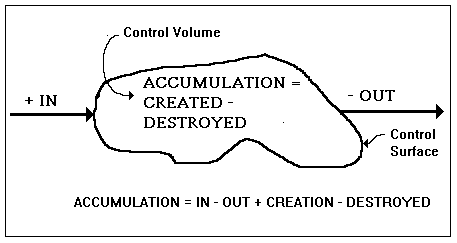
Figure I-1. The generic balance equation
The generic balance equation is so simple that, if we described it incorrectly to a three-year-old child, he or she would recognize that something was wrong, which is a good point in favor of the position that reasonableness is innate, i.e., an a priori synthetic judgment. One may argue as to what this equation may be applied to; but, if we should claim that it applies to what is commonly known as stuff, your objection would be a mere quibble. [Under the aegis of the commonality of the word stuff we consider both corporeal and incorporeal elements. For example, energy is conserved, however it may be more like the behavior of a mysterious something than the something that behaves. It may be so abstract that nothing but a mathematical mapping of the relevant portion of the Universe is adequate to describe it. Mathematicians are content to refer to this mapping as field equations. As far as they are concerned, the field equations are the phenomenon.
The generic balance (or accounting) equation states quite simply that the accumulation within the control volume equals whatever is created within the control volume minus whatever is destroyed inside the control volume plus whatever enters the control volume minus whatever leaves the control volume. The situation is illustrated in Figure I-1. By the accumulation we mean the difference between what we ended up with and what we started out with. This can be negative or positive; but, if it be negative, we might call its absolute value the deficit. As stated above, the control volume is any well-defined region in space. It may be changing shape and moving and it need not be a connected set.
[Note in proof (9-5-96): Many purists will object that the balance equations are not the laws of thermodynamics, which, according to natural philosophy, must be statements that come entirely from experience and may not employ such abstract concepts as energy, temperature, and entropy. In particular, the Second Law should be a statement about a particular type of physical device that cannot exist. In fact, we have two statements each with its own impossible device. We suggest that the reader consult the excellent book for the layman by P.W. Atkins [3]. This will not be our last mention of this book. Suffice it to say that the balance-equation approach is logically, if not philosophically, equivalent to the experiential statements of the laws.]
We now wish to describe the balance equations of thermodynamics, which we are giving the status of laws, the famous laws of thermodynamics. We shall describe the First Law first. Since the First Law is an energy balance, since everyone thinks he knows what energy is, and since entropy, which is an important property of thermodynamic systems, does not appear in the First Law, most thermodynamics texts do not define entropy before they discuss the First Law of Thermodynamics, which involves both work and heat. Work and heat are not properties of the system, but they are rather subtle concepts. Under some circumstances work and heat are mistaken for one another; whereas, if they are defined in terms of entropy, they can be distinguished easily – at least from the theoretical point of view. Therefore, we shall define and discuss entropy at this time. In our opinion, teachers of thermodynamics should give a little consideration to this departure from the usual way of presenting the First Law.
Entropy
Normally, students have a problem with the concept of entropy. This is expected, but what is unfortunate is that they think they understand energy. One supposes that if we use a term enough we think we understand it. After the population crisis and very much related to it, the most serious crisis facing humanity is usually referred to as the energy crisis – even by the President of the United States, high government officials, and famous professors. Of course it should be referred to as the entropy crisis, availability crisis, or emergy crisis, but we are getting a little ahead of ourselves. (It came as quite a shock to one of us when he discovered that the people who are running the world don't know what they are talking about – much less what they are doing.) To facilitate the definition of entropy without recourse to the Second Law, we shall depart from so-called classical thermodynamics, which forbids inquiry into the microscopic nature of the universe. Just for a moment, we shall take a quick peek at statistical thermomechanics.
Typically, a system the entropy of which we wish to know has been
defined in terms of common macroscopic thermodynamic properties that we have at
our disposal and with which the reader may already be familiar such as volume,
pressure, temperature, and internal energy for which we have not given
formal definitions. In addition, let us suppose that the analyst is in
possession (hypothetically) of a number of probability distributions Dk
= {pi, i = 1, 2, … ,Nk} each of which, k = 1, ... , M ,
(i) provides the probability that the system will be found in
the i-th microscopic state, and (ii) is entirely consistent with
the known macroscopic properties of the system. Remember, in
classical thermodynamics, we do not inquire deeply into the microscopic
picture; therefore; we should not be surprised to find that more than one –
perhaps many – such probability distributions could represent precisely the
same state viewed macroscopically. For each such distribution a candidate
Sk can be calculated for the entropy of the system. It is the
minimal amount of information – measured in bits, say – to determine from the
distribution under investigation the exact microscopic state of the
system. It should not be construed that this determination could actually
be carried out – even theoretically; but, it is easy to determine the expected
(in the probabilistic sense) information deficit corresponding to the known
macroscopic thermodynamic variables and the j-th probability
distribution

where Nj different possible and compatible microscopic states are associated with Dj . The macroscopic entropy of the system, S, is the maximum value of the minimal information deficits, i.e., S = maximum{Sj , j = 1 to M}, where M probability distributions are compatible with the macroscopic state of the system as described by classical thermodynamics. As a somewhat challenging exercise, the reader may show, by considering the old TV game Twenty Questions, that the minimal information to determine the exact microscopic state of the i-th microstate is the log to the base two of pi. This will give the entropy as the amount of information needed in bits, which would be converted into standard thermodynamic units by multiplying the same amount of information expressed as a natural logarithm

by Boltzmann’s constant, k = Ro/A, where Ro is the universal gas constant and A is Avogadro’s number. (Don’t worry if you don’t know what these numbers are.) The standard units of entropy are energy over temperature – essentially for traditional reasons. Despite the unfortuitous happenstance that Joules per Kelvin is not particularly suggestive of information, entropy is a measure of the quantity of information that would be needed to determine the microstate from the classical thermodynamic macrostate (except for a constant factor) although it is sometimes referred to as a measure of uncertainty, disorder, randomness, or chaos, which, from our view, are less satisfactory interpretations. [The preceding remarks on entropy are derived from Dr. David Bowman’s generous postings to a list server for physics teachers on the Internet.]
Let us continue our mathematical analysis for a simple and commonly encountered probability distribution. Suppose a system be capable of taking W different quantum states with the probability for the i-th state being pi. Then, the entropy of that system is S = -k S pi ln pi , where S represents the summation from i = 1 to i = Ω, ln is the natural logarithm [ln pi is the exponent to which the transcendental number e (equal to approximately 2.718282) must be raised to get the number pi] and k is Boltzmann's constant. The case where the probability of each quantum state is the same, namely, when pi = 1/ Ω , is exceptionally famous. In that case, we get S = k ln Ω. The expression S = k ln Ω appears on Boltzmann's tomb – unless we have been hoodwinked by the scientific historians, which is not entirely out of the question, although Truesdell [1] provides a photograph.
We may now distinguish between heat and work, both of which entail the transfer of energy at the boundary and only at the boundary of a control volume; however, heat carries entropy along with it and affects the entropy balance accordingly. Work, on the other hand, carries no entropy, and, therefore, has no effect on the entropy balance. Because of this difference between heat and work an asymmetry arises; namely, work can be converted entirely to heat in every case including the case where no other change occurs in the universe, but heat can be converted completely to work only when the rest of the universe is changed in some additional fundamental way. If we restrict ourselves to cyclic processes, work can be converted completely to heat but not vice versa.
[Note in proof (10-15-97). This is easy to visualize: Case 1: Consider the spring escapement in your Grandfather’s watch. It transfers work to the gears, pointers, and whatever else accepts the work done by the spring mechanism, which we will take as “the system”. The state of the material objects by means of which this energy is transferred as work is completely organized. The microstate is completely determined by the extent to which the spring has become unwound. The probability of being in that state is one and the log of one is zero. The entropy is zero. Case 2: Imagine, for a moment, a hydraulic watch, say, driven by a pumped hydraulic fluid, which is permitted to flow across the control surface as we conceive it. This appears to be work too, but the turbulence and random motion of the pumped fluid as well as the friction losses in the pipe convert the electricity that drives the pump (work) into part work and part heat due to the turbulence and other forms of fluid friction. Since heat is crossing the control surface it will be accompanied by entropy since clearly the fluid will not be found in a state clearly defined by one parameter that takes its unique value with probability one. Case 3: Finally, if we had a steam clock, we could drive it by heating water in a boiler the surface of which facing the fire is our conceptual control surface. This is a case of heat and only heat crossing the control surface. Consider the entropy associated with this heat. Hint: Imagine how complicated fire is. The complications in the nature of the fire will complicate the conduction of heat to the boiler.]
[Note in proof (6-27-04). Some analysts may quibble that heat doesn’t cross the control surface. Rather, thermal energy crossing the control surface is heat; that is, crossing the control surface is part of the description of heat not separate from it. We do not feel the necessity for this kind of precision.]
The Energy Balance
The energy balance presented here is one statement of the famous First Law of Thermodynamics. We shall write the energy balance for the simplified case of uniform state and uniform flow. Uniform state means that each element of material inside the control volume has the same internal energy, u. The control volume is assumed to be homogeneous with respect to other physical properties as well. Despite the mysterious and abstract nature of energy, as noted above, the internal energy of a substance can be thought of (loosely) as the micro-mechanical energy associated with the internal motion and configuration of its molecules. It is like the calories in the food we eat. If the state be not uniform, we compute average values of the internal energy, u, and other properties using integral calculus. (It is standard practice to notate average properties by angle brackets, thus <u> is the average internal energy. We do not generally employ angle brackets as averages are clear from context.) Uniform flow means that the enthalpy, h, and other physical properties of incoming and outgoing flows of matter are constant across the area of flow and over the period of time under discussion. Enthalpy is internal energy plus the work that would be done upon the system by the material entering the control volume or the work that would be done on the surroundings by the material leaving the control volume. In the case of a simple compressible substance, one in which surface effects, electromagnetic effects, etc., are unimportant, h = u + Pv, where P is the total pressure of the system and v is the specific volume (the reciprocal of density). Enthalpy is more or less the internal energy of the gasoline about to enter an automobile engine plus the work done by the fuel pump to get the gasoline into the engine. Enthalpy is a trick devised by engineers to avoid accounting for this so-called injection work separately and, concomitantly, to account for the actual work done by the plant, which, of course, is its raison d'être, separately in the variable We so that it can be identified readily – uncontaminated by irrelevant contributions. Again, if the flow be not uniform, we employ the integral calculus. Many practical examples approximate the conditions of uniform state and uniform flow sufficiently well for engineering calculations.
A lay reader thought that enthalpy should be the internal energy minus Pv. She reasoned that doing work to enter the control volume erodes the energy. Yes, that it does, therefore we add Pv to get the enthalpy so that, when the substance has done the injection work, the internal energy alone remains. This gives the correct accumulation of energy within the control volume. For an excellent derivation of the formula for enthalpy see Van Wylen and Sonntag [2], 2cd Edition, SI Version, pp. 116-121.
The initials SI stands for Le Systeme International d’Unites, which is a version of the metric system that is very convenient for engineers and which enjoys international acceptance everywhere – except in the United States, which still employs the “British” system, long abandoned by Britain. As far as we Americans are concerned, it’s heartening to know that the international unit of energy is the joule. The international unit of power is one joule per second, i.e., the familiar watt. Also, we can write Newton’s Second Law of Motion now without a constant of proportionality (see note following this paragraph), or, if we wish to be obstinate, with a constant of proportionality equal to one. One Newton (N) of force equals one kilogram mass (kg) times one meter (m) per second (sec) squared, which last is an acceleration. Notice that, in SI, the unit of mass is the kilogram rather than the gram. One kilogram equals 2.2026 pounds.
Absolute temperature is measured in Kelvin (K) with the familiar
and typographically annoying degree sign neither written nor spoken. (We
say that  .
A Kelvin is the same size as one degree Celsius, formerly denoted Centigrade,
as the difference between the freezing (triple?) point and boiling point of
water under its own vapor pressure is 100 degrees.) Since 2.54
centimeters (cm) equals one inch, a foot is 30.48 cm or 0.3048 meters
(m). Consequently, one meter is 3.2808399 feet, i.e., just over a
yard. One liter is 1000 cubic centimeters (approximately), thus one can
compare metric volumes with American volumes by simple arithmetic. Now,
that wasn’t so bad was it? Of course, now that the lesson is over, we
shall probably employ American units most of the time anyway.
.
A Kelvin is the same size as one degree Celsius, formerly denoted Centigrade,
as the difference between the freezing (triple?) point and boiling point of
water under its own vapor pressure is 100 degrees.) Since 2.54
centimeters (cm) equals one inch, a foot is 30.48 cm or 0.3048 meters
(m). Consequently, one meter is 3.2808399 feet, i.e., just over a
yard. One liter is 1000 cubic centimeters (approximately), thus one can
compare metric volumes with American volumes by simple arithmetic. Now,
that wasn’t so bad was it? Of course, now that the lesson is over, we
shall probably employ American units most of the time anyway.
Note. We wish to entertain the reader with one more subtlety with which he can embarrass many of his scientific friends. It is simply this: Newton’s Second Law is not F = ma . What can be said in general is that force is proportional to mass times acceleration. But, what is the constant of proportionality? Well, it depends on the system of units, doesn’t it. In the familiar British (American?) engineering system, it is called gc. But, it appears in the denominator, thus:

Now, force, F, is in poundsforce; mass, m, is in poundsmass; and acceleration, a, is in feet per second squared. Therefore, to obtain dimensional consistency, gc must have the units consisting of the ratio poundsmass per poundsforce multiplied by the ratio of feet over seconds squared. In this system,

which is supposed to be (numerically equal to) the average
acceleration due to gravity at the Earth’s surface, hence the letter g.
(We suppose that the subscript c denotes constant. That is, gc is the same on the moon as it is on
Earth, although g, the actual acceleration due to gravity, is much
less. For all practical purposes, the acceleration due to gravity was
nearly constant so long as we had the good sense to keep our feet on the
ground; but, now that we have elected to break “God’s quarantine on mankind”
provided by the “vast distances between the heavenly bodies” [C. S. Lewis],
gravitational acceleration can hardly be taken to be constant.
Nevertheless,  , which is a constant of proportionality
– not an acceleration – is constant everywhere.) Anyway, an object’s
weight in poundsforce at the Earth’s surface is numerically equal to its mass
in poundsmass. Isn’t that wonderful! Regrettably, this results in
no end of confusion as to what you weigh and what your mass is.
Ironically, (many) engineers and (a few) scientists are not spared. Just
ask your favorite engineer what Newton’s Second Law of Motion is and let him
explain the units. You may be in for some fun. In the
quasi-reasonable SI system, force has a name different from the name for
mass, but
, which is a constant of proportionality
– not an acceleration – is constant everywhere.) Anyway, an object’s
weight in poundsforce at the Earth’s surface is numerically equal to its mass
in poundsmass. Isn’t that wonderful! Regrettably, this results in
no end of confusion as to what you weigh and what your mass is.
Ironically, (many) engineers and (a few) scientists are not spared. Just
ask your favorite engineer what Newton’s Second Law of Motion is and let him
explain the units. You may be in for some fun. In the
quasi-reasonable SI system, force has a name different from the name for
mass, but
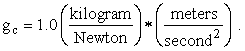
(Van Wylen and Sonntag [2] claim otherwise, namely, that in the SI system force is not an independent concept but rather is defined to be a kilogram meter per second squared. This is probably true, so I expect to get in trouble for sacrificing the elegance of one less fundamental concept for uniformity in the treatment of Newton’s Second Law of Motion.) One last thought: Please remember that (nearly) every equation in physics (as opposed to mathematics) is really two equations in one, both of which must balance, namely, an equation in numbers and an equation in units!
[Note in proof (7-30-97). In a private communication, Dave Bowman explained that, from the viewpoint of the theoretical physicist, many, most, or all of the so-called fundamental constants of the universe are really no better than conversion factors between unfortunate choices of units. For example, the speed of light in vacuum, c, is a conversion factor between (relativistic) intervals in units of time to units of length. If time-like intervals were measured in years, space-like intervals would be measured in years, too – light-years, where a light-year is just a kind of year. If energy were measured in inverse years or Hz, say, Planck’s constant would be one – with no units. Then, if temperature were measured in inverse seconds (or inverse years), entropy would be dimensionless, which it should be as it is merely a count of items of information – bits, or bytes, or pages. How could temperature be measured like a frequency? One simple way is to designate the frequency at which black-body radiation emits maximally. As we shall see, the frequency corresponding to 6000 K is about 620.7 Hz or, if you prefer, inverse seconds. We leave it as an exercise to show that the temperature is about 1.96 E10 in inverse years. Undoubtedly, these units are inconvenient for most practical purposes, nevertheless the fundamental constants have been over-hyped, have they not?]
In our statement of the First Law as a balance equation we may exclude nuclear reactions or, in case of nuclear reactions where mass is converted to energy or vice versa, we may employ Einstein's famous equation, E = mc2, to equivalence mass and energy. Also, for many applications, we may ignore kinetic energy (not adequate for a rocket in flight) and gravitational potential energy (not adequate for a hydroelectric plant). Under these assumptions the equation is as follows:

The symbol m represents mass. (It’s a variable now not a unit like the meter.) The subscript 2 designates the end of the period under consideration and the subscript 1 indicates the beginning. Thus the expression m2u2 - m1u1 represents the accumulation. (If it be negative, the amount of energy in the control volume has been depleted; i.e., the absolute value of a negative accumulation is a depletion. The subscript i stands for in and the subscript e stands for ex. (Please don't ask why we use Latin prepositions.) Thus the term mihi represents the total enthalpy Hi = mihi for one of the flows entering and the term åmihi represents the total enthalpy of all of the flows entering the control volume. (The symbol å represents summation.) Similarly for the term åmehe representing all the energy leaving the control volume as a result of material flows including the flow work done on the environment.
The term Qi represents the i-th heat term associated with the transfer of energy into the control volume; the term Qe represents the e-th heat term representing energy leaving the control volume. The term Wi represents work associated with energy entering the control volume; the term We represents energy leaving the control volume. The reader should recognize that both heat and work are phenomena that occur at the boundary of the control volume (the control surface). It doesn't make sense to talk about the heat within the control volume. (However, as in the partitioned control volume discussed above, heat may be transferred from one portion of the control volume to another. Since this transfer is associated with a temperature gradient, one commonly hears engineers and scientists refer to this transfer as a thermal flow or flux. This is fine so long as one realizes that nothing corporeal is flowing.) Heat is the transfer of thermal energy across the control surface unmediated by the flow of material. Associated with each heat term Qi is a temperature Ti , normally the temperature at the control surface. (Notice, we do not say the temperature of the control surface. That wouldn’t make sense as the control surface is incorporeal.) We use the integral calculus when the temperature varies continuously over the portion of the control surface where energy enters. Similarly, for the Qe . Although heat is not associated with the flow of mass, it is accompanied by entropy flow; i.e., it results in a change in the entropy associated with the control volume. Work, on the other hand, is energy transfer that is dissociated from material flow and entropy flow as discussed above. This is not the typical definition of work found in textbooks. Normally, work is defined to be energy crossing the boundary dissociated from mass and capable of raising a weight. Notice it doesn’t say that a weight is raised, but that a weight could have been raised. We don’t like this definition. We am not certain that we can ascertain, in every situation, whether or not a weight could have been raised. We prefer to look at what is rather than what could be. Our approach is not without difficulties however.
Some extremely thoughtful physicists have objected to the depiction of energy and entropy as something, i.e., stuff, that flows. This reminds them of the discredited, long-abandoned theory of caloric, which treats energy as something like water or air, but which is invisible. Anyone familiar with the quantum theory, even a popularization of ideas from quantum theory, knows that we are becoming accustomed to regarding reality as something unimaginably weird and strange. Let us imagine energy as something peculiar too; but, nevertheless, quantifiable and amenable to the ordinary accounting procedures afforded by balance equations – just like water or people. Since energy and entropy are properties of systems, they are relatively well-behaved and have many interesting and useful characteristics.
The Entropy Balance and Lost Work
We are now ready to write the Second Law of Thermodynamics as an entropy balance:

As before, associated with each heat term Qi accounting for energy and entropy entering the control volume is a temperature Ti normally the temperature at the control surface. Similarly, the subscript e refers to heat accounting for energy and entropy leaving the control volume (CV). If the temperature be not constant, we employ the integral calculus. The symbol To represents the temperature of the surroundings of the CV – assumed to be constant. Normally, this is the temperature of the air or a convenient body of water. In most engineering calculations, we will not make a significant error if we take TO to be 288 Kelvin (written 288 K – without a degree sign) everywhere on the Earth both summer and winter. (Temperature in Kelvin is degrees Celsius (Centigrade) plus about 273.16.) Eventually, we shall be comparing the temperature of the Earth to the temperature of the Sun and what might seem to be extreme differences in temperatures if one had to subject one's body to them will be insignificant mathematically. Therefore, we shall assume that the temperature of the Earth is constant at 288 K. However, when the CV is the entire Earth and a shell surrounding it 100 miles thick, the temperature of the surroundings must be considered carefully. The expression L stands for (thermodynamic) lost work, which is really a very suggestive term. We shall see exactly what it represents in the next section on the First and Second Laws Combined. For now, it is what makes the Second Law an equation rather than an inequality. For that reason alone, it is an extremely important concept.
Just as in the case of the First Law the expression m2s2 - m1s1 represents the accumulation term. The two terms with summation signs represent entropy crossing the control surface (in and out, respectively). The terms misi and mese represent mass crossing the control surface each unit of which carries its own specific entropy, whereas the heat terms (ratios of heat to temperature) represent entropy crossing the boundary that is not associated with mass. Notice, as mentioned earlier, the entropy balance has no work terms. (Why?) In this balance equation (unlike the First Law) we have a creation term, namely, LCV / TO. Since Lcv is always positive and To is always positive, this term always represents creation of entropy. It is this term LCV / TO that represents irreversibilities, I, in the process, i.e., I = LCV / TO. Examples of irreversibilities are friction, turbulence (in fluids), the mixing of pure substances, the unrestrained expansion of a gas, and transfer of heat over a finite temperature difference.
Thus, the heat terms, QCS / TCS, in this version of the Second Law must represent reversible heat transfer, i.e., thermal energy that is exchanged infinitely slowly with a thermal reservoir. Considerations of reversibility (approachable but not obtainable by real processes), and irreversibility are of paramount importance in classical thermodynamics – as we shall see.
Definition (Thermal reservoir). A thermal reservoir is a large thermal energy sink or thermal energy source that (i) is capable of exchanging essentially infinite thermal energy without changing temperature, i.e., is very large – like the entire atmosphere, and that (ii) differs in temperature only infinitesimally from the temperature at the control surface, TCS , in the denominator of these terms. (We have employed the subscript cs when the direction of transfer isn’t important.) That is, thermal energy can be exchanged reversibly from a thermal reservoir at Ti + dTi to a control surface at Ti. Likewise, from a control surface at Te to a thermal reservoir at Te - dTe .
The classical example of irreversibility given in popular expositions is a glass falling from a table to the floor and breaking into a thousand pieces. (This is like mechanical lost work, Lmech = T × I where T is the temperature of the system and I is the irreversibility produced in the control volume. If we subtract the work required to clean up the mess of the broken glass (and the spilled wine, perhaps) from the mechanical lost work, that is analogous to the thermodynamic lost work that we are using in our version of the famous equation; i.e., Lthermo = LCV = To´I.) We do not expect to see this process reverse itself spontaneously unless someone is running a motion picture backwards. In fact that's how we know the motion picture is running backwards and it makes us laugh (or smile). This irreversibility of nearly all real processes is referred to as “the arrow of time” and we all believe in it (or we wouldn't smile at the motion picture running backward). Thus, at least in this part of the universe and during this era in the development of the universe, the Second Law tells us that the entropy of the universe is always increasing. This does not mean, of course, that the entropy of every control volume is increasing; but, if it's decreasing in one control volume, it's increasing even faster somewhere else. We shall consider the important concept of a Carnot engine next.
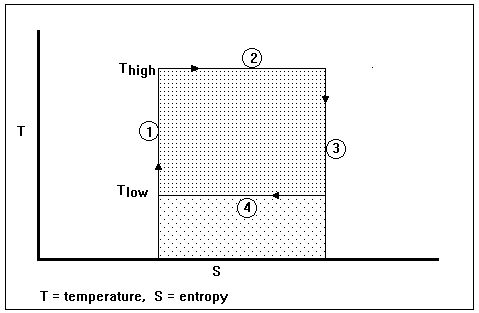
Figure I-2. The temperature-entropy (S vs T) diagram for a Carnot engine
The thermodynamic cycle for an imaginary Carnot engine is pictured on an entropy-temperature diagram in Fig. I-2. The numbers in circles refer to the following process steps: (1) an isentropic (constant entropy) pumping of the imaginary working fluid (presumably a liquid) from a low-pressure, low-temperature state to a high-temperature, high-pressure state, (2) reversible heat exchange over an infinitesimal temperature difference from a high-temperature heat reservoir to the working fluid, which stays at constant temperature (presumably while the working fluid is changing from a liquid to a vapor), (3) an isentropic expansion of the fluid (presumably through a gas turbine, which delivers work, some of which is used in Step 1) from a high-temperature, high-pressure state to a low-pressure, low-temperature state, and (4) reversible heat exchange over an infinitesimal temperature difference at a constant low temperature (presumably while the working fluid is condensing from a vapor to a liquid). The entire area within the shaded rectangles represents the heat exchanged at the high temperature; the lightly shaded rectangle represents the heat exchanged with the surroundings at the low temperature; the heavily shaded rectangle represents the work done by the imaginary heat engine, i.e., the difference between the heat in and the heat out.
Such a heat engine, operating in such a cycle, is called a Carnot engine, after Nicolas Leonard Sadi Carnot, a French physicist who was born in 1796 and died (young) in 1832. Clearly, a heat exchanger that exchanges heat through an infinitesimal temperature difference would have to have an infinite area, which is inconvenient for purposes of construction. Also, it is difficult to imagine what sort of fluid could go from low temperature to high temperature while being pumped as a liquid (this would be necessary to minimize the portion of work that would have to be drawn from the turbine to operate the device that brings the fluid from low pressure to high pressure). Nevertheless, the Carnot engine is a useful concept that represents an upper bound on efficiency for real heat engines. If someone tries to sell you a heat engine for which an efficiency better than the efficiency of a Carnot engine is claimed, “stay not on the order of your leaving, but depart immediately.” – William Burroughs in Naked Lunch. In the book by P.W. Atkins [3] a much more credible Carnot cycle is illustrated. Any reversible cyclic engine can be a Carnot engine provided only that it has two isentropic processes and two isothermal processes. Atkins illustrates his Carnot engine with a pressure-volume diagram – the well-known indicator diagram employed by James Watt.
The formula for the work from a Carnot engine is easily derived from the Second Law for a cyclic reversible process with no material entering or leaving the system. Remember that, during one cycle of a cyclic process, the system is returned to the state from which it started. Therefore, the accumulation term must be zero. Also, for a reversible process, the lost work term is zero. Thus,
 .
.
To analyze this process denote the change in entropy of the
system during Step 2 as the positive quantity DS . This is precisely equal to the positive change in
entropy of the surroundings during Step 4, as is clear from Fig. I-2. The
system gains entropy during the heat input step and loses the same amount of
entropy during the heat rejection step, which results in no change over the
course of one cycle consisting of all four steps. The heat associated
with energy added at the high temperature (H is for high) is  , while the
heat associated with energy rejected at the low temperature (L is for low) is
, while the
heat associated with energy rejected at the low temperature (L is for low) is  . The
work done by the engine, then, is Wrev =
. The
work done by the engine, then, is Wrev =  , while the
efficiency,
, while the
efficiency, 

Frequently, TL = To and TH is just plain T, so
 .
.
The efficiency of a Carnot engine can be approached as closely as we are willing to pay for, but it can never be attained by a real engine.
The First Law and Second Law Combined: The Two Availability Functions
We now wish to do some simple algebra to get the First and Second Laws Combined. Multiply Eq. I-2 by To to get

Subtract Eq. I-3 from Eq. I-1 to get


Represent u - Tos by a and h - Tos by b . We now have our availability balance.
[Note in proof (9--9-97). We should refer to a as the Helmholtz availability function and b as the Gibbs availability function, two point functions, like energy, enthalpy, and entropy, that are thermodynamic properties of a simple homogeneous substance. These functions are employed in lost work analysis, the methodology employed here. Exergy analysis is a competing or complementary methodology (depending upon one’s viewpoint) that employs, instead, the thermodynamic property exergy, which, to make matters more confusing, is sometimes referred to as availability. (In the case of the 500 K hot water, used as an example in Chapter 2, the exergy is equal to the availability.) Exergy is essentially the difference between the availability function of the system and the availability function of the same atomic species when they are in mechanical, thermal, and chemical equilibrium with the surroundings. In this essay, we sometimes refer to the availability function as just the availability, likewise for the availability function balance, but we do not employ exergy analysis to such an extent that confusion could arise. When we use the term availability alone, we always mean the availability function

or, in rate form:


where A = m<a>, mass times average availability,
i.e., availability per kilogram. When we wish to denote rate of
accumulation of availability, say, per unit time, we merely place a dot over
the symbol for availability. This is standard practice among physicists
and engineers and applies to anything; i.e., if X stand for volume of beer
drunk,  (spoken
and sometimes written ‘X dot’) stands for the volume of beer drunk per unit
time at a particular time of interest or over a period of time such that the
rate of guzzling remained constant. Although averages are denoted
normally by angular brackets, viz.,
(spoken
and sometimes written ‘X dot’) stands for the volume of beer drunk per unit
time at a particular time of interest or over a period of time such that the
rate of guzzling remained constant. Although averages are denoted
normally by angular brackets, viz.,

we may omit the brackets when no confusion can arise, in which case X dot stands for the average rate of guzzling during the period of interest. (Aren’t you glad you decided to read this?) But, we haven’t said what kind of availability function we are talking about and, in keeping with Murphy’s 352d Law, there are two kinds (represented by a and b).
Amazingly, despite the incredible importance of the quantities a and b, they do not have decent names even. Perhaps, this is indicative of a less than felicitous point of view adopted by scientists and engineers over the years. To assist our memories, let us call a = u - Tos the Helmholtz availability function (since u - Ts is the well-known Helmholtz function) and b = h - Tos the Gibbs availability function (since h - Ts is the well-known Gibbs function).
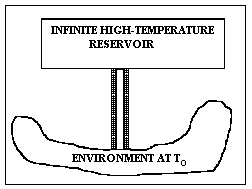
Figure I-3. Diagram to illustrate lost work
In rate equations, we find it confusing to employ derivative notation. If mcs is the quantity of mass crossing the control surface, we shall refer to the rate at which mass crosses the control surface as fcs (for flow). Similarly, Rcs is the rate of heat transfer across the control surface, and Pcs (for power) is the rate at which work is done on or by the control volume. These have convenient mathematical equivalents, which you may know already or will learn later.
We may employ Eq. I-6 to familiarize ourselves with important
thermodynamic concepts. In particular, let us consider a closed system in
steady state. The accumulation term,  , is zero and the entrance and
exit terms, åribi
and årebe, are
both zero. Suppose, in addition, that no work is done on or by the
control volume. Eq. I-6 is reduced to
, is zero and the entrance and
exit terms, åribi
and årebe, are
both zero. Suppose, in addition, that no work is done on or by the
control volume. Eq. I-6 is reduced to

Let us select a concrete example to see how this equation makes clear the meaning of lost work. Suppose we have a long metal rod – well-insulated except for the ends – touching a practically infinite high-temperature source like a large boiler at temperature Th at one end (of the rod) and the atmosphere or ground at temperature To at the other as shown in Fig. I-3. The control surface is taken to be the outside of the insulation and the bare metallic ends of the rod. The heat influx rate is Ri = RH, whilst the heat efferent rate is Re = RL = Ro. The insulation is important because, under these conditions, the heat out term Re will be multiplied by 1 – To/To = 0 , which would not be the case if heat leaked out the sides at higher temperatures. To maintain steady state, we must have a positive heat term, RH = Ri, entering the control volume from the boiler at temperature Th. Then the lost work is easily seen to be precisely the work that would have been done by a reversible (Carnot) engine operating between a heat source at temperature Th and rejecting heat to a heat sink at temperature To.
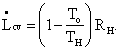
[This term 1- To/TX occurs so often that we find it expedient to further simplify our equations by denoting it CX (for Carnot). The above equation could have been written
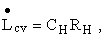
which is perhaps going too far.] Thus, L really does represent the work we could have gotten from an ideal process but didn't get from our real process, which wasted the high-temperature heat that was added to it. Question: Where was the irreversibility in this system?
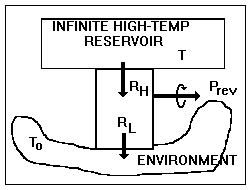
Figure I-4. A completely reversible device
In a reversible steady-state process
conducted upon a closed system, a heat engine, say, that produces work,
heat enters at temperature  and leaves at temperature To
, in which case Eq. I-6 reduces to
and leaves at temperature To
, in which case Eq. I-6 reduces to
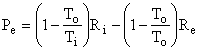
since the accumulation term, A dot, equals zero (steady state), the terms representing mass entering and leaving are zero (closed system), and the lost work term, Lcv dot, equals zero (reversibility). The work done by the control volume is equal to the reversible work, i.e., the maximum amount of work that can be extracted from Ri at temperature Ti. Thus,
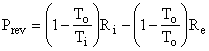
as shown in Fig. I-4. But, the second term in parentheses is identically zero, therefore the equation reduces to
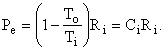
Thus, the control volume is a heat engine with an efficiency h = We / Qi = 1 - To / Ti = Ci. This is precisely the efficiency of a Carnot engine. We know that no device can have an efficiency as high as that of a Carnot engine except a Carnot engine itself; therefore, our control volume must be a Carnot engine, the imaginary device, discussed above, whose efficiency can be approached but never attained.
Finally, let us consider a reversible steady-state process with one stream entering and one stream leaving. We wish to know the maximum amount of work that could be obtained from such a process. This serves as an upper bound on the work that we can expect to obtain from a process with this input and this output.
Prev = fibi - febe .
Let us put these concepts to use immediately.
Overall Availability Analysis of Earth
Note (10-7-05). This section serves no useful function within the context of this essay, therefore it has been withdrawn. At some future time, it will be presented as an ancillary essay hyperlinked on my website.
Note (4-11-07). Lately I have revisited the calculation and computed the value of the maximum amount of reversible work that can be performed on Earth on a completely different basis, namely, that the control volume is a ball concentric with the Earth with a radius 100 miles greater so as to include the atmosphere. The effective temperature of the surroundings is taken to be the temperature of deep space. I am adding the calculation here as a point of interest:
Helmholtz availability is U – TeS = A and Gibbs availability is H - TeS = E; therefore, the availability balance, which is obtained by multiplying the entropy balance equation by Te and subtracting it from the energy balance equation, is as follows:


where U is internal energy, H = U + PV is enthalpy, W is work, Q is heat, and T is temperature. The subscripts i, o, and e refer to in, out, and environment. The enthalpy of an ensemble of photons is four-thirds of its energy. The effective temperature of the sun was computed to be 5760K and the effective temperature of Earth was computed to be 254K. Earlier work on the availability balance around Earth can be found at http://dematerialism.net/Earth Part 1.html and http://dematerialism.net/Earth Part 2.html.
The correct input and output terms to the Earth’s control volume are the enthalpy in and the enthalpy out. The Gibbs free energy of photons and elements is zero; so, Hi = TiSi and Ho = ToSo. Also, since the Earth is approximately in energy balance regardless of global warming, Hi = Ho = H. Equation 3 for the maximum reversible work for the Earth’s steady-state control volume reduces to:

This gives a value for the maximum reversible work of 0.0139 · 1.33333 · 127,000 TW = 2358 TW. This is a very large amount of reversible work, but much smaller than the 183,533 TW I computed when I assumed that the energy from the sun was discharged to the coldest temperature on Earth.
Global Warming?
Introduction
Will the burning of fossil fuels cause global warming? Computer experiments seem to indicate that, all things being equal (and they never are), an increase in the carbon dioxide (CO2) concentration in the atmosphere will allow more infrared radiation to be trapped within the Earth's atmosphere and cause the average global temperature to rise slightly (one or two degrees Celsius) over a number of decades. This would lead to some melting at the polar ice caps and many coastal cities would be under water. Other undesirable effects might occur – as well as a few desirable effects. No one knows for certain what will happen – in particular because about half of the carbon dioxide that goes into the atmosphere is unaccounted for. Freeman Dyson, in a recent lecture at Rice University, suggested that the biosphere might become so “hooked” on CO2 that we would eventually have to burn limestone! Of course, he was only joking, but one never knows!
Be that as it may, we have certainly released a great deal of carbon dioxide to the atmosphere during the last fifty years that had been withdrawn from the atmosphere by photosynthesis over extremely long periods of time. Moreover, Keeling et al. [see p. 319 Häfele [4]] measured the concentration of CO2 at Mauna Loa in Hawaii over about thirty years and found an increase in the yearly average (it goes through a yearly cycle) from about 315 parts per million (ppm) to well over 700 ppm. Therefore, it makes sense to analyze how we might have to alter our use of fossil fuels if global warming were a genuine threat.
Example of Burning Methane and Octane
If we rearrange Eq. I-6 for the steady-state ( = 0), adiabatic (no
heat term), reversible (no lost-work term) combustion of methane, say, we can
write
= 0), adiabatic (no
heat term), reversible (no lost-work term) combustion of methane, say, we can
write
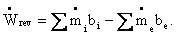
The control volume for this thought experiment is pictured in Fig. I-6. Moreover, if we set T = 300 K , then the Gibbs availability function is equal to the plain Gibbs free energy, g = h - Ts, which we can look up in a handbook [12] and
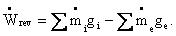
On the basis of one gram mole (9) of methane, we compute, corresponding to the chemical equation,

Wrev = gmethane+ 2 goxygen - [gcarbon dioxide + 2gwater] =
= [-12.14 + 0.00] - [-94.26 + 2 (-54.64)] = 191.4 kcal per gram-mole methane.
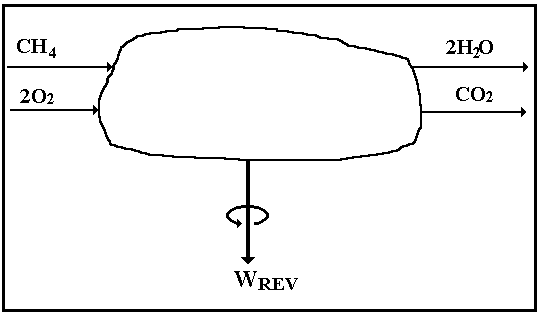
Figure I-6. Control volume for reversible, adiabatic combustion of methane
(The free energy of oxygen is zero because the free energies of all elements are zero. The non-zero Gibbs availabilities are the same as the Gibbs free energies or the free energies of formation since T = To and they can be found in Table 3-202 pp. 3-137 to 3-144 in the Chemical Engineers’ Handbook [12].) (Also, I find it less confusing to enter negative quantities as such and use parentheses appropriately. I recommend that students follow my example and make liberal use of the change-sign button on their calculators.) So far so good, but what happens if, to avoid global climate change, we must dissociate the carbon dioxide to oxygen and carbon (which last species might end up as the now-famous buckyballs [13]) to prevent it from entering the atmosphere?
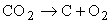
Oxygen, O2 , and carbon, C , are elements and as such are assigned a Gibbs free energy of zero. Thus, the reversible work that must be supplied to dissociate CO2 is just 94.26 kcal per gram mole of carbon dioxide, the negative of the Gibbs free energy of carbon dioxide, which we know from the previous calculation. But, these figures represent the best we can do under impossible-to-obtain ideal circumstances. Suppose, to be optimistic, we agree that we could carry out the combustion and the dissociation at the amazing efficiency of 70%. (Remember we must count the energy used to make the apparatus and some portion of the energy expenses of the people involved with the process.) In that case, the net work we should obtain by burning fossil fuel without releasing carbon dioxide to the atmosphere would be Wactual = 0.70 ´ 191.4 – (94.26 / 0.7) = -0.68 kcal /gmole methane, i.e., a dead loss. Moreover, methane is the hydrocarbon with the highest possible hydrogen to carbon ratio, therefore we should not expect to do better with any other fossil fuel and the combustion of fossil fuels would be infeasible – under this scenario. (The reader realizes that we are oxidizing the hydrogen in methane to add water to the environment, which is OK, but we are not oxidizing the carbon, which is OK (less oxygen is consumed), and producing pure carbon, which may or may not be OK.) I suppose that the carbon dioxide could be eliminated from the flue gases with less expenditure of energy than we have computed – perhaps by a new technology that produces something useful – maybe a building material; but, as we shall make abundantly clear, we have many additional compelling reasons not to depend on fossil fuel. (It has been suggested that energy could be obtained by reacting fossil fuels in such a way that carbon dioxide is not produced. Reactions where the carbon ends up in useful organic compounds all turn out to be net consumers of reversible work according to my calculations with limited data, but who knows?)
Rather than bore you with a similar calculation for octane (a fuel that behaves much like the much-more-complicated mixture we call gasoline) let me provide you with the Gibbs free energy of octane, namely, g octane = 4.14 kcal /gmole, and leave it as an exercise to show that the break-even efficiency for burning octane and dissociating the carbon dioxide in the flue gas is approximately 77.7%. The formula for octane is C8H18. A passing familiarity with general chemistry is necessary to work this exercise.
Of Things Not Treated
In this brief introduction to thermodynamics, we avoided power cycles other than the imaginary Carnot cycle. Also, in a course in a chemical engineering department, a large chunk of time will be devoted to vapor-liquid equilibrium. This is the most difficult scientific information to obtain when designing sensitive separation processes. (One of the authors has seen with his own eyes a book of such data produced from photocopies and not exceeding 300 pages by much if any that was for sale at the time for $2,500 and sales were satisfactory. Normally, liquid-liquid equilibrium is treated too but not in quite so much depth. Many thermodynamics textbooks analyze mechanical and chemical equipment from pumps to reactors. This is way too nuts-and-boltsy for us. Finally, thermodynamics is the key to chemical reaction equilibria and, normally, a chapter is devoted to chemical reactions. In mechanical engineering departments, flow through turbines and nozzles, including supersonic flow and shock waves, is studied. Theoretical chemists and physicists seem to pay more attention to the fundamental mathematical relations and special relations among the distinguished partial derivatives derived from them. I believe I made in clear that the Second Law can be studied from the viewpoint of impossible processes, namely, the Clausius Statement of the Second Law and the Kelvin-Planck Statement. We don’t bother with these at all; balance equations are so much more useful.
March 15, 1993
Revised October 13, 1997
References
1. Truesdell, Clifford, “Some Challenges Offered to Analysis by Rational Thermomechanics”, in Contemporary Developments in Continuum Mechanics and Partial Differential Equations, Eds. G. M. de La Penha and L. A. J. Medeiros, North-Holland (1978).
2. Van Wylen, Gordon J. and Richard E. Sonntag, Fundamentals of Classical Thermodynamics, John Wiley and Sons, New York (1978).
3. Atkins, P.W., The Second Law, Scientific American Library, W.H. Freeman, New York (1984).
4. Häfele, Wolf, Editor, Energy in a Finite World, Ballinger, Cambridge, MA (1981).
5. Yourgrau, Wolfgang, Alwyn van der Merwe, and Gough Raw, Treatise on Irreversible and Statistical Thermodynamics, Dover, New York (1982).
6. Hammond Headline World Atlas, Hammond, Maplewood, N.J. (1986).
7. Gegani, Meir H., Astronomy Made Simple, Doubleday and Co., Inc., Garden City, N.Y. (1955).
8. Wayburn, Thomas L., “On Space Travel and Research”, in The Collected Papers of Thomas Wayburn, Vol. II, American Policy Inst., Houston (Work in progress 1997).
9. Gleick, James, Chaos: Making a New Science, Viking, New York (1987).
10. De Nevers, Noel and J. D. Seader, “Mechanical Lost Work, Thermodynamic Lost Work, and Thermodynamic Efficiencies of Processes”, Lat. am. j. heat mass transf., 8, 77-105 (1984).
11. Szargut, Jan, David R. Morris, and Frank R. Steward, Exergy Analysis of Thermal, Chemical, and Metallurgical Processes, Springer-Verlag, New York (1988).
12. Perry’s Chemical Engineers’ Handbook, 6th Edition, Large staff of specialists, McGraw-Hill, New York (1984).
13. Kroto, H. W., J. R. Heath, S. C. O’Brien, R. F. Curl, and R. E. Smalley, “C60: Buckminsterfullerene”, Nature, 318, pp162-163 (1985).
Appendix II. Social Evils
Summary of Social Problems Discussed in Text
In Chapter 5, I introduced the list of defects of capitalism discussed by Marx and Engels in the first chapter of The Communist Manifesto [1]. This list was compared with the starting point for this essay, namely, my list of the defects of materialism.. (It was written originally on the back of an envelope.) As my thinking progressed, I began to see more problems with materialism and to think of the old problems in different terms. Throughout this essay the defects of materialism are pointed out wherever it seems appropriate to do so. In “On a New Theory of Classes” [2], I identified what I call the money and power seeking class. This is the class of people who perpetuate materialism most vigorously. This essay is not really about blame; but, if you are looking for a culprit, try looking in the mirror. Except for a handful of people who are fighting materialism as vigorously as the money and power seekers fight to satisfy their unslakable thirst never getting any closer to their goal. Like a desert mirage, the goal of the money seekers is as impossible to achieve as it is harmful and stupid to try to achieve. Such people are guaranteed to fail as they are really trying to become infinitely wealthy and/or powerful, which, obviously, is impossible. I owe this observation to Durkheim [3], however I have observed it among my wealthy friends, one of whom committed suicide.
In this essay, we have been discussing the harm done by the political and economic circumstances that allow, even permit, the existence of the money and power seeking class, mainly players of the Money Game. The materialism plague has infected every single member of the human race, regardless of the degree of intimacy of his association with known carriers of the disease. Total avoidance of the society of human beings has not prevented contagion since the “civilized” world comes to the recluse no matter where he goes to avoid it. Eventually, some bureaucrat will place him within his purview and infect him with some sort of nonsense regarding taxes, special regulations, or, in metaphorical terms, the virulent government virus. Perhaps, the plague will end before the human race is extinct. The Black Death died out; but, in that famous epidemic, not everyone was infected. (To continue the metaphor in the religious tradition, since, for all practical purposes, Jesus’ work was in the health-care sector: Perhaps, our unshakable faith that disease is no more than one of Satan’s countless tricks to create delusions and to lead us into error, which itself is illusory, may result in divine intervention and a miraculous healing – Deo volente.)
In my earlier essay “What We Want and What We Get”, which will be included in Vol. II of my collected papers [4], I discussed some of the institutional corruption caused by what we do for money – even excessive risk to entrepreneurs. I noted that the economy has become a Frankenstein monster that no one understands. I discussed the undesirable effect of the money culture on our attitude toward work (many workers are reduced to virtual slavery). Also, I discussed the effect on education, science, medicine, commerce, and highly paid dangerous sports. I implied that trade leads to imperialism, which leads to war. (Perhaps, some wars result from other causes, but these, too, can be related to our economic system.)
I discussed the environment in terms of the unintended effects of what we do. The inevitable destruction of the environment caused by materialism is a theme that recurs throughout this essay. I discussed how our economic system affects our thinking and the thinking of our children, emphasizing “doublethink” (the ability to hold conflicting opinions simultaneously), intolerance and hypocrisy, racism, and our thirst for vengeance to appease the victims of crimes that we should recognize as inevitable under the circumstances of our materialist society and that we all are responsible for – except, perhaps, the perpetrator. I pointed out that our government has become (has always been?) a tyranny and discussed the undesirable effects of that in case anyone thinks that tyrannies are useful. I discussed the demise of the best cultural traditions as money and commerce infiltrate every aspect of art and popular entertainment. I gave examples of how we dehumanize ourselves or, rather, how our economic system dehumanizes us with our cooperation. I discussed deteriorating ethics in the face of ludicrous moral standards that no person of spirit can live by. This results in anomie and the inability to respect rational morals, which we are unable to distinguish from irrational morals, which we violate routinely, usually intentionally. I gave examples of people who behave unethically and are completely unaware of it. Due to the lack of a rational social contract, social chaos and disorder should be expected and we share a mutual responsibility for unacceptable crimes no matter who commits them, thereby invalidating our system of punishment for non-standard behavior. Finally, I reissued the warning issued by George Orwell in his book 1984 [5]. The year 1984 has passed, but just barely. I have stated why I believe we stand on the brink of the Orwellian abyss. [Note in proof (5-31-96): Perhaps it’s too late.]
In the text and in my collected essays, I showed that, rather than freedom, most Americans are presented with very few choices. Most of us do what we do because we have no choice. Narrowness of choice leads to poverty and poverty leads to crime; but, naturally, the desire to get rich accounts for a great deal of crime too and rich people don't stop committing crimes once they “make it”. They stick with the methods that “got them there”, although they may refine their methods. (The Rockefellers no longer blow up competitors´ gas stations.) In my disorganized collection of short essays on crime and punishment, gathered together within my collected essays, I discussed the failure of punishment as a deterrent to crime. In fact, I identified punishment itself as one of the principal causes of crime and a fundamental evil of materialism.
Also, in the text and in my collected essays, I issued a serious warning about the intentions of the leaders of the large multi-national corporations, who constitute the greatest threat to the future of mankind the world has ever faced, as I see it and concerning which I am joined by Noam Chomsky [6]. I pointed out that the United States is a plutocracy, which masquerades as a democracy; but, on closer inspection, is recognized as a dictatorship, with the dictator changing each time a new president is elected; but, the dictatorship, consisting of the plutocracy that owns the country, tells the president what to do and is permanent. The plutocrats, working behind the scenes, are not interested in publicity. The great American democratic social experiment has been concluded and the result is – failure. Basically, the candidate who can raise the most money wins, thus materialism killed the last semblance of democracy, the chance for the people to decide who will take orders from the plutocracy. I have denounced American conservatism, which is based on materialism. I have shown that competing political philosophies are unsatisfactory because they do not address materialism. Every competing (please ignore pun) political movement of which I am aware is in an indefensible philosophical position. Also, I have begun to address the problem of “natural leaders” (or leaders in general) who are both a cause and effect of materialism.
In the preface, I complained about the difficulty of getting a hearing for these ideas because of the disappearance, if it ever existed, of free discourse in America or anywhere else for that matter. Publishers, normally, are interested in “betting” on known authors only, i.e., “sure things”, as Kurt Vonnegut put it. (And, as he reminded me, I am no sure thing.) The quest for money has driven out other considerations, however noble, including, in many cases, the stated purposes of the founder(s) of the press. The Internet will have an effect; but, in June, 1996, no one knows what that effect will be. [Note in proof (10-28-96): As of this writing, most of my papers on drug policy can be found at http://dematerialism.net/bookandessays.htm#drugs. If not found there, simply do a search on Tom Wayburn. There are only two of us.]
In Chapters 3 and 4, I outlined my philosophy, the centerpiece of which is the system of axiomatic morality. These chapters illustrate some of the defects of materialism by suggesting what could be achieved without it, but it seemed necessary to me to devote a chapter each to the fundamental evil that results from violating each of the three moral axioms.
In Chapter 6, I discussed what happens when people do not respect the freedom of others. The idea that we must give up leadership and management will be extremely difficult to swallow, especially for people who intend to become leaders. (I am not referring to leadership by example here, as I hope I have made abundantly clear, but almost nobody who considers himself (or herself) a leader intends to lead by example only. Always they imagine themselves enjoying some power over others.) These people will imagine that the evils of leadership do not or will not apply to themselves. They have heard it said that power corrupts, but they cannot believe that the old saw applies to themselves. In fact, it applies most to those who think it applies least. Nevertheless, it is difficult to see how we will extricate ourselves from the mess we have gotten the world into without leadership. This was discussed somewhat and a scenario for social change without leaders was presented in Chapter 12 as a thought experiment. I must emphasize that, even though it is difficult to see how we can progress without leadership, with leadership we are absolutely guaranteed to fail.
In Chapter 7, we revisit the environment, concerning which we obtained some useful insights in Chapter 2. I hope I have not restated the obvious. My intention was to touch upon some aspects of saving the environment that do not come up in most discussions. I pointed out the undesirable effect on the environment of our incessant quest for money and I have indicated, in my essays and in the text, that it results, also, in a class of people for whom life is nearly unbearable. As these people have less and less to lose, rich people will no longer be safe in their beds.
Also, I hope I made it clear that when an immigrant says he came to America to have a better life, he means to consume more resources. This cannot be good for the environment. The fault lies not with the immigrant but with ourselves. The average American has an impact upon the environment thirty times more destructive than the impact on the environment of the average Tibetan – I am led to believe without adequate proof. In any case, what should we expect when an immigrant turns in his bicycle for a high-powered automobile. (Ten gallons per week equals slightly more than two kilowatts. The average Bangladeshi consumes just 0.3 kW. If he should move to America, he will consume six and two-thirds times that amount provided he doesn’t eat, wear clothes, live in a home, stay warm in the winter or cool in the summer, require health-care, ... I think you get the idea.) Solution: Reduce our consumption to one kilowatt per capita. Although this should be adequate for a moderately intelligent person, it will not create a people magnet.
Finally, in Chapter 8, I discussed the evils of disrespect for truth. The occurrence equivalence of these evils and materialism was proved in Chapter 9. This enabled me to prove the Fundamental Theorem, the Doomsday Theorem, and some other results in Chapter 10.
In Chapter 5, I first introduced materialism (M) formally. (It was termed competitionism (C) by this author for several years during which time he wrote and spoke often enough that the reader might run into the term, which is to be taken to be absolutely synonymous with materialism.) Another synonym, namely, artificial economic contingency (AEC), was introduced intentionally to clarify the concept. I was amazed at how much trouble I had getting people to understand what I was talking about no matter how precisely I defined it. (Some people thought I wanted to replace cash payments with barter. The idea that people would get nothing for what they did, gave, or said must have seemed pretty strange to acquisitive Americans.)
Materialism (M), or artificial economic contingency (AEC), is the model in terms of which I wish to analyze the defects in society. I claimed it is superior to other models enjoying currency. I gave my list of the defects of materialism and the list of Marx and Engels in The Communist Manifesto, which confined itself to that manifestation of materialism that we recognize as capitalism. These criticisms were fairly inclusive, but not in any particular order. Thus, I had not yet attempted to enumerate all of the defects of materialism (other than tyranny, geophagy, and falsity) in a systematic way.
Capitalism seems to be the form of materialism that best nurtures the most wicked aspects of materialism. To be fair, the class of materialistic systems does not include many economic systems that do not think of themselves as tending toward capitalism, therefore it is not surprising that capitalism is the most harmful example of materialism; but, it would be a mistake to suppose that no others could exist. In particular, every socialistic country supports materialism. Most importantly and significantly, no economic system in the world has abandoned materialism completely, and that may have been true always! Thus a natural economy genuinely exists “nowhere”. Think about what that means. What does it say about how important this theory is? [Don’t jump on the straight-line that calls for the retort “Utopia”. This is too important for that level of criticism. By all means criticize, but be sincere.]
It is difficult to select the best order for the enumeration of social ills; therefore, in this appendix, I planned to construct a mini-encyclopedia of social problems. Under each entry, I was going to describe the problem, identify the immediate cause or causes and describe their mechanisms. (I would have traced each immediate cause to materialism.) Also, I would have shown how the problem could be traced to a breach of the morals derived from our moral axioms, discussed the harm we may expect if we don't solve the problem if it is not obvious, and, finally, considered how we might begin to solve the problem by taking a step on a path of continuous improvement – leading to the tentative ideal society espoused in this essay.
Rather than my original plan to enumerate and explicate the defects of materialism, which, naturally, are shared by capitalism (which is quintessential materialism), the best I have been able to do is no more than enumerate some of the defects and the only systemization I have had time for is to put my terms in alphabetical order, which is slightly better than unsystematic enumeration. This arrangement may be useful to the reader if he uses this essay as a handbook. (The index may not have an entry for every social ill in this list.) But, truthfully, I think most readers are aware of most of these social ills and know that they are caused by our economy with its vast disparities in property and income. Some of us hide it from ourselves, especially if our ability to earn a living depends on our naiveté; but, deep down, we know. Just wait until your child needs medical treatment that you cannot afford!
Taxonomy of Social Problems
Below I offer the outline I planned to employ in constructing an encyclopedia of social evils. The system might be useful to someone else who wishes to attempt this exercise. I went so far as to choose a single capital letter for the name of each primary problem, except that artificial economic contingency continued to be represented by AEC.
A. Definition of problem
1. Primary
2. Secondary
3. Tertiary
B. Why this category ( logic)
C. Origins
1. Tyranny (T)
2. Geophagy (G)
3. Falsity (F)
D. Relation to evil I wish to eliminate (another way of looking at the problems)
1. Artificial Economic Contingency (AEC)
2. Materialism (M)
3. Ineffectiveness (A)
4. Globalism (D)
5. Indoctrination (I)
6. Laissez-Faire Economics (failure to plan) (L)
7. Overpopulation (O)
E. Prognosis
1. The likely outcome if M is not eliminated
2. Why the problem will disappear when M is abandoned
F. First steps toward solution
Social Problems Classified Differently
This is an example of the scheme I first decided upon to classify the social problems in America and in the rest of the world, too, if it is not too presumptuous to claim knowledge of circumstances that I have not witnessed personally. (If we accept the Fundamental Premise, the misery in the rest of the world is part of our dissatisfaction.) This particular organizational scheme leaves much to be desired. I offer a few examples of my comments as a sample of what I intended to do. I abandoned the idea of the encyclopedia as soon as I realized how much work and time it would take. I want to get this essay finished. Further, I think the average reader can guess what the commentary will be as soon as he sees the list of social problems. (I was shocked when I realized how long the list would be, even accounting for duplications and redundancy.) Thus, the encyclopedia serves no useful purpose except to satisfy my weird taste for completeness, a taste that can never be satisfied with respect to anything. As it is, Appendix II will reinforce my incessant whining about how screwed up we have become. But, almost no one doubts that “we are really screwed up this time, general, Sir”. In this nation of malcontents, dissatisfaction is plentiful in all quarters regardless of the philosophy, religion, or politics of the “plaintiff” (dissatisfied person).
This version of the list was supposed to be classified according to cause despite the difficulty of assigning causes to effects. According to the author's view of the world, all of the causes are subsumed by one “cause”, namely, materialism itself, as defined in Chapter 5 and elsewhere. Under each perceived problem, I planned to place a short essay that might include: (i) a brief explanation of what is meant by the short-hand term used to name the problem (only if needed), (ii) why the problem belongs to the category into which it is placed, (iii) how the problem can be traced to a breach of morals, (iv) a brief discussion of the harm that can result from not solving the problem (again if not painfully obvious), and (v) a possible first step in solving the problem under the present circumstances. Since many of the problems would have been attributed to more than one cause, the essay would appear under whatever cause the author considers most important. A note in the other relevant categories would direct the reader’s attention to the imagined prime cause. Not everyone will agree that each is a legitimate problem, since in nearly every case someone is benefiting from the problem not being solved. The problems were divided into seven categories according to cause as follows:
1) Problems that result directly from materialism, i.e., because materialism exists
2) Problems resulting even more specifically from commerce, which is the heart and soul of materialism
3) Problems resulting from employment as an institution, which also belongs to materialism
4) Problems that could be solved by isolationism (if you are against it) or decentralization (if you are for it)
5) Problems that result from the public choice to indoctrinate and train rather than educate (I must agree that whatever we teach pre-reason children is indoctrination – by definition. My contention is that we have been filling children’s heads with nonsense that conflicts radically with the average child's “innate” sense of reasonableness. This explains why rebellion is a normal part of childhood.)
6) Problems that could be solved by economic planning
7) Problems that result from overpopulation (We will assume that after materialism has been abandoned the chief reasons for violating the Token Principle, the moral metaphor that discourages more than one child per person, will be gone. These (most important) reasons are three in number, namely, we don’t expect all of our children to live, we intend to use our own children as forced labor during our own productive years, and, finally, we hope our children will support us when we are too old to support ourselves. Earlier, I mentioned other, even worse, reasons, e.g., to spread a religion as rapidly as possible.)
All seven categories would be empty if we were to abandon materialism, defined roughly to be the linking of our personal economic well-being to our social activities – normally our job, which is conveniently described as artificial economic contingency as readily as materialism (or competitionism) because even if we do not compete for wealth and power our economic well-being will depend on something other than “acts of God”.
I realize that, from the viewpoint of the psychologist, the anthropologist, the mystic, or other scholars, the problems of the world can be identified and attributed in different ways and, to them, their view seems fundamental. (An excellent case can be made that the fundamental problem is sexual prudery, but I believe that the desire of some to control others leads to sexual prudery; in any case, the two seem to be occurrence equivalent.) We are talking about models of the world. Materialism is the model of the world that I have chosen, and it explains the relevant phenomena to my satisfaction. The reader may disagree, in which case he should supply an alternative model and I am available to criticize it. Clearly, there is a need for scientific and historical explanations of why human society clings to materialism.
Commerce is near the heart of materialism, which would not be the monster it has become without the institution of employment whereby people sell their labor and the time of their lives for money. Thus, commerce and employment are traced directly to materialism.
But materialism drives the captains of commerce to expand their operations as far as they possibly can, which leads to foreign trade. (Capitalism requires expanding markets. This was proved in my essay “On Capitalism” in Vol. II of my collected essays [7].) Moreover, industrialists need a readily available, cheap supply of docile laborers, which leads to immigration and unemployment.
To ensure a cheap supply of docile laborers, the schools avoid teaching the truth about the role played by economics in society, which, if widely understood, would result in rebellion. Also, the best that materialism can offer the majority of young people is a life of meaningless labor on the notorious corporate ladder or in complicated forced labor camps as cogs in a giant machine. With such incentives young people of spirit refuse to learn even the component of the curriculum that can be regarded as factual unless they are possessed with above average curiosity or an indomitable imagination or a burning vision of a better world. Thus, the failure of education can be traced to materialism. (On the other hand, perhaps the reason I learned so well in school is that I was inordinately stupid!)
Commerce would like to have an unrestricted license to make money. Blinded to other considerations it would soon self-destruct without the restraint of government regulation, which is permitted to exist because wiser heads among the commercial class recognize its necessity, but commerce cannot tolerate too much regulation. In particular, the federal government is permitted only one or two controls on the cardio-vascular system of the economy, namely, interest rates and the money supply, which it controls loosely through the semi-autonomous Federal Reserve Bank. Thus, the lack of economic planning can be traced to materialism.
Overpopulation can be traced to materialism in at least three ways, the first of which is the failure of education itself, which prevents people from understanding the necessity to control population and the methods of controlling it. Secondly, commerce itself has no incentive to encourage population control because of its need for cheap labor and a pool of unemployed people to deal with the cycles that arise because it cannot tolerate economic planning. Finally, one of the greatest stumbling blocks to the successful socialization of humanity is Religion with a capital R, i.e., improper religions (as opposed to the sincere pursuit of spiritual health and other spiritual goals). Religionists have become the willing tools of commerce in many ways among which is their continued opposition to all efforts to control population. Some other groups, including the Socialist Workers' Party, oppose efforts to control population, but behind all such opposition looms the specter of materialism.
The following lists will be far from complete, actually quite short, since they serve only as examples of what this approach might have looked like. The reader can skim this section rapidly. The more nearly complete and much longer list appears right after this material. The author completed nearly all of the work necessary to include it years ago, so it is no inconvenience to him to include it on the off-chance that it will be useful to someone.
1) Problems that result directly from materialism viewed as an improper game
Cronyism
a) Meaning of term
This is an antique term that refers to (usually) informal conspiracies among people who find each other useful. They aid and abet each other’s business schemes by providing favors and other benefits to the exclusion of outsiders. Old boy and young girl networks are examples of cronyism.
b) Choice of the prime cause (or category)
Since improper games do not require the same number of players on each team, one can acquire unfair advantages by accepting favors and other benefits from parties who are not generally recognized as legitimate participants. No one would be interested to achieve personal goals other than by fair and open methods dependent upon one’s own effectiveness (in interaction with the world) if effectiveness were the only route toward satisfaction and, in turn, happiness. One does not get much satisfaction from an achievement that is wrongly attributed to oneself because of cronyism – or which would have been achieved more effectively by someone else if one’s crony had not intervened. (This is not meant to disparage open and above board legitimate cooperation.) After some deliberation, the prime cause of cronyism is assigned to materialism itself. The reader may disagree.
c) Moral axioms violated
The Truth Axiom is violated because the principal actor appears to be more effective than he really is. He may be fooling himself. In a materialistic economy, people who rely on cronies have unfair advantages over competitors who rely only upon themselves or their legitimate partners. Thus, if this situation persists, eventually the Freedom Axiom will be violated – in one case, because the competitor’s decision to rely upon cronies is not really his own; in another case, because his freedom is compromised by having relatively less status than the man who cheats. In either case, all parties have incurred contingencies, which is immoral.
d) The harm done
Just as virtue is its own reward; immorality is the great harm attached to itself. We have seen how all parties are moving away from happiness. Since, in this theory and generally throughout the world, happiness is regarded as a desirable state, moving away from happiness is necessarily regarded as undesirable.
e) A step toward a remedy
During the delegislation process we shall continue to have laws (although fewer than previously). Thus, one can regard business conducted with the aid of cronies as criminal in the sense that insider trading is considered criminal nowadays. Presumably, cronies tend to increase one’s material wealth. The law, then, can drastically decrease it. Remember, the punishment I suggested for white-collar crime was to bust the criminal down to minimum wage with no possibility of obtaining a greater income by any scheme whatever. His accumulated wealth may be reduced to what is just barely tolerable. No one should have less wealth than those who wish to acquire wealth unfairly.
Note. I believe that it is clear from performing this literary exercise once only that it is extremely unprofitable. I shall not carry it out completely again. The reader may find it instructive to see why I consider fashion, say, a social evil and which moral or morals I believe to be violated. As I said earlier, what was intended as a rather grand project has turned out to be merely a list. Not much of an encyclopedia, I’m afraid. I hope that my ambition to produce an encyclopedia is cured forever.
A few examples of additional evils I had elected to place in this category, for reasons which may or may not be apparent to the reader, are as follows: conspicuous consumption, purchases of useless or harmful articles, crime, poverty, epidemic disease, polarization of society, concentration of wealth, risky and dangerous business schemes, speculation, people in prisons, uncompensated victims, people feeling worthless, people feeling exalted, frustration and helplessness, suicide, the caste system, disenfranchisement, wasted lives, foreign trade, any and all trade, etc.
2) Problems resulting from commerce
Fashion
Why is fashion a social evil and what morals are violated?
“The purpose of fashion is to induce consumers to purchase new clothing to replace older clothing before it is worn out.” This was said by a famous fashion designer whose name escapes me if I ever knew it. Thus, we shall have to accept it – at least provisionally. Certainly, it has that effect in many cases. This is a violation of the Truth Axiom as this vital information is generally concealed from the “victim”. Also, many people are under the impression that fashion enables them to express their individuality. If this notion contains even a modicum of truth and is not entirely false, it is true in a trivial and superficial sense only. It is a violation of the Environmental Axiom, also, because resources are consumed that otherwise would be conserved.
This concludes the samples of what my commentary might have been like if I had pursued my original plans. I don’t think it is worth carrying out. As exercises, however, students may wish to provide similar commentary in some of the other cases, particularly the subtle cases. For example, what’s wrong with roads? Helicopters?
Additional social evils that would have been placed in this category are government bureaucracy, corruption in government, advertising, debasement of culture, commercialization of art and artists, television, inappropriate juxtapositions of music or other media, tasteless signs and ads, ubiquitous junk music, insurance extortion and fraud, medical extortion, bad service, low quality, consumerism, aggressive marketing, phone sales and solicitation, unfair laws against computer “crime” and re-broadcasting (re-broadcasting might be considered a crime if the original broadcaster could exclude his electromagnetic radiation from your house upon demand), coupons, rebates, and sales, complicated pricing schemes, extreme variability of prices, violation of intellectual proprietorship, invasion of privacy, fads, frequent relocations, transportation, roads, airplanes, helicopters, automobiles, trains at night, decay of infrastructure, particularly bridges and tunnels, too many drugs (available to people who can’t handle drugs), not enough drugs (for people who need drugs to carry on useful (sacred?) endeavor, e.g., playing jazz music), economic vampires, economic parasites, white-collar crime, fraud, racketeering, homelessness, noise pollution, heat pollution, air and water and land pollution, big science, the star system, the cult of fame (people are taught to feel worthless if they are not famous, cf. People Magazine), immigration, government policies that favor childbirth, overpopulation.
3) Problems resulting from employment as an institution
Some of the social problems that I would have placed in this category are resistance to automation, wage slavery, hard work and long hours, two-job people, bosses, authoritarianism in the workplace, totalitarianism in the workplace, violations of human dignity, bad service, wasted lives, low wages, drug availability and unavailability, two-job families, breakup of the family, relocation, single parents, government policies that favor childbirth, overpopulation, unemployment, homelessness.
4) Problems that could be solved by isolationism (decentralization)
In this category, with the exception of those for which this is a secondary cause, e.g., a caste system, are multi-national corporations (avoiding regulation), colonization, state secrets and state crime, espionage, trade deficits, national debt, third-world debt, international trade, lobbying, imperialism, war, threats of war, economic war, the arms race, immigration, nucleation, teen-age gangs, unsafe streets, people imprisoned in homes, forced evacuation of neighborhoods, the caste system, overpopulation, emigration, loss of animal habitats, polarization of society.
5) Problems that result from the failure of education
Examples are illiteracy, racism, economic parasites, conspicuous consumption, purchases of useless or harmful articles, environmental destruction, ugliness, religionism, scientism, authoritarianism, totalitarianism, big-brotherism, trade deficit, trade, unfair laws, crime, poverty, polarization of society, homelessness, child abuse, sexual frustration among children and adults, teen-age gangs, unsafe streets, people imprisoned in homes, people in prisons, thirst for revenge, anti-social local culture, the star system, the cult of fame, people feeling worthless, frustration and helplessness, elitism, the caste system, unfair procreation, the destruction of the cities, forced evacuation of neighborhoods, clonism, disappearance of independent thought, intolerance, doublethink. The failure of education is not the prime cause of most of these social evils, however it is a prime target for reform.
6) Problems that could be solved by economic planning
A few examples are business cycles, variability of prices, banking instability, instability in financial markets, trade deficits, national debt, concentration of wealth, decay of infrastructure, commerce (I have worked hard to show that commerce imposes upon my freedom).
Commerce
Why is commerce a social evil and what morals are violated?
Commerce is occurrence equivalent with materialism itself. Its very existence is a violation of the Freedom Axiom and, normally, the other axioms as well. It forces people into the money game who do not wish to play it and it makes wage slaves of its employees. It encourages consumerism, which consumes natural resources more rapidly than they can be replaced. I would like to meet an honest businessman, but I doubt that he would withstand the type of scrutiny that the Catholic Church applies to candidates for sainthood.
7) Problems that result from overpopulation
Again a few examples for which this is a prime, secondary, or tertiary cause are epidemic disease, religionism, authoritarianism, totalitarianism, imperialism, unfair laws, nonavailability of justice, emigration, loss of animal habitats, loss of agricultural land, threat of famine, crime, uncompensated victims, poverty, homelessness, child abuse, economic war, threats of war, war, concentration of wealth, teen-age gangs, unsafe streets, people imprisoned in homes, people in prisons, innocents accused and unvindicated, noise pollution, heat pollution, air and water and land pollution, people feeling worthless, the star system, the cult of fame, frustration and helplessness, suicide, the arms race, elitism, the caste system, unfair procreation, the destruction of the cities, forced evacuation of neighborhoods, environmental destruction, ugliness, disenfranchisement, clonism, disappearance of independent thought, intolerance.
This list is not nearly complete. One can scan a single edition of a big city daily paper and write down dozens of problems. In any case, this is not the best way to classify social problems. Probably, the reader can think of better schemes. The whole idea of this appendix, though, is to assure the reader that we really do have problems. Secondly, it would be nice if it is apparent that every problem will be eliminated if we abandon materialism. Moreover, no new problems of any significance will arise. Wouldn’t it be amazing if future generations can no longer conceive of a world with the kind of problems that are not fun to solve, unlike, for example, math problems that are fun to solve and aren’t really problems at all in the sense that these are!
November 19, 1989
A Rather Long (But Still Incomplete) List of Social Evils
1. Advertising
2. Aggressive marketing
3. Airplanes
4. Alienation, of people who can’t cope with complexity of modern life, cf.., health insurance, income taxes, etc.
5. Alienation due to dehumanized work situations (cogs in a giant machine)
6. Anomie
7. Anti-social local culture
8. Arms race
9. Artists and scientists not free to create; art and science dying
10. Authoritarianism
11. Authoritarianism in the workplace
12. Autocratic and sadistic bosses
13. Automobiles
14. Bad service
15. Banking crises
16. Banking instability
17. Begging
18. Bi-coastal marriages
19. Big-brotherism
20. Bigotry
21. Bio-diversity, disappearance of
22. Boredom, due to bad entertainment and constant intrusion of commerce
23. Boredom, due to uninteresting work
24. Bosses
25. Breakup of the family
26. Bribery
27. Broken promises
28. Budget deficits
29. Bureaucratic tyranny
30. Business
31. Business, dishonesty in
32. Business cycles
33. Capital punishment
34. Caste systems
35. Catastrophic economic cycles
36. Censorship
37. Cheating
38. Child abuse
39. Child labor
40. Childhood homes unavailable
41. Chronic insobriety
42. Class war
43. Clonism
44. Colonization
45. Commerce
46. Commercialism
47. Commercialization of art and artists
48. Materialism, causing neglect of priority activities (many)
49. Complicated pricing schemes
50. Concentration of wealth
51. Conspicuous consumption
52. Conspiracies
53. Consumer fraud
54. Consumerism
55. Consumerism, as waste of resources
56. Consumerism, as a complication of life
57. Consumerism, filling up junk heaps
58. Corruption in academia
59. Corruption in government
60. Coupons, rebates, and sales
61. Craziness leading to unpredictable violence anywhere and everywhere
62. Crime
63. Cronyism
64. Cruelty to animals
65. Cult of fame
66. Culture, debasement of by commerce
67. Culture, debasement of by rich and powerful with no taste
68. Danger, of industrial ( even nuclear) accidents due to exigencies of competition
69. Death, of plants
70. Death, infant
71. Death, animals
72. Death, in cars
73. Death, in planes
74. Death, in boats
75. Death, of loved ones (unnecessarily prematurely)
76. Death, epidemic disease
77. Debasement of culture
78. Decay of infrastructure, particularly bridges and tunnels
79. Dehumanization, at workplace
80. Dehumanization, in stores and service centers
81. Dehumanization, of people who participate in cruelty to animals even if they eat them later
82. Dehumanization and debasement of culture
83. Dehumanization in all social activities (mostly junk music)
84. Democracy, as a failed experiment
85. Destruction of neighborhoods by creating a poverty class that is impossible to live among
86. Destruction of the cities
87. Deteriorating quality
88. Deteriorating service
89. Disappearance of educated people
90. Disappearance of ethics
91. Disappearance of independent thought
92. Disappearance of the wilderness
93. Disappointment, reality rarely matches expectations raised by school and media
94. Disenfranchisement
95. Dishonesty in business
96. Disruption of utilities
97. Divorce
98. Doublethink
99. Drudgery
100. Drugs, availability
101. Drugs, unavailability
102. Drugs, bad laws against
103. Drugs, impurities, wrongly identified, and no hint of strength
104. Drugs, designer, with no history of successful use
105. Earthquakes, people living where they are likely to occur
106. Economic growth, difficulties if it should actually occur
107. Economic growth, falsity employed to simulate it
108. Economic instability
109. Economic parasites and vampires
110. Economic war
111. Education, poor or none or false
112. Egotism
113. Elderly, running out of money
114. Elderly, dysfunction in family leaving them defenseless.
115. Elitism
116. Elitist clubs
117. Emigration
118. Employment, prospects unequal (unfair)
119. Environmental destruction
120. Epidemic disease
121. Escalation of levels at which war is waged abstractly, e.g., SDI
122. Espionage
123. Exaltation of excess
124. Excessive entrepreneurial risk
125. Excessive military spending
126. Excessive salaries and profits
127. Exhaustion of available energy sources
128. Existential alienation
129. Exorbitant promises
130. Extinctions of entire species
131. Extreme variability of prices
132. Fads
133. Failure of the legal system
134. Fashion
135. Fear, of poor by rich
137. Fear due to danger of humanity ending
138. Fear due to possibility of becoming extinct
139. Fear due to precariousness of life situation
140. Fear of war
141. Flooding, people living in flood plains
142. Forced evacuation of neighborhoods
143. Fraud
144. Frequent relocations
145. Frustration
146. Frustration and helplessness
147. Fully employed people who can’t afford housing
148. Gambling
149. Gambling to innovate
150. Gambling to start an enterprise
151. Geophagy, of the land itself
152. Geophagy, plants and animals
153. Geophagy, humans
154. Good manners are nearly extinct.
155. Government bureaucracy
156. Government policies that favor childbirth
157. Government regulation, excessive and requiring much paperwork
158. Greed, even children are greedy
159. Hard work and long hours
160. Harmful enterprises
161. Health-care crises
162. Helicopters
163. Homelessness
164. Hunger
165. Hustling (white-collar petty crime, e.g., confidence games) siphons off the best and the brightest from useful endeavor, i.e., producing food, clothing, shelter, health care, communications, computing, tools, and a few simple luxuries to take the misery and drudgery out of life, e.g., comfort heating and cooling.
166. Idleness
167. Ignorance
168. Ignorance of human society as it actually is
169. Illiteracy
170. Immigration
171. Imperialism
172. Inappropriate juxtapositions of music or other media
173. Incompetence
174. Individualism, unbridled, practiced and advocated
175. Individualism frustrated
176. Indoctrination in the schools
177. Industrial accidents
178. Industrial planning unacceptably bad due to elitist manner of picking bosses, who, often, are not practitioners of the craft practiced by those they manage
179. Infant mortality
180. Influence, competition tampers with
181. Influence of materialism, on marriage
182. Influence of materialism, on what people read or study
183. Influence of materialism, on vocations
184. Influence of materialism, on relationships with other people
185. Inhumane treatment of animals who will be processed for food
186. Innocents accused and unvindicated
187. Innumeracy
188. Insecurity
189. Instability in financial markets
190. Instability of neighborhoods
191. Institutionalized injustice
192. Insurance extortion and fraud
193. Intolerance
194. Invasion of privacy by business
195. Jingoism
196. Job, absolute dependence upon getting
197. Job, forcing one to make painful life choices to get
198. Job tyranny. The difficulties I myself have encountered because my interests are many and varied and are apt to shift at any time after a relatively short or long stint at one or another pursuit (I don’t know what to call this even. Everyone is expected to be just like the ideal corporate slave. Free choice of lifestyles is forbidden. Freedom doesn’t exist. Most people don’t even realize this because, for them, it is unthinkable not to act like everyone else. Conformity is willingly embraced – even pursued. Normal, natural, inevitable personal idiosyncrasies are ruthlessly weeded out – first by social pressure, then by careful imitation of others (euphemistically called role models), and, finally, medically if necessary. Let’s just call it job tyranny or career tyranny.)
199. Jobs, offers we can’t refuse
200. Jobs, compromising our morals (for me, always)
201. Jobs, exigencies of, requiring disturbance of social relationships, especially painful for children
202. Jobs, as livelihoods, which may not be dispensed with even if not needed
203. Junk mail
204. Kicking incompetents upstairs
205. Lack of opportunities
206. Landfills
207. Litigiousness
208. Lives wasted on antisocial schemes
209. Lobbying
210. Loneliness
211. Long working hours
212. Loss of agricultural land
213. Loss of animal habitats
214. Low animal cunning dominating intelligence
215. Low animal cunning supplanting human intelligence.
216. Low quality
217. Low wages
218. Lying
219. Management, bankruptcy of entire concept
220. Manipulative media
221. Meaningless jobs
222. Medical extortion
223. Mental distress
223. Meritocracy impossible
224. Migrancy
225. Millions in prisons
226. Misinformation
227. Money, worrying about
228. Money, stealing
229. Money, borrowing
230. Money, arguing about
231. Money, telling lies about
232. Money, killing for
233. Money, feeling guilty about having too much
234. Money, feeling guilty (or unworthy) about having too little
235. Money, not knowing who your friends are when you have it
236. Money, not having any friends when you don’t have it
237. Money: intruding into every aspect of our lives and the trouble it causes
238. Movies and television, waste of resources
239. Movies and television, subverting emotional and intellectual growth (also political and philosophical growth)
240. Multi-national corporations (avoiding regulation)
241. Narrowness of vocational choice
242. National debt
243. Nature, destruction of
244. New American tribalism
245. Nonavailability of justice
246. Nucleation
247. Old-boy and new-girl networks
248. Outdoor signs
249. Overconsumption of resources
250. Overpopulation
251. Patriotism
252. People feeling exalted
253. People feeling worthless
254. People have lost every aspect of dignity during their rise up the corporate ladder, which may fail.
255. People imprisoned in their own homes
256. People in prisons
257. People poisoning us with the fumes from vehicles they cannot afford to maintain.
258. Perverse interest and delight in scandal and the misery of others
259. Peter Principle
260. Phasing out health benefits and pensions, leaving wage slaves worse off than chattel slaves
261. Philosophical madness and inconsistency (e.g., fetuses vs. adult mice)
262. Phone sales and solicitation
263. Phony artists
264. Phony morality
265. Planning an economy, lack of experience in so doing
266. Play, disappearance of
267. Play, excessively destructive
268. Polarization of society
269. Polarized populations
270. Political conflicts, even petty ones far removed from these issues
271. Political corruption
272. Pollution, air
273. Pollution, heat
274. Pollution, water
275. Pollution, noise
276. Pollution, motion
277. Pollution, food supply
278. Pollution, inner space
279. Pollution, outer space
280. Pollution, mental
281. Pollution, literature
282. Pollution, art
283. Pollution, radiation
284. Pollution of the air, water, soil, and food
285. Poor access to the courts
286. Poverty
287. Powerlessness, even over one’s own affairs
288. Precariousness of life on this planet
289. Purchases of useless or harmful articles
290. Racism
291. Racketeering
292. Radiation, sound, thermal, motion, and space pollution
293. Rape
294. Rape of the land, sea, and air
295. Religionism
296. Relocation
297. Remuneration is not only not fair, unless we abandon materialism it cannot be made fair.
298. Repression of dissent
299. Resistance to automation
300. Restricted movement within the community due to class war
301. Risky and dangerous business schemes
302. Roadkill
303. Roads
304. Savages ruling cultivated people
305. Scapegoats, needed to protect the protectors of materialism, e.g., drug hysteria
306. Science, as an industry (big science)
307. Science, abuse of
Business
“Entertainment”
Gadgets
Marketing: psychology and statistics are abused.
Space research
Transportation, excessive use of energy in
Weapons
308. Science, dishonesty in
309. Scientism
310. Sexism
311. Sexual and pharmacological prudery
312. Sexual deprivation
313. Sexual frustration among children and adults
314. Single parents
315. Sold-out artists
316. Sorrow due to dying wildlife
317. Speculation
318. Star system
319. Starvation
320. Starving and frustrated artists
321. State secrets and state crime
322. Suicide
323. Superstition
324. Tasteless signs and ads
325. Teen-age gangs
326. Telemarketing
327. Television
328. Television, as a promoter of consumerism
329. Television, as brainwashing
330. Television, as encouraging consumerism
331. Television, as encouraging unnecessary violence
332. Television, as subverting education
333. Television, as a source of misinformation
334. Television, public, as promoting Anglism
335. Television, as a wasteland
336. Television, as a sham
337. Television, promoting consumer fraud
338. Television, shortening attention spans
339. Television, as an annoyance
340. Television, promoting bad (or false) ideals
341. Tempting payments for unreasonable bodily risk
342. Terrorism
343. Third-world debt
344. Thirst for revenge
345. Threat of famine
346. Threat of war
347. Torture
348. Totalitarianism
349. Totalitarianism in the workplace
350. Toxic waste dumps
351. Trade deficit
352. Trade itself, which is a form of theft where no one knows who is the thief and who is the victim
353. Trade wars
354. Trains at night
355. Transportation
356. Two-job families
357. Two-job people
358. Tyranny in art, science, and other scholarly pursuits
359. Ubiquitous junk music
360. Ugliness
361. Ugliness, cities
362. Ugliness, homes
363. Ugliness, public places
364. Uncompensated victims
365. Unemployment
366. Unfair employment practices
367. Unfair laws
368. Unfair laws against computer “crime” and rebroadcasting radio signals that enter our homes without our permission
369. Unfair procreation
370. Unfair procreation to spread religions and ideologies
371. Unfair remuneration
372. Unfair trading practices
373. Unhappiness
374. Uninsured motorists
375. Union busting
376. Unsafe, unhealthy, and inhospitable workplaces
377. Unsafe dwellings
378. Unsafe homes
379. Unsafe streets
380. Unwanted pregnancies
381. Urban decay
382. Urban flight
383. Urbanization
384. Useless enterprises
385. Vagrancy
386. Variability of prices
387. Violation of intellectual proprietorship
388. Violations of human dignity
389. VIPs and very unimportant people
390. Vocations, bad timing for entering
391. Wage slavery
392. War
393. Wasted lives
394. Wasted sexuality
395. White-collar crime
396. Work, excessive
397. Work, health risks of
398. Work, dividing up pie
399. Work, secondary, tertiary, tasks that serve useless endeavor
400. Work, hustling as a waste of talent
401. World trade without comparative advantage
November 19, 1989
Rearranged May 31, 1996
Further revised June 22, 1996
References
1. Marx, Karl, and Frederick Engels, The Communist Manifesto, Washington Square Press, New York (1964).
2. Wayburn, Thomas L., “On a New Theory of Classes”, in The Collected Papers of Thomas. Wayburn, Vol. II, American Policy Inst., Houston (Work in progress 1997).
3. Durkheim, Emile, Suicide: A Study in Sociology, The Free Press, New York (1951).
4. Wayburn, Thomas L., “What We Want and What We Get”, in The Collected Papers of Thomas. Wayburn, Vol. II, American Policy Inst., Houston (Work in progress 1997).
5. Orwell, George, 1984, Harcourt, Brace, Jovanovich, Orlando (1987).
6. Chomsky, Noam, World Orders Old and New, Columbia University Press, New York (1995).
7. Wayburn, Thomas L., “On Capitalism”, in The Collected Papers of Thomas. Wayburn, Vol. II, American Policy Inst., Houston (Work in progress 1997).
Appendix III. Some Reasonable Objections Considered
List of Troublesome Points
I shall discuss why I believe all of the difficulties discussed here are tractable; but, for now, I think I had better just list them. The reader can then begin thinking about them himself. Thinking about how social change can occur without leaders has given me as much to think about as I can handle and a few sleepless nights too. I hope the reader will give this difficult problem some thought. Hopefully, a few serious thinkers will become obsessed, even, with this important problem. I would be overjoyed if someone came up with a solution that is way beyond me. This is not a game. It’s a matter of life or death – the life or death of every species on earth!
1. The point of
this essay is to prove the main theorem; namely, the abandonment of competition
for status is, in  , a necessary condition; and, in
  , a sufficient condition for
the sustainable happiness of all of humanity. This was proved in Chapter
10, based on the occurrence equivalence of materialism with tyranny, geophagy
(environmental destruction), and falsity, which was proved in Chapter 9.
The necessary part provides a proof of the Doomsday Theorem because the
alternative to sustainable happiness is unbearable misery – at least for
sufficiently many people that the survival of the privileged few would be
problematical, to put it as mildly as possible.
, a sufficient condition for
the sustainable happiness of all of humanity. This was proved in Chapter
10, based on the occurrence equivalence of materialism with tyranny, geophagy
(environmental destruction), and falsity, which was proved in Chapter 9.
The necessary part provides a proof of the Doomsday Theorem because the
alternative to sustainable happiness is unbearable misery – at least for
sufficiently many people that the survival of the privileged few would be
problematical, to put it as mildly as possible.
The proof that without materialism we shall not have geophagy and falsity was not as rigorous as we would wish, but we found many reasons for believing that without materialism these evils could not destroy the world. Actually, without materialism, the outlook for human happiness was very good, provided sufficient renewable emergy could be found. All our social problems would be likely to disappear. The relative roles of social success and technological success would be the reverse of our common experience!
The human race is approaching a fork in the road. It appears that, in fifty to a hundred years, we will have either happiness or misery, depending on which path we take, with no middle ground. Of course, no one can predict the future with certainty. In Chapter 2, I explained what we must do to predict whether or not we will be able to harvest enough primary emergy to avoid general widespread misery, but nothing that we can do technologically can prevent more suffering than the world has ever seen unless emergy is shared.
We must determine what fraction of the sun’s ability to lower the entropy of the earth is collectable. We can call this negentropy since everyone else does. It makes a positive quantity out of the lowering of entropy and we can discuss wealth as something rather than the absence of something, which (absence of something) sounds like an unnatural use of language to most people. I find the term negentropy offensive. (Nevertheless, while suffering a rare attack of conformity, I coined the neologism negemergy in analogy with negentropy, but I have never used the term.) In Chapter 2, I outlined the direction sustainable energy research should take. It’s too bad that no one else sees it the way I do – or almost no one. (A friend who is an important researcher in a famous scientific laboratory understands the situation in the same way I do, but he laments that all they do at that famous scientific lab is attend meetings.) When (if?) this book is published (or unable to be published), I shall prepare proposals to implement the methods of emergy analysis discussed in Chapter 2.
2. I must convince the reader that we have a reasonable conception of human happiness. Some critics will claim that human nature is well-understood and that it is incapable of cooperation to the extent called for here. Man needs to struggle for his survival, they would say. I claim that we know as much about human nature as we know about everything else, i.e., practically nothing. In particular, we have not observed man in a cooperative society. The last chance to do so is rapidly disappearing as the few tribal people who practice cooperation are being exterminated systematically. I am aware that some of my conclusions seem to indicate a special knowledge of human nature.
Hopefully, this “special” knowledge will be sufficiently well-documented, perhaps even given a scientific basis. Otherwise, it must remain among the philosophical assumptions and articles of faith listed in Chapter 4. I am extremely optimistic, though, about the research of Deci [1], Ryan [1], Condry [2], and others in the intrinsic motivation school. A special bibliography dedicated to peer-reviewed research in this field appears at the end of this appendix. I have not listed any papers that I haven’t read. [Note in proof (11-1-96): Today I learned of the death of John Condry. If the world only knew how much it has lost!]
3. We need to show that materialism causes catastrophic instances of tyranny, falsity, and geophagy and that without materialism we are unlikely to encounter serious instances of tyranny, falsity, and geophagy that we cannot handle. (Also, we would like to show that tyranny, falsity, and geophagy are equivalent to one another in terms of incidence; i.e., either they are all present or none of them is present.) Actually, this is not too troublesome. It was done rather completely in Chapter 9.
4. We must prove that our system of axiomatic morality is complete and that it eliminates grey areas. Despite the radical conclusions derived from the Freedom Axiom (restricting procreation and commerce), acceptance of the three moral axioms has a decent chance for universal acceptance. However, as things stand now, every religious group will want to add its own special and (essentially) arbitrary morals. Jews and Muslims will want to prohibit eating pork. One of the sects will want to prohibit blood transfusions. This is not a problem so long as no one tries to apply these special (taboo) morals to the entire population. That’s why the battles over abortion and drug prohibition are so important. Laws against abortion and taking drugs are violations of the Freedom Axiom. Even supposing we can overcome these barriers to rational morality, we anticipate some difficulty when we announce that (under most circumstances) no one shall prohibit a child having sex with an animal as long as both parties and the child’s parent(s) or surrogate parent(s) consent. If the child has declared his independence, having reached the age of reason, the matter lies strictly between the child and the animal. Even the most open-minded among us might have a problem recognizing that even that cannot be forbidden under every circumstance. Bertrand Russell [3] has presented my views on sex adequately. That’s one essay I don’t have to write.
5. In particular, and most difficult, we must convince the reader that the Freedom Axiom implies the necessity for equality of wealth and power. We need to show that society will function under these conditions even though we exact no penalty for not contributing to the economy; moreover society will fail utterly without equality of wealth and power. Basic equality of wealth (both property and income) and basic equality of power among all people is a sine qua non.
6. Then we must prove three difficult points: (i) society can function without leaders, in fact it must function without leaders because from among many leaders at least a few tyrants are bound to arise and we cannot afford tyrants; (ii) we can prevent the rise of leaders; and (iii) we can effect social change without leaders. (Since we do not wish to cultivate political leaders, we do not advocate forming political parties – unless we can suitably redefine the political party.) This is a very troublesome point. The best we shall be able to do is provide a thought experiment (a case study) in which a society changes radically without a distinguished leader. We will then leave it up to faith that this can actually occur. This is done in terms of Socrates talking to one person at a time. We haven’t said much about this, because there isn’t much to say. I have no idea if adequate social change will occur in time. In all likelihood, it will not. I’m as pessimistic as anyone, but I had to write this book. Some of you will understand.
This is the most vulnerable aspect of my thesis. If I wished to attack this philosophy, I would attack the notion that a mass movement that requires a rapid spiritual revolution in the minds of nearly the entire human race and a painfully slow evolution of worldly institutions that must be sustained without interruption for, perhaps, decades could be carried out without leadership. Probably, it cannot, until most of the population has taught us the necessity of these reforms by doing us the favor of enduring horrifying suffering culminating in unspeakably painful deaths.
7. We must show that the church, the sovereign state, and business (in all of its ramifications) are harmful and useless and that, in point of fact, we can and must do much better. We must show that violations of (irrational) taboo morals, e.g., sexual morals, are not harmful (under normal circumstances), but violations of the morals proposed in this essay, e.g., hoarding of wealth, are. This is easy. The careful and thoughtful reader should be convinced by now. A society in which (i) people having no opportunity to compete for wealth and power and (ii) people for whom procreation is restricted by the prevailing moral standards of the community to replacing only themselves (under normal conditions) are believed to be deprived of their rightful freedoms, but people not being allowed to take drugs or have any type of sex they wish under appropriate circumstances is not considered an imposition upon freedom of the individual is called a Type-Z society. A society in which the reverse is the case, competition for wealth and power and procreation are restricted by the prevailing morality, but taking drugs and indulging in unusual sex acts are not, is called a Type-S society. We have shown that the Type-S society is preferable to the Type-Z society on the basis, ultimately, of (a) our (practically) innate senses of reasonableness and aesthetics (where these may be two sides of the same thing) and (b) our experiential judgment of utility.
8. We need to prove the absolute necessity of economic shrinkage and determine as closely as possible how abundantly we might live while sharing wealth essentially equally. We need to convince ourselves that it will be possible to stabilize or shrink the population under these circumstances. (If people are adequately fed, what is to stop them from having too many children?) The necessity proof is given in the chapter on thermodynamics, emergy, and economics. The problem of population stabilization is viewed as follows: Let us consider the probability that the combination of (1) the elimination of the usual incentives for excessive procreation, namely, (i) likelihood of infant mortality, (ii) use of children as labor, (iii) expectations of being supported in later life by children, (iv) imagining that one has achieved a sort of immortality, and (v) use of children to propagate belief systems, and (2) thorough indoctrination of pre-reason children in rational morals, especially in the immorality of excessive procreation. With some non-negligible probability, then, these two reforms will stabilize the population without coercion. My guess is that this probability is respectably high – better than 0.9, say. What do you think?
9. We must show that people will produce wealth to be effective and hence happy. They will share this wealth equally and refuse compensation for it because that would create a contingency that would diminish their own personal freedom. These ideas might not be acceptable until more scientific experiments are performed. I have referred to ongoing research in the bibliography dedicated to the intrinsic motivation literature at the end of this chapter, but I shall leave suggestions for additional experiments to others. Perhaps the reader would like to give it a try.
10. We need to prove the immorality and harmfulness of foreign trade and dispel the myth of the global economy forever. The Global Economy is the new Big Lie. The old Big Lie was the International Communist Conspiracy. It, too, was used as a “boogie man” [racist term] to frighten workers into docile compliance with the best interests of capitalists or, to be more precise, the people who own the country. Opponents of “free trade” ask for fair trade, but I have never encountered an example of a trade that would be fair. (I am not opposed to adjustments in disparities of natural abundance without compensation or strings attached, but this comes much later.)
11. We will need to convince the reader of the correctness and practicality of our new theory of crime and punishment. This will necessitate the rejection of all organized religions that we know of. I suppose this makes our task nearly impossible in the unfortunate case where the reader is already a “believer”. I have never witnessed a person being talked out of his religion, but I have never seen a proof that it cannot be done. [Note in proof (5-30-96): A friend of mine claims to have been a Christian fundamentalist (and a political reactionary) until he smoked one marijuana cigaret only, whereupon the scales fell from his eyes – instantly.]
12. Finally, we must have faith that appropriate social change can occur. I, personally, do not see a way to prove that it will. Of course, Mother Nature will ensure that some kind of change will occur, but we might not like it. Let’s see if the “politically correct” intellectuals think that Mother Nature is a dangerous utopianist.
Objections Posed by the Average Good Reader and My Responses
This Author Doesn’t Understand Happiness And Human Nature.
I don’t believe anyone understands human nature. Human nature has never been observed (except in fleeting glimpses in some primitive tribes) in a social setting without materialism. I have a measure of faith in the theories of Deci and Ryan [1], however most of their experiments were extremely circumscribed. [Note in proof (11-1-96): I have now read the literature cited in the special bibliography at the end of this chapter. The theory is beginning to look more and more convincing.] Much more research is needed, perhaps on a scale sufficiently great that the reforms advocated here have already been made. This was the case in the (unscientific) experiment in American “democracy”. I may not understand human nature and happiness, but neither does anyone else. I believe my conception is as good as any. In fact, no one can prove otherwise (to turn the argument around).
Human Nature Is Incompatible with this System.
People often imagine that human nature is well-understood. As stated above, I do not believe this is true. Our understanding of human nature, like our understanding of everything else, is primitive. In particular, we have no idea how people will behave in a cooperative society. We have observed them only in a very corrupt world. Even our observation of “primitive” tribal people, who may be living somewhat without competition, or competition less savage than business, leaves much to be desired. We always seem to bring our corrupting influences with us. Thus, I don’t think the human-nature argument is well-founded.
On the other hand, my arguments may appear to assume a great deal about human nature. I believe that is a fair criticism. Hopefully, the ideas about intrinsic motivation can be proved. I believe my other observations are relatively likely to be true. Undoubtedly, I have laid claim to a better understanding of human nature than my political opponents can lay claim to and I believe that the future will bear me out.
An Economy Based on Intrinsic Motivation Won’t Work.
The experimental evidence seems to indicate otherwise. More than this we cannot say without invoking a divinity. If a benevolent deity exists and is omnipotent, one would have to guess that my philosophy is more likely to be correct than rival (economic) philosophies that claim that the average man (all men?) can be motivated by greed and fear only. Obviously no rational person could prefer a society in which man is never to be ennobled to the extent that he is motivated without greed and fear.
Change Cannot Take Place without Leaders.
Perhaps not. On the other hand, leaders may have almost nothing to do with actual change the time for which has come – nor can they influence even the direction change will take. We all know the proverb that characterizes leaders who look for a parade and simply place themselves at the front of it. In other words, what people will do has been determined by circumstances well ahead of the rise of the leader. This point of view has the peculiar property of exonerating leaders whose parades went in unfortuitous directions, regardless of what they said or did to encourage that movement. For example, the Holocaust would have occurred with or without Hitler. It is easy to argue against this position, but no one really knows. Perhaps behavioral psychologists simply haven’t pursued this really interesting problem. Perhaps, the behavioral sciences can answer this question. I am not holding my breath even though I think a really good scientist could make progress on this problem if such a person existed. The trouble is that the really bright young men ( and women?) are much more likely to pursue mathematics and physics. I hope Deci, Ryan, Condry, et al. are anomalous. [Note in proof (11-1-96): My faith in them grows as I study their work.]
System Z Is More Reasonable Than System S.
|
Table III-1. Terminology |
|
|
Materialism |
M |
|
Tyranny |
T |
|
Natural Economy |
~M |
|
Implies (gives rise to) |
|
A Type-Z society is characterized as an economic and legal system that supposes one’s “unalienable” right to liberty (freedom) gives one the right to own a business, the right to employ people, who must do one’s bidding within certain limits (which tend to vary from place to place and time to time), and the right to compete for unlimited wealth and income without any obligation to share whatever wealth or property one acquires with the rest of the community. That is, any constraint upon materialism is viewed as tyranny. Whereas, in a Type-S society, these “liberties” are recognized as an infallible route to tyranny and materialism is viewed as occurrence equivalence to tyranny. This is the major difference between the two systems; however, other differences discussed elsewhere should be noted before we are done with Type-S and Type-Z systems. Adequate references to the arguments for System S in preference to System Z will be given, but the arguments shall not be repeated.
System Z is correct → (~M → T) → (~T → M → violation of Freedom Axiom → T) → (~T & T) which is a contradiction. Therefore, the premise that Z is correct is untenable. System Z is incorrect.
(M → T) → System S is correct. Tyranny manifests itself in a number of forms: (i) employment, (ii) unfair political power, (iii) Murphy’s Golden Rule: Whoever has the gold makes the rules, (iv) unfair access to land, natural resources, unfair share of sustainable consumption. Thus, M → T.
I believe I have shown that a Type-S society is more reasonable, beautiful, and practical than is a Type-Z society. If the type of deity described a moment ago existed, I would have no doubt. Unfortunately, human beings and Americans, in particular, are incredibly hung up on Type-Z notions. This seems to be at the heart of the malaise, alienation, anomie even that seems to have gripped modern society and which makes the news weirder and weirder day by day. Those who oppose this view need to come up with some sort of explanation for what nearly everyone agrees is going on. Some people claim that the problem is that we have deserted fundamental infallibilist religiosity. The trouble with that explanation is that the mass of the people continue to support this irrational and pernicious type of religion, for which, in this essay, we have used the term improper, certainly a moderate term, the least inflammatory term I could have chosen and certainly not an abuse of language.
It is necessary, also, to show that taking drugs per se is not immoral, abortion is a personal choice (to be deplored and occurring extremely rarely), sexual morals per se do not exist, libertinage is morally valid. Finally, and this is by no means a minor variance: the Token Theorem is observed by all decent men and women, therefore, System S is to be preferred. In rational terms, it holds the higher moral ground by far. For drugs see Vol. I of my collected papers, Drug Papers 1986 – 1996 [4]. For sex see Bertrand Russell [3]. My position on abortion, i.e., the System S position on abortion, is discussed in a collection of essays that form part of Vol. II of my collected papers [5]. Finally, the Token Theorem is discussed in Chapter 3 of this essay.
Improper Religions Including the Struggle for Wealth and Power Are Not Really Improper in the Normal Sense of the Word.
Perhaps, people who feel that the above statement, “Improper religions including the struggle for wealth and power are not really improper in the normal sense of the word,” is true could profit from reading William James’s masterpiece The Varieties of Religious Experience [6].
One could argue that most religions are improper according to my definition; therefore “improper” religions represent the norm for religions. But, whatever is the norm is, by definition, proper. Thus, I have generated a contradiction that must have come from my assumption about what is proper (and improper) in a religion, which necessarily must be wrong. Nice try. This is a technical definition, but most people will agree that I have used the word improper in the conventional sense if I describe the characteristics of an improper religion to them one at a time. Try it on a friend. I don’t think I needed to put this paragraph in the essay, as most intelligent people, agree with me and no one who is not intelligent is likely to be reading this essay. It will not be advertised on TV!
Sustainable Economic Growth Is Possible.
I believe I proved, in Chapter 2, that, unless one uses a bizarre definition of economic growth and/or a strange definition of sustainable, sustainable economic growth is impossible. Moreover, it is undesirable! Recently, I attended, at Rice University, a lecture on sustainable economic growth given by an employee of an oil company. He flat-out refused to define sustainable and economic growth separately. He defined the compound term in such a way that “sustainable economic growth” did not mean sustainable economic growth! Since that time, I find that industrialists and their sympathizers in academia do this regularly; i.e., they always do it. It seems to me that the term “economic growth” has to have some component of more products produced or more consumption in it. I agree that one can have a better tasting pie provided only that it be smaller. But, growth normally does not imply shrinkage.
Of course I agree that the economy of Bangladesh must grow until it reaches parity with the U.S. economy, which should shrink to a size that consumes its fair share of Mother Nature’s gifts and no more. We are overconsuming by a large factor, but many people in the Third World are under-consuming.
Free Trade in a Global Economy Is Best.
Besides the unfairness of free trade, one may not escape the overhead that must be present due to the movement of objects from one place to another. As I said earlier, trade between Detroit, Michigan, and Windsor, Ontario, is probably less harmful to the environment (in terms of consumption of vanishing reservoirs of high-grade energy) than is trade between New York and Los Angeles. But, on the average, goods moved between countries will travel farther than goods moved within countries. I do not expect an argument on this point, so I will not prove it. In a global economy, trade that is limited to the movement of goods a fixed and reasonably short distance cannot, in all fairness, be termed free.
Chomsky [7], interestingly, points out that nearly every term in “politically correct” language (or doubletalk, if you will) that contains the adjective free will represent a practice that is compounded of more tyranny than freedom (as freedom is defined in the Random House Dictionary [8] and copied into Chapter 3). We have beaten the tar out of the term free-enterprise in Chapter 11 and elsewhere. The free market means wage slavery for some and prison itself for others. In any case, it severely limits what the average person can do voluntarily, which is why we were able to show, in Chapter 3, that it constituted, in and of itself, a violation of the Freedom Axiom.
On the other hand, strong nations and their corporate owners, like the United States and its power elite, are able to suspend free market rules whenever it suits them to do so as shown by our friend Noam Chomsky [7], who has made my job immeasurably simpler and opened my eyes to many things of which I was completely unaware. (I guess my extreme prejudice in favor of nineteenth century novelists, with very few exceptions, shelters me fairly effectively from news of the most heinous crimes committed during my own lifetime. Remember, though, that I am not a great believer in detailed information about things that are far away and which I cannot verify personally. My passion for mathematics is fueled, in part, by the plain fact that I can check everything I believe before I accept it. And I do check it. I shall never forget the shock I received in graduate school when a fellow student announced that “nobody checks the equations in our textbooks”. I had not been aware that I was “nobody”.)
In Chapter 7, on environmental destruction, we were able to find a number of difficulties with so-called free trade. I shall not repeat them here.
Immigration Is Useful and Good.
This idea, too, was debunked systematically in Chapter 7. The environmental costs of immigration are tragic. Obviously, on the face of it, it is undesirable to have people traveling long distances on the face of the globe consuming precious resources after being torn from one’s native soil like a plant who has met the displeasure of the gardener. The arguments in Chapter 7 are conclusive.
Criminals Should Be Punished.
I think that the punishment of criminals is one of the greatest shames of this corrupt and evil society, especially the death penalty. However, I cannot see justification for putting someone in jail for five minutes even. It seems like the people who wish to punish are the real criminals. I must refer the reader to my essays on crime and punishment in the collection of my essays, available from the American Policy Institute until a “real” publisher can be found. If no publisher can be found, as a last resort, I plan to get everything on the Internet at one website or another. Perhaps, I need my own website, so that readers who have the good sense to want to read everything I write can be accommodated easily and needn’t be put through the nightmare of searching or waiting for the mail (and the mailer).
Planned Economies Always Lead to Totalitarianism.
Why? Explain how that works and why it is a theorem (in the minds of many careless thinkers), who, in particular, do not trouble themselves about proofs. That’s what the world needs – more believers, I don’t think. Generally totalitarianism precedes the planned economy wherever such economies do appear. Russia and China, for instance, have always been totalitarian. I never said that a planned economy will end tyranny wherever it is introduced. On the contrary, I have warned the reader that we must be certain that the planners do not have more power than other people. It has to be a profession that they carry out in all humility, concerning themselves with the planning itself and shunning personal gain (in wealth, power, or fame) even if it should be offered like Caesar’s crown.
In my system, which is an enlightened form of anarchy, we do not wish to have leaders; therefore, no one has the means to become the tyrant whom we fear and dislike. I believe I have settled the question of how to avoid tyranny by avoiding “natural” (or any other kind of) leaders (with the exception of people we admire and like to imitate, but not in such a way as to subject ourselves to their wills). We like the kind of leader Einstein was or Charlie Parker was, but that’s not what people are referring to normally when they use the term leadership. Leadership is a eulogistic term for tyrant, as we say over and over again. Since nearly everyone hates government and does not wish to be governed, anarchy must be a very good thing, provided the other features of a good rational moral system are in place as recommended in this essay. I believe the rejection of leaders is a rather novel feature of my philosophy, however it cannot be truly new as the term anarchist is familiar to everyone. Normally, though, the anarchist is caricatured as an entirely undesirable individual (often carrying a spherical bomb with a fuse such as we expect to see in a Pink Panther movie but nowhere else), which is unfair and misleading.
People Need An Incentive To Be Productive and Creative.
What people who are provided with the necessities of life really want, rather than wealth and power, is satisfaction, which comes only from spiritual growth and creative endeavor. One need only observe the behavior of people who are actually achieving satisfaction to verify this spiritual law. Recent research in intrinsic motivation by John Condry of Cornell University [2] and Ed Deci and Richard Ryan of The University of Rochester [1] seems to bear this out. Research seems to show that people who are promised rewards to complete a given task are less creative and do a worse job than those who are promised nothing. [Note in proof (11-27-96): At the end of this appendix I shall provide the complete list of reviewed social scientific research papers that have been read by this author. These papers (made available to me by Ed Deci out of the kindness of his heart) constitute such proof as I am able to present for what I have assumed in my important assumption concerning intrinsic motivation. I wish to thank Professor Deci again and, in addition, pay my final respects to the late John Condry who introduced me to Professor Deci and, indeed, the entire theory of intrinsic motivation, to which this essay owes an incalculable (priceless) debt. The literature on intrinsic motivation is so important that I have elected to list it separately below].
No One Will Work.
People who love their work will work, or shall we call it play? Also, people who feel a responsibility to society or are just plain reasonable will be productive. Hopefully, education will make both work and leisure enjoyable and fulfilling. Also, education might make our system of morals very attractive on aesthetic and utilitarian grounds, but children will be taught to examine the fundamental philosophical assumptions closely and often. The most onerous work is most amenable to automation. Investment in technology, humanized technology, is more efficient than investment in labor; therefore, more and more labor will be transferred to technology, which is more fun anyway, although I probably could not convince a carpenter of that, but there will be plenty to do with our hands. (Actually, the carpenter’s craft is humanized technology and one of the best kinds.) Finally, it is efficient to invest in science before investing in technology. Thus, more and more human effort will be transferred to science, which, according to many, is the most fun of all, especially if one doesn’t have to write proposals or take any flak from the system. Science is due for thorough reform, however. That reform is dematerialism.
Planning Implies Power.
Planning will be an exercise in applied math, not applied politics – mixed-integer nonlinear programming, for example. The planners will have the power to find the best solutions given data supplied by the people, i.e., no more power than anyone else. Producers will be free to select the plan of their choice. This will not have an undue effect on the input-output matrices [9] because plans computed independently will be nearly interchangeable since everyone will have access to the best scientific techniques. Trade secrets will be pointless. Although globally optimal plans might entail combinatorial complexity [10,11] and be impossible to calculate on a computer, even sub-optimal plans will be amazingly superior to the way we run our economy now. This requires a proof, which I will attempt to supply (someday), Milton Friedman’s theories notwithstanding. (It is easy to see that his premises are never met in “real life”.)
The Tyranny of the Majority Will Prevail.
People who do not accept the system of morality that determines acceptable behavior must be treated with the respect due to sovereign heads of states. They are not criminals. People who accept the moral basis but violate it are criminals. However, we will be able to afford to expend some effort in dealing with criminals humanely because crime, as a manifestation of class and race warfare, will not be ubiquitous.
The Average Person Is Incompetent.
Conservatives think that the average person is unfit to serve as a spokesperson, communicator, or organizer. I believe that any deficiencies in these respects from which the average person may suffer are due to conservative policies, primarily the lies that are told in school and the grooming of children to be cogs in the giant capitalistic economic machine.
I expect that the impediments to educating everyone to the full extent of his or her capacity will be removed by telling the truth in the schools and by educating people in their own best interests rather than in the best interests of business. People who feel that they are unfit are free to refuse to serve. But, most important of all, no one will wield the power or carry the responsibility that leaders carry in government and business today. These jobs, for which people are selected randomly, have only slightly more visibility than other jobs and that is the only circumstance from which society needs to be protected. I suggest a new pedagogy, actually based somewhat on Goethe’s William Meister’s Apprenticeship and Travels [12].
[We teach music first, then geometry, then verbalization (reading and writing in our native language and some classical and modern foreign languages) before we teach “facts”. By the age of ten, children should be able to recognize intervals, scales, and chords. This prepares the way for mathematics! Notice that music, mathematics, and verbalization are, in part, languages, but languages are actually tools for thinking as well as the key to communication with other people and all knowledge. This “new” pedagogy is discussed at length in a separate essay [13].]
October 12, 1990
Revised July 30, 1992
Revised October 6, 1994
References
1. Deci, Edward L. and Richard M. Ryan, Intrinsic Motivation and Self-Determination in Human Behavior, Plenum Press, New York (1985).
2. Condry, John, “Enhancing Motivation: A Social Developmental Perspective”, in Advances in Motivation and Achievement, Vol. 5: Enhancing Motivation, Eds. Martin L. Maehr and Douglas A. Kleiber, JAI Press, Greenwich, Connecticut (1987).
3. Russell, Bertrand, On Ethics, Sex, and Marriage, Ed. Al Seckel, Prometheus Books, Buffalo, New York (1987).
4. Wayburn, Thomas L., The Collected Papers of Thomas Wayburn, Vol. I, The American Policy Inst., Houston (1996).
5. Wayburn, Thomas L., The Collected Papers of Thomas. Wayburn, Vol. II, The American Policy Inst., Houston (Work in progress 1997).
6. James, William, The Varieties of Religious Experience, The Modern Library, New York (1936).
7. Chomsky, Noam, World Orders Old and New, Columbia University Press, New York (1995).
8. The Random House Dictionary of the English Language, Lawrence Urdang, Editor in Chief, Random House, New York (1968).
9. Herendeen, R., “An Energy Input-Output Matrix for the United States, 1963”, User’s Guide, CAC Doc. No. 69, Center for Advanced Computation, University of Illinois, March, 1973.
10. Traub, J., and G. Wasilkowski, H. Woznikowski, Information-Based Complexity, Academic Press, New York (1988).
11. Kowalski, M., K. Sikorski, and F. Stenger, Select Topics in Approximation and Computation, Oxford University Press, New York (1995).
12. Goethe, William Meister’s Apprenticeship and Travels, Thomas Carlyle, translator, A. L. Burt, New York (1839).
13. Wayburn, Thomas L., “On Education”, in The Collected Papers of Thomas. Wayburn, Vol. III, American Policy Inst., Houston (Work in progress 1997).
References to Research Papers and Books on Intrinsic Motivation
1. Deci, Edward L. and Richard M. Ryan, Intrinsic Motivation and Self-Determination in Human Behavior, Plenum Press, New York (1985).
2. Condry, John, “Enhancing Motivation: A Social Developmental Perspective”, in Advances in Motivation and Achievement, Vol. 5: Enhancing Motivation, Eds. Martin L. Maehr and Douglas A. Kleiber, JAI Press, Greenwich, Connecticut (1987).
3. Deci, Edward L., and Richard M. Ryan, “A Motivational Approach to Self: Integration in Personality”, Nebraska Symposium on Motivation 1990, Human Motivation Program, Dept. of Psychology, University of Rochester, February 13, 1991.
4. Condry, John, “Enhancing Motivation: A Social Developmental Perspective”, Advances in Motivation: Enhancing Motivation, Vol. 5, JAI Press (1987).
5. Condry, John, “Enemies of Exploration: Self-Initiated Versus Other-Initiated Learning”, J. of Personality and Social Psychology, 35, No. 7, July, 1977.
6. Condry, John, and James Chambers, “Intrinsic Motivation and the Process of Learning”, Child Psychology, 5, pp. 94-108 (1967).
7. Williams, Geoffrey C., and Edward L. Deci, “Internalization of Biopsychosocial Values by Medical Students: A Test of Self-Determination Theory”, J. of Personality and Social Psychology, 70, No. 4 (1996).
8. Deci, Edward L., Richard M. Ryan, and Geoffrey C. Williams, “Self-Determination and Learning”, Preprint from Dept. of Psychology, University of Rochester, Rochester, NY 14627, October 31, 1996.
9. Deci, Edward L., Haleh Eghrari, Brian C. Patrick, and Dean R. Leone, “Facilitating Internalization: The Self-Determination Theory Perspective”, J. of Personality, 62, No. 1, March, 1994.
10. Reeve, Johnmarshall, and Edward L. Deci, “Elements of the Competitive Situation That Affect Intrinsic Motivation”, PSPB, 22, No. 1, January, 1996.
11. Deci, Edward L., Richard M. Ryan, and Geoffrey C. Williams, “Need Satisfaction and the Self-Regulation of Learning”, Learning and Individual Differences, 8, No. 3, 1996.
12. Ryan, Richard M., Scott Rigby, and Kristi King, “Two Types of Religious Internalization and Their Relations to Religious Orientations and Mental Health”, J. of Personality and Social Psychology, 65, No. 3, 1993.
13. Kasser, Tim, and Richard M. Ryan, “Further Examining the American Dream: Differential Correlates of Intrinsic and Extrinsic Goals”, PSPB, 22, No. 3, March, 1996.
14. Ryan, Richard M., “Psychological Needs and the Facilitation of Integrative Processes”, J. of Personality, 63, No. 3, September, 1995.
15. Kasser, Tim, and Richard M. Ryan, “A Dark Side of the American Dream: Correlates of Financial Success as a Central Life Aspiration”, J. of Personality and Social Psychology, 65, No. 2, 1993.
16. Sheldon, Kennon M., Richard Ryan, and Harry T. Reis, “What Makes for a Good Day? Competence and Autonomy in the Day and in the Person”, Personality and Social Psychology Bulletin, In press.
17. Deci, Edward L., and Richard M. Ryan, Chapter 2, “Human Autonomy The Basis for True Self-Esteem”, in Efficacy, Agency, and Self-Esteem, Edited by Michael H. Kernes, Plenum Press, New York (1995).
[TLW1] In Chapter 3, we showed that M implies the certainty of differences in wealth, which, in turn, implies that some social link will impose upon another eventually; or, what amounts to the same thing, no person can be certain that such an imposition will not occur.