Chapter 1. Toward a Rational Social Contract
But the social order is a sacred right which serves as a basis for all other rights. And as it is not a natural right, it must be one founded on covenants. – Rousseau, The Social Contract
Governments cannot really divest themselves of religion, or even of dogma. ... Governments must proceed on dogmatic assumptions, whether they call them dogmas or not; and they must clearly be assumptions common enough to stamp those who reject them as eccentrics and lunatics. And the greater and more heterogeneous the population the commoner the assumptions must be. ... I repeat, government is impossible without a religion: that is, without a body of common assumptions. – G. B. Shaw, “Preface to Androcles and the Lion”
Table of Contents
The Constitution Is Unacceptable Because of Our Desperate Need for Autonomy (Freedom)
Our Constitution Is Unacceptable Because of Its Inconsistencies Due to Fundamental Religious Content
Separation of Church and State
Separation of Church and State Fails
Argument 1. The Rule of Precedence
Argument 2. The Religious Nature of the Bill of Rights
Argument 3. Our Need To Espouse Religious Values
Other Reasons Why the Current Social Contract Is Irrational and Perforce Invalid
Government Propaganda and Gratuitous Private Propaganda
Superstition and Old Wives Tales
Community and a New Type of Social Contract Based on Rational Morals
Taboo Morality Is Coincident with Hypocrisy
Rational Morals Are Easy To Satisfy
Absolute Morals Approachable But Unattainable
The Basis for Moral Axioms and Philosophical Assumptions
We Are Not Yet in a Position To Live without Laws
Laws and Morals Should Be but Are Not Consistent
Rational Morals Provide the Nucleus of a Set of Common Assumptions in a Rational Society
Occurrence Implication and Occurrence Equivalence
Occurrence Equivalence as Evidence of Divinity
A Minimal Proper Religion As a Social Contract
Building Upon a Minimal Proper Religion
A Rational Philosophical Basis for a Minimal Proper Religion
The Subject of The Varieties of Religious Experience Compared to a Proper Religion
How a Social Contract Based on Consensus Might Work
Becoming a Party to a Valid Social Contract
Definitions of Terms Employed in Fundamental Theorem
Sustainable Happiness for All of Humanity
2. Happiness in the Colloquial Sense
1. A Stable (Human) Population
2. Adequate High-Grade Renewable (Sustainable) Energy
3. Sufficiency of One Kilowatt Per Capita Renewable Emergy
Universal Sustainable Happiness
Negotiable and Non-Negotiable Fame and Influence
Occurrence Equivalence of Wealth, Power Including Negotiable Influence, and Negotiable Fame As S*
The Fundamental Theorems and Premise
Abstract Happiness vs. the Elimination of Misery
Preconditions for Happiness as Defined by Me, Not Popper, Who Doesn’t Bother To Define
Miseries that Popper Believes Should Be Addressed
Is There a Utopian Capitalist Religion?
Appendix B. The Definition of the Ruling Class
On Government
The Social Contract
Introduction
Definition (Social Contract). A social contract is a covenant between (1) governments and the governed, (2) between institutions and individuals, (3) between institutions, and (4) between individuals. It amounts to an agreement with general applicability commonly understood to regulate the behavior of every member of society just as a legal contract regulates the behavior of the parties who have entered into it with respect to the specific applicability of the contract – except that a social contract has much wider applicability than a legal contract.
As discussed above, we wish to abandon the institution of government, which no one likes anyway. This cannot be done without a period of delegislation during which laws must be replaced by rational morals gradually. The system of morals that we choose will determine the social contract we end up with. We expect that people who enter voluntarily into a social contract with their neighbors will behave at least as well as people who are constrained by laws normally not of their own choosing. They could hardly behave worse.
In the absence of government, Item 1 in the definition of a social contract will be discarded. This is the portion of a social contract that is supposed to be taken care of by a constitution – even though numerous exceptions are found in every case. Certain portions of the agreement between the rulers and the ruled fall under the purview of tradition, brute force, etc. The people make do as well as they can from their position of relative weakness. They hope that the tyranny under which they live will not be inordinately cruel and that constitutional provisions will not be violated excessively. To eliminate tyranny altogether it seems that government must be eliminated, in which case no constitution is needed.
Regardless of whether or not the contract that governs the behavior of institutions and individuals be written down or not, its provisions must be crystal clear and well-understood and accepted by everyone – or nearly everyone. In a well-ordered society with no government, the social contract must be the basis of the behavior of all those who accept it. They must internalize the morals embedded in the social contract in such a way that their behavior is, for all practical purposes, voluntary. The members of the community are free people who do what they do because they want to. In this chapter, I shall discuss the social contract I would like to have after I explain why I wish to reject the social contract that we actually do have.
Our Current Social Contract
Our current social contract, while centered upon the Constitution, is composed of many disjoint elements some of which are not recognized generally nor are they rational or just. The result is social strife and alienation bordering on outright rebellion especially among youths. The elements of what passes for a social contract nowadays require some discussion:
The Constitution Itself
The Constitution Is Unacceptable Because of Our Desperate Need for Autonomy (Freedom)
The Constitution creates numerous institutions, namely, the presidency, Congress, a judiciary, etc., whose function is to exercise power over individuals. But, individual autonomy is a prerequisite for happiness in the sense of Deci and Ryan [1]. Thus, despite the so-called checks and balances and a sort of fictional responsibility of these institutions to serve the people, we have become victims of the most insidious tyranny imaginable, a tyranny of which many people are unaware. Why should people rebel against tyranny if they have been convinced that they are free? We wish to make clear in this essay the importance of rejecting presidents, members of legislatures, and judges. If we wish to enjoy autonomy, necessary for happiness, we must establish a social contract that prevents the existence of all such leaders. This entails sweeping reform.
The problem of determining how social reform on an extremely broad scale shall be effected is exacerbated by the necessity to achieve widespread social reform essentially without so-called leadership! Normally, what is euphemistically called “leadership” is an impostor term, in the sense of Bentham [2], and should be called tyranny. Tyranny will not resolve mankind’s most serious problem, its greatest challenge, and, perforce, its most dramatic opportunity for universal ennoblement, namely, the elimination of enormous differences in economic well-being and the creation of communities of people who share real wealth virtually equally with essentially no government or “leadership” whatever! Each (undiminished) person must be his or her own leader. This will be discussed in greater detail in later chapters especially Chapter 6. [Having said this, no one should be surprised when I refuse to join with any people for any purpose – even people who agree with me who have organized to implement my ideas. Following William Morris, I reject all political parties, activist organizations however well intentioned, all and any organizations of every stamp. Don’t you see that these are ideal breeding grounds for “natural leaders”. If the government is to be overthrown, it must be overthrown by individuals working alone and anonymously.]
Our Constitution Is Unacceptable Because of Its Inconsistencies Due to Fundamental Religious Content
Religion and Philosophy
Definition (Religion) [from Random House Dictionary [3] (RHD)]. 1. a set of beliefs concerning the cause, nature, and purpose of the universe, esp. when considered as the creation of a superhuman agency or agencies, usually involving devotional and ritual observances and often having a moral code for the conduct of human affairs. [italics mine], 2. a specific and institutionalized set of beliefs and practices generally agreed upon by a number of persons or sects: the Christian religion; the Buddhist religion. 3., 4., etc., not relevant. Clearly, the “beliefs and practices” referred to in Definition 2 might have moral implications.
Definition (Philosophy) [from RHD [3]]. 1. the rational investigation of the truths of being, knowledge, or conduct. 2. a system of philosophical doctrine: the philosophy of Spinoza. 3. the critical study of the basic principles and concepts of a particular branch of knowledge: the philosophy of science. 4. a system of principles for guidance in practical affairs: a philosophy of life.
According to the RHD, then, philosophy and religion have much in common as well as a number of differences depending, of course, on which sense of either word is intended. We may regulate our affairs, then, according to philosophical principles if we accept Definition 4 of philosophy and reject the Moral Code Clause in Definition 1 of religion. Unfortunately, we cannot prevent people from recognizing that the italicized portion of Definition 1 of religion and Definition 4 of philosophy are nearly equivalent. We have fallen into a trap by trying to invoke a principle that can be construed to be religious in nature by anyone who wishes to so regard it. Indeed, in our zeal to avoid the establishment of religion, we have committed the very sin we deplore.
Now, as far as I can tell, religionists – even the most unreasonable right-wing Christian fundamentalists – are not trying to incorporate their cosmological and hermeneutical beliefs or their rituals (other than prayer) into the law of the land. Invariably what they are after is to have their moral code for the conduct of human affairs enacted into law. Therefore, the moral aspect of religion is what should interest us. While it is true that many people believe, with good enough justification, that a moral code alone does not make a religion, one cannot a priori rule out the possibility that many people, including, perhaps, judges and juries in courts of law, do aver that all moral judgments are religious in nature, therefore we must make allowances in advance for such a ruling. Also, consider the point of view of G. B. Shaw quoted in the epigraph.
Improper and Proper Religions
My first inclination is to dismiss all religions as improper; but that will not do. In the first place the theory of morals that I propound in this essay is, in a certain sense, a religion. I claim it is a proper religion, that is, it is not an improper religion. Improper religions are easy to identify. I shall list a few of their characteristics, which should suffice to disqualify all of the religions that threaten the world currently. A religion shall be said to be an improper religion if it has one or more of the following characteristics or if it is inconsistent:
1. It claims to be absolutely true – for all time – never in need of revision. Although most improper religions have undergone considerable revision, they are always in a state of reaction to enlightenment. They lose one position after another to science, but they adjust and continue to assert absolute validity. [Bertrand Russell]
2. It claims to be the sole correct religion and nonbelievers are placed in an inferior position to believers. If the claim is that nonbelievers are in some sense doomed, this constitutes fraud as well as child abuse. [Note in proof (5-30-98). It is generally agreed that free speech does not extend to yelling “Fire” in a crowded theatre. Then, a fortiori, yelling “Eternal damnation” should not be protected either.]
3. It relies on circular reasoning, e.g., such and such doctrine (A) is written in the Holy Bible from which one may deduce that (B) the Holy Bible is the inerrant word of God, therefore the doctrine (A) is true. That is, if A, which was assumed, then B and if B then A, which was to be shown. Regrettably, to prove A, A was assumed to be true at the outset. (I do not know where in the Bible we are told that the Bible is the inerrant word of God. Nor, can I show an example of circular reasoning in connection with the Bible. I do not need a case of circular reasoning to show that Christianity, as it is actually practiced, is improper!) The point, though, is that any religion that is based in whole or in part upon reasoning of the type: if A then B, if B then C, ..., if Y then Z, and if Z then A, i.e., circular reasoning, is an improper religion.
4. It comes with an excessive amount of intellectual baggage that must be taken on faith. It makes claims that cannot be substantiated by observation or experiment, which it justifies by unfalsifiable statements. It claims to know what no one can know – in particular the nature of God. Often it incorporates some sort of belief in magic.
5. It attempts to increase the number of adherents by unethical means such as childbirth or outright lies – frequently preying on human weakness.
6. It has a priesthood that claims to be invested with special knowledge sometimes received directly from God and, therefore, not open to debate.
7. Normally, it incorporates some form of irrational taboo morality.
8. Typically, it will shun all debate with nonbelievers even though it will claim not to.
9. Frequently, money is involved in one way or another.
10. Usually, its code of ethics will accommodate evildoers if they subscribe to its church.
Proper religions have none of these characteristics. I believe a simple heuristic may be employed fairly safely; namely, if it has a church, it’s most likely improper. Please remember that, if a religion be inconsistent or have even one of the above characteristics, it is improper by definition. Certainly, I do not imagine that I have some distinctive right to disqualify improper religions from consideration in a social contract without a general consensus of my neighbors, by which I might have to consider everyone in the world in some cases.
Separation of Church and State
Presumably, the Founding Fathers of the fledgling independent nation known as the United States of America envisioned a State in which every man is free to worship whatever hypothetical deity he wishes in the manner he wishes provided the mode of worship or the rites of his religion do not jeopardize the compelling interests of the State. Probably, though, (it must be admitted) they did not intend to protect people who wished to reject all of religion including every Christian sect.
In May, 1989, in my essay “The Separation of the State from the Christian Church” [4] (renamed “The Separation of the State from the Christian Church and the Case Against Christianity” [5]), I tried to make a case for the Establishment Clause of the First Amendment to the U.S. Constitution. I hoped to show that religionists may not incorporate their arbitrary moral judgments into the law of the land. [In this essay, quotes from my earlier papers will be distinguished by wide margins.] In 1989, I wrote as follows:
The First Amendment of the Constitution guarantees, among other things, that “Congress shall make no law respecting [regarding, concerning, with respect to] an establishment of religion ...” This, together with the expressed belief of the founding fathers, has provided the foundation of what has come to be known as The Doctrine of Separation of Church and State. This doctrine has been interpreted to mean that the public affairs of the people of the United States shall not be imposed upon by the particular beliefs of any religion no matter how widespread its acceptance. Even if the Doctrine were not supported by the Constitution, we would have to respect it because without separation of church and state there would be no possibility of peaceful coexistence of separate religions, cultures, or lifestyles within the United States. The Doctrine means much more than toleration of various religions; it means that individuals must be spared any impingement on their lives by any religious beliefs whatsoever, if that is what they desire. Adherence to religious belief has been shown to be entirely superfluous to the socialization (rendering fit for human companionship) of humanity, so there is no reason why people should be subjected to it against their will.
The point is that the position (stated above) that I took in my 1989 essay could be defeated by a clever debater who would argue that our laws already contain numerous moral judgments, which are never construed to be laws respecting an establishment of religion, therefore the Establishment Clause is either null and void or must be construed in a manner unfavorable to my 1989 argument. And, finally, laws prohibiting abortion and mandating prayer in school are not, after all, unconstitutional, since we have a law, for example, against murder, which is obviously a moral decision, perhaps derived directly from the Sixth Commandment.
Separation of Church and State Fails
Regrettably, the principle of separation of church and state cannot be justified completely on the basis of the First Amendment. This prevents the Constitution – in particular the Establishment Clause of the First Amendment – from protecting us from right-wing fundamentalists who wish to enslave us by solidifying the totalitarian theocratic nature of the State and by introducing into the law of the land the irrational restrictions placed upon our freedom by their improper religions. The arguments that undermine the Constitution are three in number. Generally, these arguments are not considered by champions of so-called separation of church and state, particularly Atheists and Secular Humanists.
Argument 1. The Rule of Precedence
Suppose a religionist school board decided to teach celibacy in the public schools. The religionist would argue that we already teach that killing other people is wrong, which is a moral judgment taken directly from the Bible; therefore, since celibacy is mandated by the Bible as well, it is valid to teach it in the public schools, according to the “rule of precedence”. Teaching celibacy in the public schools is wrong because celibacy is a personal or taboo moral and we have argued that no consensus can be reached regarding personal morals, but the First Amendment is no help because of the precedent provided by “Thou shalt not kill”. We need a new way to defend ourselves from the imposition of irrational or arbitrary morals upon us or upon our children by religious bigots. Sexual inhibition is extremely harmful according to many thinkers, including Wilhelm Reich [6], Bertrand Russell [7], and myself [8]. Thus, we must continue to look for a social contract we can live with.
Argument 2. The Religious Nature of the Bill of Rights
In addition to these inconsistencies, the Bill of Rights, itself, is inconsistent. Although not precisely “made” by Congress in the same sense that Congress makes ordinary laws, the Bill of Rights was originated by Congress and the spirit of the Establishment Clause was broken simultaneously with its creation because of the numerous moral judgments in the Bill of Rights, e.g., no cruel or unusual punishment, etc. If the Founding Fathers intended to disparage making laws respecting an establishment of religion, they should have recognized the inconsistency of a constitutional amendment respecting an establishment of religion. This argument was suggested by the poet Emily Nghiem.
While those who claim that the founding of the United States was based on Christian values are not entirely wrong, it is not clear that the common set of Judeo-Christian values upon which our country was based is useful or desirable now. What is clear is that the society based upon these values is coming apart at the seams and is on the brink of collapse.
What is worse, the Constitution fails to preclude the passing of laws based upon irrational morals; it leaves nearly every moral imperative untreated; and it is woefully vague with respect to the morals it does not neglect altogether. The result is that, in the United States, at the present time, we have widespread disagreement concerning the question of which morals are valid and which are not. It is fair to say that we are on the brink of another civil war. The worst possible catastrophe on the horizon is not the possibility of civil war, but the possibility that the wrong side might win.
Nevertheless, although the Founding Fathers probably did not have freedom from religion in mind when the First Amendment was enacted, the wording is sufficiently clear that religionists who claim that it does not imply separation of church and state and that they may lobby to have anti-abortion legislation enacted are not entirely honest. I continue to be appalled at the unfair use of media by televangelists to promulgate a religion that, if it were at all valid or beneficent, could be encouraged by honest means.
Recognizing the religious character of the Constitution, and perforce its inconsistency, has an interesting side effect; namely, it removes a certain weakness in the liberal position generally opposed to right-wing fundamentalists with which I have not been entirely comfortable. I have noticed, in particular, that conservatives who espouse obsolete and pernicious doctrines frequently are able to score points at the expense of the more nearly correct liberals because liberals are not willing to take a position radical enough to make sense. (Radical means “getting to the root of”.) They are well-intentioned, but they still spout nonsense, which makes them easy targets for right-wing critics. For example, laws prohibiting abortion might be attacked by citing the Establishment Clause of the First Amendment; however, the sovereignty of women over their own bodies is also a religious position; and, particularly, if it is accompanied by advocacy of drug prohibition, it is completely irrational. Also, liberals tend to accept the work ethic, which has religious origins (in Genesis); but jobs are out of the question for a large segment of the population, which is entirely justified in its reliance on crime – given the circumstances under which work is available if, indeed, such circumstances even exist.
Argument 3. Our Need To Espouse Religious Values
I consider a moral code sufficient but not necessary for a religion. Thus, I can’t disparage religion or isolate religion from public policy since almost all public policy (except for minor procedural matters, e.g., dates of public assembly) has moral implications. At least, I challenge the reader to suggest a public policy to which I am unable to assign moral implications. Perhaps not all moral rules for human conduct should be considered religious in nature, but I consider them religious in nature, which I may do if I wish.
The solution to the problem of facing the tragedy that religion, at least the all-important moral aspect of religion, may not be separated from public policy is presented in this chapter. Clearly, it is the rule-giving aspect of religion that gives rise to divisiveness nowadays. Thus, we are forced to consider any moral system whatever – a religion. Probably, a common core set of religious values is necessary to bind a group of people into a community. In the absence of a constitution, I must show how to arrive at a new social contract upon which nearly everyone can agree and which can supplant the State, government as we have grown to know it and hate it, and, indeed, leadership as it normally manifests itself. To achieve consensus through a common religious morality, I must find a way to exclude the dogma associated with the Judeo-Christian tradition and other religious traditions. Upon such dogma we can never agree.
The probability of achieving a general consensus on irrational morals is practically nil inasmuch as one set of irrational morals is no more attractive than another; therefore, the probability that people of diverse cultural, racial, and religious backgrounds should choose the same set is close to zero. A route to consensus is, indeed, what we seek; and it stands to reason that the fewer items that we require general – practically universal – agreement upon, the greater the chance of reaching consensus.
Other Reasons Why the Current Social Contract Is Irrational and Perforce Invalid
Every human being finds himself (or herself) at the beginning of his life in a strange world, presumably without having requested to be sent there. It can be argued that each person has a right to find the world in perfect shape with an ideal social system in place, not having had the opportunity to select the world he would like or the system he would choose and not having been here to arrange matters for himself. From the viewpoint of the previous generations, it doesn’t make sense to deny that the world owes the newcomer a living. The world (society) owes the newcomer much more, in particular profuse apologies for the state of the world that the newcomer finds and nontrivial reparations for not fixing it before the newcomer’s arrival. It is the business of this essay to prove that society is irrational, to describe what a rational society would be like, and to prove that such a society is feasible. If that be true, every normal (undiminished) adult is to blame that society is still not rational.
Clearly, each newcomer will not have signed the Constitution, ratified the laws of the land, or agreed upon the established institutions, but he has a right (or it can be deduced that he has a right) to find them at least reasonable, which they are not. This is what needs to be remedied. Until it is remedied, dissidents may not be treated as criminals. According to the logic just presented, all of the inmates of our jails are political prisoners. No one knows what their lives might have been like in a reasonable world.
Indoctrination in the Schools
Our early and sometimes later schooling consisted of indoctrination that amounted virtually to promises that can never be kept. This was done according to someone’s intentions. We were taught conventional falsehood, which many of us still understand as sacred truth, e.g., the greatness of our nation, the guarantees associated with hard work and conformity, etc. The way we were introduced to particular key words by our parents during the dark ages of our minds (before the age of reason) has clouded our subsequent thinking. It can safely be said that practically no one sees the world as it actually is.
Government Propaganda and Gratuitous Private Propaganda
As O’Flaherty says, “If there was twenty ways of telling the truth and only one way of telling a lie, the Government would find it out. It’s in the nature of governments to tell lies.” [George Bernard Shaw, O’Flaherty, V. C.] The government must tell lies because tyranny cannot be maintained without the consent of the victims, who will not give their consent unless they can be convinced that they are better off than they really are. The corporate media know that they must corroborate the party line to satisfy their sponsors, some of whom own the country and the government as well – for all practical purposes. The large corporations, which either own the country or are owned and/or controlled by those who do, know what to say. This is adequately documented in this essay and more thoroughly in the book by Herman and Chomsky [9]. This party line perforce becomes part and parcel of the social contract as the parties to the contract have accepted it and have been promised that it is true, in return for which they sacrifice their lives or the time of their lives. All of the conditions of a contract are met.
Tradition
The
glorification of wealth and excessive consumption has been inculcated by
A De Facto Caste System
If we are truly equal and live in an equal opportunity egalitarian society, why do we make a distinction between exempt workers and non-exempt workers? See Chapter 6 for additional discussion of the caste system in America, an aspect of our culture that is rarely mentioned in the President’s State of the Union address.
Brute Force
The element of brute force in our de facto social contract is exercised through cops and courts and brought home otherwise by the necessity to be employed or to desire to be employed.
Our National Religion
Our national religion is the Judeo-Christian tradition of teaching blind obedience to the false gods of money, power, and fame. Clearly, this is an element in our social contract.
Superstition and Old Wives Tales
As an exercise, the reader may list a few examples of superstitions and old wives tales that qualify as elements of our social contract.
Community and a New Type of Social Contract Based on Rational Morals
Community Replaces the State
The exhaustion of our readily available supplies of high-grade energy will make large sovereign entities impossible to govern within the foreseeable future. The conclusions of Chapter 2 should convince us that large sovereign states like the U.S. are doomed. We need small lightly linked communities such that everything we need is within walking distance. The exigencies of economics will require that these communities be nearly self-sufficient. Again, see Chapter 2.
The members of these communities will be sufficiently few in number that an agreement upon a new social contract based on very few rational moral axioms and a small number of additional (rational) assumptions is not absolutely out of the question. We must find something of this sort that we can agree upon. We must have consensus to dispense with government and the concomitant strife arising from conflict between the rulers and the ruled. We cannot have a constitutional democracy, but we can exclude irrational religious principles and base our community upon a religion, a minimal proper religion, that makes sense and is easy to follow. We can get rid of tyranny if we replace laws by rational morals. This new type of social contract, based on a minimal number of conditions accepted by nearly everyone, is the binding force within the community and the only hope for sustainable happiness.
Definition (Minimal Proper Religion (MPR)). A minimal proper religion (MPR) is a proper religion that incorporates the minimal number of behavioral requirements necessary to ensure “sustainable happiness” for all of humanity. An MPR places constraints upon those who agree to follow it, but only those constraints upon behavior and public policy that cannot be relaxed without creating unbearable misery for a significant portion of humanity.
On Morals
Most of the material presented below in wide-margin format has been taken from an earlier essay on drug policy [10]. A few passages differ from the original rendering.
Rational vs Taboo Morality
I choose to distinguish two categories of morals: The first category consists of personal or arbitrary morals, the violation of which does not interfere with the freedom or well-being of any other person except, perhaps, in an irrational way. Thus, we could call these morals irrational morals without stretching a point. For example, the homosexual activities of a young man may distress his mother but only because of her irrational bias. Her freedom may be limited because she is afraid to face her friends; but, again, this is due to her misunderstanding of the situation. What I mean by [i] arbitrary morals [or [ii] irrational morals] is roughly congruent with what Bertrand Russell [7] calls [iii] taboo morality. [Let us take these three terms [i, ii, and, iii] to be synonymous for our purposes.] For the most part, arbitrary morals consist of proscriptions of certain activities that are disallowed by primitive cultures for non-rational reasons or to advance the unspoken agendas of the ruling or priestly classes, which might correspond with the best interests of the people from time to time but in an unsystematic way. Examples from this category are the requirement to do no work on the Sabbath, the proscription of eating meat on Friday (no longer in fashion), the prohibition of certain sexual acts, and the use of or abstinence from the interesting drugs.
For example, doing no work one day of the week may be a good idea to permit individuals to [refocus] themselves spiritually and to reconsider what they are doing on the other six days. Also, it might make the tribe more cohesive and facilitate social activities to make Sunday the day off for everyone, but we no longer live in sufficiently small tribes that the regimentation of requiring the day of rest to be the same for everyone can be justified. Even the seven-day cycle is unsuitable for many people whose inclinations and needs differ from the norm. [Soon, we may be living in eco-communities that will resemble tribes more than they resemble nations, but I hope we shall be able to tolerate great diversity within these “tribes”.]
[Note in proof (7-10-04). Perhaps our mean solar days (or sidereal days), lunar months, and sidereal years should be put on the decimal system. Days (either mean-solar or sidereal, whichever is best) could be divided into decidays (144 minutes), centidays (14.4 minutes), millidays (1.44 minutes), and microdays (0.0864 seconds corresponding to greater precision in the measurement of time). (My watch shows hundredths of seconds!) The mismatches between days, months, and years could be dealt with in a number of ways. I believe the day is most important and we should count up to a thousand days before beginning over. We might then write the day of the thousand-day cycle, followed by the month number until 33863 months or one million days have expired, after which we might re-initialize the month number. The number of sidereal years that will have passed is about 2,738, after which time someone else can figure out what to do. Dates might look like this 512,846:21,319:1408, the 846th day of the 512th thousand-day cycle, the 21,319th month, and the 1408th year of our era, the First Era. Dates before the initiation of this system could be written 7-10-2004, for example. This idea just occurred to me and I have given it about ten minute’s thought only. I don’t think I am quite the right person to work out the details. But, notice that, by including three decimal places, I can identify to the nearest minute Moonrise on the night of the Full Moon of the Autumnal Equinox. For example, 512,846.743:21,319.500:1408.750 would represent Moonrise of the Harvest Moon if 0.743 were the time of Moonrise and the 512,846 were the number of the day and 21, 319 were the number of the month of the Autumnal Equinox in the 1408th year.
The second category consists of higher morals the violation of which does interfere with the freedom and well-being of others, which might include plants and animals, although harming plants and animals always impacts on the human race as well. Examples from this category are “Thou shalt not kill”, “Thou shalt not bear false witness against thy neighbor”, thou shalt not incinerate trash, especially in the middle of an urban neighborhood, thou shalt not impose thy religious beliefs on others, thou shalt not start forest fires wantonly. These higher morals correspond to what Bertrand Russell calls rational morals, although they might be based on aesthetics as well as reason and utility. We shall reject lower morals as a criterion for law.
Shockingly, since the social contract – upon which we wish to achieve nearly universal consensus – can be construed to be a religion according to the RHD, I shall be advocating a community religion. But, most religions are harmful, as shown abundantly in my essays on religion. My solution to this problem employs the concept of a minimal proper religion, which, in turn, depends upon our ability to distinguish between proper and improper religions as defined previously.
Taboo Morality Is Coincident with Hypocrisy
Now, an important point made by Russell in his essay “On Chinese Morals” [7] is that, in many cases, taboo morals, particularly sexual morals, are morals that “we preach but seldom practice”. We set up requirements that no man of spirit can live by. We are not supposed to lust after a beautiful, sexual, and otherwise attractive woman; and, as soon as we do, which we cannot seem to help, we are wracked by feelings of guilt. Moreover, we hold our elected officials to higher sexual standards than we ourselves (I am speaking of men in particular now) could ever uphold were we faced with temptations that a young, handsome millionaire who reeks of power is subjected to nearly daily. This leads to gross hypocrisy of the most egregious type, as it discourages talented people from becoming candidates for positions that will be exposed to moral scrutiny. (I find it difficult to imagine that anyone could hold such a position for an appreciable length of time without suffering moral decay – as Lord Acton’s proverb would have it.)
Rational Morals Are Easy To Satisfy
Russell points out that the Chinese don’t bother with morals that no one can live by. On the other hand, everyone is expected not to violate the morals they have adopted. The Chinese take their morals very seriously! Of course, Judeo-Christian morality is full of ridiculous morals and neglects some very important ones. Since Judeo-Christian morality does not satisfy reasonableness, aesthetics, or utility, it should be rejected. To put it bluntly, it’s wrong! Instead, why not select rational morals that we can actually live by, thus avoiding all the hypocrisy, guilt, and stupidity – the stories of which fill our junk periodicals and even first-class newspapers! Regrettably, many of our laws are based on the Jewish and Christian religions concerning which we shall elaborate in a moment. That’s part of the problem. Let people have sex with whomever and under whatever circumstances they wish and, for God’s sake, get high whenever they wish and, in particular, whenever it’s the appropriate thing to do. Every drug in its time and a time for every drug. We are human. Let us act like human beings – and enjoy our natural atavistic animal natures too. It is easy to be virtuous. Unfortunately, we Westerners haven’t the foggiest idea of what virtue is. Russell has had the plain common sense to transcend this difficulty; and, by standing on Russell’s shoulders, I have illuminated the subject further.
Morals Are Preferable to Laws
The sense in which I use the word culture here is distinct from fine art but rather refers to the everyday life in a community, race, nation, or similarly identifiable group of people. One could make a pretty good case that this is the only morality that matters, since practically no one adheres to secular or ecclesiastical law if he finds it inconvenient. I will argue that The Law is practically innocuous and that the reason people take only one newspaper from the box into which one drops a quarter or more to open the hatch is that not taking more than one paper is part of their culture. Cultural values discourage suicide by driving one’s car at full speed into the left-hand lane of a two-lane country road. It simply is not done! I find it amusing, and slightly disturbing, that nearly everyone ignores the Big Time morals like “Thou shalt not steal”. Nevertheless, if a particular mode of theft, e.g., newspaper theft, is not condoned by our culture, it is avoided nearly universally. Could it be that we are not particularly imaginative or creative? Clearly, laws are absolutely the last resort. They are the worst possible solution to the problem of human behavior.
The vast
litany of law ensures that ignorance of the law is part of the mind set of
every single individual – even Supreme Court justices. Does anyone else
find it strange that the country is 200 years old and we don’t even know what
the laws should be? When they raised the drinking age in
Absolute Morals Approachable But Unattainable
We would like to have a system of absolute morals, morals that are independent of culture or point of view. Of course, some religious people believe that we already have a system of absolute morals given, for example, by the Bible, but most of these people are not aware of the epistemological difficulties that would have to be overcome to establish such a system. Actually, it is easy to show that the Bible is entirely inadequate as a handbook of morals. It is inconsistent and is filled with moral advice that does not satisfy aesthetics, reasonableness, or utility.
Note. I have shown this in some detail in the essay “Separation of the State from the Christian Church and the Case Against Christianity” [5], which can be found in Vol. II of my collected essays [8], which I have called Ancillary Essays on my home page. I return to the quoted passage.
The Basis for Moral Axioms and Philosophical Assumptions
To avoid infinite recursion we need a priori principles according to which we can evaluate the basis of our system of morals. Suppose, following William James [11], we choose reasonableness, aesthetics, and utility. [Note. Reasonableness and aesthetics might be the “left brained” and “right brained” aspects of the same thing. This is to be taken metaphorically until it is shown that reasonableness and aesthetics actually reside in the left and right sides of the brain, respectively. For now, we shall write “left-brained” and “right-brained” in quotation marks.] Then we are confronted with showing that reasonableness, aesthetics, and utility are suitable metaphysical values. Somewhere we must terminate the process and agree that something must be taken on faith. Thus, in all things, even in science, faith plays a pivotal role.
Our system of morals should be derived from a complete, self-consistent, mutually independent set of first principles that can be explained to a six-year-old and upon which most educated people can agree. It is unlikely, though, that mutual independence is possible or necessary. At this writing I do not know if it is possible to derive all morality from a single principle like the Freedom Axiom proposed in this essay. (We will show that the Environmental Axiom (A2) can be derived from the Freedom Axiom (A1), but the Truth Axiom seems to be logically independent of A1 and A2.)
If, in addition, we can prove that the principles upon which our system of morals is based are optimal in the sense that they maximize personal liberty, prosperity consistent with permanence, happiness, and spiritual growth, prevent inequality and injustice, and can never lead to undesirable consequences; and, if we can find a way to win over dissent by examples and counterexamples, i.e., by inductive reasoning (not coercion), we shall have done very well indeed. A system of morals may fall short of optimality and still be good enough to gain universal acceptance within a nation whose members are finite in number. The probability of our system achieving global acceptance might depend on its success wherever it is first applied.
We Are Not Yet in a Position To Live without Laws
It will be some time before the people of the United States reach a consensus on a new social contract. In the meantime, I don’t see how we can dispense with laws immediately as much as I would like to do so. We shall have to limp along with our botched Constitution. Perhaps the most antagonistic members of society, namely, the absolutist religionists, can possess themselves with patience to a somewhat more creditable degree while we undergo what is bound to be a profound spiritual transformation. Perhaps, then, they may begin to understand what their religions are all about.
Laws and Morals Should Be but Are Not Consistent
To continue the above quote from my own essay [10]:
Whether a self-consistent and complete system of morals can be constructed or not, a subset of a system of morals or a superstructure built upon it has been chosen to be the law of the land, or at least that part of the law that deals with human and institutional behavior, as opposed to political formalities, e.g., when Congress shall meet. I submit that the law should be congruent with our system of morals and easily derivable from it. We are far from that advanced state of affairs where legislators would be unnecessary inasmuch as any normal person could determine quickly whether a given proposition was a “law” (or not) by deriving it (or its contradiction) from fundamental axioms or first principles.
In the United States, laws are not congruent with community moral standards. This amounts to a contradiction to the detriment of Law. Rather than having been derived from first principles, laws have been enacted willy-nilly to consolidate the power of the ruling class and to appease the superstitions of the people. (The ruling class is defined in the appendix of this chapter.) The American legal system is in such shambles that we can hardly be considered a society governed by laws at all. However, everyone knows that Law has very little effect on the actual behavior of people. Law is more or less the last resort. People are inclined to obey the laws they wish to obey and to disregard the rest. Presumably, however, we shall have to put up with the institution of Law for a little while longer, and the best we can do is to bring it into line with rational morals insofar as it lies within our power to do so. Moreover, we must do our best to make community moral standards more rational.
Until delegislation is complete such laws as we require should be derived from and be congruent with a system of morals upon which we can all agree. Probably the Freedom Axiom of this essay was the prehistoric basis for all laws, i.e., the necessity to give each person his share or his space. In any case, there is no possibility of a nation living in America in peace unless we can agree to embrace higher morals and to recognize that some morals are a matter of personal preference. (Even if they were the personal preference of every person in the United States, they would still be personal morals.) [I believe that the reason we have so many gray areas in our public discussions of morals is that we are talking about the wrong morals. With the system described in Chapter 3 most (better yet, all) of the gray areas should disappear.] [This ends the quoted passages from Reference 10.]
It is easy to show that morals and laws (other than procedural laws, e.g., on what day a public servant retires to private life) should be congruent.
Lemma: In any rational social contract, laws (other than procedural laws) must be identical with morals.
Proof: Suppose not. Either The Law is evil (something illegal but not immoral) or incomplete (something immoral but not illegal) or both. To elaborate:
Suppose we had a law prohibiting an act that harms no one and is not offensive to the good taste or finely honed reasonableness of a rational person, e.g., the law against adding butter in which marijuana has been sautéed to coffee. Paraphrasing Bertrand Russell: To appeal to The Law to invalidate an act that otherwise would be good is to impute evil to The Law. Conversely, if The Law did not prohibit telemarketers from calling us on our own phones (for which we pay the basic bill including line charges) whenever they chose (which it does not), The Law is incomplete. If The Law of the Land achieves anything at all worth achieving, it certainly does not achieve all that its champions would like to claim for it, namely, protecting citizens from evil.
Rational Morals Provide the Nucleus of a Set of Common Assumptions in a Rational Society
Due to the technological changes in communication and for other reasons, cultural changes occur amazingly fast these days and no one can predict what might happen if a different set of core religious values were presented to society. I intend to present an alternative core set of religious values based not on myths and superstition but rather on firm philosophical principles that satisfy our three criteria, namely, reasonableness, aesthetics, and utility. These criteria are innate, experiential, subjective, or intuitive.
Hopefully, we can agree upon the theoretical aspects of this single most difficult task ever attempted by the human race, namely, the adoption of a new social contract for a large number of loosely linked small communities that will replace the Former United States (FUS). The North American experiment in which a large number of (large) sovereign states were united under a constitution is over. The United States is dead. (We should write FUS instead of U.S.) I set myself the task of forging a new basis for community!
Improper religions will struggle to provide the social contract, but the social contract must come from proper religion only – not just proper religion but a minimal proper religion, so as to reduce the number of points of contention to a level for which an acceptable probability of consensus can be expected. A minimal proper religion is our best hope for a rational social contract that will be safe from the imposition of irrational religious morals.
My agenda, then, for the first five chapters of this book is to establish a philosophical basis for a social contract that, after a suitably long period of adjustment, can be adopted by the vast majority of the members of a community, which might be very tiny, or might encompass the entire human race. This social contract, then, will replace the Constitution locally and provide a guide for human behavior adequate to ensure peace, harmony, and a prolonged period of human happiness. (Procedural matters, such as the time of community meetings, might be decided by consensus on an ad hoc basis.)
Many
ecological systems are very large, e.g., the
Summary
We have solved the problem of the failure of the doctrine of separation of church and state by distinguishing two types of religions – proper and improper. Improper religions disqualify themselves from any rational social contract by their own irrationality. We have solved the problem of achieving wide acceptance for a rational community religion by postulating a certain type of rational religion, a minimal proper religion (MPR), that protects a community of autonomous people from any restrictions upon their (personal and individual) autonomy. (We intend that the members of the community be autonomous and self-governing at the individual level, not merely at the community level.) Let us now consider the construction of a philosophy that will provide a suitable basis for an MPR whether it’s considered religious or secular philosophy. (Recall the similarities in the definitions of (i) religion and (ii) philosophy.)
On Philosophy
No man who shuts his eyes and opens his mouth when religion and morality are concerned can share the same Parnassian bench with those who make an original contribution to religion and morality, were it only a criticism. – George Bernard Shaw, The Irrational Knot
Abstract
I am not a professional philosopher, nor am I particularly learned in the history of philosophical thought; therefore, whatever I do in this essay must be especially simple if I am to have a decent chance of getting it right. I am not inclined to read the philosophers of “antiquity”, which shall be taken to include Hegel and all those who precede him. Without going into specific examples – to save space, I believe they accept too many premises, such as the validity of rulers and slaves, that are not acceptable in the present era. Also, their methods of obtaining proofs seem to be inferior to the methods of the best mathematicians, such as Poincaré, Hilbert, and Lax, who is still alive. Regrettably, when I attend lectures on philosophy, I am disappointed that the speaker is interested in the philosophy of someone else, such as Leibnitz, Bentham, or Aristotle, rather than his or her own philosophy. If a professor of philosophy discusses a new point, it is usually a point that is so narrow that the outcome of the discussion is irrelevant. Presumably, professors of philosophy know what they are doing and why, but the point of their efforts eludes me – for which I make no apology. I am aware of my debt to philosophers, though, and I shall begin by borrowing from William James.
[Note in proof 9-23-95. Many months after this section was written I read Bertrand Russell’s wonderful book A History of Western Philosophy [12]. It convinced me that I haven’t missed much in neglecting the philosophers who preceded me other than John Dewey. Also, I heard about Charles Sanders Peirce [13] at a meeting of The Society for the Advancement of American Philosophy. And, of course, we have Russell himself.]
On Existence
The discussion in this section touches on existence itself. We would like to define existence in terms of primitive concepts. However, it is difficult to find a concept more primitive than existence. Obviously the word “thing” follows from existence rather than precedes it. Nevertheless, we shall use the word “thing” in deciding what exists. Following the old semantic trick, we say that everything exists provided it is not said to be something that it is not. By thing we do not limit ourselves to corporeal things.
Definition (Existence). 1. Existence is a name for all that exists. 2. Existence is a property of things that exist and everything exists unless it is said to be something that it is not.
[Note in proof (12-4-04). Consider the statement, “Some things don’t exist.” Is this a paradox that requires a sharpening of our definition of existence? The statement seems to say, “Some things exist that don’t exist” or “There exists a non-empty class of objects that both do exist and do not exist,” which is paradoxical. Thus, the thing is said to be something that it is not, therefore it does not exist. But, it was said that it does not exist, therefore it is not said to be something it is not. So, it exists. This is amusing and, perhaps, a waste of time, but, otherwise, unimportant. The correct sentence is, “Some things do not belong to the Universe or even the Ideals; they belong to our imaginations, our mythology, and/or our fiction.” This sentence is easy to parse, whereas the sentence “Some things don’t exist” is bad syntax, but otherwise innocuous.]
Our conception of existence is illustrated by Fig. 1-1. The thick rectangle is supposed to be the boundary of all that exists. (Never mind the finiteness, boundedness, and two-dimensionality.) We divide existence into five parts as follows:
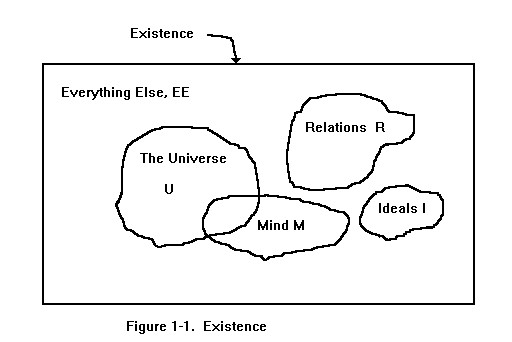
1. The Universe, U, in space and time (with a few extra compact dimensions thrown in to account for the fundamental forces according to Grand Unified Theories). I do not know if this can be said to include all of time or not. (Sometimes only the part of U of which we are aware is referred to as the real world. On other occasions the term real world is taken to be synonymous with U. Differences should be clear from context. In my philosophy, The World, W, refers to all that exists, i.e., Fig. 1-1. Thus W = U U M U I U R U E . For the benefit of the uninitiated, I should say that the symbol in the equation that looks a little like a sans-serif U is the symbol for union; i.e., the objects represented by the letters U, M, I, R, and E are joined together and taken all together to be The World.) The symbol W, then, refers to The World in the large sense as it actually is.
[Note in proof 4-13-96. I believe I can describe a universe that includes all of time and is all of a piece. Every future event in that universe is predetermined, however no part of that universe can be said to be conscious mind. Therefore, events in mind are not predetermined. They enjoy a separate existence, which cannot alter the future of the universe in any way. Nevertheless, from the point of view of mind, the way in which it makes its decisions, i.e., its free will, makes all the difference in the world. What we think determines who we are and our relation to the universe even though it has no effect on the universe as it really is. This is good enough. I am not claiming that what I have just written is the actual case. It is only a renegade thought.]
2. Mind, M, i.e., the sum total of all mental activity and mental latency of all creatures. Mind might be a subset of the universe. I don’t know. Probably, it cannot be known. I do not require a one-to-one relationship between mind and events in the universe such as the flow of electronic currents or the migration of ions in brains even though such a relationship might exist. Mind may be a large connected set or a large number of disjoint sets. The topology of mind is not understood.
3. The realm of Ideals, I, which includes, among many other things, every geometry that could ever exist complete with every lemma, theorem, and corollary – including the correct geometry of the universe, the Grand Unified Theories, if they exist, in all their glory and for every possible world, relations in their universal sense, i.e., greater than, North of, and many other things – things that Russell calls universals. The Ideals are eternal and immutable.
4. The correct relations among things in U and M belong to the realm of the Relations, R, e.g., the distance from the tip of my nose to every other macroscopic, identifiable object in the Universe as I go on my nightly walk is a collection of relations. Of course, incorrect relations exist only in Mind or on the printed page where they are mere artifacts of the Universe. In fact, if one says that the distance from the tip of my nose to the edge of the Grand Canyon – now – is six feet, one speaks of something that does not exist – not the distance of the tip of my nose from the Grand Canyon – then – but the six-foot relation as an object in R. That relation is said to be something that it is not, so it cannot be in R, which consists of correct relations only. Notice that the correct relations are hardly ever known to Mind, first, because their infinitude dwarfs what can be known and, second, because we do not apprehend sense data with infinite precision. The relations available to our minds are only approximations to the correct relations in R, which, nevertheless, exist – unless quantum mechanics somehow makes them impossible, in which case we would replace them with quantum surrogates. This is much more than we need to know; so, necessarily, I have said more than I needed to say. Please disregard anything that seems vague or otherwise incomprehensible.
5. Everything Else, E, i.e., that in which U, M, I, and R are embedded, if it exists, whether it has dimensionality or not – something completely beyond our comprehension or imagination.
Note. The Relations (not the universal relations, which abide in I, such as to the right of, greater than, etc.) evolve in time, but whether or not all Relations for all time exist depends upon whether the Universe, for example, in all of its proper dimensions including time-like dimensions exists; i.e., not only the present exists, but the past and the future exist on an equal footing with the so-called present. This is an interesting question, which opens up inquiry into Everything Else (E), in particular, the possibility of something in which U, M, I, and R are embedded. If that “space” has a time-like dimension, U et al. would appear from the viewpoint of an intelligence living in E, which, if you remember, we know nothing about, as a complete and finished object.
Clearly, this division of existence is valid logically. It is – quite simply – a linguistic convenience, but it achieves a great deal philosophically in that it solves “the problem of God”, for example. It provides a place for God to exist without resorting to a statement such as “God is all in all”, which would be an abuse of language. It comes perilously close to being the “merest truism”; nevertheless, I believe we shall find it useful. For example, we have solved the problem of metaphysical truth, which shall arise in Chapter 3, by reducing it to semantics.
At the same time we have proved half of a conjecture I would like to present for the reader’s consideration, namely, that it is impossible to prove either the existence or non-existence of God – under any reasonable definition of God. Clearly, this proves that a non-existence proof is impossible. But, how can we prove the impossibility of an existence proof? Such a proof would be extremely useful. In particular, it would permit us to follow Walt Whitman’s alleged advice, “Don’t argue about God.”
The category of the Relations was defined to deal with the slight (or profound?) difficulty in identifying the Ideals. When first defined, these were of two types – regrettably. Type I: the eternal and timeless Ideals such as the Idea of the color blue. Type II: the constantly enlarging set of relations among things in U and M, e.g., as I go for my evening walk, the relativistic distances (intervals) between a point on my right thumb and the other objects in the Universe, the relation of every thought of one man to every thought of another. One would like to have the eternal things in a different set from the relations in the evolving Universe; however, we are getting used to regarding time as not very different from the other dimensions regardless of its “arrow”. Who knows but that some of the (compact) dimensions required to unify the forces may have arrows as well. After much deliberation, I have called the Type II Ideals the Relations. However, one wonders if all of Euclidean Geometry – complete and perfect – is a collection of relations and nothing more, in which case the categories are badly named. Let the reader decide.
Avoiding Infinite Regression
At a well-known West Coast university, a series of weekly lectures in science was open to the general public. A lecturer had just finished describing the manner in which the earth revolves about the sun. “Nice theory,” quoth an elderly woman, “but the earth rests on the backs of four elephants who stand on the back of a giant turtle.” With an appreciative grin the lecturer countered with the usual Socratic question as to what supported the turtle. “Oh, I know all about that old argument, but it’s turtles all the way down.” [Note in proof (7-20-2004). This is not a true story, probably.]
William James [11] based his evaluations of religious sentiments on his personal judgments and experience of philosophical reasonableness and moral helpfulness. Following James, I have avoided infinite regression, e.g., “turtles all the way down”, by basing my three moral axioms and my philosophical assumptions (or articles of faith if you prefer) upon my innate judgments of reasonableness and aesthetics and my acquired conception of utility, which might have originated, at least in part, from my experience of pleasure and pain. The foundation of my philosophy differs somewhat from the criteria of James, but what I owe to James is the principle that one not only can but must rely on oneself to provide a foundation for a philosophical edifice.
[Note in proof (1-1-97). When I say “rely on oneself” I refer to certain primitive judgments that are fundamentally subjective – although we may hope for a large class of human beings, perhaps all human beings, experiencing such things in a manner sufficiently similar to the manner in which we ourselves experience them. Perhaps these subjective judgments are universal in nature and we and other people will agree on important matters of aesthetics, reasonableness, and utility.]
My three moral axioms are, roughly speaking, (i) respect for the freedom of oneself and others, (ii) respect for the environment, including animals and plants, and (iii) respect for truth. From these axioms and the basic assumptions, I derive additional morals and what are commonly known as rights, i.e., certain liberties permitted by the axioms and certain entitlements similarly derived. I next define justice and finally arrive at a rational, beautiful, and practical social contract upon which we can gather a very general consensus that permits a community to function in peace and harmony essentially without government! This social contract is what I have termed a minimal proper religion.
Presumably, we are born with a sense of what is reasonable. If not, we acquire it at such an early age that it is not necessary, for this discussion, to determine how it arises. Aesthetics, too, is assumed to be given a priori, but I shall not rely on that assumption here. Then, (1) our experiences of the world, i.e., the universe, which we acquire through our physical senses, extended, perhaps, by instruments, and (2) the events that take place in our own minds, can be used to develop the ability to reason (without assuming that the real world exists; that is, we may be reasoning about things that have no independent existence). But, once we have developed the ability to reason, perhaps by studying logic, sentential calculus, set theory, Boolean algebra, or the works of the masters, we may use it to interpret our experiences as evidence of an objective world; that is, we may deduce the existence of a real world using our developed reason.
[Note in proof (3-28-95). I do not wish to argue the reality of the complementary measurement in quantum mechanics, e.g., the Einstein-Podolsky-Rosen (EPR) thought experiment [14]. Personally, I believe the indeterminate observable is just as real as the measured one; but, obviously, something is real – either the horizontal spin or the vertical spin.]
[Note in proof (9-24-96). Underlying the phenomena we observe lies something that has an existence independent of ourselves as evidenced by the undeniable fact that the Aspect experiments (well-known to physicists [14]) will yield the same results no matter who performs them.]
Once we have established the independent existence of the world, we may rely upon the evidence of our senses and our consciousness to develop a sense of utility enhanced by our comprehension of pleasure and pain. Our comprehension of pleasure and pain is based, in part, on our sense of aesthetics, which we assumed was given a priori, but which may be enhanced by experience and other factors. We are now in possession of the three tools, namely, reasonableness, aesthetics, and utility, with which we will evaluate philosophical assumptions and moral axioms. I hope that I am not an anomalous specimen of humanity, but that my primitive notions will be experienced by most, if not all, of humanity.
Once the moral axioms have been stated with a sufficient degree of rigor, a system of morals can be derived from them that can serve, in turn, as a basis for human rights and for the rights of other creatures. Justice is based on morals and rights. Thus, morals are based on aesthetics, reasonableness, and utility; rights and justice are based on morals; and our knowledge of the world, including our knowledge of the usefulness of things, is supposed to come from experience and reason. What we choose to experience or apply our powers of reasoning to, and how we decide to take the next step in our reasoning may be dictated by our imaginations or other faculties, which might include intuition, a faculty that is presumed to come primarily from experience. It is not necessary to suppose that the origins of intuition are well understood. We do not necessarily deny the existence of divine inspiration. If the conclusions based on the moral system derived from the fundamental assumptions and the moral axioms lead back to reasonableness, aesthetics, and utility, we will have developed a consistent philosophy. I do not see how we can hope to do better. If some future generation accepts it as a minimal proper religion suitable for a social contract upon which a cooperative society such as the one described in this essay can be based, the most improbable dream of a dreamer of impossible dreams will have come true.
I shall give a list of philosophical assumptions, which might as well be called articles of faith. I hope that I do not assume too much. This essay is supposed to be an example of the axiomatic methods of science applied to human society. Normally, if an axiom is required to prove what we already believe is true, we simply go ahead and assume it. For example, most of modern mathematics rests on the Axiom of Choice, which makes claims about what would happen in a process that takes place an infinite number of times, namely, the selection of one member from each of an uncountable number of nonempty sets [15]. Naturally, the axiom cannot be verified experimentally; moreover, it might be possible to derive an entirely different mathematics by assuming that the Axiom of Choice is false. I cannot imagine what would be gained by devoting volumes to determining which is the case even if it is possible to do so. [I believe that it is not.]
I hope that this development is adequate, but, if it turns out to be deficient, I will add whatever else I need to construct this system, which appears to me to be nearly complete according to my intellect and my intuition. These ideas came to me in chronological order, i.e., in the only way in which anything comes to anyone, rather than in logical order, so I must search constantly for errors that may have arisen in the reordering process that occurs when one thinks and writes. This is an important point, which, it seems to me, is frequently overlooked, namely, that we do not present arguments in the order in which they occur to us. One of the ramifications of this may account for our unwillingness to abandon our most cherished notions.
Reasonableness and Aesthetics
Reasonableness is very much related to our sense of aesthetics. Musicians say that a beautiful passage “makes sense” and mathematicians say a reasonable argument is “beautiful”. Perhaps the part of our being that receives pleasure from things aesthetic is identical with or similar to the part of our being that finds satisfaction in things that make sense. It is possible that, if they are not identical but rather two parts of ourselves, they are mirror images of one another, one on the right side of the brain, the other on the left. (Since the right-brain / left-brain theory is unproved, hereafter I shall enclose the terms in quotes to indicate the provisional and figurative nature of the terminology. I do not need to inquire into their mechanisms to identify them categorically or definitionally, but I would like to inquire, briefly, into the origins of our sense of beauty and our sense of reasonableness so that I can depend upon them as a guide for philosophical judgments.)
Are we born with a sense of aesthetics, which, for me, is the same as the sense of beauty? If so, are we born with a sense of what is reasonable? If we are not born with them, do we acquire them early in our lives in an infallible way upon which we can depend with as much certainty as if we were born with them? In the introduction to The Critique of Pure Reason [16], Immanuel Kant claims the existence of a priori synthetic judgments, however the examples he gives do not seem to be valid – in my opinion. The first example is mathematics, which as I have noted below, is essentially definitional and, therefore, analytic, as opposed to synthetic. [Note in proof. The definitions from which mathematics is derived by analysis are synthesized, therefore I am not sure to which category mathematics ought to belong.] The second example is the judgment that every effect has a cause, which might be discredited by the quantum theory. Thus, Kant ends up by trying to determine the properties of a class of objects which may not have any members.
But, if any form of knowledge could be both a priori and synthetic, it seems that it must be our sense of beauty. As far as we know, the beauty of an object cannot be deduced from it by analysis (although probably some scientist or artist is trying to discover how to do it); moreover, it seems that it is not given by experience either. Thus, if I do not misapprehend Kant’s intention, our sense of beauty must be an a priori synthetic judgment. It remains only to determine that our sense of beauty, for example, is what Kant meant by a judgment or a faculty of judgment and I must assume that it is. On the other hand, if Kant would exclude the sense of beauty and the sense of reasonableness from his category of a priori synthetic judgments, his category might be empty, which, of course, is of absolutely no importance.
In this essay, I do not appeal to the idea of a conscience. If the conscience is, in whole or in part, the residuum of notions picked up in our earliest years, before we were able to apply our judgment, then, conceivably, a portion of it could be confused with aesthetics. We might judge that something, e.g., sex, is not beautiful because we have retained an irrational notion that it is not beautiful from notions picked up early on that are in conflict with what we would decide had we been left alone. We would like to distinguish conscience as a negative attribute in contradistinction to aesthetics and reasonableness, which we hold to be natural and desirable. This is a mere semantic quibble and should not cause any difficulties.
Similar reasoning can be applied to our sense of reasonableness. I am not referring to the science of logic or to the theory of sets. In order to acquire these systems of thought one must already be in possession of a sense of reasonableness or one would not be able to turn the first page without throwing up one’s hands in disgust or despair. We understand the fundamental premises of these systems of thought because we are given a sense of what is reasonable a priori. Moreover, the reasonableness of something cannot be deduced from its other qualities without having in place the mechanisms of thought upon which analysis is based and these mechanisms must follow from our sense of what is reasonable. Piaget [17] has given evidence of developed reasoning ability in very young children, who, presumably, are not in possession of a calculus of reasoning such as set theory. I do not know the position of modern child psychology on when the rudiments of reason can first be observed in infants.
We begin to experience the real world (the objective universe or, at least, the part of it of which we are aware) through our senses before we are able to deduce its existence. Also, we are aware of events occurring in our own minds whether we consider them a part of the real world or not. We take advantage of these experiences, which might include our educations, to develop our innate reasonableness into an ability to reason. We are able, then, to deduce the existence of an objective universe from the evidence of our senses. Since I will not give the steps in this deductive process, I will assume the existence of the real world as an article of faith.
Note:
Despite the results of the Alain Aspect experiments to test
Utility
Our experience consists of our perceptions of events in the world through our physical senses and the events that occur in our own minds, which we interpret as joy, sadness, pain, love, anger, hate, compassion, nostalgia, etc. We are endowed, too, with memory. The faculties with which we are endowed permit us to develop our primitive sense of reasonableness into an ability to reason, which, in turn, permits us to deduce the reality of some sort of objective universe – regardless of our position in the Einstein-Bohr debate, if we, indeed, have such a position. Our initial experiences and impressions of existence come far in advance of that deduction and, without reasoning, cannot be presumed not to be delusions. Given an objective reality, which includes our own existence and the events that occur in our minds, we are in a position to judge the usefulness of objects and institutions that spawn events of a predictable nature. Since we believe in objective reality as a collection of events and we believe in ourselves, we are not in doubt as to the meaning of experience. Utility, then, is judged in terms of experience and how we perceive pleasure and pain, that is, in terms of our sensibilities. We may exercise our sense of aesthetics, too, in evaluating usefulness. I do not wish to explore the role played by experience in the development of our sense of aesthetics. It may be similar to the role played by experience in the development of reason, but, since I do not claim that our sense of aesthetics has developed into anything new (such as artistic infallibility), I do not need to explore that subject further.
We now have a complete basis for judging values, philosophical assumptions, and moral systems, namely, (i) aesthetics, which is presumed to have been given a priori, (ii) reason, an outgrowth of our primitive sense of reasonableness, and (iii) utility, which is based on experience of the real world. We can construct a basis, then, for deciding what else can be known and for evaluating new knowledge, but we should be aware that the basis rests on assumptions that may not be correct.
Occurrence Implication and Occurrence Equivalence
In mathematical logic, letters stand for simple statements. For example, the letter A might stand for “It is snowing” or “All governments are bad” or “Smarty Jones is a dog with two heads” or “All horses have five legs”. In the statement “It is snowing”, one wonders what or who “It” is. The sentence could have been replaced by “We have snow” or “There is snow” or, simply, “Snowing”. The symbols A → B are read normally as “A implies B”; however, all of the following are equivalent: (i) A implies B, (ii) B if A, (iii) A only if B, (iv) not-B implies not-A, (v) B is a necessary condition for A, (vi) A is a sufficient condition for B, (vii) if A then B. By the symbols A ↔ B we mean: (i) A implies B and B implies A, (ii) if A then B and if B then A, (iii) A if and only if B, (iv) A is a necessary and sufficient condition for B, all of which express the fact that (v) A and B are logically equivalent.
By analogy with the preceding, we may use symbols to stand for circumstances that obtain in society such as ‘Materialism’, ‘Tyranny’, ‘Environmental Destruction’, or ‘Dishonesty’. As in the case of ‘Snowing’, ‘Materialism’ means ‘There is materialism’ or ‘We have materialism’, ‘Materialism is occurring’, etc. Let us replace the questionable notion of cause and effect, as in A causes B, with the useful concept of occurrence implication by analogy with A implies B. In this book, I represent occurrence implication with the symbols A → B which mean that B occurs whenever A occurs. If we have A, B is present too, or, at least, it soon will be. We cannot have A without B, which is the same as not-(A & not-B). We neglect time lags separating the occurrence of A from the occurrence of B as these, typically, are short in comparison with the time frames with which we shall be concerned. Finally, in analogy with logical equivalence, we have occurrence equivalence, written A ↔ B, whenever A → B and B→ A. Occurrence equivalence is an equivalence relation in the mathematical sense.
Occurrence Equivalence as Evidence of Divinity
Of any personal experience that would suggest to me the existence of a Divine Intelligence, I find the following the most compelling: It seems to me that everything that is reasonable is beautiful and practical; everything that is beautiful is reasonable and practical; and everything that is practical is reasonable and beautiful. This strikes me as truly wonderful. I interpret it to mean that, despite the enormous amount of evil in the world, a just and perfect world is within the reach of mankind and our fellow species. I am aware that we may have evolved in such a way that this occurrence equivalence works for us and that the amazing coincidence in which I rejoice is merely a natural result of the way in which we evolved with no need for divine intervention whatever. Nevertheless, I like to think that we would judge reasonableness, aesthetics, and utility the same no matter how we evolved and no matter what we evolved into. Contact with extraterrestrials might settle the question, but I can’t imagine what else would. Do you ever get the feeling that you are out of your depth?
A Minimal Proper Religion as a Social Contract
Minimal Proper Religions
For the convenience of the reader, the definition of an MPR is repeated:
Definition (Minimal Proper Religion). A minimal proper religion (MPR) is a proper religion that incorporates the minimal number of behavioral requirements necessary to ensure “sustainable happiness” for all of humanity. An MPR places constraints upon those who agree to follow it, but only those constraints upon behavior and public policy that cannot be relaxed without creating unbearable misery for a significant portion of humanity.
The MPR proposed by me makes no statements about the nature of any god or gods. It has no unnecessary intellectual baggage; and, although it is designed to gain nearly universal consensus, it prohibits unlimited procreation and any form of trade or commerce (in keeping with the freedom axiom). Obviously, it will not be accepted by everyone immediately. Nevertheless, it has a set of conditions none of which can be removed without destroying the possibility of sustainable human happiness; so, it is minimal. Admittedly, this is counter-intuitive (not what most people would expect).
A minimal proper religion, either mine or someone else’s, has the potential to be the basis for a social contract among the people of a community, which might be as large as the United States, although it would be better if communities were smaller, more decentralized, and, indeed, quite local. It is recognized, though, that some sort of contract among essentially all the people of the world is necessary eventually, in particular so that resources can be shared without introducing contingency. Again I point out that I could avoid the term minimal proper religion and go directly to social contract, but I like to anticipate my critics. It is important to prevent improper religions from trying to pass themselves off as legitimate candidates for social contracts because we shall be indoctrinating very young children with our social contract so that we won’t need a government. Perhaps, no one has tried to indoctrinate children with rational philosophical tenets. Naturally previous attempts to indoctrinate children with unreasonable philosophical or religious tenets have failed and we still have governments – all bad.
The important thing is to achieve a nearly universal consensus about how people living in a community will behave; and, for that difficult goal, one needs the fewest conditions possible. The social contract must deal in a humane and enlightened manner with a few people who do not accept the social contract (based on a minimal proper religion) no matter how reasonable, beautiful, and practical it may be. It will be assumed that something close to a universal consensus can be achieved. This is like Einstein’s Special Theory of Relativity. You don’t have to sell it. People accept it when they understand it. Eventually almost no one thinks it’s wrong whether they understand it or not. Of course, it will have to be modified eventually because, although it’s the best thing we’ve got, IT IS WRONG. (Not because it is disallowed by some reactionary principle but because it is not sufficiently radical.)
Building Upon a Minimal Proper Religion
We might think of the following as interior decoration for the soul. [Sometimes I think of the soul as the history and future, i.e., the trajectory (if you like that word), of the mind. We can count people by counting souls. Please do not argue with me about the soul.] In addition to the conditions in the social contract, people may place themselves under any number of behavioral requirements or conditions (as long as the conditions are consistent with the social contract) and may believe in a God, or a Life Force, or Élan Vital, or whatever they wish to call it. In my linguistic categorization of the world-in-the-large-sense (all that exists), I solved the problem of God by recognizing that the Universe, the Ideals, the Relations, and Mind might be embedded in something, therefore I have provided a category called Everything Else.
I find, upon close introspection, that, whether I wish to or not, I do believe in a personal god, but that belief is not part of my MPR because it is not needed to achieve sustainable happiness for all, nor can it be accounted for by any rational process. It is the philosophical system described in this essay, not the religion of my heart, that provides a basis for an MPR. While an irrational belief in God may be a part of my heart’s own religion, it doesn’t belong in my philosophical system. It is, in fact, a superstition! The position of my MPR is that I don’t know, you don’t know, no one knows, and it can’t be known, whether or not there is a god and, if there is, what it’s like. I call this position hard agnosticism. I, like everyone else, can and will believe whatever I please – or everything, or nothing, or what is reasonably likely to be true. An MPR says nothing about belief and very little about public policy – only the absolute minimum that must be said to protect the rights of others.
A Rational Philosophical Basis for a Minimal Proper Religion
Many able thinkers have attempted to give the Judeo-Christian tradition a philosophical basis, but this was done many years after the tradition was firmly established. Predictably all such attempts have failed. The Jewish and Christian religions arose more or less independently of rational or critical thought and it is extremely unlikely that they could be given a rational basis a posteriori. And yet the aforementioned thinkers recognized the desirability of a rational philosophical basis in view of the ascendancy of science almost concurrently with the Christian era.
I agree that such a rational philosophical basis for religion is desirable. Consider for a moment all of the people who place their faith in science every day with the sole exception of the Sabbath, upon which day they suspend disbelief in the irrational and superstitious aspects of their particular religion, attend church, and do violence to the consistency of their mental attitudes. This is undesirable as it makes the mind much more susceptible to the holding of contradictory beliefs, which is a form of mental derangement and can have dire effects on the behavior of its victims.
The Subject of The Varieties of Religious Experience Compared to a Proper Religion
In the course of lectures upon which he based his famous book, The Varieties of Religious Experience [11], William James deliberately chose to concentrate upon a particular aspect of religious experience, namely, the personal aspect. I am curious to determine if his avoidance of the ecclesiastical and formal aspects of religion, e.g., the commonplace ritual of going to church on Sunday, can be construed as a much earlier rejection of improper religions. Thus, I am largely motivated by natural curiosity and self-interest to determine if William James anticipated some of my “original” ideas. This has been an afterthought. My system was developed completely before it occurred to me that James and I might share similar views. While it should be a matter of complete indifference to the reader, I find that I cannot resist this brief digression. It might even be a source of gratification to discover that not every thought that entered my head found its first earthly home there!
James defends his choice of personal over ecclesiastical (or formal) religion by noting that all formal religions began with someone’s personal religious experience. He argues that personal religious experiences are more profound than the alternatives. “Lutherans wouldn’t attend the church of their choice had not Luther experienced religion in a way that quite probably is to be denied his latter-day followers.” I concur. My personal religious interests are congruent with the pedagogical choices of James, which is not something I normally report, except that, in this case, I wonder to what extent his notion of personal religion corresponds with my notion of proper religion, even though I do not consider James’s opinion more important than yours or mine or in any way essential to my thesis. The reader, therefore, may skip this section as it is strictly tangential.
I would like to dismiss improper religions completely. Improper religions are not religions. In his famous book, James makes no such claims and freely admits that institutions that satisfy other definitions of religion or, actually, aspects of religion, which might include “improper religions”, may properly be called religion. Thus, according to James, improper religions might be proper. (Of course James hadn’t seen television evangelists.) As he says, “[I]t would indeed be foolish to set up an absolute definition of religion’s essence and then proceed to defend that definition against all comers, yet this need not prevent me from taking my own narrow view of what religion shall consist in for the purpose of these lectures, or, out of the many meanings of the word, from choosing the one meaning in which I wish to interest you particularly, and proclaiming arbitrarily that when I say ‘religion’ I mean that.”
And, further, “Worship and sacrifice, procedures for working on the disposition of the deity, theology and ceremony and ecclesiastical organization, are the essentials of religion and the institutional branch. Were we to limit our view to it, we should have to define religion as an external art, the art of winning the favor of the gods. In the more personal branch of religion it is on the contrary the inner dispositions of man himself which form the center of interest, his conscience, his deserts, his helplessness, his incompleteness. And, although the favor of the God, as forfeited or gained, is still an essential feature of the story, and theology plays a vital part therein, yet the acts to which this sort of religion prompts are personal not ritual acts, the individual transacts the business alone, and the ecclesiastical organization, with its priests and sacraments and other go-betweens, sinks to an altogether secondary place. The relation goes direct from heart to heart, from soul to soul, between man and his maker.”
I think it is fair to say that James has expressed a preference in this passage that night be congruent with my view. I have not proposed an exact definition of the essence of religion. Working backwards I gave a preliminary list of what proper religions are not! I didn’t say that my list was exhaustive. James may not wish to offend the purveyors of improper religions, as I term them; but, probably, his sympathies lie with me.
However, the minimal proper religion would not be received enthusiastically by James – the religionist. He would find it too dispassionate and, frankly, too lukewarm, for a religious concept. The sort of religion James had in mind would be considered madness by many people: “There can be no doubt that as a matter of fact a religious life, exclusively pursued, does tend to make the person exceptional and eccentric. I speak not of your ordinary religious believer, who follows the conventional observances of his country. These experiences we can only find in individuals for whom religion exists not as a dull habit, but as an acute fever rather. But such individuals are ‘geniuses’ in the religious line, and like many other geniuses who have brought forth fruits effective enough for commemoration in the pages of biography, such religious geniuses have often shown symptoms of nervous instability.”
As the reader may have noticed, such “nervous instability” is no longer tolerated in the United States, if it ever was. One might just as well be a drug addict. I must not conclude these remarks without discussing my personal religious feelings, including a sense of awe and wonder and a feeling that my every thought and deed is informed by something divine that completely fills my being in the unlikely event that I am fortunate enough to take the right drugs under the right circumstances. This is a feeling that renders death itself a matter of no importance. I wonder if anyone in America has what can reasonably be called a religious experience without drugs. I tend to doubt it because our “advanced” capitalist industrial and technological society floods our minds to their utmost capacity with the thousands of mundane and materialistic considerations that fill our day. Although, in a certain sense God is everywhere (or nowhere), one is not likely to experience the divine spark of the Holy Ghost in one’s bank, brokerage, or business. The sacred drugs permit one to discard all of this obsession with “coping” with “life” for an interlude protracted to as much of the rest of our lives as possible, depending on our capacities. During that blessèd interval, we can be what we were intended to be. The reader had better think twice before he persecutes the next druggie he meets. The druggie may be one of God’s own people – if I may indulge in a literary figure.
How a Social Contract Based on Consensus Might Work
Becoming a Party to a Valid Social Contract
When we discussed proper religions and minimal proper religion, we noted that a minimal proper religion could be the basis for a social contract. When a child reaches the age of reason, he may elect to accept the social contract enjoying currency. An alternative is to surrender his personal sovereignty to one or more of his guardians until some later time when he feels he is better prepared to take that step.
Rejecting a Social Contract
Also, he has the option to reject the social contract and retain his personal sovereignty just as a head of a foreign state living in our community might do. Personal sovereignty is the sovereignty that remains when all other sovereignty is found to be invalid. He would enjoy diplomatic immunity and other similar considerations until such time as he wishes to join the community into which he has been born. He must not be treated as a criminal under any circumstances because he has not agreed upon the moral code by which the majority live. If his behavior creates a very great nuisance, he may be treated as a prisoner of war with all of the privileges pertaining thereto. Personal sovereignty persists under all conditions. All contracts are voluntary. That is guaranteed by the Freedom Axiom.
Definitions of Terms Employed in Fundamental Theorem
Sustainable Happiness for All of Humanity
Definition of Happiness
By happiness we do not mean a continuous state of bliss. We agree that happiness requires a reasonable satisfaction of the usual tissue deficits. One can be happy while one is a little hungry, but one cannot be expected to be happy in the technical sense while starving to death, or, as we shall make clear in a moment, while one’s child is starving to death.
Following Deci and Ryan [1], we say that happiness is a state of mind that often occurs when the following necessary conditions are met: (a) autonomy, (b) effectiveness, and (c) relatedness. (We prefer this phenomenological definition because we cannot measure the state of a person’s mind.)
Autonomy means that the requirements of the Freedom Axiom, discussed in detail in Chapter 3, are satisfied. We are free. [See also the note following the definition of happiness on p. 79 in Chapter 3.]
Effectiveness refers to the accomplishment of something satisfying and possibly useful. The usefulness may come from our interest in the task and may have nothing to do with scarcity economics. Time passes so quickly that we are amazed when we realize how long we have been completely engaged and totally absorbed in our task. We say we are “in the flow” or “in a zone”. Our thirst for effectiveness ensures that mankind will not perish in a world where no one is required to do anything to live. Everyone must do something to be happy!
Relatedness refers to our interactions with and feelings toward other sentient beings, in particular, human society. The need for relatedness makes cooperation worthwhile and accounts for the unhappiness of a woman whose child is starving although she may not be.
Finally, happiness in this technical sense requires that the conditions discussed above exist in perpetuity. Happiness requires safety. We must be free of worry that the other requirements for happiness can be taken away (by the rise of a despotic “natural leader”, for example). “Acts of God”, on the other hand, such as astronomical catastrophes, we accept with equanimity, free of negative emotion, and we die the good death of a person who has lived a happy life – without regrets or bitterness of any kind. Actually, most of us don’t devote much of our concern to worries that the sun will burn out or that earth will be struck by a huge comet. And, we should not be influenced by desperate scientists, about to lose lucrative defense contracts, to invest in a gigantic big-science, Star-Wars-type Asteroid Defense Project. Nor, should we be tempted to avert the end of the human race by escape to outer space, as explained in my essay “On Space Travel and Research” [8]. The point is that wisdom, concomitant with happiness, transcends fear of calamity.
To summarize, the conditions for happiness are:
1. Reasonable satisfaction of tissue deficits.
2a. Autonomy or freedom from tyranny.
2b. Effectiveness, the ability to interact with one’s environment in a satisfying and positive manner.
2c. Relatedness, good relations with fellow human beings and, perhaps, animals.
3. Safety, assurance that the above four preconditions cannot be taken away, except, perhaps, by Mother Nature, e.g., astronomical events.
Hypothetical World W′
1. Intrinsic Motivation
Intrinsic motivation is assumed to be the preferred form of human motivation. This is the basis for the scientific theory under development by a number of scientists, notably Deci and Ryan [1]. [Note in proof (11-27-96). I can now provide a long list of peer-reviewed scientific research papers that support the theory of intrinsic motivation. This research makes intrinsic motivation much more than a philosophical assumption. A dedicated bibliography of just the papers read by this author is given at the end of Appendix III.]
[Note in proof (7-20-2004) on Intrinsic Motivation. For most of my life, I have been driven by extrinsic motivation, that is, by parents, teachers, and bosses. Since 1989, I have had no such motivation. I can testify that, without extrinsic motivation, I had a hard time moving. This corroborates Deci and Ryans’ finding that extrinsic motivation poisons intrinsic motivation. Nevertheless, I did get moving, at last, and I have completed a considerable volume of work, some of which can be found on this website. Lately, I have been “working” sixteen hours a day, with the hours melting away like minutes, and the work itself is the sole motivation – as far as I can tell. I believe I am “in a zone”.]
2. Happiness in the Colloquial Sense
People who enjoy the preconditions for happiness, which in this theory were, for technical reasons, identified with happiness itself, will by-and-large allow that they are happy in the colloquial sense. Thus, we retain a phenomenological view.
Essentially, in W′, the theory of Deci and Ryan is correct. Happiness means what it should mean.
Hypothetical World W"
The world W″ is a hypothetical world that has all of the attributes of W′, except that in W″ three additional conditions are met:
1. A Stable (Human) Population
The population will be stable at about ten billion human beings or, preferably, closer to the optimal population size, i.e., a sufficient number of people that succor from one’s fellows is available when needed, not so many people that the quality of individual lives is appreciably reduced, the opportunity for as many people as possible, consistent with the previous two conditions, to be able to enjoy the blessings of having been alive. Probably, the optimum population size will be smaller than ten billion people.
2. Adequate High-Grade Renewable (Sustainable) Energy
In W″, renewable energy technology adequate to provide the energy per capita equivalent to one kilowatt-hour per hour of 110-volt, 60-Hz AC will be available. This is the standard for emergy calculations, therefore we have one emergy unit per hour per capita. (Since this is based on power plant electricity, it represents more energy than 1 kWhr/hr. For example, if half were coal and the rest electricity, the rate of energy consumption per capita would be 2 kW.) Also in W″, the matching problem, providing lower grade energy to those uses for which it is adequate so as not to lose availability converting lower-grade energy to higher-grade energy that is not needed, has been solved. This is discussed in slightly more detail in Chapter 2.
3. Sufficiency of One Kilowatt Per Capita Renewable Emergy
We assume that every human being can live on 1 kWhr/hr – or simply an average rate of consumption of emergy units equivalent to 1 kW of 60-Hz, 110-volt AC electric power. In addition, we must assume that a one kilowatt per capita emergy budget is sufficiently abundant to provide happiness as we have defined it. Perhaps, no American can be happy on only one kilowatt emergy consumption, but we know of primitive peoples who consume much less and they are happy. In any case, this per capita rate of emergy consumption is assumed adequate for a satisfactory life wherein happiness for everyone is possible if not guaranteed.
Sustainable Happiness
Definition (Sustainable happiness). We say happiness is sustainable when it cannot end because of human social factors but only because of astronomical events.
Universal Sustainable Happiness
Definition (Universal sustainable happiness). Universal sustainable happiness is sustainable happiness enjoyed by all of humanity and as many other species of plants and animals as possible. It is a goal of this philosophy that can be approached only asymptotically.
Power
Wealth will be discussed in the next chapter. We now wish to discuss power. The word power has a definite meaning in physics. That sort of power is really material wealth whenever it is exercised. In this essay, we are referring to power such as the power that a rich and influential person holds over a poor and “unimportant” person or the United States holds over Haiti. We ought to choose a new word, but we shall use the same term that is used in physics in keeping with other authors who discuss political power. One can say without fear of contradiction (by reasonable people) that the pursuit of wealth and power is the most highly regarded activity of Western man. It amounts to his religion for all practical purposes, regardless of what he claims his religion is.
Influence in the sense that the United States influences the affairs of Panama is a form of power. Influence in this sense is undesirable. Joseph Stalin and Ronald Reagan wielded tremendous influence in the form of power as leadership; moreover, they did not lead primarily by examples that were imitated voluntarily. The leadership of Joseph Stalin or Ronald Reagan was genuine power over other people and, therefore, undesirable, as no person should have power over another. Unless I specify otherwise, leadership will be referred to in its undesirable sense in this essay. I find it amusing to use a eulogistic term in a dyslogistic sense, i.e., attach a negative connotation to a word that is usually associated with something that most people imagine is desirable even though it may not be – ever. The way the word leadership is used in ordinary discourse makes it an impostor term in the sense of Bentham [4]. I will devote an entire chapter to disposing of leadership, which I portray as the cause of the apparently unending cycles of the rise of leaders, their corruption, and their eventual displacement by reformers, who then become corrupt leaders. “Power corrupts; absolute power corrupts absolutely.”
Rather than the petty tyrant who rules our fireside, we should be concerned with the very rich people (and some who are not so rich) who rule our nation and the even-more-powerful multi-national corporations and who essentially hold power of life and death over us. The definition of the ruling class is given in the appendix of this chapter. (We have agreed to define terms as soon after they are used as is practicable.) These are the leaders with whom we must contend to become free men and women. When the ruling class is deposed, never to be replaced, we can deal with our mothers-in-law, shrewish wives, and incorrigible children appropriately.
Negotiable and Non-Negotiable Fame and Influence
Most of us have noticed that one can exchange wealth for power – perhaps by buying political influence through campaign contributions, perhaps by starting a company and hiring people who must then do one’s bidding. Negotiable fame is in the same class with wealth and power. It is a dangerous thing. It can be exchanged for wealth and power including negotiable influence.
One can easily exchange wealth or power for fame – perhaps by appearing in one’s own ads on TV, as the owner of a well-known hamburger chain has done. Also, most types of power can be exchanged for wealth, for example by selling influence, as former high-ranking elected and appointed officials do when they become lobbyists. Most powerful elected officials leave office nowadays in a better position financially than before holding public office. (I have heard that Nixon, at one time, did not want to reveal his net worth (as required by election rules) not because it was excessive but, on the contrary, because, in fact, it was next to nothing. Apparently, he improved his fortunes considerably by virtue of having been president, even though he left office in disgrace.)
However, power sometimes consists only in influence over other people. This influence may or may not be convertible to wealth. If it cannot be converted to wealth, we shall denote it non-negotiable influence. If it can be converted to wealth, it shall be referred to as negotiable influence. Obviously, negotiable influence is a form of power that can be converted to wealth and, for that matter, fame. Similarly, we have non-negotiable fame and negotiable fame. Negotiable fame can be converted into wealth and power, including negotiable influence. It remains only to give examples of negotiable fame, non-negotiable fame, negotiable influence, and non-negotiable influence. Now, Michael Jordan possesses negotiable fame and Richard Nixon possesses negotiable influence. The other two are harder to find.
Obviously, I hope to influence the reader of this essay, and, conceivably, my influence could be the predominant external influence in some reader’s life, but I shall not exert power over anyone nor shall I accept a position of personal predominance in public affairs voluntarily. My influence must be in and by my words, as opposed to my personality or my authority; i.e., it must be non-negotiable influence.
How can one be sure it is genuinely non-negotiable? That is a difficult question and the best answer I can come up with right now is “Because I say so”. I promise not to negotiate that influence. It may be a bit harder to come up with an example of influence wielded by a living person that, obviously and because of its very nature, cannot be converted into anything else, except, possibly, non-negotiable fame. Except for the very minor and, for our purposes, insignificant power Albert Einstein had over his graduate and post-doctoral students, I would argue that his influence and fame were non-negotiable.
Occurrence Equivalence of Wealth, Power Including Negotiable Influence, and Negotiable Fame As S*
Thus we can form a commutative triangle among (i) negotiable fame, (ii) negotiable influence together with other types of power, and (iii) wealth. That is, negotiable fame can be converted into wealth and power, including negotiable influence; negotiable influence and other types of power can be converted into negotiable fame and wealth,; and wealth can be converted into negotiable fame and power including negotiable influence. The situation is as shown in Fig. 1-2.
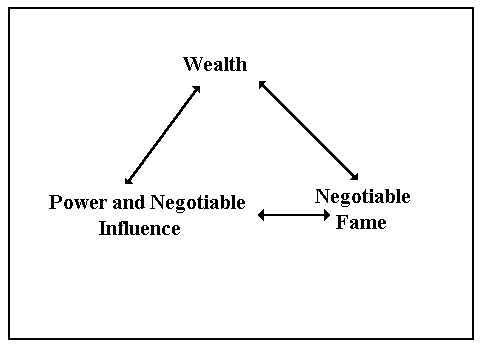
Figure 1-2. Negotiating Wealth, Power, and Fame
To maintain philosophical rigor we must acknowledge that some forms of fame and influence might be non-negotiable. Then, excluding these (which might not exist), we can make our generalization about the equivalence of wealth, power, and fame in the sense discussed above; that is, they form a commutative triangle. I need refer only to material wealth when I mean material wealth and anything that can be converted into material wealth. Because of the above commutation equivalence, we might consider lumping all of these things together and giving them a name. The name I have chosen in the past is importance; but, since I meant worldly importance as distinguished from true importance, it might be better to choose a different term. Perhaps status is the best choice I can make. Other choices include: rank, enviability, distinction, consequence, eminence, worldly success, materialistic success, standing, etc. [Notes in proof (1-28-06 and 7-1-07). To avoid confusion with other concepts, I have elected to use the symbol S* to stand for the equivalent concepts of wealth and power. Probably, to encourage excellence and to accommodate our natural propensities to seek reproductive advantage, we must allow competition for fame, which becomes non-negotiable. On July 5, 2007, I believe that these concepts are best distinguished by the words “status” for negotiable power and fame and “importance” for non-negotiable influence and fame.]
Note in proof (1-4-06). We shall need a term for the esteem in which we hold people for whom we name our children. Indeed, these people may very likely be the recipients of Tokens that cannot be used by their holders to have children of their own in accordance with the Token Principle of Chapter 3. I have not used the term ‘prestige’ to mean anything else; however, we must be certain that we are talking about something that will not be exchanged for greater wealth or political power. We agree that it can result in greater reproductive advantages – not only for the usual reasons but because of the Token Principle. It may be fame; but, if it is, it must be non-negotiable fame.
We should note at once that if one of the three aspects of S* never occurs, then none of them can occur; whereas, if any of them is permitted to exist in a hypothetical society, then all of them will be present eventually. We refer to this kind of relationship as occurrence equivalence; i.e., wealth, power (including negotiable influence), and negotiable fame are occurrence equivalent. We shall find this concept useful in the sequel.
Ambition
The noble Brutus
Hath told you Cæsar was ambitious
If it were so, it was a grievous fault,
and grievously hath Cæsar answered it.
Definition (Ambition) RHD [3]. 1. an earnest desire for some type of achievement or distinction, as power, fame, wealth, [italics mine] etc. 2. and 3. irrelevant.
I, for one, find it interesting that the Random House Dictionary (the very best English language dictionary that I, personally, can lift without the use of a forklift truck) chose precisely the elements of what we have agreed to call S* to illustrate what I may now adopt as a dyslogistic term, namely, ambition.
Throughout my life, even as a young boy, whenever I have heard ambition praised or the lack of it denounced, I have experienced disgust. Certainly I have no objection to a desire to achieve something worthwhile and I am only a little uncomfortable with distinction. But, I find it amusing that this lifelong antipathy toward ambition has turned out to play a role in my philosophy (and religion).
Ambition, then, restricted to an earnest desire for S*, can be taken to be a major component of what we shall call materialism, competitionism, or, in phenomenological lingo, artificial economic contingency.
Materialism
Definition (Materialism). Materialism is defined to be any system having the following characteristics or the belief in, promotion of, or dedication to such a system:
1. Competition for wealth, power and negotiable influence, or negotiable fame, i.e., S*, in any form.
2. The use of S* as a reward for achievement or good behavior or as a measure of success.
3. Any institutions that permit people to influence the amount of S* they themselves or anyone else (especially their own children) may accumulate, consume, or possess because of who they are or what they do or because of any aspect of their beings whatsoever.
4. Differences in the amount or rate of accumulation of S* whether derived from competition directly or not, e.g., inheritance of wealth. Small differences in the values of homes or their furnishings are not included in the definition. (Normally, homes of similar value are not strictly comparable; i.e., it is impossible to say which possesses the greater real worth. Techniques employed by real estate appraisers might be useful to determine whether or not the differences in value are sufficiently small to be exempted from this definition.)
5. The existence of institutions by means of which wealth can be hoarded in the form of paper money, financial instruments, or ledger entries – usually in a computer.
6. The acceptance of S* as a reward for anything one does, gives, or says.
7. Contingency upon something extrinsic and artificial (as opposed to the amount of rainfall) affecting one’s ability to live abundantly.
We find the following definitions in The Random House Dictionary [4]:
Definition (Contingence). n. contact or tangency
Definition (Contingency). n. 1. dependence on chance or on the fulfillment of a condition. 2. an uncertain event; chance possibility. 3. something incidental.
Definition (Contingent). adj. 1. dependent for existence, occurrence, character, etc., on something not yet certain; conditional ( often followed by on or upon). 2. happening by chance or without known cause, fortuitous, accidental. 3. Logic. (of a proposition) neither logically necessary nor logically impossible.
Definition (Artificial Economic Contingency (AEC)). Artificial economic contingency is the same as materialism. (The term artificial economic contingency will help some people get the idea faster. It is simply amazing how many people do not grasp this concept quickly.)
Perhaps competition for wealth and money is the cause of competition for power; perhaps competition for power (“the will to power”) is the cause of competition for wealth; perhaps both are caused by a strange perverted desire to be loved. In any case, it will be more difficult for people to seek power if they do not enjoy excess wealth and, presumably, the damage done by those who somehow do rise to greater influence will be less severe if they cannot convert that advantage to excess wealth. Whatever the case, the phenomena do coincide.
Originally I employed the term materialism (M) but, as someone pointed out, we really need to respect material more – not less – and we ought to accept and exercise our responsibilities as custodians of the earth’s material wealth. For a while I used the term competitionism (C) instead, and you may see that word occasionally in my writing. Competitionism means the same as materialism, which is the word I prefer – mainly because materialism is the word that most people use to express something very close to this concept, namely, economic acquisitiveness and an obsession with worldly success. The reader should be aware that this definition of materialism (or competitionism or artificial economic contingency (AEC)) applies to this essay only and other essays written by the author. These terms may be used by others in the sense employed by the author, but he is not responsible for their use in other contexts.
The Fundamental Theorems and Premise
Theorem (Fundamental Theorem). The abandonment of materialism is a necessary condition for universal sustainable happiness in W′ and a sufficient condition for universal sustainable happiness in W″.
Fundamental Premise. It is unreasonable to be happy when one is aware of people living now who are experiencing unbearable misery no matter how far away in space they may be. It is unreasonable to be happy when one is aware of circumstances that will lead inevitably to unbearable misery for people who will live at some future time however remote.
Discussion of the Premise. Notice that we said unreasonable rather than impossible. Clearly, a human being would have to be diminished considerably to be happy in the presence of an extremely miserable person. I do not refer to comic or false misery. I refer to starvation, extreme pain, the horror of impending painful death, extreme mental anguish. We can’t ignore the suffering of our fellow human beings including posterity. Surely, we are affected by the unhappiness of those close to us first; but, since we are intelligent reasoning creatures, we cannot be happy while others are miserable even though they are far away in space or future time.
Moral distance in space is the physical distance beyond which a person aware of misery no longer feels the responsibility of a brother for a brother, a sentient being for his fellow sentient being. The question is: How far away does the misery have to be for a reasonable person to be happy? Down the street? Across town? In the next county? In a far-flung principality? I claim that for reasonable people there is no moral distance sufficiently great. If reasonable people are aware of suffering in India, they are unhappy. Their awareness does not attenuate with physical distance like a radio signal. (I shall be delighted, however, if the concern of most people for others should extend to the entire earth – merely, with no concern whatever for hypothetical beings on far-flung galaxies when we happen to witness an astronomical catastrophe that occurred millions or billions of years ago. Also, I would appreciate the reciprocal tolerance of a few of the “unconcerned” if I should moderate my grief over the demise of a single-celled human zygote whose misfortune it was to run afoul of an unlooked for intrauterine device.) By analogy with the relativistic interval, moral interval is moral distance in space and time.
Presumably, we should be distressed by the foreseeable misery of people who will live at some future time – long after we have passed. Although I have written this book to please myself, the principal beneficiaries might be people I shall never know or see. I am concerned about the people who will starve to death when the petroleum is gone. Nevertheless, I, for one, am able to remain aloof from the suffering of past generations. What’s done is done and can’t be undone.
I believe the way in which we respond to the Fundamental Premise divides us into distinct classes. If I indulged in human taxonomy, these classes would be given the highest priority. At this time, however, I see nothing to be gained by giving names to the different classes of persons created by these distinctions. Nevertheless, I am willing to predict that moral distance in space and time (moral interval) will be (or has been) discovered to be an important indicator of “relatedness” in the theory of Deci and Ryan and, perforce, will take its place in W′, which we agreed was identical to the real world, W.
According to the Truth Axiom, described in Chapter 3, all moral persons satisfy their love and respect for truth, in part, by setting their fundamental philosophical goal as follows: To see the world as it actually is. Thus, we may not ignore the misery of unknown people even for the sake of our own happiness. We know that people are starving to death right now and we know that we know it.
Clearly, the Fundamental Premise precludes happiness in the technical sense for this generation of moral persons. Although we cannot be happy in the technical sense, we can enjoy temporary moments of great joy or any of the other sublime emotions while still being dissatisfied with the state of the world and all of the misery in it. We might experience moments of artistic pleasure and intense gratification when we have been effective in completing a difficult project. In particular, we might experience great joy and temporary satisfaction when we are able to alleviate the misery of others or when we achieve a political victory that will permanently reduce the misery in the world. But, this cannot compare to the satisfaction and joy we would experience if we achieved a permanent victory over all man-made human misery.
If we add one more assumption to The Fundamental Theorem, namely, The Fundamental Premise, which deserves some discussion, particularly with respect to moral interval, we can deduce the following result:
Theorem (Strong Version of Fundamental Theorem). Assuming the Fundamental Premise is true, the abandonment of materialism is a necessary condition for a reasonable person to be happy in W' and a sufficient condition for a reasonable person to be happy in W".
In Chapter 10 of this book these results will be proved as well as I can prove them.
Utopianism and Ideals
According to the Random House Dictionary of the English Language [3], the adjective utopian refers to something “founded upon or involving imaginary political or social perfection”. Webster’s New Collegiate Dictionary [18] employs the phrase “impractically ideal social and political schemes”. In Webster, a utopian believes in the perfectibility of human nature or advocates utopian schemes. According to Bentham [2], utopianism is a system of beliefs that attempts to construct an ideal political or social system based upon a program of social changes that is guaranteed to have the opposite effect of what is desired. Thus, utopianism is a fallacy!
Utopian socialism, according to the Random House Dictionary of the English Dictionary [3], is “an economic system based on the premise that, if capital voluntarily surrendered its ownership of the means of production to the state or the workers, unemployment and poverty would be abolished”. Is utopian socialism a fallacy? I believe that it is fallacy the way it is stated here and elsewhere, but that it can be restated so that it is not a fallacy. For example, if one rejects ownership of the means of production by the state and defines employment in a generalized sense, rather than as the condition of having a paying job, one can take the utopianism, in the sense of Bentham, out of socialism; but, then, I suppose, it would not be the socialism we have come to know. It would have to satisfy a different premise, as we have seen.
[Note in proof (5-12-97). Lately, I have heard the term socialism applied to a scheme sufficiently close to the measures advocated in this essay. In this chaotic linguistic climate, I should avoid the word or, at least, not go out of my way to employ it.]
We have discussed the Realm of Ideals above. Now we wish to use the word ideal in another sense. [Note in proof (5-31-96): To avoid any possible confusion, we could have adopted Russell’s term universals for the Realm of Ideals.] The relevant meanings of the noun ideal in The Random House Dictionary are: (2) a standard of perfection or excellence, (4) an ultimate object or aim of endeavor, especially one of high or noble character, and (5) something that exists only in the imagination. The relevant meanings of the adjective ideal are (6) conceived as constituting a standard of perfection or excellence from (2) above, (7) regarded as perfect of its kind, (8) existing only in the imagination, not real or practical; visionary, and (9) advantageous; excellent; best, and (10) based upon an ideal or ideals.
When I use this word, some readers might suppose that I am always referring to something existing only in the imagination as an archetype, something that is absolute and immutable. When I am referring to a Platonic Ideal, it will be clear from context. In many cases, I use the word ideal both as an adjective and as a noun to refer to something advantageous that can serve as a model until something better is discovered. It is not my intention to distinguish among things that are attainable and things that exist only as a vision. I use the word to describe both types of objects. Perhaps the word model would have been a better choice, except that “model” does not always connote excellence.
For example, in this work I refer to an ideal political-economic-social system, by which I mean a basis upon which mankind can build. Nothing could be more fundamental. The discussion of ideals should be the point of departure for all discussion of social change. I need to say what I am trying to accomplish, after which my readers can decide (i) whether or not they accept my vision of the future, (ii) whether or not they believe that my recommendations will accomplish the goals I seek (if not, my plan is merely utopian), and (iii) whether or not my other values are consistent with my ideal. Thus, even futuristic ideals are not only useful, they are indispensable.
When I refer to an ideal society, I am not referring to something absolute and immutable. Ideals are subject to updates and should always take into account the latest information. The ideal society discussed in this work is, indeed, the standard to which I compare all other societies and visions of societies; it is the society I would like to see mankind attain even if it requires a long struggle; and it is closest to perfection of any society that I can imagine; but, it is also the furthest from perfection of any society that I could accept on a permanent basis; i.e., it is the best possible and the least acceptable, not just the least acceptable, but the worst society that is likely to prevent the human race from becoming extinct. It is a necessary and sufficient society. This is a hypothetical judgment, of course, as it is unlikely that I will have to endure any society whatever on a permanent basis, at least as far as this earthly life is concerned, and that is the one upon which I am trying to have an effect. A utopian society, then, is a fallacy, but an ideal society is a useful concept that can serve as a guide for social change and even for discussion of social change. It is a vision of a hypothetical future.
Popper’s Objections Answered
Utopian Religions
Popper’s definition of Utopianism in “Utopia and Violence” [19] is admittedly very much like my explanation of a political ideal. Thus, we shall not quibble with his notion of Utopian religion because it is not so different from my minimal proper religion (MPR), which, if you remember, solved the problem of the religious nature of our Constitution. Now, there is widespread agreement upon our Constitution or, at least, there once was. Today the Constitution is in crisis, cf., abortion, capital punishment, drug prohibition, drug and weapons searches, gun laws, airport security devices showing up everywhere, roadblocks to intercept drunk drivers, etc. If, at the founding of our nation, we had hit upon the concept of the MPR, we might not be able to avoid intolerance between various Utopian religions, but those who reject the social contract established by consensus would not be able to call upon logic in their defense. My claim, then, is that the MPR is at least as good as the Constitution and I don’t hear Popper denouncing the Constitution.
Now, suppose the MPR is a Utopian religion. Let’s catalogue its evils according to Popper and see how many of these my MPR is prone to.
1. [T]here can be no tolerance between these different Utopian religions.
2. [T]he Utopianist must win over, or else crush, his Utopian competitors.
3. He has to be very thorough in eliminating and stamping out all heretical competing views.
4. Again, the only way to avoid ••• changes of our aims [resulting from new conditions arising due to the passage of time] seems to be to use violence, which includes propaganda, the suppression of criticism, and the annihilation of all opposition.
5. The Utopian engineers must become omniscient as well as omnipotent.
6. [I]t does not bring happiness, but only the familiar misery of being condemned to live under a tyrannical government.
Now, anyone who knows my philosophy, knows that none of these things can happen when it has been adopted (in the form of a social contract) by a large consensus – even if there be many reservations and a relatively large body of dissent. So, one of two things is the case: (i) my philosophy is not Utopian or (ii) it will never be implemented, in which case further discussion is of academic interest only and it might as well be incorporated in a work of fiction written for the entertainment of its readers.
Clearly, Popper is aiming at one and only one Utopian religion, namely, Marxism, as evidenced by his reference to “the point of view of an alleged aim of the development of history”. His remarks are not valid in all generality.
Abstract Happiness vs. the Elimination of Misery
Now, Popper says, “Do not aim at establishing happiness by political means. Rather aim at the elimination of concrete miseries”. Let us first list the preconditions for happiness as defined phenomenologically following, in part, Deci and Ryan; then list the various miseries Popper wishes to correct. Popper doesn’t bother to define happiness; so, probably, we aren’t talking about the same thing, which could cause confusion – but it wouldn’t be my fault.
Preconditions for Happiness as Defined by Me, Not Popper, Who Doesn’t Bother To Define
1. Reasonable satisfaction of tissue deficits.
2a. Autonomy or freedom from tyranny.
2b. Effectiveness, the ability to interact with one’s environment in a satisfying and positive manner.
2c. Relatedness, good relations with fellow human beings and, perhaps, animals.
3. Safety, assurance that the above four preconditions cannot be taken away, except, perhaps, by Mother Nature, e.g., astronomical events.
Miseries that Popper Believes Should Be Addressed
4. International crime, i.e., national aggression and the ill-treatment of minorities or perhaps majorities.
5. Poverty. He wants a minimum income.
6. Epidemics and disease. He wants universal health care.
He could think of more if he wanted to. But, notice that happiness is no more demanding than the elimination of his concrete miseries. He is simply more disorganized. There is nothing to distinguish the two programs in scope, steps necessary for implementation, and major necessary social changes. Thus, the difference between abstract happiness and the elimination of concrete misery is an illusion. In the case of unemployment his task is impossible, which is worse than Utopian. He is way behind the curve. It is easy to deduce that the changes recommended by me or changes just as radical as mine would have to be implemented to eliminate the miseries he is against. He is more radical than I, but in the wrong way. How in the world is he going to end poverty without some kind of communism! I may be the Idealist, but he is the Utopian. Popper gives no clue as to how his goals are to be accomplished. Is he day dreaming?
Is There a Utopian Capitalist Religion?
Popper does not give a converse to his theorem, but one wonders whether, if all of the above difficulties ascribed to Utopian religions are present, is a Utopian religion present as well. In America, for instance, all of the symptoms, including a tyrannical government, are clearly present as I have amply demonstrated elsewhere. Why do we not suspect, then, a cabal of interested capitalists who wish to control the entire world under their perverse and evil Utopian (for them) religion, which, in my view, will result in nine-tenths or more of the human race dying off!
Final Remarks
I agree with some of “Utopia and Violence”, but it is not clear that the results of certain points of view must follow inevitably. This is just as absurd as the historicity he denounces. I disagree that “much has been accomplished in the last hundred years” from the point of view of social betterment. I think it’s easy to prove that society is much worse off than it was in 1847. Popper is unaware of the environmental and population problems it seems. And, so was I in 1947. I, too, reject the idea that the happiness of the current generation can be traded off for some future abstract happiness, however attractive. Finally, he speaks of his belief in man as he is. This belief is the basis for my philosophy. “Man is good but corruptible.” – Wayburn
[Note in proof (5-31-96). I have disposed of these accusations of utopianism in a different way in the latest version of the preface. Regrettably, I cannot help suspecting that Popper was a toady of the rich and powerful, despite his remarkable achievements, none of which placed him in danger of incurring the wrath of the power elite, which he served faithfully.]
References
1.
Deci, Edward L. and Richard M. Ryan, Intrinsic Motivation and Self-Determination
in Human Behavior, Plenum Press,
2.
Bentham, Jeremy, Bentham’s Handbook of Political Fallacies, Ed. Harold
A. Larrabee, Johns Hopkins Press,
3.
The Random House Dictionary of the English Language,
4. Wayburn, Thomas L., “On the Separation of the State from the Christian Church”, Truth Seeker Supplement, 117, Nos. 2,4,6 (1990) Nos. 2,4,6 (1991).
5. Wayburn, Thomas L., “The Separation of the State from the Christian Church and the Case Against Christianity,” in Humanists of Houston 1995 Yearbook, Marian Hillar and Frank Prahl, Eds., Humanists of Houston Chapter of the American Humanist Association, Houston (1995).
6.
Reich, Wilhelm, The Function of the Orgasm, Pocket Books,
7. Russell,
Bertrand, On Ethics, Sex, and Marriage, Ed. Al Seckel, Prometheus Books,
8. Wayburn, Thomas L., The Collected Papers of Thomas Wayburn, Vol. II, American Policy Inst., Houston (Work in progress 1997).
9.
Herman, Edward S. and Noam Chomsky, Manufacturing Consent, Pantheon,
10. Wayburn, Thomas L., “No One Has a Right To Impose an Arbitrary System of Morals on Others,” in Drug Policy 1889-1990, A Reformer's Catalogue, Arnold S. Trebach and Kevin B. Zeese, Eds., The Drug Policy Foundation, Washington, D.C. (1989).
11.
James, William, The Varieties of Religious Experience, The Modern
Library,
12.
Russell, Bertrand, A History of Western Philosophy, Simon and
13.
Peirce, Charles Sanders, Philosophical Writings of Peirce, Ed. Justus
Buchler,
14.
Baggott, Jim, The Meaning of Quantum Theory,
15.
Hungerford, Thomas W., Algebra,
16. Kant, Immanuel, Critique of Pure Reason, Norman Kemp Smith, Translator, St Martin’s Press, New York (1965).
17.
Piaget, Jean, The Origins of Intelligence in Children, Int'l.
Universities Press,
18. Webster’s New Collegiate Dictionary, Henry Bosley Woolf, Editor in Chief, G. & C. Merriam Co., Springfield , Massachusetts (1977).
19.
Popper, Karl R., “Utopia and Violence”, in Conjectures and Refutations,
Basic Books,
Appendix A. The Case for Rational Anarchism (Libertarianism) or Why We Hate Government and Wish to Rule Ourselves
The following, which needs to be revised, expanded, and, possibly, rendered in a separate essay, is an abstract of what needs to be said:
1. Consideration of the rise of the ruling class from fierce war-like nomadic quasi-savages who initially raided and looted agricultural communities but eventually elected to move in on the husbandry by way of stealing the entire community as described in H. G. Wells’ Outline of History leads us to reject the ruling class as an inferior breed that degenerated in time due to soft living so that even prowess at arms eluded them. Eventually people realized that they didn’t have to put up with this so-called nobility. This scenario of submission followed by rebellion was the prototype of the endless cycles described next.
2. Leadership (hierarchy) condemns us to endless cycles of corruption followed by revolution or reform. The revolution or reformation always becomes corrupt if a “natural leader” [G. B. Shaw] is involved.
3. Leaders invariably force religious beliefs (taboos) upon us as do our neighbors who have no concept of tolerance, which Anarchism will introduce.
4. Deci and Ryan (intrinsic motivation scholars) show that autonomy is necessary for happiness, which forces Anarchism upon those who wish to be happy.
5. People who make their own decisions are more highly evolved (truly noble, if you wish) than the governed.
6. Communism is impossible without anarchy and we are just about at the point where if anyone consumes more than necessary someone will die. (We must try to consume the least we can - avoiding cars, planes, spacecraft, etc.)
7. Starting with “Who owns the skies?” we show that we are already communists.
8. Under the present system, the government is ineffective in many respects, therefore we muddle along under a poorly understood irrational anarchy anyway.
Appendix B. The Definition of the Ruling Class
Never in a million years did I expect to find myself giving a definition of the ruling class. After all, a student at Brown University who could not understand the cause in which Amy Carter and Abbie Hoffman had become involved declared in a television soundbite that his raison d'être for attending Brown was to get into the ruling class and no one asked him what he meant. But, Peter Denning, a columnist for the Scientific American, demanded proof that such a thing exists during the course of a straightforward debate on an entirely different matter. I was shocked; but, if one person needed an explanation of what I meant by the ruling class, it makes sense to include it in the book since one never knows the extent of the naiveté of one’s readers. After a moment’s reflection, I came up with the following:
Definition 1 (Class). A class is a number of persons (or things) regarded as belonging together by reason of common attributes, characteristics, qualities, or traits; e.g., the class of front-wheel-drive automobiles with at least one broken headlight.
Note. I could define the ruling class by virtue of its attributes, but that wouldn’t prove the class isn’t empty. It’s better to enumerate the members by subclass, then the question as to whether or not the ruling class has any members has been answered. Of course, one might still doubt whether the attributes of the subclasses give the ruling class the power to rule. While it is true that no one has absolute power, it is necessary only that people exist who have a disproportionate share of (political) power in order for democracy to be subverted. (Consider your share in the decision as to whose names will appear on the ballot.)
Definition 2 (Ruling Class). The ruling class consists of:
1. Everyone who can afford to give $50,000/year or more to political campaigns, PACs, or lobbies. I chose the number 50,000 for definiteness.
2. The officers of companies who are authorized to make such expenditures on behalf of their companies.
3. Holders of high office, including judges, provided they have not traded away all of their autonomy for campaign contributions, gifts, or favors.
4. Those who have great influence over (i) the holders of high office, (ii) lobbyists, and (iii) members of the other categories because they have acquired great intellectual prestige, e.g., Henry Kissinger, or because they belong to old, prestigious families that traditionally have wielded such influence, whether they have the financial means to assist campaigns or not (old wealth and feudal aristocracy). Other wielders of influence include important members of the media and high priests in the cult of fame, e.g., Frank Sinatra, who, simply because they are famous, exert influence in matters concerning which they have no expertise.
5. The leading lawyers and doctors, for reasons similar to those given under Subclass 4 and, in addition, because they are often in positions of power over other members of the ruling class.
6. The highest officers in corporations, which sometimes wield greater power than sovereign states. Our jobs influence our lives even more than the government does, hence those who rule the workplace have more power over us than does the government, at least until we go to war.
7. The leaders of the military, the presidents of the “great” universities, church leaders, leaders of enterprises, other than government, that have a great influence on society, such as the American Medical Association (AMA), even the NAACP (maybe), perhaps even Sigma Xi, organized crime bosses, leaders of secret societies, such as the Masons or the Knights of Columbus, who might be able to dictate the policies of elected officials, members of conspiracies, such as the Trilateral Commission, if they exist. G. B. Shaw discussed the problem of “natural leaders” in the preface to The Millionairess.
9. The most important lobbyists, e.g., Michael Deaver before he got busted.
These categories are not mutually exclusive and they probably are not exhaustive. This may seem like a lot of people, but it probably doesn’t amount to more than 1% of the population. Remember, too, that America is ruled by some people who are not even Americans. The attribute that is shared by all of these people is a disproportionate share of political power and influence. For all practical purposes, the U.S. is a plutocracy rather than a democracy. We don’t need to quibble about a few four-star generals, admirals, or university superstars who aren’t rich (yet), do we?