DARKNESS
I had a dream, which was not all a dream.
The bright sun was extinguish'd, and the stars
Did wander darkling in the eternal space,
Rayless, and pathless, and the icy earth
Swung blind and blackened in the moonless air;
Morn came and went – and came, and brought no day,
And men forgot their passions in the dread
Of this desolation; and all hearts
Were chill'd into a selfish prayer for light.
And they did live by watch fires – and the thrones,
The palaces of crownèd kings – the huts,
The habitations of all things which dwell,
Were burnt for beacons; cities were consumed,
And men were gather'd round their blazing homes
To look once more into each other's face.
Happy were those who dwelt within the eye
Of the volcanoes, and their mountain-torch:
A fearful hope was all the world contain'd;
Forests were set on fire – but hour by hour
They fell and faded – and the crackling trunks
Extinguish'd with a crash – and all was black.
The brows of men by the despairing light
Wore an unearthly aspect, as by fits
The flashes fell upon them; some lay down
And hid their eyes and wept; and some did rest
Their chins upon their clenchèd hands, and smiled;
And others hurried to and fro, and fed
Their funeral piles with fuel, and look'd up
With mad disquietude on the dull sky,
The pall of a past world; and then again
With curses cast them down upon the dust,
And gnash'd their teeth and howl'd. The wild birds shriek'd,
and, terrrified, did flutter on the ground,
And flap their useless wings; the wildest brutes
Came tame and tremulous; and vipers crawl'd
And twined themselves among the multitude,
Hissing, but stingless – they were slain for food.
And War, which for a moment was no more,
Did glut himself again; – a meal was bought
With blood, and each sate sullenly apart
Gorging himself in gloom. No love was left;
All earth was but one thought – and that was death,
Immediate and inglorious; and the pang
of famine fed upon all entrails – men
Died, and their bones were tombless as their flesh;
The meagre by the meagre were devour'd,
Even dogs assail'd their masters, all save one,
and he was faithful to a cor[p]se, and kept
The birds and beasts and famish'd men at bay,
Till hunger clung them, or the dropping dead
Lured their lank jaws. Himself sought out no food,
But with a piteous and perpetual moan,
And a quick desolate cry, licking the hand
which answer'd not with a caress – he died.
The crowd was famish'd by degrees; but two
of an enormous city did survive,
And they were enemies. They met beside
The dying embers of an altar-place,
Where had been heap'd a mass of holy things
For an unholy usage; they raked up,
And shivering scraped with their cold skeleton hands
The feeble ashes, and their feeble breath
Blew for a little life, and made a flame
Which was a mockery. Then they lifted up
Their eyes as it grew lighter, and beheld
Each other's aspects – saw, and shriek'd, and died –
Even of their mutual hideousness they died,
Unknowing who he was upon whose brow
Famine had written Fiend. The world was void,
The populous and the powerful was a lump,
Seasonless, herbless, treeless, manless, lifeless –
A lump of death – a chaos of hard clay.
The rivers, lakes, and ocean all stood still,
And nothing stirr'd within their silent depths;
Ships sailorless lay rotting on the sea,
And their masts fell down piecemeal; as they dropp'd
They slept on the abyss without a surge –
The waves were dead; the tides were in their grave,
The Moon, their mistress, had expired before;
The winds were wither'd in the stagnant air,
And the clouds perish'd; Darkness had no need
Of aid from them – She was the Universe.
Diodati
July, 1816
This frightening masterpiece describes the end of sunlight. Although it does not correspond to what scientists in 1993 think will happen when the sun burns out, it might describe a situation that man could bring upon himself without astronomical intervention. This essay, however, is not necessarily a prophesy of doom but rather a promise of a bright new future of freedom, justice, and sustainable happiness wherein man treads lightly on the earth, which might become a beautiful garden replete with vast areas of wilderness and untainted oceans. Mankind might live in harmony with nature with abundant leisure and no significant deprivation.
Table of Contents
Relation to Population Size and Growth
Undesirable Residential Property
How To Argue with People Who Say We Do Not Have a Population Problem
Category I. Victims of U.S. Imperialism
Category III. Students and High-Tech Workers
Category IV. Political Refugees
Direct Harm to the Environment from Competition for Wealth
Competition for Wealth Even without Foreign Trade
The Difficulty of Eliminating Pollution Altogether
The Air-Pollution Crisis and Free Enterprise
BUT: A Story of Automobiles, Airplanes, and Business
The Benefits of a Planned Economy
My Personal Experience as a Chemical Engineer
Recent Items from the Houston Post
Foolish Policies Advocated by Leaders
Introduction
I have chosen the term geophagy to represent all types of environmental destruction, including the depletion of our natural resources, especially our reserves of high-grade available energy – or simply availability. Geophagy is a real word that means, literally, earth eating, which is imagined to be a psychiatric disorder unless the earth eater is starving to death and hopes to extract nutrition from chalk or clay, for example. This psychiatric connotation appeals to me, since, if anything be madness, the destruction of our environment is. Geophagy denotes any violation of the Environmental Axiom. (The reader will kindly permit the author to stretch a point slightly in terming cruelty to animals “geophagy”.)
In Chapter 2, we established, modulo reasonable assumptions, that the continued depletion of fossil-fuel reserves and the failure to develop sustainable high-grade energy supplies in comparable quantities is a prescription for doom. We suggested that a reasonable rate of expenditure of high-grade energy per capita might be one kilowatt (or one kilowatt-hour per hour, as energy experts like to report consumption rates). We indicated that approximately 20% of that would account for our food and that, although we hoped to sustain and extend communication, mechanized transportation seemed to be out of the question. Since we must establish a society without mechanized transportation within a few decades to avoid widespread famine, we should begin the transition soon. If it must be soon, why not now? Public policy that continues to bandy about terms like “economic growth” and “more jobs” is folly. We are not quite finished discussing the contradictions inherent in the institution of paid employment or – jobs.
Issues Other Than Population
The Importance
The human race has survived a long time with tyranny and falsehood, and it could probably survive another ten thousand years under the yoke of tyrants and the burden of superstition, but it cannot survive very much longer at all with environmental destruction proceeding at the present rate. Thus, the consideration of environmental destruction imparts an urgency to our discussion that tyranny, brainwashing, and, for that matter, poverty, could not impart. Now, since it turns out that environmental destruction persists because of tyranny and falsehood, we can no longer tolerate any of the social problems concomitant with these evils because they bring along with them the destruction of our planet and the extinction of the human race. Let us, then, continue to investigate how all of this comes about and what we can do about it.
Classification of Harm
We tolerate the pollution of air, water, soil, and our supply of food and medicine by undesirable chemicals and radiation. Large amounts of space, portions of the earth’s surface, are devoted to storing dangerous chemicals. Even if such storage facilities were monitored continuously, i.e., treated like a chemical process (which they are not), they could be regarded as a form of pollution because they make space unavailable for other purposes; but, probably, the term space pollution should be reserved for the junk we are leaving in orbit around the earth, sun, and in more complicated trajectories. Some people believe that ordinary electromagnetic radiation is dangerous, but the jury is out on that. No one, however, disputes the putative fact that beta radiation from radioactive materials is a threat under some circumstances. Actually, if we believe that X-rays, which are a form of electromagnetic radiation, are dangerous, I don’t see why we should not be suspicious of electromagnetic radiation from other parts of the frequency spectrum. People no longer view sunbathing in the same light as previously. (If they are wise, they might view it from the shade.)
Our environment is polluted in other ways that are not usually considered by environmentalists. For example, our cities are polluted by noise, including some noise that masquerades as music, although it is safe to say that any music we do not wish to hear at a particular time is as bad as noise or worse since it carries information. (Popular music, to which we are subjected when we make telephone calls to most institutions, carries information imparted by commerce. I don’t see why we should expect this information to be any more truthful than other information imparted by commerce.)
Most of us have heard about the Second Law of Thermodynamics that assures us that the net effect of most, if not all, of our activities is to reject low-grade energy in the form of heat to our surroundings. Since this heat cannot be used further to perform useful work, we might as well allow that it represents pollution of a sort, and we shall call it thermal pollution. Clearly, if we feel that the heating up of the planet due to greenhouse gases represents a threat, we ought to be concerned about thermal pollution.
Also, we are immersed in an environment of constant movement and busy-ness. When the number of objects in our vicinity traveling at appreciable velocities becomes annoying, we may justifiably say that we are suffering from motion pollution. I feel that this is the case in our cities. I am not sure that I could put up with the residual motion of very many walkers even if the use of automobiles were abandoned. Finally, I do not wish to discuss, except in passing, the pollution of our sources of information with falsehood and triviality. Obviously, the proliferation of harmful or useless information increases other forms of pollution, such as emissions from paper plants, that harm us directly. Also, I would like to mention light pollution, which prevents the observation of the Milky Way from populated areas, by which I mean nearly everywhere in the United States, say, even on an exceptionally clear night. I am not certain what the effect of light pollution is on the human race. I am certain that it has harmed me spiritually; I have to rely on my memory to re-experience the vision of a million billion stars, one of the most spiritually exhilarating experiences I can recall.
Other concomitant and equally serious forms of environmental destruction are the spoliation of the landscape, the squandering of high-grade energy and material reserves, and the killing off of plants and animals that have as much right to the planet as do we. The proliferation of urban sprawl is like a fungus or even a cancer that is spreading across the surface of the earth. The attendant ugliness is another form of pollution, but only those who can tell the difference between beauty and ugliness and continue to create ugliness can be found guilty. There is no accounting for taste. If someone tells me that he finds gravel pits more aesthetic than virgin forests, I have no choice but to believe him. On the other hand, I shall want to keep a close eye on his activities.
Most forms of environmental destruction have been discussed widely [1,2,3]. I have tried to restrict myself to questions that have been ignored or questions upon which opinions differ markedly.
Relation to Population Size and Growth
Acreage Per Person
Population growth requires and facilitates economic growth and economic growth leads to population growth. Infinite growth in a finite world is a contradiction in terms conveniently or stupidly overlooked by growth advocates. Economic growth leads to the clearing of land to build factories; population growth leads to the clearing of land to build subdivisions. Sometimes agricultural land is diverted to other uses. If this practice should continue indefinitely, the inevitable result is widespread famine. I have already shown, in the section on the Token Theorem in Chapter 3, that, with only 1% annual growth in population, each person’s portion of the earth’s surface will shrink to less than 0.01 acres in less than 1000 years. Even supposing that housing can be stacked infinitely high, so that the portion allotted to housing can be neglected, we would rapidly approach a state of affairs where going out of doors would have to be rationed if poor people were permitted to go outside at all. But, population growth has already begun to cause some very unpleasant effects.
Undesirable Residential Property
It seems to me that when I was a little boy I did not hear about catastrophic floods very often. As I said before, I am not willing to look up flood statistics and find out if more or fewer people are being affected adversely by floods. But, with all the money that has been spent in the name of flood control, one wonders why floods continue to be a major source of human misery. May I suggest that people are building houses in undesirable places because of crowding in desirable places. Recently I moved from a rural community in upstate New York. Even at a distance of one hundred miles from an interstate (and a look at the map shows that not many habitable places in the U.S. are one hundred miles from an interstate), very few days passed such that I was not within earshot of a chain saw or the beep-beep-beep of earth-moving equipment backing up. Our previous residence was a remote farm chosen specifically for its remoteness. Before the year was up, surveyors were measuring off lots across the street and construction had already begun next door.
Pressure on Animals
The pressure of crowding on people is unfortunate, but people have no one to blame for it but themselves. The crowding of animals would be inexcusable even at levels of crowding to which human beings are subjected, but the crowding of animals is of infinitely greater extent, namely, crowding off the face of the earth. Recently I heard the shocking estimate, hopefully exaggerated, that half of the extant species of animals will be extinct by the year 2000. Someday men will learn to their sorrow to what a great extent their happiness is contingent upon the well-being of the other species with whom they share the earth. Perhaps someday mankind will be able to share the same space with animals; but, if so, it will have to be without the convenience of the motor-powered passenger vehicles that litter our highways with roadkill, each individual animal an unforgivable indictment of mankind. For the time being, the only possibility is to prohibit the intrusion of human beings into large portions of wilderness set aside for animals. Under very special circumstances, zoologists might be permitted to enter; but, frankly, I resent the so-called scientists constantly pestering wildlife with tranquilizer darts, tags, and transmitters. Perhaps they are doing some good, but I wish they would leave the animals alone.
Garbage and Sewage
Undoubtedly crowding is undesirable. Rats have been shown to exhibit bizarre behavior when placed in crowded cages. Perhaps some of our so-called senseless crimes are triggered by crowding. But, crowding results in unavoidable environmental destruction over and above the marginal increase in the rate of consumption of our storehouses of high-grade available energy. We create garbage and sewage even if we are not highly industrialized. We can reduce the amount of garbage significantly by recycling, but we cannot eliminate it, and about the quantity of sewage we can do nothing – except diet. [Note in proof (9-29-96): We should encourage research on technology to recycle the water in sewage and to make use of it in other ways as well.] The rivers are polluted, even the Great Lakes are polluted, and, finally – and unbelievably – the oceans are polluted. Permit me to hazard a guess on why we are seeing whales beaching themselves. They are committing suicide as an alternative to enduring a slow death, as a species, resulting from the gradual destruction of their entire habitat. Farfetched? Perhaps, but I cannot think of an alternative explanation.
Recently, my wife and I dined on whitefish taken that day from Lake Michigan, but we were warned not to repeat the experience more frequently than seven time a year. I find this shocking and, as a person who grew up near Lake Michigan, astounding. In my lifetime filet of sole has gone from one of the cheapest foods, a staple of a young unemployed musician, to one of the most expensive foods one can choose. This is accounted for by the long distances fishing boats must travel from the coast of the United States to avoid pollution due to dumped garbage.
Treatment
Certainly we can develop the technology to treat sewage and garbage and release nothing harmful to the environment. This we must do, but we should be aware of the tremendous energy costs in so doing. Ideally, we might be able to extract energy from garbage and sewage. In fact, someday they might be prime feedstocks for chemical processes. But we shall be attempting to purify very dilute solutions. The thermodynamics of the situation is not in our favor, moreover we must consider the energy costs in building and maintaining the equipment that is to perform this essential task. The energy expended in rendering our sewage and garbage harmless must come from somewhere and, particularly if we agree not to deplete our storehouses of high-grade available energy, which we may not do anyway because of its effect on the atmosphere (maybe), the quantities of energy available for the production of consumer goods will be limited severely. It is not a question of whether or not we intend to live with fewer gadgets and doodads. Rather, it’s a question of which we should eliminate first. My choice is automobiles, but eliminating automobiles tends to dictate the need for permanent employment for anyone who wants it, which, in turn, seems to indicate the necessity for a planned economy because, in the first place, market economies are guaranteed to undergo cycles, as proved by Norbert Weiner in Cybernetics [4]. This thesis will be advanced later on in the chapter in the form of a sort of story written earlier by me but never published.
By nearly eliminating the manufacture of mechanized transportation and its ancillary equipment, we can reduce the production of chemicals dramatically, which, in turn, would reduce pollution. (You will not hear many chemical engineers endorse this policy. Later in this chapter I will explain why chemical processing has associated with it at least a residuum of air and water pollution.) This would be a good start. But, what about the loss of jobs? Since the workers displaced were producing something destructive rather than constructive or useful, it is preferable that they live off the productive members of society until they find something to do that will help society. This can be achieved without loss of self-respect provided we change our attitude toward work, as recommended in this essay.
Energy Recovery
We can get some energy back from sewage and garbage. Thermophilic bacteria, for example, can be used to convert biomass to alcohol, a process that has been the subject of research for at least ten years, but does not go forward well because of the irrational way in which Americans look at their economy. Even so, the energy cost in carrying out the conversion of some part of our garbage and sewage to useful things may not be left out of the equation, and, again, we must not forget that it requires energy to build equipment and equipment requires maintenance, nor does it last forever. After we have done everything that can be done with our sewage and garbage by the most efficient means possible, we are still left with an insurmountable problem unless we find a way to stabilize or reduce our population.
How To Argue with People Who Say We Do Not Have a Population Problem
People who try to tell us that the earth is big enough to accommodate a much larger population probably have their own hidden agendas. For example, they may want to ensure a cheap, readily available labor supply for themselves or for those they serve, or they might hope that many more dissatisfied people will give them political power faster. Thus, they hope to make things better by making things worse. Perhaps one could justify increasing the number of people on the earth to give as many souls as possible the opportunity to experience life regardless of the quality of the life they experience, but that is a theological argument and most critics of population stabilization do not present it. (In the system of philosophy espoused by me, human beings who might have been born but have never been conceived are accorded no meaning.)
One such critic (of population control) is Julian L. Simon [5], whose attack on the arguments for population stabilization is so persistent that it is worth a few lines to discredit him once and for all. We should be suspicious of a scholar who publishes a paper with one serious error in it. A scholar who publishes papers with many errors in them and refuses to acknowledge his errors when they are proved in detail could be a menace to society. I shall not apologize for my membership in Phi Kappa Phi, an elitist honor society. By belonging to Phi Kappa Phi I am able to monitor the harm done by its leaders and, in addition, I become familiar with the many indefensible views of the “well-known” “scholars” who publish in the Phi Kappa Phi National Forum that comes free with membership. Since many members pay the modest dues merely to enhance their resumes, one assumes that most copies of the National Forum go into the wastepaper basket, which increases the pollution of the land but decreases the pollution of our minds. (The outrageous article by William Bennett discussed in “A Litany of American Myths” in Vol. II of my collected papers [6] came from the National Forum. Not every author who publishes in the National Forum is as ridiculous as William Bennett, but most of them express the typical “one-quarter-inch-wide academic view” [attribution forgotten]. Sometimes I think academicians are simply afraid to say anything that might offend their deans, their colleagues, or their funding agencies.) [Note in proof: In 1992, I ceased to pay dues to Phi Kappa Phi, but I have not yet formally resigned – as if anyone cared.]
In a letter, I challenged the following statement in the paper “Population Growth Is Not Bad for Humanity” by Simon: “It is this decrease in the death rate that is the cause of their (sic) being a larger world population nowadays than in former times.” [emphasis mine] Let A be the proposition that the death rate decreased and B be the proposition that the population of the world is larger now than formerly. When one says that A was the cause of B (as opposed to a cause of B), one means that if not A then not B. This is the same as saying that, if the death rate had not decreased, the population would not have grown. All I have to do to disprove this statement is show that the population would have increased even if the death rate had not decreased, i.e., both not A and B. I can show that even if the death rate had not decreased over the last forty years the population would have continued to increase, even though the birth rate decreased too.
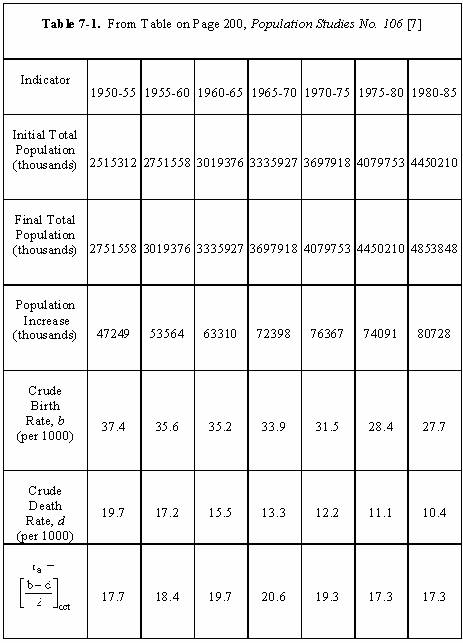
Look at the crude birth rates and crude death rates in the table on page 200 of Population Studies No. 106, World Population Prospects 1988, United Nations, Dept. of Intl. Economic and Social Affairs, New York (1989) [7] The pertinent data appears in Table 7-1 on the next page. The birth rates decreased from 0.0374 in the period between 1950 and 1955 to 0.0277 in the period between 1980 and 1985. The death rates decreased from 0.0197 in the period between 1950 and 1955 to 0.0104 in the period between 1980 and 1985. These rates were calculated by dividing the number of births or deaths in the given period by the average of the populations at the two end points. Starting with the population in 1950, we can calculate what the population, pfinal, would have been at the end of each successive period if the birth rate were as shown but the death rate remained at what the death rate had been between 1950 and 1955, i.e., if the death rate did not improve.

where b = crude birth rate and d = crude death rate and

A little algebra shows that

where

Thus, unless the death rate exceed the birth rate, the population will continue to increase, since the fraction (1+r)/(1-r) will be greater than one. Clearly, it is not true that the increase in the population since 1950 has come only from a decrease in the death rate. Even if the death rate had not decreased, the total population would have increased. The increase came from the fact that the birth rate exceeded the death rate. Simon answered my letter with a phone call and attempted to defend the statement by showing that increase in population per capita was due to a decrease in the death rate per capita, but in his paper (and perhaps in one or more of his books) he said that the total population increased solely because of the decrease in the death rate. He used the phrase “a larger population” without any reference to increase per capita. In his defense, I agree that at some time in the past, but not within living memory (perhaps excluding the periods of the world wars), the death rate was so bad that, if we did not improve upon it, the population would be shrinking – at the present birth rates.
His mistake came in dividing the first equation through by pavg and assuming that, since the increase in population per capita, as opposed to population itself, would have decreased had the death rate remained constant, the total population would have decreased. The actual differences b-d over the seven time period studied were 0.0177, 0.0184, 0.0197, 0.0206, 0.0193, 0.0173, 0.0173. So, one sees that the actual difference did not rise monotonically. The differences between bactual and d1950-55 were 0.0177, 0.0159, 0.0155, 0.0142, 0.0118, 0.0087, 0.0080, which, as we see, did decrease monotonically. This is what Simon was referring to over the phone, but the population continued to rise.
Simon’s paper is now discredited, but it is worthwhile attacking other false and deceptive ideas in the paper to enable the reader to discredit them wherever they arise. Simon states that “the number of children that one wishes to bear and raise” is “one of the most sacred and valued choices a family can make.” Where does the sacred nature of this choice come from? Surely not religion, which may not be introduced into public policy? I have shown the immoral nature of replacing more than oneself and one’s spouse in Chapter 3, but I have not elucidated on the use of procreation to promote one’s religion, political ideology, culture, values, etc. In my opinion, the single most unfair, aggressive, and hostile act, with the exception of war itself, that can be perpetrated by a race, religion, political party, sovereign state, family or other similarly identifiable group is to increase deliberately for an ulterior purpose, e.g., the spread of religious or political doctrine, its proportional representation in the population by increasing or failing to decrease its birth rate.
Simon defends population growth because it encourages rather than impedes economic growth. This is exactly the point. Population growth is both a cause and an effect of economic growth, but economic growth in a finite world is absurd unless economic growth be measured in an absurd way. If, for example, efforts to cut pollution that do not result in the increased production of consumer goods are considered economic growth, we could have concurrent economic growth and the shrinkage of the supply of consumer goods and the shrinkage of the accumulation of capital, too, an obvious absurdity. While it is true that more useful effort may be made in the future to support even a smaller population, it is not necessarily true that the amount of wealth (as opposed to money) created will be greater than currently. As I have stated in this essay and elsewhere, we must be particularly careful not to confuse money and wealth. We can’t eat money.
Simon claims that economic growth and the concomitant decrease in birth rates (not number of births) has been greater in market-directed economies than in centrally planned economies and that this “provides solid evidence that an enterprise system works better than a planned economy”. It is clear that Simon’s other arguments are directed toward his devotion to capitalists and capitalism. But, the phrase “works better” ought to refer to more than economic growth. In fact, the thesis advanced by me is that, if the entire population enjoys sufficiency, economic shrinkage is preferable to economic growth. The failures of centrally planned economies cannot be attributed to planning itself. I have discussed and shall continue to discuss the other variables. I hope that Simon does not imagine that market economies have been proved superior to planned economies. If you planned a trip and the plan didn’t work out, would you neglect to plan the next trip? Wait until the new market economies get a load of capitalism. The carpetbaggers are already over there or on the way. In any case, economic planning need not imply state capitalism, which seems to be what has failed, planning or not (and I don’t think much of the planning that was tried). Even though I insist upon a planned economy, although perhaps not a centrally planned economy, I deplore state capitalism and I have listed its defects elsewhere. (Some projects, e.g., flood control, require central planning and, indeed, are centrally planned in all societies.) [The point I wished to make here is that nothing has been proved by the collapse of the Soviet Union. This point can be made easily in a number of ways.]
Simon claims that the scarcity of natural resources, even of high-grade energy reserves, is not a problem. He shows that the relative costs of natural resources have decreased over the years. Again he is confusing wealth with money. The price of petroleum depends on the cost of getting it out of the ground, which we are able to do with greater efficiency nowadays than formerly, but it does not account for the millions of years of work done by nature. No one argues that we can discover and mine natural resources more efficiently and rapidly than formerly. What Simon neglects is their finiteness. He is depending on the development of technology that does not yet exist, nor do we know that it can ever exist. The trend in science over the last century is to reveal what cannot be done, cf., the Second Law of Thermodynamics, special relativity, the Heisenberg Uncertainty Principle, Gödel’s proof, deterministic chaos. Despite the tremendous strides made in technology, we know better than ever that some limitations will not be overcome. Simon is playing fast and loose with predictions about the future that are likely to have catastrophic effects if we believed in them and acted upon them. Moreover, he neglects the effects of removing natural resources from the ground, which might have catastrophic effects on the earth itself that are just beginning to be studied. Also, he neglects the effects of expending energy, not just greenhouse effects, but thermal and motion pollution. He neglects the alienation from nature that is an unfortunate consequence of widespread industrialization and migration from the countryside to the cities.
Simon imagines that, since natural resources, including agricultural soil (!), represent a smaller percentage of the gross national product than formerly, they are less important or not at all important. (He suggests that if we lost all of our agricultural land, it would effect our economy only slightly!) This fits in with the popular myth that we are becoming an information economy, that we can survive by counting beads, shuffling paper, and selling that which we do not produce, and, indeed, it seems that, during the eighties, the rich got richer by doing just that. What is actually happening is that we are mortgaging our futures and driving the majority of our population toward unbearable poverty. We are turning our nation into a third-world country replete with feudal plutocracy.
Simon offers three graphs to support his claim that water and air are getting cleaner rather than dirtier. He shows that our drinking water is becoming purer over time without mentioning the tremendous amount of high-grade energy that must be expended to clean it or to acquire water from an unpolluted source. The implication is that the purity of the drinking water is a good measure of the purity of all water. He shows that the annual emissions of some toxic or greenhouse gases, particulate matter, and lead is decreasing, but not by much. Granted that political pressure by some people (but not by many professors at business schools) has forced the reduction of some emissions, particularly lead, which is recognized as extremely dangerous and is easy to prevent from getting into the environment as it is a solid at room temperature, is not a component of fossil fuels, and is easy to separate from other chemicals. But, until we know the rate at which the gases are removed from the atmosphere, we do not know if the gases are accumulating in the atmosphere or not. Net accumulations represent a deficit for which we will pay dearly. Again Simon confuses rates with accumulations as he did with population itself.
Finally, Simon advocates a way of life, i.e., a political-social-economic system, that is guaranteed to have effects opposite to what he claims for it. He believes that people should have incentives to work hard and take risks to provide for themselves and their families and that selfishness will have beneficial results. He believes in respect for property. He believes that the rules of the market can be made fair and sensible. He believes in personal liberty that is compatible with economic freedom, which, presumably, refers to the classical “right” to exploit whomever one pleases. He believes people will act “spontaneously” in search of individual welfare, ignoring completely the fact that a large proportion of the people in a capitalist society are bound to be no better than wage slaves and that, under capitalism, if they were not, college professors would have nothing to eat or wear and nowhere to live. The entire thrust of this essay is to show the absurdity of Simon’s claims and to show, in fact, how to do much better – without government intervention and without anyone teaching business.
Industrial Activity
All things being equal, the more people, the more industrial activity. Greater population facilitates industrial activity and, to a certain degree, it makes it more necessary (but not as necessary as we are accustomed to think). Even in a humanistic society, we will require a certain amount of (humanized) industrial activity to optimize our chances for survival under tolerable conditions, although the scale of our industrial activity undoubtedly will be reduced. In any case, even in the best possible world, the extent of our industrial activity will be roughly proportional to the number of people. The most likely deviation from proportionality would be to cause the activity per person to rise to account for the additional measures that must be taken due to crowding, cf., taller buildings cost more per story. But, industrial activity has its inevitable environmental costs, again because of the difficulty of attaining high purity in any purification process. Even in a zero-emissions industrial facility, which, for now, is only the engineer’s far-distant dream, the amount of energy that is consumed both directly, to produce a product, and indirectly, to clean up the mess (which ought to be as small a mess as possible by design), will be the ultimate unavoidable cost of industrial activity. Ultimately, everything boils down to energy. (Of course, I mean high-grade energy, or availability, or, better yet, emergy). Even in the simplest possible human society, the energy cost will rise at least proportionately to the number of people.
[Probably, the zero-emissions facility will produce volumes of activated charcoal in drums containing hazardous substances concerning which nothing more can be done. This reminds us of the atomic waste problem. Bio-remediation offers some hope, though, for a permanent solution to air and water pollution; but, presumably, it will not be free; i.e., it will entail emergy costs.]
Renewable Energy
To what extent can we provide ourselves with renewable energy sources that do not themselves harm the environment unacceptably when the energy is acquired or when it is consumed? That’s a big question. The answer will determine if the world W″ can exist, which is the sufficiency condition for the Fundamental Theorem. We have tried to answer it in Chapter 2, but I’m afraid that we asked more questions than we answered. Clearly, research is needed along the lines suggested in Chapter 2, but I am not aware of any such research currently being funded. Hopefully, I am merely uninformed. Unfortunately, the best answers we have heard so far are disappointing. Solar energy has energy costs of its own associated with it that make solar collectors less efficient than trees and plants that could be grown in the same space, according to Odum and Odum [8]. [Unless they make their raw data and calculations available to me, I shall have to repeat their work, which, of course, may be wrong.] So far, we have not developed materials that are adequate for exploiting geothermal energy, nor do we know what the effect of hastening the cooling of the earth’s interior might be, although it might be negligible. Similar remarks could be made about wind power and tidal power. And yet, all of these possibilities must be investigated thoroughly because the burning of fossil fuels seems to be out of the question. The Odums claim that nuclear fission is a net loser of energy. Fusion seems as far away as ever, perhaps infinitely far away. I, personally, shall continue to be an opponent of nuclear energy so long as it is produced within a market economy to make money, even though I recognize many of the advantages of nuclear energy if we are able to care for (notice, I did not say dispose of) the radioactive waste, which, after all, may some day turn out to be very useful stuff (certainly it is too special to discard). My experience (including extensive reading) tells me that a person trying to accumulate wealth will do anything. (That, in all of its manifestations, is, to a great degree, what motivates this essay.)
Immigration
Introduction
As a continuation of the subject of population growth and crowding, it is time to make some remarks that ought to be very unpopular among many people who might otherwise be my allies. First of all, though, I want to make it very clear that I do not favor the mistreatment of immigrants. On the contrary, I wish to prevent them from being exploited. They should be treated as honored guests. But, the time has come to defend my view that immigration should be sharply curtailed if not eliminated.
[Note in proof: In defense of the idea of the melting pot (I myself come from mixed parentage), I must say that the mixing of the races probably has been good genetically, as nature loves diversity. I hope that racial mixing continues and I see no reason why it should not – even if excessive migrancy should be curtailed now. I shall need to say more about this when I discuss institutions of the future, which might include world tours – on foot – with free hospices everywhere.]
Clearly, excessive movement of people on the face of the earth is per se undesirable. It causes excessive expenditure of energy, it creates excess motion pollution, and it tears up the fabric of society. Travel is a broadening and otherwise rewarding experience, but most migration of people has economic ramifications and undesirable effects that overbalance the normal rewards of travel. Normally, it has nothing to do with what Thomas Cook meant by travel, namely, an educational and entertaining experience.
Interchange of people between countries on a temporary basis is desirable for purposes of cross-acculturation and because it makes life more interesting, but migration should not be allowed to increase the population density or to upset economic planning. It might be argued that, while immigration increases the population density somewhere, it decreases the population density somewhere else. This is true except in cases where the immigrant is moving from a nation that has reached a sort of saturation density to a nation that has not. By a saturation density, I mean that the population is in a self-limiting condition due to infant mortality, inability to take care of the elderly, inadequate health care, malnutrition, epidemic disease, or civil war. In the nation with a near-term saturated population density, the individual removed from the population will be replaced, at least statistically, whereas, had he not been removed, the saturated state of the population would not have permitted the population to rise. This is true only statistically; but, the fact is that, when under-saturated nations act as relief valves for saturated nations, the under-saturated nation becomes more nearly saturated, endangering life for all living things there; and, the saturated nation is encouraged not to take steps to remedy its saturated state. Moreover, as pointed out by Ehrlich and Ehrlich [3], a person in the United States does about thirty times as much damage to the planet as does a person in Nepal, say. One of the reasons people want to come to the United States is so that they can participate in this environmental destruction! “I came to America for a better life.” They might as well not kid themselves and simply say: “I came to America to consume more.” More consumption is not the same as a better life! Of course, stupid people think it will be, but they are doomed to live a life of perpetual dissatisfaction, as discussed by Durkheim [9] years ago and verified by anyone who has ever tried to attain happiness by acquisition and consumption if he is at all introspective.
Immigration is a threat to people who do not own their own businesses. I am not impressed when you tell me that immigrants are willing to work harder. Most of us work too hard already and we don’t need competition from someone who is willing to work even harder. Most immigrants are delightful people and don’t realize they are doing anything wrong; but, since they weaken the bargaining position of American workers, they are basically what union people call scabs.
The immigration policy of this country was wrong when we turned the “hungry and tired, yearning to be free” into virtual slaves and it’s still wrong. Basically, it has been a pyramid club: A wave of immigrants comes in and is exploited by people who are established. If they survive, they are allowed to have children who can exploit the next wave of immigrants, and so on. This game can be played out forever provided the country is infinitely large; but, like all pyramid clubs, it must come to an end because of finiteness. I believe we have come to the end. The people are pushing out the wildlife and destroying the environment.
I shall discuss briefly five categories of immigrants here, namely, (i) people who come from countries that have been exploited by U.S. imperialism, (ii) exploitative businessmen or – what amounts to the same thing – crooks, (iii) graduate students and high-tech workers, (iv) political refugees, and (v) other economic refugees, sometimes people who have come from countries that have been exploited by imperial powers other than the United States; however, in any case, people who wish to consume more. It is doubtful that anyone comes to the United States to consume less! Of course, we must react by consuming much less ourselves. Until that has been accomplished, we haven’t much of a case.
Category I. Victims of U.S. Imperialism
As most of us know, American foreign policy in Central and South America, Haiti, the Philippines, and elsewhere has not taken into consideration the well-being of the majority of people there. We have exploited their natural and human resources and even our foreign aid has been a form of depredation. For example, in a recent address (at The Other Economic Summit, Houston, Texas, July 6-8, 1990), Professor Howard T. Odum of the Department of Environmental Engineering Sciences of the University of Florida at Gainesville, pointed out that, when we lend $1,000,000 to a typical Central American country, for example, they receive $1,000,000 in American standard of living. Some of this money goes back into the hands of American construction companies and contractors.
Often the loan does not benefit the people who need help the most. But, what is shocking, according to Professor Odum, is that when the money is paid back, even leaving the interest out of account, the Central American country must pay back four times as much standard of living as $1,000,000 buys in the United States.
This is obviously true, although the factor may be too small or too large. We hear that a peasant in a third world country is living on $600 dollars a year, but he is living; so, we know that $600 must buy a lot more “living” there than it would in New York, say. A person would die in New York if he or she had only $600 to spend in one year. So, it’s clear that the repayment of the loan, much of which was spent on the purchase of U.S. goods and services, entails paying back a lot more “living” than was borrowed, and that doesn’t take into account the interest.
Our debtors to the south have paid back the principal on their loans many times over. Some of them are spending a very high percentage of their GNP on interest payments. Thus the money transferred to the U.S. is a major hemorrhage of the life’s blood of their economies. The upshot of this is that many of their citizens are forced to follow their money from its nation of origin to its destination in the United States to get jobs. Of course, most of them do this in violation of our immigration laws, but not in violation of the fundamental law of nature, the right to survival. But, this does not account for all of the immigration from Central America.
The United States continues to pursue its imperialistic policies in many of these countries under the guise of containing communism or under the guise of a “war on drugs” (as if one could make war on an inanimate object). What the United States really wants, as all but the most naive among us know, is continued access to raw materials (including the nutrients in the soil), cheap labor, and expanded markets. We have always considered our neighbors to the south ours to exploit. The term “banana republic” has meaning to all of us because it bespeaks the truth. If the reader has not already done so, he or she might look at some of the novels and short stories of Gabriel Garcia Marquez, who won the Nobel Prize in literature, particularly the novel entitled One Hundred Years of Solitude, a Bard book published by Avon Books [10]. On or about Page 282 in the fifteenth printing of the paperback edition, the author describes the shooting of 3000 striking workers of the banana company. This is fiction, but sometimes reality is worse – too horrible to put in a novel. Nonfiction works on American imperialism are readily available [11,12]. Presumably, the government tolerates such books because they reach very few people, and it is too much trouble to suppress them. At no cost to themselves, the powers-that-be can claim to observe the Bill of Rights, which they do not do in many important cases discussed elsewhere in this essay and other essays by the author.
Many people in opposition to corrupt regimes in Central America have been forced to flee for their lives because of vicious repression of dissent and violations of human rights that would not exist except for present and past American foreign policy. (Many of these, I am told, are being detained in what amounts to little better than a concentration camp at Port Isabel, Texas.) Thus, immigration of this type would not occur were it not for America’s vicious foreign policy, whose only beneficiaries are those who least deserve to be Americans, namely, parasites and vampires. Clearly, immigration to America in pursuit of one’s money or to flee from state-sponsored terrorism is undesirable on the face of it. It entails leaving one’s home and friends, traveling to a strange land where a different language is spoken by most of the population (still), and starting all over again. The forced migration of people over the face of the globe has its human and its environmental costs.
Rejection of imperialism is part of what many people may feel is an isolationist policy advocated in this essay. If one doesn’t like the policy, one might call it isolationist; but, if one does, one might call it decentralist or anti-imperialist or anti-colonialist or decolonialist. Actually, since I am rejecting trade in every form, I am a fortiori rejecting foreign trade. This is discussed below.
Category II. Invaders
I wish to limit my discussion of the class of immigrants who have moved to the United States to exploit Americans to a brief comment. (I shall resist my inclination to tell the story of the foreign-born cardiologist who presented me recently with an outrageous bill for minimal service and an incorrect diagnosis. Presumably, I would like to ask, there are no sick people in her native land!)
In Hocus Pocus [13] Vonnegut refers to people who move to America because the government here does so little to protect poor people from predators. Of a character named Paul Slazinger, a (fictional) recipient of a MacArthur Foundation grant, Vonnegut writes, “He said that so many people wanted to come here because it was so easy to rob the poor people, who got absolutely no protection from the Government.” Many have come to take advantage of our tolerance of any activity whatever – so long as its purpose is to make money. Also, these parasites know that even if they run afoul of the ruling elite they have little chance of being punished for their crimes because of the chaos and disorder in our legal system. Moreover, if things get hot, they can escape to their native lands.
Many take care of that eventuality in advance by operating their businesses from abroad. These people are like the carpetbaggers who swarmed down upon the crippled and vulnerable states of the Confederacy after their defeat in the Civil War. Similar types will be infesting Eastern Europe soon if they are not already there. Wait ’til the folks there get a taste of what free enterprise really means. Also, and perhaps concomitantly with this phenomena, we have observed a class of immigrants (perhaps very small) who despise Americans and a somewhat larger class who have no intention of integrating into the mainstream of American life as the ancestors of most of us have done. Why in the world should we put up with this! Isn’t the country fragmented enough! (In this essay, we wish to encourage variation in lifestyles, but we depend on a consensus to establish the moral basis for it. We do not need to import variation.)
Category III. Students and High-Tech Workers
I now wish to summarize what my thoughts were more than two years ago on the immigration of graduate students in engineering and science by quoting from two letters, the first to Science (not published) and the second to Time (never sent).
The response of engineering faculty members to the survey reported in Science, April 3, l987, [The Impact of Foreign Graduate Students on Engineering Education in the United States]; viz., approval of foreign graduate students, demonstrates disregard for American engineers and, indeed, the rest of the U.S. economy. Professors require research assistants (slaves?) to satisfy their lust for prestige and money; they are blind to the consequences of their greed.
If foreign-born recipients of American PhD degrees leave our country, they transfer technology to competitor nations. (Some foreign-born PhDs work in America for awhile then leave, thus compounding the rapid technology transfer.) The net result is a lowering of the standard of living of American workers. (It is true that in an ideal democratic, egalitarian world with fair play between nations this lowering would not occur.) If foreign-born PhDs stay in the U.S., they compete with American PhDs and drive down the market value of the degree, which becomes less attractive to talented American students.
It is hypocritical to encourage Americans to do graduate work while admitting foreigners into graduate programs. Also, to accept tuition from a student to launch his or her engineering career and then to undermine that career by glutting the employment market is, at best, a breach of faith. Of course, academic, governmental, and industrial employers of engineers benefit from a large, cheap, readily available supply of engineering talent, but why should the exploitation of engineering be more rewarding than the practice of engineering! It is ironic that an American engineer could lose his or her job to a foreigner whose education he or she has supported through taxes.
Even if we are willing to ignore the best interests of American engineers, we should not accept graduate students from countries with governments or social systems of which we do not approve. If they return to these nations, they reinforce a bad political (or social) system with American expertise. If they do not return because, for example, they do not approve of the political system, they decrease the possibility of reform through dissent. (If they approve of the bad political system, they are not likely to have a positive impact on American society.) On the other hand, if the student comes from a “good” country, we do that deserving nation a disservice by increasing the likelihood that its pool of talent will be depleted.
Potsdam, New York
May 10, 1987
[Note in proof: Of course, nowadays, I don’t believe that any “good” nations exist. Moreover, it’s hard to imagine a country with a more repressive government than ours, however Singapore comes to mind. In any case, to argue that things are good here because they are worse elsewhere is the well-known ad metum fallacy.]
Foreign-born engineering graduate students [Education, Jan. 11] transfer technology instantly to our competition if they return home. If they stay here, they are often exploited, particularly by universities, and they drive down the market value of the PhD degree, which then becomes insufficiently attractive to young Americans. Engineers (including immigrants) should petition congress to curtail sharply the number of student visas issued and to prohibit subsidizing foreign students with public funds. It would be ironic if engineers were displaced by (even newer) immigrants whose educations they have paid for through taxes.
Houston, Texas
January 7, 1988
I feel now essentially as I felt then. I have been replaced successively by two foreign-born engineers, both of whom tolerate circumstances of their employment that should be intolerable to most Americans of my generation with my expectations. It is not that these people dispossessed me. I was leaving those jobs anyway; but, if a large supply of ready and willing workers weren’t standing behind me waiting to take my place, my employers would not have been able to get away with some of the employment policies that made working for them so degrading. Thus, management has been able to reverse the trend of improvement of working conditions that engineers enjoyed for a number of decades. I noted recently that the M. W. Kellogg Company, a formerly U.S.-owned engineering construction company, which in the best of times peddles the warm flesh of its employees to its clients who pay by the engineer-hour, now takes sick leave out of vacation pay, an open invitation to work while one is sick and to infect one’s fellow employees. This could not have been done without the help of the U.S. immigration policy and/or competition for jobs from abroad, although it must be admitted that this company obtains a great deal of work that should be done by the nationals of other countries.
Before I make a few additional observations, let me say that I have nothing but the highest regard for most of the foreign-born engineers and scientists I have met. I really like them and I have enjoyed the opportunity to meet and know people whose backgounds and experiences are different from my own. I am not a bigot. I am not even a xenophobe. [Note in proof: At a recent technology conference I heard an older Indian engineer say to a younger Indian engineer who had been educated in the U.S. and a resident for ten years, “Why should they hire you? They can get someone right off the boat from Bombay much cheaper.”]
Observation 1: In the event that the U.S. finds itself at war, it will find itself hard-pressed to fill scientific jobs that require security clearance. Actually, it is unlikely that our enemies, including Japan, have been so stupid that they have not placed spies in the American scientific and industrial community. [Note (12-3-90). Americans used to be concerned about wars with communists, but the war with Iraq for which the country is preparing at this writing is a war among capitalists. Capitalism spawns economic competition and economic competition spawns wars. Japan has been at war with the United States almost continuously since 1941. Nowadays the war takes the form of economic depredation at which Japan excels.]
Observation 2: The American ruling elite has a long history of exploiting immigrants. Now, immigrants are being exploited at a slightly higher level but, essentially, as scabs.
Observation 3: Many immigrants are coming from nations that do not permit foreigners to work.
Observation 4: All things being equal (and they never are), each new immigrant must be accounted for by an additional person unemployed and an additional person without a home. Much of the burden of immigration is borne by disadvantaged American minorities. When new housing is built, animals are displaced. As Calvin of “Calvin and Hobbes” puts it, “Squirrels can’t afford condominiums.”
Category IV. Political Refugees
The fourth class of immigrants to be considered here is the class of political refugees. We discussed political refugees in the section on U.S. imperialism. We must assume that these people are in genuine danger of being liquidated by the government of the country from which they came. If the political refugee is a victim of a truly repressive regime, we ought to assist the refugee in developing the skills required to reclaim his (or her) country, which means that, so long as the victim is here, he must attend to that business to the exclusion of other business even if his stay is permanent and he has to be supported by donations from freedom-loving Americans. Of course, in the usual case, the United States is an active ally of the repressive regime and is materially aiding the repression of dissent; so, it’s unlikely that we would sponsor a school to train Salvadoran guerrillas to overthrow their government.
Category V. Economic Refugees
If we were to accept economic refugees, we would confine immigration to those who are nearest to starvation, but those are the ones we make the greatest effort to exclude. This last category is not independent as its members are in I or IV – usually. If not, they fit into the even less desirable categories. If a country from which a refugee is fleeing has a more enlightened political system than the American system, e.g., communism, one can imagine that I am not terribly sympathetic with those who wish to escape it. For example, people who wish to escape communist countries because they object to not being allowed to exploit people weaker than themselves and would like to carry out such exploitation under the good old Stars and Stripes are not my favorite people.
If the Immigration and Naturalization Service (INS) lets them in, I must observe that the INS is acting as a semi-permeable political filter, blocking liberal politics from entering and passing conservative politics freely, perhaps even discharging some elements on the left by trumping up charges that result in deportation.
Totalitarian communism is preferable to totalitarian materialism, which is what we have here in the United States. Libertarian communism is to be preferred over both, but the chances of obtaining it are better starting with a planned economy and few super-rich members of the commissar class. I think I should like to include a letter I wrote, from my heart, to a Chinese graduate student who was requesting my technical papers. I do not know if he received this letter or not. I never heard from him again, which should amuse at least some of my detractors; but, it might not be funny. I, too, hope he simply thought I was nuts. Here’s the letter.
I am delighted that someone is still interested in the work I did in the 80s. Currently, I am, to a slight extent, the victim of American repression of dissent, which has cost me, in part, the loss of three jobs, although, of course, I can’t prove this. The methods are quite subtle. Perhaps, even the perpetrators are unaware of it. In America dissent is not exactly punished; dissent is impossible. Nearly, everyone accepts the propaganda of the government and the multi-national corporations, who control most of the world and are intent upon controlling all of it. The propaganda is very subtle. It is embodied in the clothing worn by the children on the “Cosby Show”, a television program. Practically no one is immune. Independent thought is extremely rare. The people believe they are free while, in fact, they are controlled by a vicious plutocracy, which amounts to a totalitarian dictatorship under the President. (The dictator changes from time to time; but, the dictatorship is the plutocracy, which is permanent.) Most Americans think that market systems and capitalism not only work but are ideal, while, in fact, the system is on the verge of collapse – both morally and economically. Don’t for an instant believe the lies of the people who wish to emulate the United States. Most of them wish only to exploit those weaker or less gifted than themselves. Conditions here are horrible. The quality of life of the average engineer is no better than that of an eighteenth century Russian serf. [Note in proof (12-5-96). I can defend this statement.]
While the government in China may not be ideal. The chances are much better in China of developing a libertarian communism of free people working together voluntarily in peace, sustainable happiness, and true equality than they are nearly anywhere else.
I don’t know if my letter will reach you and I don’t know what they will do to me if they intercept it, but I don’t think they can check all of the mail, so I am willing to take a chance on getting the truth out to you. Of course, we are all fallible and I may be wrong, but I don’t think so. I am including my hopes for the future of the world.
Whatever you do, please do not come to the United States! Stay in China. Your country needs you. With luck, we can stay in touch and exchange ideas. Perhaps the mails will continue to get through. If not, perhaps the electronic superhighway (faxes, etc.) will allow world-wide communication.
[Note in proof (5-30-96). When I hear an immigrant explain that he came to the United States for a better life, I am not terribly thrilled. I know that he thinks a better life is lived by consuming more, which is far from the case. Americans already consume many times the world average and some of that, e.g., automobiles, is involuntary. The U.S. is the most over-populated country in the world from the viewpoint of the environment, as an American consumes as much as thirty times the emergy of a person living in a less developed country, e.g., Tibet. Yet, the quality of life here is poor! Also, with each new immigrant the habitat of wildlife shrinks still further and yet another animal (species) faces extinction. Immigration into the United States cannot be justified by the Statue of Liberty.]
[Note in proof (9-29-96): Immigrants escaping unbearable poverty caused by a colonial power other than the United States should consider visiting themselves upon their current or former economic oppressors. Currently, England is paying for some of her former and current sins in just this way. To the poor of India I would say, “Try England if you can’t fix India.”]
A Word on Patriotism
Two distinct viewpoints are in evidence in the foregoing remarks: (i) I would like to improve the political situation in the entire world as rapidly as possible since good is good and evil is evil no matter where in the world they occur and (ii) I seem to have a higher regard for my fellow Americans than I do for other people. Due to the disparity in these viewpoints, I must say a few words about patriotism. From the first point of view patriotism does for nations what egotism does for people and we are bound to despise it. The people who want to pass laws against burning the flag or introduce the Pledge of Allegiance everywhere are the stupid sort of patriots who make us sick. But there is something to be said for caring more for our immediate family than our neighbor’s, caring more for the people in our own community than for the entire state, more for our state than for other states, more for the our nation than for other nations. This can be interpreted as selfishness because the operative quality is proximity or it can be interpreted as a natural affective tendency. It must be admitted that we find evil committed under our own noses more repulsive than evil we read about in the newspapers, although, if we are at all imaginative, we are repelled equally by evil perpetrated far away, even in a different era. (This is the gist of the Fundamental Premise.) Similarly, we are moved more directly and without the aid of our imaginations when we observe goodness with our own eyes. This is to a degree excusable because we do not really understand events far away from us in space and time as well as we understand nearby events. It is possible, even, to mistake good for evil and evil for good if we are sufficiently far removed from the event. Therefore, it is necessary to interpret patriotism from both viewpoints. I don’t have much patience, though, with a person who wants to lynch someone who burns the flag but who himself drives a Toyota.
[Note in proof (1-10-98). Despite my best efforts, it’s really hard to find anything good to say about patriotism. Who am I kidding! I was young and stupid when I wrote those letters in which I expressed concern for the United States. Of course, I’m just as enraged as ever about foreign engineers and scientists taking my jobs and, for all practical purposes, stealing my money. I have to live in this world.]
Direct Harm to the Environment from Competition for Wealth
With International Trade
It is easy to see that the destruction of the environment will never end so long as there is competition for wealth between separate sovereign states. While it is true that international laws could be enacted that would be administered by the United Nations, they could not be enforced without the expenditure of more resources than we possess. International law has never enjoyed the power of national law. If it did, the sovereign states would have been absorbed into one giant nation. Something might be said for such an arrangement in the far-distant future, when the ideas presented in this essay (or better ideas) are accepted by everyone; but, until that is the case, a world state would simply mean world conformity – conformity to the disgusting norms enjoying nearly universal acceptance in this world at its worst moment. Although emigration does not represent much of an option to most and I have already said what I think of immigration, leaving one’s homeland remains the option of last resort, short of revolution, for those who cannot tolerate their governments at all.
Thus, we might hope for – and expect to have – separate sovereign states for some time to come even though our ideal is small or mid-sized communities without borders. When the very existence of an enterprise in one sovereign state is threatened by competition from abroad or even when it can gain an advantage over its competitors, we can expect that it will apply pressure to have its nation’s environmental laws relaxed in its favor and, if that cannot be carried out to a sufficiently great degree, it will violate the laws of its nation. If the owners and top management of the offending firm are located in a country other than the one in which the laws are broken, they will be able to wreak havoc with impunity. That’s why we fear the institution of the multinational company more than nearly any other institution in the world today. We may assume without fear of contradiction that so long as foreign trade and competition for wealth coexist environmental destruction will continue at an unacceptable level.
Certainly, economic transactions must have occurred between nations or nationals of different nations at some time in all of human history that have been beneficial to the human family and to all parties involved. My problem is that I do not know of any and I cannot imagine a scenario, even in a thought experiment, that does not harm one party or the other, usually both, and that does not violate the morals espoused in this essay.
Comparative advantage is no longer a valid reason for foreign trade, as it, for the most part, no longer exists; but, if it did, it would depend on the sequestering of knowledge, which is a violation of Axiom 3, the Truth Axiom. The uneven distribution of natural resources over the Earth’s surface (and under it) has been addressed by suggesting a weak world federalism to redistribute natural resources without reciprocity. For now, let me pose a few questions: Why should natives of Sri Lanka make sweaters for the people of the United States for less money than they would need to buy sweaters? Why should American workers have to compete with foreign workers who are willing to live in thatched huts without running water? Why should Iraq sell its oil to the West when it has no means for earning a livelihood for its people when the oil is gone and when giving up the oil materially reduces the prospects of ever having the means? Why should Iraq be allowed to sell the natural resources bequeathed by the earth to its entire population (including plants and animals) just because of the accident of its nation’s birth having placed it directly over those resources? Why should citizens of the United States be permitted to sell, at a profit, goods produced by the labor of the citizens of other nations? The real fruit of imperialism and colonialism is war and death.
Finally, I would like to dispose of the myth of the global economy and to some extent I have already done so. Nothing stops us from producing everything we consume locally. We do not have to compete with enterprises in foreign countries. Capitalists and their highly paid toadies would like us to think that global competition is unavoidable so that we will work harder, for less money, under poor conditions, for more days with longer shifts per day and fewer benefits. They want us to put up with anything and be glad that we are not unemployed. Moreover, we are supposed to understand that it is not their fault when we eventually lose our jobs and have no incomes. We don’t have to put up with these lies and this type of exploitation. There are more of us than there are of them!
In the old days, foreign trade caused war. Many say that protectionism caused war, but probably we can show that foreign trade is not found without protectionism. In any case, nowadays, protectionism or not, trade is war. As far as the environment is concerned, it cannot afford the emergy to move goods thousands of miles (or even hundreds of miles) before they are consumed.
Competition for Wealth Even without Foreign Trade
But the banning of foreign trade will not put an end to environmental destruction. Question: Why does not Congress legislate an energy policy that would put an end to the transportation of huge quantities of oil in a single vessel over the oceans upon which life on this planet depends? Answer: because the interests that benefit from this insane practice control Congress. We will not be able to end environmental destruction while those who stand to gain from it wield this total power. This will continue so long as the institutions exist that permit one person to gain at the expense of another – in short, so long as people compete for wealth or, for that matter, so long as a single person can influence his (or her) share of material wealth and worldly influence by anything he says or does.
The Difficulty of Eliminating Pollution Altogether
Also, many of the measures that the strictest environmentalists would like to see taken are impossible without ceasing altogether the manufacture of chemicals that all of us have grown accustomed to using. I believe that we must reduce the quantities of chemicals upon which we rely, and phasing out the institution of business is consistent with this, but we will always need to produce some chemicals. Perhaps, chemical engineers should consider garbage, sewage, agricultural waste, and other biomass as the only acceptable candidates for feedstocks.
As an example of unreasonable demands, many environmentalists would like to see process engineers account for all of the materials entering and leaving the process up to microscopic amounts. With today’s computers we can calculate material balances up to 0.1 pound moles per hour of most chemical species, but this leaves amounts of up to several pounds per hour unaccounted for due to round-off error. One can make the plant’s joints and seals as tight as possible; but, with our best technology, gases leak somewhat no matter what is done.
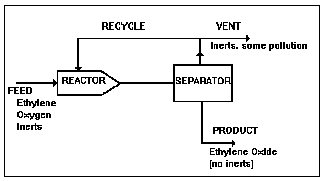
Figure 7-1. Chemical Reactor and Separator with Vent
Also – and regrettably – in nearly every chemical process inert gases are introduced with the starting materials and, at some point in the process, they must be purged. They will be mixed with valuable process chemicals, toxic waste products, greenhouse gases, etc. If the process chemicals are not too valuable, the most economical tactic in many cases, in a market economy, is to purge to the atmosphere. Suppose this may not be done. Then, the purge stream must be processed further and, hopefully, some useful materials will be captured from this secondary process, but the secondary process itself must be purged. We can imagine a tertiary process; but, if the secondary process were uneconomical (according to old-fashioned economics), the tertiary process will be more uneconomical still. We may have a quaternary process and so on; but, eventually, something must be discarded. The situation is illustrated in Fig. 7-1 for the case of an ethylene oxide reactor and separator. The feed contains oxygen and, therefore, some inert gases such as argon, krypton, helium, etc. When these are discharged some of the ethylene must be discharged with them as all of the inerts are extremely volatile and, if the ethylene is to be recycled, some inerts will leave the top of the separator with it. Suppose, as in Fig. 7-2, there is no vent. This is the situation that diehard radical environmental activists would like to force upon industrialists, isn’t it? Inerts are entering in the feed and the only place they could be leaving is in the product stream at the bottom of the separator. But, their volatility is too high to leave there; so, they must not be leaving at all! Thus, inerts must be accumulating in the process and, eventually, the reaction must cease and the plant must stop working, in which case society will have to do without its product.
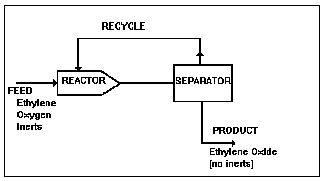
Figure 7-2. Reactor and Separator Without Vent
This is a situation that most environmentalists – or, rather, those who say they are – would find inconvenient, to say the least. They want the products but not the pollution. Unfortunately, if we are to live without air and water pollution, we will have to give up many products that we have grown accustomed to, such as paints, glues, detergents, cosmetics, some pharmaceuticals, not to mention motor fuels, lubricating agents, and, in the case of this plant, anti-freeze. It is simply amazing how many chemicals we have in our dwelling places – let alone the commodity chemicals that are used in the myriad consumer items with which we are surrounded. Agriculture, of course, is chemically intensive; but, if we wish to reduce pollution to acceptable levels, we had better become organic farmers in one way or another. We must return to a simpler lifestyle if we don’t want pollution and, if I am not mistaken, most of us will find that lifestyle harder but sweeter. Yes, harder but much sweeter.
Fortunately, the biosphere can absorb a finite quantity of chemicals that would be dangerous in high concentrations – or if they were allowed to accumulate – and a steady-state biosphere still be maintained. Chemical reactions occur in animals, plants, the oceans, the earth, and the atmosphere that are not dangerous and that help us dispose of some otherwise dangerous chemicals. For example, trees absorb carbon dioxide beneficially. If we go far enough in processing chemical waste streams, all of the chemicals that would be in excess of what the biosphere can absorb and maintain a steady state will be accounted for by our process. Bio-remediation and dynamic storage of drums of contaminated activated charcoal – stored like we should store atomic waste – might end the last vestiges of air and water pollution.
But, in a materialistic setting, a competitor could always give itself an advantage by releasing waste streams with dangerous levels of environmental contaminants. Every experience we have had with the so-called free-enterprise system shows that, when competitors have the opportunity to take advantage, they will take advantage – regardless of the social costs. Capitalists, for example, may try to remedy this situation with one or another new institution, and it must be admitted that they have improved slightly, but only because they have been forced to improve because of socialistic restraints, which they don’t like, which they try to eliminate or avoid, and which are costly to society because of the burden of the concomitant socialistic bureaucracy. If multinational corporations obtain monopolistic control over entire societies, they will do as they please, presumably because the handful of plutocrats that control the multinationals imagine that they can isolate themselves from the damage even if it requires travel to outer space.
The Environment as a Business
We are accustomed to thinking of the environment as the Earth, its atmosphere, its oceans, the biosphere, etc.; but, nowadays, “the environment” is much more. It is a billion dollar business! We have environmental organizations – both for and against, the lobbyists, the spin doctors, the media, legislators, environmental engineers and managers, environmental lawyers and consultants – whether pro-active, compliant, or evasive – manufacturers of pollution-control equipment, and the sellers and promoters of pollution-control equipment and all of the ancillary business associated with such equipment, e.g., the manufacturers of catalysts. We even have the advertising people who portray massive polluters like Dow or DuPont on television as pro-active environmentalists. That’s big business. I’m sure I’ve left out plenty because in America, indeed in the whole world, when there’s money to be made, there’s someone out there to make it, even if it be selling messages from heaven – on easy pay-as-you-go terms.
I have before me a complicated systems diagram. I drew it by hand. Even so, it barely fits on one piece of paper. When I contemplate drawing this with the primitive graphics software I have at my disposal, I shudder. Instead, let me tell you the drawing. That might be easier on both of us. Remember, this is just my conception of how the environmental business works. It might be completely at odds with reality in many cases. Some companies want to do as much as possible to avoid environmental destruction – going way beyond the law – so long as they don’t put themselves out of business. These I term pro-active, but I’m not sure any exist. Many companies – or, rather, many individuals in many companies – would like to comply with the law, provided it be not too strict. These I term compliant. Finally, and I believe this is the largest category, many companies wish to evade the law – to increase profits, obviously. These I term evasive.
The systems diagram begins with the public and ends with the environment. The public gives money and personal support to environmental organizations and participates in the “environmental business” in other ways – perhaps by voting against congresspeople who sponsor tough environmental legislation. The public receives feedback from the environment in terms of a better or worse quality of life. It also receives propaganda from environmental organizations – perhaps through the media – and propaganda from the management of industry – perhaps through multi-million dollar ads on TV. (I won’t trace all the in-between steps, e.g., the ad agency.) Both the environmental organizations and industry put armies of lobbyists into the arena, who try to influence members of Congress, other members of Government, and Government itself. Members of Congress draft laws, which, after a great deal of lobbying, etc., are sent to Congress. Let’s follow the path of a new law sent to Congress. Congress is forced by various factors, including lobbying, to amend the law, which is then passed. The environmental experts in the management of affected industries read the law and, depending upon whether the company be pro-active, compliant, or evasive, they draft a preliminary company policy, which is sent to an environmental lawyer or consultant, who prepares a report to be sent back to the environmental experts within management. This report may show the company how to comply with the law most economically. It might point out loopholes in the law, or it might show the company how best not to get caught. After a few go-arounds, a final policy is drafted, which is sent to production.
Now, production has its own agenda. Production personnel might like to follow the company policy on environment, but they have production quotas and budgetary constraints. At this time, transactions with pollution-control equipment vendors may or may not take place. Actually, it’s much more complicated than that. They might call in their process designers; they might change feedstocks or their primary energy source or a combination of everything. Or – they may do nothing.
Production will pollute. What they report to the environmental consultant or lawyer and what they report to the environmental experts in their own management is up to them. They may say, “You don’t know, and you don’t want to know,” or they may tell flat-out lies, or they may tell the truth and ask for help in concealing or evading the effects of their actions. Or, amazingly, they may do the right thing; but probably not in every instance. I will share my suspicions with the reader toward the end of this chapter by way of accounts taken from the Houston Post, a conservative paper that is certainly not biased against the chemical or petroleum industries.
Now, in our thought experiment, let’s add a new element, namely, the whistle blower. Suppose a brave right-thinking soul decides to blow the whistle on his employer who is committing environmental atrocities with which the whistle blower is familiar. In my systems diagram, I show the pollution as an input to the whistle blower, but I show also tremendous coercion from industry, management, its “experts”, and its lawyers and consultants. He (or she) could even be killed; but, in my system diagram, I show feedback to the public in terms of information, which might go through the media or a film maker, and feedback to the public in terms of less pollution.
This is all imaginary; but, in any case, environmental considerations generate much activity that’s not really about the environment. It’s about the environmental business. Of course, economists will add all this to the Gross Domestic Product and claim it adds to our standard of living, which, depending on circumstances, ranges from debatable to absurd. The following was written a couple of years ago, but I never tried to publish it. (I gave copies to a few friends, though.) At last, I’ve found a use for it, although writing for the sake of writing is fine with me.
Mass Transit
Here in Houston and in other U.S. cities we have a terrible problem with air pollution. The city government has spent millions on studies to determine if a rail rapid-transit system is feasible. Houston is a city with several business districts and far-flung neighborhoods; so, if the rail system is supposed to eliminate cars by bringing people to work, it will have to be too big for the budget of any U.S. city, let alone Houston. If it is desired to connect only the main business districts, including the medical center, which would enhance the prestige of the city, as the mayor hopes, and aid tourists or business travelers, it will not affect air pollution appreciably. It will aid the affluent only and be paid for by everyone. In any case, the rail system is infeasible.
But, suppose for a moment that it were economically feasible. That would present an entirely different set of problems, similar to the problems on the New York City subways. Middle-class people would be safe only at certain hours. Unless strongly repressive, presumably unconstitutional, measures were taken, the rail system would become a haven of last resort for the homeless and a predatory jungle during the nonpeak hours. Of course, we are delighted that the homeless would have a “haven of last resort”, but the use of the rail system as shelter for the homeless would conflict, no doubt, with its use for mass transit. This new set of problems is unavoidable since the free-enterprise system allows for and encourages vast differences in wealth. Free enterprise creates class warfare and, in particular, an underclass with nothing to lose. So, mass transit cannot serve the needs of the entire city at all times and the restrictions placed on its use by the defects in society would be impossible to predict far in advance or even from hour to hour.
February 7, 1990
Revised February 25, 1992
Additional Notes on Mass Transit
This brief dismissal of mass transit as an energy conservation tool seems inadequate according to discussions I have had with proponents of rail plans. In an extremely uncharacteristic gesture (and at the invitation of the guest) I called a radio talk show and could make no headway in explaining these points. The following are some notes I sent to both participants following the show. Pardon the informality. I may never get around to “fleshing them out” or, for that matter, discovering the name of the architect referred to, but the reader probably knows his name anyway.
Joe and Scott, here are some rough notes that I’ll flesh out when I get more time. Basically, they are objections to Joe’s plan, which I take to be the lesser of many evils – perhaps – but still wrong.
1. Power plants pollute and their pollution is concentrated even if they have a tall stack and are kept away from populous areas. Moreover, they produce electricity from fossil fuels at 25% efficiency according to Howard Odum. Let’s suppose we can get the efficiency up to 33% using cogeneration etc. We still haven’t accounted for the fossil fuel used to build them, carry the operators back and forth to work, carry the people who serve the operators lunch back and forth, ¼ You get the idea. In fact, if we count the hidden costs, nuclear plants have a negative efficiency. So, to break even, the mass transit trains have to be three times as efficient as cars – at least. Crude oil can be refined into gasoline with about 97% efficiency.
2. But, the
trains must run nearly empty much of the time or no one will use them.
They must run all night. What if you miss the last train? If they
run all night, you must account for the objection [concerning conflicting uses
discussed in the paragraph at the top of this page]. I admit that I have
not done the complete analysis of the efficiency of trains. We can draw a
bimodal plot of ridership and assume that an empty train uses only one-half the
energy of a full train. It should be easy to get the statistics for
energy per unit mile for a full train with N cars and some assumed
acceleration-constant_velocity-braking profile – assuming dynamic
braking. Joe, you need these figures. And, speaking of electric
power – What if it turns out that the electromagnetic radiation from the power
lines is unacceptable! What about  losses?
High-temperature superconductivity is out of the question. That’s
utopian! [Note in proof (9-29-96). Perhaps not. I have
done some very rough heat transfer calculations that indicate refrigeration
costs, even for liquid nitrogen, might be less than i2R losses.]
losses?
High-temperature superconductivity is out of the question. That’s
utopian! [Note in proof (9-29-96). Perhaps not. I have
done some very rough heat transfer calculations that indicate refrigeration
costs, even for liquid nitrogen, might be less than i2R losses.]
3. Joe’s system will create more activity not less and, in fact, if people can get to the airport faster, they will take more plane trips. (I assume that flying is even less efficient than driving. People will take the plane to Austin where previously they would have driven. Let’s check on whether flying is less efficient than driving. Planes create terrible environmental problems, in any case, not the least of which is noise. Also, they dump unburnt fuel into the air over cities from time to time because they don’t like to land with too much in the tanks.) In fact, every means of moving people will tend to become saturated as long as people are “addicted” to movement. (Call that Wayburn’s Law of Transportation. Ha, ha.) Joe is giving people more reasons to move around: trips to Galveston, a fun downtown, etc.
4. The answer to my objection to students living off campus was not well taken. Do we mean to say that people will never change? Change they must. Nature will ensure that.
5. People in Houston will still need a car because in July one cannot walk very far without one’s temperature beginning to rise. Each suburban home generates about 14 car trips a day according to that architect from Florida. (Could his first or last name be Andre?) Mass transit will take care of only two [perhaps four] of those trips at most. (My private opinion is that in 50 years Houston will barely exist – and good riddance. I’m sorry, but that’s how I feel.) People in Houston will use cars in the summer if they have them because walking is intolerable. The transit system will have low ridership all summer unless it delivers everyone right to his or her door.
6. The energy costs of building and maintaining the system and all the hidden energy costs must be charged to the system and they will not be offset by fewer automobiles. Moreover, the lifetime of the system is limited to about 50 years at most. This is debatable.
In fact, everything is debatable. Let’s debate! Joe, if you are unwilling to debate me, how can you expect Bob Lanier [the mayor of Houston] to debate you. I think you should come to the Future Forum [a discussion group discussed in Vol. II of my collected papers] more often. I understand that you’re a man on a mission and it may be impossible to get you to devote your considerable talents to something more worthwhile.
February 25, 1992
A Parable
I choose to demonstrate, by means of a parable, written by me earlier (but never offered for publication), why air pollution alone, as a typical and serious form of environmental destruction, can never be eliminated in a market economy. This parable was preceded by a brief analysis (printed above) of why public transportation cannot supply a solution to air pollution in Houston, Texas, where a highly flawed rail plan is being forced on an unwilling public at this writing.
The Air-Pollution Crisis and Free Enterprise
BUT: A Story of Automobiles, Airplanes, and Business
John Doe worked for seven years for a large oil company on the west side of town. Since he was just out of college and newly married when he got the job at the oil company, he wanted to buy a home close to the office building where the business offices of the oil company were located. He hoped to walk to work, but the oil company had to be in a business neighborhood in order to conduct business with its contractors and customers without inconvenience. Thus, the nearest suitable residence was two miles from John’s place of business. Two miles isn’t too far to bicycle though, and John could have helped cut down air pollution by riding a bike, but all the people who drive cars, either because they live too far to bicycle or because they need an automobile to do their work, make riding a bike too dangerous.
About three years ago, John lost his job with the oil company because of one of those business cycles that are inevitable in the free-enterprise system, but John immediately embarked upon a long and costly job search. He found a job, but not the job he wanted. He considered himself lucky to find a job in a chemical plant; but, unfortunately, it was on the east side of town. He wanted to relocate, but selling and buying a house and moving his small children to a new school was not feasible, so he has to bite the bullet and commute twenty miles twice a day during rush hours. His car continues to emit noxious fumes even when he is stuck in traffic, and he spends a lot of his “leisure” time in his car, but at least he has a radio.
John has to work a lot of overtime now that his company is being pressured by foreign competition. By letting John work overtime, rather than increasing personnel by 50%, the company saves a bundle on benefits; but, unfortunately, John gets sick much more often now and the health insurance carrier is going to raise its rates by 40%. Also, John doesn’t see much of his kids anymore, but he can see them when he’s sick.
John works at an operating plant, but his degree in business doesn’t qualify him to make chemicals. John spends a lot of time on the road, usually in a company car, tooling around Houston drumming up business for the plant, but also on plane trips to American and foreign cities. Those airplanes use a lot of gasoline so John’s old company is doing pretty well now, but the planes pollute the air, even dumping excess fuel into the air over cities from time to time. You see, John is a salesman; but, if he perseveres, in a few years he will get in on the really big deals.
Actually, in high-school, John thought he would like to be a physicist; but, when he entered college, he became convinced he would have a better chance to make a good living if he studied engineering. He had an aptitude for engineering; but, when he saw what those graduating business majors were making right out of college, he decided that engineering was too much of a grind anyway. John’s first love is still science. He can hardly wait for his Scientific American to come in the mail each month, but he rarely has time to look at anything but the ads.
It’s too bad, though, that John didn’t stick with engineering because a lot of other young Americans had the same idea as John and now business majors are a dime a dozen and engineers have to be imported. Of course, importing engineers increases the population, which means more roads and more cars and more pollution. All summer John has needed an extra half-hour to get to and from work because of highway construction. In fact, they tell him he is going to have a feeder road nearly in the backyard of his house soon. He didn’t use his backyard much for recreation anyway, but the kids did. John prefers to enjoy his leisure on hunting trips into nature’s great unspoiled wilderness.
Unfortunately, the forest where John used to go deer hunting has become a subdivision, but it doesn’t matter since John doesn’t have time to go hunting anymore anyway. But, what the hell, soon there won’t be any deer left, not because of hunters, but because free-enterprise capitalism requires an expanding economy and further expansion abroad is limited by severe competition from hard-working Asians and Europeans and by revolutions in our former colonies. We’ll be lucky if, in a few years, we don’t have to substitute for the raw materials we used to get by raping someone else’s wilderness. But, ¼
The Benefits of a Planned Economy
If the U.S. had a planned economy, the oil company would not have had to transact business with anyone, or with only a fixed set of suppliers and receivers, and would have had to transmit only factual information rather than lies, empty promises, recriminations, and quibblings over deals. Thus, the necessity to place its offices in a business district might have vanished, in which case John could have walked or bicycled to work. If everyone did that, air pollution due to automobile emissions would be reduced considerably. However, even in a planned economy, there might be some justification for grouping enterprises together in an enterprise district, which might preclude walking to work.
But, if the U.S. had a planned economy, there would not be the need for an entire building devoted to the oil company’s business. In fact, business as business, dedicated to getting a bigger share of the oil business for John’s company, wouldn’t exist and, probably, John would work in an operating environment. Perhaps John would not be able to live within walking distance of his job because operating companies need to cluster together on waterways and near rail lines. Nor would John want to live near the company’s operation unless the plant had acceptably low emissions. (The plant would be odorless – at least.) Reducing waste is cost effective up to a point; “zero” emissions is another story. One would have to bear the high expense of dealing with extremely dilute mixtures. But, the plant would have at least a chance of having acceptably low emissions because there would no longer be any companies threatening to take away the plant’s share of the market if it didn’t keep its anti-pollution costs down. In any case, there would be housing within bicycling distance of the operating plants because waterways and rail lines extend in only one dimension (as opposed to covering up entire areas) and space that is too far away from the waterway, say, for refineries, but not too far for bicycles, would be available for residences. Also, if the U.S. had a self-contained, planned economy, John wouldn’t have to make all those business trips, increasing the entropy of the universe, wasting the fossil-fuel reserves, and polluting the air; but, then, John would have studied physics or engineering in that case instead of business.
The Moral of the Story
We have seen that the air pollution problem cannot be solved by mass transit. Also, it isn’t possible to retain the free-enterprise system and eliminate the use of automobiles and airplanes. Four things, at least, must be done to eliminate air pollution:
1) We must shrink the economy, reducing industry to what we can accommodate with acceptably low emissions.
2) We must have a stable, self-sufficient, scientifically planned economy in order to prevent forced relocations of our work force and to eliminate the need for business travel.
3) We must make workers full partners in the enterprises in which they participate in order to provide incentives for excellence and to reduce the inclination to change jobs.
4) We must reorganize our cities and suburbs so that (i) workers can walk or bicycle to work and (ii) workers can travel between production or planning facilities under their own power, since motor vehicles will be used for emergencies only.
Some Reasoning
Acceptably low emissions implies lower production per unit input. (Compute, if you will, the reversible work required to reduce 10,000 gallons/day of water containing one part per million benzene to water containing one part per trillion benzene – while recovering 99% pure benzene. [Note in proof (9-29-96). Actually, the reversible work is negligible. The real cost is in the equipment.]) Either fewer goods must be produced, greater input applied, or production efficiency must be increased by advanced technology, which requires increased input of its own. (Probably production efficiency can be increased only slightly after which we will need to reduce output. Pollution can be reduced slightly with some savings in cost, but to bring pollution down to acceptable levels requires solving some very difficult separations problems, which will increase energy consumption markedly.) The input comes either from the environment or from human effort. (Some increased benefits might result from better use of solar energy and wind power, but improvements from these sources are limited, unless, again, the economy shrinks, and, of course, like all technological improvements, they require more human effort.) If increased input comes from the environment, other environmental problems result. If it comes from increased human effort, the human resources must come from increased population, which places the pressure back on the environment, or from the transfer of human resources from somewhere else in the economy into useful activities. Business itself and its army of ancillary institutions [including government] are the only possible places where large amounts of human resources (wasted human effort) can be found, resources that can be transferred to (i) production to operate the pollution control equipment, (ii) engineering to develop the technology, (iii) science to provide the basis for the technology, and (iv) manual labor consistent with a reasonable energy budget. This would require more people working with their hands and more people studying mathematics, science, and technology rather than accounting, law, and business. Perhaps it would be better if we abandoned the enterprises that create harmful emissions and allowed the business class to supply the energy to replace them or the energy we will need to conduct our lives without them rather than sitting at a desk ten hours a day, then going to the gym. It would be helpful if the disenfranchised could be given the opportunity to become involved in their own support, nevertheless we need the roughly 90% of working people who directly or indirectly support business to produce the wealth they actually consume. Hence we are forced to consider a planned economy to reduce the resources allocated to business.
If passenger automobiles are to be eliminated as a means of getting people to work, bicycles (perhaps solar-powered bicycles) or tricycles or quadracycles or walking are the only remaining practical possibilities. (Non-polluting public transportation is infeasible without changes even more sweeping than those recommended above.) This means that all workers must be located near where they work. This means that cycles in the economy must be eliminated and workers must be full partners in their workplaces. If not, either they will be forced to change jobs or they will be inclined to change jobs eventually. This implies a planned economy with workers full partners in the enterprises where they work.
Even with these improvements, some workers will be changing jobs because they want to, for reasons of their own. They will simply have to relocate unless they are lucky enough to be attracted to a new work environment close to the old one or they can arrange to do their work in their homes. Working in the home is something that could be instituted even under free enterprise, except that entrepreneurs are not inclined to trust hired workers to make a full effort unless they are under surveillance. As I have pointed out elsewhere, computers might play a role in facilitating surveillance by Big Brother, but this is undesirable for other reasons. If workers are full partners in the workplace, they will not require surveillance.
If airplanes are to be eliminated, either communications must be vastly improved or business travel eliminated. Even with improved communications, there will be a need for some face-to-face talks because businessmen don’t trust one another unless they are looking directly into each other’s eyes and can read each other’s body language. (Even then, trust is a rare commodity and rightly so.) Also, businessmen will not be able to resist trips across town. (The organization of villages to eliminate trips across town in a planned economy is [discussed in Chapter 11].) The only possibility is to eliminate business. The airplane would still be needed if people relocated to different cities often enough, thus the measures taken to keep people from making frequent job changes must be employed to eliminate the need for airplanes as well as cars.
The elimination of costly devices for transportation constitutes, in itself, a shrinkage of the economy. Automobiles and planes might persist as sporting devices to be operated on fixed courses for pleasure and sport, but they would always return the adventurers to the starting point at the end of the adventure.
February 7, 1990
Revised February 25, 1992
My Personal Experience as a Chemical Engineer
The foregoing essay regards air pollution from a particular viewpoint. The author’s employment as a chemical process design engineer serving the chemical and petroleum industries whenever economic circumstances made such employment relatively necessary gives him special insights into the environmental destruction for which chemical engineers and their employers are responsible. Over the years I’ve seen a lot of abuses, some of which I shall describe. In defense of chemical engineers, though, it must be said that their attitude has improved.
Nevertheless, I have witnessed with my own eyes a number of corporate environmental atrocities and I have heard reliable second-hand reports from colleagues who are just as sickened by the crimes committed against society by our profession as I am. (I have abandoned chemical engineering four times for periods of varying length, mostly because I wanted to do other things, but I have returned three times because I was too hypocritical to pass up the chance to earn money doing that which has paid me best over the years.) For example, it seems that many plants here in Houston operate at night in a highly polluting (but economically efficient) mode because no one can observe what’s coming out of their stacks. They return to safer operation at sunrise when the plume of noxious materials above their plants would be visible.
In 1964 (or thereabouts) I worked on an air-pollution control project for Owens-Corning Fiberglass. (Remember that nowadays almost no one is in control of that company who was in control in 1964, so we cannot blame present management for these events. Perhaps the result I am about to describe was so unfortunate for the company that they elected never to do that again. Who knows?) The company was forced by public opinion to scrub the stack gases coming off their fiberglass line with caustic soda followed by water to absorb most of the contaminants, but they wished to kill two birds with one stone; namely, they hoped to show that large vessels of the type needed for scrubbers could be made of fiberglass. Owens-Corning selected Bechtel, my employer, to be the prime contractor, who, in turn, chose a small fabricating company to design and build the vessels. This company had been doing space (outer space) work and had not built anything larger than a breadbox previously. That company, in turn, purchased fiberglass from Owens-Corning – completing a circle that turned out to be vicious.
The vessels were built and I was selected to work on the start-up team, a thankless job that involved staying up all night and postponing going to the bathroom indefinitely, although all of us relieved ourselves on the roof of the plant. We had a great deal of difficulty getting the setup to work. In particular, whenever the pressure from the blower was increased even by inches of water (one atmosphere or 14.696 pounds per square inch is about 407.2 inches of water at 60 degrees Fahrenheit, so an inch of water is a very small pressure) the tanks bulged like balloons. I can’t imagine how anyone could have induced me to walk from the top of one tank to the top of the other to check something under those circumstances. (The plant personnel objected that I wore tennis shoes, but tennis shoes were safer than safety shoes for that job.) Finally, it was obvious that we would not be able to get the caustic to circulate properly, but I don’t remember why. The representative for Owens-Corning said something like this: “Oh, what the hell, the only thing they can see is the water vapor, so just run it with water and the neighbors will think the problem is fixed.”
I thought that was pretty callous, but I was not politically active enough to be a whistle blower. He told us a lot of other stories too. He bragged about the time they paid all the employees with two-dollar bills in a small town in the Midwest to help the local merchants understand the economic importance of the plant and stop complaining about air pollution.
Finally, the phony air-pollution-control project was handed over to the plant personnel. About two weeks later both tanks collapsed and emptied millions of gallons of water onto the roof of the plant. I’m afraid I would have liked to see that, but from a distance. When I think that those tanks could have collapsed with me on top of one of them ... The subsequent legal actions never materialized. Owens-Corning would have sued Bechtel, who would have sued the small contractor, who would have sued Owens-Corning, who had made unrealistic claims for the physical properties of fiberglass as they had never built anything that big out of it before. Engineers do make mistakes. Think of Bhopal. The catastrophe at Bhopal was an engineering error as well as an operating error because the design engineer chose the worst possible intermediate product to store.
Modern day examples of callous pollution by big chemical and petroleum companies are not hard to find. Conoco just paid off a big claim without admitting guilt, but the evidence against them was fairly dramatic. Then there was Love Canal, and so on, and so on. I hope no one still thinks that competitive businesses will voluntarily clean up their acts, or that they will stop lobbying for looser regulations, or that they will stop violating them no matter how loose they are.
Cooperation, that is, economic planning, rather than competition is necessary to control pollution. An incredible effort will have to be made that will affect every aspect of society – where people live, what goods may be produced safely, how much energy is to be expended, etc. This could be done voluntarily. I think that it should be done voluntarily. For now, we must urge responsible people to do what they can do and continue to point out to anyone who doesn’t realize it that, without economic planning, environmental destruction will never be brought under control. The big question is: How can we plan the economy without coercion? The ideas presented in this essay are supposed to answer that question.
Recent Items from the Houston Post
Most of the horror stories experienced personally by me occurred so long ago that the industry can justifiably claim that things are different now. I believe things are better, but they aren’t good. Not nearly good enough. For the last few months, I have been clipping articles out of the Houston Post. We are not talking about the Socialist Worker here. This is an establishment newspaper most of whose editorial views I oppose whole-heartedly. I hope to add some examples of bias in the news articles in the Houston Post to the chapter on falsity if I have time; but, if anything, this newspaper is biased in favor of the chemical and petroleum companies, which still carry tremendous political and economic clout in the Houston area. Undoubtedly, the Houston Post would prefer to omit bad news in the chemical and refining sector if it weren’t for the fact that such bad news cannot be hidden and, if they suppressed it, they would lose all credibility. The dates at the left margin refer to the day the story appeared.
The purpose of this section is to corroborate my claim that business is essentially evil. I cannot prove this in all generality, but I can deduce the result partly from a priori reasoning and specific instances such as the ones documented below. Television advertising is another area where well-known multi-national companies reveal cynicism and dishonesty to a marked degree. The incidents documented below merely show that some famous corporations are capable of criminal acts. It should not be difficult for reasonable people to see the connection between these isolated incidents and a general tendency to do evil when the profit motive is present.
Accidents
December 27, 1991. OSHA says Union Carbide’s Seadrift plant ignored safety recommendations for 20 years and exposed employees to serious hazards resulting in some deaths.
July 5, 1993. Sumitomo Chemical Co. semi-conductor materials plant explosion kills one and injures three.
January 7, 1993. Exxon Valdez toll may reach further into future than previously estimated.
January 26, 1993. Gas cloud from sulfuric acid from Lubrizol Petroleum Chemicals Co., Houston, released. Neighbors asked to turn off pilot lights etc. (accident)
January 29, 1993. Blast at chemical tank owned by Khempak Industries Inc., Houston, kills one, injures one.
February 1, 1993. University of Michigan researcher contends Bureau of Labor Statistics vastly understates number of workdays lost due to accidents.
January 1, 1994. Nearly 500 packages of pesticides spilled from a French ship into the North Sea. Pesticide sickens 26 working in orchards. Seventeen toll collectors on New Jersey Turnpike were overcome by fumes and hospitalized after toxic leak from refinery.
February 28, 1994. A train carrying chemicals and explosives derailed and exploded in Burlington, North Dakota. More than 1500 people had to be evacuated from their homes.
March 2, 1994. Radioactive water was discovered leaking from pipes at Unit No. 1 of the South Texas Project (nuclear plant).
March 15, 1994. Collision between tanker and freighter in Bosporus causes huge fire with loss of life.
March 31, 1994. Oil tankers collide in Persian Gulf spilling 2 million gallons.
April 21, 1994. A series of explosions at Gulf Coast Fractionators could be heard for miles, but only two injured.
April 22, 1994. Toxic chemical gas leak at Johnson Space Center is under investigation.
May 11, 1994. 1,200 seek treatment for ammonia leak at Sterling Chemical in Texas City. Warning system failed. Scientists at the EPA have found that very low (normal) levels of dioxin can cause serious health problems for developing fetuses and the immune system. Cancer is not the most serious risk. Dioxin is in our food chain.
Pollution
January 23, 1992. Animals, especially eagles, living near Great Lakes still not reproducing normally. Man-made chemicals suspected. Haze due to air pollution in national parks will take a long time to clear according to National Research Council.
January 31, 1993. Lead sinkers used by fishermen may be a threat to wildlife. Batteries in landfills pose threat. Treating roads with salt in Winter causes environmental damage.
November 14, 1993. Canada’s Atmospheric Environmental Service published a report in Science that shows potentially skin-damaging ultraviolet radiation has increased by 35% in Winter since 1989. This is attributed to ozone depletion, some of which may have natural causes, e.g., Mount Pinatubo eruption.
December 5, 1993. Worldwatch Institute claims drastic action is required to save world’s oceans from pollution, overfishing, and degradation of coastal habitats. U. N. Food and Agriculture Organization reports 1,433 of an estimated 4,000 breeds of domestic animals are threatened with extinction.
January 9, 1994. High sea levels are caused by man, study at Ohio State University reveals. Various causes were cited: pumping water from aquifers, deforestation, etc. MAXXAM (the head honcho is the notorious Charles Hurwitz) is destroying redwoods. (Why is this man walking around?)
February 1, 1994. Harris County will sue Pollution Control Management Corp. for pollution at its Channelview plant!
February 22, 1994. World population must be slashed, ecologist David Pimentel of Cornell says.
March 2, 1994. EPA clamping down on 370 facilities, of which 111 are in Texas, that have unacceptably high toxic emissions. The plan targets 510,000 tons of substances like benzene, chloroform, and ethylene glycol. This should have the side benefit of reducing smog by 1 million tons.
April 3, 1994. Acid rain is killing off snails, which, in turn, hurts birds as reported in Nature.
April 17, 1994. DOE cost for containing nuclear waste skyrockets. [This means that efficiencies calculated by friends of nuclear power may be even more distorted (on the high side) than we imagined previously.]
April 20, 1994. A number of Texas congressmen who do not support measures to improve our tap water drink bottled water at their offices according to Sierra Club protest.
April 21, 1994. A federal jury ordered Monsanto to pay $84,000,000 in a lawsuit related to a superfund site.
May 3, 1994. The Clean Water Act and other federal legislation are failing to protect freshwater fish, shellfish, and wildlife in and around America’s lakes and rivers according to an Environmental Defense Fund study. This could have disastrous ecological consequences. The Supreme Court ruled that cities that burn garbage for energy must treat the ash as hazardous waste.
May 10, 1994. U.S. Rep. Jack Fields will ask federal agencies to expedite their inquiry into what is killing record numbers of sea turtles along the Texas coast this Spring.
May 20, 1994. The owner of a cruise ship videotaped dumping waste oil into the ocean pleaded guilty to two felony charges.
Convictions
These reports are most compelling, first, because the Houston Post is not likely to report a conviction of a powerful industrial entity unless it were true, and second, because powerful industrial entities, with their huge teams of expensive lawyers, are not likely to be convicted unless they are guilty. Just imagine the number of industrial crimes that go undetected and of those that are detected how many go unpunished. I believe the way to bet is that this is just the tip of an iceberg – millions of times more destructive than the iceberg that sunk the Titanic.
On 3-25-92, Michael Cinelli writes, “Federal prosecutors have reached a $1 million settlement with a Houston-based chemical storage and transfer company, ending a protracted legal battle from the mid-1980s over violations of U.S. environmental laws.”. Three current or former executives of Baytank Inc., the company involved in the case, also settled with prosecutors on Monday and face fines ranging from $20,000 to $40,000.” ¼ “The jury found the defendants guilty of discharging pollutants into the Bayport Turning Basin in violation of government permits.” ¼ “In Monday’s settlement, Baytank agreed to the $1 million fine for six counts of violating the federal cleanwater act between 1983 and 1986, as well as one count under the federal ‘superfund act’. Two executives, former Baytank executive vice president Havaar Nordberg and operation manager Roy Johnsen pleaded guilty to two violations of the act and were each fined $40,000. A third executive, technical manager Donald Gore, pleaded guilty to one count of the act and [was] fined $20,000.”
On 12-20-92, Frank Bass writes in the Houston Post, as part of a much longer article, “The biggest penalty assessed (through the first three months of 1992) was $15 million against Texas Eastern Transmission Corp. The 1989 decision was based on three violations of laws that regulate the disposal of polychlorinated biphenyls.” This is pretty nasty stuff, but I shall not try to quantify that.
On 6-16-92, David Ellison writes, “Monsanto Co. agreed Monday to a $39 million settlement with over 1,700 people who claimed injuries as a result of living near a toxic waste dump in Southeast Harris County.”
On 8-20-92, we read, “Atochem North America Inc. has paid a $900,000 administrative penalty for pollution violations in its organic chemicals plant ... the Environmental Protection Agency announced Wednesday. The incidents, which occurred between June 1990 and February 1991, included 56 separate violations of the federal hazardous waste law. The penalty was based on 51 violations. ... The Atochem penalty is the second highest in this region for hazardous waste violations according to the EPA. The highest, assessed in February 1991, was a $3,375,000 penalty against Formosa Plastics Inc. in Point Comfort.”
On 11-20-92, Kate Thomas, “Union Carbide has agreed to a $1.5 million penalty and to modify operations at its Seadrift plant to settle allegations the company violated government safety standards. ... In agreeing to the settlement, the Danbury, Conn.-based firm denied it violated any Occupational Safety and Health Administration standards or that signing the agreement constituted an admission of guilt.” Dear reader, do you believe it constituted an admission of guilt? How about an admission of being at fault? Don’t tell me they didn’t do anything wrong. I was once an assistant professor of chemical engineering at Clarkson University, a diploma mill in upstate New York that graduates people who have never solved a process design problem correctly in their lives. Union Carbide was one of the major employers of Clarkson graduates. I was told by a colleague that the engineer who designed the Union Carbide Bhopal plant was a Clarkson graduate. He needn’t have stored such vast amounts of such a dangerous intermediary. It was a very bad design decision that turned into one of the worst catastrophes in industrial history.
On 11-10-92, Teledyne Industries paid a $17.5 million criminal fine Monday for falsifying tests on electronic switches, a fine U.S. Attorney Tyree A. Bowers called the largest ever imposed for defense fraud. Teledyne pleaded guilty to 35 counts of preparing and submitting false statements on tests of relays from its Teledyne Relays Division in Hawthorne, Cal.
On 12-6-92, we read, “The Atlantic Richfield Co. [ARCO] has agreed to pay $500,000 to settle a federal lawsuit accusing the company of exceeding federal limits on lead in gasoline.” ARCO protested innocence in the same style as Union Carbide above. Personally, I would not accept punishment for a crime I didn’t commit without a fight, although I am aware that small-time street people do all the time, especially if they are Black. ARCO could have cleared its name for expenditures not too much in excess of the settlement if they had been innocent. Isn’t a good name worth anything?
On 1-5-93, we read that Rockwell International paid a fine of $18.5 million for wrongdoings at the infamous Rocky Flats weapons plant in Colorado.
On 6-20-93, Mark Smith writes, as part of a long article, “Formosa Plastics’ original Point Comfort plant – built in the 1980s – has been hit with numerous penalties. There was a record $3.37 million hazardous waste fine by the Environmental Protection Agency in February 1991 and a $244,700 fine by the Texas Water Commission in May 1990 for 54 water quality violations from 1986 through 1989.”
On 12-9-93, we read “Two men have been handed prison terms for their roles in the improper dumping of hazardous waste – the first time in Texas history, a prosecutor says, that a defendant has been ordered sent to prison for a state environmental crime.”
“But state District Judge Jim Barr sentenced the president and vice president of Allied Applicators Inc., a painting and refinishing company, to three years in prison and fined them each $5,000. Charles Dean, the company’s president, and his brother, Edgar “Larry” Dean, pleaded no contest in October to multiple violations of the state’s health and safety codes.
“A third man involved in the case, Duane Dees, was sentenced to five year’s probation and fined $5,000. The company itself also was fined $25,000 for the illegal dumping and the county’s attorney’s office has filed suit to shut down the company in the 6000 block of St. Augustine.
“Haseman [the assistant D.A.] said the three men were indicted in January after an off-duty airport police officer, in April 1992, witnessed Dees dumping 13 tons full of waste material on a dead-end street in north Harris County.”
On an unknown day, I learned from the Houston Post that one of the nation’s largest lumber companies, Louisiana-Pacific Corp. was fined $11.1 million on a Monday for violating clean-air laws and was ordered to install $70 million in anti-pollution equipment in 14 facilities ... (I believe one could determine what that date was if necessary.)
On 4-2-94, we read, “United Parcel Service will pay a record $3 million for not fully complying with a 1992 agreement to improve the way its workers handle hazardous materials, the government said Friday.”
On 4-21-94, we read, “A Federal jury in Houston on Wednesday ordered Monsanto Co. to pay $84 million in a lawsuit related to a Superfund site in LaMarque. Monsanto must pay $52.9 million in compensatory damages, $28.55 million in punitive damages, and $2.55 million in fees. A jury found in favor of IT Corp., a subsidiary of International Technology Corp. The lawsuit claimed fraud, negligent misrepresentation, and breach of a contract calling for IT to incinerate contaminated material at the Monsanto site. Monsanto’s reaction: outrage.” My reaction: minimum wage for life for all directors and executives of Monsanto.
On 5-5-94, we read, “Hoechst Celanese Corp. has settled two law suits with more than 800 plaintiffs who accuse the chemical company of contaminating the air and water.”
On 5-20-94, we read, “The owner of a cruise ship videotaped dumping of waste oil into the ocean pleaded guilty Thursday to two felony charges and agreed to pay a $500,000 fine. The dumping caused a 2½-mile-long oil slick less than four miles off Palm Beach, Fla., the U.S. justice department said. No fish kill or environmental damage was reported from the spill.” Do any of my readers believe that last sentence?
On 11-1-94, we read, “Fina Inc. has been ordered by a U.S. District Court judge to pay $400,000 criminal fine for discharging oil into a southeast Texas waterway on two occasions in 1992. In addition to ordering the fines, Judge Richard Schell also placed Fina on three years probation and ordered it to complete a remedial action plan that will include unannounced plant inspections. Fina is the U.S. affiliate of Belgian oil group Petrofina SA. Schell said the spills showed a pattern of negligence and ‘conscious disregard’ by senior plant management. On May 4, Fina pleaded guilty to releasing oil into the Neches River on two separate occasions in June and July 1992.”
Foolish Policies Advocated by Leaders
February 4, 1993. “Greater Houston Partnership advocates economic growth and environmental sensitivity.”
Miscellaneous
January 23, 1992. Poachers killing swans in Greece.
February 7, 1993. Famous East Texas oil field dwindling.
February 25 1993. Recycling not that helpful. (Actually, it permits foolish people to justify excessive consumption – among its other difficulties. No scientific research on its helpfulness or emergy costs has been done.)
February 27, 1992
Last revision June 26, 1996
References
1. Caudill, Harry, My Land Is Dying, E. P. Dutton, New York (1971).
2. Carson, Rachel, Silent Spring, Houghton Mifflin, New York (1962).
3. Ehrlich, Paul and Anne Ehrlich, Earth, Franklin Watts, New York (1987).
4. Weiner, Norbert, Cybernetics, John Wiley, New York (1948).
5. Simon, Julian L., “Population Growth Is Not Bad for Humanity”, National Forum, Phi Kappa Phi, Box 16000, Louisiana State University, Baton Rouge, Winter, 1990.
6. Wayburn, Thomas L., “A Litany of American Myths”, Collected Papers of Thomas Wayburn, Vol. II, American Policy Inst. (Work in progress 1997).
7. Population Studies No. 106, World Population Prospects 1988, United Nations, Dept. of Intl. Economic and Social Affairs, New York, 1989.
8. Odum, Howard T. and Elizabeth C. Odum, Energy Basis for Man and Nature, McGraw-Hill, New York (1976).
9. Durkheim, Emile, Suicide, A Study in Sociology, The Free Press, Glencoe, Illinois (1951).
10. Garcia Marqez, Gabriel, One Hundred Years of Solitude, Avon, New York (1971).
11. Chomsky, Noam, World Orders Old and New, Columbia University Press, New York (1995).
12. Chomsky, Noam, What Uncle Sam Really Wants, Odonian Press, Berkeley, CA (1992).
13. Vonnegut, Kurt, Hocus Pocus, G. P. Putnam’s Sons, New York (1990).